14
A Sequence Learning Method for Domain-Specific Entity Linking
Emrah Inan
Department of Computer Engineering Ege University
Oguz Dikenelli
Department of Computer Engineering Ege University
Abstract
Recent collective Entity Linking studies usually promote global coherence of all the mapped entities in the same document by using semantic embeddings and graph-based approaches. Although graph-graph-based approaches are shown to achieve remark-able results, they are computationally ex-pensive for general datasets. Also, seman-tic embeddings only indicate relatedness between entity pairs without considering sequences. In this paper, we address these problems by introducing a two-fold neu-ral model. First, we match easy mention-entity pairs and using the domain informa-tion of this pair to filter candidate entities of closer mentions. Second, we resolve more ambiguous pairs using bidirectional Long Short-Term Memory and CRF mod-els for the entity disambiguation. Our pro-posed system outperforms state-of-the-art systems on the generated domain-specific evaluation dataset.
1 Introduction
Entity Linking is the task of matching ambiguous mentions in a text to the corresponding entities in the given knowledge base. The output of the en-tity linking is a crucial step for many tasks, in-cluding relation extraction (Weston et al., 2013), link prediction (Nickel et al., 2015) and knowl-edge graph completion (Minervini et al., 2016). The main challenge is to disambiguate candidate entities for the given mentions. For instance, it requires to resolve the mention Wicker Park in the following text ”Wicker Park is a 2004 Amer-ican psychological drama mystery film directed by Paul McGuigan and starring Josh Hartnett...” to
the referent entity Wicker Park (film)1 in DBpe-dia. But the mentionWicker Parkhas three differ-ent candidate differ-entities as indicated in the Wikipedia disambiguation page of this mention.
The key step for entity disambiguation is the similarity computation between mention-entity and entity-entity pairs. Early studies focused on modeling the similarity between local context that computes the similarity between mention con-text and relevant candidate entities (Bunescu and Pas¸ca, 2006; Mihalcea and Csomai, 2007). Re-cent state-of-the-art methods consider global co-herence that is the relatedness between all can-didate entities in the same document (Milne and Witten,2008;Kulkarni et al.,2009;Ratinov et al., 2011). These methods depend on well-defined link structures as seen in Wikipedia to compute global coherence. After the emergence of word embeddings (Mikolov et al., 2013), it facilitates to produce more generalized coherence computa-tions without using hand-crafted features. Hence, the dependency of well-defined knowledge bases has decreased and knowledge base agnostic ap-proaches become revealed (Zwicklbauer et al., 2016). Most recent deep learning approaches have been presented as a way to support better general-ization for the similarity measurement of context, mention and entity (Sun et al.,2015). Also, men-tions and entities are combined into the same con-tinuous vector space for the entity disambiguation (Yamada et al.,2016). From a different perspec-tive, the entity disambiguation should be trans-formed into as a sequence learning task to capture more generalized semantics between candidate en-tities and also mentions.
In this paper, we generate RDF embeddings (Ristoski and Paulheim, 2016) as the input of a sequence learning model using bidirectional
Long Short-Term Memory (LSTM) (Graves and Schmidhuber, 2005). Then, we perform Con-ditional Random Field (CRF) to match the best mention-entity pairs. LSTM networks are not suit-able for large entity vocabularies since English DBpedia contains more than 5M entities. To re-duce the size of these vocabularies, our study em-ploys the two-fold method. First, we match easy mention-entity pairs in which each mention con-tains only one candidate entity. Similar to AIDA-light study (Hoffart et al., 2013) we identify the domain of the given text and the size of candi-date entities are reduced to reasonable dimensions for the detected domain. The contributions of our study can be summarized as below:
• Our study proposes a novel algorithm that first disambiguates easy mention-entity pairs for a specific domain. Thereafter, it applies CRF model to link more ambiguous entities.
• Our study provides a sequence learning model like a translation task in which a se-quence of mentions will be translated into a sequence of referent entities in the domain-specific knowledge base.
Our method employs one of prominent Named Entity Recognition approaches (Lample et al., 2016) to perform a domain-specific Entity Link-ing. We aim to model the topical coherence of the mention-entity pairs in terms of a sequence label-ing task. We conduct the experimental setup us-ing the well-known evaluation framework called GERBIL (Usbeck et al., 2015) to compare our study with the state-of-the-art Entity Linking sys-tems. The rest of this paper is organized as fol-lows: In Section 2, it gives an overview of re-lated work. In Section 3, the sequence learning method is proposed for a specific domain. Sec-tion4presents the experiments are for the selected approaches on the prepared evaluation dataset. We conclude our study and highlight the research questions in Section5.
2 Related Work
Common trends in Entity Linking employs the global coherence to identify entities. Traditional studies mainly depend on Wikipedia link struc-ture to disambiguate entities (Milne and Witten, 2008;Cucerzan,2007). Also, TAGME (Ferragina and Scaiella,2010) exploits Wikipedia anchor link
texts for the mention detection and aims on-the-fly annotation of short texts using agreement ap-proach based on Wikipedia link structure. More-over, these approaches focus on global coherence approaches that emphasize the consistency of all mention-entity pairs in the given text. AIDA-light (Nguyen et al., 2014) considers global coherence to disambiguate the entities and exploits YAGO2 (Hoffart et al.,2013) and Wikipedia domain hier-archy. DBpedia Spotlight (Mendes et al., 2011), Babelfy (Moro et al., 2014) and WAT (Piccinno and Ferragina,2014) have achieved remarkable re-sults while using open domain knowledge bases. However, these type of systems tends to work in-herently worse in domain intensive environment. These studies generally exploit hand-crafted fea-tures to represent mentions and entities. Methods based on word embeddings (Mikolov et al.,2013) are recently popular including continuous word vectors representations from large unstructured texts. Doser (Zwicklbauer et al.,2016) leverages word embeddings as the input of Personalized-PageRank algorithm to disambiguate candidate entities.
Most recently, neural models have been pre-sented as a way to promote better generalization without hand-crafted features. Sun et al. (2015) presents a neural network approach using mention, entity and context embeddings in a unified way. They leverage a Convolutional Neural Network model for context representation and consider po-sitions of context words around mentions. They identify entity disambiguation as a ranking task that computes the similarity between mention-context inputs and candidate entities. Yamada et al. (2016) present a joint learning method com-bining word and entity embeddings into the same continuous vector space to disambiguate entities. Similar to these two studies, Gupta et al. (2017) extends the joint encoding of context, mention, and entities with a fine-grained type information defined for candidate entities. Similarly, we use this entity type information as a domain indicator to filter the candidate entities.
right sides of each mention. Our study is simi-lar to NeuPL in terms of resolving closer mention-entity pairs rather than all pairs. Our disambigua-tion method of closer mendisambigua-tion-entity pairs is dif-ferent from the pair linking method of NeuPL. Our method leverages CRFs to disambiguate closer neighbors as a named entity recognition task for a specific domain.
3 Method
Our study implies Entity Linking as a sequence learning task. For a given sequence mapping be-tween mentions and entities, it consists a set of mentions M = {m1, m2, ..., mN} and a set of
referent entities E = {e1, e2, ..., eN} in the
En-tity Linking task. In our work, the input size of mentions are equal to the output size of entities for each sequence mapping and N indicates the size of sequence elements rather than defining the size of the entire dictionary. The mention dic-tionary may contain variations of a proper noun. For instance, founder of the Republic of Turkey is ”Mustafa Kemal Ataturk” and M may include ”Ataturk”, ”Mustafa Kemal”. Therefore, the size of the entity dictionary is much less than the men-tion dicmen-tionary. Also, sequence mappings contain duplicates and the entity dictionary includes a lim-ited number of unique entities for a specific do-main.
In this study, we aim to map each mention to a corresponding entity (Mi → Ei) in the given
knowledge base for specific domains. Similar to recent studies (Zwicklbauer et al., 2016; Us-beck et al.,2014) we assume that documents with already detected mentions are the inputs of our method. Also, we have another assumption in which every mention contains one or more refer-ent refer-entities in the given knowledge base.
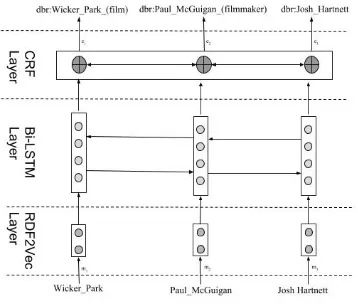
Figure 1 illustrates the general architecture of our method including 3 layers
1. RDF2Vec Layer: RDF2Vec (Ristoski and Paulheim,2016) layer transforms each men-tion into a numerical d-dimensional vectors. We focus on entities and mentions, relations are not taken into considerations in this study.
2. Bi-LSTM Layer:Bidirectional LSTM layer will output hidden vector ht per time stept
and ht is computed for the given sequence
[image:3.595.327.506.68.220.2]S = {r1, r2, ..., rN} where −→rt and ←r−t are
Figure 1: General structure of our method.
forward and backward pass vectors of RDF elements.
3. CRF Layer: This layer is composed of full-connected CRFs for ambiguous candidate en-tities and maps the best mention-entity pairs as a joint disambiguation task for specific do-mains.
We obtain training data by extracting mentions from Wikipedia and corresponding entities from DBpedia for the movie domain. In the previ-ous sample text about the mention Wicker Park, three mentions are detected and these are inputs of RDF2Vec layer. On the other hand, three referent entities of these mentions are given as the output of CRF layer.
To increase ambiguity of training data, we extract Wikipedia disambiguation pages for this type of mentions. For instance, the mention Wicker Park has three candi-date entities such as Wicker Park (film)2,
Wicker Park (Chicago park)3 and
Wicker Park (soundtrack)4. Also, another mention Paul McGuigan includes two different candidate entities. In the sample text, the last mention Josh Hartnett has only one candidate entity and it can be recognized as an easy tag and is an indicator that this text might be related to the movie domain.
3.1 Candidate Entity Generation
To generate candidate entities we select DBpedia as the base knowledge base. We gather texts with
2
http://dbpedia.org/resource/Wicker Park (film)
3
http://dbpedia.org/resource/Wicker Park (Chicago park)
already detected mentions for these entities from Wikipedia pages. For each mention, we query can-didate entities and their domain information from DBpedia. To do it, we check ”dct:subject” and ”rdf:type” properties of entities. Then, mentions and candidate entities with their domain informa-tion are recorded in a key-value store.
Wikipedia articles are separated into paragraphs and each paragraph is retrieved in the key-value store whether the paragraph includes any anno-tated entity. If there is one or more entity in the given paragraph and this paragraph does not ex-ist in the annotated text lex-ist, the given paragraph is loaded into a document store. At the same time, Wikipedia disambiguation pages are searched for each mention found in the paragraph. If there exists any disambiguation page for any mention, annotated texts with ambiguous entities are also stored.
3.2 RDF2Vec
RDF2Vec model (Ristoski and Paulheim, 2016) transforms word representations of Word2Vec model into representations of RDF elements such as classes, relations and instances. Instead of us-ing words, dense RDF vectors are generated by entities and relations from the given RDF model. The overall structure of RDF2Vec model is listed as follows:
1. Entity-relation sequences are constructed from one of the strategies (Weistfeiler-Lehman Subtree RDF Graph Kernels, graph walks, etc.)
2. Neural language model is built by either Skip-gram or CBOW algorithm from entity-relation sequences
3. Entity relatedness is computed with Softmax function from the neural language model
Before the neural language model is trained, RDF model is transformed into the form of RDF embeddings. Consequently, each embedding can be represented as a numerical vector in Latent Fea-ture Space. In this study, we do not use graph walks to transform RDF model into entity-relation sequences. Instead, we generate sequences of mentions and their entities considering their posi-tions in the Wikipedia pages. Then, we obtain two different sequence documents for mention and en-tity sequences like a neural translation model as
denoted in Figure 1. As sketched in this figure, mentions of the sample text of Wicker Park and corresponding entity sequences without relations are the input of RDFVec model.
3.3 Bi-LSTM Layer
Recurrent Neural Networks (RNNs) employ se-quential information to make predictions. It dif-fers from classical neural networks by consider-ing dependency between sequences of inputs and outputs. RNNs operate recurrent tasks for every element of the sequence and memorizes informa-tion what has been computed so far. Bengio et al. (Bengio et al., 1994) emphasizes that RNNs can operate on long sequences in theory but in prac-tice, they fail because they remember their most recent inputs in the sequence. Long Short-term Memory Networks(LSTMs) have been proposed to overcome this problem by producing a memory-cell to operate on long sequences (Hochreiter and Schmidhuber,1997).
To disambiguate entities, we first operate an LSTM over input and output sequences. It will output the hidden stateht at timestept. Then the
entity disambiguation rule fore∗i
e∗i =argmaxj(logσ(Ohi+b))j (1)
where logσ is the log softmax function of the hidden state, ande∗i is the annotated entity which has the highest score in this vector. The output space of O is |E|x|E| dimensions in which E is the length of candidate entities.
For the given input sequences of mentions, this LSTM model computes a representation−→ht from
beginning to end in this sequence at every mention t. But it may ignore the critical information from the reverse order. To achieve it, a second LSTM operates over the same sequence from end to be-ginning. Then, this forward and backward LSTM pair denotes as a bidirectional LSTM (Graves and Schmidhuber, 2005). Bi-LSTM represents men-tions with its left and right context and it is useful to gather more comprehensive information from the sequences.
3.4 Entity Disambiguation with CRFs
Hence, CRF computes a conditional probability as a log-linear formulation
p(e|m) = Pexp(lp(m, e)) e0exp(lp(m, e0))
(2)
where m is the input sequence of mentions, e is the output sequence of entities. Then, lp indi-cates the log potential score of mention and en-tity sequences. To generate a tractable function, the potentials should be only included at local fea-tures. Then we define Emission and Transition as two types of potential scores in the Bi-LSTM CRF. Then, the score is determined for these log poten-tials such that
lp(e, m) =X
i
logθE(ei →mi)+logθT(ei−1→ei)
(3) where (logθE) is the emission potential score
for the mention at indexicomes from the hidden state of the Bi-LSTM at timestepi. The transition potential scores (logθT) are stored in a |E|x|E|
matrix P, where E is the entity dictionary and consists of unique entities from short texts.
We use PyTorch5to compute LSTM, Bi-LSTM and CRF models. PyTorch is a dynamic neural network tool in which we can define a computation graph for each instance and can be executed on-the-fly.
4 Experimental Setup
4.1 Dataset Generation
Manually annotated texts tend to be biased be-cause people usually select familiar terms for the entity annotation. Also, this annotation process is sometimes noisy for unpopular terms. There-fore, Wikipedia should be chosen because it is curated by crowdsourcing and involves structured annotation process. MSNBC (Cucerzan, 2007), IITB (Kulkarni et al.,2009) and Wikilinks (Singh et al., 2012) proposes experimental datasets for general entity annotation tasks. Wikilinks pro-vides a large-scale labeled corpus automatically constructed via links to Wikipedia. Wikilinks presents an automated method to identify a collec-tion of massive amounts of entity mencollec-tions and is based on crawling anchor links in Wikipedia pages and exploiting anchor text as mentions. However, Wikipedia can also be employed for the level of
5http://pytorch.org/tutorials/index.html
ambiguity adjustments in order to use disambigua-tion pages and this is not directly indicated in Wik-ilinks.
Ambiguity is the ratio between ambiguous and unique entities and provides more realistic en-vironment to entity annotators (Li et al., 2012). To adjust ambiguity and generate annotated texts for specific domains, we use a recent study (Inan and Dikenelli,2017) which extracts the lat-est Wikipedia dump in English6 for specific do-mains. To do it, they use Wikipedia category pages and DBpedia ”dct:subject”7property. Also, they provide an ambiguous environment in which, Wikipedia disambiguation pages are used for the selected domains. As an example, the men-tionWicker Parkhas a Wikipedia disambiguation page8and it can be used to increase ambiguity in the movie domain.
The movie evaluation dataset involves 123 an-notated texts in English. For each text, the average number of entities is 4.99 and there are 614 enti-ties in total. Entienti-ties such as movies, directors, and starring are extracted from infoboxes of Wikipedia articles and mapped with referent entities by DB-pedia. Disambiguation pages of these entities are extracted in other domains such as music and loca-tion to increase the ratio of ambiguity in the eval-uation dataset for the movie domain. The ambigu-ity ratio of the evaluation dataset is 48.79% com-puted as the division of all ambiguous entities to the total number of unique entities extracted for the movie domain. Therefore, a more realistic am-biguous dataset can be generated to evaluate Entity Linking systems.
4.2 Results
We evaluate our method with several Entity Linking approaches from GERBIL benchmarking framework (Usbeck et al., 2015). We select Dis-ambiguate to Knowledge Base (D2KB) task which focuses on the disambiguation of detected men-tions to the related entities in the knowledge base. In this task, a given mention is guaranteed to map to the corresponding entity.
AGDISTIS (Usbeck et al.,2014) chooses can-didate entities for the detected mentions from sur-face forms and generates a disambiguation graph for these candidates. The generated disambigua-tion graph is used in graph-based HITS algorithm
6
https://dumps.wikimedia.org/enwiki/20170420/
7
http://purl.org/dc/terms/subject
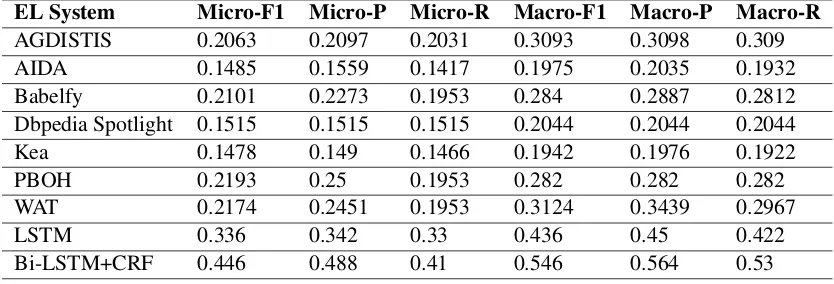
EL System Micro-F1 Micro-P Micro-R Macro-F1 Macro-P Macro-R AGDISTIS 0.2063 0.2097 0.2031 0.3093 0.3098 0.309
AIDA 0.1485 0.1559 0.1417 0.1975 0.2035 0.1932
Babelfy 0.2101 0.2273 0.1953 0.284 0.2887 0.2812
Dbpedia Spotlight 0.1515 0.1515 0.1515 0.2044 0.2044 0.2044
Kea 0.1478 0.149 0.1466 0.1942 0.1976 0.1922
PBOH 0.2193 0.25 0.1953 0.282 0.282 0.282
WAT 0.2174 0.2451 0.1953 0.3124 0.3439 0.2967
LSTM 0.336 0.342 0.33 0.436 0.45 0.422
[image:6.595.90.507.63.205.2]Bi-LSTM+CRF 0.446 0.488 0.41 0.546 0.564 0.53
Table 1: Evaluation scores of Entity Linking (EL) systems in GERBIL.
to match the best mention-entity pairs in the dis-ambiguation step.
AIDA (Hoffart et al.,2011b) relies on a compu-tation of global coherence between candidate en-tities and dense subgraph algorithms executing on the YAGO (Hoffart et al.,2011a) knowledge base. Babelfy uses a graph-based disambiguation algorithm and finds the densest subgraph sur-rounded by candidate entities for the given men-tion. Then, Babelfy leverages the densest sub-graph to match the best mention and entity pair.
DBpedia Spotlight (Mendes et al., 2011) uses a Vector Space Model (VSM) including DBpedia entity occurrences where a multidimensional word space has a representation per entity. Disambigua-tion task of DBpedia spotlight transforms Inverse Term Frequency (ITF) into an Inverse Candidate Frequency (ICF) which depends on candidate en-tities rather than terms and is an inverse propor-tion of candidate entities associated with words in VSM.
KEA (Waitelonis and Sack, 2016) proposes a combination of dictionary and knowledge based approaches. They analyze word co-occurrences of Wikipedia pages and merge these co-occurences with a graph analysis on the Wikipedia link struc-ture and DBpedia.
PBOH (Ganea et al., 2016) is a collective entity linking system that is based on light-weight Wikipedia statistics. PBOH computes co-occurrence of words and entities for a probabilistic graphical model.
WAT (Piccinno and Ferragina, 2014) system is a complex version of TagMe (Ferragina and Scaiella,2010). WAT depends on graph-based al-gorithm and selection of the best mention-entity pair from a vote-based algorithm.
Cornolti et al. (2013) expands general F1
mea-sures to the Macro- and Micro- meamea-sures. While Macro- measures are the average of the corre-sponding measure over each document in all an-notated documents, the Micro- measures consider all tags together thus giving more importance to documents having more tags. Table 1 illustrates the overall scores for Entity Linking task is mea-sured in the generated evaluation set with respect to precision, recall, and F1-score. All scores are low because of high ambiguity of the gen-erated evaluation dataset. F1 scores show that our study outperforms state-of-the-art studies us-ing Bi-LSTM+CRF model on the generated eval-uation dataset in the movie domain.
5 Conclusion
This study mainly presents a sequence learning method for domain-specific entity linking using sequence learning as a neural machine translation task. We filter candidate entities leveraging do-main information and eliminating easy matches of mention-entity pairs. We employ a domain-specific dataset to compare our work with exist-ing studies in GERBIL. Our method outperforms the state-of-the-art methods in the domain-specific configuration.
In the future, we apply other decoder mod-els using the attention mechanism to the current model as a different joint disambiguation method of candidate entities. Also, we will examine many domain-specific datasets on this method.
References
Razvan Bunescu and Marius Pas¸ca. 2006. Using en-cyclopedic knowledge for named entity disambigua-tion. In11th conference of the European Chapter of the Association for Computational Linguistics.
Marco Cornolti, Paolo Ferragina, and Massimiliano Ciaramita. 2013. A framework for benchmarking entity-annotation systems. In Proceedings of the 22nd international conference on World Wide Web, pages 249–260. ACM.
Silviu Cucerzan. 2007. Large-scale named entity dis-ambiguation based on wikipedia data. In Proceed-ings of the 2007 Joint Conference on Empirical Methods in Natural Language Processing and Com-putational Natural Language Learning (EMNLP-CoNLL).
Paolo Ferragina and Ugo Scaiella. 2010. Tagme: On-the-fly annotation of short text fragments (by
wikipedia entities). In Proceedings of the 19th
ACM International Conference on Information and Knowledge Management, CIKM ’10, pages 1625– 1628, New York, NY, USA. ACM.
Octavian-Eugen Ganea, Marina Ganea, Aurelien Luc-chi, Carsten Eickhoff, and Thomas Hofmann. 2016. Probabilistic bag-of-hyperlinks model for entity linking. In Proceedings of the 25th International Conference on World Wide Web, pages 927–938. In-ternational World Wide Web Conferences Steering Committee.
Alex Graves and J¨urgen Schmidhuber. 2005. Frame-wise phoneme classification with bidirectional lstm and other neural network architectures. Neural Net-works, 18(5-6):602–610.
Nitish Gupta, Sameer Singh, and Dan Roth. 2017. En-tity linking via joint encoding of types, descriptions, and context. In Proceedings of the 2017 Confer-ence on Empirical Methods in Natural Language Processing, pages 2681–2690.
Sepp Hochreiter and J¨urgen Schmidhuber. 1997. Long short-term memory. Neural computation, 9(8):1735–1780.
Johannes Hoffart, Fabian M Suchanek, Klaus Berberich, Edwin Lewis-Kelham, Gerard De Melo, and Gerhard Weikum. 2011a. Yago2: exploring and querying world knowledge in time, space, context, and many languages. In Proceedings of the 20th international conference companion on World wide web, pages 229–232. ACM.
Johannes Hoffart, Fabian M. Suchanek, Klaus Berberich, and Gerhard Weikum. 2013. Yago2: A spatially and temporally enhanced knowledge base
from wikipedia.Artif. Intell., 194:28–61.
Johannes Hoffart, Mohamed Amir Yosef, Ilaria Bor-dino, Hagen F¨urstenau, Manfred Pinkal, Marc Span-iol, Bilyana Taneva, Stefan Thater, and Gerhard Weikum. 2011b. Robust disambiguation of named entities in text. InProceedings of the Conference on
Empirical Methods in Natural Language Process-ing, pages 782–792. Association for Computational Linguistics.
Emrah Inan and Oguz Dikenelli. 2017. Wedgem: A domain-specific evaluation dataset generator for multilingual entity linking systems. InInternational Conference on Web Information Systems Engineer-ing, pages 221–228. Springer.
Sayali Kulkarni, Amit Singh, Ganesh Ramakrishnan, and Soumen Chakrabarti. 2009. Collective annota-tion of wikipedia entities in web text. In Proceed-ings of the 15th ACM SIGKDD international con-ference on Knowledge discovery and data mining, pages 457–466. ACM.
John Lafferty, Andrew McCallum, and Fernando CN Pereira. 2001. Conditional random fields: Prob-abilistic models for segmenting and labeling se-quence data.
Guillaume Lample, Miguel Ballesteros, Sandeep Sub-ramanian, Kazuya Kawakami, and Chris Dyer. 2016. Neural architectures for named entity recognition.
arXiv preprint arXiv:1603.01360.
Xuansong Li, Stephanie M Strassel, Heng Ji, Kira Grif-fitt, and Joe Ellis. 2012. Linguistic resources for en-tity linking evaluation: from monolingual to cross-lingual. Annotation, 1:1.
Pablo N. Mendes, Max Jakob, Andr´es Garc´ıa-Silva, and Christian Bizer. 2011.Dbpedia spotlight:
Shed-ding light on the web of documents. InProceedings
of the 7th International Conference on Semantic Sys-tems, I-Semantics ’11, pages 1–8, New York, NY, USA. ACM.
Rada Mihalcea and Andras Csomai. 2007. Wikify!: linking documents to encyclopedic knowledge. In
Proceedings of the sixteenth ACM conference on Conference on information and knowledge manage-ment, pages 233–242. ACM.
Tomas Mikolov, Kai Chen, Greg Corrado, and Jef-frey Dean. 2013. Efficient estimation of word representations in vector space. arXiv preprint arXiv:1301.3781.
David Milne and Ian H. Witten. 2008.Learning to link
with wikipedia. InProceedings of the 17th ACM
Conference on Information and Knowledge Man-agement, CIKM ’08, pages 509–518, New York, NY, USA. ACM.
Pasquale Minervini, Claudia d’Amato, Nicola Fanizzi, and Floriana Esposito. 2016. Leveraging the schema in latent factor models for knowledge graph comple-tion. InProceedings of the 31st Annual ACM Sym-posium on Applied Computing, Pisa, Italy, April 4-8, 2016, pages 327–332.
Association for Computational Linguistics (TACL), 2:231–244.
Dat Ba Nguyen, Johannes Hoffart, Martin Theobald, and Gerhard Weikum. 2014. Aida-light:
High-throughput named-entity disambiguation. In
LDOW, volume 1184 ofCEUR Workshop Proceed-ings. CEUR-WS.org.
Maximilian Nickel, Kevin Murphy, Volker Tresp, and Evgeniy Gabrilovich. 2015. A review of rela-tional machine learning for knowledge graphs: From multi-relational link prediction to automated
knowl-edge graph construction.CoRR, abs/1503.00759.
Minh C Phan, Aixin Sun, Yi Tay, Jialong Han, and Chenliang Li. 2017. Neupl: Attention-based seman-tic matching and pair-linking for entity disambigua-tion. In Proceedings of the 2017 ACM on Confer-ence on Information and Knowledge Management, pages 1667–1676. ACM.
Francesco Piccinno and Paolo Ferragina. 2014. From
tagme to WAT: a new entity annotator. InERD’14,
Proceedings of the First ACM International Work-shop on Entity Recognition & Disambiguation, July 11, 2014, Gold Coast, Queensland, Australia, pages 55–62.
Lev Ratinov, Dan Roth, Doug Downey, and Mike Anderson. 2011. Local and global algorithms for disambiguation to wikipedia. In Proceedings of the 49th Annual Meeting of the Association for Computational Linguistics: Human Language Technologies-Volume 1, pages 1375–1384. Associ-ation for ComputAssoci-ational Linguistics.
Petar Ristoski and Heiko Paulheim. 2016. Rdf2vec:
RDF graph embeddings for data mining. InThe
mantic Web - ISWC 2016 - 15th International Se-mantic Web Conference, Kobe, Japan, October 17-21, 2016, Proceedings, Part I, pages 498–514.
Sameer Singh, Amarnag Subramanya, Fernando Pereira, and Andrew McCallum. 2012. Wikilinks: A large-scale cross-document coreference corpus la-beled via links to wikipedia. University of Mas-sachusetts, Amherst, Tech. Rep. UM-CS-2012-015.
Yaming Sun, Lei Lin, Duyu Tang, Nan Yang, Zhenzhou Ji, and Xiaolong Wang. 2015. Modeling mention, context and entity with neural networks for entity disambiguation. InIJCAI, pages 1333–1339.
Ricardo Usbeck, Axel-Cyrille Ngonga Ngomo, Michael R¨oder, Daniel Gerber, SandroAthaide Coelho, S¨oren Auer, and Andreas Both. 2014.
AGDISTIS - Graph-Based Disambiguation of
Named Entities Using Linked Data. In Peter Mika,
Tania Tudorache, Abraham Bernstein, Chris Welty, Craig Knoblock, Denny Vrandeˇci´c, Paul Groth, Natasha Noy, Krzysztof Janowicz, and Carole Goble, editors, The Semantic Web – ISWC 2014, volume 8796 ofLecture Notes in Computer Science, pages 457–471. Springer International Publishing.
Ricardo Usbeck, Michael R¨oder, Axel-Cyrille Ngonga Ngomo, Ciro Baron, Andreas Both, Martin Br¨ummer, Diego Ceccarelli, Marco Cornolti, Di-dier Cherix, Bernd Eickmann, Paolo Ferragina, Christiane Lemke, Andrea Moro, Roberto Navigli, Francesco Piccinno, Giuseppe Rizzo, Harald Sack, Ren´e Speck, Rapha¨el Troncy, J¨org Waitelonis, and Lars Wesemann. 2015. GERBIL – general entity
annotation benchmark framework. In24th WWW
conference.
J¨org Waitelonis and Harald Sack. 2016. Named entity linking in# tweets with kea. In# Microposts, pages 61–63.
Jason Weston, Antoine Bordes, Oksana Yakhnenko, and Nicolas Usunier. 2013. Connecting language and knowledge bases with embedding models for
re-lation extraction. InProceedings of the 2013
Con-ference on Empirical Methods in Natural Language Processing, EMNLP 2013, 18-21 October 2013, Grand Hyatt Seattle, Seattle, Washington, USA, A meeting of SIGDAT, a Special Interest Group of the ACL, pages 1366–1371.
Ikuya Yamada, Hiroyuki Shindo, Hideaki Takeda, and Yoshiyasu Takefuji. 2016. Joint learning of the em-bedding of words and entities for named entity dis-ambiguation. arXiv preprint arXiv:1601.01343.