76
BERT Masked Language Modeling for Co-reference Resolution
Felipe Alfaro Lois Jos´e A. R. Fonollosa Marta R. Costa-juss`a
TALP Research Center
Universitat Polit`ecnica de Catalunya, Barcelona
jose.fonollosa,marta.ruiz}@upc.edu
Abstract
This paper explains the TALP-UPC partici-pation for the Gendered Pronoun Resolution shared-task of the 1st ACL Workshop on Gen-der Bias for Natural Language Processing. We have implemented two models for mask lan-guage modeling using pre-trained BERT ad-justed to work for a classification problem. The proposed solutions are based on the word probabilities of the original BERT model, but using common English names to replace the original test names.
1 Introduction
The Gendered Pronoun Resolution task is a nat-ural language processing task whose objective is to build pronoun resolution systems that identify the correct name a pronoun refers to. It’s called a co-reference resolution task. Co-reference res-olution tackles the problem of different elements of a text that refer to the same thing. Like for ex-ample a pronoun and a noun, or multiple nouns that describe the same entity. There are multiple deep learning approaches to this problem. Neu-ralCoref1presents one based on giving every pair of mentions (pronoun + noun) a score to represent whether or not they refer to the same entity. In our current task, this approach is not possible, because we don’t have the true information of every pair of mentions, only the two names per entry.
The current task also has to deal with the prob-lem of gender. As the GAP researchers point out (Webster et al., 2018), the biggest and most common datasets for co-reference resolution have a bias towards male entities. For example the OntoNotes dataset, which is used for some of the most popular models, only has a 25% female rep-resentation (Pradhan and Xue,2009). This creates
1 https://medium.com/huggingface/state-of-the-art-neural-coreference-resolution-for-chatbots-3302365dcf30
a problem, because any machine learning model is only as good as its training set. Biased training sets will create biased models, and this will have repercussions on any uses the model may have.
This task provides an interesting challenge spe-cially by the fact that it is proposed over a gender neutral dataset. In this sense, the challenge is ori-ented towards proposing methods that are gender-neutral and to not provide bias given that the data set does not have it.
To face this task, we propose to make use of the recent popular BERT tool (Devlin et al., 2018). BERT is a model trained for masked language modeling (LM) word prediction and sentence pre-diction using the transformer network (Vaswani et al.,2017). BERT also provides a group of pre-trained models for different uses, of different lan-guages and sizes. There are implementations for it in all sorts of tasks, including text classification, question answering, multiple choice question an-swering, sentence tagging, among others. BERT is gaining popularity quickly in language tasks, but before this shared-task appeared, we had no awareness of its implementation in co-reference resolution. For this task, we’ve used an imple-mentation that takes advantage of the masked LM which BERT is trained for and uses it for a kind of task BERT is not specifically designed for.
In this paper, we are detailing our shared-task participation, which basically includes descrip-tions on the use we gave to the BERT model and on our technique of ’Name Replacement’ that al-lowed to reduce the impact of name frequency.
2 Co-reference Resolution System Description
2.1 BERT for Masked LM
exer-cise that word is the pronoun whose referent we’re trying to identify. This one pronoun gets replaced by the[MASKED] tag, the rest of the sentence is subjected to the different name change rules de-scribed in section2.2.
The text is passed through the pre-trained BERT model. This model keeps all of its weights intact, the only changes made in training are to the net-work outside of the BERT model. The resulting sequence then passes through what is called the masked language modeling head. This consists of a small neural network that returns, for every word in the sequence, an array the size of the entire vocabulary with the probability for every word. The array for our masked pronoun is extracted and then from that array, we get the probabilities of three different words. These three words are : the first replaced name (name 1), the second replaced name (name 2) and the wordnonefor the case of having none.
This third case is the strangest one, because the wordnonewould logically not appear in the sen-tence. Tests were made with the original pronoun as the third option instead. But the results ended up being very similar albeit slightly worse, so the word none was kept instead. These cases where there is no true answer are the hardest ones for both of the models.
We experimented with two models.
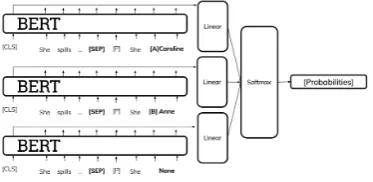
Model 1 After the probabilities for each word are extracted, the rest is treated as a classification problem. An array is created with the probabili-ties of the 2 names and none([name 1, name 2, none]), where each one represents the probability of a class in multi-class classification. This array is passed through a softmax function to adjust it to probabilities between 0 and 1 and then the log loss is calculated. A block diagram of this model can be seen in figure1.
Model 2 This model repeats the steps of model 1 but for two different texts. These texts are mostly the same except the replacement names name 1 andname 2 have been switched (as explained in the section2.2). It calculates the probabilities for each word for each text and then takes an aver-age of both. Then finally applies the softmax and calculates the loss with the average probability of each class across both texts. A block diagram of this model can be seen in figure2.
2.2 Name Replacement
The task contains names of individuals who are featured in Wikipedia, and some of these names are uncommon in the English language. As part of the pre-processing for both models, these names are replaced. They are replaced with common En-glish names in their respective genders2. If the pronoun is female, one of two common English female names are chosen, same thing for the male pronouns. In order to replace them in the text, the following set of rules are followed.
1. The names mentioned on the A and B columns are replaced.
2. Any other instances of the full name as it ap-pears on the A/B columns are replaced.
3. If the name on the A/B column contains a first name and a last name. Instances of the first name are also replaced. Unless both entities share a first name, or the first name of one is contained within the other.
4. Both the name and the text are converted to lowercase
This name replacement has two major benefits. First, the more common male and female names work better with BERT because they appear more in the corpus in which it is trained on. Secondly, when the word piece encoding splits certain words the tokenizer can be configured so that our chosen names are never split. So they are single tokens (and not multiple word pieces), which helps the way the model is implemented.
Both models (1 and 2 presented in the above section) use BERT for Masked LM prediction where the mask always covers a pronoun, and because the pronoun is a single token (not split into word pieces), it’s more useful to compare the masked pronoun to both names, which are also both single tokens (not multiple word pieces).
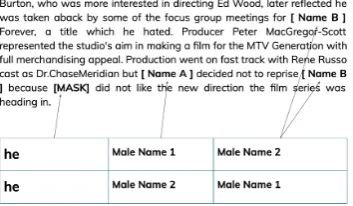
Because the chosen names are very common in the English language, BERT’s previous train-ing might contain biases towards one name or the other. This can be detrimental to this model where it has to compare between only 3 options. So the alternative is the approach in model number 2. In model 2 two texts are created. Both texts are ba-sically the same except the names chosen as the
Figure 1: Model 1 representation.
Figure 2: Model 2 representation.
Figure 3: Example of a text present in the dataset and how the word replacement was done for the model 2.
replacement names 1 and 2 are switched. So, as figure3shows, we get one text with each name in each position.
For example lets say we get the text:
”In the late 1980s Jones began working with
Duran Duran on their live shows and then in the studio producing a B side single “This Is How A Road Gets Made”, before being hired to record the album Liberty with producer Chris Kimsey.”,
A isJonesand B isChris Kimsey. For the name replacement lets say we choose two common En-glish names likeJohn andHarry. The new text produced for model 1 (figure 1) would be some-thing like:
”in the late 1980sharrybegan working with du-ran dudu-ran on their live shows and then in the stu-dio producing a b side single “this is how a road gets made”, before being hired to record the album liberty with producerjohn.”
[image:3.595.94.271.529.632.2]3 Experimental Framework
3.1 Task details
The objective of the task is that of a classifica-tion problem. Where the output for every entry is the probability of the pronoun referencing name A, name B or Neither.
3.2 Data
The GAP dataset (Webster et al.,2018) created by Google AI Language was the dataset used for this task. This dataset consists of 8908 co-reference la-beled pairs sampled from Wikipedia, also it’s split perfectly between male and female representation. Each entry of the dataset consists of a short text, a pronoun that is present in the text and its offset and two different names (name A and name B) also present in the text. The pronoun refers to one of these two names and in some cases, none of them. The GAP dataset doesn’t contain any neutral pro-nouns such asitorthey.
For the two different stages of the competition dif-ferent datasets were used.
• ForStage 1the data used for the submission is the same as the development set available in the GAP repository. The dataset used for training is the combination of the GAP vali-dation and GAP testing sets from the reposi-tory.
• ForStage 2the data used for submission was only available through Kaggle3 and the cor-rect labels have yet to be released, so we can only analyze the final log loss of each of the models. This testing set has a total of 12359 rows, with 6499 male pronouns and 5860 fe-male ones. For training, a combination of the GAP development, testing and validation sets was used. And, as all the GAP data, it is evenly distributed between genders.
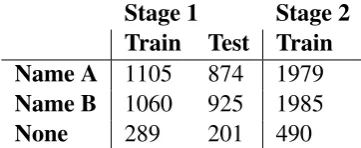
The distributions of all the datasets are shown in table1. It can be seen that in all cases, theNone option has the least support by a large margin. This, added to the fact that the model naturally is better suited to identifying names rather than the absence of them, had a negative effect on the re-sults.
3 https://www.kaggle.com/c/gendered-pronoun-resolution/overview
Stage 1
Stage 2
Train
Test
Train
Name A
1105
874
1979
Name B
1060
925
1985
[image:4.595.325.506.63.137.2]None
289
201
490
Table 1: Dataset distribution for the datasets of stages 1 and 2.
3.3 Training details
For the BERT pre-trained weights, several models were tested. BERT base is the one that produced the best results. BERT large had great results in a lot of other implementations, but in this model it produced worse results while consuming much more resources and having a longer training time. During the experiments the model had an overfitting problem, so the learning rate was tuned as well as a warm up percentage was introduced. As table 2 shows, the optimal learning rate was
3e−5 while the optimal with a 20% warm up. The length of the sequences is set at 256, where it fits almost every text without issues. For texts too big, the text is truncated depending on the offsets of each of the elements in order to not eliminate any of the names or the pronoun.
Accuracy Loss Learning Rate Warmup mean min mean min 0.00003 0.0 0.840167 0.8315 0.519565 0.454253
0.2 0.844444 0.8340 0.502667 0.442313
0.00004 0.0 0.822389 0.7970 0.556491 0.473528
0.2 0.834000 0.7925 0.530862 0.456223
0.00005 0.1 0.743500 0.7435 0.666750 0.666750
0.00006 0.0 0.756333 0.7040 0.630707 0.544841
[image:4.595.317.519.483.558.2]0.2 0.802278 0.7465 0.587041 0.497051
Table 2: Results of the tuning for both models. Min-imum and average Loss and Accuracy across all the tuning experiments performed.
Parameter Value
Optimizer Adam
Vocabulary Size 28996
Dropout 0.1
Sequence Length 256
Batch Size 32
Learning Rate 3e−5
Warm Up 20%
Steps Stage 1: 81 — Stage 2: 148
Epochs 1
[image:5.595.73.297.62.182.2]Gradient Accumulation Steps 5
Table 3: Hyperparameters for the model training
4 Results
Tables 4 and5 report results for models 1 and 2 reported in section2.1 for stage 1 of the compe-tition. Both models 1 and 2 have similar overall results. Also both models show problems with the None class, model 2 specially. We believe this is because our model is based on guessing the correct name, so the guessing of none is not as well suited to it. Also, the training set contains much less of these examples, therefore making it even harder to train for them.
Precision Recall F1 Support
A 0.83 0.87 0.85 874
B 0.88 0.88 0.88 925
None 0.64 0.52 0.57 201
[image:5.595.325.512.223.314.2]Avg 0.83 0.84 0.84 2000
Table 4: Model 1 results for the testing stage 1.
Precision Recall F1 Support
A 0.81 0.86 0.83 874
B 0.88 0.78 0.82 925
None 0.48 0.62 0.54 201
[image:5.595.75.294.390.463.2]Avg 0.81 0.80 0.80 2000
Table 5: Model 2 results for the testing stage 1.
4.1 Advantages of the Masked LM Model
As well as the Masked LM, other BERT imple-mentations were experimented with for the task. First, a text multi class classification model (figure
4) where the[CLS]tag is placed at the beginning of every sentence, the text is passed through a pre-trained BERT and then the result from this label is passed through a feed forward neural network.
And a multiple choice question answering model (figure 5), where the same text with the
Figure 4: Model: BERT for text classification
Figure 5: Model: BERT for multiple choice answering
[CLS]label is passed through BERT with different answers and then the result these labels is passed through a feed forward neural network.
These two models, which were specifically de-signed for other tasks had similar accuracy to the masked LM but suffered greatly with the log loss, which was the competition’s metric. This is because in a lot of examples the difference be-tween the probabilities of one class and another was minimal. This made for a model where each choice had low confidence and therefore the loss increased considerably.
Accuracy Loss BERT for Classification 0.8055 0.70488
BERT for Question Answering 0.785 0.6782
BERT for Masked LM 0.838 0.44231
Table 6: Results for the tests with different BERT im-plementations.
4.2 Name Replacement Results
[image:5.595.74.291.507.582.2]Accuracy Loss Model 1 Original Names 0.782 0.7021
Model 1 Name Replacement 0.838 0.4423
Table 7: Results for the models with and without name replacement.
4.3 Competition results
In the official competition on Kaggle we placed 46th, with the second model having a loss around 0.301. As the results in table8show, the results of stage 2 were better than those of stage 1. And the second model, which had performed worse on the first stage was better in stage 2.
Model 1 Model 2 Stage 1 0.44231 0.49607
Stage 2 0.31441 0.30151
Table 8: Results for both models across both stages of the competition
5 Conclusions
We have proved that pre-trained BERT is useful for co-reference resolution. Additionally, we have shown that our simple ’Name Replacement’ tech-nique was effective to reduce the impact of name frequency or popularity in the final decision.
The main limitation of our technique is that it requires knowing the gender from the names and so it only makes sense for entities which have a defined gender. Our proposed model had great results when predicting the correct name but had trouble with with thenoneoption.
As a future improvement it’s important to an-alyze the characteristics of these examples where none of the names are correct and how the model could be trained better to identify them, specially
because they are fewer in the dataset. Further im-provements could be made in terms of fine-tuning the weights in the actual BERT model.
Acknowledgements
This work is also supported in part by the Span-ish Ministerio de Econom´ıa y Competitividad, the European Regional Development Fund and the Agencia Estatal de Investigaci´on, through the postdoctoral senior grant Ram´on y Cajal, con-tract TEC2015-69266-P (MINECO/FEDER,EU) and contract PCIN-2017-079 (AEI/MINECO).
References
Jacob Devlin, Ming-Wei Chang, Kenton Lee, and Kristina Toutanova. 2018. Bert: Pre-training of deep bidirectional transformers for language understand-ing.arXiv preprint arXiv:1810.04805.
Sameer S. Pradhan and Nianwen Xue. 2009. OntoNotes: The 90% solution. In Proceedings of Human Language Technologies: The 2009 Annual Conference of the North American Chapter of the Association for Computational Linguis-tics, Companion Volume: Tutorial Abstracts, pages 11–12, Boulder, Colorado. Association for Computational Linguistics.
Ashish Vaswani, Noam Shazeer, Niki Parmar, Jakob Uszkoreit, Llion Jones, Aidan N Gomez, Ł ukasz Kaiser, and Illia Polosukhin. 2017. Attention is all you need. In I. Guyon, U. V. Luxburg, S. Bengio, H. Wallach, R. Fergus, S. Vishwanathan, and R. Gar-nett, editors, Advances in Neural Information Pro-cessing Systems 30, pages 5998–6008. Curran As-sociates, Inc.