Annotating Relation Inference in Context via Question Answering
Omer Levy Ido Dagan
Computer Science Department Bar-Ilan University
Ramat-Gan, Israel
{omerlevy,dagan}@cs.biu.ac.il
Abstract
We present a new annotation method for collecting data on relation inference in context. We convert the inference task to one of simple factoid question answering, allowing us to easily scale up to 16,000 high-quality examples. Our method cor-rects a major bias in previous evaluations, making our dataset much more realistic.
1 Introduction
Recognizing entailment between natural-language relations (predicates) is a key challenge in many semantic tasks. For instance, in question answer-ing (QA), it is often necessary to “bridge the lex-ical chasm” between the asker’s choice of words and those that appear in the answer text. Relation inference can be notoriously difficult to automat-ically recognize because of semantic phenomena such as polysemy and metaphor:
Q: Which drug treats headaches? A: Aspirin eliminates headaches.
In this context, “eliminates” implies “treats” and the answer is indeed “aspirin”. However, this rule does not always hold for other cases – “eliminates patients” has a very different meaning from “treats patients”. Hence, context-sensitive methods are required to solve relation inference.
Many methods have tried to address relation inference, from DIRT (Lin and Pantel, 2001) through Sherlock (Schoenmackers et al., 2010) to the more recent work on PPDB (Pavlick et al., 2015b) and RELLY (Grycner et al., 2015). How-ever, the way these methods are evaluated remains largely inconsistent. Some papers that deal with phrasal inference in general (Beltagy et al., 2013; Pavlick et al., 2015a; Kruszewski et al., 2015) use
an extrinsic task, such as a recent recognizing tex-tual entailment (RTE) benchmark (Marelli et al., 2014). By nature, extrinsic tasks incorporate a va-riety of linguistic phenomena, making it harder to analyze the specific issues of relation inference.
The vast majority of papers that do focus on re-lation inference perform some form of post-hoc evaluation (Lin and Pantel, 2001; Szpektor et al., 2007; Schoenmackers et al., 2010; Weisman et al., 2012; Lewis and Steedman, 2013; Riedel et al., 2013; Rockt¨aschel et al., 2015; Grycner and Weikum, 2014; Grycner et al., 2015; Pavlick et al., 2015b). Typically, the proposed algorithm gen-erates several inference rules between two rela-tion templates, which are then evaluated manu-ally. Some studies evaluate the rules out of con-text (is the rule “X eliminatesY”→“X treatsY” true?), while others apply them to textual data and evaluate the validity of the rule in context (given “aspirin eliminates headaches”, is “aspirin treats
headaches” true?). Not only are these post-hoc evaluations oblivious to recall, their “human in the loop” approach makes them expensive and virtu-ally impossible to accurately replicate.
Hence, there is a real need for pre-annotated
datasets forintrinsic evaluation of relation infer-encein context. Zeichner et al. (2012) constructed such a dataset by applying DIRT-trained inference rules to sampled texts, and then crowd-annotating whether each original text (premise) entails the text generated from applying the inference rule (hypothesis). However, this process is biased; by using DIRT to generate examples, the dataset is inherently blind to the many cases where relation inference exists, but is not captured by DIRT.
We present a new dataset for evaluating rela-tion inference in context, which is unbiased to-wards one method or another, andnaturalto anno-tate. To create this dataset, we design a QA setting where annotators are presented with a single
Figure 1: A screenshot from our annotation task.
tion and several automatically-retrieved text frag-ments. The annotators’ goal is to mark which of the text fragments provide a potential answer to the question (see Figure 1). Since the entities in the text fragments are aligned with those in the question, this process implicitly annotates which
relationsentail the one in the question. For exam-ple, in Figure 1, if “[US PRESIDENT] increased taxes” provides an answer to “Which US president raised taxes?”, then “increased” implies “raised” in that context. Because this task is so easy to an-notate, we were able to scale up to 16,371 anno-tated examples (3,147 positive) with 91.3% preci-sion for only $375 via crowdsourcing.
Finally, we evaluate a collection of existing methods and common practices on our dataset, and observe that even the best combination of methods cannot recall more than 25% of the pos-itive examples without dipping below 80% preci-sion. This places into perspective the huge amount of relevant cases of relation inference inherently ignored by the bias in (Zeichner et al., 2012). Moreover, this result shows that while our anno-tation task is easy for humans, it is difficult for existing algorithms, making it an appealing chal-lenge for future research on relation inference. Our code1and data2are publicly available.
2 Relation Inference Datasets
To the best of our knowledge, there are only three pre-annotated datasets for evaluating rela-tion inference in context.3 Each example in
these datasets consists of two binary relations, premise and hypothesis, and a label
indicat-1http://bitbucket.org/omerlevy/ relation_inference_via_qa
2http://u.cs.biu.ac.il/˜nlp/resources/ downloads/relation_inference_via_qa
3It is worth noting the lexical substitution datasets
(Mc-Carthy and Navigli, 2007; Biemann, 2013; Kremer et al., 2014) also capture instances of relation inference. However, they do not focus on relations and are limited to single-word substitutions. Furthermore, the annotators are tasked with generating substitutions, whereas we are interested in judg-ing (classifyjudg-ing) an existjudg-ing substitution.
ing whether the hypothesis is inferred from the premise. These relations are essentially Open IE (Banko et al., 2007) assertions, and can be repre-sented as(subject, relation, object)tuples.
Berant et al. (2011) annotated inference between typed relations (“[DRUG] eliminates
[SYMPTOM]”→“[DRUG] treats
[SYMP-TOM]”), restricting the definition of “context”. They also used the non-standard type-system from (Schoenmackers et al., 2010), which limits the dataset’s applicability to other corpora. Levy et al. (2014) annotated inference between in-stantiatedrelations sharing at least one argument (“aspirin eliminates headaches”→“drugs treat
headaches”). While this format captures a more natural notion of context, it also conflates the task of relation inference with that of entity inference (“aspirin”→“drug”). Both datasets were annotated by experts.
Zeichner et al. (2012) annotated inference be-tween instantiated relations sharing both argu-ments:
aspirineliminatesheadaches→aspirintreatsheadaches aspirineliminatesheadaches9aspirinmurdersheadaches This format provides a broad definition of context on one hand, while isolating the task of relation inference. In addition, methods that can be evalu-ated on this type of data, can also be directly em-bedded into downstream applications, motivating subsequent work to use it as a benchmark (Mela-mud et al., 2013; Abend et al., 2014; Lewis, 2014). We therefore create our own dataset in this format. The main drawback of Zeichner et al.’s process is that it is biased towards a specific relation infer-ence method, DIRT (Lin and Pantel, 2001). Essen-tially, Zeichner et al. conducted a post-hoc eval-uation of DIRT and recorded the results. While their approach does not suffer from the major dis-advantages of post-hoc evaluation – cost and ir-replicability – it ignores instances that do not be-have according to DIRT’s assumptions. These in-visible examples amount to an enormous chunk of the inference performed when answering ques-tions, which are covered by our approach (see§4).
3 Collection & Annotation Process
man-ner; (2) to allow for cheap, consistent, and scalable annotations based on an intuitive QA setting.
3.1 Methodology Overview
We start by collecting factoid questions. Each question is captured as a tuple q= (qtype, qrel, qarg), for example:
Which foodqtype is included inqrel chocolate ?qarg
In addition to “Which?” questions, this template captures other WH-questions such as “Who?” (qtype=person).
We then collect a set of candidate answers for each question q. A candidate answer is also represented as a tuple(aanswer, arel, aarg)or
(aarg, arel, aanswer), for example:
aarg
chocolate is made fromarel the cocoa beanaanswer
We collect answer candidates according to the following criteria:
1. aarg =qarg
2. aanswer is a type ofqtype 3. arel 6=qrel
These criteria isolate the task of relation inference from additional inference tasks, because they en-sure thata’s arguments are entailingq’s. In addi-tion, the first two criteria ensure that enough can-didate answers actually answer the question, while the third discards trivial cases. In contrast to (Ze-ichner et al., 2012) and post-hoc evaluations, these criteria do not impose any bias on the relation pair arel, qrel. Furthermore, we show in§3.2 that both aandq are both independent naturally-occurring texts, and are not machine-generated by applying a specific set of inference rules.
For each (a, q) pair, Mechanical Turk annota-tors are asked whetheraprovides an answer toq. This natural approach also enables batch annota-tion; for each question, several candidate answers can be presented at once without shifting the anno-tator’s focus. To make sure that the annotators do not use their world knowledge aboutaanswer, we mask it during the annotation phase and replace it withqtype(see Figure 1 and§3.3).
Finally, we instantiate qtype with aanswer, so that each(a, q)pair fits Zeichner’s format: instan-tiated predicates sharing both arguments.
3.2 Data Collection
We automatically collected 30,703 pairs of ques-tions and candidate answers for annotation. Our process is largely inspired by (Fader et al., 2014).
Questions We collected 573 questions by
manu-ally converting questions from TREC (Voorhees and Tice, 2000), WikiAnswers (Fader et al., 2013), WebQuestions (Berant et al., 2013), to our “Which qtypeqrelqarg?” format. Though many questions did fit our format, a large portion of them were about sports and celebrities, which were not appli-cable to our choice of corpus (Google books) and taxonomy (WordNet).4
Corpus QA requires some body of knowledge
from which to retrieve candidate answers. We follow Fader et al. (2013; 2014), and use a col-lection of Open IE-style assertions (Banko et al., 2007) as our knowledge base. Specifically, we used hand-crafted syntactic rules5 to extract over
63 million unique subject-relation-object triplets from Google’s Syntactic N-grams (Goldberg and Orwant, 2013). The assertions may include multi-word phrases as relations or arguments, as illus-trated earlier. This process yields some ungram-matical or out-of-context assertions, which are later filtered during annotation (see§3.3).
Answer CandidatesIn§3.1 we defined three
cri-teria for matching an answer candidate to a ques-tion, which we now translate into a retrieval pro-cess. We begin by retrieving all assertions where one of the arguments (subject or object) is equal toqarg, ignoring stopwords and inflections. The matching argument is namedaarg, while the other (non-matching) argument becomesaanswer.
To implement the second criterion (aanswer is a type of qtype) we require a taxonomy T, as well as a word-sense disambiguation (WSD) al-gorithm to match natural-language terms to enti-ties inT. In this work, we employ WordNet’s hy-pernymy graph (Fellbaum, 1998) as T and Lesk (Lesk, 1986) for WSD (both via NLTK (Bird et al., 2009)). While automatic WSD is prone to some errors, these cases are usually annotated as non-sensical in the final phase.
Lastly, we remove instances wherearel=qrel.6
4This is the only part in our process that might introduce
some bias. However, this bias is independent of existing re-lation inference methods such as DIRT.
5See supplementary material for a detailed description. 6Several additional filters were applied to prune
3.3 Crowdsourced Annotation
Masking Answers We noticed that exposing
aanswer to the annotator may skew the annota-tion; rather than annotating whether arel implies qrel in the given context, the annotator might an-notate whetheraansweranswersqaccording to her general knowledge. For example:
Q: Which country borders Ethiopia? A: Eritrea invaded Ethiopia.
An annotator might be misled by knowing in ad-vance that Eritrea borders Ethiopia. Although an invasion typically requires land access, it does not imply a shared border, even in this context; “Italy invaded Ethiopia” also appears in our corpus, but it is not true that “Italy borders Ethiopia”.
Effectively, what the annotator might be doing in this case is substituting qtype (“country”) with aanswer (“Eritrea”) and asking herself if the as-sertion(aanswer, qrel, qarg) is true (“Does Eritrea border Ethiopia?”). As demonstrated, this ques-tion may have a different answer from the infer-ence question in which we are interested (“If a country invaded Ethiopia, does that country bor-der Ethiopia?”). We therefore maskaanswer dur-ing annotation by replacdur-ing it withqtypeas a place-holder:
A: [COUNTRY] invaded Ethiopia.
This forces the annotator to ask herself whether arelimpliesqrelin this context, i.e. does invading Ethiopia imply sharing a border with it?
Labels Each annotator was given a single
ques-tion with several matching candidate answers (20 on average), and asked to mark each candidate an-swer with one of three labels:
3 The sentence answers the question.
7 The sentence does not answer the question.
? The sentence does not make sense, or is severely non-grammatical.
Figure 1 shows several annotated examples. The third annotation (?) was useful in weeding out noisy assertions (23% of candidate answers).
AggregationOverall, we created 1,500
question-naires,7 spanning a total of 30,703 (a, q) pairs.
Each questionnaire was annotated by 5
differ-7Each of our 573 questions had many candidate answers.
These were split into smaller chunks (questionnaires) of less than 25 candidate answers each.
ent people, and aggregated using the unanimous-up-to-one (at least 4/5) rule. Examples that did not exhibit this kind of inter-annotator agreement were discarded, and so were examples which were determined as nonsensical/ungrammatical (anno-tated with?). After aggregating and filtering, we were left with 3,147 positive (3) and 13,224 neg-ative (7) examples.8
To evaluate this aggregation rule, we took a ran-dom subset of 32 questionnaires (594(a, q)pairs) and annotated them ourselves (expert annotation). We then compared the aggregated crowdsourced annotation on the same (a, q) pairs to our own. The crowdsourced annotation yielded 91.3% pre-cision on our expert annotations (i.e. only 8.7% of the crowd-annotated positives were expert-annotated as negative), while recalling 86.2% of expert-annotated positives.
4 Performance of Existing Methods
To provide a baseline for future work, we test the performance of two inference-rule resources and two methods of distributional inference on our dataset, as well as a lemma-similarity baseline.9
4.1 Baselines
Lemma BaselineWe implemented a baseline that
takes into account four features from the premise relation (arel) and the hypothesis relation (qrel) af-ter they have been lemmatized: (1) Doesarel con-tain all of qrel’s content words? (2) Do the re-lations share a verb? (3) Does the rere-lations’ ac-tive/passive voice match their arguments’ align-ments? (4) Do the relations agree on negation? The baseline will classify the example as positive if all features are true.
PPDB 2.0 We used the largest collection of
paraphrases (XXXL) from PPDB (Pavlick et al., 2015b). These paraphrases include argument slots for cases where word order changes (e.g. pas-sive/active).
Entailment Graph We used the
publicly-available inference rules derived from Berant et al.’s (2011) entailment graph. These rules con-tain typed relations and can also be applied in a context-sensitive manner. However, ignoring the
8This harsh filtering process is mainly a result of poor
an-notator quality. See supplementary material for a detailed de-scription of the steps we took to improve annotator quality.
types and applying the inference rules out of con-text worked better on our dataset, perhaps because Berant et al.’s taxonomy was learned from a dif-ferent corpus.
Relation EmbeddingsSimilar to DIRT (Lin and
Pantel, 2001), we create vector representations for relations, which are then used to measure relation similarity. From the set of assertions extracted in §3.2, we create a dataset of relation-argument pairs, and use word2vecf (Levy and Goldberg, 2014) to train the embeddings. We also tried to use the arguments’ embeddings to induce a context-sensitive measure of similarity, as suggested by Melamud et al. (2015); however, this method did not improve performance on our dataset.
Word Embeddings Using Google’s Syntactic
N-grams (Goldberg and Orwant, 2013), from which candidate answers were extracted, we trained dependency-based word embeddings with word2vecf (Levy and Goldberg, 2014). We used the average word vector to represent multi-word relations, and cosine to measure their similarity.
4.2 Results
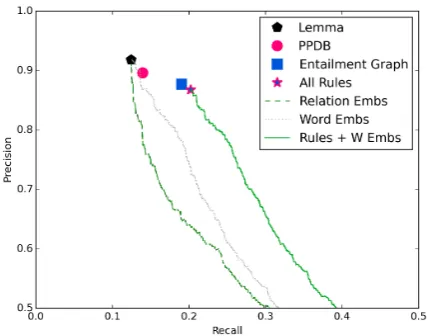
Under the assumption that collections of inference rules are more precision-oriented, we also try dif-ferent combinations of rule-based and embedding-based methods by first applying the rules and then calculating the embedding-based similarity only on instances that were not identified as positive by the rules. Since the embeddings produce a similarity score, not a classification, we plot all methods’ performance on a single precision-recall curve (Figure 2).
All methods used the lemma baseline as a first step to identify positive examples; without it, per-formance drops dramatically. This is probably more of a dataset artifact than an observation about the baselines; just like we filtered examples where arel6=qrel, we could have used a more aggressive policy and removed all pairs that share lemmas.
It seems that most methods provide little value beyond the lemma baseline – the exception being Berant et al.’s (2011) entailment graph. Unify-ing the entailment graph with PPDB (and, implic-itly, the lemma baseline) slightly improves perfor-mance, and provides a significantly better starting point for the method based on word embeddings. Even so, performance is still quite poor in absolute terms, with less than 25% recall at 80% precision.
Figure 2: The performance of existing methods on our dataset. All methods are run on top of the lemma baseline. All Rulesis the union of PPDB and the entailment graph. Rules + W Embsis a combination ofAll Rulesand our word embeddings.
4.3 The Ramifications of Low Recall
These results emphasize the huge false-negative rate of existing methods. This suggests that a mas-sive amount of inference examples, which are nec-essary for answering questions, are inherently ig-nored in (Zeichner et al., 2012) and post-hoc eval-uations. Our dataset remedies this bias, and poses a new challenge for future research on relation in-ference.
Acknowledgements
This work was supported by the German Research Foundation via the German-Israeli Project Coop-eration (grant DA 1600/1-1), the Israel Science Foundation grant 880/12, and by grants from the MAGNET program of the Israeli Office of the Chief Scientist (OCS).
References
[Abend et al.2014] Omri Abend, Shay B. Cohen, and Mark Steedman. 2014. Lexical inference over multi-word predicates: A distributional approach. In Proceedings of the 52nd Annual Meeting of the Association for Computational Linguistics (Volume 1: Long Papers), pages 644–654, Baltimore, Mary-land, June. Association for Computational Linguis-tics.
[image:5.595.309.523.64.232.2]Intelligence, Hyderabad, India, January 6-12, 2007, pages 2670–2676.
[Beltagy et al.2013] Islam Beltagy, Cuong Chau, Gemma Boleda, Dan Garrette, Katrin Erk, and Raymond Mooney. 2013. Montague meets markov: Deep semantics with probabilistic logical form. In Second Joint Conference on Lexical and Computa-tional Semantics (*SEM), Volume 1: Proceedings of the Main Conference and the Shared Task: Semantic Textual Similarity, pages 11–21, Atlanta, Georgia, USA, June. Association for Computational Linguistics.
[Berant et al.2011] Jonathan Berant, Ido Dagan, and Ja-cob Goldberger. 2011. Global learning of typed entailment rules. In Proceedings of the 49th An-nual Meeting of the Association for Computational Linguistics: Human Language Technologies, pages 610–619, Portland, Oregon, USA, June. Association for Computational Linguistics.
[Berant et al.2013] Jonathan Berant, Andrew Chou, Roy Frostig, and Percy Liang. 2013. Semantic pars-ing on Freebase from question-answer pairs. In Pro-ceedings of the 2013 Conference on Empirical Meth-ods in Natural Language Processing, pages 1533– 1544, Seattle, Washington, USA, October. Associa-tion for ComputaAssocia-tional Linguistics.
[Biemann2013] Chris Biemann. 2013. Creating a system for lexical substitutions from scratch using crowdsourcing. Language Resources and Evalua-tion, 47(1):97–122.
[Bird et al.2009] Steven Bird, Ewan Klein, and Edward Loper. 2009. Natural Language Processing with Python. O’Reilly Media.
[Fader et al.2013] Anthony Fader, Luke Zettlemoyer, and Oren Etzioni. 2013. Paraphrase-driven learning for open question answering. InProceedings of the 51st Annual Meeting of the Association for Compu-tational Linguistics (Volume 1: Long Papers), pages 1608–1618, Sofia, Bulgaria, August. Association for Computational Linguistics.
[Fader et al.2014] Anthony Fader, Luke Zettlemoyer, and Oren Etzioni. 2014. Open question answering over curated and extracted knowledge bases. In Pro-ceedings of the 20th ACM SIGKDD International Conference on Knowledge Discovery and Data Min-ing, pages 1156–1165. ACM.
[Fellbaum1998] Christiane Fellbaum. 1998. WordNet. Wiley Online Library.
[Goldberg and Orwant2013] Yoav Goldberg and Jon Orwant. 2013. A dataset of syntactic-ngrams over time from a very large corpus of english books. In Second Joint Conference on Lexical and Computa-tional Semantics (*SEM), Volume 1: Proceedings of the Main Conference and the Shared Task: Semantic Textual Similarity, pages 241–247, Atlanta, Georgia, USA, June. Association for Computational Linguis-tics.
[Grycner and Weikum2014] Adam Grycner and Ger-hard Weikum. 2014. Harpy: Hypernyms and align-ment of relational paraphrases. In Proceedings of COLING 2014, the 25th International Conference on Computational Linguistics: Technical Papers, pages 2195–2204, Dublin, Ireland, August. Dublin City University and Association for Computational Linguistics.
[Grycner et al.2015] Adam Grycner, Gerhard Weikum, Jay Pujara, James Foulds, and Lise Getoor. 2015. Relly: Inferring hypernym relationships between relational phrases. In Proceedings of the 2015 Conference on Empirical Methods in Natural Lan-guage Processing, pages 971–981, Lisbon, Portugal, September. Association for Computational Linguis-tics.
[Kremer et al.2014] Gerhard Kremer, Katrin Erk, Se-bastian Pad´o, and Stefan Thater. 2014. What substi-tutes tell us - analysis of an ”all-words” lexical sub-stitution corpus. InProceedings of the 14th Confer-ence of the European Chapter of the Association for Computational Linguistics, pages 540–549, Gothen-burg, Sweden, April. Association for Computational Linguistics.
[Kruszewski et al.2015] Germ´an Kruszewski, Denis Paperno, and Marco Baroni. 2015. Deriv-ing boolean structures from distributional vectors. Transactions of the Association for Computational Linguistics, 3:375–388.
[Lesk1986] Michael Lesk. 1986. Automatic sense dis-ambiguation using machine readable dictionaries: How to tell a pine cone from an ice cream cone. In Proceedings of the 5th Annual International Con-ference on Systems Documentation, pages 24–26. ACM.
[Levy and Goldberg2014] Omer Levy and Yoav Gold-berg. 2014. Dependency-based word embeddings. In Proceedings of the 52nd Annual Meeting of the Association for Computational Linguistics (Volume 2: Short Papers), pages 302–308, Baltimore, Mary-land, June. Association for Computational Linguis-tics.
[Levy et al.2014] Omer Levy, Ido Dagan, and Jacob Goldberger. 2014. Focused entailment graphs for open ie propositions. In Proceedings of the Eigh-teenth Conference on Computational Natural Lan-guage Learning, pages 87–97, Ann Arbor, Michi-gan, June. Association for Computational Linguis-tics.
[Lewis and Steedman2013] Mike Lewis and Mark Steedman. 2013. Combining distributional and logical semantics. Transactions of the Association for Computational Linguistics, 1:179–192.
[Lin and Pantel2001] Dekang Lin and Patrick Pantel. 2001. Dirt: Discovery of inference rules from text. In Proceedings of the seventh ACM SIGKDD in-ternational conference on Knowledge discovery and data mining, pages 323–328. ACM.
[Marelli et al.2014] Marco Marelli, Stefano Menini, Marco Baroni, Luisa Bentivogli, Raffaella bernardi, and Roberto Zamparelli. 2014. A sick cure for the evaluation of compositional distributional semantic models. In Nicoletta Calzolari, Khalid Choukri, Thierry Declerck, Hrafn Loftsson, Bente Maegaard, Joseph Mariani, Asuncion Moreno, Jan Odijk, and Stelios Piperidis, editors, Proceedings of the Ninth International Conference on Language Resources and Evaluation (LREC’14), pages 216–223, Reyk-javik, Iceland, May. European Language Resources Association (ELRA). ACL Anthology Identifier: L14-1314.
[McCarthy and Navigli2007] Diana McCarthy and Roberto Navigli. 2007. Semeval-2007 task 10: English lexical substitution task. In Proceedings of the Fourth International Workshop on Seman-tic Evaluations (SemEval-2007), pages 48–53, Prague, Czech Republic, June. Association for Computational Linguistics.
[Melamud et al.2013] Oren Melamud, Jonathan Berant, Ido Dagan, Jacob Goldberger, and Idan Szpektor. 2013. A two level model for context sensitive infer-ence rules. InProceedings of the 51st Annual Meet-ing of the Association for Computational LMeet-inguis- Linguis-tics (Volume 1: Long Papers), pages 1331–1340, Sofia, Bulgaria, August. Association for Computa-tional Linguistics.
[Melamud et al.2015] Oren Melamud, Omer Levy, and Ido Dagan. 2015. A simple word embedding model for lexical substitution. In Proceedings of the 1st Workshop on Vector Space Modeling for Natural Language Processing, pages 1–7, Denver, Colorado, June. Association for Computational Linguistics.
[Pavlick et al.2015a] Ellie Pavlick, Johan Bos, Malvina Nissim, Charley Beller, Benjamin Van Durme, and Chris Callison-Burch. 2015a. Adding semantics to data-driven paraphrasing. InProceedings of the 53rd Annual Meeting of the Association for Compu-tational Linguistics and the 7th International Joint Conference on Natural Language Processing (Vol-ume 1: Long Papers), pages 1512–1522, Beijing, China, July. Association for Computational Linguis-tics.
[Pavlick et al.2015b] Ellie Pavlick, Pushpendre Ras-togi, Juri Ganitkevitch, Benjamin Van Durme, and Chris Callison-Burch. 2015b. Ppdb 2.0: Bet-ter paraphrase ranking, fine-grained entailment re-lations, word embeddings, and style classification. In Proceedings of the 53rd Annual Meeting of the Association for Computational Linguistics and the 7th International Joint Conference on Natural Lan-guage Processing (Volume 2: Short Papers), pages
425–430, Beijing, China, July. Association for Com-putational Linguistics.
[Riedel et al.2013] Sebastian Riedel, Limin Yao, An-drew McCallum, and Benjamin M. Marlin. 2013. Relation extraction with matrix factorization and universal schemas. InProceedings of the 2013 Con-ference of the North American Chapter of the Asso-ciation for Computational Linguistics: Human Lan-guage Technologies, pages 74–84, Atlanta, Georgia, June. Association for Computational Linguistics. [Rockt¨aschel et al.2015] Tim Rockt¨aschel, Sameer
Singh, and Sebastian Riedel. 2015. Injecting logical background knowledge into embeddings for relation extraction. InProceedings of the 2015 Conference of the North American Chapter of the Association for Computational Linguistics: Human Language Technologies, pages 1119–1129, Denver, Colorado, May–June. Association for Computational Linguistics.
[Schoenmackers et al.2010] Stefan Schoenmackers, Jesse Davis, Oren Etzioni, and Daniel Weld. 2010. Learning first-order horn clauses from web text. In Proceedings of the 2010 Conference on Empirical Methods in Natural Language Processing, pages 1088–1098, Cambridge, MA, October. Association for Computational Linguistics.
[Szpektor et al.2007] Idan Szpektor, Eyal Shnarch, and Ido Dagan. 2007. Instance-based evaluation of en-tailment rule acquisition. InProceedings of the 45th Annual Meeting of the Association of Computational Linguistics, pages 456–463, Prague, Czech Repub-lic, June. Association for Computational Linguis-tics.
[Voorhees and Tice2000] Ellen M Voorhees and Dawn M Tice. 2000. Building a question answering test collection. InProceedings of the 23rd Annual International ACM SIGIR Conference on Research and Development in Information Retrieval, pages 200–207. ACM.
[Weisman et al.2012] Hila Weisman, Jonathan Berant, Idan Szpektor, and Ido Dagan. 2012. Learning verb inference rules from linguistically-motivated evidence. In Proceedings of the 2012 Joint Con-ference on Empirical Methods in Natural Language Processing and Computational Natural Language Learning, pages 194–204, Jeju Island, Korea, July. Association for Computational Linguistics.