Proceedings of the 55th Annual Meeting of the Association for Computational Linguistics (Short Papers), pages 269–274 Vancouver, Canada, July 30 - August 4, 2017. c2017 Association for Computational Linguistics
Proceedings of the 55th Annual Meeting of the Association for Computational Linguistics (Short Papers), pages 269–274 Vancouver, Canada, July 30 - August 4, 2017. c2017 Association for Computational Linguistics
Improving Implicit Discourse Relation Recognition with
Discourse-specific Word Embeddings
Changxing Wu1,2, Xiaodong Shi1,2, Yidong Chen∗ 1,2, Jinsong Su3, Boli Wang1,2 Fujian Key Lab of the Brain-like Intelligent Systems, Xiamen University, China1
School of Information Science and Technology, Xiamen University, China2 Xiamen University, China3
[email protected] [email protected]
{mandel, ydchen, jssu}@xmu.edu.cn
Abstract
We introduce a simple and effective method to learn discourse-specific word embeddings (DSWE) for implicit dis-course relation recognition. Specifically, DSWE is learned by performing connec-tive classification on massive explicit course data, and capable of capturing dis-course relationships between words. On the PDTB data set, using DSWE as fea-tures achieves significant improvements over baselines.
1 Introduction
Recognizing discourse relations (e.g., Contrast, Conjunction) between two sentences is a crucial subtask of discourse structure analysis. These re-lations can benefit many downstream NLP tasks, including question answering, machine translation and so on. A discourse relation instance is usually defined as a discourse connective (e.g., but, and) taking two arguments (e.g.,clause, sentence). For explicit discourse relation recognition, using only connectives as features achieves more than 93% in accuracy (Pitler and Nenkova, 2009). Without obvious clues like connectives, implicit discourse relation recognition is still challenging.
The earlier researches usually develop linguisti-cally informed features and use supervised learn-ing method to perform the task (Pitler et al.,2009;
Lin et al.,2009;Louis et al.,2010;Rutherford and
Xue,2014;Braud and Denis,2015). Among these
features, word pairs occurring in argument pairs are considered as important features, since they can partially catch discourse relationships between two arguments. For example, synonym word pairs like(good, great)may indicate aConjunction re-lation, while antonym word pairs like(good, bad)
∗Corresponding author.
may mean a Contrast relation. However, classi-fiers based on word pairs in previous work do not work well because of the data sparsity problem. To address this problem, recent researches use word embeddings (aka distributed representations) in-stead of words as input features, and design vari-ous neural networks to capture discourse relation-ships between arguments (Zhang et al., 2015;Ji and Eisenstein,2015;Qin et al.,2016;Chen et al.,
2016;Liu and Li, 2016). While these researches
achieve promising results, they are all based on pre-trained word embeddings ignoring discourse information (e.g., good, great, and bad are of-ten mapped into close vectors). Intuitively, using word embeddings sensitive to discourse relations would further boost the performance.
In this paper, we propose to learn discourse-specific word embeddings (DSWE) from explicit data for implicit discourse relation recognition. Our method is inspired by the observation that synonym (antonym) word pairs tend to appear around the discourse connectiveand (but). Other connectives can also provide some discourse clues. We expect to encode these discourse clues into the distributed representations of words, to capture discourse relationships between them. To this end, we use a simple neural network to per-form connective classification on massive explicit data. Explicit data can be considered to be au-tomatically labeled by connectives. While they cannot be directly used as training data for im-plicit discourse relation recognition and contain some noise, they are effective enough to pro-vide weakly supervised signals for training the discourse-specific word embeddings.
We apply DSWE as features in a supervised neural network for implicit discourse relations recognition. On the PDTB (Prasad et al., 2008), using DSWE yields significantly better perfor-mance than using off-the-shelf word embeddings,
or recent systems incorporating explicit data. We detail our method in Section2 and evaluate it in Section3. Conclusions are given in Section4. Our learnedDSWEis publicly available athere.
2 Discourse-specific Word Embeddings
In this section, we first introduce the neural net-work model for learning discourse-specific word embeddings (DSWE), and then the way of collect-ing explicit discourse data for traincollect-ing. Finally, we highlight the differences between our work and the related researches.
avg
c w
1
h
w 2
h
w con
n
1
1
warg
1 wmarg
2
1
warg
2 wn
arg
…
…
…
…
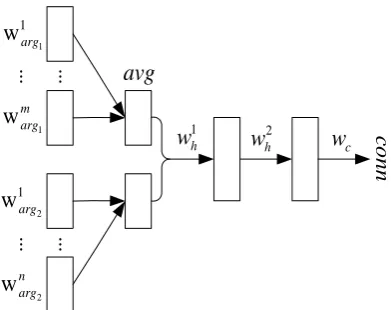
Figure 1: Neural network model for learn-ing DSWE. An explicit instance is denoted as
(arg1, arg2, conn). w1arg1, ..., wmarg1 mean the
words in arg1. Two arguments are concatenated as input and the number of hidden layers is not limited to two.
We induceDSWEbased on explicit data by per-forming connective classification. The connective classification task predicts which discourse con-nective is suitable for combining two given argu-ments. It is essentially similar to implicit rela-tion recognirela-tion, just with different output labels. Therefore, any existing neural network model for implicit relation recognition can be easily used for connective classification. We adapt the model in
(Wu et al.,2016) for connective classification
be-cause it is simple enough to enable us to train on massive data. As illustrated in Figure 1, an ar-gument is first represented as the average of dis-tributed representations of words in it. On the con-catenation of two arguments, multiple non-linear hidden layers are then used to capture the inter-actions between them. Finally, asoftmaxlayer is stacked for classification. We combine the cross-entropy error and regularization error multiplied
by the coefficientλas the objective function. Dur-ing trainDur-ing, we initialize distributed representa-tions of all words randomly and tune them to min-imize the objective function. The finally obtained distributed representations of all words are our discourse-specific word embeddings.
Collecting explicit discourse data includes two steps: 1) distinguish whether a connective occur-ring reflects a discourse relation. For example, the connectiveandcan either function as a discourse connective to join twoConjunctionarguments, or be just used to link two nouns in a phrase. 2) iden-tify the positions of two arguments. According to
(Prasad et al.,2008),arg2 is defined as the
argu-ment following a connective, however, arg1 can be located within the same sentence as the connec-tive, in some previous or following sentence. Lin
et al.(2014) show that the accuracy of
distinguish-ing connectives is more than 97%, while identify-ing arguments is below than 80%. Therefore, we use the existing toolkit1to find discourse
connec-tives, and just collect explicit instances using pat-terns like [arg1because arg2], where two argu-ments are in the same sentence, to decrease noise. We believe these simple patterns are enough when using a very large corpus. Note that there are 100 discourse connectives in the PDTB, we ignore four parallel connectives (e.g., if...then) for simplicity. The way of collecting explicit data can be easily generalized to other languages, one just need to train a classifier to find discourse connectives fol-lowing (Lin et al.,2014).
Some aspects of this work are similar to (
Bi-ran and McKeown,2013;Braud and Denis,2016).
Based on massive explicit instances, they first build a word-connective co-occurrence frequency matrix2, and then weight these raw frequencies. In
this way, they represent words in the space of con-nectives to directly encode their discourse func-tion. The major limitation of their approach is that the dimension of the word representations must be less than or equal to the number of connec-tives. By comparison, we learnDSWEby predict-ing connectives conditionpredict-ing on arguments, which yields better performance and has no such dimen-sion limitation. Some researchers use explicit data as additional training data via multi-task learning (Lan et al.,2013;Liu et al.,2016) or data selec-tion (Rutherford and Xue,2015;Wu et al.,2016).
1https://github.com/linziheng/pdtb-parser.
2Biran and McKeown(2013) calculate co-occurrences
[image:2.595.84.280.243.398.2]In both cases, explicit data are directly used to esti-mate the parameters of implicit relation classifiers. As a result, it is hard for them to incorporate mas-sive explicit data because of the noise problem. By contrast, we leverage massive explicit data by learning word embeddings from them.
3 Experiments
3.1 Data and Settings
We collect explicit data from theXinandLtwparts of the English Gigaword Corpus (3rd edition), and get about 4.92M explicit instances. We randomly sample 20,000 instances as the development set and the others as the training set forDSWE. Af-ter discarding words occurring less than 5 times, the size of the vocabulary is 185,048. For the con-nective classification task, we obtain an accuracy of about 53% on the development set.
We adapt the neural network model described in Figure1as the classifier for implicit discourse re-lation recognition (CDRR). Specifically, we con-catenate some surface features with the last hid-den layer as the input of thesoftmaxlayer to pre-dict discourse relations. We choose 500 Produc-tion rule(Lin et al.,2009) and 500Brown Cluster
Pair(Rutherford and Xue,2014) features based on
mutual information using the toolkit provided by
Peng et al.(2005). Our learnedDSWEis used as
the pre-trained word embeddings forCDRR, and fixed during training.
Hyper-parameters for training DSWE and CDRR are selected based on their corresponding development set, and listed in Table1.
Hyper-parameter DSWE CDRR
wdim 300 300
hsizes [200] [200, 50]
lr 1.0 0.005
λ 0.0001 0.0001 update SGD AdaGrad
f ReLU ReLU
Table 1: Hyper-parameters for trainingDSWEand CDRR.wdimmeans the dimension of word em-beddings, hsizes the sizes of hidden layers, lr the learning rate, λthe regularization coefficient, update the parameter update strategy and f the nonlinear function. Note that [200, 50] means that CDRRuses two layers with the sizes of 200 and 50, respectively. And the learning rate for training DSWEis decayed by a factor of 0.8 per epoch.
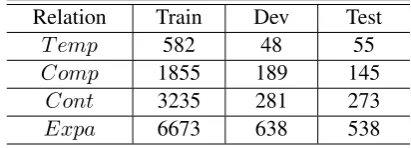
Following Liu et al. (2016), we perform a 4-way classification on the four top-level relations in the PDTB: T emporal (T emp),Comparison (Comp), Contingency (Cont) and Expansion (Expa). The PDTB is split into the training set (Sections 2-20), development set (Sections 0-1) and test set (Sections 21-22). Table 2 lists the statistics of these data sets. Due to the small and uneven test data set, we run our method 10 times with different random seeds (therefore different initial parameters), and report the results (of a run) which are closest to the average results. Finally, we use both Accuracy and M acro F1 (macro-averagedF1) to evaluate our method.
Relation Train Dev Test
T emp 582 48 55
[image:3.595.312.518.266.340.2]Comp 1855 189 145 Cont 3235 281 273 Expa 6673 638 538
Table 2: Statistics of data sets on the PDTB.
3.2 Results
We compare our learned discourse-specific word embeddings (DSWE) with two publicly available embeddings3:
1)GloVe4: trained on 6B words fromWikipedia
2014andGigaword 5using the count based model
in (Pennington et al.,2014), with a vocabulary of
400K and a dimensionality of 300.
2) word2vec5: trained on 100B words from
Google Newsusing the CBOW model in (Mikolov
et al.,2013), with a vocabulary of 3M and a
dimen-sionality of 300.
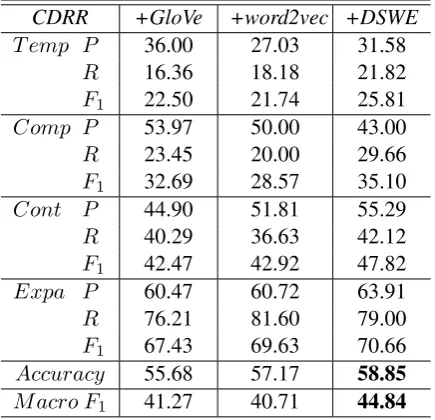
Results in Table3show that usingDSWEgains significant improvements (one-tailed t-test with p<0.05) over using GloVe or word2vec, on both
Accuracy and M acro F1. Furthermore, using DSWEachieves better performance across all re-lations on theF1 score, especially for minority re-lations (T emp, Comp and Cont). Overall, our DSWEcan effectively incorporate discourse
infor-3The reasons for using those publicly available word
em-beddings are: 1) They are both trained on massive data. 2) It will be convenient for other people to reproduce our ex-periments. 3) UsingGloVeorword2vecword embeddings trained on the same corpus asDSWEachieves worse perfor-mance than using these two public ones.
4http://nlp.stanford.edu/projects/glove/glove.6B.zip 5
CDRR +GloVe +word2vec +DSWE T emp P 36.00 27.03 31.58
[image:4.595.73.291.63.273.2]R 16.36 18.18 21.82 F1 22.50 21.74 25.81 Comp P 53.97 50.00 43.00 R 23.45 20.00 29.66 F1 32.69 28.57 35.10 Cont P 44.90 51.81 55.29 R 40.29 36.63 42.12 F1 42.47 42.92 47.82 Expa P 60.47 60.72 63.91 R 76.21 81.60 79.00 F1 67.43 69.63 70.66 Accuracy 55.68 57.17 58.85 M acro F1 41.27 40.71 44.84
Table 3: Results of using different word embed-dings. We also list the Precision, Recall and F1 score for each relation.
mation in explicit data, and thus benefits implicit discourse relation recognition.
We also compare our method with three recent systems which also use explicit data to boost the performance:
1)R&X2015: Rutherford and Xue(2015) con-struct weakly labeled data from explicit data based on the chosen connectives, to enlarge the training data directly.
2) B&D2016: Braud and Denis (2016) learn connective-based word representations and build a logistic regression model based on them6.
3) Liu2016: Liu et al.(2016) use a multi-task neural network to incorporate several discourse-related data, including explicit data and the RST-DT corpus (William and Thompson,1988).
System Accuracy M acro F1 R&X2015 57.10 40.50 B&D2016 52.81 42.27
Liu2016 57.27 44.98
CDRR+DSWE 58.85 44.84
Table 4: Comparison with recent systems.
Results in Table 4 show the superiority of our method. AlthoughLiu2016performs slightly bet-ter on M acro F1, it uses the additional labeled RST-DT corpus. ForR&X2015andLiu2016, they
6We carefully reproduce their model since they adopt a
different setting in preprocessing the PDTB.
both incorporate relatively small explicit data be-cause of the noise problem, for example, 20,000 and 40,000 instances respectively. By contrast, our method benefits from about 4.9M explicit in-stances. While B&D2016 uses massive explicit data, it is limited by the fact that the maximum dimension of word representations is restricted to the number of connectives, for example 96 in their work. Overall, our method can effectively utilize massive explicit data, and thus is more powerful than baselines.
not good
word2vec DSWE word2vec DSWE do no great great
did n’t bad lot
anymore never terrific very necessarily nothing decent better
anything neither nice success anyway none excellent well
does difficult fantastic happy never nor better certainly
want refused solid respect neither impossible lousy fine
if limited wonderful import know declined terrible positive anybody nobody Good help
[image:4.595.307.528.223.459.2]yet little tough useful either denied best welcome
Table 5: Top 15 closest words ofnotandgoodin bothword2vecandDSWE.
To give an intuition of what information is en-coded into the learnedDSWE, we list in Table5
[image:4.595.76.287.572.648.2]10 20 30 60 all
Number of connectives
0.42 0.43 0.44 0.45 0.46
M
ac
ro
[image:5.595.81.282.74.227.2]F1
Figure 2: Impact of connectives used in training DSWE.
Finally, we conduct experiments to investigate the impact of connectives used in trainingDSWE on our results. Specifically, we use the explicit discourse instances with the top 10, 20, 30, 60 most frequent or all connectives to learn DSWE, accounting for 78.9%, 91.9%, 95.8%, 99.4% or 100% of total instances, respectively. The top 10 most frequent connectives are: and, but, also, while, as, when, after, if, however and because, which cover all four top-level relations defined in the PDTB. As illustrated in Figure2, with only the top 10 connectives, the learned DSWE achieves better performance than the common word em-beddings. We observe a significant improvement when using top 20 connectives, almost the best performance with top 30 connectives, and no fur-ther substantial improvement with more connec-tives. These results indicate that we can use only topnmost frequent connectives to collect explicit discourse data for DSWE, which is very conve-nient for most languages.
4 Conclusion
In this paper, we learn discourse-specific word em-beddings from massive explicit data for implicit discourse relation recognition. Experiments on the PDTB show that using the learned word embed-dings as features can significantly boost the per-formance. We also show that our method can use explicit data more effectively than previous work. Since most of neural network models for implicit discourse relation recognition use pre-trained word embeddings as input, we hope that our learned word embeddings would benefit them.
Acknowledgments
We would like to thank all the reviewers for their constructive and helpful suggestions on this pa-per. This work is partially supported by the Nat-ural Science Foundation of China (Grant Nos. 61573294, 61672440, 61075058), the Ph.D. Pro-grams Foundation of Ministry of Education of China (Grant No. 20130121110040), the Foun-dation of the State Language Commission of China (Grant No. WT135-10), the Natural Sci-ence Foundation of Fujian Province (Grant No. 2016J05161).
References
Or Biran and Kathleen McKeown. 2013. Aggregated Word Pair Features for Implicit Discourse Relation Disambiguation. InProceedings of ACL. Sofia, Bul-garia, pages 69–73.
Chlo´e Braud and Pascal Denis. 2015. Comparing Word Representations for Implicit Discourse Rela-tion ClassificaRela-tion. InProceedings of EMNLP. Lis-bon, Portugal, pages 2201–2211.
Chlo´e Braud and Pascal Denis. 2016. Learning Connective-based Word Representations for Implicit Discourse Relation Identification. InProceedings of EMNLP. Austin, Texas, pages 203–213.
Jifan Chen, Qi Zhang, Pengfei Liu, Xipeng Qiu, and Xuanjing Huang. 2016. Implicit Discourse Relation Detection via a Deep Architecture with Gated Rele-vance Network. InProceedings of ACL. Berlin, Ger-many, pages 1726–1735.
Yangfeng Ji and Jacob Eisenstein. 2015. One Vector is Not Enough: Entity-Augmented Distributed Seman-tics for Discourse Relations. Transactions of the As-sociation for Computational Linguistics3:329–344.
Man Lan, Yu Xu, and Zhengyu Niu. 2013. Leveraging Synthetic Discourse Data via Multi-task Learning for Implicit Discourse Relation Recognition. In Pro-ceedings of ACL. Sofia, Bulgaria, pages 476–485.
Ziheng Lin, Min-Yen Kan, and Hwee Tou Ng. 2009. Recognizing Implicit Discourse Relations in the Penn Discourse Treebank. In Proceedings of EMNLP. PA, USA, pages 343–351.
Ziheng Lin, Hwee Tou Ng, and Min-Yen Kan. 2014. A PDTB-styled End-to-end Discourse Parser. Natural Language Engineering20(02):151–184.
Yang Liu, Sujian Li, Xiaodong Zhang, and Zhifang Sui. 2016. Implicit Discourse Relation Classifica-tion via Multi-Task Neural Networks. In Proceed-ings of AAAI. Arizona, USA, pages 2750–2756. Annie Louis, Aravind Joshi, Rashmi Prasad, and Ani
Nenkova. 2010. Using Entity Features to Classify Implicit Discourse Relations. In Proceedings of SIGDIAL. PA, USA, pages 59–62.
Tomas Mikolov, Kai Chen, Greg Corrado, and Jeffrey Dean. 2013. Efficient Estimation of Word Represen-tations in Vector Space. arXiv:1301.3781 [cs]. H. Peng, Fulmi Long, and C. Ding. 2005.
Fea-ture Selection Based on Mutual Information Cri-teria of Max-dependency, Max-relevance, and Min-redundancy. IEEE Transactions on PAMI 27(8):1226–1238.
Jeffrey Pennington, Richard Socher, and Christopher Manning. 2014. Glove: Global Vectors for Word Representation. InProceedings of EMNLP. Doha, Qatar, pages 1532–1543.
Emily Pitler, Annie Louis, and Ani Nenkova. 2009. Automatic Sense Prediction for Implicit Discourse Relations in Text. InProceedings of ACL-IJCNLP. PA, USA, pages 683–691.
Emily Pitler and Ani Nenkova. 2009. Using Syntax to Disambiguate Explicit Discourse Connectives in Text. In Proceedings of ACL-IJCNLP. PA, USA, pages 13–16.
Rashmi Prasad, Nikhil Dinesh, Alan Lee, Eleni Milt-sakaki, Livio Robaldo, Aravind Joshi, and Bonnie Webber. 2008. The Penn Discourse TreeBank 2.0. In Proceedings of LREC. volume 24, pages 2961– 2968.
Lianhui Qin, Zhisong Zhang, and Hai Zhao. 2016. A Stacking Gated Neural Architecture for Implicit Dis-course Relation Classification. In Proceedings of EMNLP. Austin, Texas, pages 2263–2270.
Attapol Rutherford and Nianwen Xue. 2014. Discov-ering Implicit Discourse Relations Through Brown Cluster Pair Representation and Coreference Pat-terns. InProceedings of EACL. Gothenburg, Swe-den, pages 645–654.
Attapol Rutherford and Nianwen Xue. 2015. Improv-ing the Inference of Implicit Discourse Relations via Classifying Explicit Discourse Connectives. In Pro-ceedings of NAACL. Denver, Colorado, pages 799– 808.
Mann William and Sandra Thompson. 1988. Rhetori-cal Structure Theory: Towards a Functional Theory of Text Organization. Text8(3):243–281.
Changxing Wu, Xiaodong Shi, Yidong Chen, Yanzhou Huang, and Jinsong Su. 2016. Bilingually-constrained Synthetic Data for Implicit Discourse Relation Recognition. In Proceedings of EMNLP. Austin, Texas, pages 2306–2312.