J. Range Manage.
56:81-91 January 2003
Vegetation of chained and non-chained seedings after wild- fire in Utah
JEFFREY E. OTT, E. DURANT MCARTHUR, AND BRUCE A. ROUNDY
Authors are Biological Technician and Project Leader, USDA, Forest Service, Rocky Mountain Research Station, Shrub Sciences Laboratory, Provo, Utah 84606; and Professor, Department of Botany and Range Science, Brigham Young University, Provo, Utah 84602. Research was a portion of the first author's M. S. degree work, Department of Botany and Range Science, Brigham Young University.
Abstract
After wildfires in 1996 in the sagebrush (Artemisia spp.) and pinyon-juniper (Pinus spp.-Juniperus spp.) zones of west-cen- tral Utah, the USDI-BLM attempted to reduce soil erosion and cheatgrass proliferation (Bromus tectorum L.) through rehabili- tation treatments. We compared the vegetation of aerially seed- ed, chained treatments with aerially seeded but non-chained treatments for 3 years following seeding. Vegetation cover increased significantly in both treatments between the first and second year, concurrent with above-average precipitation. By the second year, seeded grasses, primarily crested wheatgrass
[Agropyron cristatum (L.) Gaertn.] and intermediate wheatgrass [Elymus hispidus (Opiz) Meld. and Elymus elongatus (Host) Runem.], dominated the chained treatment while cheatgrass dominated the non-chained treatment. Seeded grass establish- ment in non-chained areas was highest beneath dead trees on steep northeast-facing slopes. The first year following the fires, frequency of most annual species and some native perennial species was higher in the non-chained than chained treatment.
Native species richness and diversity declined in both treatments between the first and third year following the fires due to the loss of early-seral native annuals and probably because of climatic factors and competition from seeded grasses and cheatgrass. This study reaffirmed the utility of aerial seeding followed by chaining as a rehabilitation technique for rapid establishment of standard plant materials and suppression of cheatgrass, although the implications for soil protection were less clear. Maintenance of native biodiversity on public lands will require greater develop- ment and use of native plant materials for wildfire rehabilitation.
Planning for future rehabilitation needs is important in light of continuing wildfire risks.
Key Words: Bureau of Land Management, rehabilitation, chain- ing, aerial seeding, plant materials, cheatgrass
Wildfire rehabilitation via the Emergency Fire Rehabilitation program has been widely used by the USDI Bureau of Land Management (BLM) in the Intermountain West with primary pur-
Resumen
Despues de los fuegos sin control ocurridos en 1996 en las zonas de "Sagebrush" (Artemisia spp.) y "Pinyon-Juniper"
(Pinus spp.-Juniperus spp.) de la region central - oeste de Utah, el USDI-BLM intento reducir la erosion y la proliferation del
"Cheatgrass" (Bromus tectorum L.) a traves de tratamientos de rehabilitacion. Comparamos la vegetacion de areas sujetas a cadeneo y siembra aerea contra areas sin cadeneo y con siembra aerea, la comparacion se realizo durante 3 aiios despues de la siembra.. Entre el primer y segundo ano la cobertura vegetal se incremento significativamente en ambos sitios, concordando con precipitatoion arriba del promedio. Para el segundo ano los zacates sembrados, principalmente "Crested wheatgrass"
[Agropyron cristatum (L.) Gaertn.], "intermediate wheatgrass"
[Elymus hispidus (Opiz) Meld. y Elymus elongatus (Host) Runem.], dominaron en el tratamiento con cadeneo, mientras que el "Cheatgrass"domino las areas sin cadeneo. El establec- imiento de los zacates sembrados en las areas sin cadeneo fue mayor debajo de los arboles muertos en las pendientes pronunci- adas con exposicion nordeste. En el primer ano despues de los fuegos, la frecuencia de la mayoria de las especies anuales y de algunas especies nativas perennes fue mas alta en el tratamiento sin cadeneo que en el tratamiento con cadeneo. La riqueza y diversidad de especies nativas disminuyo en ambos tratamientos entre el primer y tercer aiios despues del fuego, debido a la per- dida de especies anuales nativas de las primeras etapas serales y probablemente a causa de los factores climaticos y la competen- cia entre los zacates sembrados y el "Cheatgrass". Este estudio reafirma la utilidad de la siembra aerea seguida de un cadeneo como una tecnica de rehabilitacion para el establecimiento rapi- do de material vegetal estandar y la supresion del "Cheatgrass", aunque las implicaciones para la proteccion del suelo fueron menos claras. El mantenimiento de la biodiversidad nativa en terrenos publicos requerira un mayor desarrollo y use de mater- ial vegetal nativo para la rehabilitacion a fuegos no prescritos.
La planeacion de las necesidades futuras de rehabilitacion es importante por el riesgo continuo de fuegos no prescritos.
Research was funded in part by Interagency Agreement J910A70026 between USDI, Bureau of Land Management, Utah State and Fillmore Field Offices and USDA, Forest Service, Rocky Mountain Research Station. The authors thank Pat Fosse and Harvey Gates for logistical support; Stewart Sanderson, Lans Stavast and Alex Parent for data collection assistance; Dave Turner for statistical advice;
and Jim Bowns, Steve Monsen, Mike Pellant, and reviewers chosen by the journal editors for review of earlier versions of the manuscript.
Manuscript accepted 19 Apr. 02.
poses to reduce soil erosion, protect property and life, and pre- vent the spread of weeds (BLM 1999a, Roberts 1999). One reha- bilitation goal on semiarid sites may be to prevent site dominance by the exotic annual cheatgrass (Bromus tectorum L.) by estab- lishing perennial species (BLM 1999b, MacDonald 1999).
In areas where rangeland drills cannot be used, rehabilitation can be accomplished through aerial broadcast seeding, often fol-
JOURNAL OF RANGE MANAGEMENT 56(1) January 2003 81
Table 1. Characteristics of study sites that burned in the summer of 1996 in west-central Utah.
Site Name Dog Slopes
Gilson
Jericho
Paul Bunyan
Railroad
Twin
Location (Reference Marker)
I IOm at 195° from Tidwell Spring exclosure, T 13S R2W S19
Section marker T13S R3W S35 T14S R3W SI S2 Milemarker 124, US Hwy. 6, T12S R3W S28 Near Paul Bunyan's Woodpile road, TI 2S R3W S23
151m at 195° from section marker T 12S R3W S 15 S 16 S21 S22 Quarter-section marker T25S R7W S29 S32
ITrickier
and Hall (1984) -Stott and Olsen (1976)
lowed by chaining (Vallentine 1989, BLM 1999b, MacDonald 1999). Chaining has been widely used on rangelands to elimi- nate unwanted trees and brush (Vallentine 1989), but in wildfire rehabilitation its pri- mary role is to create a suitable seedbed including coverage of seed by soil (BLM 1999b). Although the BLM has accumu- lated much corporate knowledge of wild- fire rehabilitation using chaining through years of practical experience, few formal
Elevation (m) 1,650-1,690
Slope and Aspect 20-34% slopes;
north- to east-facing
1,615-1,645 4-15% slopes; mainly northeast- to southeast-facing
1,650-1,670 4-16% slopes: east, south-, and west-facing
1,800-1,810 5-1117c slopes;
mainly west- and south-facing
1,670-1,680 5-7% slopes; north-, south-, and west-facing
1,800-1,810 1-6% slopes; north- to northeast-facing
studies have been conducted. See Clary (1988) for some Utah chaining and seed- ing study examples and results.
This paper presents a comparative study in which vegetation of chained and non- chained seedings was monitored for 3
years following 1996 Utah wildfires.
Controversy over the impact of chaining treatments on archeological sites, wilder- ness resources, and native vegetation dynamics following these fires stimulated
Soils
Saxby very cobbly loam: Loamy-skeletal, mixed, mesic Lithic Xerollic
Calciorthids'
Borvant cobbly loam: Loamy-skeletal, carbonatic, mesic, shallow Aridic Petrocalcic Paleoxerolls' Jericho gravelly fine sandy loam:
Loamy-skeletal, mixed, mesic, shallow Xerollic DurorthidsI
Jericho gravelly fine sandy loam:
Loamy-skeletal, mixed, mesic, shallow Xerollic Durorthids' Wales loam: Fine-loamy, mixed
(calcareous), mesic Xeric Torrifluvents
Kessler-Penoyer very cobbly loam:
Fine-silty, carbonatic, mesic XerollicCalciorthids; and/or coarse-silty, mixed (calcareous), mesic Typic Torriorthents2
this research. Our objective was to docu- ment the effects of these rehabilitation treatments, particularly in relation to seed- ed plant establishment, exotic annual sup- pression, and consequences to native species.
Study Area and Rehabilitation Description
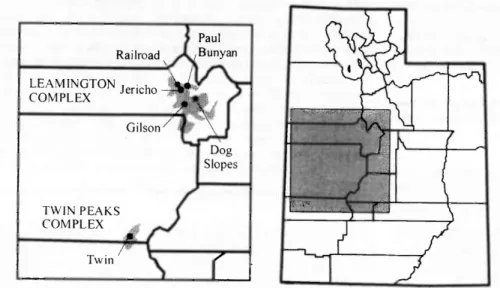
The Twin Peaks Complex fire was ignit- ed by lightning on 5 July 1996 and was controlled on 12 July 1996 (BLM, person- al communication). The area affected by this fire lies between 38° 30'-45"N and
1 13° 35'-50'W in Millard and Beaver counties, Utah (Fig. 1; Table 1), primarily between 1,580-1,950 m elevation, on plains and low ridges composed primarily of basalt flows and alluvium (Hintze
1975). Pre-burn vegetation was dominated by mature Wyoming big sagebrush [Artemisia tridentata var. wvomingensis (Beetle & A. Young) Welsh] and Utah juniper [Juniperus osteospermna (Torr.) Little], in a precipitation regime averaging 30 to 41 cm per year over a 30-year period (USDA-NRCS 1999). Pre-burn understory vegetation varied but included substantial amounts of cheatgrass.
Fig. Utah. 1. Location of 1996 fire complexes (shaded) and rehabilitation study sites in west-central Another fire, the Leamington Complex, occurred in an area about 120 km to the
north of the Twin Peaks Complex, in Juab county, Utah, between 39° 24'-50'N and 111° 50-112° 20'W (Fig. 1; Table 1). The Leamington Complex fire began with a lightning strike on 1 August 1996 and was controlled on 17 August 1996 (BLM, per- sonal communication). Most of this fire occurred between 1,520-2,100 m eleva- tion, on topography characterized by allu- vial plains, foothills, and fault-block mountains composed of volcanic rocks and limestone (Hintze 1975). Pre-burn vegetation was a mosaic of seral stages of sagebrush steppe and pinyon (Pinus spp.)- juniper and juniper woodlands as well as stands of cheatgrass and seeded grasses.
Precipitation in this area ranges from a 30- year average of 25 to 30 cm per year in lower valley areas to 41 to 46 cm per year on lower mountain slopes (USDA-NRCS
1999).
Seed mixes were prepared primarily using `Hycrest' and `Nordan' crested wheatgrass [(Agropyron cristatum(L.) Gaertn.)], `Oahe' intermediate wheatgrass [Elymus hispidus (Opiz) Meld.], `Luna' pubescent wheatgrass [Elymus hispidus (Opiz) Meld.], `Alkar' tall wheatgrass [Elymus elongatus (Host) Runem.], Bozoisky' Russian wildrye (Elymus junceus Fisch.), `Magnar' Great Basin wildrye (Elymus cinereus Scribn. &
Men.), `Lincoln' smooth brome (Bromus inermis Leysser), `Ladak' alfalfa (Medicago sativa L.), and fourwing salt- bush [Atriplex canescens (Pursh) Nutt.].
Seed mix composition, seeding rates, and timing of application differed for different locations and treatments (Table 2). An Ely anchor chain was used at all sites consid- ered in this study. The Ely chain is a mod- ification of the standard anchor chain (rail segments are welded to some of the chain links to provide added weight and addi- tional soil disturbance-Vallentine 1989).
Aerial seeding followed by chaining was carried out as weather conditions per- mitted from autumn 1996 until 31 March 1997, when chaining was halted by a tem- porary court restraining order (BLM, per- sonal communication). This was the result of legal proceedings led by citizens con- cerned with the impact of these chaining treatments on archeological sites (Haase 1983) and on the integrity of wilderness resources and native vegetation (SUWA 1997, SUWA personal communication).
At the time of this order, aerial seeding treatments had been completed but chain- ing treatments were only partially com- pleted and were not pursued further by the Utah BLM during that year (BLM, person- al communication). Thus, some lands had
been seeded and chained and some had been seeded but not chained. No further chaining occurred on the 1996 burns until 1998 after legal restraints were lifted.
Livestock grazing was restricted from rehabilitated sites for 2 growing seasons following treatment.
Methods
During the summer of 1997, we selected 6 study sites, 5 within the burned area of the Leamington Complex, and 1 within the Twin Peaks Complex (Fig. 1; Table 1).
Sites were selected based on accessibility and the presence of treatments of interest on comparable topographic settings. All sites included a chained treatment (aerially seeded followed by Ely chaining) adjacent to an aerially seeded, non-chained treat- ment. Site selection resulted in 5 different seed mixes being represented (Table 2).
The non-chained treatment area at the Railroad site was inadvertently reseeded and chained by the BLM during a 1998- 1999 operation. We relocated plot markers following this chaining and collected plot data in 1999-see Ott (2001) for further details.
At 3 sites, cadastral survey markers were used as reference points. Metal rebar stakes were placed to mark reference points at sites lacking such markers.
Transect lines were extended directly from the reference point, following cardinal directions, or otherwise arranged system- atically within the different treatment areas of each site. Plots were established at regular intervals along the transect lines, with 4 plots per treatment at each site. A rebar was placed to mark each plot at tape- measured intervals of 50 m (Twin, Gilson, Dog Slopes, and Railroad sites), or 60 m (Jericho and Paul Bunyan sites). This rebar served as the center of a circular plot of radius 5.6 m (100 m2) and also served as the southwest corner of a square- shaped, 1 m2 plot (McArthur and Sanderson 1996). The larger plot allowed
greater scope, while the smaller plot allowed greater precision of data collect- ed. Data were collected each year for 3 consecutive years (July-August 1997, June-early July 1998, and late June-early August 1999).
We used the ocular releve methods of Shimwell (1971) and McArthur and Sanderson (1996) to estimate cover of vas- cular plants, bare soil, litter, rock (> 2 cm diameter), and cryptogams (biological soil crusts and non-vascular plants) in both large (100 m2) and small (1 m2) plots.
Table 2. Aerial applied seed mixtures and seed- ing rates for 1996-1997 rehabilitation at sites that burned in the summer of 1996 in west- central Utah (Information supplied by the Fillmore Field Office, USDI BLM).
Plant Material' Seeding Rate
Dog Slopes Site
Crested wheatgrass (`Hycrest')
(kglha 5.0
Pubescent wheatgrass2 3.4
Russian wildrye (Bozoisky') 2.4
Tall wheatgrass2 1.7
Crested wheatgrass (`Fairway') 0.4
Total 12.9
Gilson Site
Crested wheatgrass (`Hycrest') 3.4 Smooth brome ('Lincoln') 2.2 Russian wildrye (Bozoisky') 2.2
Tall wheatgrass2 2.2
Fourwing saltbush2 1.1
Total 11.2
Jericho Site
Crested wheatgrass (`Hycrest') 3.5-4.53 Russian wildrye (`Bozoisky') 2.4-3.4
Tall wheatgrass2 2.2
Smooth brome (Lincoln) 0-2.0
Great Basin wildrye2 0-1.1
Fourwing saltbush2 1.1
Total 11.2-12.3
Paul Bunyan Site
Crested wheatgrass (`Hycrest') 4.5 Russian wildrye (Bozoisky') 3.4
Tall wheatgrass2 2.2
Fourwing saltbush2 1.1
Total 11.2
Railroad Site
Crested wheatgrass (`Hycrest') 3.5 Russian wildrye (`Bozoisky') 2.4
Tall wheatgrass 2.2
Smooth brome (`Lincoln') 2.0
Great Basin wildrye 1.1
Fourwing saltbush2 1.1
Total 12.3
Twin Site
Crested wheatgrass (`Hycrest') 6.7 Russian wildrye (`Bozoisky') 4.1 Pubescent wheatgrass (`Luna') 3.2 Crested wheatgrass (`Nordan') 2.8
Alfalfa (`Ladak') 0.3
Total 17.3
'For scientific names see Table 3.
2Cultivar information not available.
3The Jericho study site included two seed mixes on oppo- site sides of U.S. Highway 6, the same mixes as applied to the Paul Bunyan and Railroad sites.
Foliar vascular plant cover percent was estimated first, and the remaining plot area was then assigned to the other categories so that the total of these 5 categories always equaled 100%. Litter was defined as any herbaceous material from a previ- ous growing season, and any dead woody material in contact with the surface of the ground, including fallen branches and bases of dead trees.
Foliar cover was estimated for each vas- cular plant species having canopy within
JOURNAL OF RANGE MANAGEMENT 56(1) January 2003 83
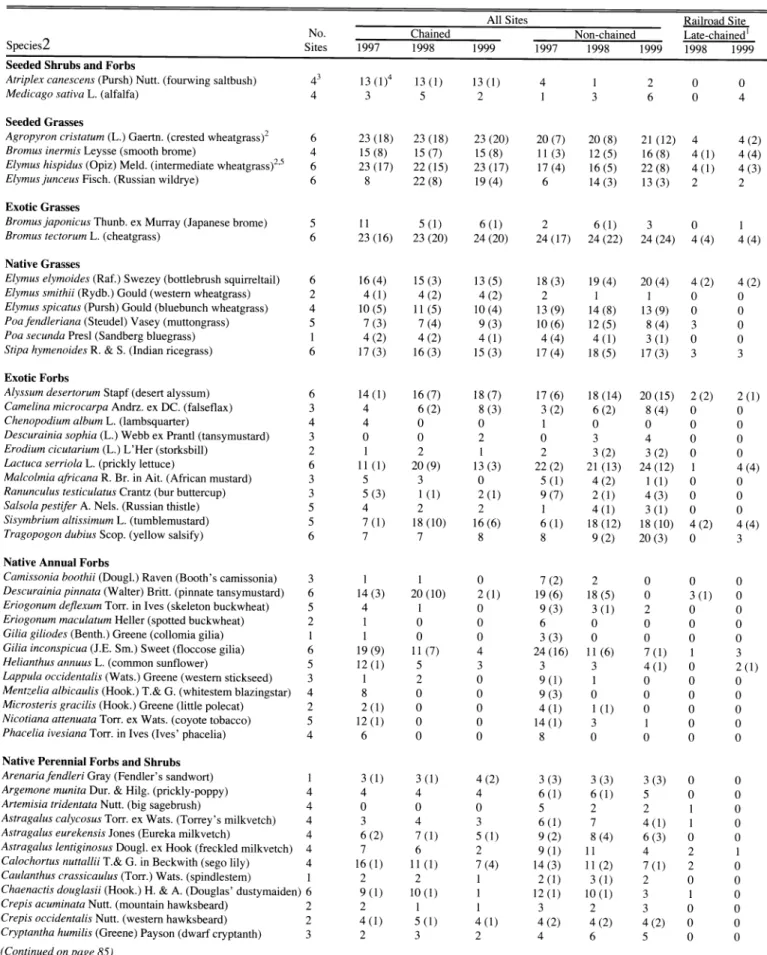
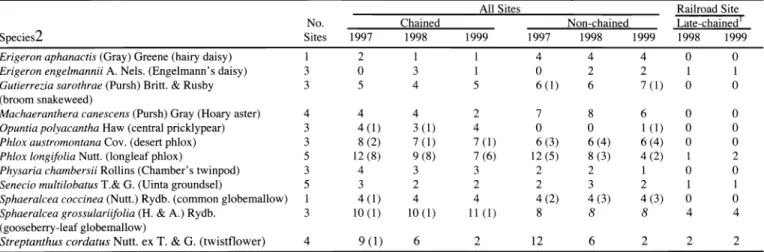
Table 3. Frequency of species by treatment and year in 2 plot sizes at sites burned in the summer of 1996 in west-central Utah. Only species with fre- quency of 4 or greater in any given year across both treatments are shown [See Ott (2001) for additional detail].
All Sites Railroad Site
No. Chained Non-chained
Species2 Sites 1997 1998 1999 1997 1998 1999 1998 1999
Seeded Shrubs and Forbs
Atriplex canescens (Pursh) Nutt. (fourwing saltbush) 43 13 (1)4 13 (1) 13 (1) 4 1 2 0 0
Medicago sativa L. (alfalfa) 4 3 5 2 1 3 6 0 4
Seeded Grasses
Agropyron cristatum (L.) Gaertn. (crested wheatgrass)2 6 23 (18) 23 (18) 23 (20) 20 (7) 20 (8) 21(12) 4 4 (2) Bromus inermis Leysse (smooth brome) 4 15 (8) 15 (7) 15 (8) 11(3) 12 (5) 16 (8) 4 (1) 4 (4) Elymus hispidus (Opiz) Meld. (intermediate wheatgrass) 6 23 (17) 22 (15) 23 (17) 17 (4) 16 (5) 22 (8) 4 (1) 4 (3)
Elymus junceus Fisch. (Russian wildrye) 6 8 22 (8) 19 (4) 6 14 (3) 13 (3) 2 2
Exotic Grasses
Bromus japonicus Thunb. ex Murray (Japanese brome) 5 11 5 (1) 6 (1) 2 6 (1) 3 0 1
Bromus tectorum L. (cheatgrass) 6 23 (16) 23 (20) 24 (20) 24 (17) 24 (22) 24 (24) 4 (4) 4 (4) Native Grasses
Elymus elymoides (Raf.) Swezey (bottlebrush squirreltail) 6 16 (4) 15 (3) 13 (5) 18 (3) 19 (4) 20 (4) 4 (2) 4 (2)
Elymus smithii (Rydb.) Gould (western wheatgrass) 2 4 (1) 4 (2) 4 (2) 2 1 1 0 0
Elymus spicatus (Pursh) Gould (bluebunch wheatgrass) 4 10 (5) 11(5) 10 (4) 13 (9) 14 (8) 13 (9) 0 0 Poa fendleriana (Steudel) Vasey (muttongrass) 5 7 (3) 7 (4) 9 (3) 10 (6) 12 (5) 8 (4) 3 0
Poa secunda Presl (Sandberg bluegrass) 1 4 (2) 4 (2) 4 (1) 4 (4) 4 (1) 3 (1) 0 0
Stipa hymenoides R. & S. (Indian ricegrass) 6 17(3) 16(3) 15(3) 17(4) 18(5) 17(3) 3 3
Exotic Forbs
Alyssum desertorum Stapf (desert alyssum) 6 14 (1) 16 (7) 18 (7) 17 (6) 18 (14) 20 (15) 2 (2) 2 (1)
Camelina microcarpa Andrz. ex DC. (falseflax) 3 4 6 (2) 8 (3) 3 (2) 6 (2) 8 (4) 0 0
Chenopodium album L. (lambsquarter) 4 4 0 0 1 0 0 0 0
Descurainia sophia (L.) Webb ex Prantl (tansymustard) 3 0 0 2 0 3 4 0 0
Erodium cicutarium (L.) L'Her (storksbill) 2 1 2 1 2 3 (2) 3 (2) 0 0
Lactuca serriola L. (prickly lettuce) 6 11(1) 20 (9) 13 (3) 22 (2) 21(13) 24 (12) 1 4 (4)
Malcolmia africana R. Br. in Ait. (African mustard) 3 5 3 0 5 (1) 4 (2) 1(1) 0 0
Ranunculus testiculatus Crantz (bur buttercup) 3 5 (3) 1(1) 2 (1) 9 (7) 2 (1) 4 (3) 0 0
Salsola pestifer A. Nels. (Russian thistle) 5 4 2 2 1 4 (1) 3 (1) 0 0
Sisymbrium altissimum L. (tumblemustard) 5 7 (1) 18 (10) 16 (6) 6 (1) 18 (12) 18 (10) 4 (2) 4 (4)
Tragopogon dubius Scop. (yellow salsify) 6 7 7 8 8 9 (2) 20 (3) 0 3
Native Annual Forbs
Camissonia boothii (Doug'.) Raven (Booth's camissonia) 3 1 1 0 7 (2) 2 0 0 0
Descurainia pinnata (Walter) Britt. (pinnate tanymustard) 6 14 (3) 20 (10) 2 (1) 19 (6) 18 (5) 0 3 (1) 0
Eriogonum deflexum Ton. in Ives (skeleton buckwheat) 5 4 1 0 9 (3) 3 (1) 2 0 0
Eriogonum maculatum Heller (spotted buckwheat) 2 1 0 0 6 0 0 0 0
Gilia giliodes (Benth.) Greene (collomia gilia) 1 1 0 0 3 (3) 0 0 0 0
Gilia inconspicua (J.E. Sm.) Sweet (floccose gilia) 6 19 (9) 11(7) 4 24 (16) 11(6) 7 (1) 1 3
Helianthus annuus L. (common sunflower) 5 12 (1) 5 3 3 3 4 (1) 0 2 (1)
Lappula occidentalis (Wats.) Greene (western stickseed) 3 1 2 0 9 (1) 1 0 0 0
Mentzelia albicaulis (Hook.) T.& G. (whitestem blazingstar) 4 8 0 0 9 (3) 0 0 0 0
Microsteris gracilis (Hook.) Greene (little polecat) 2 2 (1) 0 0 4 (1) 1(1) 0 0 0
Nicotiana attenuata Ton. ex Wats. (coyote tobacco) 5 12 (1) 0 0 14 (1) 3 1 0 0
Phacelia ivesiana Torn in Ives (Ives' phacelia) 4 6 0 0 8 0 0 0 0
Native Perennial Forbs and Shrubs
Arenaria fendleri Gray (Fendler's sandwort) 1 3 (1) 3 (1) 4 (2) 3 (3) 3 (3) 3 (3) 0 0
Argemone munita Dur. & Hilg. (prickly-poppy) 4 4 4 4 6 (1) 6 (1) 5 0 0
Artemisia tridentata Nutt. (big sagebrush) 4 0 0 0 5 2 2 1 0
Astragalus calycosus Torn ex Wats. (Torrey's milkvetch) 4 3 4 3 6 (1) 7 4 (1) 1 0
Astragalus eurekensis Jones (Eureka milkvetch) 4 6 (2) 7 (1) 5 (1) 9 (2) 8 (4) 6 (3) 0 0 Astragalus lentiginosus Dougl. ex Hook (freckled milkvetch) 4 7 6 2 9 (1) 11 4 2 1
Calochortus nuttallii T.& G. in Beckwith (sego lily) 4 16 (1) 11(1) 7 (4) 14 (3) 11(2) 7 (1) 2 0
Caulanthus crassicaulus (Tory.) Wats. (spindlestem) 1 2 2 1 2 (1) 3 (1) 2 0 0
Chaenactis douglasii (Hook.) H. & A. (Douglas' dustymaiden) 6 9 (1) 10 (1) 1 12 (1) 10 (1) 3 1 0
Crepis acuminata Nutt. (mountain hawksbeard) 2 2 1 1 3 2 3 0 0
Crepis occidentalis Nutt. (western hawksbeard) 2 4 (1) 5 (1) 4 (1) 4 (2) 4 (2) 4 (2) 0 0
Cryptantha humilis (Greene) Payson (dwarf cryptanth) 3 2 3 2 4 6 5 0 0
(Continued on page 85)
Table 3. Continued.
All Sites Railroad Site
No. Chained Non-chained
Species2 Sites 1997 1998 1999 1998 1999 1999
1 1 1 0 0
3 1 2 1 1
3 5 4 5 6 (1) 6 7 (1) 0 0
(broom snakeweed)
Machaeranthera canescens (Pursh) Gray (Hoary aster) 4 4 4 2 7 8 6 0 0
Opuntia polyacantha Haw (central pricklypear) 3 4 (1) 3 (1) 4 0 0 1(1) 0 0
Phlox austromontana Coy. (desert phlox) 3 8 (2) 7 (1) 7 (1) 6 (3) 6 (4) 6 (4) 0 0
Phlox longifolia Nutt. (longleaf phlox) 5 12 (8) 9 (8) 7 (6) 12 (5) 8 (3) 4 (2) 1 2
Physaria chambersii Rollins (Chamber's twinpod) 3 4 3 3 2 2 1 0 0
Senecio multilobatus T.& G. (Uinta groundsel) 5 3 2 2 2 3 2 1 1
Sphaeralcea coccinea (Nutt.) Rydb. (common globemallow) 1 4 (1) 4 4 4 (2) 4 (3) 4 (3) 0 0
Sphaeralcea grossulariifolia (H. & A.) Rydb. 3 10(1) 10(1) 11(1) 8 8 8 4 4
(gooseberry-leaf globemallow)
Streptanthus cordatus Nutt. ex T. & G. (twistflower) 4 9 (1) 6 2 12 6 2 2 2
ILate-chained refers to the Railroad site non-chained treatment that was reseeded and chained between 1998 and 1999. Note that the frequency values in these columns are also part of the total frequency values shown in the 1998 and 1999 columns of the non-chained treatment for all sites.
2Scientfic nomenclature follows Welsh et al. (1993). In that treatment, Agropyron desertorum (Link) Schultes is synonymized with A. cristatum and both A. intermedium (Host) Beauv. And A. trichophorum (Link) Richter are treated as Elymus hispidus.
4Number of sites where species was recorded, of 6 sites total.
Value on left is frequency in 100 m2 plots; value in parentheses is frequency in 1 m2 plots, shown if greater than zero. Maximum frequency value is 24 for all sites, 4 for the Railroad site.
Slncludes tall wheatgrass [Elymus elongatus (Host) Runem.] because we could not distinguish it from E. hispidus at the time of data collection.
plot boundaries. Species nomenclature fol- lowed Welsh et al. (1993). We did not attempt to distinguish varieties of seeded species; all varieties of crested and desert wheatgrass were placed together and referred to as crested wheatgrass, and all varieties of intermediate, pubescent, and tall wheatgrass where combined and referred to as intermediate wheatgrass. For the large plots, each species was assigned a cover class, following Daubenmire (1959) with an additional class for less than 1% cover (McArthur and Sanderson 1996). For the small plots, percent cover of each species was estimated to the near- est whole number. We combined individ- ual species into 7 groups of interest, based on growth form, longevity, and origin (Table 3). "Exotic" species, principally cheatgrass, were neither native to the region nor derived from the fire rehabilita- tion seed mixes but were present in the seed bank. Cover values of species in the same group within the same plot were added together to create total cover values for these groups. For the large plots, total cover values were calculated using the midpoints of cover classes. The total num- ber of species (species richness) and the number of native species were tabulated for each large plot, as were total and native species diversity using the Shannon-Wiener Index (Krebs 1999).
Cover was used as a measure of species abundance in diversity calculations.
We compared chained and non-chained treatments using SAS PROC MIXED in a mixed model, first order autoregressive
repeated measures analysis (SAS 1990).
This statistical approach adjusts standard errors so that comparisons can be made across factors (Littell et al. 1996). Large and small plot sizes were analyzed sepa- rately. All combinations of these 2 treat- ments, 6 sites, and 3 years were included in this analysis, except the 1999 Railroad site non-chained treatment (which had lost its non-chained status by 1999, as described above). The variables analyzed were species richness, species diversity, and percent cover of selected species and categories. Percent cover values were transformed by taking the aresine of the square root (Steel and Torrie 1960). Site and the interaction of site with treatment and year were treated as random effects, while treatment, year, and their interaction were treated as fixed effects. Tukey's HSD procedure (Steel and Torrie 1960) was used to test differences among treat- ment, year, and treatment by year means.
We chose the value of P < 0.05 as the level of significant differences.
With site as a random factor in the mixed model, statistical inferences can be made for the larger set of sites from which the sites of this study were drawn.
Differences between sites and their inter- action with treatment and year are incor- porated into the error terms of the mixed model (Littell et al. 1996). Thus site dif- ferences were not analyzed explicitly, although site means were examined visu- ally for each treatment and year.
Results
Species Frequencies, Richness, and Diversity
A total of 117 species were recorded in 48 plots over the course of 3 years, not including unidentified species or species within taxa that were lumped. Groups with the most recorded species were native perennial forbs and shrubs (49 species), native annual forbs (27 species), exotic forbs (mostly annual, 16 species), and native grasses (mostly perennial, 8
species). Species recorded more than 4 times in large plots during the course of the study are shown in Table 3. Species frequencies in both large plots and small plots are shown in Table 3, allowing for visual assessment of species importance and trends at 2 different scales. In the text that follows we use common names; we refer readers to Table 3 for scientific names and authorities.
The most frequently recorded species in 1997 (recorded in 40 or more of 48 large plots) were cheatgrass, crested wheatgrass, intermediate wheatgrass, and floccose gilia (Table 3). Frequency of seeded species was greater with chaining in 1997, but most other species were unaffected by chaining. Annual forbs had higher fre- quency in the non-chained treatment in 1997. Over the 3-year study seeded grass- es increased in frequency in both large and small plots in the non-chained treatment.
Low frequency of Russian wildrye in 1997 reflects our failure to properly identify this
JOURNAL OF RANGE MANAGEMENT 56(1) January 2003 85