J. Range Manage.
55: 242-252 May 2002
White-tailed deer habitats in the central Black Hills
CHRISTOPHER S. DEPERNO, JONATHAN A. JENKS, STEVEN L. GRIFFIN, LESLIE A. RICE, AND KENNETH F. HIGGINS
Authors are Deer Project Leader, Minnesota Department of Natural Resources, Farmland Wildlife Populations and Research Group, Madelia, Minn. 56062;
Professor, Department of Wildlife and Fisheries Sciences, South Dakota State University, Brookings, S.D. 57007; Wildlife Biologist, South Dakota Department of Game, Fish and Parks, 3305 W. South Street, Rapid City, S.D. 57702: Retired Senior Wildlife Biologist, South Dakota Department of Game, Fish and Parks, 3305 W. South Street, Rapid City, S.D. 57702: Professor, South Dakota Cooperative Fish and Wildlife Research Unit, USGS-BRD, South Dakota State University, Brookings, S.D. 57007.
Abstract
White-tailed deer (Odocoileus virginianus dacotensis Zimm.) numbers in the central Black Hills have declined since the middle 1970s. Population status has been documented by a decline in hunter success, deer reproductive success, and fawn survival.
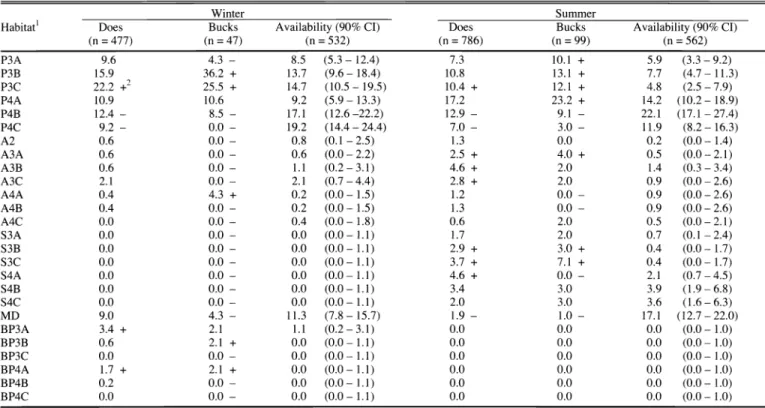
Most management agencies believe habitat deterioration is the primary cause of population decline in the Black Hills. We evalu- ated habitat selection for a white-tailed deer herd in the central Black Hills of South Dakota and Wyoming. From July 1993- July 1996, 73 adult and yearling doe and 12 adult and yearling buck white-tailed deer were radiocollared and visually moni- tored. Habitat information was collected at 4,662 white-tailed deer locations and 1,087 random locations. During winter, white- tailed deer selected ponderosa pine- (Pinus ponderosa P. & C.
Lawson) deciduous and burned pine cover types. Overstory- understory habitats selected included pine/grass-forb, pine/bear- berry (Arctostaphylos uva-ursi (L.) Spreng.), pine/snowberry (Symphoricarpos albus L.), burned pine/grass-forb, and pine/shrub habitats. Structural stages selected included sapling- pole pine stands with > 70% canopy cover, burned pine sapling- pole and saw-timber stands with < 40% canopy cover. During summer, white-tailed deer selected pine-deciduous, aspen (Populus tremuloides Michx.), aspen-coniferous, spruce (Picea glauca (Moench) Voss), and spruce-deciduous cover types.
Overstory-understory habitats selected included pine/juniper (Juniperus communis L.), aspen/shrubs, spruce/juniper, and spruce/shrub habitats. Structural stages selected included pine, aspen, and spruce sapling pole stands with all levels (0-40%, 41-70%, 71-100%) of canopy cover. Results supported low habi- tat quality as a factor involved with the decline of the deer popu- lation. We recommend that habitat management techniques, such as aspen regeneration and prescribed burns, be used to improve the habitat base in the central Black Hills.
This study was supported by Federal Aid to Wildlife Restoration Fund, Project W-75-R through the South Dakota Department of Game, Fish and Parks (Study Numbers 7563 and 7564). D. Flory, J. McCormick, D. Knowlton, S. Clark, B. Bol, D. Beck, and B. A. Hippensteel provided field assistance. We thank L. D. Flake, M. K. Johnson, G. E. Larson, and J. Vandever for their review of this manuscript.
T. Klinkner and J. Giudice provided editorial assistance. We wish to thank the USDA, Forest Service, Pactola and Harney Ranger Districts and all landowners that allowed access to their property throughout this study.
Manuscript accepted 7 Sep. 01.
Resumen
E1 numero de venados cola blanca (Odocoileus virginianus dacotensis Zimm.) del area central de Black Hills ha disminuido desde mediados de la decada de los 70's. El estado de la poblacion ha sido documentado por una reduccion en el exito de la caceria, la reproduccion exitosa del venado y la sobrevivencia de los cervatos. La mayoria de las agencies de manejo creen que el deterioro del habitat es la causa principal de la disminucion de la poblacion en Black Hill. Evaluamos la seleccion de habitat por un hato de venados cola blanca en la region central de Black Hill en South Dakota y Wyoming. De Julio de 1993 a Julio de 1996, a 73 hembras adultas y juveniles y 12 machos adultos y juveniles de venado cola blanca se les coloco un radiotransmisor y se mon- itorearon visualmente. La information del habitat se colecto en 4,662 localidades de venado cola blanca y 1,078 localidades aleatorias. Durante el invierno, el venado cola blanca selecciono los tipos de cobertura de pino ponderosa (Pinus ponderosa P. &
C. Lawson) deciduo y quemados. Los habitats con cobertura superior/inferior seleccionados incluyeron pino/zacate-hierba, pino/ "Bearberry"(Arctostaphylos uva-ursi (L.) Spreng.), pino/
"Snowberry" (Symphoricarpos albus L.), pino quemado/zacate- hierba y pino/arbusto. Las etapas estructurales seleccionados incluyeron poblaciones de plantulas de pino con una cobertura de copa mayor al 70 %, poblaciones de plantulas de pino quema- do y poblaciones de pino aserrado con menos del 40% de cober- tura. Durante el verano, el venado cola blanca selecciono cober- turas del tipo pino-deciduo, alamo (Populus tremuloides Michx.), alamo-coniferas, picea (Picea glauca (Moench) Voss) y picea- deciduo. Los habitats de cobertura alta-baja seleccionados incluyeron habitats de pino/enebro (Juniperus communis L.), alamo/arbustos, picea/enebro y picea/arbustos. Los niveles estructurales seleccionados incluyeron poblaciones de plantulas de pino, alamo y picea con todos los niveles (0-40%, 41-70%, 71-100%) de cobertura de copa. Los resultados apoyan la baja calidad del habitat como un factor involucrado en la disminucion de la poblacion de venados. Recomendamos que tecnicas de manejo del habitat, tales como la regeneracion del alamo y los fuegos prescritos, sean utilizadas para mejorar el habitat base en la region central de Black Hills.
Key Words: aspen regeneration, Black Hills, habitat quality, habitat selection, Odocoileus virginianus dacotensis, prescribed burns, South Dakota, white-tailed deer, Wyoming
242 JOURNAL OF RANGE MANAGEMENT 55(3) May 2002
White-tailed deer (Odocoileuus virgini- antis dacotensis Zimm.) are an important economic resource within the Black Hills of South Dakota and throughout North America. Williamson and Doster (1981) estimated that each white-tailed deer in North America generates about $1,657 per year through consumptive and non-con- sumptive uses. Restaurants, lodges, conve- nience stores, and gas stations receive income from visitors attempting to observe white-tailed deer (Martin and Gum 1978, Wallace et al. 1991 ).
Annually, the Black Hills deer herd gener- ates over $2 million dollars, in addition to license fees (Richardson and Peterson 1974), with each resident hunter spending approximately $372/year (United States Fish and Wildlife Service 1993).
White-tailed deer numbers in the central Black Hills have declined since the middle 1970's (Griffin et al. 1992, Griffin 1994) and DePerno (1998) estimated this popula- tion declined by 10-15% per year from 1993-1996. Population status has been documented by a decline in hunter success (McPhillips and Rice 1991), deer repro- ductive success (Rice 1984, Hauk 1987, McPhillips 1990), and fawn survival (Rice 1979). Additionally, because reproductive and recruitment rates have not increased with herd reductions, it appears that deer carrying capacity in the central Black Hills has declined (DePerno et al. 2000). Griffin et al. (1992) reported that most manage- ment agencies believe the low productivity affecting the central Black Hills deer herd was directly related to long-term habitat deterioration.
We evaluated habitat selection by white- tailed deer in the central Black Hills of South Dakota and Wyoming. Habitats are differentiated by tree size and amount of overstory cover present; characteristics that represent age and structural class of vegetation within forested areas (Smith 1962). Documentation of habitat use by bucks and does during winter and summer is necessary to develop area-specific strategies for maintaining deer popula- tions. For example, in the northern Black Hills, many habitats used by white-tailed deer differ from their relative availability on summer and winter ranges (Kennedy 1992). During winter, Moen (1968, 1976)
concluded that dense pine stands are important to deer; these stands minimize energy expenditures for thermoregulation by reducing windchill and radiant heat loss (Parker and Gillingham 1990). During spring and summer, because condition and
type of cover used for fawning may influ- ence the survival rate of fawns, does seek isolation in areas where hiding cover is abundant (King and Smith 1980, Fox and Krausman 1994). We hypothesized that white-tailed deer in the central Black Hills select habitats on summer range that con- tain abundant forage (stands with low overstory cover and significant shrub bio- mass) and cover (stands with high oversto- ry cover and significant shrub biomass) necessary to enhance reproductive suc- cess, while selecting habitats on winter range that contain abundant forage and cover necessary to reduce thermal stress.
Study Area
The Black Hills is an isolated mountain- ous area in western South Dakota and northeast Wyoming that extends approxi- mately 190 km north to south and 95 km
east to west (Petersen 1984). Elevation of the Black Hills ranges from
973-2,202 m above mean sea level (Orr 1959, Turner 1974).
Annual mean tempera- tures are typical of a con-
tinental climate and range from 5-9° C with extremes of -40-44° C (Thilenius 1972). Mean annual precipitation ranges from 45-66 cm (Orr 1959) and yearly snowfall may exceed 254 cm at higher elevations (Thilenius 1972).
The central Black Hills study area (43° 52' N to 44° 15' N-104° 07' W to 103° 22' W) includes Pennington and Lawrence counties of South Dakota and Crook and Weston counties of Wyoming (Fig. 1). The study area is composed of separate winter and summer ranges used by migratory
white-tailed deer (DePerno 1998, DePerno et al. 2000, Griffin et al.
1995, 1999). In the cen- tral Black Hills, typical autumn migration for white-tailed deer is in a
I