Proceedings of the 55th Annual Meeting of the Association for Computational Linguistics (Short Papers), pages 64–71 Proceedings of the 55th Annual Meeting of the Association for Computational Linguistics (Short Papers), pages 64–71
An Analysis of Action Recognition Datasets for
Language and Vision Tasks
Spandana Gella and Frank Keller
Institute for Language, Cognition and Computation School of Informatics, University of Edinburgh
10 Crichton Street, Edinburgh EH8 9AB [email protected], [email protected]
Abstract
A large amount of recent research has focused on tasks that combine language and vision, resulting in a proliferation of datasets and methods. One such task is action recognition, whose applications include image annotation, scene under-standing and image retrieval. In this survey, we categorize the existing ap-proaches based on how they conceptualize this problem and provide a detailed review of existing datasets, highlighting their di-versity as well as advantages and disad-vantages. We focus on recently devel-oped datasets which link visual informa-tion with linguistic resources and provide a fine-grained syntactic and semantic anal-ysis of actions in images.
1 Introduction
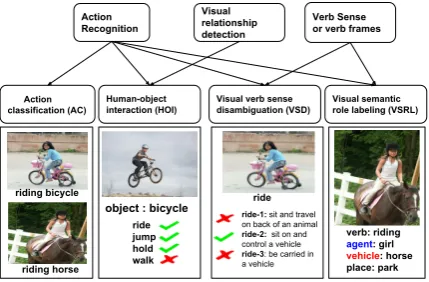
Action recognition is the task of identifying the action being depicted in a video or still image. The task is useful for a range of applications such as generating descriptions, image/video retrieval, surveillance, and human–computer interaction. It has been widely studied in computer vision, of-ten on videos (Nagel,1994;Forsyth et al.,2005), where motion and temporal information provide cues for recognizing actions (Taylor et al.,2010). However, many actions are recognizable from still images, see the examples in Figure1. Due to the absence of motion cues and temporal features (Ik-izler et al.,2008) action recognition from stills is more challenging. Most of the existing work can be categorized into four tasks: (a) action classi-fication (AC); (b) determining human–object in-teraction (HOI); (c) visual verb sense disambigua-tion (VSD); and (d) visual semantic role labeling (VSRL). In Figure 2 we illustrate each of these
[image:1.595.310.519.222.295.2]riding horse running playing guitar jumping Figure 1: Examples of actions in still images
tasks and show how they are related to each other. Until recently, action recognition was studied as action classification on small-scale datasets with a limited number of predefined actions labels (Iki-zler et al.,2008;Gupta et al.,2009;Yao and Fei-Fei, 2010; Everingham et al., 2010; Yao et al., 2011). Often the labels in action classification tasks are verb phrases or a combination of verb and object such asplaying baseball,riding horse. These datasets have helped in building models and understanding which aspects of an image are im-portant for classifying actions, but most methods are not scalable to larger numbers of actions (Ra-manathan et al.,2015). Action classification mod-els are trained on images annotated with mutually exclusive labels, i.e., the assumption is that only a single label is relevant for a given image. This ignores the fact that actions such asholding bicy-cle and riding bicycle can co-occur in the same image. To address these issues and also to under-stand the range of possible interactions between humans and objects, the human–object interaction (HOI) detection task has been proposed, in which all possible interactions between a human and a given object have to be identified (Le et al.,2014; Chao et al.,2015;Lu et al.,2016).
However, both action classification and HOI de-tection do not consider the ambiguity that arises when verbs are used as labels, e.g., the verbplay
has multiple meanings in different contexts. On the other hand, action labels consisting of verb-object pairs can miss important generalizations:
Action Recognition
Action classification (AC)
Visual verb sense disambiguation (VSD)
Visual relationship detection
Human-object interaction (HOI)
Visual semantic role labeling (VSRL)
Verb Sense or verb frames
ride jump hold walk
object : bicycle
riding bicycle
riding horse
verb: riding
agent: girl
vehicle: horse place: park
ride
ride-1: sit and travel on back of an animal
ride-2: sit on and control a vehicle
ride-3: be carried in a vehicle
Figure 2: Categorization of action recognition tasks in images
riding horse and riding elephant both instanti-ate the same verb semantics, i.e., riding animal. Thirdly, existing action labels miss generaliza-tions across verbs, e.g., the fact that fixing bike
andrepairing bikeare semantically equivalent, in spite of the use of different verbs. These observa-tions have led authors to argue that acobserva-tions should be analyzed at the level of verb senses. Gella et al. (2016) propose the new task of visual verb sense disambiguation (VSD), in which a verb– image pair is annotated with a verb sense taken from an existing lexical database (OntoNotes in this case). While VSD handles distinction be-tween different verb senses, it does not identify or localize the objects that participate in the action denoted by the verb. Recent work (Gupta and Ma-lik, 2015;Yatskar et al., 2016) has filled this gap by proposing the task of visual semantic role la-beling (VSRL), in which images are labeled with verb frames, and the objects that fill the semantic roles of the frame are identified in the image.
In this paper, we provide a unified view of ac-tion recogniac-tion tasks, pointing out their strengths and weaknesses. We survey existing literature and provide insights into existing datasets and models for action recognition tasks.
2 Datasets for Action Recognition
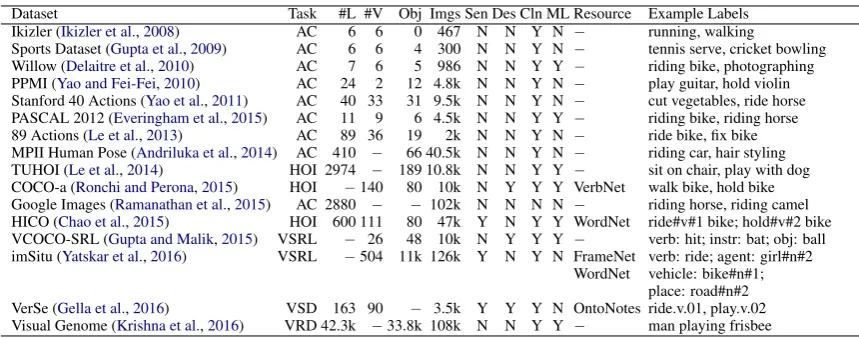
We give an overview of commonly used datasets for action recognition tasks in Table1and group them according to subtask. We observe that the number of verbs covered in these datasets is often smaller than the number of action labels reported (see Table 1, columns #V and #L) and in many cases the action label involves object reference. A few of the first action recognition datasets such as the Ikizler and Willow datasets (Ikizler et al.,
2008;Delaitre et al.,2010) had action labels such as throwing and running; they were taken from the sports domain and exhibited diversity in cam-era view point, background and resolution. Then datasets were created to capture variation in hu-man poses in the sports domain for actions such astennis serveandcricket bowling; typically fea-tures based on poses and body parts were used to build models (Gupta et al.,2009). Further datasets were created based on the intuition that object information helps in modeling action recognition (Li and Fei-Fei,2007;Ikizler-Cinbis and Sclaroff, 2010), which resulted in the use of action labels such asriding horse orriding bike (Everingham et al.,2010;Yao et al.,2011). Not only were most of these datasets domain specific, but the labels were also manually selected and mutually exclu-sive, i.e., two actions cannot co-occur in the same image. Also, most of these datasets do not localize objects or identify their semantic roles.
2.1 Identifying Visual Verbs and Verb Senses
The limitations with early datasets (small scale, domain specificity, and the use of ad-hoc labels that combine verb and object) have been recently addressed in a number of broad-coverage datasets that offer linguistically motivated labels. Of-ten these datasets use existing linguistic resources such as VerbNet (Schuler, 2005), OntoNotes (Hovy et al., 2006) and FrameNet (Baker et al., 1998) to classify verbs and their senses. This al-lows for a more general, semantically motivated treatment of verbs and verb phrases, and also takes into account that not all verbs are depictable. For example, abstract verbs such aspresumingand ac-quiringare not depictable at all, while other verbs have both depictable and non-depictable senses:
[image:2.595.76.291.64.205.2]Dataset Task #L #V Obj Imgs Sen Des Cln ML Resource Example Labels
Ikizler (Ikizler et al.,2008) AC 6 6 0 467 N N Y N − running, walking
Sports Dataset (Gupta et al.,2009) AC 6 6 4 300 N N Y N − tennis serve, cricket bowling
Willow (Delaitre et al.,2010) AC 7 6 5 986 N N Y Y − riding bike, photographing
PPMI (Yao and Fei-Fei,2010) AC 24 2 12 4.8k N N Y N − play guitar, hold violin
Stanford 40 Actions (Yao et al.,2011) AC 40 33 31 9.5k N N Y N − cut vegetables, ride horse
PASCAL 2012 (Everingham et al.,2015) AC 11 9 6 4.5k N N Y Y − riding bike, riding horse
89 Actions (Le et al.,2013) AC 89 36 19 2k N N Y N − ride bike, fix bike
MPII Human Pose (Andriluka et al.,2014) AC 410 − 66 40.5k N N Y N − riding car, hair styling
TUHOI (Le et al.,2014) HOI 2974 − 189 10.8k N N Y Y − sit on chair, play with dog
COCO-a (Ronchi and Perona,2015) HOI −140 80 10k N Y Y Y VerbNet walk bike, hold bike
Google Images (Ramanathan et al.,2015) AC 2880 − − 102k N N N N − riding horse, riding camel
HICO (Chao et al.,2015) HOI 600 111 80 47k Y N Y Y WordNet ride#v#1 bike; hold#v#2 bike
VCOCO-SRL (Gupta and Malik,2015) VSRL − 26 48 10k N Y Y Y − verb: hit; instr: bat; obj: ball
imSitu (Yatskar et al.,2016) VSRL −504 11k 126k Y N Y N FrameNet
WordNet verb: ride; agent: girl#n#2vehicle: bike#n#1; place: road#n#2
VerSe (Gella et al.,2016) VSD 163 90 − 3.5k Y Y Y N OntoNotes ride.v.01, play.v.02
[image:3.595.82.512.60.229.2]Visual Genome (Krishna et al.,2016) VRD 42.3k −33.8k 108k N N Y Y − man playing frisbee
Table 1: Comparison of various existing action recognition datasets. #L denotes number of action labels in the dataset; #V denotes number of verbs covered in the dataset; Obj indicates number of objects annotated; Sen indicates whether sense ambiguity is explicitly handled; Des indicates whether image descriptions are included; Cln indicates whether dataset is manually verified; ML indicates the possibility of multiple labels per image; Resource indicates linguistic resource used to label actions.
2.2 Datasets Beyond Action Classification
Over the last few years tasks that combine lan-guage and vision such as image description and visual question answering have gained much at-tention. This has led to the creation of new, large datasets such as MSCOCO (Chen et al.,2015) and the VQA dataset (Antol et al., 2015). Although these datasets are not created for action recogni-tion, a number of attempts have been made to use the verbs present in image descriptions to annotate actions. The COCO-a, VerSe and VCOCO-SRL datasets all use the MSCOCO image descriptions to annotate fine-grained aspects of interaction and semantic roles.
HICO: The HICO dataset has 47.8k images
an-notated with 600 categories of human-object in-teractions with 111 verbs applying to 80 object categories of MSCOCO. It is annotated to include diverse interactions for objects and has an aver-age of 6.5 distinct interactions per object category. Unlike other HOI datasets such as TUHOI which label interactions as verbs and ignore senses, the HOI categories of HICO are based on WordNet (Miller,1995) verb senses. The HICO dataset also has multiple annotations per object and it incorpo-rates the information that certain interactions such asriding a bikeandholding a bikeoften co-occur. However, it fails to include annotations to distin-guish between multiple senses of a verb.
Visual Genome: The dataset created byKrishna
et al.(2016) has dense annotations of objects,
at-tributes, and relationships between objects. The Visual Genome dataset contains 105k images with 40k unique relationships between objects. Unlike other HOI datasets such as HICO, visual genome relationships also include prepositions, compara-tive and prepositional phrases such as near and
taller than, making the visual relationship task more generic than action recognition. Krishna et al. (2016) combine all the annotations of ob-jects, relationships, and attributes into directed graphs known as scene graphs.
COCO-a: Ronchi and Perona (2015) present
Visual VerbNet (VVN), a list of 140 common vi-sual verbs manually mined from English VerbNet (Schuler, 2005). The coverage of visual verbs in this dataset is not complete, as many visual verbs such asdive, performandshoot are not in-cluded. This also highlights a bias in this dataset as the authors relied on occurrence in MSCOCO as a verification step to consider a verb as vi-sual. They annotated 10k images containing hu-man subjects with one of the 140 visual verbs, for 80 MSCOCO objects. This dataset has better cov-erage of human-object interactions than the HICO dataset despite of missing many visual verbs.
VerSe: Gella et al. (2016) created a dataset of
of a verb. However, the total number of images annotated and number of images for some senses is relatively small, which makes it difficult to use this dataset to train models. The authors further divided their 90 verbs into motion and non-motion verbs according toLevin(1993) verb classes and analyzed visual ambiguity in the task of visual sense disambiguation.
VCOCO-SRL: Gupta and Malik (2015)
anno-tated a dataset of 16k person instances in 10k im-ages with 26 verbs and associated objects in the scene with the semantic roles for each action. The main aim of the dataset is to build models for vi-sual semantic role labeling in images. This task involves identifying the actions depicted in an im-age, along with the people and objects that in-stantiate the semantic roles of the actions. In the VCOCO-SRL dataset, each person instance is an-notated with a mean of 2.8 actions simultaneously.
imSitu: Yatskar et al. (2016) annotated a large
dataset of 125k images with 504 verbs, 1.7k se-mantic roles and 11k objects. They used FrameNet verbs, frames and associated objects or scenes with roles to develop the dataset. They annotate every image with a single verb and the semantic roles of the objects present in the image. VCOCO-SRL the is dataset most similar to imSitu, however VCOCO-SRL includes localization information of agents and all objects and provides multiple action annotations per image. On the other hand, imSitu is the dataset that covers highest number of verbs, while also omitting many commonly studied poly-semous verbs such asplay.
2.3 Diversity in Datasets
With the exception of a few datasets such as COCO-a, VerSe, imSitu all action recognition datasets have manually picked labels or focus on covering actions in specific domains such as sports. Alternatively, many datasets only cover actions relevant to specific object categories such as musical instruments, animals and vehicles. In the real world, people interact with many more objects and perform actions relevant to a wide range of domains such as personal care, house-hold activities, or socializing. This limits the di-versity and coverage of existing action recogni-tion datasets. Recently proposed datasets partly handle this issue by using generic linguistic re-sources to extend the vocabulary of verbs in ac-tion labels. The diversity issue has also been
high-lighted and addressed in recent video action recog-nition datasets (Caba Heilbron et al., 2015; Sig-urdsson et al.,2016), which include generic house-hold activities. An analysis of various image de-scription and question answering datasets by Fer-raro et al.(2015) shows the bias in the distribution of word categories. Image description datasets have a higher distribution of nouns compared to other word categories, indicating that the descrip-tions are object specific, limiting their usefulness for action-based tasks.
3 Relevant Language and Vision Tasks
Template based description generation systems for both videos and images rely on identifying subject–verb–object triples and use language mod-eling to generate or rank descriptions (Yang et al., 2011; Thomason et al., 2014; Bernardi et al., 2016). Understanding actions also plays an impor-tant role in question answering, especially when the question is pertaining to an action depicted in the image. There are some specifically curated question answering datasets which target human activities or relationships between a pair of objects (Yu et al., 2015). Mallya and Lazebnik (2016) have shown that systems trained on action recog-nition datasets could be used to improve the ac-curacy of visual question answering systems that handle questions related to human activity and human–object relationships. Action recognition datasets could be used to learn actions that are vi-sually similar such asinteracting with pandaand
feeding a panda or tickling a baby and calming a baby, which cannot be learned from text alone (Ramanathan et al., 2015). Visual semantic role labeling is a crucial step for grounding actions in the physical world (Yang et al.,2016).
4 Action Recognition Models
2005). These are useful in identifying key points, detecting humans, and scene or background infor-mation in images, respectively. In addition to iden-tifying humans and objects, the relative position or angle between a human and an object is useful in learning human–object interactions (Le et al., 2014). Most of the existing approaches rely on learning supervised classifiers over low-level fea-tures to predict action labels.
More recent approaches are based on end-to-end convolutional neural network architectures which learn visual cues such as objects and im-age features for action recognition (Chao et al., 2015; Zhou et al., 2016; Mallya and Lazebnik, 2016). While most of the action classification models rely solely on visual information, mod-els proposed for human–object interaction or vi-sual relationship detection sometimes combine hu-man and object identification (using visual fea-tures) with linguistic knowledge (Le et al.,2014; Krishna et al.,2016;Lu et al.,2016). Other work on identifying actions, especially methods that fo-cus on relationships that are infrequent or unseen, utilize word vectors learned on large text corpora as an additional source of information (Lu et al., 2016). Similarly,Gella et al.(2016) show that em-beddings generated from textual data associated with images (object labels, image descriptions) is useful for visual verb sense disambiguation, and is complementary to visual information.
5 Discussion
Linguistic resources such as WordNet, OntoNotes, and FrameNet play a key role in textual sense disambiguation and semantic role labeling. The visual action disambiguation and visual semantic role labeling tasks are extensions of their textual counterparts, where context is provided as an im-age instead of as text. Linguistic resources there-fore have to play a key role if we are to make rapid progress in these language and vision tasks. However, as we have shown in this paper, only a few of the existing datasets for action recognition and related tasks are based on linguistic resources (Chao et al.,2015;Gella et al.,2016;Yatskar et al., 2016). This is despite the fact that the WordNet noun hierarchy (for example) has played an impor-tant role in recent progress in object recognition, by virtue of underlying the ImageNet database, the de-facto standard for this task (Russakovsky et al., 2015). The success of ImageNet for objects has
in turn helped NLP tasks such as bilingual lexi-con induction (Vuli´c et al., 2016). In our view, language and vision datasets that are based on the WordNet, OntoNotes, or FrameNet verb sense in-ventories can play a similar role for tasks such as action recognition or visual semantic role labeling, and ultimately be useful also for more distantly re-lated tasks such as language grounding.
Another argument for linking language and vi-sion datasets with linguistic resources is that this enables us to deploy the datasets in a multilingual setting. For example a polysemous verb such as
ride in English has multiple translations in Ger-man and Spanish, depending on the context and the objects involved. Riding a horse is trans-lated as reitenin German and cabalgar in Span-ish, whereas riding a bicycle is translated asfahren
in German andpedalear in Spanish. In contrast, some polysemous verb (e.g., English play) are always translated as the same verb, independent of sense (spielen in German). Such sense map-pings are discoverable from multilingual lexical resources (e.g., BabelNet, Navigli and Ponzetto 2010), which makes it possible to construct lan-guage and vision models that are applicable to multiple languages. This opportunity is lost if lan-guage and vision dataset are constructed in isola-tion, instead of using existing linguistic resources.
6 Conclusions
References
Mykhaylo Andriluka, Leonid Pishchulin, Peter Gehler, and Bernt Schiele. 2014. 2d human pose estimation: New benchmark and state of the art analysis. In Pro-ceedings of the IEEE Conference on Computer Vi-sion and Pattern Recognition. pages 3686–3693.
Stanislaw Antol, Aishwarya Agrawal, Jiasen Lu, Mar-garet Mitchell, Dhruv Batra, C. Lawrence Zitnick, and Devi Parikh. 2015. VQA: visual question an-swering. In2015 IEEE International Conference on Computer Vision, ICCV 2015, Santiago, Chile, De-cember 7-13, 2015. pages 2425–2433.
Collin F Baker, Charles J Fillmore, and John B Lowe. 1998. The berkeley framenet project. In Proceed-ings of the 36th Annual Meeting of the Associa-tion for ComputaAssocia-tional Linguistics and 17th Inter-national Conference on Computational Linguistics-Volume 1. Association for Computational Linguis-tics, pages 86–90.
Raffaella Bernardi, Ruket Cakici, Desmond Elliott, Aykut Erdem, Erkut Erdem, Nazli Ikizler-Cinbis, Frank Keller, Adrian Muscat, and Barbara Plank. 2016. Automatic description generation from im-ages: A survey of models, datasets, and evaluation measures. Journal of Artifical Intelligence Research
55:409–442.
Fabian Caba Heilbron, Victor Escorcia, Bernard Ghanem, and Juan Carlos Niebles. 2015. Activ-itynet: A large-scale video benchmark for human activity understanding. InProceedings of the IEEE Conference on Computer Vision and Pattern Recog-nition. pages 961–970.
Yu-Wei Chao, Zhan Wang, Yugeng He, Jiaxuan Wang, and Jia Deng. 2015. HICO: A benchmark for recog-nizing human-object interactions in images. In2015 IEEE International Conference on Computer Vision, ICCV 2015, Santiago, Chile, December 7-13, 2015. pages 1017–1025.
Xinlei Chen, Hao Fang, Tsung-Yi Lin, Ramakr-ishna Vedantam, Saurabh Gupta, Piotr Doll´ar, and C. Lawrence Zitnick. 2015. Microsoft COCO cap-tions: Data collection and evaluation server. CoRR
abs/1504.00325.
Navneet Dalal and Bill Triggs. 2005. Histograms of oriented gradients for human detection. In Com-puter Vision and Pattern Recognition, 2005. CVPR 2005. IEEE Computer Society Conference on. IEEE, volume 1, pages 886–893.
Vincent Delaitre, Ivan Laptev, and Josef Sivic. 2010. Recognizing human actions in still images: a study of bag-of-features and part-based representations. InBMVC 2010-21st British Machine Vision Confer-ence.
Mark Everingham, S. M. Ali Eslami, Luc Van Gool, Christopher K. I. Williams, John M. Winn, and An-drew Zisserman. 2015. The Pascal visual object
classes challenge: A retrospective. International Journal of Computer Vision111(1):98–136.
Mark Everingham, Luc J. Van Gool, Christopher K. I. Williams, John M. Winn, and Andrew Zisserman. 2010. The Pascal visual object classes (VOC) chal-lenge. International Journal of Computer Vision
88(2):303–338.
Francis Ferraro, Nasrin Mostafazadeh, Ting-Hao (Ken-neth) Huang, Lucy Vanderwende, Jacob Devlin, Michel Galley, and Margaret Mitchell. 2015. A sur-vey of current datasets for vision and language re-search. InProceedings of the 2015 Conference on Empirical Methods in Natural Language Process-ing, EMNLP 2015, Lisbon, Portugal, September 17-21, 2015. pages 207–213.
David A. Forsyth, Okan Arikan, Leslie Ikemoto, James F. O’Brien, and Deva Ramanan. 2005. Com-putational studies of human motion: Part 1, tracking and motion synthesis. Foundations and Trends in Computer Graphics and Vision1(2/3).
Spandana Gella, Mirella Lapata, and Frank Keller. 2016. Unsupervised visual sense disambiguation for verbs using multimodal embeddings. In Pro-ceedings of the 2016 Conference on North American Chapter of the Association for Computational Lin-guistics: Human Language Technologies, San Diego California, USA, June 12-17, 2016. pages 182–192.
Abhinav Gupta, Aniruddha Kembhavi, and Larry S. Davis. 2009. Observing human-object interactions: Using spatial and functional compatibility for recog-nition. IEEE Transactions on Pattern Analysis and Machine Intelligence31(10):1775–1789.
Saurabh Gupta and Jitendra Malik. 2015. Visual se-mantic role labeling. CoRRabs/1505.04474.
Eduard H. Hovy, Mitchell P. Marcus, Martha Palmer, Lance A. Ramshaw, and Ralph M. Weischedel. 2006. Ontonotes: The 90% solution. In Hu-man Language Technology Conference of the North American Chapter of the Association of Compu-tational Linguistics, Proceedings, June 4-9, 2006, New York, New York, USA. pages 57–60.
Nazli Ikizler, Ramazan Gokberk Cinbis, Selen Pehli-van, and Pinar Duygulu. 2008. Recognizing actions from still images. In19th International Conference on Pattern Recognition (ICPR 2008), December 8-11, 2008, Tampa, Florida, USA. pages 1–4.
Nazli Ikizler-Cinbis and Stan Sclaroff. 2010. Object, scene and actions: Combining multiple features for human action recognition. InEuropean conference on computer vision. Springer, pages 494–507. Ranjay Krishna, Yuke Zhu, Oliver Groth, Justin
John-son, Kenji Hata, Joshua Kravitz, Stephanie Chen, Yannis Kalantidis, Li-Jia Li, David A Shamma, et al. 2016. Visual genome: Connecting language and vi-sion using crowdsourced dense image annotations.
Dieu Thu Le, Raffaella Bernardi, and Jasper Uijlings. 2013. Exploiting language models to recognize un-seen actions. In Proceedings of the 3rd ACM con-ference on International concon-ference on multimedia retrieval. ACM, pages 231–238.
Dieu-Thu Le, Jasper Uijlings, and Raffaella Bernardi. 2014. Proceedings of the Third Workshop on Vi-sion and Language, Dublin City University and the Association for Computational Linguistics, chapter TUHOI: Trento Universal Human Object Interaction Dataset, pages 17–24.
Beth Levin. 1993. English verb classes and alterna-tions: A preliminary investigation. University of Chicago Press.
Li-Jia Li and Li Fei-Fei. 2007. What, where and who? classifying events by scene and object recognition. In Computer Vision, 2007. ICCV 2007. IEEE 11th International Conference on. IEEE, pages 1–8.
David G Lowe. 1999. Object recognition from local scale-invariant features. InComputer vision, 1999. The proceedings of the seventh IEEE international conference on. Ieee, volume 2, pages 1150–1157.
Cewu Lu, Ranjay Krishna, Michael Bernstein, and Li Fei-Fei. 2016. Visual relationship detection with language priors. InEuropean Conference on Com-puter Vision. Springer, pages 852–869.
Arun Mallya and Svetlana Lazebnik. 2016. Learn-ing models for actions and person-object interac-tions with transfer to question answering. In Eu-ropean Conference on Computer Vision. Springer, pages 414–428.
George A Miller. 1995. Wordnet: a lexical database for english. Communications of the ACM 38(11):39– 41.
Hans-Hellmut Nagel. 1994. A vision of ”vision and language” comprises action: An example from road traffic. Artif. Intell. Rev.8(2-3):189–214.
Roberto Navigli and Simone Paolo Ponzetto. 2010. Babelnet: Building a very large multilingual seman-tic network. InACL 2010, Proceedings of the 48th Annual Meeting of the Association for Computa-tional Linguistics, July 11-16, 2010, Uppsala, Swe-den. pages 216–225.
Vignesh Ramanathan, Congcong Li, Jia Deng, Wei Han, Zhen Li, Kunlong Gu, Yang Song, Samy Bengio, Chuck Rossenberg, and Li Fei-Fei. 2015. Learning semantic relationships for better action re-trieval in images. InProceedings of the IEEE Con-ference on Computer Vision and Pattern Recogni-tion. pages 1100–1109.
Matteo Ruggero Ronchi and Pietro Perona. 2015. De-scribing common human visual actions in images. In Proceedings of the British Machine Vision Con-ference (BMVC 2015). BMVA Press, pages 52.1– 52.12.
Olga Russakovsky, Jia Deng, Hao Su, Jonathan Krause, Sanjeev Satheesh, Sean Ma, Zhiheng Huang, An-drej Karpathy, Aditya Khosla, Michael S. Bernstein, Alexander C. Berg, and Fei-Fei Li. 2015. Imagenet large scale visual recognition challenge. Interna-tional Journal of Computer Vision115(3):211–252.
Karin Kipper Schuler. 2005. VerbNet: A broad-coverage, comprehensive verb lexicon. Ph.D. thesis, University of Pennsylvania.
Gunnar A Sigurdsson, G¨ul Varol, Xiaolong Wang, Ali Farhadi, Ivan Laptev, and Abhinav Gupta. 2016. Hollywood in homes: Crowdsourcing data collec-tion for activity understanding. InEuropean Confer-ence on Computer Vision. Springer, pages 510–526.
Graham W Taylor, Rob Fergus, Yann LeCun, and Christoph Bregler. 2010. Convolutional learning of spatio-temporal features. In European conference on computer vision. Springer, pages 140–153.
Jesse Thomason, Subhashini Venugopalan, Sergio Guadarrama, Kate Saenko, and Raymond J. Mooney. 2014. Integrating language and vision to generate natural language descriptions of videos in the wild. InCOLING 2014, 25th International Con-ference on Computational Linguistics,Proceedings of the Conference: Technical Papers, August 23-29, 2014, Dublin, Ireland. pages 1218–1227.
Ivan Vuli´c, Douwe Kiela, Stephen Clark, and Marie-Francine Moens. 2016. Multi-modal representations for improved bilingual lexicon learning. In Pro-ceedings of the 54th Annual Meeting of the Asso-ciation for Computational Linguistics. ACL, pages 188–194.
Shaohua Yang, Qiaozi Gao, Changsong Liu, Caiming Xiong, Song-Chun Zhu, and Joyce Y. Chai. 2016. Grounded semantic role labeling. In NAACL HLT 2016, The 2016 Conference of the North American Chapter of the Association for Computational Lin-guistics: Human Language Technologies, San Diego California, USA, June 12-17, 2016. pages 149–159.
Yezhou Yang, Ching Lik Teo, Hal Daum´e III, and Yian-nis Aloimonos. 2011. Corpus-guided sentence gen-eration of natural images. In Proceedings of the Conference on Empirical Methods in Natural Lan-guage Processing. Association for Computational Linguistics, pages 444–454.
Bangpeng Yao and Li Fei-Fei. 2010. Grouplet: A structured image representation for recognizing hu-man and object interactions. In Computer Vision and Pattern Recognition (CVPR), 2010 IEEE Con-ference on. IEEE, pages 9–16.
Mark Yatskar, Luke Zettlemoyer, and Ali Farhadi. 2016. Situation recognition: Visual semantic role labeling for image understanding. In 2016 IEEE Conference on Computer Vision and Pattern Recog-nition, CVPR 2016, Las Vegas, NV, USA, June 26-July 1, 2016.
Licheng Yu, Eunbyung Park, Alexander C. Berg, and Tamara L. Berg. 2015. Visual madlibs: Fill in the blank description generation and question answer-ing. In 2015 IEEE International Conference on Computer Vision, ICCV 2015, Santiago, Chile, De-cember 7-13, 2015. pages 2461–2469.