Proceedings of the 55th Annual Meeting of the Association for Computational Linguistics, pages 1810–1820 Vancouver, Canada, July 30 - August 4, 2017. c2017 Association for Computational Linguistics Proceedings of the 55th Annual Meeting of the Association for Computational Linguistics, pages 1810–1820
Vancouver, Canada, July 30 - August 4, 2017. c2017 Association for Computational Linguistics
Jointly Extracting Relations with Class Ties
via Effective Deep Ranking
Hai Ye1, Wenhan Chao1, Zhunchen Luo2∗, Zhoujun Li1
1School of Computer Science and Engineering, Beihang University, Beijing 100191, China
{yehai, chaowenhan, lizj}@buaa.edu.cn
2China Defense Science and Technology Information Center, Beijing 100142, China [email protected]
Abstract
Connections between relations in relation extraction, which we call class ties, are common. In distantly supervised scenario, one entity tuple may have multiple relation facts. Exploiting class ties between rela-tions of one entity tuple will be promising for distantly supervised relation extrac-tion. However, previous models are not ef-fective or ignore to model this property. In this work, to effectively leverage class ties, we propose to make joint relation extrac-tion with a unified model that integrates convolutional neural network (CNN) with a general pairwise ranking framework, in which three novel ranking loss functions are introduced. Additionally, an effective method is presented to relieve the severe class imbalance problem from NR (not re-lation) for model training. Experiments on a widely used dataset show that leverag-ing class ties will enhance extraction and demonstrate the effectiveness of our model to learn class ties. Our model outperforms the baselines significantly, achieving state-of-the-art performance.
1 Introduction
Relation extraction (RE) aims to classify the relations between two given named entities from natural-language text. Supervised machine learn-ing methods require numerous labeled data to work well. With the rapid growth of volume of relation types, traditional methods can not keep up with the step for the limitation of labeled data. In order to narrow down the gap of data spar-sity, Mintz et al. (2009) propose distant
supervi-sion (DS)for relation extraction, which
automati-∗Corresponding author.
place lived (Patsy Ramsey, Atlanta) place of birth (Patsy Ramsey, Atlanta)
Sentence Latent Label
#1 Patsy Ramseyhas been living in
Atlantasince she was born. place of birth
#2 Patsy Ramsyalways loves
[image:1.595.311.521.237.295.2]At-lantasince it is her hometown. place lived Table 1: Training instances generated by freebase.
cally generates training data by aligning a knowl-edge facts database (ie. Freebase (Bollacker et al.,
2008)) with texts.
Class ties mean the connections between
rela-tions in relation extraction. In general, we con-clude that class ties can have two types: weak class ties and strong class ties. Weak class ties mainly involve the co-occurrence of relations such
as place of birth and place lived, CEO of and
founder of. On the contrary, strong class ties
mean that relations have latent logical entailments. Take the two relations of capital of and city of
for example, if one entity tuple has the rela-tion of capital of, it must express the relation fact ofcity of, because the two relations have the entailment of capital of ⇒ city of. Obviously the opposite induction is not correct. Further take the sentence of “Jonbenet told me that her
mother [Patsy Ramsey]e1 never left [Atlanta]e2
since she was born.” in DS scenario for
exam-ple. This sentence expresses two relation facts which are place of birth and place lived. How-ever, the word “born” is a strong bios to extract
place of birth, so it may not be easy to predict the
relation of place lived, but if we can incorporate the weak ties between the two relations, extracting
place of birthwill provide evidence for prediction
ofplace lived.
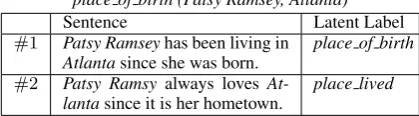
Exploiting class ties is necessary for DS based relation extraction. In DS scenario, there is a chal-lenge that one entity tuple can have multiple
tion facts as shown in Table1, which is called
rela-tion overlapping(Hoffmann et al.,2011;Surdeanu
et al.,2012). However, the relations of one entity tuple can have class ties mentioned above which can be leveraged to enhance relation extraction for it narrowing down potential searching spaces and reducing uncertainties between relations when predicting unknown relations. If one pair entities
hasCEO of, it will contain founder of with high
possibility.
To exploit class ties between relations, we pro-pose to make joint extraction for all positive labels of one entity tuple with consideringpairwise con-nections between positive and negative labels in-spired by (F¨urnkranz et al.,2008;Zhang and Zhou,
2006). As the two relations with class ties shown in Table1, by joint extraction of two relations, we can maintain theclass ties(co-occurrence) of them from training samples to be learned by potential model, and then leverage this learned information to extract instances with unknown relations, which can not be achieved by separated extraction for it dividing labels apart losing information of co-occurrence. To classify positive labels from nega-tive ones, we adopt pairwise ranking to rank pos-itive ones higher than negative ones, exploiting pairwise connections between them. In a word, joint extraction exploits class ties between rela-tions and pairwise ranking classify positive labels from negative ones. Furthermore, combining in-formation across sentences will be more appropri-ate for joint extraction which provides more infor-mation from other sentences to extract each rela-tion (Zheng et al.,2016;Lin et al.,2016). In Table
1, sentence #1 is the evidence for place of birth, but it also expresses the meaning of “living in someplace”, so it can be aggregated with sentence #2 to extractplace lived. Meanwhile, the word of “hometown” in sentence #2 can provide evidence
forplace of birthwhich should be combined with
sentence #1 to extractplace of birth.
In this work, we propose a unified model that integrates pairwise ranking with CNN to exploit class ties. Inspired by the effectiveness of deep learning for modeling sentences (LeCun et al.,
2015), we use CNN to encode sentences. Simi-lar to (Santos et al., 2015; Lin et al., 2016), we use class embeddings to represent relation classes. The whole model architecture is presented in Fig-ure1. We first use CNN to embed sentences, then we introduce two variant methods to combine the
x2
x1 xn
s1 s2 sn
s
c1 c2 cm
𝑊[#$]& 𝑠
class embedding
encoded by CNN sentence embedding bag representation
vector combine
[image:2.595.318.506.65.218.2]sentences
Figure 1: The main architecture of our model.
embedded sentences into one bag representation vector aiming to aggregate information across sen-tences, after that we measure the similarity be-tween bag representation and relation class in real-valued space. With two variants for combining sentences, three novel pairwise ranking loss func-tions are proposed to make joint extraction. Be-sides, to relieve the bad impact of class imbalance from NR (not relation) (Japkowicz and Stephen,
2002) for training our model, we cut down loss propagation from NR class during training.
Our experimental results on dataset of Riedel et al. (2010) are evident that: (1) Our model is much more effective than the baselines; (2) Lever-aging class ties will enhance relation extraction and our model is efficient to learn class ties by joint extraction; (3) A much better model can be trained after relieving class imbalance from NR.
Our contributions in this paper can be encapsu-lated as follows:
• We propose to leverage class ties to enhance
relation extraction. An effective deep ranking model which integrates CNN and pairwise rank-ing framework is introduced to exploit class ties.
• We propose an effective method to relieve
the impact of data imbalance from NR for model training.
• Our method achieves state-of-the-art
perfor-mance.
2 Related Work
We summarize related works on two main as-pects:
2.1 Distant Supervision Relation Extraction
rela-tions.
Riedel et al. (2010) introduce multi-instance learning to relieve the wrong labelling problem, ignoring class ties. Afterwards, Hoffmann et al.
(2011) andSurdeanu et al.(2012) model this prob-lem by multi-instance multi-label learning to ex-tract overlapping relations. Though they also pro-pose to make joint extraction of relations, they only use information from single sentence losing information from other sentences. Han and Sun
(2016) try to use Markov logic model to capture consistency between relation labels, on the con-trary, our model leverages deep ranking to learn class ties automatically.
With the remarkable success of deep learning in CV and NLP (LeCun et al.,2015), deep learning has been applied to relation extraction (Zeng et al.,
2014,2015;Santos et al.,2015;Lin et al.,2016), the specific deep learning architecture can be CNN (Zeng et al.,2014), RNN (Zhou et al.,2016), etc.
Zeng et al. (2015) propose a piecewise convolu-tional neural network with multi-instance learning for DS based relation extraction, which improves the precision and recall significantly. Afterwards,
Lin et al. (2016) introduce the mechanism of at-tention (Luong et al.,2015;Bahdanau et al.,2014) to select the sentences to relieve the wrong la-belling problem and use all the information across sentences. However, the two deep learning based models only make separated extraction thus can not model class ties between relations.
2.2 Deep Learning to Rank
Deep learning to rank has been widely used in many problems to serve as a classification model. In image retrieval, Zhao et al. (2015) apply deep semantic ranking for multi-label image retrieval. In text matching, Severyn and Moschitti (2015) adopt learning to rank combined with deep CNN for short text pairs matching. In traditional super-vised relation extraction,Santos et al. (2015) de-sign a pairwise loss function based on CNN for single label relation extraction. Based on the ad-vantage of deep learning to rank, we propose pair-wise learning to rank (LTR) (Liu,2009) combined with CNN in our model aiming to jointly extract multiple relations.
3 Proposed Model
In this section, we first conclude the notations used in this paper, then we introduce the used
CNN for sentence embedding, afterwards, we present our algorithm of how to learn class ties be-tween relations of one entity tuple.
3.1 Notation
We define the relation classes as L =
{1,2,· · · , C}, entity tuples as T = {ti}Mi=1 and
mentions1asX ={x
i}Ni=1. Dataset is constructed
as follows: for entity tuple ti ∈ T and its rela-tion class set Li ⊆ L, we collect all the men-tionsXi that containti, the dataset we use isD=
{(ti, Li, Xi)}iH=1. Given a data (tk, Lk, Xk) ∈
{(ti, Li, Xi)}Hi=1, the sentence embeddings ofXk encoded by CNN are defined asSk={si}|iX=1k|and we use class embeddingsW ∈R|L|×dto represent
the relation classes.
3.2 CNN for Sentence Embedding
We take the effective CNN architecture adopted from (Zeng et al.,2015;Lin et al.,2016) to encode sentence and we briefly introduce CNN in this sec-tion. More details of our CNN can be obtained from previous work.
3.2.1 Words Representations
• Word Embedding Given a word embedding
matrix V ∈ Rlw×d1
where lw is the size of word dictionary and d1 is the dimension of
word embedding, the words of a mention x =
{w1, w2,· · · , wn} will be represented by real-valued vectors fromV.
• Position Embedding The position embedding
of a word measures the distance from the word to entities in a mention. We add position em-beddings into words representations by append-ing position embeddappend-ing to word embeddappend-ing for every word. Given a position embedding matrix
P ∈ Rlp×d2 where lp is the number of distances
andd2 is the dimension of position embeddings,
the dimension of words representations becomes
dw =d1+d2×2.
3.2.2 Convolution, Piecewise max-pooling
After transforming words in x to real-valued
vectors, we get the sentenceq ∈ Rn×dw
. The set of kernelsK is{Ki}d
s
i=1 whereds is the number
of kernels. Define the window size as dwin and
given one kernelKk∈Rd
win×dw
, the convolution operation is defined as follows:
m[i]=q[i:i+dwin−1]Kk+b[k] (1)
where m is the vector after conducting convolu-tion alongq forn−dwin+ 1times andb∈ Rds
is the bias vector. For these vectors whose indexes out of range of [1, n], we replace them with zero vectors.
By piecewise max-pooling, when pooling, the sentence is divided into three parts: m[p0:p1], m[p1:p2]andm[p2:p3](p1andp2are the positions of
entities, p0 is the beginning of sentence andp3 is
the end of sentence). This piecewise max-pooling is defined as follows:
z[j]=max(m[pj−1:pj]) (2)
wherez∈R3is the result of mentionxprocessed
by kernelKk;1≤j≤3. Given the set of kernels
K, following the above steps, the mention x can
be embedded toowhereo∈Rds∗3
.
3.2.3 Non-Linear Layer, Regularization
To learn high-level features of mentions, we ap-ply a non-linear layer after pooling layer. After that, a dropout layer is applied to prevent over-fitting. We define the final fixed sentence repre-sentation ass∈Rdf
(df =ds∗3).
s=g(o)◦h (3)
where g(·) is a non-linear function and we use tanh(·)in this paper;his a Bernoulli random
vec-tor with probability p to be1.
3.3 Learning Class Ties by Joint Extraction with Pairwise Ranking
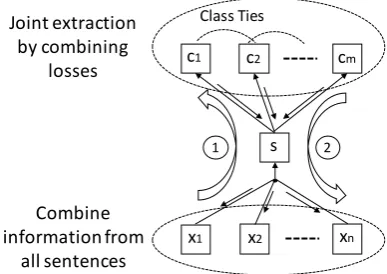
As mentioned above, to learn class ties, we propose to make joint extraction with consider-ing pairwise connections between positive labels and negative ones. Pairwise ranking is applied to achieve this goal. Besides, combining informa-tion across sentences is necessary for joint extrac-tion. More specifically, as shown in Figure2, from down to top, all information from sentences is pre-propagated to provide enough information for joint extraction. From top to down, pairwise rank-ing jointly extractrank-ing positive relations by combin-ing losses, which are back-propagated to CNN to learn class ties.
3.3.1 Combining Information across Sentences
We propose two options to combine sentences to provide enough information for joint extraction.
1 2
x1 x2 xn
c1 c2 cm
s
Class Ties
Combine information from
all sentences Joint extraction
[image:4.595.317.511.68.205.2]by combining losses
Figure 2: Illustration of mechanism of our model to model class ties between relations.
•AVE The first option is average method. This
method regards all the sentences equally and di-rectly average the values in all dimensions of sen-tence embedding. ThisAVEfunction is defined as follows:
s= 1
n
X
si∈Sk
si (4)
where nis the number of sentences and s is the
representation vector combining all sentence em-beddings. Because it weights the importance of sentences equally, this method may bring much noise data from two aspects: (1) the wrong la-belling data; (2) irrelated mentions for one relation class, for all sentences containing the same entity tuple being combined together to construct the bag representation.
•ATT The second one is a sentence-level atten-tion algorithm used by Lin et al. (2016) to mea-sure the importance of sentences aiming to relieve the wrong labelling problem. For every sentence,
ATTwill calculate a weight by comparing the sen-tence to one relation. We first calculate the similar-ity between one sentence embedding and relation class as follows:
ej =a·W[c]·sj (5)
where ej is the similarity between sentence em-beddingsjand relation classcand a is a bias fac-tor. In this paper, we setaas0.5. Then we apply Softmaxto rescalee(e={ei}i|X=1k|) to[0,1]. We
get the weightαj forsjas follows:
αj =
exp(ej)
P
ei∈eexp(ei)
(6)
s=
|Xk|
X
i=1
αi·si (7)
3.3.2 Joint Extraction by Combining Losses to Learn Class Ties
Firstly, we have to present the score function to measure the similarity betweensand relationc.
•Score Function We use dot function to produce
score forsto be predicted as relationc. The score function is as follows:
F(s, c) =W[c]·s (8)
There are other options for score function. In
Wang et al. (2016), they propose a margin based loss function that measures the similarity between
sandW[c]by distance. Because score function is
not an important issue in our model, we adopt dot function, also used bySantos et al.(2015) andLin et al.(2016), as our score function.
Now we start to introduce the ranking loss func-tion.
Pairwise ranking aims to learn the score func-tionF(s, c)that ranks positive classes higher than
negative ones. This goal can be summarized as follows:
∀c+∈Lk,∀c−∈ L−Lk:F(s, c+)>F(s, c−)+β (9) whereβis a margin factor which controls the
min-imum margin between the positive scores and neg-ative scores.
To learn class ties between relations, we extend the formula (9) to make joint extraction and we propose three ranking loss functions with variants of combining sentences. Followings are the pro-posed loss functions:
•with AVE (Variant-1) We define the
margin-based loss function with option ofAVEto aggre-gate sentences as follows:
G[ave]= X
c+∈Lk
ρ[0, σ+− F(s, c+)]+
+ρ|Lk|[0, σ−+F(s, c−)]+ (10)
where[0,·]+ = max(0,·); ρis the rescale
fac-tor,σ+is positive margin andσ−is negative
mar-gin. Similar toSantos et al.(2015) andWang et al.
(2016), this loss function is designed to rank pos-itive classes higher than negative ones controlled by the margin of σ+−σ−. In reality, F(s, c+)
will be higher thanσ+andF(s, c−)will be lower
thanσ−. In our work, we setρas2,σ+as2.5and
σ−as0.5adopted fromSantos et al.(2015).
Similar toWeston et al.(2011) andSantos et al.
(2015), we update one negative class at every training round but to balance the loss between positive classes and negative ones, we multiply
|Lk|before the right term in function (10) to ex-pand the negative loss. We apply mini-bach based stochastic gradient descent (SGD) to minimize the loss function. The negative class is chosen as the one with highest score among all negative classes (Santos et al.,2015), i.e.:
c−= argmax
c∈L−Lk
F(s, c) (11)
•with ATT (Variant-2) Now we define the loss
function for the option of ATT to combine sen-tences as follows:
G[att]= X
c+∈Lk
(ρ[0, σ+− F(sc+, c+)]+
+ρ[0, σ−+F(sc+, c−)]+) (12)
wherescmeans the attention weights of
represen-tationsare merged by comparing sentence
embed-dings with relation classcandc−is chosen by the following function:
c−= argmax
c∈L−Lk
F(sc+, c) (13)
which means we update one negative class in ev-ery training round. We keep the values ofρ, σ+
andσ−same as values in function (10).
According to this loss function, we can see that: for each classc+ ∈ Lk, it will capture the most related information from sentences to merge
sc+, then rankF(sc+, c+)higher than all negative
scores which each isF(sc+, c−)(c− ∈ L −Lk). We use the same update algorithm to minimize this loss.
•Extended with ATT (Variant-3) According to
function (12), for eachc+, we only select one
neg-ative class to update the parameters, which only considers the connections between positive classes and negative ones, ignoring connections between positive classes, so we extend function (12) to bet-ter exploit class ties by considering the connec-tions between positive classes. We give out the extended loss function as follows:
G[Exatt]= X
c∗∈Lk
( X
c+∈L
k
ρ[0, σ+− F(sc∗, c+)]+
Pro. Training Test SemE. 17.63% 16.71%
[image:6.595.307.529.63.301.2]Riedel 72.52% 96.26%
Table 2: The proportions of NR samples from SemEval-2010 Task 8 dataset and Riedel dataset.
Similar to function (13), we selectc−as follows:
c−= argmax
c∈L−Lk
F(sc∗, c) (15)
and we use the same method to update this loss function as discussed above. From the function (14), we can see that: forc∗ ∈ Lk, after merging the bag representationswithc∗, we shareswith
all the other positive classes and update the class embeddings of other positive classes withs, in this
way, the connections between positive classes can be captured and learned by our model.
In loss function (10), (12) and (14), we com-bine losses from all positive labels to make joint extraction to capture the class ties among rela-tions. Suppose we make separated extraction, the losses from positive labels will be divided apart and will not get enough information of connec-tions between positive labels, comparing to joint extraction. Connections between positive labels and negative ones are exploited by controlling margins:σ+andσ−.
3.4 Relieving Impact of NR
In relation extraction, the dataset will always contain certain negative samples which do not ex-press relations classified as NR (not relation). Ta-ble 2 presents the proportion of NR samples in SemEval-2010 Task 8 dataset2 (Erk and
Strappa-rava,2010) and dataset fromRiedel et al.(2010), which shows almost data is about NR in the latter dataset. Data imbalance will severely affect the model training and cause the model only sensitive to classes with high proportion (He and Garcia,
2009).
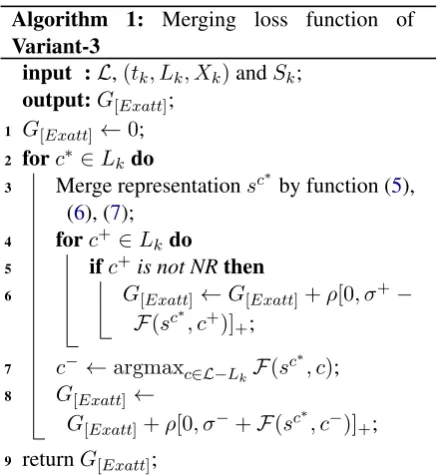
In order to relieve the impact of NR in DS based relation extraction, we cut the propagation of loss from NR, which means if relationcis NR, we set
its loss as0. Our method is similar toSantos et al.
(2015) with slight variance. Santos et al. (2015) directly omit the NR class embedding, but we keep it. If we use ATT method to combine informa-tion across sentences, we can not omit NR class 2This is a dataset for relation extraction in traditional su-pervision framework.
Algorithm 1: Merging loss function of
Variant-3
input :L,(tk, Lk, Xk)andSk;
output:G[Exatt]; 1 G[Exatt]←0;
2 forc∗ ∈Lkdo
3 Merge representationsc∗by function (5),
(6), (7);
4 forc+∈Lkdo
5 ifc+is not NRthen
6 G[Exatt]←G[Exatt]+ρ[0, σ+−
F(sc∗, c+)] +;
7 c−←argmaxc∈L−LkF(sc∗, c); 8 G[Exatt]←
G[Exatt]+ρ[0, σ−+F(sc∗, c−)]+;
9 returnG[Exatt];
embedding according to function (6) and (7), on the contrary, it will be updated from the negative classes’ loss.
In Algorithm 1, we give out the pseudocodes of merging loss withVariant-3and considering to relieve the impact of NR.
4 Experiments
4.1 Dataset and Evaluation Criteria
We conduct our experiments on a widely used dataset, developed byRiedel et al.(2010) and has been used by Hoffmann et al. (2011), Surdeanu et al. (2012), Zeng et al. (2015) and Lin et al.
(2016). The dataset aligns Freebase relation facts with the New York Times corpus, in which train-ing mentions are from 2005-2006 corpus and test mentions from 2007.
Following Mintz et al. (2009), we adopt held-out evaluation framework in all experiments. Ag-gregated precision/recall curves are drawn and precision@N (P@N) is reported to illustrate the model performance.
4.2 Experimental Settings
Word Embeddings. We use a word2vec tool
that is gensim3to train word embeddings on NYT
corpus. Similar to Lin et al.(2016), we keep the words that appear more than100times to construct
word dictionary and use “UNK” to represent the other ones.
Parameter Name Symbol Value
Window size dwin 3
Sentence. emb. dim. df 690
Word. emb. dim. d1 50
Position. emb. dim. d2 5
Batch size B 160
Learning rate λ 0.03
[image:7.595.311.523.61.195.2]Dropout pos. p 0.5
Table 3: Hyper-parameter settings.
Hyper-parameter Settings. Three-fold
valida-tion on the training dataset is adopted to tune the parameters followingSurdeanu et al.(2012). We use grid search to determine the optimal hyper-parameters. We select word embedding size from
{50,100,150,200,250,300}. Batch size is tuned
from{80,160,320,640}. We determine learning rate among{0.01,0.02,0.03,0.04}. The window size of convolution is tuned from {1,3,5}. We
keep other hyper-parameters same as Zeng et al.
(2015): the number of kernels is230, position
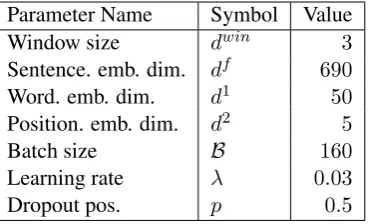
em-bedding size is5and dropout rate is0.5. Table3
shows the detailed parameter settings.
4.3 Comparisons with Baselines
Baseline. We compare our model with the
fol-lowing baselines:
• Mintz (Mintz et al., 2009) the original
dis-tantly supervised model.
• MultiR (Hoffmann et al., 2011) a
multi-instance learning based graphical model which aims to address overlapping relation problem.
• MIML (Surdeanu et al., 2012) also
solv-ing overlappsolv-ing relations in a instance multi-label framework.
• PCNN+ATT(Lin et al.,2016) the
state-of-the-art model in dataset of Riedel et al. (2010) which appliesATTto combine the sentences.
Results and Discussion. We compare our three
variants of loss functions with the baselines and the results are shown in Figure 3. From the re-sults we can see that: (1) Rank + AVE (Variant-1) achieves comparable results with PCNN+ATT; (2) Rank + ATT (Variant-2) and Rank + ExATT (Variant-3) significantly outperform PCNN + ATT with much higher precision and slightly higher re-call in whole view; (3) Rank + ExATT (Variant-3) exhibits the best performances comparing with all the other methods including PCNN + ATT, Rank + AVE and Rank + ATT.
Recall
0 0.05 0.1 0.15 0.2 0.25 0.3 0.35 0.4 0.45
Precision
0.3 0.4 0.5 0.6 0.7 0.8 0.9 1
Mintz MultiR MIML PCNN+ATT Rank+AVE Rank+ATT Rank+ExATT
Figure 3: Performance comparison of our model and the baselines.
Recall
0 0.1 0.2 0.3 0.4
Precision
0.4 0.5 0.6 0.7 0.8 0.9 1
Rank+AVE+Sep. Rank+AVE+Joint
Recall
0 0.1 0.2 0.3 0.4
Precision
0.4 0.5 0.6 0.7 0.8 0.9 1
Rank+ATT+Sep. Rank+ATT+Joint
Recall
0 0.1 0.2 0.3 0.4
Precision
0.4 0.5 0.6 0.7 0.8 0.9 1
[image:7.595.91.276.62.174.2]Rank+ExATT+Sep. Rank+ExATT+Joint
Figure 4: Results for impact of joint extraction and class ties with methods of Rank + AVE, Rank + ATT and Rank + ExATT under the setting of re-lieving impact of NR.
4.4 Impact of Joint Extraction and Class Ties
In this section, we conduct experiments to re-veal the effectiveness of our model to learn class ties with three variant loss functions mentioned above, and the impact of class ties for relation traction. As mentioned above, we make joint ex-traction to learn class ties, so to achieve the goal of this set of experiments, we compare joint ex-traction with separated exex-traction. To make sep-arated extraction, we divide the labels of entity tuple into single label and for one relation label we only select the sentences expressing this rela-tion, then we use this dataset to train our model with the three variant loss functions. We conduct experiments with Rank + AVE (Variant-1), Rank + ATT 2) and Rank + ExATT (Variant-3) relieving impact of NR. Aggregated P/R curves are drawn and precisions@N (100,200,· · ·,500)
[image:7.595.309.532.248.412.2]P@N(%) 100 200 300 400 500 Ave.
R.+AVE+J. 81.3 76.4 74.6 69.6 66.0 73.6
R.+AVE+S. 82.4 79.6 74.6 74.4 69.9 76.2
R.+ATT+J. 87.9 84.3 78.0 74.9 70.3 79.1
R.+ATT+S. 82.4 79.1 75.9 71.9 69.5 75.7
R.+ExATT+J. 83.5 82.2 78.7 77.2 73.1 79.0
[image:8.595.308.535.161.338.2]R.+ExATT+S. 82.4 82.7 79.4 74.2 69.2 77.6
Table 4: Precisions for top100,200,300,400,500
and average of them for impact of joint extraction and class ties.
Recall
0 0.05 0.1 0.15 0.2 0.25 0.3 0.35 0.4 0.45
Precision
0.4 0.5 0.6 0.7 0.8 0.9 1
Rank+AVE Rank+ATT Rank+ExATT
Figure 5: Results for comparisons of variant joint extractions.
Experimental results are shown in Figure4and Table4. From the results we can see that: (1) For Rank + ATT and Rank + ExATT, joint extraction exhibits better performance than separated extrac-tion, which demonstrates class ties will improve relation extraction and the two methods are effec-tive to learn class ties; (2) For Rank + AVE, sur-prisingly joint extraction does not keep up with separated extraction. For the second phenomenon, the explanation may lie in theAVEmethod to ag-gregate sentences will incorporate noise data con-sistent with the finding inLin et al.(2016). When make joint extraction, we will combine all sen-tences containing the same entity tuple no matter which class type is expressed, so it will engender much noise if we only combine them equally.
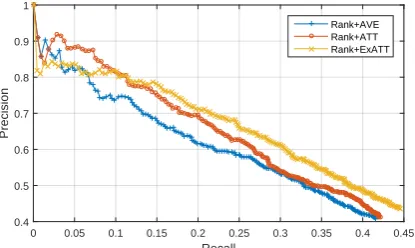
4.5 Comparisons of Variant Joint Extractions
To make joint extraction, we have proposed three variant loss functions including Rank + AVE, Rank + ATT and Rank + ExATT in the above dis-cussion and Figure 3 shows that the three vari-ants achieve different performances. In this ex-periment, we aim to compare the three variants in detail. We conduct the experiments with the three variants under the setting of relieving
im-P@N(%) 100 200 300 400 500 Ave.
R.+AVE 81.3 76.4 74.6 69.6 66.0 73.6
R.+ATT 87.9 84.3 78.0 74.9 70.3 79.1
R.+ExATT 83.5 82.2 78.7 77.2 73.1 79.0
Table 5: Precisions for top100,200,300,400,500
and average of them for Rank + AVE, Rank + ATT and Rank + ExATT.
Recall
0 0.1 0.2 0.3 0.4
Precision
0.4 0.5 0.6 0.7 0.8 0.9 1
Rank+AVE+NR Rank+AVE
Recall
0 0.1 0.2 0.3 0.4
Precision
0.4 0.5 0.6 0.7 0.8 0.9 1
Rank+AVE+NR Rank+AVE
Recall
0 0.1 0.2 0.3 0.4
Precision
0.4 0.5 0.6 0.7 0.8 0.9 1
Rank+ExATT+NR Rank+ExATT
Figure 6: Results for impact of relation NR with methods of Rank + AVE, Rank + ATT and Rank + ExATT. “+NR” means not relieving impact of NR.
pact of NR and joint extraction. We draw the P/R curves and report the top N (100, 200, · · ·, 500)
precisions to compare model performance with the three variants.
From the results as shown in Figure5 and Ta-ble5we can see that: (1) Comparing Rank + AVE with Rank + ATT, from the whole view, they can achieve the similar maximal recall point, but Rank + ATT exhibits higher precision in all range of recall; (2) Comparing Rank + ATT with Rank + ExATT, Rank + ExATT achieves much better per-formance with broader range of recall and higher precision in almost range of recall.
4.6 Impact of NR Relation
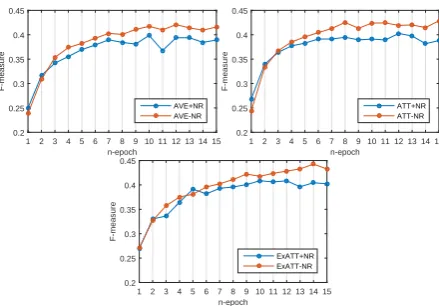
The goal of this experiment is to inspect how much relation of NR can affect the model perfor-mance. We use Rank + AVE, Rank + ATT, Rank + ExATT under the setting of relieving impact of NR or not to conduct experiments. We draw the aggregated P/R curves as shown in Figure6, from which we can see that after relieving the impact of NR, the model performance can be improved significantly.
[image:8.595.78.286.227.351.2]train-n-epoch
1 2 3 4 5 6 7 8 9 10 11 12 13 14 15
F-measure
0.2 0.25 0.3 0.35 0.4 0.45
AVE+NR AVE-NR
n-epoch
1 2 3 4 5 6 7 8 9 10 11 12 13 14 15
F-measure
0.2 0.25 0.3 0.35 0.4 0.45
ATT+NR ATT-NR
n-epoch
1 2 3 4 5 6 7 8 9 10 11 12 13 14 15
F-measure
0.2 0.25 0.3 0.35 0.4 0.45
ExATT+NR ExATT-NR
Figure 7: Impact of NR for model convergence. “+NR” means not relieving NR impact; “-NR” is opposite.
ing. Also with the three variant loss functions, in each iteration, we record the maximal value of F-measure4 to represent the model performance at
current epoch. Model parameters are tuned for
15times and the convergence curves are shown in
Figure7. From the result, we can find out: “+NR” converges quicker than “-NR” and arrives to the fi-nal score at the around11or12epoch. In general,
“-NR” converges more smoothly and will achieve better performance than “+NR” in the end.
4.7 Case Study
Joint vs. Sep. Extraction (Class Ties). We
randomly select an entity tuple(Cuyahoga County,
Cleveland)from test set to see its scores for every
relation class with the method of Rank + ATT un-der the setting of relieving impact of NR with joint extraction and separated extraction. This entity tu-ple have two relations:/location/./county seatand
/location/./contains, which derive from the same
root class and they have weak class ties for they all relating to topic of “location”. We rescale the scores by adding value10. The results are shown in Figure 8, from which we can see that: un-der joint extraction setting, the two gold relations have the highest scores among the other relations but under separated extraction setting, only
/loca-tion/./containscan be distinguished from the
neg-ative relations, which demonstrates that joint ex-traction is better than separated exex-traction by cap-turing the class ties between relations.
4F = 2
∗P∗R/(P+R)
class-id
5 10 15 20 25 30 35 40 45 50
value
6 8 10 12 14 16 18 20
Joint
class-id
5 10 15 20 25 30 35 40 45 50
value
6 8 10 12 14 15
Sep.
/l./l./contains
/l./us./county-seat
/l./us./county-seat
[image:9.595.75.295.61.214.2]/l./l./contains
Figure 8: The output scores for every relation with method of Rank + ATT. The top is under joint extraction setting; the bottom is under separated extraction.
5 Conclusion and Future Works
In this paper, we leverage class ties to enhance relation extraction by joint extraction using pair-wise ranking combined with CNN. An effective method is proposed to relieve the impact of NR for model training. Experimental results on a widely used dataset show that leveraging class ties will enhance relation extraction and our model is ef-fective to learn class ties. Our method significantly outperforms the baselines.
In the future, we will focus on two aspects: (1) Our method in this paper considers pairwise inter-sections between labels, so to better exploit class ties, we will extend our method to exploit all other labels’ influences on each relation for relation ex-traction, transferring second-order to high-order
(Zhang and Zhou, 2014); (2) We will focus on other problems by leveraging class ties between labels, specially on multi-label learning problems (Zhou et al.,2012) such as multi-category text cat-egorization (Rousu et al., 2005) and multi-label image categorization (Zha et al.,2008).
Acknowledgments
[image:9.595.308.522.62.173.2]References
Dzmitry Bahdanau, Kyunghyun Cho, and Yoshua Ben-gio. 2014. Neural machine translation by jointly
learning to align and translate. arXiv preprint
arXiv:1409.0473.
Kurt D. Bollacker, Colin Evans, Praveen Paritosh, Tim Sturge, and Jamie Taylor. 2008. Freebase: a col-laboratively created graph database for structuring
human knowledge. In Proceedings of KDD. pages
1247–1250.
Katrin Erk and Carlo Strapparava, editors. 2010.
Pro-ceedings of SemEval. The Association for Computer Linguistics.
Johannes F¨urnkranz, Eyke H¨ullermeier, Eneldo Loza Menc´ıa, and Klaus Brinker. 2008. Multilabel classi-fication via calibrated label ranking. Machine
learn-ing73(2):133–153.
Xianpei Han and Le Sun. 2016. Global distant supervi-sion for relation extraction. InProceedings of AAAI. pages 2950–2956.
Haibo He and Edwardo A. Garcia. 2009. Learning
from imbalanced data. IEEE Trans. Knowl. Data
Eng.21(9):1263–1284.
Raphael Hoffmann, Congle Zhang, Xiao Ling, Luke Zettlemoyer, and Daniel S Weld. 2011. Knowledge-based weak supervision for information extraction
of overlapping relations. In Proceedings of
ACL-HLT. Association for Computational Linguistics,
pages 541–550.
Nathalie Japkowicz and Shaju Stephen. 2002. The
class imbalance problem: A systematic study.
In-telligent data analysis6(5):429–449.
Yann LeCun, Yoshua Bengio, and Geoffrey Hinton.
2015. Deep learning. Nature521(7553):436–444.
Yankai Lin, Shiqi Shen, Zhiyuan Liu, Huanbo Luan, and Maosong Sun. 2016. Neural relation extraction with selective attention over instances. In Proceed-ings of ACL. volume 1, pages 2124–2133.
Tie-Yan Liu. 2009. Learning to rank for information
retrieval. Foundations and Trends in Information
Retrieval3(3):225–331.
Thang Luong, Hieu Pham, and Christopher D.
Man-ning. 2015. Effective approaches to
attention-based neural machine translation. In Proceedings
of EMNLP. pages 1412–1421.
Mike Mintz, Steven Bills, Rion Snow, and Dan Ju-rafsky. 2009. Distant supervision for relation
ex-traction without labeled data. In Proceedings of
ACL-IJCNLP. Association for Computational Lin-guistics, pages 1003–1011.
Sebastian Riedel, Limin Yao, and Andrew McCallum. 2010. Modeling relations and their mentions
with-out labeled text. InProceedings of ECML-PKDD.
Springer, pages 148–163.
Juho Rousu, Craig Saunders, Sandor Szedmak, and John Shawe-Taylor. 2005. Learning hierarchical
multi-category text classification models. In
Pro-ceeding of ICML. ACM, pages 744–751.
Cicero Nogueira dos Santos, Bing Xiang, and Bowen Zhou. 2015. Classifying relations by ranking with
convolutional neural networks. In Proceeding of
ACL. pages 626–634.
Aliaksei Severyn and Alessandro Moschitti. 2015. Learning to rank short text pairs with convolutional
deep neural networks. In Proceedings of the 38th
International ACM SIGIR Conference on Research and Development in Information Retrieval. ACM, pages 373–382.
Mihai Surdeanu, Julie Tibshirani, Ramesh Nallapati, and Christopher D Manning. 2012. Multi-instance multi-label learning for relation extraction. In Pro-ceedings of EMNLP. Association for Computational Linguistics, pages 455–465.
Linlin Wang, Zhu Cao, Gerard de Melo, and Zhiyuan Liu. 2016. Relation classification via multi-level
attention cnns. InProceedings of ACL, Volume 1:
Long Papers.
Jason Weston, Samy Bengio, and Nicolas Usunier. 2011. WSABIE: scaling up to large vocabulary
image annotation. InProceedings of IJCAI. pages
2764–2770.
Daojian Zeng, Kang Liu, Yubo Chen, and Jun Zhao. 2015. Distant supervision for relation extraction via
piecewise convolutional neural networks. In
Pro-ceedings of EMNLP. pages 17–21.
Daojian Zeng, Kang Liu, Siwei Lai, Guangyou Zhou, Jun Zhao, et al. 2014. Relation classification via
convolutional deep neural network. InProceeding
of COLING. pages 2335–2344.
Zheng-Jun Zha, Xian-Sheng Hua, Tao Mei, Jingdong Wang, Guo-Jun Qi, and Zengfu Wang. 2008. Joint multi-label multi-instance learning for image classi-fication. InCVPR. IEEE, pages 1–8.
Min-Ling Zhang and Zhi-Hua Zhou. 2006. Multilabel neural networks with applications to functional
ge-nomics and text categorization. IEEE transactions
on Knowledge and Data Engineering18(10):1338– 1351.
Min-Ling Zhang and Zhi-Hua Zhou. 2014. A
re-view on multi-label learning algorithms. IEEE
transactions on knowledge and data engineering 26(8):1819–1837.
Fang Zhao, Yongzhen Huang, Liang Wang, and Tieniu Tan. 2015. Deep semantic ranking based hashing
for multi-label image retrieval. In Proceedings of
Hao Zheng, Zhoujun Li, Senzhang Wang, Zhao Yan, and Jianshe Zhou. 2016. Aggregating inter-sentence information to enhance relation extraction. In Thir-tieth AAAI Conference on Artificial Intelligence.
Peng Zhou, Wei Shi, Jun Tian, Zhenyu Qi, Bingchen Li, Hongwei Hao, and Bo Xu. 2016. Attention-based bidirectional long short-term memory net-works for relation classification. In Proceeding of ACL. page 207.