Proceedings of the 55th Annual Meeting of the Association for Computational Linguistics-System Demonstrations, pages 37–42 Vancouver, Canada, July 30 - August 4, 2017. c2017 Association for Computational Linguistics
Proceedings of the 55th Annual Meeting of the Association for Computational Linguistics-System Demonstrations, pages 37–42 Vancouver, Canada, July 30 - August 4, 2017. c2017 Association for Computational Linguistics
Extended Named Entity Recognition API and
Its Applications in Language Education
Nguyen Tuan Duc1, Khai Mai1, Thai-Hoang Pham1, Nguyen Minh Trung1, Truc-Vien T. Nguyen1,Takashi Eguchi1,Ryohei Sasano2,Satoshi Sekine3
1Alt Inc 2Nagoya University 3New York University
[email protected], [email protected]
Abstract
We present an Extended Named Entity Recognition API to recognize various types of entities and classify the entities into 200 different categories. Each entity is classified into a hierarchy of entity cat-egories, in which the categories near the root are more general than the categories near the leaves of the hierarchy. This cat-egory information can be used in various applications such as language educational applications, online news services and rec-ommendation engines. We show an ap-plication of the API in a Japanese online news service for Japanese language learn-ers.
1 Introduction
Named entity recognition (NER) is one of the most fundamental tasks in Information Retrieval, Information Extraction and Question Answer-ing (Bellot et al.,2002;Nadeau and Sekine,2007). A high quality named entity recognition API (Ap-plication Programming Interface) is therefore im-portant for higher level tasks such as entity re-trieval, recommendation and automatic dialogue generation. To extend the ability of named en-tity recognition, Sekine et al. (Sekine et al.,2002;
Sekine and Nobata, 2004) have proposed an Ex-tended Named Entity (ENE) hierarchy, which re-fines the definition of named entity. The ENE hi-erarchy is a three-level hihi-erarchy, which contains more than ten coarse-grained categories at the top level and 200 fine-grained categories at the leaf level.
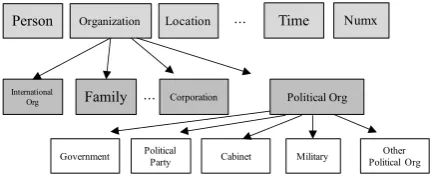
The top level of the hierarchy includes tradi-tional named entity categories, such as Person, Lo-cation or Organization. The middle level and leaf level refine the top level categories to more
fine-Person Organization Location ... Time Numx
International
Org Family ... Corporation Political Org
Political
Party Cabinet Military
[image:1.595.308.525.223.313.2]Other Political Org Government
Figure 1: Extended Named Entity hierarchy
grained categories. Figure 1 shows a partial hi-erarchy for the top level category Organization. In Extended Named Entity recognition (ENER) problem, given an input sentence, such as “Donald Trump was officially nominated by the Republican Party”, the system must recognize and classify the ENEs in the sentence, such as “Donald Trump” as
Personand “Republican Party” asPolitical Party.
In this paper, we present the architecture de-sign and implementation of an ENER API for Japanese. We named this API as “AL+ ENER API”. The proposed architecture works well with a large number of training data samples and re-sponses fast enough to use in practical applica-tions. To illustrate the effectiveness of the AL+ ENER API, we describe an application of the API for automatic extraction of glossaries in a Japanese online news service for Japanese language learn-ers. Feedbacks from the users show that the pre-sented ENER API gives high precision on the glossary creation task.
The rest of this paper is organized as follows. Section 2 describes the design and implementa-tion of the ENER API. Experiment results are pre-sented in Section 3 to evaluate the performance of the API. Section 4describes an application of the ENER API into an online news service for Japanese learners, the method to get user feed-backs from this service to improve the ENER sys-tem, and the statistics obtained from the user
backs. Section5reviews related systems and com-pares with the presented system. Finally, Section6
concludes the paper.
2 Extended Named Entity Recognition API
2.1 Overview of the AL+ ENER API
The AL+ ENER API is an API for Extended Named Entity recognition, which takes an input sentence and outputs a JSON containing a list of ENEs in the sentence, as shown in Figure2.
AL+ ENER API
Obama is the 44th president of the United States
Input
Output
[
{ “surface” : “Obama”, “entity” : “PERSON”, “start” : 0, “length” : 5}, { “surface” : “44th”, “entity” : “ORDINAL_NUMBER”, …}, { “surface” : “president”, “entity” : “POSITION_VOCATION”, …}, { “surface” : “United States”, “entity” : “COUNTRY”, … } ]
Figure 2: AL+ ENE Recognition API
Different from traditional NER APIs, this ENER API is capable of tagging 200 categories1,
including some entities that are actually not named entities (therefore, they are called “extended” named entities, as described in (Sekine and No-bata, 2004)). In Figure 2, “president” is not a traditional named entity, but it is tagged as
POSITION VOCATION, which is a category in the ENE hierarchy. For each entity, we output its surface (e.g., “president”), its ENE tag (“PO-SITION VOCATION”), its index in the input sen-tence (the “start” field in the JSON) and its length. A developer who uses the ENER API can utilize the start and length information to calculate the exact position of the entity in the input sentence. The ENE tag can then be used in various sub-sequent tasks such as Relation Extraction (RE), Question Answering (QA) or automatic dialogue generation. The AL+ ENER API is freely accessi-ble online.2 Currently, the API supports Japanese
only, but we are also developing an API for En-glish ENER. Figure3shows an example input sen-tence and output ENE tags.
1The list of categories is here: http://nlp.cs.nyu.edu/ene/ 2http://enerdev.alt.ai:8030/#!/Chatbot/
Worship_Place Insect N_Animal
Figure 3: An example input sentence and out-put ENE tags. Translated sentence with tags: “I caught 3/N Animalcicadas/Insectat Meiji Shrine/Worship Place”.
2.2 Extended Named Entity recognition algorithms
Existing NER systems often use Conditinal Ran-dom Fields (CRFs) (McCallum and Li, 2003;
Finkel et al., 2005), HMM (Zhou and Su, 2002) or SVM (Yamada et al.,2002;Takeuchi and Col-lier,2002;Sasano and Kurohashi,2008) to assign tags to the tokens in an input sentence. However, these methods are supposed to work with only small number of categories (e.g., 10 categories). In the ENER problem, the number of categories is 200, which is very large, compared with the num-ber in traditional NER. Consequently, traditional approaches might not achieve good performance and even be infeasible. Actually, we have tried to use CRF for 200 classes, but the training process took too long time and did not finish.
In this system, we use a combination approach to recognize ENEs. We first implement four base algorithms, namely, CRF-SVM hierarchi-cal ENER, RNN-based ENER, Wikification-based ENER and Rule-based ENER. We then combine these algorithms by a selection method, as shown in Figure4.
Rule-based
CRF-SVM
Wikification
Training data (tagged sentences)
Wikipedia data
RNN(LSTM)
Selecting the best algorithm
[image:2.595.308.518.525.595.2]Al+ ENER model
Figure 4: Overview of the proposed ENER algo-rithm
2016), which gives a score for each (entity, ENE category) pair. For the entities that are assigned automatically, we only take the entities with high scores to ensure that the algorithm assigns correct labels. If the rules fail to extract some entities, we extract all noun-phrases and lookup in the dictio-nary to check if they can be ENEs or not.
We use a training dataset which contains ENE-tagged sentences to train a CRF model to tag input sentences with the top-level ENE categories (in the training dataset, we get the correct labels for these ENEs from the parent or grandparent category in the ENE hierarchy). As illustrated in Figure1, at the top level, we only have 11 ENE categories that we need to recognize by CRF-SVM (other cate-gories such as Date, Time, Number can be rec-ognized by rules), thus using a CRF model here would achieve comparable performance with ex-isting NER systems. After tagging the sentences with the top-level ENE categories, we can con-vert the ENER problem into a simple classification problem (not a sequence labeling problem any-more), thus we can use SVM to classify the ex-tracted ENEs at the top level into leaf-level cate-gories. Therefore, we have a CRF model to tag the input sentences with top-level categories, and sev-eral SVM models (each for a top-level category) to classify the ENEs into the leaf-level ENE cate-gories. The features that we use in CRF and SVM are bag-of-words, POS-tag, the number of digits in the word, the Brown cluster of the current word, the appearance of the word as a substring of a word in the Wikipedia ENE dictionary, the orthography features (the word is written in Kanji, Hiragana, Katakana or Romaji), whether the word is capi-talized, and the last 2-3 characters. Because the number of leaf-level categories in each top-level category is also not too large (e.g., less than 15), SVM can achieve a reasonable performance at this step.
We also train an LSTM (Long-Short Term Memory network), a kind of RNN (Recurrent Neural Network) to recognize ENEs. We use LSTM because it is appropriate for sequence la-beling problems. The inputs of the LSTM are the word embedding of the current word and the POS-tag of the current word. The POS-POS-tags are auto-matically generated using JUMAN3, a Japanese
morphological analyzer. The word embedding is obtained by training a word2vec model with
3http://nlp.ist.i.kyoto-u.ac.jp/EN/?JUMAN
Japanese Wikipedia text. We hope that LSTM can memorize the patterns in the training data and in-terpolate to the CRF-SVM method in many cases. To cope with free-text ENEs, we use Wikifi-cation approach. Free-text ENEs refer to the en-tities that can be of any text, such as a movie name or a song name (e.g., “What is your name” is a famous movie name in Japanese). If these names are famous, they often become the titles of some Wikipedia articles. Consequently, using Wikification-based approach could work well with these types of entities.
We also create an algorithm selection model by evaluating the F-scores of the four base algorithms (Rule, CRF-SVM, RNN and Wikification) with a development dataset (which is different from the test set). In the final phase, after having all la-bels from the four base algorithms for each entity, we select the label of the algorithm with the high-est F-score in the development set. Note that we use the best selection scheme at entity level, not at sentence level. This is because each base algo-rithm tends to achieve high performance on some specific categories, so if we select the best algo-rithm for each entity, we will achieve higher per-formance for the entire sentence.
3 Evaluation
3.1 Data set
We hired seven annotators to create an ENE tagged dataset. Specifically, for each ENE category, the annotators created 100 Japanese sentences, each sentence includes at least one entity in the cor-responding category. The annotators then manu-ally tagged the sentences with ENE tags. After filtering out erroneous sentences (sentences with invalid tag format), we obtain totally 19,363 well-formed sentences. We divided the dataset into three subsets: the training set (70% of the total number of sentences), development set (15%) and test set (15%). Table1shows some statistics of the dataset.
Dataset No. sentences No. tokens No. entities
Train 13,625 266,454 37,062
Dev 2,869 58,529 7,673
Test 2,869 55,999 7,711
3.2 Performance of the ENER API
We use the test set to evaluate the precision, re-call and F-score of the ENER API. Table2shows
Category Precision Recall F-score
(%) (%) (%)
Cabinet 100.00 100.00 100.00 Intensity 100.00 100.00 100.00
URL 100.00 100.00 100.00
Phone Number 100.00 95.25 97.56
Email 100.00 93.33 96.55
Volume 100.00 93.10 96.43
... ... ... ...
Aircraft 80.95 65.38 72.34
Company Group 68.42 76.47 72.22 Continental Region 74.29 69.33 71.72
... ... ... ...
Printing Other 50.00 11.76 19.05 Name Other 23.08 15.00 18.18
Weapon 9.09 4.17 5.71
[image:4.595.77.286.114.295.2]Average 73.47 70.50 71.95
Table 2: Precision, Recall, F-score of the ENER API on the test dataset
the Precision, Recall and F-score of the ENER API on some specific categories as well as the average evaluation results of the entire 200 cate-gories (in the last row). We achieved very high performance on the categories with small number of known entities (such as Cabinet) or the cate-gories that the rules can capture almost all enti-ties (such as Intensity, Volume, URL, and Email). For categories with free text names (e.g, printing names) or very short name (e.g., AK-47, a type of weapon) the system can not predict the ENE very well because these names might appear in various contexts. We might prioritize Wikification method in these cases to improve the performance. On av-erage, we achieve an F1-score of 71.95%, which is a reasonable result for 200 categories.
3.3 Response time of the API
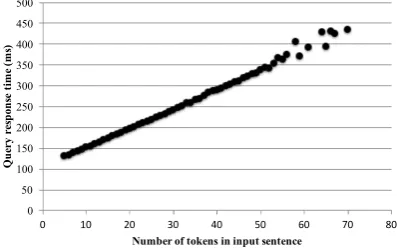
As ENER is often used by subsequent NLP tasks, the response speed of the ENER API must be fast enough for the subsequent tasks to achieve a high speed. Consequently, we executed the ENER API with the test dataset (containing 2869 sentences) and evaluated the response time of the API. The average response time of a sentence (a query) is 195 ms (0.195 second). This response speed is fast enough for various tasks such as generating answer for an intelligent chatbot or a search en-gine session. Figure5shows the relation between the response time and the length of the input sen-tence (calculated by the number of tokens, each
token is a word produced by the morphological an-alyzer). When the input sentence length increases, the response time increases nearly linearly (except when the sentence is too long, as we have a small number of such sentences so the variance is large). The typical sentence length in Japanese is from 10 to 20 tokens so the speed of the ENER is fast in most cases.
0 50 100 150 200 250 300 350 400 450 500
! "! #! $! %! &! '! (! )!
Q
u
er
y
re
sp
on
se
t
im
e
(m
s)
[image:4.595.317.516.186.311.2]Number of tokens in input sentence
Figure 5: Relation between input sentence length and response time of the API
4 Application of the ENER API
In this section, we present a real-world application of the AL+ ENER API: glossary linking in an on-line news service.
4.1 Mazii: an online news service for Japanese learners
The Mazii News service4 is an online news
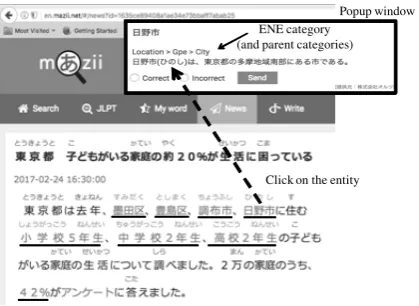
ser-vice for Japanese learners. For each sentence in a news article, Mazii automatically analyzes it and creates a link for each word that it recognizes as an ENE or an entry in its dictionary. This will help Japanese learners to quickly reference to the words/entities when they do not understand the meaning of the words/entities. To recognize ENEs in a news article, Mazii inputs each sentence of the article into the AL+ ENER API (sentence bound-ary detection in Japanese is very simple because Japanese language has a special symbol for sen-tence boundary mark). Because the AL+ ENER API also returns the position (and the length) of the ENEs, Mazii can easily create a link to under-line the ENEs in the sentence. When a user clicks on a link, Mazii will open a popup window to pro-vide details information concerning the entity: the ENE category (with parent categories) of the en-tity, the definition of the entity (if any). Figure6
shows a screenshot of the Mazii ENE linking re-sults.
ENE category (and parent categories)
Popup window
[image:5.595.73.283.100.253.2]Click on the entity
Figure 6: Mazii entity linking with AL+ ENER API, the underlined entities are linked. When a user clicks on a link (as shown in the Figure, a mention to a city in Japan is clicked), a popup win-dow will open and show the ENE category hierar-chy of the corresponding ENE.
4.2 Collecting user feedbacks
Mazii has more than 4 thousands daily active users and many users click on the linked ENEs. This provides us a big chance to obtain user feedbacks about the prediction results of the AL+ ENER API. We have implemented two interfaces to col-lect user feedbacks, as shown in Figure6and Fig-ure7.
Figure 7: Collecting ENE user feedback from Mazii with playcard game
In Figure6, when a user clicks on an entity, we display the ENE hierarchy of the entity in a popup window. We also display two radio buttons:
Cor-rect and Incorrect to let the user give us
feed-backs. If the user choosesIncorrectthen we also ask the user the correct category of the entity.
Using the method in Figure6, we can only col-lect feedbacks when the users click on the enti-ties. However, the number of clicks is often much
smaller than the number of views. To increase the user feedbacks, we invented a playcard game for language learners, as shown in Figure7. When a user views an article, we show a frame with a ques-tion asking about the correct category of an ENE in the article (we also provide the sentence which includes the ENE to gather the context for the CRF-SVM and RNN models). If the user reacts to this frame (by pressing Correct/Incorrect button), we store the feedback and move to the next ENE in our database. This involves the user in a language learning game and helps he/she to study many new words as well as grammatical constructs.
4.3 User feedback statistics
In this section, we show some statistics that we derived from the user feedback log of the Mazii News service. We collected the user feedback log (including the view, click and correct log) in 3 months (from Dec 2016 to Feb 2017). We then count the number of views, clicks and number of feedbacks (number of times the Correct/Incorrect button is pressed) and number of Correct times for each ENE categories. We calculate the correct ra-tio (%Correct) by the number of corrects divided by number of feedbacks (Correct/Feedback).
Category View Click Feedback %Correct Date 360,625 7,100 1,421 95.50 N Person 139,191 1,934 523 98.47 Province 109,974 9,880 439 94.76
... ... ... ... ...
Animal Part 6,514 637 8 100.00 Broadcast
Program 6,121 1,003 21 47.62
Clothing 4,079 632 14 85.71
... ... ... ... ...
Fish 656 474 2 100.00
Fungus 615 106 1 0.00
Religion 614 227 4 100.00
Total 1,582,081 138,404 5,198 88.96
Table 3: Number views, clicks, feedbacks and percentage of correct times from the Mazii feed-back log
[image:5.595.310.523.428.577.2] [image:5.595.115.248.491.586.2]the users are interested in the linked ENEs. More-over, the percentage of correct times shows that the ENER API is good enough to provide useful information to the users.
5 Related Work
The ENE hierarchy that we recognize in this pa-per is proposed in (Sekine et al.,2002). (Sekine and Nobata,2004) proposed a Japanese rule-based ENER with a precision of 72% and recall of 80%. The performance of the rule-based ENER is good if the ENEs containing in the text are included in the dictionary or the rules can capture the patterns in which the ENEs appeared. However, ENEs of-ten evolve with time, new ENEs are frequently added and their meaning might be changed. Con-sequently, rule-based systems might not work well after a several years. In the presented system, we re-use the rules and dictionary in (Sekine and Nobata, 2004) but we also add machine learning models to capture the evolution of the ENEs. The proposed model can be retrained at anytime if we have new training data. Iwakura et al. (Iwakura et al., 2011) proposed an ENER based on de-composition/concatenation of word chunks. They evaluated the system with 191 ENE categories and achieved an F-score of 81%. However, in their evaluation, they did not evaluate directly on input sentences, but only on correct chunks. Moreover, they did not deal with word boundaries as stated in their paper. Therefore, we cannot compare our results with theirs.
6 Conclusion
We presented an API for recognition of Extended Named Entities (ENEs). The API takes a sentence as input and outputs a JSON containing a list of ENEs with their categories. The API can recog-nize named entities at deep level with high accu-racy in a timely manner, and has been applied in real-life applications. We described an applica-tion of the ENER API to a Japanese online news service. The experimental results showed that the API achieves good performance and is fast enough for practical applications.
Acknowledgments
We would like to thank Yoshikazu Nishimura, Hideyuki Shibuki, Dr. Phuong Le-Hong and Maya Ando for their precious comments and suggestions on this work.
References
Patrice Bellot, Eric Crestan, Marc El-B`eze, Laurent Gillard, and Claude de Loupy. 2002. Coupling Named Entity Recognition, Vector-Space Model and Knowledge Bases for TREC 11 Question Answering Track. InProc. of TREC 2002.
Jenny Rose Finkel, Trond Grenager, and Christo-pher D. Manning. 2005. Incorporating Non-local Information into Information Extraction Systems by Gibbs Sampling. InProc. of ACL 2005. pages 363– 370.
Tomoya Iwakura, Hiroya Takamura, and Manabu Oku-mura. 2011. A Named Entity Recognition Method based on Decomposition and Concatenation of Word Chunks. InProc. of IJCNLP 2011. pages 828–836.
Andrew McCallum and Wei Li. 2003. Early Results for Named Entity Recognition with Conditional Ran-dom Fields, Feature Induction and Web-Enhanced Lexicons. InProc. of CoNLL 2003. pages 188–191.
David Nadeau and Satoshi Sekine. 2007. A Survey of Named Entity Recognition and Classification. Lin-guisticae Investigationes30(1):3–26.
Ryohei Sasano and Sadao Kurohashi. 2008. Japanese Named Entity Recognition Using Structural Natu-ral Language Processing. InProc. of IJCNLP 2008. pages 607–612.
Satoshi Sekine and Chikashi Nobata. 2004. Definition, Dictionaries and Tagger for Extended Named Entity Hierarchy. In Proc. of LREC 2004. pages 1977– 1980.
Satoshi Sekine, Kiyoshi Sudo, and Chikashi Nobata. 2002. Extended Named Entity Hierarchy. InProc. of LREC 2002. pages 1818–1824.
Masatoshi Suzuki, Koji Matsuda, Satoshi Sekine, Naoaki Okazaki, and Kentaro Inui. 2016. Fine-Grained Named Entity Classification with Wikipedia Article Vectors. InProc. of Int’l Conf. on Web Intelligence (WI 2016). pages 483–486.
Koichi Takeuchi and Nigel Collier. 2002. Use of Sup-port Vector Machines in Extended Named Entity Recognition. InProc. of CoNLL 2002.
Hiroyasu Yamada, Taku Kudo, and Yuji Matsumoto. 2002. Japanese Named Entity Extraction Using Support Vector Machine. Transactions of Informa-tion Processing Society of Japan (IPSJ) 43(1):44– 53.
Weinan Zhang, Shuai Yuan, and Jun Wang. 2014. Opti-mal Real-Time Bidding for Display Advertising. In Proc. of KDD 2014. pages 1077–1086.