2727
Finding Syntax in Human Encephalography with Beam Search
John Hale♠,4 Chris Dyer♠ Adhiguna Kuncoro♠,♣ Jonathan R. Brennan♦
♠DeepMind, London, UK
♣Department of Computer Science, University of Oxford ♦Department of Linguistics, University of Michigan
4Department of Linguistics, Cornell University
{jthale,cdyer,akuncoro}@google.com [email protected]
Abstract
Recurrent neural network grammars
(RNNGs) are generative models of
(tree,string)pairs that rely on neural net-works to evaluate derivational choices. Parsing with them using beam search yields a variety of incremental com-plexity metrics such as word surprisal and parser action count. When used as regressors against human electrophys-iological responses to naturalistic text,
they derive two amplitude effects:
an early peak and a P600-like later
peak. By contrast, a non-syntactic
neural language model yields no reli-able effects. Model comparisons attribute the early peak to syntactic composition within the RNNG. This pattern of results
recommends the RNNG+beam search
combination as a mechanistic model of the syntactic processing that occurs during normal human language comprehension.
1 Introduction
Computational psycholinguistics has “always been...the thing that computational linguistics stood the greatest chance of providing to
hu-manity” (Kay, 2005). Within this broad area,
cognitively-plausible parsing models are of par-ticular interest. They are mechanistic computa-tional models that, at some level, do the same task people do in the course of ordinary language com-prehension. As such, they offer a way to gain in-sight into the operation of the human sentence pro-cessing mechanism (for a review seeHale,2017). As Keller (2010) suggests, a promising place to look for such insights is at the intersection of (a) incremental processing, (b) broad coverage, and (c) neural signals from the human brain.
The contribution of the present paper is situ-ated precisely at this intersection. It combines a
probabilistic generative grammar (RNNG; Dyer
et al., 2016) with a parsing procedure that uses this grammar to manage a collection of syntac-tic derivations as it advances from one word to the next (Stern et al., 2017, cf. Roark, 2004). Via well-known complexity metrics, the interme-diate states of this procedure yield quantitative predictions about language comprehension diffi-culty. Juxtaposing these predictions against data from human encephalography (EEG), we find that they reliably derive several amplitude effects in-cluding the P600, which is known to be associated
with syntactic processing (e.g.Osterhout and
Hol-comb,1992).
Comparison with language models based on long short term memory networks (LSTM, e.g.
Hochreiter and Schmidhuber, 1997; Mikolov,
2012;Graves, 2012) shows that these effects are specific to the RNNG. A further analysis pinpoints one of these effects to RNNGs’ syntactic com-position mechanism. These positive findings re-frame earlier null results regarding the
syntax-sensitivity of human processing (Frank et al.,
2015). They extend work with eyetracking (e.g.
Roark et al.,2009;Demberg et al.,2013) and neu-roimaging (Brennan et al.,2016;Bachrach,2008)
to higher temporal resolution.1 Perhaps most
sig-nificantly, they establish a general correspondence between a computational model and electrophysi-ological responses to naturalistic language.
Following this Introduction, section 2 presents
recurrent neural network grammars, emphasiz-ing their suitability for incremental parsemphasiz-ing.
Sections 3 then reviews a previously-proposed
1Magnetoencephalography also offers high temporal
(S
the
NP
hungry cat
(VP
“stack” LSTM current state vector of “stack” LSTM open a new phrasegenerate a wor
d
close o
ff phrase
Prob(action)
NP VP PP S …
… Prob(nonterminal)
cat
Prob(word) …
[image:2.595.78.291.65.338.2]… dog eat hungrythechase
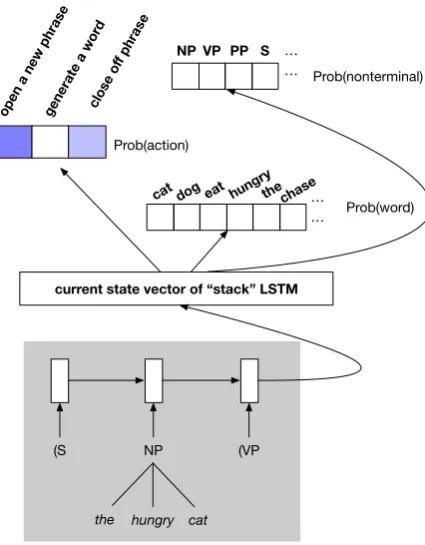
Figure 1: Recurrent neural network grammar con-figuration used in this paper. The absence of a lookahead buffer is significant, because it forces parsing to be incremental. Completed constituents such as[NPthe hungry cat]are represented on the stack by numerical vectors that are the output of the syntactic composition function depicted in Figure2.
beam search procedure for them. Section 4
goes on to introduce the novel application of this procedure to human data via incremental
com-plexity metrics. Section5explains how these
the-oretical predictions are specifically brought to bear
on EEG data using regression. Sections 6
and 7 elaborate on the model comparison
men-tioned above and report the results in a way that isolates the operative element. Section8discusses these results in relation to established computa-tional models. The conclusion, to anticipate sec-tion9, is that syntactic processing can be found in naturalistic speech stimuli if ambiguity resolution is modeled as beam search.
2 Recurrent neural network grammars for incremental processing
Recurrent neural network grammars (henceforth:
RNNGs Kuncoro et al., 2017; Dyer et al.,
NP
u v w
NP u v w NP
x x
Figure 2: RNNG composition function traverses
daughter embeddingsu,vandw, representing the
entire tree with a single vector x. This Figure is reproduced from (Dyer et al.,2016).
2016) are probabilistic models that generate trees. The probability of a tree is decomposed via the chain rule in terms of derivational action-probabilities that are conditioned upon
previ-ous actions i.e. they are history-based
gram-mars (Black et al.,1993). In the vanilla version of RNNG, these steps follow a depth-first traversal of the developing phrase structure tree. This en-tails that daughters are announced bottom-up one by one as they are completed, rather than being predicted at the same time as the mother.
Each step of this generative story depends on the state of a stack, depicted inside the gray box
in Figure 1. This stack is “neuralized” such that
each stack entry corresponds to a numerical vec-tor. At each stage of derivation, a single vector summarizing the entire stack is available in the form of the final state of a neural sequence model. This is implemented using the stack LSTMs of
Dyer et al. (2015). These stack-summary
vec-tors (central rectangle in Figure1) allow RNNGs
to be sensitive to aspects of the left context that would be masked by independence assumptions in a probabilistic context-free grammar. In the present paper, these stack-summaries serve as in-put to a multi-layer perceptron whose outin-put is converted via softmax into a categorical distribu-tion over three possible parser acdistribu-tions: open a new constituent, close off the latest constituent, or generate a word. A hard decision is made, and if the first or last option is selected, then the same vector-valued stack–summary is again used, via multilayer perceptrons, to decide which specific nonterminal to open, or which specific word to generate.
Phrase-closing actions trigger a syntactic
[image:2.595.327.505.79.148.2]squeezes a sequence of subtree vectors into one single vector. This happens by applying a bidi-rectional LSTM to the list of daughter vectors, prepended with the vector for the mother category following§4.1 ofDyer et al.(2016).
The parameters of all these components are adaptively adjusted using backpropagation at training time, minimizing the cross entropy rela-tive to a corpus of trees. At testing time, we parse incrementally using beam search as described be-low in section3.
3 Word-synchronous beam search
Beam search is one way of addressing the search problem that arises with generative gram-mars — constructive accounts of language that are sometimes said to “strongly generate” sentences. Strong generation in this sense simply means that they derive both an observable word-string as well as a hidden tree structure. Probabilistic grammars are joint models of these two aspects. By contrast, parsers are programs intended to infer a good tree from a given word-string. In incremental pars-ing with history-based models this inference task is particularly challenging, because a decision that looks wise at one point may end up looking foolish in light of future words. Beam search addresses this challenge by retaining a collection called the “beam” of parser states at each word. These states are rated by a score that is related to the probabil-ity of a partial derivation, allowing an incremen-tal parser to hedge its bets against temporary
am-biguity. If the score of one analysis suddenly
plummets after seeing some word, there may still be others within the beam that are not so drasti-cally affected. This idea of ranked parallelism has become central in psycholinguistic modeling (see e.g.Gibson,1991;Narayanan and Jurafsky,1998;
Boston et al.,2011).
As Stern et al. (2017) observe, the most straightforward application of beam search to generative models like RNNG does not perform well. This is because lexical actions, which ad-vance the analysis onwards to successive words, are assigned such low probabilities compared to structural actions which do not advance to the
next word. This imbalance is inevitable in a
probability model that strongly generates sen-tences, and it causes naive beam-searchers to get bogged down, proposing more and more phrase structure rather than moving on through the
sentence. To address it, Stern et al.(2017) pro-pose a word-synchronous variant of beam search. This variant keeps searching through structural ac-tions until “enough” high-scoring parser states fi-nally take a lexical action, arriving in synchrony at the next word of the sentence. Their procedure is written out as Algorithm1.
Algorithm 1Word-synchronous beam search with fast-tracking. AfterStern et al.(2017)
1: thisword←input beam 2: nextword← ∅
3: while|nextword|< kdo
4: fringe←successors of all states
s∈thiswordvia any parsing action
5: prunefringeto topk
6: thisword← ∅
7: foreach parser states∈ fringedo
8: ifscame via a lexical actionthen
9: addstonextword
10: else .must have been structural
11: addstothisword
12: end if
13: end for
14: end while
15: returnnextwordpruned to topkwordk
In Algorithm1the beam is held in a set-valued
variable callednextword. Beam search continues
until this set’s cardinality exceeds the designated action beam size, k. If the beam still isn’t large enough (line 3) then the search process explores one more action by going around the while-loop again. Each time through the loop, lexical ac-tions compete against structural acac-tions for a place
among the top k (line 5). The imbalance
men-tioned above makes this competition fierce, and
on many loop iterations nextword may not grow
by much. Once there are enough parser states,
another threshold called the word beam kword
kicks in (line 15). This other threshold sets
the number of analyses that are handed off to
the next invocation of the algorithm. In the
study reported here the word beam remains at the default setting suggested by Stern and col-leagues,k/10.
k=100 k=200 k=400 k=600 k=800 k=1000 k=2000
Fried et al.(2017) RNNG
ppl unknown,−fast track 74.1 80.1 85.3 87.5 88.7 89.6 not reported
this paper ppl=141,−fast track 71.5 78.81 84.15 86.42 87.34 88.16 89.81
this paper ppl=141,kft=k/100 87.1 88.96 90.48 90.64 90.84 90.96 91.25
Table 1: Penn Treebank development section bracketing accuracies (F1) under Word-Synchronous beam search. These figures show that an incremental parser for RNNG can perform well on a stan-dard benchmark. “ppl” indicates the perplexity of over both trees and strings for the trained model on the development set, averaged over words In all cases the word beam is set to a tenth of the action beam, i.e.kword=k/10.
Algorithm1 such that some small numberkf t of
parser states are promoted directly intonextword. These states are required to come via a lexical ac-tion, but in the absence of fast tracking they quite possibly would have failed the thresholding step in line 5.
Table 1 shows Penn Treebank accuracies for
this word-synchronous beam search procedure, as applied to RNNG. As expected, accuracy goes up as the parser considers more and more analyses.
Abovek= 200, the RNNG+beam search
combi-nation outperforms a conditional model based on greedy decoding (88.9). This demonstration
re-emphasizes the point, made byBrants and Crocker
(2000) among others, that cognitively-plausible
incremental processing can be achieved without loss of parsing performance.
4 Complexity metrics
In order to relate computational models to mea-sured human responses, some sort of auxiliary hy-pothesis or linking rule is required. In the domain of language, these are traditionally referred to as complexity metrics because of the way they quan-tify the “processing complexity” of particular sen-tences. When a metric offers a prediction on each
successive word, it is an incremental
complex-ity metric.
Table 2 characterizes four incremental
com-plexity metrics that are all obtained from
inter-mediate states of Algorithm 1. The metric
de-notedDISTANCE is the most classic; it is inspired
by the count of “transitions made or attempted” inKaplan(1972). It quantifies syntactic work by counting the number of parser actions explored by
Algorithm 1 between each word i.e. the number
of times around the while-loop on line 3. The
information theoretical quantitiesSURPRISALand
ENTROPY came into more widespread use later.
They quantify unexpectedness and uncertainty, re-spectively, about alternative syntactic analyses at
a given point within a sentence. Hale (2016)
re-views their applicability across many different lan-guages, psycholinguistic measurement techniques and grammatical models. Recent work proposes possible relationships between these two metrics, at the empirical as well as theoretical level (van Schijndel and Schuler,2017;Cho et al.,2018).
metric characterization
DISTANCE count of actions required to
synchronize k analyses at the
next word
SURPRISAL log-ratio of summed
for-ward probabilities for analyses in the beam
ENTROPY average uncertainty of analyses in the beam
ENTROPY∆ difference between previous and current entropy value
Table 2: Complexity Metrics
The SURPRISALmetric was computed over the
word beam i.e. the kword highest-scoring partial
syntactic analyses at each successive word. In an
attempt to obtain a more faithful estimate, EN
-TROPY and its first-difference are computed over
nextworditself, whose size varies but is typically much larger thankword.
5 Regression models of naturalistic EEG
Electroencephalography (EEG) is an experimen-tal technique that measures very small
volt-age fluctuations on the scalp. For a review
emphasizing its implications vis-´a-vis computa-tional models, seeMurphy et al.(2018).
We analyzed EEG recordings from 33
[image:4.595.70.537.62.128.2]spoken recitation of the first chapter of
Alice’s Adventures in Wonderland.2 This
au-ditory stimulus was delivered via earphones
in an isolated booth. All participants scored
significantly better than chance on a post-session
8-question comprehension quiz. An additional
ten datasets were excluded for not meeting this behavioral criterion, six due to excessive noise, and three due to experimenter error. All partic-ipants provided written informed consent under the oversight of the University of Michigan HSBS Institutional Review Board (#HUM00081060)
and were compensated $15/h.3
Data were recorded at 500 Hz from 61 ac-tive electrodes (impedences<25kΩ) and divided into 2129 epochs, spanning -0.3–1 s around the onset of each word in the story. Ocular artifacts were removed using ICA, and remaining epochs
with excessive noise were excluded. The data
were filtered from 0.5–40 Hz, baseline corrected against a 100 ms pre-word interval, and separated into epochs for content words and epochs for func-tion words because of interacfunc-tions between
pars-ing variables of interest and word-class (Roark
et al.,2009).
Linear regression was used per-participant,
at each time-point and electrode, to
iden-tify content-word EEG amplitudes that corre-late with complexity metrics derived from the
RNNG+beam search combination via the
com-plexity metrics in Table 2. We refer to these
time series as Target predictors.
Each Target predictor was included in its own model, along with several Control predictors that are known to influence sentence processing: sen-tence order, word-order in sensen-tence, log word
fre-quency (Lund and Burgess, 1996), frequency of
the previous and subsequent word, and acoustic sound power averaged over the first 50 ms of the epoch.
All predictors were mean-centered. We also
constructed null regression models in which the rows of the design matrix were randomly per-muted.4 β coefficients for each effect were tested against these null models at the group level across
2
https://tinyurl.com/alicedata
3A separate analysis of these data appears inBrennan and
Hale(2018); datasets are available from JRB.
4
Temporal auto-correlation across epochs could impact model fits. Content-words are spaced 1 s apart on average and a spot-check of the residuals from these linear models indi-cates that they do not show temporal auto-correlation: AR(1) <0.1across subjects, time-points, and electrodes.
all electrodes from 0–1 seconds post-onset, using a non-parametric cluster-based permutation test to correct for multiple comparisons across electrodes and time-points (Maris and Oostenveld,2007).
6 Language models for literary stimuli
We compare the fit against EEG data for models that are trained on the same amount of textual data but differ in the explicitness of their syntactic rep-resentations.
At the low end of this scale is the LSTM lan-guage model. Models of this type treat sentences as a sequence of words, leaving it up to backprop-agation to decide whether or not to encode syntac-tic properties in a learned history vector (Linzen et al.,2016). We useSURPRISALfrom the LSTM as a baseline.
RNNGs are higher on this scale because they explicitly build a phrase structure tree using a sym-bolic stack. We consider as well a degraded
ver-sion, RNNG−comp which lacks the
composi-tion mechanism shown in Figure 2. This
de-graded version replaces the stack with initial
sub-strings of bracket expressions, followingChoe and
Charniak(2016);Vinyals et al.(2015). An
exam-ple would be the length7string shown below
(S (NP the hungry cat )N P (VP
Here, vertical lines separate symbols whose vec-tor encoding would be considered separately by
RNNG−comp. In this degraded representation, the
noun phrase is not composed explicitly. It takes up five symbols rather than one. The balanced paren-theses (NP and )NPare rather like instructions for some subsequent agent who might later perform the kind of syntactic composition that occurs on-line in RNNGs, albeit in an implicit manner.
In all cases, these language
mod-els were trained on chapters 2–12 of
Alice’s Adventures in Wonderland. This
com-prises 24941 words. The stimulus that participants saw during EEG data collection, for which the metrics in Table2are calculated, was chapter 1 of the same book, comprising 2169 words.
RNNGs were trained to match the output trees
provided by the Stanford parser (Klein and
as clausal embedding and direct objecthood; nev-ertheless we did not undertake any manual correc-tion.
During RNNG training, the first chapter was used as a development set, proceeding until the per-word perplexity over all parser actions on this set reached a minimum, 180. This performance was obtained with a RNNG whose state vector was 170 units wide. The corresponding LSTM language model state vector had 256 units; it reached a per-word perplexity of 90.2. Of course the RNNG estimates the joint probability of both treesandwords, so these two perplexity levels are not directly comparable. Hyperparameter settings were determined by grid search in a region near the one which yielded good performance on the
Penn Treebank benchmark reported on Table1.
7 Results
To explore the suitability of the RNNG +
beam search combination as a cognitive model of language processing difficulty, we fitted
regres-sion models as described above in section 5 for
each of the metrics in Table2. We considered six
beam sizes k = {100,200,400,600,800,1000}.
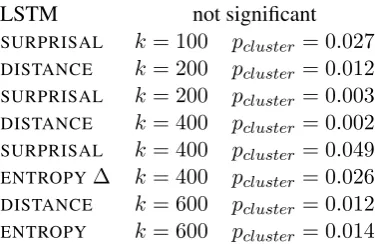
Table3 summarizes statistical significance levels
reached by these Target predictors; no other com-binations reached statistical significance.
LSTM not significant
SURPRISAL k= 100 pcluster= 0.027
DISTANCE k= 200 pcluster= 0.012
SURPRISAL k= 200 pcluster= 0.003
DISTANCE k= 400 pcluster= 0.002
SURPRISAL k= 400 pcluster= 0.049
ENTROPY∆ k= 400 pcluster= 0.026
DISTANCE k= 600 pcluster= 0.012
[image:6.595.78.266.458.580.2]ENTROPY k= 600 pcluster= 0.014
Table 3: Statistical significance of fitted Target
predictors in Whole-Head analysis. pcluster
val-ues are minima for each Target with respect to a
Monte Carlo cluster-based permutation test (Maris
and Oostenveld,2007).
7.1 Whole-Head analysis
Surprisal from the LSTM sequence model did not reliably predict EEG amplitude at any timepoint
or electrode. TheDISTANCEpredictor did derive a
central positivity around 600 ms post-word onset
as shown in Figure 3a. SURPRISAL predicted an
early frontal positivity around 250 ms, shown in
Figure3b. ENTROPYandENTROPY∆seemed to
drive effects that were similarly early and frontal, although negative-going (not depicted); the effect forENTROPY∆localized to just the left side.
7.2 Region of Interest analysis
We compared RNNG to its degraded cousin,
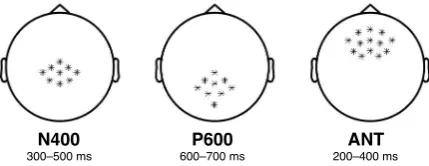
RNNG−comp, in three regions of interest shown
in Figure 4. These regions are defined by a
se-lection of electrodes and a time window whose zero-point corresponds to the onset of the spo-ken word in the naturalistic speech stimulus. Re-gions “N400” and “P600” are well-known in EEG research, while “ANT” is motivated by
find-ings with a PCFG baseline reported by Brennan
and Hale(2018).
Single-trial data were averaged across elec-trodes and time-points within each region and fit with a linear mixed-effects model with fixed ef-fects as described below and random intercepts by-subjects (Alday et al.,2017). We used a step-wise likelihood-ratio test to evaluate whether indi-vidual Target predictors from the RNNG
signifi-cantly improved over RNNG−comp, and whether a
RNNG−compmodel significantly improve a
base-line regression model. The baseline regression
model, denoted∅, contains the Control predictors
described in section 5 and SURPRISAL from the
LSTM sequence model. Targets represent each of the eight reliable whole-head effects detailed in Table3. These 24 tests (eight effects by three
regions) motivate a Bonferroni correction ofα =
0.002 = 0.05/24.
Statistically significant results obtained forDIS -TANCEfrom RNNG−compin the P600 region and forSURPRISALfor RNNG in the ANT region. No significant results were observed in the N400 re-gion. These results are detailed in Table4.
8 Discussion
Since beam search explores analyses in
descend-ing order of probability, DISTANCE and SUR
-PRISAL ought to be yoked, and indeed they are
correlated at r = 0.33 or greater across all of
the beam sizeskthat we considered in this study.
However they are reliably associated with
differ-ent EEG effects. SURPRISAL manifests at
ante-rior electrodes relatively early. This seems to be a different effect from that observed byFrank et al.
ampli-(a)DISTANCEderives a P600 atk= 200. (b)SURPRISALderives an early response atk= 200.
Figure 3: Plotted values are fitted regression coefficients and 95% confidence intervals, statistically
sig-nificant in the dark-shaded region with respect to a permutation test followingMaris and Oostenveld
(2007). The zero point represents the onset of a spoken word. Insets show electrodes with significant
effects along with grand-averaged coefficient values across the significant time intervals. The diagram averages over all content words in the first chapter of Alice’s Adventures in Wonderland.
N400
300–500 ms
P600
600–700 ms
ANT
200–400 ms
Figure 4: Regions of interest. The first region on the left, named “N400”, comprises central-posterior electrodes during a time window 300– 500 ms post-onset. The middle region, “P600” includes posterior electrodes 600–700 ms post-onset. The rightmost region “ANT” consists of just anterior electrodes 200-400 ms post-onset.
tude to word surprisals from an Elman-net, anal-ogous to the LSTM sequence model evaluated
in this work. Their study found no effects of
syntax-based predictors over and above sequen-tial ones. In particular, no effects emerged in the 500–700 ms window, where one might have ex-pected a P600. The present results, by contrast, show that an explicitly syntactic model can derive
the P600 quite generally via DISTANCE. The
ab-sence of an N400 effect in this analysis could be attributable to the choice of electrodes, or perhaps the modality of the stimulus narrative, i.e. spoken versus read.
The model comparisons in Table4indicate that
the early peak, but not the later one, is attributable
to the RNNG’s composition function. Choe and
Charniak’s (2016) “parsing as language
model-ing” scheme potentially could explain the P600-like wave, but it would not account for the ear-lier peak. This earear-lier peak is the one derived by
the RNNG under SURPRISAL, but only when the
RNNG includes the composition mechanism de-picted in Figure2.
This pattern of results suggests an approach to the overall modeling task. In this approach, both grammar and processing strategy remain the same,
and alternative complexity metrics, such as SUR
-PRISALandDISTANCE, serve to interpret the uni-fied model at different times or places within the
brain. This inverts the approach ofBrouwer et al.
(2017) andWehbe et al.(2014) who interpret dif-ferentlayersof the same neural net using the same complexity metric.
9 Conclusion
[image:7.595.77.292.351.434.2]RNNG−comp>∅ RNNG>RNNG−comp
χ2 df p χ2 df p
DISTANCE, “P600” region
k= 200 13.409 1 0.00025 4.198 1 0.04047
k= 400 15.842 1 <0.0001 3.853 1 0.04966
k= 600 13.955 1 0.00019 3.371 1 0.06635 SURPRISAL, “ANT” region
k= 100 3.671 1 0.05537 13.167 1 0.00028
k= 200 3.993 1 0.04570 10.860 1 0.00098
k= 400 3.902 1 0.04824 10.189 1 0.00141 ENTROPY∆, “ANT” region
[image:8.595.115.486.62.226.2]k= 400 10.141 1 0.00145 5.273 1 0.02165
Table 4: Likelihood-ratio tests indicate that regression models with predictors derived from RNNGs with syntactic composition (see Figure2) do a better job than their degraded counterparts in accounting for the early peak in region “ANT” (right-hand columns). Similar comparisons in the “P600” region show that
the model improves, but the improvement does not reach theα = 0.002significance threshold imposed
by our Bonferroni correction (bold-faced text). RNNGs lacking syntactic composition do improve over a baseline model (∅) containing lexical predictors and an LSTM baseline (left-hand columns).
rerank proposals from a conditional model (Dyer
et al., 2016). If this one-stage model is cog-nitively plausible, then its simplicity undercuts arguments for string-based perceptual strategies such as the Noun-Verb-Noun heuristic (for a
text-book presentation seeTownsend and Bever,2001).
Perhaps, asPhillips(2013) suggests, these are un-necessary in an adequate cognitive model. Cer-tainly, the road is now open for more fine-grained investigations of the order and timing of individ-ual parsing operations within the human sentence processing mechanism.
Acknowledgments
This material is based upon work supported by the National Science Foundation under Grants No. 1607441 and No. 1607251. We thank Max Cantor and Rachel Eby for helping with data col-lection.
References
Phillip M. Alday, Matthias Schlesewsky, and Ina Bornkessel-Schlesewsky. 2017. Electrophysiology reveals the neural dynamics of naturalistic auditory language processing: event-related potentials reflect continuous model updates. eNeuro, 4(6).
Asaf Bachrach. 2008. Imaging neural correlates of
syntactic complexity in a naturalistic context. Ph.D.
thesis, MIT.
Ezra Black, Fred Jelinek, John Lafrerty, David M. Magerman, Robert Mercer, and Salim Roukos.
1993. Towards history-based grammars: Using
richer models for probabilistic parsing. In31st An-nual Meeting of the Association for Computational Linguistics.
Marisa Ferrara Boston, John T. Hale, Shravan Vasishth,
and Reinhold Kliegl. 2011. Parallel processing and
sentence comprehension difficulty. Language and Cognitive Processes, 26(3):301–349.
Thorsten Brants and Matthew Crocker. 2000. Prob-abilistic parsing and psychological plausibility. In Proceedings of 18th International Confer-ence on Computational Linguistics COLING-2000, Saarbr¨ucken/Luxembourg/Nancy.
Jonathan R. Brennan and John T. Hale. 2018. Hier-archical structure guides rapid linguistic predictions during naturalistic listening. Forthcoming.
Jonathan R. Brennan and Liina Pylkk¨anen. 2017. MEG evidence for incremental sentence composition in
the anterior temporal lobe. Cognitive Science,
41(S6):1515–1531.
Jonathan R. Brennan, Edward P. Stabler, Sarah E. Van Wagenen, Wen-Ming Luh, and John T. Hale. 2016. Abstract linguistic structure correlates with temporal activity during naturalistic comprehension.
Brain and Language, 157-158:81–94.
Harm Brouwer, Matthew W. Crocker, Noortje J.
Ven-huizen, and John C. J. Hoeks. 2017. A
neurocompu-tational model of the N400 and the P600 in language processing.Cognitive Science, 41:1318–1352.
Pyeong Whan Cho, Matthew Goldrick, Richard L.
Lewis, and Paul Smolensky. 2018. Dynamic
Proceedings of the 8th Workshop on Cognitive Mod-eling and Computational Linguistics (CMCL 2018), pages 19–28.
Do Kook Choe and Eugene Charniak. 2016. Parsing
as language modeling. InProceedings of the 2016 Conference on Empirical Methods in Natural Lan-guage Processing, pages 2331–2336, Austin, Texas.
Vera Demberg, Frank Keller, and Alexander Koller.
2013. Incremental, predictive parsing with
psy-cholinguistically motivated tree-adjoining grammar.
Computational Linguistics, 39(4):1025–1066.
Chris Dyer, Miguel Ballesteros, Wang Ling, Austin
Matthews, and Noah A. Smith. 2015.
Transition-based dependency parsing with stack long short-term memory. InProceedings of the 53rd Annual Meeting of the Association for Computational Lin-guistics and the 7th International Joint Conference on Natural Language Processing (Volume 1: Long Papers), pages 334–343.
Chris Dyer, Adhiguna Kuncoro, Miguel Ballesteros,
and Noah A. Smith. 2016. Recurrent neural network
grammars. InProceedings of the 2016 Conference of the North American Chapter of the Association for Computational Linguistics: Human Language Technologies, pages 199–209, San Diego, Califor-nia.
Stefan L. Frank, Leun J. Otten, Giulia Galli, and
Gabriella Vigliocco. 2015. The ERP response to the
amount of information conveyed by words in sen-tences.Brain and Language, 140:1–11.
Daniel Fried, Mitchell Stern, and Dan Klein. 2017. Im-proving neural parsing by disentangling model com-bination and reranking effects. InProceedings of the 55th Annual Meeting of the Association for Compu-tational Linguistics (Volume 2: Short Papers), pages 161–166, Vancouver, Canada.
Edward Gibson. 1991. A Computational Theory of
Human Linguistic Processing: Memory Limitations and Processing Breakdown. Ph.D. thesis, Carnegie Mellon University.
Alex Graves. 2012.Supervised sequence labelling with recurrent neural networks. Springer.
John Hale. 2016. Information-theoretical
complex-ity metrics. Language and Linguistics Compass, 10(9):397–412.
John Hale. 2017. Models of human sentence
com-prehension in computational psycholinguistics. In
Mark Aronoff, editor, Oxford Research
Encyclope-dia of Linguistics. Oxford University Press.
Sepp Hochreiter and J¨urgen Schmidhuber. 1997.
Long short-term memory. Neural Computation, 9(8):1735–1780.
Ronald M. Kaplan. 1972. Augmented transition net-works as psychological models of sentence compre-hension. Artificial Intelligence, 3:77–100.
Martin Kay. 2005. ACL lifetime achievement award:
A life of language. Computational Linguistics, 31(4).
Frank Keller. 2010. Cognitively plausible models of
human language processing. InProceedings of the ACL 2010 Conference Short Papers, pages 60–67.
Dan Klein and Christopher D. Manning. 2003.
Accu-rate unlexicalized parsing. In Proceedings of the 41st Annual Meeting of the Association for Com-putational Linguistics, pages 423–430, Sapporo, Japan.
Adhiguna Kuncoro, Miguel Ballesteros, Lingpeng Kong, Chris Dyer, Graham Neubig, and Noah A.
Smith. 2017. What do recurrent neural network
grammars learn about syntax? In Proceedings of the 15th Conference of the European Chapter of the Association for Computational Linguistics: Volume 1, Long Papers, pages 1249–1258. Association for Computational Linguistics.
Tal Linzen, Emmanuel Dupoux, and Yoav Goldberg.
2016. Assessing the ability of LSTMs to learn
syntax-sensitive dependencies. Transactions of the
Association for Computational Linguistics, 4:521– 535.
Kevin Lund and Curt Burgess. 1996. Producing
high-dimensional semantic spaces from lexical co-occurrence. Behavior Research Methods, Instru-ments, & Computers, 28(2):203–208.
Eric Maris and Robert Oostenveld. 2007.
Nonparamet-ric statistical testing of EEG- and MEG-data. Jour-nal of Neuroscience Methods, 164(1):177–190.
Tom´aˇs Mikolov. 2012. Statistical Language Models
Based on Neural Networks. Ph.D. thesis, Brno Uni-versity of Technology.
Brian Murphy, Leila Wehbe, and Alona Fyshe. 2018.
Decoding language from the brain. In Thierry Poibeau and Aline Editors Villavicencio, editors,
Language, Cognition, and Computational Models, pages 53–80. Cambridge University Press.
Srini Narayanan and Daniel Jurafsky. 1998. Bayesian
models of human sentence processing. In
Proceed-ings of the 20th Annual Conference of the Cognitive Science Society, University of Wisconsin-Madson.
Lee Osterhout and Phillip J. Holcomb. 1992.
Event-related brain potentials elicited by syntactic
anomaly. Journal of Memory and Language,
31:785–806.
Colin Phillips. 2013. Parser & grammar relations: We don’t understand everything twice. In Montserrat Sanz, Itziar Laka, and Michael K. Tanenhaus,
edi-tors, Language Down the Garden Path: The
Cog-nitive and Biological Basis of Linguistic Structures, chapter 16, pages 294–315. Oxford University Press.
Brian Roark. 2004. Robust garden path parsing.
Brian Roark, Asaf Bachrach, Carlos Cardenas, and
Christophe Pallier. 2009. Deriving lexical and
syntactic expectation-based measures for psycholin-guistic modeling via incremental top-down parsing. In Proceedings of the 2009 Conference on Empiri-cal Methods in Natural Language Processing, pages 324–333, Singapore.
Marten van Schijndel, Brian Murphy, and William Schuler. 2015. Evidence of syntactic working
mem-ory usage in MEG data. InProceedings of CMCL
2015, Denver, Colorado, USA.
Marten van Schijndel and William Schuler. 2017. Ap-proximations of predictive entropy correlate with reading times. InProceedings of CogSci 2017, Lon-don, UK. Cognitive Science Society.
Mitchell Stern, Daniel Fried, and Dan Klein. 2017. Ef-fective inference for generative neural parsing. In
Proceedings of the 2017 Conference on Empirical Methods in Natural Language Processing, pages 1695–1700, Copenhagen, Denmark.
David J. Townsend and Thomas G. Bever. 2001.
Sen-tence comprehension : the integration of habits and rules. MIT Press.
Oriol Vinyals, Łukasz Kaiser, Terry Koo, Slav Petrov, Ilya Sutskever, and Geoffrey Hinton. 2015.
Gram-mar as a foreign language. InAdvances in Neural
Information Processing Systems, pages 2773–2781.
Leila Wehbe, Ashish Vaswani, Kevin Knight, and Tom
Mitchell. 2014. Aligning context-based statistical
models of language with brain activity during read-ing. In Proceedings of the 2014 Conference on Empirical Methods in Natural Language Processing (EMNLP), pages 233–243, Doha, Qatar.
Cai Wingfield, Li Su, Xunying Liu, Chao Zhang, Phil Woodland, Andrew Thwaites, Elisabeth Fonteneau,
and William D. Marslen-Wilson. 2017. Relating