Proceedings of the 56th Annual Meeting of the Association for Computational Linguistics (Long Papers), pages 1010–1020 1010
Reasoning with Sarcasm by Reading In-between
Yi Tay†, Luu Anh Tuanψ, Siu Cheung Huiφ, Jian Suδ †
†,φSchool of Computer Science and Engineering, Nanyang Technological University
ψ,δA*Star, Institute for Infocomm Research, Singapore
Abstract
Sarcasm is a sophisticated speech act which commonly manifests on social communities such as Twitter and Reddit. The prevalence of sarcasm on the social web is highly disruptive to opinion min-ing systems due to not only its tendency of polarity flipping but also usage of figu-rative language. Sarcasm commonly man-ifests with a contrastive theme either tween positive-negative sentiments or be-tween literal-figurative scenarios. In this paper, we revisit the notion of model-ing contrast in order to reason with sar-casm. More specifically, we propose an attention-based neural model that looks in-betweeninstead of across, enabling it to explicitly model contrast and incongruity. We conduct extensive experiments on six benchmark datasets from Twitter, Reddit and the Internet Argument Corpus. Our proposed model not only achieves state-of-the-art performance on all datasets but also enjoys improved interpretability.
1 Introduction
Sarcasm, commonly defined as‘An ironical taunt used to express contempt’, is a challenging NLP problem due to its highly figurative nature. The us-age of sarcasm on the social web is prevalent and can be frequently observed in reviews, microblogs (tweets) and online forums. As such, the battle against sarcasm is also regularly cited as one of the key challenges in sentiment analysis and opinion mining applications (Pang et al.,2008). Hence, it is both imperative and intuitive that effective sar-casm detectors can bring about numerous benefits to opinion mining applications.
Sarcasm is often associated to several linguis-tic phenomena such as (1) an explicit contrast be-tween sentiments or (2) disparity bebe-tween the con-veyed emotion and the author’s situation (context). Prior work has considered sarcasm to be a contrast between a positive and negative sentiment (Riloff et al.,2013). Consider the following examples:
1. I absolutelyloveto beignored!
2. Yay!!! The best thing to wake up to is my neighbor’s drilling.
3. Perfect movie for people who can’t fall asleep.
Given the examples, we make a crucial obser-vation - Sarcasm relies a lot on the semantic rela-tionships (and contrast) between individual words and phrases in a sentence. For instance, the rela-tionships between phrases{love,ignored},{best,
drilling} and {movie, asleep} (in the examples above) richly characterize the nature of sarcasm conveyed, i.e., word pairs tend to be contradictory and more often than not, express a juxtaposition of positive and negative terms. This concept is also explored in (Joshi et al., 2015) in which the authors refer to this phenomena as‘incongruity’. Hence, it would be useful to capture the relation-ships between selected word pairs in a sentence, i.e.,looking in-between.
State-of-the-art sarcasm detection systems mainly rely on deep and sequential neural net-works (Ghosh and Veale, 2016; Zhang et al.,
2016). In these works, compositional encoders such as gated recurrent units (GRU) (Cho et al.,
2014) or long short-term memory (LSTM)
no explicit interaction between word pairs, which hampers its ability to explicitly model contrast, in-congruity or juxtaposition of situations. Secondly, it is difficult to capture long-range dependencies. In this case, contrastive situations (or sentiments) which are commonplace in sarcastic language may be hard to detect with simple sequential models.
To overcome the weaknesses of standard se-quential models such as recurrent neural networks, our work is based on the intuition that model-ing intra-sentence relationships can not only im-prove classification performance but also pave the way for more explainable neural sarcasm detec-tion methods. In other words, our key intuidetec-tion manifests itself in the form of an attention-based neural network. While the key idea of most neu-ral attention mechanisms is to focus on relevant words and sub-phrases, it merely looksacrossand does not explicitly capture word-word relation-ships. Hence, it suffers from the same shortcom-ings as sequential models.
In this paper, our aim is to combine the effec-tiveness of state-of-the-art recurrent models while harnessing the intuition oflooking in-between. We propose a multi-dimensional intra-attention recur-rent network that models intricate similarities be-tween each word pair in the sentence. In other words, our novel deep learning model aims to cap-ture ‘contrast’ (Riloff et al., 2013) and ‘incon-gruity’(Joshi et al.,2015) within end-to-end neu-ral networks. Our model can be thought of self-targeted co-attention (Xiong et al., 2016), which allows our model to not only capture word-word relationships but also long-range dependencies. Finally, we show that our model produces inter-pretable attention maps which aid in the explain-ability of model outputs. To the best of our knowl-edge, our model is the first attention model that can produce explainable results in the sarcasm de-tection task.
Briefly, the prime contributions of this work can be summarized as follows:
• We propose a new state-of-the-art method for sarcasm detection. Our proposed model, the Multi-dimensional Intra-Attention Recurrent Network (MIARN) is strongly based on the intuition of compositional learning by lever-aging intra-sentence relationships. To the best of our knowledge, none of the existing state-of-the-art models considered exploiting
intra-sentence relationships, solely relying on sequential composition.
• We conduct extensive experiments on mul-tiple benchmarks from Twitter, Reddit and the Internet Argument Corpus. Our proposed MIARN achieves highly competitive perfor-mance on all benchmarks, outperforming ex-isting state-of-the-art models such as GRNN (Zhang et al., 2016) and CNN-LSTM-DNN (Ghosh and Veale,2016).
2 Related Work
Sarcasm is a complex linguistic phenomena that have long fascinated both linguists and NLP re-searchers. After all, a better computational un-derstanding of this complicated speech act could potentially bring about numerous benefits to ex-isting opinion mining applications. Across the rich history of research on sarcasm, several theo-ries such as the Situational Disparity Theory ( Wil-son,2006) and the Negation Theory (Giora,1995) have emerged. In these theories, a common theme is a motif that is strongly grounded in contrast, whether in sentiment, intention, situation or con-text. (Riloff et al., 2013) propagates this premise forward, presenting an algorithm strongly based on the intuition that sarcasm arises from a juxta-position of positive and negative situations.
2.1 Sarcasm Detection
2.2 Deep Learning for Sarcasm Detection
Deep learning based methods have recently gar-nered considerable interest in many areas of NLP research. In our problem domain, (Zhang et al.,
2016) proposed a recurrent-based model with a gated pooling mechanism for sarcasm detection on Twitter. (Ghosh and Veale, 2016) proposed a convolutional long-short-term memory network (CNN-LSTM-DNN) that achieves state-of-the-art performance.
While our work focuses on document-only sar-casm detection, several notable works have pro-posed models that exploit personality information (Ghosh and Veale, 2017) and user context (Amir et al., 2016). Novel methods for sarcasm de-tection such as gaze / cognitive features (Mishra et al.,2016,2017) have also been explored. (Peled and Reichart, 2017) proposed a novel framework based on neural machine translation to convert a sequence from sarcastic to non-sarcastic. (Felbo et al.,2017) proposed a layer-wise training scheme that utilizes emoji-based distant supervision for sentiment analysis and sarcasm detection tasks.
2.3 Attention Models for NLP
In the context of NLP, the key idea of neural attention is to soft select a sequence of words based on their relative importance to the task at hand. Early innovations in attentional paradigms mainly involve neural machine translation (Luong et al., 2015; Bahdanau et al., 2014) for aligning sequence pairs. Attention is also commonplace in many NLP applications such as sentiment clas-sification (Chen et al., 2016; Yang et al., 2016), aspect-level sentiment analysis (Tay et al.,2018s,
2017b;Chen et al.,2017) and entailment classifi-cation (Rockt¨aschel et al., 2015). Co-attention / Bi-Attention (Xiong et al.,2016;Seo et al.,2016) is a form of pairwise attention mechanism that was proposed to model query-document pairs. Intra-attention can be interpreted as a self-targetted co-attention and is seeing a lot promising results in many recent works (Vaswani et al., 2017;Parikh et al.,2016;Tay et al., 2017a;Shen et al.,2017). The key idea is to model a sequence against itself, learning to attend while capturing long term de-pendencies and word-word level interactions. To the best of our knowledge, our work is not only the first work that only applies intra-attention to sarcasm detection but also the first attention model for sarcasm detection.
3 Our Proposed Approach
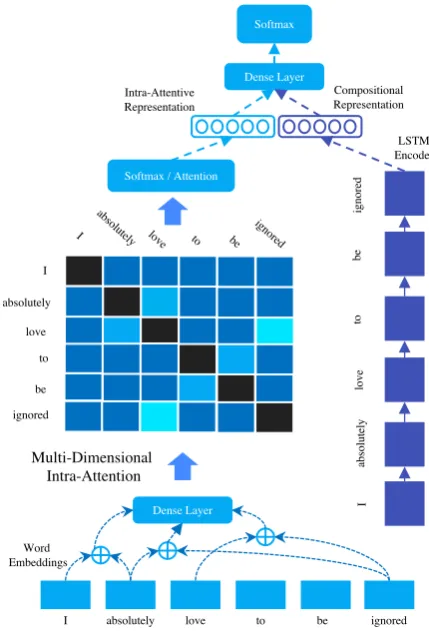
In this section, we describe our proposed model. Figure1illustrates our overall model architecture.
3.1 Input Encoding Layer
Our model accepts a sequence of one-hot encoded vectors as an input. Each one-hot encoded vec-tor corresponds to a single word in the vocabulary. In the input encoding layer, each one-hot vector is converted into a low-dimensional vector represen-tation (word embedding). The word embeddings are parameterized by an embedding layer W ∈ Rn×|V|. As such, the output of this layer is a se-quence of word embeddings, i.e.,{w1, w2,· · ·w`}
where`is a predefined maximum sequence length.
3.2 Multi-dimensional Intra-Attention
In this section, we describe our multi-dimensional intra-attention mechanism for sarcasm detec-tion. We first begin by describing the standard single-dimensional intra-attention. The multi-dimensional adaptation will be introduced later in this section. The key idea behind this layer is to look in-between, i.e., modeling the semantics between each word in the input sequence. We first begin by modeling the relationship of each word pair in the input sequence. A simple way to achieve this is to use a linear1transformation layer to project the concatenation of each word embed-dingpairinto a scalar score as follows:
sij =Wa([wi;wj]) +ba (1)
where Wa ∈ R2n×1, ba ∈ R are the parameters of this layer. [.;.]is the vector concatenation op-erator andsij is a scalar representing the affinity
score between word pairs(wi, wj). We can easily
observe thatsis a symmetrical matrix of`×` di-mensions. In order to learn attention vectora, we apply a row-wise max-pooling operator on matrix s.
a=sof tmax(max
row s) (2)
where a ∈ R` is a vector representing the
learned intra-attention weights. Then, the vector ais employed to learn weighted representation of {w1, w2· · ·w`}as follows:
va= `
X
i=1
wiai (3)
1Early experiments found that adding nonlinearity here
where v ∈ Rn is the intra-attentive
representa-tion of the input sequence. While other choices of pooling operators may be also employed (e.g., mean-pooling over max-pooling), the choice of max-pooling is empirically motivated. Intuitively, this attention layer learns to pay attention based on a word’slargestcontribution to all words in the se-quence. Since our objective is to highlight words that might contribute to the contrastive theories of sarcasm, a more discriminative pooling operator is desirable. Notably, we also mask values of s where i = j such that we do not allow the rela-tionship scores of a word with respect to itself to influence the overall attention weights.
Furthermore, our network can be considered as an ‘inner’ adaptation of neural attention, model-ing intra-sentence relationships between the raw word representations instead of representations that have been compositionally manipulated. This allows word-to-word similarity to be modeled‘as it is’ and not be influenced by composition. For example, when using the outputs of a composi-tional encoder (e.g., LSTM), matching words n and n + 1 might not be meaningful since they would be relatively similar in terms of semantic composition. For relatively short documents (such as tweets), it is also intuitive that attention typi-cally focuses on the last hidden representation.
Intuitively, the relationships between two words is often not straightforward. Words are complex and often hold more than one meanings (or word senses). As such, it might be beneficial to model
multiple views between two words. This can be modeled by representing the word pair interac-tion with a vector instead of a scalar. As such, we propose a multi-dimensional adaptation of the intra-attention mechanism. The key idea here is that each word pair is projected down to a low-dimensional vector before we compute the affin-ity score, which allows it to not only capture one view (one scalar) but also multiple views. A mod-ification to Equation (1) constitutes our Multi-Dimensional Intra-Attention variant.
sij =Wp(ReLU(Wq([wi;wj]) +bq)) +bp (4)
whereWq ∈Rn×k, Wp ∈Rk×1, bq ∈Rk, bp ∈R are the parameters of this layer. The final intra-attentive representation is then learned with Equa-tion (2) and Equation (3) which we do not repeat here for the sake of brevity.
Word Embeddings
I
absolutely
love to
ignored be
Multi-Dimensional Intra-Attention
I absolutely love to be ignored
Dense Layer
Compositional Representation
Softmax / Attention
I
abs
ol
ut
el
y
love
to
be
ignor
ed
Dense Layer Softmax
Intra-Attentive Representation
[image:4.595.308.523.62.378.2]LSTM Encoder
Figure 1: High level overview of our proposed MIARN ar-chitecture. MIARN learns two representations, one based on intra-sentence relationships (intra-attentive) and another based on sequential composition (LSTM). Both views are used for prediction.
3.3 Long Short-Term Memory Encoder
While we are able to simply use the learned repre-sentationvfor prediction, it is clear thatvdoes not encode compositional information and may miss out on important compositional phrases such as
‘not happy’. Clearly, our intra-attention mecha-nism simply considers a word-by-word interaction and does not model the input document sequen-tially. As such, it is beneficial to use a separate compositional encoder for this purpose, i.e., learn-ing compositional representations. To this end, we employ the standard Long Short-Term Mem-ory (LSTM) encoder. The output of an LSTM en-coder at each time-step can be briefly defined as:
hi =LSTM(w, i), ∀i∈[1, . . . `] (5)
LSTMs are commonplace in standard NLP appli-cations, we omit the technical details for the sake of brevity. Finally, to obtain a compositional rep-resentation of the input document, we usevc=h`
which is the last hidden output of the LSTM en-coder. Note that the inputs to the LSTM en-coder are the word embeddings right after the in-put encoding layer and not the outin-put of the intra-attention layer. We found that applying an LSTM on the intra-attentively scaled representations do not yield any benefits.
3.4 Prediction Layer
The inputs to the final prediction layer are two representations, namely (1) the intra-attentive rep-resentation (va ∈ Rn) and (2) the compositional representation (vc ∈Rd). This layer learns a joint representation of these two views using a nonlin-ear projection layer.
v=ReLU(Wz([va;vc]) +bz) (6)
whereWz ∈ R(d+n)×dandbz ∈Rd. Finally, we passvinto a Softmax classification layer.
ˆ
y=Sof tmax(Wf v+bf) (7)
where Wf ∈ Rd×2, bf ∈ R2 are the parameters of this layer. yˆ ∈ R2 is the output layer of our proposed model.
3.5 Optimization and Learning
Our network is trained end-to-end, optimizing the standard binary cross-entropy loss function.
J=−
N X
i=1
[yilog ˆyi+ (1−yi) log(1−yˆi)] +R (8)
whereJ is the cost function,yˆis the output of the network,R = ||θ||L2is the L2 regularization and λis the weight of the regularizer.
4 Empirical Evaluation
In this section, we describe our experimental setup and results. Our experiments were designed to an-swer the following research questions (RQs).
• RQ1- Does our proposed approach outper-form existing state-of-the-art models?
• RQ2 - What are the impacts of some
of the architectural choices of our model? How much does intra-attention contribute
to the model performance? Is the Multi-Dimensional adaptation better than the Single-Dimensional adaptation?
• RQ3- What can we interpret from the intra-attention layers? Does this align with our hy-pothesis aboutlooking in-betweenand mod-eling contrast?
4.1 Datasets
We conduct our experiments on six publicly avail-able benchmark datasets which span across three well-known sources.
• Tweets - Twitter2 is a microblogging plat-form which allows users to post statuses of less than 140 characters. We use two collections for sarcasm detection on tweets. More specifically, we use the dataset ob-tained from (1) (Pt´aˇcek et al.,2014) in which tweets are trained via hashtag based semi-supervised learning, i.e., hashtags such as #not, #sarcasm and #irony are marked as sar-castic tweets and (2) (Riloff et al., 2013) in which Tweets are hand annotated and manu-ally checked for sarcasm. For both datasets, we retrieve. Tweets using the Twitter API us-ing the provided tweet IDs.
• Reddit - Reddit3 is a highly popular social forum and community. Similar to Tweets, sarcastic posts are obtained via the tag ‘/s’ which are marked by the authors themselves. We use two Reddit datasets which are ob-tained from the subreddits /r/movies and
/r/technologyrespectively. Datasets are sub-sets from (Khodak et al.,2017).
• Debates- We use two datasets4from the In-ternet Argument Corpus (IAC) (Lukin and Walker, 2017) which have been hand anno-tated for sarcasm. This dataset, unlike the first two, is mainly concerned with long text and provides a diverse comparison from the other datasets. The IAC corpus was designed for research on political debates on online fo-rums. We use the V1 and V2 versions of the sarcasm corpus which are denoted as IAC-V1 and IAC-V2 respectively.
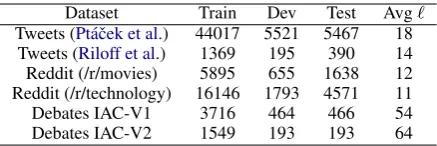
The statistics of the datasets used in our experi-ments is reported in Table1.
2https://twitter.com
3
https://reddit.com
Dataset Train Dev Test Avg`
Tweets (Pt´aˇcek et al.) 44017 5521 5467 18
Tweets (Riloff et al.) 1369 195 390 14
Reddit (/r/movies) 5895 655 1638 12
Reddit (/r/technology) 16146 1793 4571 11
Debates IAC-V1 3716 464 466 54
[image:6.595.72.291.61.134.2]Debates IAC-V2 1549 193 193 64
Table 1: Statistics of datasets used in our experiments.
4.2 Compared Methods
We compare our proposed model with the follow-ing algorithms.
• NBOW is a simple neural bag-of-words baseline that sums all the word embeddings and passes the summed vector into a simple logistic regression layer.
• CNNis a vanilla Convolutional Neural Net-work with max-pooling. CNNs are con-sidered as compositional encoders that cap-ture n-gram feacap-tures by parameterized sliding windows. The filter width is3and number of filtersf = 100.
• LSTMis a vanilla Long Short-Term Memory Network. The size of the LSTM cell is set to d= 100.
• ATT-LSTM (Attention-based LSTM) is a LSTM model with a neural attention mecha-nism applied to all the LSTM hidden outputs. We use a similar adaptation to (Yang et al.,
2016), albeit only at the document-level.
• GRNN (Gated Recurrent Neural Network)
is a Bidirectional Gated Recurrent Unit (GRU) model that was proposed for sarcasm detection by (Zhang et al., 2016). GRNN uses a gated pooling mechanism to aggregate the hidden representations from a standard BiGRU model. Since we only compare on document-level sarcasm detection, we do not use the variant of GRNN that exploits user context.
• CNN-LSTM-DNN (Convolutional LSTM + Deep Neural Network), proposed by (Ghosh and Veale,2016), is the state-of-the-art model for sarcasm detection. This model is a combination of a CNN, LSTM and Deep Neural Network via stacking. It stacks two layers of 1D convolution with 2 LSTM lay-ers. The output passes through a deep neural network (DNN) for prediction.
Both CNN-LSTM-DNN (Ghosh and Veale,2016) and GRNN (Zhang et al., 2016) are state-of-the-art models for document-level sarcasm de-tection and have outperformed numerous neu-ral and non-neuneu-ral baselines. In particular, both works have well surpassed feature-based mod-els (Support Vector Machines, etc.), as such we omit comparisons for the sake of brevity and fo-cus comparisons with recent neural models in-stead. Moreover, since our work focuses only on document-level sarcasm detection, we do not com-pare against models that use external information such as user profiles, context, personality informa-tion (Ghosh and Veale,2017) or emoji-based dis-tant supervision (Felbo et al.,2017).
For our model, we report results on both multi-dimensional and single-dimensional intra-attention. The two models are named as MIARN and SIARN respectively.
4.3 Implementation Details and Metrics
We adopt standard the evaluation metrics for the sarcasm detection task, i.e., macro-averaged F1 and accuracy score. Additionally, we also report precision and recall scores. All deep learning models are implemented using Tensor-Flow (Abadi et al., 2015) and optimized on a NVIDIA GTX1070 GPU. Text is preprocessed with NLTK5’s Tweet tokenizer. Words that only appear once in the entire corpus are removed and marked with the UNK token. Document lengths are truncated at40,20,80tokens for Twitter, Red-dit and Debates dataset respectively. Mentions of other users on the Twitter dataset are replaced by ‘@USER’. Documents with URLs (i.e., contain-ing ‘http’) are removed from the corpus. Docu-ments with less than 5 tokens are also removed. The learning optimizer used is the RMSProp with an initial learning rate of 0.001. The L2 regu-larization is set to 10−8. We initialize the word embedding layer with GloVe (Pennington et al.,
2014). We use the GloVe model trained on 2B Tweets for the Tweets and Reddit dataset. The Glove model trained on Common Crawl is used for the Debates corpus. The size of the word em-beddings is fixed at d = 100 and are fine-tuned during training. In all experiments, we use a de-velopment set to select the best hyperparameters. Each model is trained for a total of 30 epochs and the model is saved each time the performance
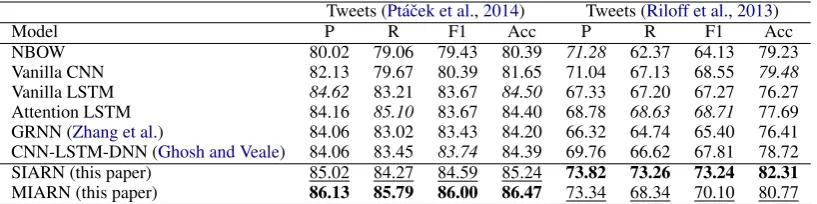
Tweets (Pt´aˇcek et al.,2014) Tweets (Riloff et al.,2013)
Model P R F1 Acc P R F1 Acc
NBOW 80.02 79.06 79.43 80.39 71.28 62.37 64.13 79.23
Vanilla CNN 82.13 79.67 80.39 81.65 71.04 67.13 68.55 79.48
Vanilla LSTM 84.62 83.21 83.67 84.50 67.33 67.20 67.27 76.27
Attention LSTM 84.16 85.10 83.67 84.40 68.78 68.63 68.71 77.69
GRNN (Zhang et al.) 84.06 83.02 83.43 84.20 66.32 64.74 65.40 76.41
CNN-LSTM-DNN (Ghosh and Veale) 84.06 83.45 83.74 84.39 69.76 66.62 67.81 78.72
SIARN (this paper) 85.02 84.27 84.59 85.24 73.82 73.26 73.24 82.31
[image:7.595.96.505.62.164.2]MIARN (this paper) 86.13 85.79 86.00 86.47 73.34 68.34 70.10 80.77
Table 2: Experimental Results on Tweets datasets. Best result in is boldface and second best is underlined. Best performing baseline is initalics.
Reddit (/r/movies) Reddit (/r/technology)
Model P R F1 Acc P R F1 Acc
NBOW 67.33 66.56 66.82 67.52 65.45 65.62 65.52 66.55
Vanilla CNN 65.97 65.97 65.97 66.24 65.88 62.90 62.85 66.80
Vanilla LSTM 67.57 67.67 67.32 67.34 66.94 67.22 67.03 67.92
Attention LSTM 68.11 67.87 67.94 68.37 68.20 68.78 67.44 67.22
GRNN (Zhang et al.) 66.16 66.16 66.16 66.42 66.56 66.73 66.66 67.65
CNN-LSTM-DNN (Ghosh and Veale) 68.27 67.87 67.95 68.50 66.14 66.73 65.74 66.00
SIARN (this paper) 69.59 69.48 69.52 69.84 69.35 70.05 69.22 69.57
[image:7.595.95.505.361.466.2]MIARN (this paper) 69.68 69.37 69.54 69.90 68.97 69.30 69.09 69.91
Table 3: Experimental results on Reddit datasets. Best result in is boldface and second best is underlined. Best performing baseline is initalics.
Debates (IAC-V1) Debates (IAC-V2)
Model P R F1 Acc P R F1 Acc
NBOW 57.17 57.03 57.00 57.51 66.01 66.03 66.02 66.09
Vanilla CNN 58.21 58.00 57.95 58.55 68.45 68.18 68.21 68.56
Vanilla LSTM 54.87 54.89 54.84 54.92 68.30 63.96 60.78 62.66
Attention LSTM 58.98 57.93 57.23 59.07 70.04 69.62 69.63 69.96
GRNN (Zhang et al.) 56.21 56.21 55.96 55.96 62.26 61.87 61.21 61.37
CNN-LSTM-DNN (Ghosh and Veale) 55.50 54.60 53.31 55.96 64.31 64.33 64.31 64.38
SIARN (this paper) 63.94 63.45 62.52 62.69 72.17 71.81 71.85 72.10
MIARN (this paper) 63.88 63.71 63.18 63.21 72.92 72.93 72.75 72.75
Table 4: Experimental results on Debates datasets. Best result in is boldface and second best is underlined. Best performing baseline is initalics.
on the development set is topped. The batch size is tuned amongst{128,256,512}for all datasets. The only exception is the Tweets dataset from (Riloff et al.,2013), in which a batch size of16is used in lieu of the much smaller dataset size. For fair comparison, all models have the same hidden representation size and are set to100for both re-current and convolutional based models (i.e., num-ber of filters). For MIARN, the size of intra-attention hidden representation is tuned amongst {4,8,10,20}.
4.4 Experimental Results
Table 2, Table 3 and Table 4 reports a perfor-mance comparison of all benchmarked models on the Tweets, Reddit and Debates datasets respec-tively. We observe that our proposed SIARN and MIARN models achieve the best results across
text (i.e., Twitter and Reddit). For example, MI-ARN outperforms GRNN and CNN-LSTM-DNN by≈8%−10%on both IAC-V1 and IAC-V2. At this note, we can safely putRQ1to rest.
Overall, the performance of MIARN is often marginally better than SIARN (with some ex-ceptions, e.g., Tweets dataset from (Riloff et al.,
2013)). We believe that this is attributed to the fact that more complex word-word relationships can be learned by using multi-dimensional values instead of single-dimensional scalars. The per-formance brought by our additional intra-attentive representations can be further observed by com-paring against the vanilla LSTM model. Clearly, removing the intra-attention network reverts our model to the standard LSTM. The performance improvements are encouraging, leading to almost
10% improvement in terms of F1 and accuracy. On datasets with short text, the performance im-provement is often a modest≈2%−3%(RQ2). Notably, our proposed models also perform much better on long text, which can be attributed to the intra-attentive representations explicitly modeling long range dependencies. Intuitively, this is prob-lematic for models that only capture sequential de-pendencies (e.g., word by word).
Finally, the relative performance of competitor methods are as expected. NBOW performs the worse, since it is just a naive bag-of-words model without any compositional or sequential informa-tion. On short text, LSTMs are overall better than CNNs. However, this trend is reversed on long text (i.e., Debates) since the LSTM model may be overburdened by overly long sequences. On short text, we also found that attention (or the gated pooling mechanism from GRNN) did not re-ally help make any significant improvements over the vanilla LSTM model and a qualitative expla-nation to why this is so is deferred to the next section. However, attention helps for long text (such as debates), resulting in Attention LSTMs becoming the strongest baseline on the Debates datasets. However, our proposed intra-attentive model is both effective on short text and long text, outperforming Attention LSTMs consistently on all datasets.
4.5 In-depth Model Analysis
In this section, we present an in-depth analysis of our proposed model. More specifically, we not only aim to showcase the interpretability of
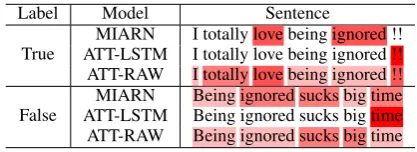
our model but also explain how representations are formed. More specifically, we test our model (trained on Tweets dataset by (Pt´aˇcek et al.,2014)) on two examples. We extract the attention maps of three models, namely MIARN, Attention LSTM (ATT-LSTM) and applying Attention mechanism directly on the word embeddings without using a LSTM encoder (ATT-RAW). Table5shows the vi-sualization of the attention maps.
Label Model Sentence
True
MIARN I totally love being ignored !!
ATT-LSTM I totally love being ignored !! ATT-RAW I totally love being ignored !!
False
MIARN Being ignored sucks big time
ATT-LSTM Being ignored sucks big time
[image:8.595.311.520.195.271.2]ATT-RAW Being ignored sucks big time
Table 5: Visualization of normalized attention weights on three different attention models (Best viewed in color). The intensity denotes the strength of the attention weight on the word.
In the first example (truelabel), we notice that the attention maps of MIARN are focusing on the words‘love’and‘ignored’. This is in concert with our intuition about modeling contrast and incon-gruity. On the other hand, both ATT-LSTM and ATT-RAW learn very different attention maps. As for ATT-LSTM, the attention weight is focused completely on the last representation - the token ‘!!’. Additionally, we also observed that this is true for many examples in the Tweets and Red-dit dataset. We believe that this is the reason why standard neural attention does not help as what the attention mechanism is learning is to select the last representation (i.e., vanilla LSTM). Without the LSTM encoder, the attention weights focus on
‘love’but not‘ignored’. This fails to capture any concept of contrast or incongruity.
Next, we consider the false labeled example. This time, the attention maps of MIARN are not as distinct as before. However, they focus on sentiment-bearing words, composing the words
‘ignored sucks’to form the majority of the intra-attentive representation. This time, passing the vector made up of‘ignored sucks’allows the sub-sequent layers to recognize that there is no con-trasting situation or sentiment. Similarly, ATT-LSTM focuses on the last wordtimewhich is to-tally non-interpretable. On the other hand, ATT-RAW focuses on relatively non-meaningful words such as‘big’.
very explainable attention maps. In general, we found that MIARN is able to identify contrast and incongruity in sentences, allowing our model to better detect sarcasm. This is facilitated by model-ing intra-sentence relationships. Notably, the stan-dard vanilla attention is not explainable or inter-pretable.
5 Conclusion
Based on the intuition of intra-sentence similar-ity (i.e.,looking in-between), we proposed a new neural network architecture for sarcasm detection. Our network incorporates a multi-dimensional attention component that learns an intra-attentive representation of the sentence, enabling it to detect contrastive sentiment, situations and incongruity. Extensive experiments over six pub-lic benchmarks confirm the empirical effective-ness of our proposed model. Our proposed MI-ARN model outperforms strong state-of-the-art baselines such as GRNN and CNN-LSTM-DNN. Analysis of the intra-attention scores shows that our model learns highly interpretable attention weights, paving the way for more explainable neu-ral sarcasm detection methods.
References
Mart´ın Abadi, Ashish Agarwal, Paul Barham, Eugene Brevdo, Zhifeng Chen, Craig Citro, Greg S. Cor-rado, Andy Davis, Jeffrey Dean, Matthieu Devin, Sanjay Ghemawat, Ian Goodfellow, Andrew Harp, Geoffrey Irving, Michael Isard, Yangqing Jia, Rafal Jozefowicz, Lukasz Kaiser, Manjunath Kudlur, Josh Levenberg, Dan Man´e, Rajat Monga, Sherry Moore, Derek Murray, Chris Olah, Mike Schuster, Jonathon Shlens, Benoit Steiner, Ilya Sutskever, Kunal Tal-war, Paul Tucker, Vincent Vanhoucke, Vijay Vasude-van, Fernanda Vi´egas, Oriol Vinyals, Pete Warden, Martin Wattenberg, Martin Wicke, Yuan Yu, and Xi-aoqiang Zheng. 2015. TensorFlow: Large-scale ma-chine learning on heterogeneous systems. Software available from tensorflow.org.
Silvio Amir, Byron C Wallace, Hao Lyu, and Paula Carvalho M´ario J Silva. 2016. Modelling context with user embeddings for sarcasm detection in so-cial media.arXiv preprint arXiv:1607.00976.
Dzmitry Bahdanau, Kyunghyun Cho, and Yoshua Ben-gio. 2014. Neural machine translation by jointly learning to align and translate. arXiv preprint arXiv:1409.0473.
Francesco Barbieri, Horacio Saggion, and Francesco Ronzano. 2014. Modelling sarcasm in twitter, a
novel approach. In Proceedings of the 5th Work-shop on Computational Approaches to Subjectivity, Sentiment and Social Media Analysis. pages 50–58.
Huimin Chen, Maosong Sun, Cunchao Tu, Yankai Lin, and Zhiyuan Liu. 2016. Neural sentiment classifi-cation with user and product attention. In Proceed-ings of the 2016 Conference on Empirical Methods in Natural Language Processing. pages 1650–1659.
Peng Chen, Zhongqian Sun, Lidong Bing, and Wei Yang. 2017. Recurrent attention network on mem-ory for aspect sentiment analysis. InProceedings of the 2017 Conference on Empirical Methods in Nat-ural Language Processing. pages 452–461.
Kyunghyun Cho, Bart Van Merri¨enboer, Caglar Gul-cehre, Dzmitry Bahdanau, Fethi Bougares, Holger Schwenk, and Yoshua Bengio. 2014. Learning phrase representations using rnn encoder-decoder for statistical machine translation. arXiv preprint arXiv:1406.1078.
Bjarke Felbo, Alan Mislove, Anders Søgaard, Iyad Rahwan, and Sune Lehmann. 2017. Using millions of emoji occurrences to learn any-domain represen-tations for detecting sentiment, emotion and sar-casm. arXiv preprint arXiv:1708.00524.
Aniruddha Ghosh and Tony Veale. 2016. Frack-ing sarcasm usFrack-ing neural network. In Proceed-ings of the 7th Workshop on Computational Ap-proaches to Subjectivity, Sentiment and Social Me-dia Analysis, WASSA@NAACL-HLT 2016, June 16, 2016, San Diego, California, USA. pages 161– 169. http://aclweb.org/anthology/W/W16/W16-0425.pdf.
Aniruddha Ghosh and Tony Veale. 2017. Magnets for sarcasm: Making sarcasm detection timely, con-textual and very personal. In Proceedings of the 2017 Conference on Empirical Methods in Natural Language Processing, EMNLP 2017, Copenhagen, Denmark, September 9-11, 2017. pages 482–491.
Rachel Giora. 1995. On irony and negation.Discourse processes19(2):239–264.
Roberto Gonz´alez-Ib´anez, Smaranda Muresan, and Nina Wacholder. 2011. Identifying sarcasm in twit-ter: a closer look. In Proceedings of the 49th Annual Meeting of the Association for Computa-tional Linguistics: Human Language Technologies: Short Papers-Volume 2. Association for Computa-tional Linguistics, pages 581–586.
Iraz´u Hern´andez-Far´ıas, Jos´e-Miguel Bened´ı, and Paolo Rosso. 2015. Applying basic features from sentiment analysis for automatic irony detection. In
Iberian Conference on Pattern Recognition and Im-age Analysis. Springer, pages 337–344.
Sepp Hochreiter and J¨urgen Schmidhuber. 1997. Long short-term memory. Neural computation
Aditya Joshi, Pushpak Bhattacharyya, and Mark J Car-man. 2017. Automatic sarcasm detection: A survey.
ACM Computing Surveys (CSUR)50(5):73.
Aditya Joshi, Vinita Sharma, and Pushpak Bhat-tacharyya. 2015. Harnessing context incongruity for sarcasm detection. In Proceedings of the 53rd An-nual Meeting of the Association for Computational Linguistics and the 7th International Joint Confer-ence on Natural Language Processing (Volume 2: Short Papers). volume 2, pages 757–762.
Aditya Joshi, Vaibhav Tripathi, Kevin Patel, Pushpak Bhattacharyya, and Mark Carman. 2016. Are word embedding-based features useful for sarcasm detec-tion? arXiv preprint arXiv:1610.00883.
Mikhail Khodak, Nikunj Saunshi, and Kiran Vodra-halli. 2017. A large self-annotated corpus for sar-casm. arXiv preprint arXiv:1704.05579.
Stephanie Lukin and Marilyn Walker. 2017. Really? well. apparently bootstrapping improves the perfor-mance of sarcasm and nastiness classifiers for online dialogue. arXiv preprint arXiv:1708.08572.
Minh-Thang Luong, Hieu Pham, and Christopher D Manning. 2015. Effective approaches to attention-based neural machine translation. arXiv preprint arXiv:1508.04025.
Abhijit Mishra, Kuntal Dey, and Pushpak Bhat-tacharyya. 2017. Learning cognitive features from gaze data for sentiment and sarcasm classification using convolutional neural network. InProceedings of the 55th Annual Meeting of the Association for Computational Linguistics, ACL 2017, Vancouver, Canada, July 30 - August 4, Volume 1: Long Papers. pages 377–387. https://doi.org/10.18653/v1/P17-1035.
Abhijit Mishra, Diptesh Kanojia, Seema Nagar, Kuntal Dey, and Pushpak Bhattacharyya. 2016. Harness-ing cognitive features for sarcasm detection. In Pro-ceedings of the 54th Annual Meeting of the Associ-ation for ComputAssoci-ational Linguistics, ACL 2016, Au-gust 7-12, 2016, Berlin, Germany, Volume 1: Long Papers. http://aclweb.org/anthology/P/P16/P16-1104.pdf.
Bo Pang, Lillian Lee, et al. 2008. Opinion mining and sentiment analysis. Foundations and TrendsR in
In-formation Retrieval2(1–2):1–135.
Ankur P. Parikh, Oscar T¨ackstr¨om, Dipanjan Das, and Jakob Uszkoreit. 2016. A decomposable attention model for natural language inference. In Proceed-ings of the 2016 Conference on Empirical Meth-ods in Natural Language Processing, EMNLP 2016, Austin, Texas, USA, November 1-4, 2016. pages 2249–2255.
Lotem Peled and Roi Reichart. 2017. Sarcasm SIGN: interpreting sarcasm with sentiment based monolin-gual machine translation. InProceedings of the 55th
Annual Meeting of the Association for Computa-tional Linguistics, ACL 2017, Vancouver, Canada, July 30 - August 4, Volume 1: Long Papers. pages 1690–1700. https://doi.org/10.18653/v1/P17-1155.
Jeffrey Pennington, Richard Socher, and Christo-pher D. Manning. 2014. Glove: Global vectors for word representation. In Proceedings of the 2014 Conference on Empirical Methods in Natural Lan-guage Processing, EMNLP 2014, October 25-29, 2014, Doha, Qatar, A meeting of SIGDAT, a Special Interest Group of the ACL. pages 1532–1543.
Tom´aˇs Pt´aˇcek, Ivan Habernal, and Jun Hong. 2014. Sarcasm detection on czech and english twitter. In
Proceedings of COLING 2014, the 25th Interna-tional Conference on ComputaInterna-tional Linguistics: Technical Papers. pages 213–223.
Ashwin Rajadesingan, Reza Zafarani, and Huan Liu. 2015. Sarcasm detection on twitter: A behavioral modeling approach. In Proceedings of the Eighth ACM International Conference on Web Search and Data Mining. ACM, pages 97–106.
Antonio Reyes, Paolo Rosso, and Tony Veale. 2013. A multidimensional approach for detecting irony in twitter. Language resources and evaluation
47(1):239–268.
Ellen Riloff, Ashequl Qadir, Prafulla Surve, Lalin-dra De Silva, Nathan Gilbert, and Ruihong Huang. 2013. Sarcasm as contrast between a positive sentiment and negative situation. In Proceedings of the 2013 Conference on Empirical Methods in Natural Language Processing, EMNLP 2013, 18-21 October 2013, Grand Hyatt Seattle, Seattle, Washington, USA, A meeting of SIGDAT, a Spe-cial Interest Group of the ACL. pages 704–714.
http://aclweb.org/anthology/D/D13/D13-1066.pdf.
Tim Rockt¨aschel, Edward Grefenstette, Karl Moritz Hermann, Tom´aˇs Koˇcisk`y, and Phil Blunsom. 2015. Reasoning about entailment with neural attention.
arXiv preprint arXiv:1509.06664.
Minjoon Seo, Aniruddha Kembhavi, Ali Farhadi, and Hannaneh Hajishirzi. 2016. Bidirectional attention flow for machine comprehension. arXiv preprint arXiv:1611.01603.
Tao Shen, Tianyi Zhou, Guodong Long, Jing Jiang, Shirui Pan, and Chengqi Zhang. 2017. Disan: Directional self-attention network for rnn/cnn-free language understanding. arXiv preprint arXiv:1709.04696.
Yi Tay, Anh Tuan Luu, and Siu Cheung Hui. 2018s. Learning to attend via word-aspect associative fu-sion for aspect-based sentiment analysis. InIn Pro-ceedings of the AAAI 2018, 5956-5963.
Yi Tay, Luu Anh Tuan, and Siu Cheung Hui. 2017b. Dyadic memory networks for aspect-based sentiment analysis. In Proceedings of the 2017 ACM on Conference on Information and Knowledge Management, CIKM 2017, Singa-pore, November 06 - 10, 2017. pages 107–116.
https://doi.org/10.1145/3132847.3132936.
Oren Tsur, Dmitry Davidov, and Ari Rappoport. 2010. Icwsm-a great catchy name: Semi-supervised recog-nition of sarcastic sentences in online product re-views.
Ashish Vaswani, Noam Shazeer, Niki Parmar, Jakob Uszkoreit, Llion Jones, Aidan N Gomez, Łukasz Kaiser, and Illia Polosukhin. 2017. Attention is all you need. InAdvances in Neural Information Pro-cessing Systems. pages 6000–6010.
Deirdre Wilson. 2006. The pragmatics of verbal irony: Echo or pretence? Lingua116(10):1722–1743.
Caiming Xiong, Victor Zhong, and Richard Socher. 2016. Dynamic coattention networks for question answering. CoRRabs/1611.01604.
Zichao Yang, Diyi Yang, Chris Dyer, Xiaodong He, Alexander J Smola, and Eduard H Hovy. 2016. Hi-erarchical attention networks for document classifi-cation.
Meishan Zhang, Yue Zhang, and Guohong Fu. 2016.
Tweet sarcasm detection using deep neural net-work. InCOLING 2016, 26th International Con-ference on Computational Linguistics, Proceed-ings of the Conference: Technical Papers, Decem-ber 11-16, 2016, Osaka, Japan. pages 2449–2460.