Proceedings of the 56th Annual Meeting of the Association for Computational Linguistics (Long Papers), pages 1725–1735 1725
Efficient and Robust Question Answering
from Minimal Context over Documents
Sewon Min1∗, Victor Zhong2, Richard Socher2, Caiming Xiong2
Seoul National University1, Salesforce Research2
[email protected],{vzhong, rsocher, cxiong}@salesforce.com
Abstract
Neural models for question answering (QA) over documents have achieved sig-nificant performance improvements. Al-though effective, these models do not scale to large corpora due to their complex mod-eling of interactions between the docu-ment and the question. Moreover, re-cent work has shown that such models are sensitive to adversarial inputs. In this paper, we study the minimal context re-quired to answer the question, and find that most questions in existing datasets can be answered with a small set of sen-tences. Inspired by this observation, we propose a simple sentence selector to se-lect the minimal set of sentences to feed into the QA model. Our overall system achieves significant reductions in training (up to 15 times) and inference times (up to 13 times), with accuracy comparable to or better than the state-of-the-art on SQuAD, NewsQA, TriviaQA and SQuAD-Open. Furthermore, our experimental results and analyses show that our approach is more robust to adversarial inputs.
1 Introduction
The task of textual question answering (QA), in which a machine reads a document and answers a question, is an important and challenging problem in natural language processing. Recent progress in performance of QA models has been largely due to the variety of available QA datasets ( Richard-son et al., 2013;Hermann et al.,2015;Rajpurkar et al., 2016; Trischler et al., 2016; Joshi et al.,
2017;Koˇcisk`y et al.,2017).
∗
All work was done while the author was an intern at Salesforce Research.
Many neural QA models have been proposed for these datasets, the most successful of which tend to leverage coattention or bidirectional atten-tion mechanisms that build codependent represen-tations of the document and the question (Xiong et al.,2018;Seo et al.,2017).
Yet, learning the full context over the document is challenging and inefficient. In particular, when the model is given a long document, or multiple documents, learning the full context is intractably slow and hence difficult to scale to large corpora. In addition,Jia and Liang(2017) show that, given adversarial inputs, such models tend to focus on wrong parts of the context and produce incorrect answers.
In this paper, we aim to develop a QA system that is scalable to large documents as well as ro-bust to adversarial inputs. First, we study the con-text required to answer the question by sampling examples in the dataset and carefully analyzing them. We find that most questions can be an-swered using a few sentences, without the consid-eration of context over entire document. In partic-ular, we observe that on the SQuAD dataset ( Ra-jpurkar et al.,2016),92%of answerable questions can be answered using a single sentence.
Second, inspired by this observation, we pro-pose a sentence selector to select the minimal set of sentences to give to the QA model in order to answer the question. Since the minimum num-ber of sentences depends on the question, our tence selector chooses a different number of sen-tences for each question, in contrast with previ-ous models that select a fixed number of sentences. Our sentence selector leverages three simple tech-niques — weight transfer, data modification and score normalization, which we show to be highly effective on the task of sentence selection.
N %on %on
Document Question
sent SQuAD TriviaQA
1 90 56 In 1873, Tesla returned to his birthtown,Smiljan.Shortly after he arrived, (...) Where did Tesla return to in 1873?
2 6 28 After leaving Edison’s company Tesla partnered with two businessmen in 1886, What did Tesla Electric Light & Manufacturing Robert Lane and Benjamin Vail, who agreed to finance an electric lighting do?
company in Tesla’s name, Tesla Electric Light & Manufacturing.The company
installed electrical arc light based illumination systemsdesigned by Tesla and also had designs for dynamo electric machine commutators, (...)
3↑ 2 4 Kenneth Swezey, a journalist whom Tesla had befriended, confirmed that Tesla Who did Tesla call in the middle of the night?
rarely slept .Swezey recalled one morning when Tesla called him at 3 a.m. : ”I was sleeping in my room (...) Suddenly, the telephone ring awakened me ...
N/A 2 12 Writers whose papers are in the library are as diverse asCharles Dickensand The papers of which famous English Victorian
[image:2.595.74.527.60.178.2]Beatrix Potter.Illuminated manuscripts in the library dating from (...) author are collected in the library?
Table 1: Human analysis of the context required to answer questions on SQuAD and TriviaQA. 50 examples from each dataset are sampled randomly. ‘N sent’ indicates the number of sentences required to answer the question, and ‘N/A’ indicates the question is not answerable even given all sentences in the document. ‘Document’ and ‘Question’ are from the representative example from each category on SQuAD. Examples on TriviaQA are shown in AppendixB. The groundtruth answer span is inred text, and the oracle sentence (the sentence containing the grountruth answer span) is inbold text.
No. Description % Sentence Question
0 Correct (Not exactly same 58 Gothic architectureis represented in the majestic churches but also at the burgher What type of architecture is represented as grountruth) houses and fortifications. in the majestic churches?
1 Fail to select precise span 6 Brownlee argues that disobedience in opposition to the decisions of non-governmental Brownlee argues disobedience can be agencies such astrade unions, banks, and privateuniversities can be justified if it justified toward what institutions? reflects ‘a larger challenge to the legal system that permits those decisions to be taken;.
2 Complex semantics in 34 Newton was limited by Denver’s defense, which sacked himseventimes and forced him How many times did the Denver defense sentence/question into three turnovers, including a fumble which they recovered for a touchdown. force Newton into turnovers? 3 Not answerable even with 2 He encourages a distinction between lawful protest demonstration,nonviolentcivil What type of civil disobedience is
full paragraph disobedience, and violent civil disobedience. accompanied by aggression?
Table 2: Error cases (on exact match (EM)) of DCN+ given oracle sentence on SQuAD. 50 examples are sampled randomly. Grountruth span is in underlined text, and model’s prediction is inbold text.
minimalset of sentences (MINIMAL) on five dif-ferent QA tasks with varying sizes of documents. On SQuAD, NewsQA, TriviaQA(Wikipedia) and SQuAD-Open, MINIMALachieves significant re-ductions in training and inference times (up to
15×and13×, respectively), with accuracy com-parable to or better than FULL. On three of those datasets, this improvements leads to the new state-of-the-art. In addition, our experimental results and analyses show that our approach is more ro-bust to adversarial inputs. On the development set of SQuAD-Adversarial (Jia and Liang,2017), MINIMAL outperforms the previous state-of-the-art model by up to13%.
2 Task analyses
Existing QA models focus on learning the context over different parts in the full document. Although effective, learning the context within the full docu-ment is challenging and inefficient. Consequently, we study the minimal context in the document re-quired to answer the question.
2.1 Human studies
First, we randomly sample50examples from the SQuAD development set, and analyze the mini-mum number of sentences required to answer the question, as shown in Table1. We observed that
98%of questions are answerable given the docu-ment. The remaining 2% of questions are not an-swerable even given the entire document. For in-stance, in the last example in Table1, the question requires the background knowledge that Charles Dickens is an English Victorian author. Among the answerable examples, 92% are answerable with a single sentence,6%with two sentences, and
2%with three or more sentences.
We perform a similar analysis on the TriviaQA (Wikipedia) development (verified) set. Finding the sentences to answer the question on TriviaQA is more challenging than on SQuAD, since Triv-iaQA documents are much longer than SQuAD documents (488 vs 5 sentences per document). Nevertheless, we find that most examples are an-swerable with one or two sentences — among the
[image:2.595.75.528.281.365.2]2.2 Analyses on existing QA model
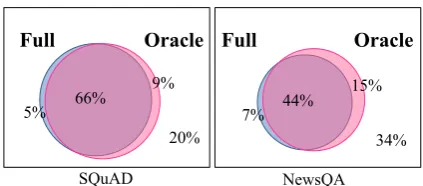
Given that the majority of examples are answer-able with a single oracle sentence on SQuAD, we analyze the performance of an existing, compet-itive QA model when it is given the oracle sen-tence. We train DCN+ (Xiong et al.,2018), one of the state-of-the-art models on SQuAD (details in Section3.1), on the oracle sentence. The model achieves83.1 F1 when trained and evaluated us-ing the full document and 85.1 F1 when trained and evaluated using the oracle sentence. We ana-lyze 50 randomly sampled examples in which the model fails on exact match (EM) despite using the oracle sentence. We classify these errors into 4 categories, as shown in Table 2. In these exam-ples, we observed that 40% of questions are an-swerable given the oracle sentence but the model unexpectedly fails to find the answer. 58% are those in which the model’s prediction is correct but does not lexically match the groundtruth answer, as shown in the first example in Table 2. 2%are those in which the question is not answerable even given the full document. In addition, we com-pare predictions by the model trained using the full document (FULL) with the model trained on the oracle sentence (ORACLE). Figure1shows the
Venn diagram of the questions answered correctly
by FULL and ORACLEon SQuAD and NewsQA.
ORACLE is able to answer 93% and 86% of the
questions correctly answered by FULLon SQuAD and NewsQA, respectively.
These experiments and analyses indicate that if the model can accurately predict the oracle sen-tence, the model should be able to achieve compa-rable performance on overall QA task. Therefore, we aim to create an effective, efficient and robust QA system which only requires a single or a few sentences to answer the question.
3 Method
Our overall architecture (Figure 2) consists of a sentence selector and a QA model. The sentence selector computes a selection score for each sen-tence in parallel. We give to the QA model a re-duced set of sentences with high selection scores to answer the question.
3.1 Neural Question Answering Model
We study two neural QA models that obtain close to state-of-the-art performance on SQuAD. DCN+ (Xiong et al., 2018) is one of the
start-Full Oracle Full Oracle
5% 66%
9%
7% 44%
15%
20% 34%
[image:3.595.310.522.61.154.2]SQuAD NewsQA
Figure 1: Venn diagram of the questions answered correctly (on exact match (EM)) by the model given a full document (FULL) and the model given an oracle sentence (ORACLE) on SQuAD (left) and NewsQA (right).
of-the-art QA models, achieving 83.1 F1 on the SQuAD development set. It features a deep resid-ual coattention encoder, a dynamic pointing de-coder, and a mixed objective that combines cross entropy loss with self-critical policy learning. S-Reader is another competitive QA model that is simpler and faster than DCN+, with79.9F1 on the SQuAD development set. It is a simplified version of the reader in DrQA (Chen et al.,2017), which obtains 78.8F1 on the SQuAD development set. Model details and training procedures are shown in AppendixA.
3.2 Sentence Selector
Our sentence selector scores each sentence with respect to the question in parallel. The score indi-cates whether the question is answerable with this sentence.
The model architecture is divided into the coder module and the decoder module. The en-coder is a shared module with S-Reader, which computes sentence encodings and question encod-ings from the sentence and the question as inputs. First, the encoder computes sentence embeddings D∈Rhd×Ld, question embeddingsQ∈Rhd×Lq,
and question-aware sentence embeddings Dq ∈
Rhd×Ld, where h
d is the dimension of word em-beddings, andLdandLq are the sequence length of the document and the question, respectively. Specifically, question-aware sentence embeddings are obtained as follows.
αi = softmax(DTi W1Q)∈RLq (1)
Diq =
Lq
X
j=1
(αi,jQj)∈Rhd (2)
Here,Di ∈ Rhd is the hidden state of sentence
Embed Matrix Embed Matrix
BiLSTM BiLSTM
…
LD Sentence
…
LQ
D … …
Question Q 𝐷𝑄
…
… …
Denc Qenc
… …
Denc Qenc
Linear+Softmax …
scorestart
BiLinear
scoreend
…
Denc
…
BiLinear
… …
Denc Qenc
Linear+Softmax …
Max score
BiLinear
above threshold?
merge Answer
Encoder Sentence
Selector Decoder
QA Model Decoder
Linear (a)
(b)
(c)
[image:4.595.84.521.68.395.2](d)
Figure 2: Our model architecture. (a) Overall pipeline, consisting of sentence selector and QA model. Selection score of each sentence is obtained in parallel, then sentences with selection score above the threshold are merged and fed into QA model. (b) Shared encoder of sentence selector and S-Reader (QA Model), which takes document and the question as inputs and outputs the document encodingsDencand question encodingsQenc. (c) Decoder of S-Reader (QA Model), which takesDenc andQenc as inputs and outputs the scores for start and end positions. (d) Decoder of sentence selector, which takesDencand Qencfor each sentence and outputs the score indicating if the question is answerable given the sentence.
a trainable weight matrix. After this, sentence en-codings and question enen-codings are obtained using an LSTM (Hochreiter and Schmidhuber,1997).
Denc = BiLSTM([Di;Dqi])∈Rh
×Ld (3)
Qenc = BiLSTM(Qj)∈Rh×Lq (4)
Here, ‘;’ denotes the concatenation of two vec-tors, andh is a hyperparameter of the hidden di-mension.
Next, the decoder is a task-specific module which computes the score for the sentence by cal-culating bilinear similarities between sentence en-codings and question enen-codings as follows.
β = softmax(wTQenc)∈RLq (5)
˜
qenc = Lq
X
j=1
(βjQencj )∈Rh (6)
˜
hi = (Denci W2qenc˜ )∈Rh (7) ˜
h = max( ˜h1,h˜2,· · · ,h˜Ld) (8)
score = W3T˜h∈R2 (9)
Here, w ∈ Rh, W2 ∈ Rh×h×h, W3 ∈ Rh×2,
are trainable weight matrices. Each dimension in scoremeans the question is answerable or nonan-swerable given the sentence.
We introduce 3 techniques to train the model. (i) As the encoder module of our model is iden-tical to that of S-Reader, we transfer the weights to the encoder module from the QA model trained on the single oracle sentence (ORACLE). (ii) We
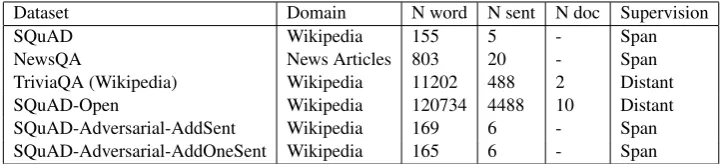
Dataset Domain N word N sent N doc Supervision
SQuAD Wikipedia 155 5 - Span
NewsQA News Articles 803 20 - Span
[image:5.595.118.479.62.144.2]TriviaQA (Wikipedia) Wikipedia 11202 488 2 Distant SQuAD-Open Wikipedia 120734 4488 10 Distant SQuAD-Adversarial-AddSent Wikipedia 169 6 - Span SQuAD-Adversarial-AddOneSent Wikipedia 165 6 - Span
Table 3: Dataset used for experiments. ‘N word’, ‘N sent’ and ‘N doc’ refer to the average number of words, sentences and documents, respectively. All statistics are calculated on the development set. For SQuAD-Open, since the task is in open-domain, we calculated the statistics based on top 10 documents from Document Retriever in DrQA (Chen et al.,2017).
obtain the score for each sentence, we normalize scores across sentences from the same paragraph, similar toClark and Gardner(2017). All of these three techniques give substantial improvements in sentence selection accuracy, as shown in Table4. More details including hyperparameters and train-ing procedures are shown in AppendixA.
Because the minimal set of sentences required to answer the question depends on the question, we select the set of sentences by thresholding the sentence scores, where the threshold is a hyper-parameter (details in Appendix A). This method allows the model to select a variable number of sentences for each question, as opposed to a fixed number of sentences for all questions. Also, by controlling the threshold, the number of sen-tences can be dynamically controlled during the inference. We define Dyn (for Dynamic) as this method, and define Top kas the method which simply selects the top-k sentences for each ques-tion.
4 Experiments
4.1 Dataset and Evaluation Metrics
We train and evaluate our model on five different datasets as shown in Table3.
SQuAD (Rajpurkar et al., 2016) is a well-studied QA dataset on Wikipedia articles that re-quires each question to be answered from a para-graph.
NewsQA (Trischler et al.,2016) is a dataset on news articles that also provides a paragraph for each question, but the paragraphs are longer than those in SQuAD.
TriviaQA (Joshi et al.,2017) is a dataset on a large set of documents from the Wikipedia domain and Web domain. Here, we only use the Wikipedia
domain. Each question is given a much longer context in the form of multiple documents.
SQuAD-Open (Chen et al., 2017) is an open-domain question answering dataset based on SQuAD. In SQuAD-Open, only the question and the answer are given. The model is responsible for identifying the relevant context from all English Wikipedia articles.
SQuAD-Adversarial (Jia and Liang,2017) is a variant of SQuAD. It shares the same training set as SQuAD, but an adversarial sentence is added to each paragraph in a subset of the development set.
We use accuracy (Acc) and mean average pre-cision (MAP) to evaluate sentence selection. We also measure the average number of selected sen-tences (N sent) to compare the efficiency of our
Dynmethod and theTop kmethod.
To evaluate the performance in the task of ques-tion answering, we measure F1 and EM (Exact Match), both being standard metrics for evaluat-ing span-based QA. In addition, we measure train-ing speed (Train Sp) and inference speed (Infer Sp) relative to the speed of standard QA model (FULL). The speed is measured using a single GPU (Tesla K80), and includes the training and inference time for the sentence selector.
4.2 SQuAD and NewsQA
Model SQuAD NewsQA Top 1 MAP Top 1 Top 3 MAP
TF-IDF 81.2 89.0 49.8 72.1 63.7
Our selector 85.8 91.6 63.2 85.1 75.5 Our selector (T) 90.0 94.3 67.1 87.9 78.5 Our selector (T+M, T+M+N) 91.2 95.0 70.9 89.7 81.1
Tan et al.(2018) - 92.1 - -
-Selection method SQuAD NewsQA N sent Acc N sent Acc
Top k(T+M)a
1 91.2 1 70.9
Top k(T+M)a
2 97.2 3 89.7
Top k(T+M)a 3 98.9 4 92.5
Dyn(T+M) 1.5 94.7 2.9 84.9
Dyn(T+M) 1.9 96.5 3.9 89.4
Dyn(T+M+N) 1.5 98.3 2.9 91.8
[image:6.595.75.290.61.228.2]Dyn(T+M+N) 1.9 99.3 3.9 94.6
Table 4: Results of sentence selection on the dev set of SQuAD and NewsQA. (Top) We compare different models and training methods. We report Top 1 accuracy (Top 1) and Mean Average Pre-cision (MAP). Our selector outperforms the pre-vious state-of-the-art (Tan et al.,2018). (Bottom) We compare different selection methods. We re-port the number of selected sentences (N sent) and the accuracy of sentence selection (Acc). ‘T’, ‘M’ and ‘N’ are training techniques described in Sec-tion 3.2 (weight transfer, data modification and score normalization, respectively).
a‘N’ does not change the result onTop k, sinceTop
[image:6.595.308.526.62.298.2]kdepends on the relative scores across the sentences from same paragraph.
Figure 3: The distributions of number of sentences that our selector selects usingDynmethod on the dev set of SQuAD (left) and NewsQA (right).
Results Table4shows results in the task of sen-tence selection on SQuAD and NewsQA. First, our selector outperforms TF-IDF method and the previous state-of-the-art by large margin (up to
2.9%MAP).
Second, our three training techniques – weight transfer, data modification and score normaliza-tion – improve performance by up to5.6%MAP. Finally, ourDynmethod achieves higher accuracy with less sentences than theTop kmethod. For example, on SQuAD,Top 2achieves97.2 accu-racy, whereas Dyn achieves 99.3 accuracy with
SQuAD (with S-Reader)
F1 EM Train Sp Infer Sp FULL 79.9 71.0 x1.0 x1.0
ORACLE 84.3 74.9 x6.7 x5.1
MINIMAL(Top k) 78.7 69.9 x6.7 x5.1
MINIMAL(Dyn) 79.8 70.9 x6.7 x3.6 SQuAD (with DCN+)
FULL 83.1 74.5 x1.0 x1.0
ORACLE 85.1 76.0 x3.0 x5.1
MINIMAL(Top k) 79.2 70.7 x3.0 x5.1
MINIMAL(Dyn) 80.6 72.0 x3.0 x3.7
GNR 75.0a 66.6a -
-FastQA 78.5 70.3 -
-FusionNet 83.6 75.3 - -NewsQA (with S-Reader)
F1 EM Train Sp Infer Sp FULL 63.8 50.7 x1.0 x1.0
ORACLE 75.5 59.2 x18.8 x21.7
MINIMAL(Top k) 62.3 49.3 x15.0 x6.9
MINIMAL(Dyn) 63.2 50.1 x15.0 x5.3
FastQA 56.1 43.7 -
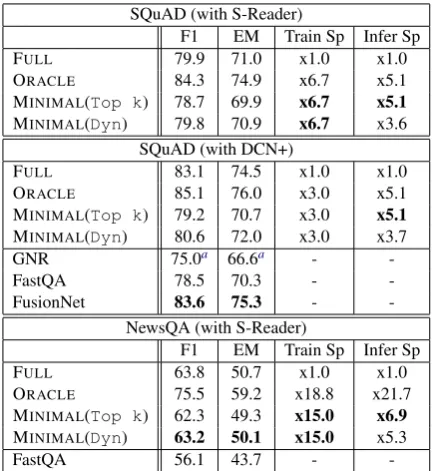
-Table 5: Results on the dev set of SQuAD (First
two) and NewsQA (Last). For Top k, we use
k = 1andk = 3 for SQuAD and NewsQA,
re-spectively. We compare with GNR (Raiman and Miller,2017), FusionNet (Huang et al.,2018) and FastQA (Weissenborn et al.,2017), which are the model leveraging sentence selection for question answering, and the published state-of-the-art mod-els on SQuAD and NewsQA, respectively.
a
Numbers on the test set.
1.9 sentences per example. On NewsQA, Top
4achieves92.5 accuracy, whereas Dyn achieves
94.6accuracy with 3.9 sentences per example. Figure 3 shows that the number of sentences selected by Dyn method vary substantially on both SQuAD and NewsQA. This shows that
Dynchooses a different number of sentences de-pending on the question, which reflects our intu-ition.
Table 5 shows results in the task of QA on SQuAD and NewsQA. MINIMALis more efficient
in training and inference than FULL. On SQuAD, S-Reader achieves6.7× training and3.6× infer-ence speedup on SQuAD, and15.0×training and
6.9×inference speedup on NewsQA. In addition to the speedup, MINIMALachieves comparable re-sult to FULL(using S-Reader,79.9vs79.8F1 on
[image:6.595.74.286.453.527.2]The initial LM model weighed approximately 33,3000 pounds, and allowed surface stays up to around34 hours. . . .
An Extended Lunar Module weighed over 36,200 pounds, and allowed surface stays of over3 days.
For about how long would the extended LM allow a surface stay on the moon?
Approximately1,000British soldiers were killed or injured. . . .
The remaining500British troops, led by George Washington, retreated to Virginia.
How many casualties did British get?
This book, which influenced the thought of Charles Darwin, successfully promoted the doctrine ofuniformitarianism. This theory states that slow geological processes have occurred throughout the Earth’s history and are still occurring today. In contrast,catastrophismis the theory that Earth’s features formed in single, catastrophic events and remained unchanged thereafter.
[image:7.595.74.527.55.381.2]Which theory states that slow geological processes are still occuring today, and have occurred throughout Earth’s history?
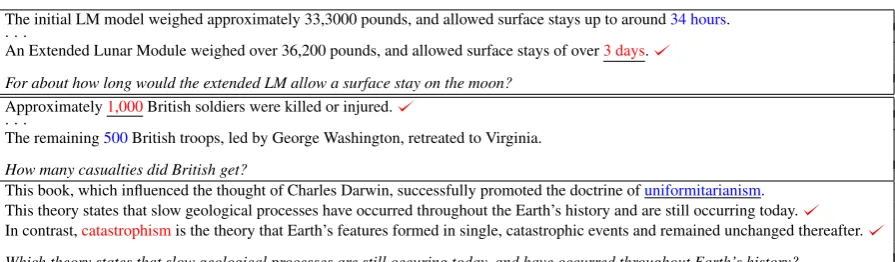
Table 6: Examples on SQuAD. Grountruth span (underlined text), the prediction from FULL(blue text) and MINIMAL (red text). Sentences selected by our selector is denoted with . In the above two
examples, MINIMALcorrectly answer the question by selecting the oracle sentence. In the last example, MINIMALfails to answer the question, since the inference over first and second sentences is required to answer the question.
selected sentence
However, in 1883-84 Germany began to build a colonial empire in Africa and the South Pacific, before losing interest in imperialism. The establishment of the German colonial empire proceeded smoothly, starting with German New Guinea in 1884.
When did Germany found their first settlement?1883-8418841884
In the late 1920s, Tesla also befriended George Sylvester Viereck, a poet, writer, mystic, and later, a Nazi propagandist. In middle age, Tesla became a close friend of Mark Twain; they spent a lot of time together in his lab and elsewhere. When did Tesla become friends with Viereck?late 1920smiddle agelate 1920s
Table 7: An example on SQuAD, where the sentences are ordered by the score from our selector. Groun-truth span (underlined text), the predictions fromTop 1(blue text),Top 2(green text) andDyn(red text). Sentences selected byTop 1,Top 2andDynare denoted with , and , respectively.
and the QA model correctly answers the question. In the last example, our sentence selector fails to choose the oracle sentence, so the QA model can-not predict the correct answer. In this case, our se-lector chooses the second and the third sentences instead of the oracle sentence because the former contains more information relevant to question. In fact, the context over the first and the second sen-tences is required to correctly answer the question.
Table 7 shows an example on SQuAD, which
MINIMAL with Dyn correctly answers the ques-tion, and MINIMALwithTop ksometimes does not.Top 1selects one sentence in the first exam-ple, thus fails to choose the oracle sentence. Top 2 selects two sentences in the second example, which is inefficient as well as leads to the wrong answer. In both examples,Dynselects the oracle sentence with minimum number of sentences, and subsequently predicts the answer. More analyses are shown in AppendixB.
4.3 TriviaQA and SQuAD-Open
TriviaQA and SQuAD-Open are QA tasks that reason over multiple documents. They do not
provide the answer span and only provide the question-answer pairs.
For each QA model, we experiment with two
types of inputs. First, since TriviaQA and
SQuAD-Open have many documents for each question, we first filter paragraphs based on the TF-IDF similarities between the question and the paragraph, and then feed the full paragraphs to the QA model (FULL). On TriviaQA, we choose the top 10 paragraphs for training and inference. On SQuAD-Open, we choose the top 20 paragraphs for training and the top 40 for inferences. Next, we use our sentence selector withDyn (MINIMAL).
We select 5-20 sentences using our sentence se-lector, from200sentences based on TF-IDF.
[image:7.595.76.524.59.190.2]TriviaQA (Wikipedia) SQuAD-Open
n sent Acc Sp F1 EM n sent Acc Sp F1 EM FULL 69 95.9 x1.0 59.6 53.5 124 76.9 x1.0 41.0 33.1
MINIMAL
TF-IDF 5 73.0 x13.8 51.9 45.8 5 46.1 x12.4 36.6 29.6 10 79.9 x6.9 57.2 51.5 10 54.3 x6.2 39.8 32.5 Our 5.0 84.9 x13.8 59.5 54.0 5.3 58.9 x11.7 42.3 34.6
Selector 10.5 90.9 x6.6 60.5 54.9 10.7 64.0 x5.8 42.5 34.7
Rank 1 - - - 56.0a 51.6a 2376a 77.8 - - 29.8 Rank 2 - - - 55.1a 48.6a - - - 37.5 29.1 Rank 3 - - - 52.9b 46.9a 2376a 77.8 - - 28.4
Table 8: Results on the dev-full set of TriviaQA (Wikipedia) and the dev set of SQuAD-Open. Full re-sults (including the dev-verified set on TriviaQA) are in AppendixC. For training FULLand MINIMALon TriviaQA, we use10 paragraphs and20 sentences, respectively. For training FULLand MINIMAL on SQuAD-Open, we use20paragraphs and20sentences, respectively. For evaluating FULLand MINIMAL, we use40paragraphs and5-20sentences, respectively. ‘n sent’ indicates the number of sentences used during inference. ‘Acc’ indicates accuracy of whether answer text is contained in selected context. ‘Sp’ indicates inference speed. We compare with the results from the sentences selected by TF-IDF method and our selector (Dyn). We also compare with published Rank1-3 models. For TriviaQA(Wikipedia), they are Neural Casecades (Swayamdipta et al., 2018), Reading Twice for Natural Language Under-standing (Weissenborn, 2017) and Mnemonic Reader (Hu et al., 2017). For SQuAD-Open, they are DrQA (Chen et al.,2017) (Multitask), R3(Wang et al.,2018) and DrQA (Plain).
aApproximated based on there are 475.2 sentences per document, and they use 5 documents per question b
Numbers on the test set.
Results Table 8 shows results on TriviaQA
(Wikipedia) and SQuAD-Open. First, MINI
-MAL obtains higher F1 and EM over FULL, with the inference speedup of up to 13.8×. Sec-ond, the model with our sentence selector with
Dyn achieves higher F1 and EM over the model
with TF-IDF selector. For example, on the
development-full set, with 5 sentences per ques-tion on average, the model withDynachieves59.5
F1 while the model with TF-IDF method achieves
51.9 F1. Third, we outperforms the published state-of-the-art on both dataset.
4.4 SQuAD-Adversarial
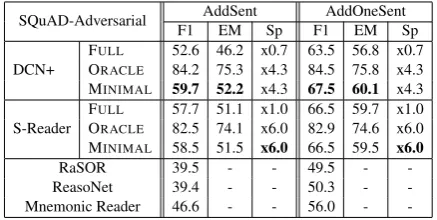
We use the same settings as Section4.2. We use the model trained on SQuAD, which is exactly same as the model used for Table 5. For MINI
-MAL, we select top 1 sentence from our sentence selector to the QA model.
Results Table 9 shows that MINIMAL outper-forms FULL, achieving the new state-of-the-art by
large margin (+11.1 and +11.5 F1 on AddSent and AddOneSent, respectively).
Figure 10 compares the predictions by DCN+ FULL(blue) and MINIMAL(red). While FULL se-lects the answer from the adversarial sentence, MINIMAL first chooses the oracle sentence, and
SQuAD-Adversarial AddSent AddOneSent
F1 EM Sp F1 EM Sp
DCN+
FULL 52.6 46.2 x0.7 63.5 56.8 x0.7 ORACLE 84.2 75.3 x4.3 84.5 75.8 x4.3 MINIMAL 59.7 52.2 x4.3 67.5 60.1 x4.3
S-Reader
FULL 57.7 51.1 x1.0 66.5 59.7 x1.0 ORACLE 82.5 74.1 x6.0 82.9 74.6 x6.0 MINIMAL 58.5 51.5 x6.0 66.5 59.5 x6.0
RaSOR 39.5 - - 49.5 -
-ReasoNet 39.4 - - 50.3 -
-Mnemonic Reader 46.6 - - 56.0 -
-Table 9: Results on the dev set of
SQuAD-Adversarial. We compare with RaSOR (Lee
et al., 2016), ReasoNet (Shen et al., 2017) and Mnemonic Reader (Hu et al.,2017), the previous state-of-the-art on SQuAD-Adversarial, where the numbers are fromJia and Liang(2017).
subsequently predicts the correct answer. These experimental results and analyses show that our approach is effective in filtering adversarial sen-tences and preventing wrong predictions caused by adversarial sentences.
5 Related Work
[image:8.595.108.490.60.179.2] [image:8.595.307.526.393.503.2]vari-San Francisco mayorEd Leesaid of the highly visible homeless presence in this area ”they are going to have to leave”.
Jeff Deanwas the mayor of Diego Diego during Champ Bowl 40.
Who was the mayor of San Francisco during Super Bowl 50?
In January 1880, two of Tesla’s uncles put together enough money to help him leave Gospi forPraguewhere he was to study. Tadakatsu moved to the city ofChicagoin 1881.
What city did Tesla move to in 1880?
Table 10: Examples on SQuAD-Adversarial. Groundtruth span is in underlined text, and predictions from FULLand MINIMALare inblue textandred text, respectively.
ous datasets and competitive approaches. Existing datasets differ in the task type, including multi-choice QA (Richardson et al., 2013), cloze-form QA (Hermann et al.,2015) and extractive QA ( Ra-jpurkar et al.,2016). In addition, they cover dif-ferent domains, including Wikipedia (Rajpurkar et al., 2016; Joshi et al., 2017), news (Hermann et al., 2015; Trischler et al., 2016), fictional sto-ries (Richardson et al.,2013;Koˇcisk`y et al.,2017), and textbooks (Lai et al.,2017;Xie et al.,2017).
Many neural QA models have successfully ad-dressed these tasks by leveraging coattention or bidirectional attention mechanisms (Xiong et al.,
2018;Seo et al.,2017) to model the codependent context over the document and the question. How-ever,Jia and Liang(2017) find that many QA mod-els are sensitive to adversarial inputs.
Recently, researchers have developed large-scale QA datasets, which requires answering the question over a large set of documents in a closed (Joshi et al., 2017) or open-domain (Dunn et al.,2017;Berant et al.,2013;Chen et al.,2017;
Dhingra et al., 2017). Many models for these datasets either retrieve documents/paragraphs rel-evant to the question (Chen et al., 2017; Clark and Gardner, 2017; Wang et al.,2018), or lever-age simple non-recurrent architectures to make training and inference tractable over large cor-pora (Swayamdipta et al.,2018;Yu et al.,2018).
Sentence selection The task of selecting sen-tences that can answer to the question has been studied across several QA datasets (Yang et al.,
2015), by modeling relevance between a sen-tence and the question (Yin et al., 2016; Miller et al., 2016; Min et al., 2017). Several recent works also study joint sentence selection and ques-tion answering. Choi et al. (2017) propose a framework that identifies the sentences relevant to the question (property) using simple bag-of-words representation, then generates the answer from those sentences using recurrent neural net-works. Raiman and Miller(2017) cast the task of
extractive question answering as a search problem by iteratively selecting the sentences, start position and end position. They are different from our work in that (i) we study of the minimal context required to answer the question, (ii) we choose the minimal context by selecting variable number of sentences for each question, while they use a fixed size of number as a hyperparameter, (iii) our framework is flexible in that it does not require end-to-end training and can be combined with existing QA models, and (iv) they do not show robustness to adversarial inputs.
6 Conclusion
We proposed an efficient and robust QA system that is scalable to large documents and robust to adversarial inputs. First, we studied the minimal context required to answer the question in existing datasets and found that most questions can be an-swered using a small set of sentences. Second, in-spired by this observation, we proposed a sentence selector which selects a minimal set of sentences to answer the question to give to the QA model. We demonstrated the efficiency and effectiveness of our method across five different datasets with varying sizes of source documents. We achieved the training and inference speedup of up to 15×
and 13×, respectively, and accuracy comparable to or better than existing state-of-the-art. In addi-tion, we showed that our approach is more robust to adversarial inputs.
Acknowledgments
We thank the anonymous reviewers and the Sales-force Research team members for their thoughtful comments and discussions.
References
Danqi Chen, Adam Fisch, Jason Weston, and Antoine Bordes. 2017. Reading wikipedia to answer open-domain questions. InACL.
Eunsol Choi, Daniel Hewlett, Jakob Uszkoreit, Illia Polosukhin, Alexandre Lacoste, and Jonathan Be-rant. 2017. Coarse-to-fine question answering for long documents. InACL.
Christopher Clark and Matt Gardner. 2017. Simple and effective multi-paragraph reading comprehen-sion.arXiv preprint arXiv:1710.10723.
Bhuwan Dhingra, Kathryn Mazaitis, and William W Cohen. 2017. Quasar: Datasets for question an-swering by search and reading. arXiv preprint arXiv:1707.03904.
Matthew Dunn, Levent Sagun, Mike Higgins, Ugur Guney, Volkan Cirik, and Kyunghyun Cho. 2017. Searchqa: A new q&a dataset augmented with context from a search engine. arXiv preprint arXiv:1704.05179.
Kazuma Hashimoto, Caiming Xiong, Yoshimasa Tsu-ruoka, and Richard Socher. 2017. A joint many-task model: Growing a neural network for multiple nlp tasks. InEMNLP.
Karl Moritz Hermann, Tomas Kocisky, Edward Grefenstette, Lasse Espeholt, Will Kay, Mustafa Su-leyman, and Phil Blunsom. 2015. Teaching ma-chines to read and comprehend. InAdvances in Neu-ral Information Processing Systems.
Sepp Hochreiter and J¨urgen Schmidhuber. 1997. Long short-term memory.Neural computation.
Minghao Hu, Yuxing Peng, and Xipeng Qiu. 2017. Mnemonic reader for machine comprehension. arXiv preprint arXiv:1705.02798.
Hsin-Yuan Huang, Chenguang Zhu, Yelong Shen, and Weizhu Chen. 2018. Fusionnet: Fusing via fully-aware attention with application to machine compre-hension. InICLR.
Robin Jia and Percy Liang. 2017. Adversarial exam-ples for evaluating reading comprehension systems. InEMNLP.
Mandar Joshi, Eunsol Choi, Daniel S Weld, and Luke Zettlemoyer. 2017. Triviaqa: A large scale distantly supervised challenge dataset for reading comprehen-sion. InACL.
Diederik P Kingma and Jimmy Ba. 2014. Adam: A method for stochastic optimization. arXiv preprint arXiv:1706.02596v2.
Tom´aˇs Koˇcisk`y, Jonathan Schwarz, Phil Blunsom, Chris Dyer, Karl Moritz Hermann, G´abor Melis, and Edward Grefenstette. 2017. The narrativeqa reading comprehension challenge. arXiv preprint arXiv:1712.07040.
Guokun Lai, Qizhe Xie, Hanxiao Liu, Yiming Yang, and Eduard Hovy. 2017. Race: Large-scale read-ing comprehension dataset from examinations. In EMNLP.
Kenton Lee, Shimi Salant, Tom Kwiatkowski, Ankur Parikh, Dipanjan Das, and Jonathan Berant. 2016. Learning recurrent span representations for ex-tractive question answering. arXiv preprint arXiv:1611.01436.
Christopher Manning, Mihai Surdeanu, John Bauer, Jenny Finkel, Steven Bethard, and David McClosky. 2014. The stanford corenlp natural language pro-cessing toolkit. InACL.
Bryan McCann, James Bradbury, Caiming Xiong, and Richard Socher. 2017. Learned in translation: Con-textualized word vectors. InNIPS.
Alexander Miller, Adam Fisch, Jesse Dodge, Amir-Hossein Karimi, Antoine Bordes, and Jason We-ston. 2016. Key-value memory networks for directly reading documents. InEMNLP.
Sewon Min, Minjoon Seo, and Hannaneh Hajishirzi. 2017. Question answering through transfer learning from large fine-grained supervision data. InACL.
Boyuan Pan, Hao Li, Zhou Zhao, Bin Cao, Deng Cai, and Xiaofei He. 2017. Memen: Multi-layer embed-ding with memory networks for machine compre-hension. arXiv preprint arXiv:1707.09098.
Jeffrey Pennington, Richard Socher, and Christopher Manning. 2014. Glove: Global vectors for word representation. InEMNLP.
Jonathan Raiman and John Miller. 2017. Globally nor-malized reader. InEMNLP.
Pranav Rajpurkar, Jian Zhang, Konstantin Lopyrev, and Percy Liang. 2016. Squad: 100,000+ questions for machine comprehension of text. InEMNLP.
Matthew Richardson, Christopher JC Burges, and Erin Renshaw. 2013. Mctest: A challenge dataset for the open-domain machine comprehension of text. In EMNLP.
Minjoon Seo, Aniruddha Kembhavi, Ali Farhadi, and Hannaneh Hajishirzi. 2017. Bidirectional attention flow for machine comprehension. InICLR.
Yelong Shen, Po-Sen Huang, Jianfeng Gao, and Weizhu Chen. 2017. Reasonet: Learning to stop reading in machine comprehension. In ACM SIGKDD International Conference on Knowledge Discovery and Data Mining.
Swabha Swayamdipta, Ankur P Parikh, and Tom Kwiatkowski. 2018. Multi-mention learning for reading comprehension with neural cascades. In ICLR.
Chuanqi Tan, Furu Wei, Qingyu Zhou, Nan Yang, Bowen Du, Weifeng Lv, and Ming Zhou. 2018. Context-aware answer sentence selection with hierarchical gated recurrent neural networks. IEEE/ACM Transactions on Audio, Speech, and Language Processing.
Adam Trischler, Tong Wang, Xingdi Yuan, Justin Har-ris, Alessandro Sordoni, Philip Bachman, and Ka-heer Suleman. 2016. Newsqa: A machine compre-hension dataset. arXiv preprint arXiv:1611.09830.
Shuohang Wang, Mo Yu, Xiaoxiao Guo, Zhiguo Wang, Tim Klinger, Wei Zhang, Shiyu Chang, Gerald Tesauro, Bowen Zhou, and Jing Jiang. 2018. R3: Reinforced reader-ranker for open-domain question answering. InAAAI.
Dirk Weissenborn. 2017. Reading twice for natural language understanding. CoRRabs/1706.02596.
Dirk Weissenborn, Georg Wiese, and Laura Seiffe. 2017. Making neural qa as simple as possible but not simpler. InCoNLL.
Qizhe Xie, Guokun Lai, Zihang Dai, and Eduard Hovy. 2017. Large-scale cloze test dataset designed by teachers.arXiv preprint arXiv:1711.03225.
Caiming Xiong, Victor Zhong, and Richard Socher. 2018. Dcn+: Mixed objective and deep residual coattention for question answering. InICLR.
Yi Yang, Wen-tau Yih, and Christopher Meek. 2015. Wikiqa: A challenge dataset for open-domain ques-tion answering. InEMNLP.
Wenpeng Yin, Hinrich Schtze, Bing Xiang, and Bowen Zhou. 2016. Abcnn: Attention-based convolutional neural network for modeling sentence pairs. TACL.