Proceedings of the 56th Annual Meeting of the Association for Computational Linguistics (Long Papers), pages 2214–2224 2214
Efficient Large-Scale Neural Domain Classification
with Personalized Attention
Young-Bum Kim Dongchan Kim Anjishnu Kumar Ruhi Sarikaya Amazon Alexa
{youngbum,dongchan,anjikum,rsarikaya}@amazon.com
Abstract
In this paper, we explore the task of map-ping spoken language utterances to one of thousands of natural language understand-ing domains in intelligent personal digital assistants (IPDAs). This scenario is ob-served in mainstream IPDAs in industry that allow third parties to develop thou-sands of new domains to augment built-in first party domabuilt-ins to rapidly built-increase domain coverage and overall IPDA
ca-pabilities. We propose a scalable
neu-ral model architecture with a shared en-coder, a novel attention mechanism that incorporates personalization information and domain-specific classifiers that solves the problem efficiently. Our architecture is designed to efficiently accommodate incremental domain additions achieving two orders of magnitude speed up com-pared to full model retraining. We con-sider the practical constraints of real-time production systems, and design to min-imize memory footprint and runtime la-tency. We demonstrate that incorporating personalization significantly improves do-main classification accuracy in a setting with thousands of overlapping domains.
1 Introduction
Intelligent personal digital assistants (IPDAs) are one of the most advanced and successful artifi-cial intelligence applications that have spoken lan-guage understanding (SLU). Many IPDAs have recently emerged in industry including Amazon Alexa, Google Assistant, Apple Siri, and Mi-crosoft Cortana (Sarikaya, 2017). IPDAs have tra-ditionally supported only dozens of well-separated domains, each defined in terms of a specific
ap-plication or functionality such as calendar and lo-cal search (Tur and de Mori, 2011; Sarikaya et al., 2016). To rapidly increase domain coverage and extend capabilities, some IPDAs have released Software Development Toolkits (SDKs) to allow third-party developers to quickly build and
inte-grate new domains, which we refer to as skills
henceforth. Amazon’s Alexa Skills Kit (Kumar
et al., 2017a), Google’s Actions and Microsoft’s
Cortana Skills Kitare all examples of such SDKs. Alexa Skills Kit is the largest of these services with over 40,000 skills.
For IPDAs, finding the most relevant skill to handle an utterance is an open problem for three reasons. First, the sheer number of skills makes the task difficult. Unlike traditional systems that have on the order of 10-20 built-in domains, large-scale IPDAs can have up to 40,000 skills. Sec-ond, the number of skills is rapidly expanding
with 100+ new skills added per week.
Large-scale IPDAs should be able to accommodate new skills efficiently without compromising perfor-mance. Third, unlike traditional built-in domains that are carefully designed to be disjoint by a cen-tral team, skills are built independently by differ-ent developers and can cover overlapping func-tionalities. For instance, there are over 50 recipe skills in Alexa that can handle recipe-related utter-ances.
One simple solution to this problem has been to require the user to explicitly mention a skill name
and follow a strict invocation pattern as in ”Ask
en-gagement with skills and potentially with IPDAs. In this paper, we propose a solution that ad-dresses all three practical challenges without re-quiring skill names or invocation patterns. Our approach is based on a scalable neural model ar-chitecture with a shared encoder, a skill atten-tion mechanism and skill-specific classificaatten-tion networks that can efficiently perform large-scale skill classification in IPDAs using a weakly
su-pervised training dataset. We demonstrate that
our model achieves a high accuracy on a manu-ally transcribed test set after being trained with weak supervision. Moreover, our architecture is designed to efficiently integrate new skills that ap-pear in-between full model retraining cycles into the model. Besides accuracy, we also keep prac-tical constraints in mind and focus on minimiz-ing memory footprint and runtime latency, while ensuring architecture is scalable to thousands of skills, all of which are important for real-time pro-duction systems. Furthermore, we investigate two different ways of incorporating user personaliza-tion informapersonaliza-tion into the model, our naive base-line method adds the information as a 1-bit flag in the feature space of the skill-specific networks, the
personalized attentiontechnique computes a con-vex combination of skill embeddings for the user’s enabled skills and significantly outperforms the naive personalization baseline. We show the ef-fectiveness of our approach with extensive exper-iments using 1,500 skills from a deployed IPDA system.
2 Related Work
Traditional multi-domain SLU/NLU systems are designed hierarchically, starting with domain clas-sification to classify an incoming utterance into one of many possible domains, followed by fur-ther semantic analysis with domain-specific intent classification and slot tagging (Tur and de Mori, 2011). Traditional systems have typically been limited to a small number of domains, designed
by specialists to be well-separable. Therefore,
domain classification has been considered a less complex task compared to other semantic anal-ysis such as intent and slot predictions. Tradi-tional domain classifiers are built using simple lin-ear models such as Multinomial Logistic Regres-sion or Support Vector Machines in a one-versus-all setting for multi-class prediction. The models typically use word n-gram features and also those
based on static lexicon match, and there have been several recent studies applying deep learning tech-niques (Xu and Sarikaya, 2014).
There is also a line of prior work on enhanc-ing sequential text classification or taggenhanc-ing. Hier-archical character-to-word level LSTM (Hochre-iter and Schmidhuber, 1997) architectures similar to our models have been explored for the Named Entity Recognition task by Lample et al. (2016). Character-informed sequence models have also been explored for simple text classification with small sets of classes by Xiao and Cho (2016). Joulin et al. (2016) explored highly scalable text classification using a shared hierarchical encoder, but their hierarchical softmax-based output formu-lation is unsuitable for incremental model updates. Work on zero-shot domain classifier expansion by Kumar et al. (2017b) struggled to rank incom-ing domains higher than trainincom-ing domains. The attention-based approach of Kim et al. (2017d) does not require retraining from scratch, but it requires keeping all models stored in memory which is computationally expensive. Multi-Task learning was used in the context of SLU by Tur (2006) and has been further explored using neu-ral networks for phoneme recognition (Seltzer and Droppo, 2013) and semantic parsing (Fan et al., 2017; Bapna et al., 2017). There have been many other pieces of prior work on improving NLU sys-tems with pre-training (Kim et al., 2015b; Celiky-ilmaz et al., 2016; Kim et al., 2017e), multi-task learning (Zhang and Wang, 2016; Liu and Lane, 2016; Kim et al., 2017b), transfer learning (El-Kahky et al., 2014; Kim et al., 2015a,c; Chen et al., 2016a; Yang et al., 2017), domain adaptation (Kim et al., 2016; Jaech et al., 2016; Liu and Lane, 2017; Kim et al., 2017d,c) and contextual signals (Bhar-gava et al., 2013; Chen et al., 2016b; Hori et al., 2016; Kim et al., 2017a).
3 Weakly Supervised Training Data Generation
Char-level Bidirectional
LSTM Word-level Bidirectional LSTM
Character embedding
𝑤" 𝑤#
𝑐%," 𝑐%,# 𝑐%,'
𝑤%
…
𝑐#," 𝑐#,# 𝑐#,'
𝑐"," 𝑐",# 𝑐",' Word
embedding
…
… 𝜙)*
𝜙+*
…
…
𝜙)*
𝜙+*
𝜙)*
𝜙+*
… 𝜙)*
𝜙+*
𝜙)*
𝜙+*
𝜙)*
𝜙+* …
𝜙)*
𝜙+*
𝜙)*
𝜙+*
𝜙)*
𝜙+*
… 𝜙)*
𝜙+*
𝜙)*
𝜙+*
𝜙)*
𝜙+*
Utterance
…
…
𝑑" 𝑑# 𝑑
-Domain Feedforward 𝑑.
𝑑" 𝑑. 𝑑/
Enabled Domains
Domain embedding
Domain 1 Domain 2 Domain 3 Domain K
[image:3.595.77.525.64.279.2]…
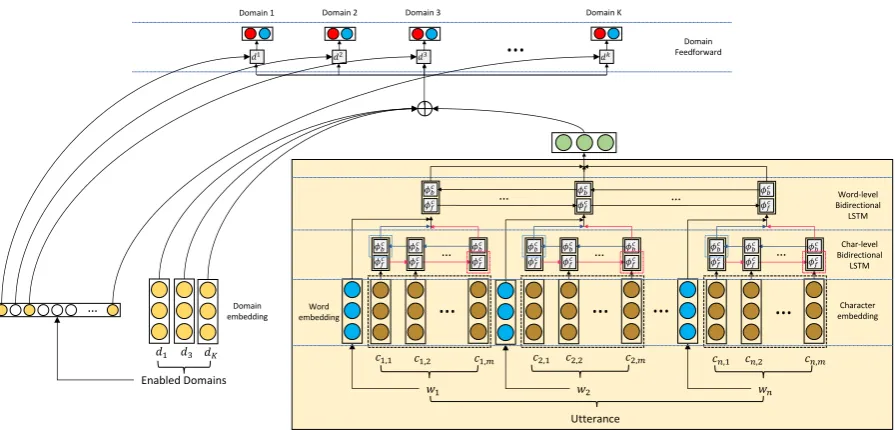
Figure 1:The overall architecture of the personalized dynamic domain classifier.
is no longer feasible, and we cannot assume that domains are designed to be well separable.
Instead we can generate training data by adopt-ing the weak supervision paradigm introduced by (Hoffmann et al., 2011), which proposes using heuristic labeling functions generate large num-bers of noisy data samples. Clean data generation with weak supervision is a challenging problem, so we address it by decomposing it into two sim-pler problems, of candidate generation and noise suppression, however it remains important for our model to be noise robust.
3.1 Data Programming
The key insight of the Data Programming
ap-proach is thatO(1)simple labeling functions can
be used to approximate O(n) human annotated
data points with much less effort. We adopt the formalism used by (Ratner et al., 2016) to treat each of instance data generation rule as a rich
gen-erative model, defined by a labeling functionλand
describe different families of labeling functions. Our data programming pipeline is analogous to the noisy channel model proposed for spelling correc-tion by (Kernighan et al., 1990), and consists of a set of candidate generation and noise detection functions.
arg max
µ
P(µ|si) = arg max µ
P(si|µ). P(µ)
where µ and si represent utterances and the ith
skill respectively.P(si|µ)the probability of a skill
being valid for an utterance is approximated by
simple functions that act as candidate data
genera-torsλg∈Λgbased on recognitions produced by a
family ofquery patternsλq ∈ Λq. P(µ)is
repre-sented by a family of simple functions that act as
noise detectorsλn ∈ Λn, which mark utterances
as likely being noise.
We apply the technique to the query logs of a popular IPDA, which has support for personalized third party domains. Looking at the structure of
utterances that match query patternλq, each
utter-ance of form”Ask{Uber}to{get me a car}”can
be considered as being parametrized by the
under-lying latent commandµz, that is”Get me a car”,
a target domain corresponding to servicest, which
in this case isUberand the query recognition
pat-ternλq, in this case”Ask{st}to{µz}”. Next we
assume that the distribution of latent commands over domains are independent of the query pattern.
P(µz, st)≈P(µ, st, λq)
Making this simple distributional approximation allows us to generate a large number of noisy train-ing samples. The family of generator functions
λg ∈Λgis thus defined such thatuz =λig(µ, λiq)
3.2 Noise Reduction
The distribution defined above contains a large
number of noisy positive samples. Related to
P(µ) in the noisy channel in the spell correction
context, we defined a small family of heuristic
training data instances that are not likely to be well formed. For instance,
• λ1n requiresu to contain a minimum
thresh-old of information by removing those with
µzthat has token length fewer than 3.
Utter-ances shorter than this mostly consist of non-actionable commands.
• λ2n discards all data samples below a certain
threshold of occurrences in live traffic, since utterances that are rarely observed are more likely to be ASR errors or unnatural.
• λ3ndiscards the data samples for a domain if
they come from an overly broad pattern with a catch-all behavior.
• λ4n discards utterances that belong to shared
intents provided by the SLU SDK.
The end result of this stage is to retain utter-ances such as ‘call me a cab’ from ‘Ask Uber to call me a cab’ but discard ‘Boston’ from ‘Ask Ac-cuweather for Boston’. One can easily imagine extending this framework with other high recall noise detectors, for example, using language mod-els to discard candidates that are unlikely to be spoken sentences.
4 Model Architecture
Our model consists of ashared encoder network
consisting of an orthography-sensitive hierarchical LSTM encoder that feeds into a set of domain spe-cific classification layers trained to make a binary decision for each output label.
Our main novel contribution is the extension
of this architecture with a personalized attention
mechanism which uses the attention mechanism of (Bahdanau et al., 2014) to attend to memory lo-cations corresponding to the specific domains en-abled by a user, and allows the system to learn
semantic representations of each domain via
do-main embeddings. As we will show, incorporat-ing personalization features is key to
disambiguat-ing between multiple overlappdisambiguat-ing domains1, and
the personalized attention mechanism outperforms more naive forms of personalization. The person-alized attention mechanism first computes an at-tention weight for each of enabled domains, per-forms a convex combination to compute a context
1We assume that users can customize their IPDA settings
to enable certain domains.
vector and then concatenates this vector to the en-coded utterance before the final domain classifica-tion. Figure 1 depicts the model in detail.
Our model can efficiently accommodate new domains not seen during initial training by keep-ing the shared encoder frozen, bootstrappkeep-ing a do-main embedding based on existing ones, then opti-mizing a small number of network parameters cor-responding to domain-specific classifier, which is orders of magnitude faster and more data efficient than retraining the full classifier.
We make design decisions to ensure that our model has a low memory and latency footprint. We avoid expensive large vocabulary matrix mul-tiplications on both the input and output stages, and instead use a combination of character
embed-dings and word embedembed-dings in the input stage.2
The output matrix is lightweight because each domain-specific classifier is a matrix of only
201×2 parameters. The inference task can be
triv-ially parallelized across cores since there’s no re-quirement to compute a partition function across a high-dimensional softmax layer, which is the slowest component of large label multiclass neu-ral networks. Instead, we achieve comparability between the probability scores generated by indi-vidual models by using a customized loss
formu-lation.3
4.1 Shared Encoder
First we describe our shared hierarchical utterance encoder, which is marked by the almond colored
box in Figure 1. Our hierarchical character to
word to utterance design is motivated by the need to make the model operate on an open vocabulary in terms of words and to make it robust to small changes in orthography resulting from fluctuations in the upstream ASR system, all while avoiding expensive large matrix multiplications associated with one-hot word encoding in large vocabulary systems.
We denote an LSTM simply as a mapping φ :
Rd×Rd 0
→ Rd0 that takes a ddimensional
in-put vector x and a d0 dimensional state vector h
to output a newd0 dimensional state vectorh0 =
2Using a one-hot representation of word vocabulary size
60,000 and hidden dimension 100 would require learning a matrix of size 60000 x 100 - using 100-dim word embeddings requires only aO(1)lookup followed by a 100 x 100 matrix, thus allowing our model to be significantly smaller and faster despite having what is effectively an open vocabulary
3Current inference consumes 50MB memory and the p99
φ(x, h). LetCdenote the set of characters andW
the set of words in a given utterance. Let⊕denote
the vector concatenation operation. We encode an utterance using BiLSTMs, and the model
parame-tersΘassociated with this BiLSTM layer are
• Char embeddingsec∈R25for eachc∈ C
• Char LSTMsφCf, φCb :R25×R25→R25
• Word embeddingsew∈R50for eachw∈ W
• Word LSTMsφWf , φWb :R100×R50→R50
Let w1. . . wn ∈ W denote a word sequence
where wordwihas characterwi(j)∈ Cat position
j. First, the model computes a character-sensitive
word representationvi ∈R100as
fjC =φCf ewi(j), fjC−1
∀j= 1. . .|wi|
bCj =φCb ewi(j), bCj+1
∀j=|wi|. . .1
vi =f|Cwi|⊕bC1⊕ewi
for each i = 1. . . n.4 These word
representa-tion vectors are encoded by forward and backward
LSTMs for wordφWf , φWb as
fiW =φWf vi, fiW−1
∀i= 1. . . n
bWi =φWb vi, bWi+1
∀i=n . . .1
and induces a character and context-sensitive word
representationhi ∈R100as
hi =fiW⊕b W i
for eachi = 1. . . n. For convenience, we write
the entire operation as a mapping BiLSTMΘ:
(h1. . . hn)←BiLSTMΘ(w1. . . wn)
¯ h=
n
X
i=1
hi (1)
4.2 Domain Classification
Our Multitask domain classification formulation is motivated by a desire to avoid computing the full partition function during test time, which tends to be the slowest component of a multiclass neural network classifer, as has been documented before by (Jozefowicz et al., 2016) and (Mikolov et al., 2013), amongst others.
4For simplicity, we assume some random initial state
vec-tors such asf0Candb
C
|wi|+1when we describe LSTMs.
However, we also want access to reliable proba-bility estimates instead of raw scores - we accom-plish this by constructing a custom loss function. During training, each domain classifier receives in-domain (IND) and out-of-domain (OOD) utter-ances, and we adapt the one-sided selection mech-anism of (Kubat et al., 1997) to prevent OOD ut-terances from overpowering IND utut-terances, thus
an utterance in a domaind ∈ Dis considered as
an IND utterance in the viewpoint of domaindand
OOD for all other domains.
We first use the shared encoder to compute the
utterance representation¯has previously described.
Then we define the probability of domaind˜for the
utterance by mapping ¯h to a 2-dimensional
out-put vector with a linear transformation for each
domaind˜as
zd˜=σ(Wd˜·¯h+bd˜)
p( ˜d|¯h)∝
exp
[zd˜]IN D
, ifd˜=d
exp[zd˜]OOD
, otherwise
whereσ is scaled exponential linear unit (SeLU)
for normalized activation outputs (Klambauer
et al., 2017) and[zd˜]IN D and[zd˜]OOD denote the
values in the IND and OOD position of vectorzd˜.
We define the joint domain classification loss
LD as the summation of positive (LP) and
neg-ative (LN) class loss functions5:
LP Θ,Θd˜=−logpd˜|¯h
LNΘ,Θd˜
=− 1
k−1
X
¯
d∈D,d¯6= ˜d
logp d¯|¯h
LDΘ,Θd˜=LPΘ,Θd˜+LNΘ,Θd˜
where kis the total number of domains. We
di-vide the second term byk−1so thatLP andLN
are balanced in terms of the ratio of the training examples for a domain to those for other domains. While a softmax over the entire domains tends to highlight only the ground-truth domain while sup-pressing all the rest, the our joint domain classifi-cation with a softmax over two classes is designed to produce a more balanced confidence score per domain independent of other domains.
4.3 Personalized Attention
We explore encoding a user’s domain preferences
in two ways. Our baseline method is a 1-bit
flagthat is appended to the input features of each
domain-specific classifier. Our novelpersonalized
attentionmethod induces domain embeddings by supervising an attention mechanism to attend to a user’s enabled domains with different weights depending on their relevance. The domain em-bedding matrix in Figure 1 represents the embed-dings of a user’s enabled domains. We hypothe-size that attention enables the network learn richer representations of user preferences and domain co-occurrence features.
Let eD( ˜d) ∈ R100 and ¯h ∈ R100 denote the
domain embeddings for domain d˜and the
utter-ance representation calculated by Eq. (1), respec-tively. The domain attention weights for a given
user u who has a preferred domain list d(u) =
˜
d(1u), . . . ,d˜(ku)
are calculated by the dot-product operation,
ai = ¯h·eD
˜
d(iu) ∀i= 1. . . k
The final, normalized attention weights ¯aare
ob-tained after normalization via a softmax layer,
¯ ai=
exp(ai)
Pk
j=1exp(aj)
∀i= 1. . . k
The weighted combination of domain embeddings is
¯
Sattended =
k
X
i=1
¯ ai·eD
˜ d(iu)
Finally the two representations of enabled
do-mains, namely the attentionmodel and 1-bit flag
are then concatenated with the utterance represen-tation and used to make per-domain predictions via domain-specific affine transformations:
¯
zatt= ¯h⊕S¯attended
¯
z1bit = ¯h⊕I( ˜d∈enabled)
Here I( ¯d ∈ enabled) is a 1-bit indicator for
whether the domain is enabled by the user or not.
¯
zatt and z¯1bit represent the encoded hidden state
of theAttentionand1-Bit Flag
configura-tions of the model from the experiment section. In our experiments we will compare these two ways of encoding personalization information, as well
as evaluate a variant that combines the two. In this way we can ascertain whether the two personal-ization signals are complementary via an ablation study on the full model.
4.4 Domain Bootstrapping
Our model separates the responsibilities for utter-ance representation and domain classification be-tween the shared encoder and the domain-specific classifiers. That is, the shared encoder needs to be retrained only if it cannot encode an utter-ance well (e.g., a new domain introduces com-pletely new words) and the existing domain clas-sifiers need to be retrained only when the shared encoder changes. For adding new domains effi-ciently without full retraining, the only two com-ponents in the architecture need to be updated for
each new domain d˜new, are the domain
embed-dings for the new domain and its domain-specific
classifier.6 We keep the weights of the encoder
network frozen and use the hidden state vector¯h,
calculated by Eq. 1, as a feature vector to feed into the downstream classifiers. To initialize the
m-dimensional domain embeddingsednew˜ , we use
the column-wise average of all utterance vectors in
the training data¯havg, and project it to the domain
embedding space using a matrix U ∈ Rm×m.
Thus,
ednew˜ =U∗·h¯avg
The parameters of U∗ are learned using the
column-wise average utterance vectors ¯havgj and
learned domain vectors for all existing domainsdj
U∗ = arg min
U
||U ·¯havgj −edj|| ∀dj ∈ D
This is a write-to-memory operation that creates a new domain representation after attending to all existing domain representations. We then train the parameters of the domain-specific classifier with the new domain’s data while keeping the encoder
fixed. This mechanism allows us to efficiently
support new domains that appear in-between full model deployment cycles without compromising performance on existing domains. A full model refresh would require us to fully retrain with the domains that have appeared in the intermediate pe-riod.
6
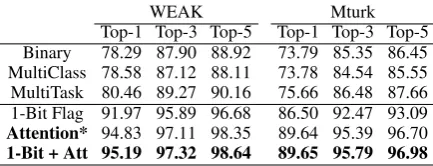
WEAK Mturk Top-1 Top-3 Top-5 Top-1 Top-3 Top-5 Binary 78.29 87.90 88.92 73.79 85.35 86.45 MultiClass 78.58 87.12 88.11 73.78 84.54 85.55 MultiTask 80.46 89.27 90.16 75.66 86.48 87.66 1-Bit Flag 91.97 95.89 96.68 86.50 92.47 93.09 Attention* 94.83 97.11 98.35 89.64 95.39 96.70 1-Bit + Att 95.19 97.32 98.64 89.65 95.79 96.98
Table 1:The performance of different variants of our neural
model in terms of top-N accuracy.Binarytrains a separate binary classifier for each skill. MultiClasshas a shared encoder followed by a softmax. MultiTaskreplaces the softmax with per-skill classifiers. 1-Bit Flagadds a sin-gle bit for personalization to each skill classifier in MultiTask.
Attentionextends MultiTask with personalized attention. The last 3 models are personalized.*Best single encoding.
5 Experiments
In this section we aim to demonstrate the effec-tiveness of our model architecture in two settings. First, we will demonstrate that attention based per-sonalization significantly outperforms the baseline approach. Secondly, we will show that our model new domain bootstrapping procedure results in ac-curacies comparable to full retraining while re-quiring less than 1% of the orignal training time.
5.1 Experimental Setup
Weak: This is a weakly supervised dataset was generated by preprocessing utterances with strict invocation patterns according to the setup men-tioned in Section 3. The dataset consists of 5.34M utterances from 637,975 users across 1,500 differ-ent skills. Since we are interested in capturing the temporal effects of the dataset as well as personal-ization effects, we partitioned the data based both on user and time. Our core training data for the ex-periments in this paper was drawn from one month of live usage, the validation data came from the next 15 days of usage, and the test data came from the subsequent 15 days. The training, validation and test sets are user-independent, and each user belongs to only one of the three sets to ensure no leakage of information.
MTurk: Since the Weak dataset is generated by weak supervision, we verified the performance of our approach with human generated utterances. A random sample of 12,428 utterances from the test partition of users were presented to 300 human judges, who were asked to produce two natural ways to issue the same command. This dataset is treated as a representative clean held out test set on which we can observe the generalization of our weakly supervised training and validation data to
natural language.
New Skills: In order to simulate the scenario in which new skills appear within a week be-tween model updates, we selected 250 new skills which do not overlap with the skills in the Weak
dataset. The vocabulary size of 1,500 skills is
200K words, and on average, 5% of the vocabu-lary for new skills is not covered. We randomly sampled 4,000 unique utterances for each skill us-ing the same weak supervision method, and split them into 3,000 utterances for training and 1,000 for testing.
5.2 Results and Discussion
Generalization from Weakly Supervised to Natural Utterances We first show the progres-sion of model performance as we add more com-ponents to show their individual contribution. Sec-ondly, we show that training our models on a weakly supervised dataset can generalize to nat-ural speech by showing their test performance on the human-annotated test data. Finally, we com-pare two personalization strategies.
The full results are summarized in Table 1,
which shows the top-N test results separately for
the Weak dataset (weakly supervised) and MTurk
dataset (human-annotated). We report top-N
ac-curacy to show the potential for further re-ranking
or disambiguation downstream. For top-1 results
on the Weak dataset, using a separate binary clas-sifier for each domain (Binary) shows a prediction accuracy at 78.29% and using a softmax layer on top of the shared encoder (MultiClass) shows a comparable accuracy at 78.58%. The performance shows a slight improvement when using the Mul-titask neural loss structure, but adding personal-ization signals to the Multitask structure showed a significant boost in performance. We noted the large difference between the 1-bit and attention ar-chitecture. At 94.83% accuracy, attention resulted in 35.6% relative error reduction over the 1-bit baseline 91.97% on the Weak validation set and 23.25% relative on the MTurk test set. We hypoth-esize that this may be because the attention mecha-nism allows the model to focus on complementary features in case of overlapping domains as well as learning domain co-occurrence statistics, both of which are not possible with the simple 1-bit flag.
When both personalization representations
were combined, the performance peaked at
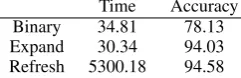
Time Accuracy Binary 34.81 78.13 Expand 30.34 94.03 Refresh 5300.18 94.58
Table 2: Comparison of per-epoch training time (seconds)
and top-1 accuracy (%) on an NVIDIA Tesla M40 GPU.
89.65% for the MTurk dataset. The improvement trend is extremely consistent across all top-N re-sults for both of the Weak and MTurk datasets across all experiments. The disambiguation task is complex due to similar and overlapping skills, but the results suggest that incorporating person-alization signals equip the models with much bet-ter discriminative power. The results also suggest that the two mechanisms for encoding personal-ization provide a small amount of complementary information since combining them together is bet-ter than using them individually. Although the per-formance on the Weak dataset tends to be more optimistic, the best performance on the
human-annotated test data is still close to 90% for top-1
accuracy, which suggests that training our model with the samples derived from the invocation pat-terns can generalize well to natural utterances.
Rapid Bootstrapping of New Skills We show the results when new domains are added to an IPDA and the model needs to efficiently accom-modate them with a limited number of data
sam-ples. We show the classification performance
on the skills in the New Skills dataset while as-suming we have access to the WEAK dataset to pre-train our model for transfer learning. In the
Binarysetting, a domain-specific binary
classi-fier is trained for each domain.Expanddescribes
the case in which we incrementally train on top
of an existing model. Refreshis the setting in
which the model is fully retrained from scratch with the new data - which would be ideal in case there were no time constraints.
We record the average training time for each epoch and the performance is measured with top-1 classification accuracy over new skills. The exper-iment results can be found in Table 2. Adapting a new skill is two orders of magnitude faster (30.34 seconds) than retraining the model (5300.18 sec-onds) while achieving 94.03% accuracy which is comparable to 94.58% accuracy of full retraining. The first two techniques can also be easily
paral-lelized unlike theRefreshconfiguration.
[image:8.595.119.240.64.103.2]Top-1 Top-3 Top-5 Full 6.17 14.30 20.41 Enabled 85.62 96.15 98.06
Table 3:Top-N prediction accuracy (%) on the full skill set
(Full) and only enabled skills (Enabled).
Behavior of Attention Mechanism Our expec-tation is that the model is able to learn to attend the relevant skills during the inference process. To study the behavior of the attention layer, we compute the top-N prediction accuracy based on the most relevant skills defined by the attention weights. In this experiment, we considered the subset of users who had enabled more than 20
do-mains to exclude trivial cases7. The results are
shown in Table 3. When the model attends to
the entire set of 1500 (Full), the top-5 prediction
accuracy is 20.41%, which indicates that a large number of skills can process the utterance, and thus it is highly likely to miss the correct one in the top-5 predictions. This ambiguity issue can be significantly improved by users’ enabled
do-main lists as proved by the accuracies (Enabled):
85.62% for top-1, 96.15% for top-3, and 98.06%
for top-5.8Thus the attention mechanism can thus
be viewed as an initial soft selection which is then followed by a fine-grained selection at the classifi-cation stage.
End-to-End User Evaluation All intermediate metrics on this task are proxies to a human cus-tomer’s eventual evaluation. In order to assess the user experience, we need to measure its end-to-end performance. For a brief end-to-end-to-end-to-end system evaluation, 983 utterances from 283 domains were randomly sampled from the test set in the large-scale IPDA setting. 15 human judges (male=12, female=3) rated the system responses, 1 judge per utterance, on a 5-point Likert scale with 1 being
Terribleand 5 beingPerfect. The judgment score
of 3 or above was taken asSUCCESSand 2 or
be-low asDEFECT. The end-to-endSUCCESS rate,
7
Thus, the random prediction accuracy on enabled do-mains is less than 5% and across the Full domain list is 0.066%
8
Figure 2: Embeddings of different domain categories visualized in 2D using TSNE (van der Maaten and Hinton, 2008). Different colors represent different categories, for e.g. the large blue cluster on the left is Home Automation.
[image:9.595.316.517.277.395.2]thus user satisfaction, was shown to be 95.52%. The discrepancy between this score and the score produced on MTurk dataset indicates that even in cases in which the model makes classification mis-takes, some of these interpretations remain percep-tually meaningful to humans.
Figure 3:A large cluster of home automation domains.
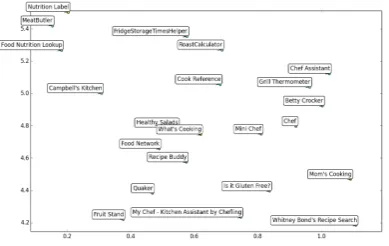
[image:9.595.74.280.383.505.2]Figure 4:A cluster of domains related to cooking.
Figure 5: A mixed cluster with several different domain
categories represented.
6 Conclusions
[image:9.595.85.280.589.712.2]References
Dzmitry Bahdanau, Kyunghyun Cho, and Yoshua Ben-gio. 2014. Neural machine translation by jointly learning to align and translate. arXiv preprint arXiv:1409.0473.
Ankur Bapna, Gokhan Tur, Dilek Hakkani-Tur, and Larry Heck. 2017. Towards zero shot frame seman-tic parsing for domain scaling. In Interspeech 2017.
A. Bhargava, Asli Celikyilmaz, Dilek Z. Hakkani-Tur, and Ruhi Sarikaya. 2013. Easy contex-tual intent prediction and slot detection. IEEE International Conference on Acoustics, Speech and Signal Processing, pages 8337–8341.
Asli Celikyilmaz, Ruhi Sarikaya, Dilek Hakkani-T¨ur, Xiaohu Liu, Nikhil Ramesh, and G¨okhan T¨ur. 2016. A new pre-training method for training deep learn-ing models with application to spoken language un-derstanding. In Interspeech, pages 3255–3259.
Yun-Nung Chen, Dilek Hakkani-T¨ur, and Xiaodong He. 2016a. Zero-shot learning of intent embeddings for expansion by convolutional deep structured se-mantic models. In Acoustics, Speech and Signal Processing (ICASSP), 2016 IEEE International Conference on, pages 6045–6049.
Yun-Nung Chen, Dilek Hakkani-T¨ur, Gokhan Tur, Jianfeng Gao, and Li Deng. 2016b. End-to-end memory networks with knowledge carryover for multi-turn spoken language understanding. In Interspeech.
Ali El-Kahky, Xiaohu Liu, Ruhi Sarikaya, Gokhan Tur, Dilek Hakkani-Tur, and Larry Heck. 2014. Ex-tending domain coverage of language understand-ing systems via intent transfer between domains us-ing knowledge graphs and search query click logs. In IEEE International Conference on Acoustics, Speech and Signal Processing (ICASSP), pages 4067–4071. IEEE.
Xing Fan, Emilio Monti, Lambert Mathias, and Markus Dreyer. 2017. Transfer learning for neural semantic parsing. CoRR, abs/1706.04326.
Sepp Hochreiter and J¨urgen Schmidhuber. 1997. Long short-term memory. Neural computation, 9(8):1735–1780.
Raphael Hoffmann, Congle Zhang, Xiao Ling, Luke Zettlemoyer, and Daniel S Weld. 2011. Knowledge-based weak supervision for information extrac-tion of overlapping relaextrac-tions. In Proceedings of the 49th Annual Meeting of the Association for Computational Linguistics: Human Language Technologies-Volume 1, pages 541–550. Associa-tion for ComputaAssocia-tional Linguistics.
Chiori Hori, Takaaki Hori, Shinji Watanabe, and John R Hershey. 2016. Context-sensitive and role-dependent spoken language understanding using bidirectional and attention lstms. Interspeech, pages 3236–3240.
Aaron Jaech, Larry Heck, and Mari Ostendorf. 2016. Domain adaptation of recurrent neural networks for natural language understanding. In Interspeech.
Armand Joulin, Edouard Grave, Piotr Bojanowski, and Tomas Mikolov. 2016. Bag of tricks for efficient text classification. arXiv preprint arXiv:1607.01759.
Rafal Jozefowicz, Oriol Vinyals, Mike Schuster, Noam
Shazeer, and Yonghui Wu. 2016. Exploring
the limits of language modeling. arXiv preprint arXiv:1602.02410.
Mark D Kernighan, Kenneth W Church, and William A Gale. 1990. A spelling correction program based on a noisy channel model. In Proceedings of the 13th conference on Computational linguistics-Volume 2, pages 205–210. Association for Computational Lin-guistics.
Young-Bum Kim, Minwoo Jeong, Karl Stratos, and Ruhi Sarikaya. 2015a. Weakly supervised slot tag-ging with partially labeled sequences from web search click logs. In Proceedings of the 2015 Conference of the North American Chapter of the Association for Computational Linguistics: Human Language Technologies, pages 84–92.
Young-Bum Kim, Sungjin Lee, and Ruhi Sarikaya. 2017a. Speaker-sensitive dual memory networks for multi-turn slot tagging. In Automatic Speech Recognition and Understanding Workshop (ASRU), 2017 IEEE, pages 547–553. IEEE.
Young-Bum Kim, Sungjin Lee, and Karl Stratos. 2017b. Onenet: Joint domain, intent, slot prediction for spoken language understanding. In Automatic Speech Recognition and Understanding Workshop (ASRU), 2017 IEEE, pages 547–553. IEEE.
Young-Bum Kim, Karl Stratos, and Dongchan Kim. 2017c. Adversarial adaptation of synthetic or stale data. In Proceedings of the 55th Annual Meeting of the Association for Computational Linguistics, pages 1297–1307. Association for Computational Linguistics.
Young-Bum Kim, Karl Stratos, and Dongchan Kim. 2017d. Domain attention with an ensemble of ex-perts. In Annual Meeting of the Association for Computational Linguistics.
Young-Bum Kim, Karl Stratos, and Ruhi Sarikaya. 2015b. Pre-training of hidden-unit crfs. In Proceedings of the 53rd Annual Meeting of the Association for Computational Linguistics and the 7th International Joint Conference on Natural Language Processing, volume 2, pages 192–198.
Young-Bum Kim, Karl Stratos, and Ruhi Sarikaya. 2017e. A framework for pre-training hidden-unit conditional random fields and its extension to long short term memory networks. Computer Speech & Language, 46:311–326.
Young-Bum Kim, Karl Stratos, Ruhi Sarikaya, and Minwoo Jeong. 2015c. New transfer learning tech-niques for disparate label sets. In Proceedings of the 53rd Annual Meeting of the Association for Computational Linguistics and the 7th International Joint Conference on Natural Language Processing, volume 1, pages 473–482.
Gunter Klambauer, Thomas Unterthiner, Andreas Mayr, and Sepp Hochreiter. 2017. Self-normalizing neural networks. CoRR, abs/1706.02515.
Miroslav Kubat, Stan Matwin, et al. 1997. Address-ing the curse of imbalanced trainAddress-ing sets: one-sided selection. In ICML, volume 97, pages 179–186. Nashville, USA.
Anjishnu Kumar, Arpit Gupta, Julian Chan, Sam Tucker, Bjorn Hoffmeister, and Markus Dreyer. 2017a. Just ask: Building an architecture for ex-tensible self-service spoken language understand-ing. arXiv preprint arXiv:1711.00549.
Anjishnu Kumar, Pavankumar Reddy Muddireddy, Markus Dreyer, and Bj¨orn Hoffmeister. 2017b. Zero-shot learning across heterogeneous overlap-ping domains. Proc. Interspeech 2017, pages 2914– 2918.
Guillaume Lample, Miguel Ballesteros, Sandeep Sub-ramanian, Kazuya Kawakami, and Chris Dyer. 2016. Neural architectures for named entity recognition. In Proceedings of NAACL-HLT, pages 260–270.
Bing Liu and Ian Lane. 2016. Attention-based recur-rent neural network models for joint intent detection and slot filling. In Interspeech, pages 685–689.
Bing Liu and Ian Lane. 2017. Multi-domain adversar-ial learning for slot filling in spoken language un-derstanding. In NIPS Workshop on Conversational AI.
Laurens van der Maaten and Geoffrey Hinton. 2008. Visualizing high-dimensional data using t-sne. Journal of Machine Learning Research, 9:2579– 2605.
Tomas Mikolov, Kai Chen, Greg Corrado, and Jef-frey Dean. 2013. Efficient estimation of word representations in vector space. arXiv preprint arXiv:1301.3781.
Alexander J Ratner, Christopher M De Sa, Sen Wu, Daniel Selsam, and Christopher R´e. 2016. Data programming: Creating large training sets, quickly. In Advances in Neural Information Processing Systems, pages 3567–3575.
Ruhi Sarikaya. 2017. The technology behind per-sonal digital assistants: An overview of the sys-tem architecture and key components. IEEE Signal Processing Magazine, 34(1):67–81.
Ruhi Sarikaya, Paul A Crook, Alex Marin, Minwoo Jeong, Jean-Philippe Robichaud, Asli Celikyilmaz, Young-Bum Kim, Alexandre Rochette, Omar Zia Khan, Xiaohu Liu, et al. 2016. An overview of end-to-end language understanding and dialog man-agement for personal digital assistants. In Spoken Language Technology Workshop (SLT), 2016 IEEE, pages 391–397. IEEE.
Michael L Seltzer and Jasha Droppo. 2013. Multi-task learning in deep neural networks for im-proved phoneme recognition. In Acoustics, Speech and Signal Processing (ICASSP), 2013 IEEE International Conference on, pages 6965–6969. IEEE.
Gokhan Tur. 2006. Multitask learning for spo-ken language understanding. In Acoustics, Speech and Signal Processing, 2006. ICASSP 2006 Proceedings. 2006 IEEE International Conference on, volume 1, pages I–I. IEEE.
Gokhan Tur and Renato de Mori. 2011. Spoken Language Understanding: Systems for Extracting Semantic Information from Speech. New York, NY: John Wiley and Sons.
Yijun Xiao and Kyunghyun Cho. 2016. Efficient character-level document classification by combin-ing convolution and recurrent layers. arXiv preprint arXiv:1602.00367.
Puyang Xu and Ruhi Sarikaya. 2014. Contextual do-main classification in spoken language understand-ing systems usunderstand-ing recurrent neural network. In Acoustics, Speech and Signal Processing (ICASSP), 2014 IEEE International Conference on, pages 136– 140. IEEE.
Zhilin Yang, Ruslan Salakhutdinov, and William W
Cohen. 2017. Transfer learning for
se-quence tagging with hierarchical recurrent net-works. International Conference on Learning Representation (ICLR).