Learning representations for text-level discourse parsing
Gregor Weiss
Faculty of Computer and Information Science University of Ljubljana
Veˇcna pot 113, Ljubljana, Slovenia [email protected]
Abstract
In the proposed doctoral work we will de-sign an end-to-end approach for the chal-lenging NLP task of text-level discourse parsing. Instead of depending on mostly hand-engineered sparse features and in-dependent components for each subtask, we propose a unified approach completely based on deep learning architectures. To train more expressive representations that capture communicative functions and se-mantic roles of discourse units and rela-tions between them, we will jointly learn all discourse parsing subtasks at different layers of our architecture and share their intermediate representations. By combin-ing unsupervised traincombin-ing of word embed-dings with our layer-wise multi-task learn-ing of higher representations we hope to reach or even surpass performance of cur-rent state-of-the-art methods on annotated English corpora.
1 Introduction
Modern algorithms for natural language process-ing (NLP) are based on statistical machine learn-ing and require a computationally convenient rep-resentation of input data. Unfortunately real-world plain text is usually represented as an unstruc-tured sequence of words with complex relations between them. Therefore it is extremely impor-tant to discover good representations in the form of informative text features.
In NLP such features are almost always hand-engineered sparse features and require expensive human labor and expert knowledge to construct. They are usually based on lexicons or features extracted by other NLP subtasks and have the form of hand-engineered extraction rules, regular expressions, lemmatization, part-of-speech (POS)
tags, positions or lengths of arguments, tense forms, syntactic parse trees, and similar. Although such features are specific for a given language, do-main, and task, they work well enough for sim-ple NLP tasks, like named entity recognition or POS tagging. Nevertheless, the ability to learn text features and representations automatically would have a lot of potential to improve state-of-the-art performance on more challenging NLP tasks, such as text-level discourse parsing. This may even be more important for languages where progress in NLP is still lacking.
Variants of deep learning architectures have been shown to provide a different approach to learning in which latent features are automatically learned as distributed dense vectors. They man-aged to represent meaningful relations with word (Collobert, 2011), POS and dependency tag (Chen and Manning, 2014), sentence (Guo and Diab, 2012), and document (Socher et al., 2012) embed-dings and achieved surprising results for a number of NLP tasks. It has been shown that both unsuper-vised pre-training (Hinton et al., 2006) and multi-task learning (Collobert and Weston, 2008) signif-icantly improve their performance in the absence of hand-engineered features. This makes them es-pecially interesting for the problem of text-level discourse parsing.
2 Text-level discourse parsing
In natural language, a piece of text meant to com-municate specific information, function, or knowl-edge (clauses, sentences, or even paragraphs) is called a discourse. They are often understood only in relation to other discourse units (at any level of grouping) and their combination creates a joint meaning larger than individual unit’s mean-ing alone (Mann and Thompson, 1988).
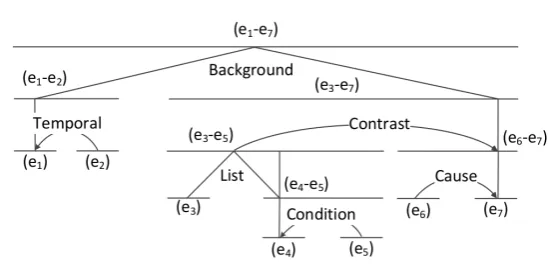
Discourse parsing is the task of determining how these units are related to each other (like in Figure 1) and plays a central role in a
ber of high-impact natural language processing (NLP) applications, including text summarization, sentence compression, sentiment analysis, and question-answering. For analyzing different per-spectives of discourse analysis researchers pro-posed a number of theoretical frameworks and re-leased annotated corpora, such as RST Discourse Treebank (RST-DT) (Carlson et al., 2003) and Penn Discourse Treebank (PDTB) (Prasad et al., 2008). Both of these decompose discourse pars-ing into a few subtasks and, like in most of NLP, their success depends on expert knowledge of each subtask and hand-engineering of more powerful features (Feng and Hirst, 2012; Lin et al., 2014), representations, and heuristics (Joty et al., 2013; Prasad et al., 2010).
Despite recent progress in automatic discourse segmentation and sentence-level parsing (Fisher and Roark, 2007; Joty et al., 2012; Soricut and Marcu, 2003), text-level discourse parsing re-mains a significant challenge (Feng and Hirst, 2012; Ji and Eisenstein, 2014; Lin et al., 2014). Traditional hand-engineering approaches unfortu-nately seem to be insufficient, as discourses and relations between them do not follow any strict grammar or obvious rules.
Two main theoretical frameworks with English corpus have been proposed to capture different rhetorical characteristics, and serve different ap-plications.
The Penn Discourse Treebank (PDTB) (Prasad et al., 2008) is currently the largest discourse-annotated corpus, consisting of 2159 articles from Wall Street Journal. It strives to maintain a theory-neutral approach by adopting the predicate-argument view and independence of discourse re-lations. In it either explicitly or implicitly given discourse connectives, such as coordinating junction (e.g. "and", "but"), subordinating con-junction (e.g. "if", "because"), or discourse ad-verbial (e.g. "however", "also"), combine pairs of discourse arguments into relations. For PDTB-style discourse parsing, extracting argument spans seems to be the most difficult subtask (Lin et al., 2014), resulting in the best overall performance of only34.80%inF1-measure (Kong et al., 2014).
The RST Discourse Treebank (RST-DT) (Carl-son et al., 2003) follows the theoretical frame-work of Rhetorical Structure Theory (RST) (Mann and Thompson, 1988). It contains 385 annotated documents from the Wall Street Journal with 18
high-level categories and 110 fine-grained rela-tions. Any coherent text can be represented as a RST discourse tree structure (like in Figure 1) whose leaves are minimal non-overlapping text spans called elementary discourse units. Adja-cent nodes are joined depending on their discourse relations to form a tree. In a mono-nuclear dis-course relation one of the text spans is the nucleus, which is more salient than the satellite, while in a multi-nuclear relation all text spans are equally important for interpretation. Performance of RST-style discourse parsing is evaluated based on their ability to locate spans of text that serve as argu-ments (best85.7%inF1-measure (Feng and Hirst,
2012)), identify which of the arguments is the nu-cleus (best 71.1% in F1-measure (Ji and
Eisen-stein, 2014)), and tag the sense and location of dis-course relations (best61.6%inF1-measure (Ji and
Eisenstein, 2014)).
3 Related work
bottom-• [The dollar finished lower yesterday,]e1[after another session on Wall Street.]e2
• [Concern about the volatile U.S. stock market had faded in recent sessions,]e3[and traders let
the dollar languish in a narrow range until tomorrow,]e4 [when the preliminary report on U.S.
gross national product is released.]e5
[image:3.595.166.441.188.322.2]• [But movements in the Dow Jones Industrial Average yesterday put Wall Street back in the spotlight]e6 [and inspired participants to bid the U.S. unit lower.]e7
Figure 1: An example of seven elementary discourse units (e1-e7), and (mono- or multi-nuclear) relations
between them in an RST discourse tree representation (Feng et al., 2014).
up fashion while distinguishing within-sentence and cross-sentence relations (Joty et al., 2013) and improved with discriminative reranking of dis-course trees using tree kernels (Joty and Moschitti, 2014). It has been shown that constituent- and dependency-based syntax and features based on coreference links improve performance (Surdeanu et al., 2015). The first PDTB-style end-to-end dis-course parser (Lin et al., 2014) uses a connec-tive list to identify explicit candidates, followed by simple features and parse trees to extract ar-guments and identify discourse relations. Classi-fying implicit discourse relations can be improved by combining distributed representations of parse trees with coreferent entity mentions (Ji and Eisen-stein, 2015). Extracting discourse arguments has been attempted by using classic linear word tag-ging with conditional random fields and global features (Ghosh et al., 2012), identifying nodes in constituent subtrees (Lin et al., 2014), and hybrid merging and pruning of parse trees with integer linear programming (Kong et al., 2014).
Deep learning architectures consist of multiple layers of simple learning blocks stacked on each other and, when well trained, tend to do a bet-ter job at disentangling the underlying factors of variation. Beginning with raw data, its represen-tation is transformed into increasingly higher and
more abstract forms in each layer, until the final low-dimensional features or representation useful for a given task is reached. Their success is possi-ble with breakthroughs and improvements in train-ing techniques (like AdaGrad or Adam optimiza-tion, rectifier funcoptimiza-tion, dropout regularization) and with initialization using unsupervised pre-training (Hinton et al., 2006; Collobert, 2011) on massive datasets (such as Wikipedia or Wall Street Jour-nal). Pre-training helps deep networks to develop natural abstractions and combined with multi-task learning (Collobert and Weston, 2008) it can sig-nificantly improve their performance in the ab-sence of hand-engineered features.
showed that only some NLP tasks benefit from recursive models applied on syntactic parse trees and recurrent models seem to be sufficient for dis-course parsing. By stacking multiple hidden lay-ers into a deep RNN makes them represent a tem-poral hierarchy with multiple layers operating at different time scales (Hermans and Schrauwen, 2013). Learning to store information over ex-tended time intervals has been achieved with long short-term memory (Hochreiter and Schmidhu-ber, 1997), time delay neural network (Waibel et al., 1989), or neural Turing machines (Graves et al., 2014). Bidirectional variants of these mod-els can incorporate information from preceding as well as following tokens (Schuster and Pali-wal, 1997). Recursive neural networks have also been shown to support different task-specific rep-resentations, such as matrix-vector representation of words (Socher et al., 2012) or recurrent neu-ral tensor networks (Socher et al., 2013). For our discourse parsing task such deeper models, that can learn abstract representations on different time scales, might better model the discourse re-lations between input vectors and (hopefully) cap-ture their communicative functions and semantic meaning.
A few initial attempts of applying representa-tion learning to our task have already shown sub-stantial performance improvements over previous state-of-the-art. Ji and Eisenstein (Ji and Eisen-stein, 2014) implement a shift-reduce discourse parser on top of given RST-style discourse units to simultaneously learn parsing and a discourse-driven projection of features using support vector machines with gradient-based updates. Li et al. (Li, 2014) produce a distributed representation of RST-style discourse units using recursive convolu-tion on sentence parse trees and apply a classifier to determine relations between them. Ji and Eisen-stein (Ji and EisenEisen-stein, 2014) also improved clas-sification of PDTB-style implicit discourse rela-tions by combining distributed representarela-tions of parse trees with coreferent entity mentions.
4 Contribution to science
Because text-level discourse parsing is an impor-tant, yet still challenging NLP task, it is the focus of our doctoral dissertation.
Method for text-level discourse parsing.
Instead of depending on mostly hand-engineered sparse features and independent
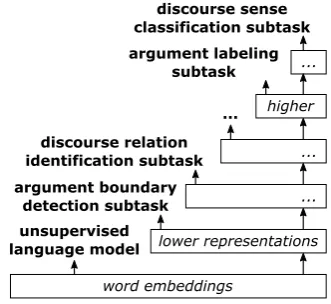
[image:4.595.332.498.383.535.2]separately-developed components for each subtask, we propose a unified end-to-end approach for text-level discourse parsing completely based on deep learning architectures. First each of the discourse parsing subtasks, such as argument boundary detection, labeling, discourse relation identification and sense classification, need to be formulated in terms of RNNs and similar derivable learning architectures. To benefit from their ability to learn intermediate representations they will be partially stacked on top of each order, such that the last but one layer (i.e. output layer) for each subtask is shared with other subtasks. By placing increasingly more difficult subtasks at different layers in one deep architecture, they can benefit from each others intermediate representations, improve robustness and training speed. Figure 2 further combines unsupervised training of word embeddings with our layer-wise multi-task learning of higher representations and illustrates our goal of a unified end-to-end approach for text-level discourse parsing utilizing different layers of representations.
Figure 2: Illustration of our unified end-to-end ap-proach for text-level discourse parsing with layer-wise multi-task learning of higher representations.
5 Work plan
To accomplish this we will, on one hand, need to find the best deep learning models for each of the discourse parsing subtasks, suitable architecture, activation functions, and figure out how to adapt them to operate on sequential data and with each other. This includes analyzing deep learning archi-tectures, identifying their strengths, useful compo-nents, and their suitability for our NLP task.
rep-resentations and unsupervised training of word embeddings. Developing a prototype for shal-low discourse parsing will open the door for find the best initialization procedures, training func-tions, learning rates, and similar. Shallow PDTB-style discourse parsing is also a challenge on this years CoNLL 2015 conference, where adjacent text spans are not necessarily connected with dis-course relations to form a tree.
Additionally we will experiment with new and more expressive representations and structures (like neural tensor networks) that could capture communicative functions and semantic roles of discourse units and relations between them.
Even though our method could be applied to any plain text, we plan on evaluating it on stan-dard annotated English corpora. After applying our approach on at lest one of the corpora, we intend to qualitatively analyze the identified dis-course units and relations between them to gain in-sights about its strengths and weaknesses. On the other hand, the dataset will allow us to also quan-titatively compare its performance to current state-of-the-art methods. The procedure for our method will begin by pre-training the weights in our deep architecture on external unlabeled datasets (like Wikipedia), than jointly train on all discourse pars-ing subtasks on the trainpars-ing set, use a separate val-idation set to optimize hyper-parameters, and es-timate its performance on the test set. For eval-uation purposes standard evaleval-uation measures for subtasks based onF1-scores will be used.
6 Conclusion
To increase the generality of our unified end-to-end approach for text-level discourse parsing, we will try to depend as little as possible on back-ground knowledge in the form of hand-engineered features for a specific language, domain, or task. By incorporating various improvements in auto-matic learning of features and representations we hope to reach or even surpass performance of cur-rent state-of-the-art methods on annotated English corpora.
References
Jason Baldridge and Alex Lascarides. 2005. Proba-bilistic head-driven parsing for discourse structure. InProc. 9th Conf. Comput. Nat. Lang. Learn., pages 96–103. Association for Computational Linguistics.
Lynn Carlson, Daniel Marcu, and Mary Ellen Okurowski. 2003. Building a discourse-tagged cor-pus in the framework of Rhetorical Structure Theory.
Curr. New Dir. Discourse Dialogue, 22:85–112.
Danqi Chen and Christopher D Manning. 2014. A Fast and Accurate Dependency Parser using Neural Networks. InProc. 2014 Conf. Empir. Methods Nat. Lang. Process., pages 740–750.
Ronan Collobert and Jason Weston. 2008. A Uni-fied Architecture for Natural Language Processing: Deep Neural Networks with Multitask Learning. In
Proc. 25th Int. Conf. Mach. Learn., volume 20, pages 160–167.
Ronan Collobert. 2011. Deep Learning for Efficient Discriminative Parsing. Int. Conf. Artif. Intell. Stat., 15:224–232.
David A. DuVerle and Helmut Prendinger. 2009. A novel discourse parser based on support vector ma-chine classification. In Proc. Jt. Conf. 47th Annu. Meet. ACL 4th Int. Jt. Conf. Nat. Lang. Process. AFNLP, pages 665–673. Association for Computa-tional Linguistics.
Jeffrey L. Elman. 1990. Finding structure in time* 1.
Cogn. Sci., 14(1990):179–211.
Vanessa Wei Feng and Graeme Hirst. 2012. Text-level Discourse Parsing with Rich Linguistic Features. In
Proc. 50th Annu. Meet. Assoc. Comput. Linguist., pages 60–68. Association for Computational Lin-guistics.
Vanessa Wei Feng, Ziheng Lin, and Graeme Hirst. 2014. The Impact of Deep Hierarchical Discourse Structures in the Evaluation of Text Coherence. In
Proc. 25th Int. Conf. Comput. Linguist.
Seeger Fisher and Brian Roark. 2007. The utility of parse-derived features for automatic discourse seg-mentation. InProc. 45th Annu. Meet. Assoc. Com-put. Linguist., volume 45, pages 488–495.
Sucheta Ghosh, Giuseppe Riccardi, and Richard Jo-hansson. 2012. Global features for shallow dis-course parsing. In Annu. Meet. Spec. Interes. Gr. Discourse Dialogue, pages 150–159.
Christoph Goller and Andreas Küchler. 1996. Learn-ing Task-Dependent Distributed Representations by Backpropagation Through Structure. In IEEE Int. Conf. Neural Networks, pages 347–352.
Alex Graves, Greg Wayne, and Ivo Denihelka. 2014. Neural Turing Machines. arXiv Prepr. arXiv410.5401, pages 1–26.
Michiel Hermans and Benjamin Schrauwen. 2013. Training and Analyzing Deep Recurrent Neural Net-works. InAdv. Neural Inf. Process. Syst., volume 26, pages 190–198.
Hugo Hernault, Helmut Prendinger, David A. DuVerle, and Mitsuru Ishizuka. 2010. HILDA: A Discourse Parser Using Support Vector Machine Classification.
Dialogue and Discourse, 1(3):1–33.
Geoffrey E. Hinton, Simon Osindero, and Yee-Whye Teh. 2006. A Fast Learning Algorithm for Deep Belief Nets. Neural Comput., 18:1527–1554. Sepp Hochreiter and Jürgen Schmidhuber. 1997. Long
Short-Term Memory. Neural Comput., 9(8):1735– 1780.
Yangfeng Ji and Jacob Eisenstein. 2014. Representa-tion Learning for Text-level Discourse Parsing. In
Proc. 52nd Annu. Meet. Assoc. Comput. Linguist., pages 13–24.
Yangfeng Ji and Jacob Eisenstein. 2015. One Vector is Not Enough: Entity-Augmented Distributed Seman-tics for Discourse Relations. Trans. Assoc. Comput. Linguist.
Shafiq Joty and Alessandro Moschitti. 2014. Discrim-inative Reranking of Discourse Parses Using Tree Kernels. InProc. 2014 Conf. Empir. Methods Nat. Lang. Process., pages 2049–2060.
Shafiq Joty, Giuseppe Carenini, and Raymond T. Ng. 2012. A novel discriminative framework for sentence-level discourse analysis. InProc. 2012 Jt. Conf. Empir. Methods Nat. Lang. Process. Comput. Nat. Lang. Learn., pages 904–915. Association for Computational Linguistics.
Shafiq Joty, Giuseppe Carenini, Raymond T. Ng, and Yashar Mehdad. 2013. Combining Intra- and Multi-sentential Rhetorical Parsing for Document-level Discourse Analysis. InProc. 51st Annu. Meet. Assoc. Comput. Linguist., pages 486–496.
Fang Kong, Hwee Tou, and Ng Guodong. 2014. A Constituent-Based Approach to Argument Labeling with Joint Inference in Discourse Parsing. InConf. Empir. Methods Nat. Lang. Process., pages 68–77.
Jiwei Li, Dan Jurafsky, and Eduard Hovy. 2015. When Are Tree Structures Necessary for Deep Learning of Representations? Arxiv.
Junyi Jessy Li. 2014. Reducing Sparsity Improves the Recognition of Implicit Discourse Relations. In
Proc. SIGDIAL 2014 Conf., number June, pages 199–207.
Ziheng Lin, Min-yen Kan, and Hwee Tou Ng. 2009. Recognizing Implicit Discourse Relations in the Penn Discourse Treebank. InProc. 2009 Conf. Em-pir. Methods Nat. Lang. Process., pages 343–351. Association for Computational Linguistics.
Ziheng Lin, Hwee Tou Ng, and Min-Yen Kan. 2014. A PDTB-Styled End-to-End Discourse Parser. Nat. Lang. Eng., 20(2):151–184.
William C. Mann and Sandra A. Thompson. 1988. Rhetorical structure theory: Toward a functional the-ory of text organization. Text-Interdisciplinary J. Study Discourse, 8(3):243–281.
Daniel Marcu. 2000. The Rhetorical Parsing of Unre-stricted Texts: A Surface-based Approach. Comput. Linguist., 26(38):395–448.
Rashmi Prasad, Nikhil Dinesh, Alan Lee, Eleni Milt-sakaki, Livio Robaldo, Aravind Joshi, and Bonnie Webber. 2008. The Penn Discourse TreeBank 2.0.
Proc. Sixth Int. Conf. Lang. Resour. Eval., pages 2961–2968.
Rashmi Prasad, Aravind Joshi, and Bonnie Webber. 2010. Exploiting Scope for Shallow Discourse Pars-ing. InInt. Conf. Lang. Resour. Eval., pages 2076– 2083.
Mike Schuster and Kuldip K Paliwal. 1997. Bidirec-tional recurrent neural networks. IEEE Trans. Sig-nal Process., 45(11):2673–2681.
Richard Socher, Brody Huval, Christopher D. Man-ning, and Andrew Y. Ng. 2012. Semantic Compo-sitionality through Recursive Matrix-Vector Spaces. In Proc. 2012 Jt. Conf. Empir. Methods Nat. Lang. Process. Comput. Nat. Lang. Learn., pages 1201– 1211. Association for Computational Linguistics. Richard Socher, Alex Perelygin, Jean Y. Wu, Jason
Chuang, Christopher D. Manning, Andrew Y. Ng, and Christopher Potts. 2013. Recursive deep mod-els for semantic compositionality over a sentiment treebank. InProc. Conf. Empir. Methods Nat. Lang. Process., pages 1631–1642.
Radu Soricut and Daniel Marcu. 2003. Sentence level discourse parsing using syntactic and lexical infor-mation. Proc. 2003 Conf. North Am. Chapter Assoc. Comput. Linguist. Hum. Lang. Technol., 1:228–235. Rajen Subba and Barbara Di Eugenio. 2009. An effec-tive discourse parser that uses rich linguistic infor-mation. InProc. Hum. Lang. Technol. 2009 Annu. Conf. North Am. Chapter Assoc. Comput. Linguist., pages 566–574. Association for Computational Lin-guistics.
Mihai Surdeanu, Thomas Hicks, and Marco A. Valenzuela-Escarcega. 2015. Two Practical Rhetor-ical Structure Theory Parsers. InProc. North Am. Chapter Assoc. Comput. Linguist.