Munich Personal RePEc Archive
Economic Operation of Self-Sustained
Microgrid Optimal Operation by
Multiobjective Evolutionary Algorithm
Based on Decomposition
Mahdavi, Sadegh and Bayat, Alireza and Khazaei, Ehsan
and Jamaledini, Ashkan
Electrical and Computer Engineering Department, Sazeh Sazan
Power Company, Iran, Electrical and Computer Engineering
Department, Sazeh Sazan Power Company, Iran, Electrical and
Computer Engineering Department, Sazeh Sazan Power Company,
Iran
2019
Online at
https://mpra.ub.uni-muenchen.de/95393/
Economic Operation of Self-Sustained
Microgrid Optimal Operation by
Multiobjective Evolutionary Algorithm Based
on Decomposition
Sadegh Mahdavi, Alireza Bayat, Ehsan Khazaei, Ashkan Jamaledini
Electrical and Computer Engineering Department, Sazeh Sazan Power Company, Iran
Abstract: This paper focuses on the optimal operation of the islanded microgrid. A novel
heuristic method known as the Multiobjective Evolutionary Algorithm Based on
Decomposition is presented to search for the optimal solution with a fast response. The
efficiency of the method is tested on the IEEE 33 bus test network.
I. INTRODUCTION
In the recent decade, MICROGRID has gained growing interest among researchers due
to its economic and technical advantages [1-5]. Microgrid is referred to a small electricity
grid which produces power for the consumers that exist inside the network. In other words,
electricity power producers and consumers are posited inside this small network. One of
the main advantages of this system is the less transmission line required which
consequently lowers the expansion planning cost. Moreover, the adjacency of the
system’s elements results in increase in reliability, voltage profile, and power quality of the
Despite so many advantages of microgrid, there are several problems with it that are not
thoroughly solved such as the protection and optimal operation of the system. This paper
addresses the optimal scheduling of islanded microgrid. A microgrid is said to be islanded
when it is disconnected from the main grid. The load of dispatchable generators of the
microgrid should not exceed the defined limit. Connected mode of a microgrid means that
it can exchange power with conventional power grids, the grid that it is connected to. The
investigation of this paper is narrowed down to only the islanded operation of microgrid.
Control of an Islanded microgrid is studied in [6]. Also, reference [7] studied design of a
DC/DC boost converter that is implemented for microgrid operation. A few heuristic
algorithm techniques such as CDOA, GA, PSO, TLABO, etc. are used to solve the
microgrid operation, which are discussed in the literatures [8-11]. Moreover, references
[12-15] have focused on development of an effective control for microgrid operation.
References [16-19] have investigated addition of the electric vehicles, superconductivity
of the microgrid, and security of the microgrid. It should be noted that different optimizing
techniques, such as response surface methodology (RSM), the Taguchi-based methods,
the fuzzy neural system (FNS), and the artificial intelligence (AI), are common methods for
data analysis of different systems in a wide range of engineering applications, some of
these technique are excellent for evaluation of complicated processes with uncertainty
[20-27]. This paper presents a new heuristic method known as chaotic Multiobjective
Evolutionary Algorithm Based on Decomposition search optimization algorithm for optimal
II. PROBLEM FORMULATIONS
The discussed problem tries to minimize the operation cost of the islanded microgrid by
defining an objective function and applying several constraints to it.
A. Objective function
The objective function in this problem is as follows:
𝑚𝑖𝑛 ∑ [𝐶∀𝑖 𝑖𝑃𝑖𝑡𝐼𝑖𝑡+ 𝑆𝑈𝑖𝑡 + 𝑆𝐷𝑖𝑡] (1)
Where:
I is a binary variable that can be zero or one and determine the status of unit i at time t.
SU and SD are the startup and shutdown costs of the ith unit at time t.
B. Constraints
Several constraints are applied on the proposed optimization problem. Since the capacity
of the generators as limited, the output power (P) of each DG should be within the following
limit at ant single time.
𝑃𝑖𝑡,𝑚𝑖𝑛 ≤ 𝑃𝑖𝑡 ≤ 𝑃𝑖𝑡,𝑚𝑎𝑥 (2)
In addition, the limitation on the ramp up and down of generators are as:
𝑃𝑖𝑡 − 𝑃𝑖(𝑡−1) ≤ 𝑅𝑈𝑖 (3)
𝑃𝑖(𝑡−1)− 𝑃𝑖𝑡 ≤ 𝑅𝐷𝑖 (4)
Where:
𝑅𝑈𝑖 and 𝑅𝑈𝑖 are the ramp up and ramp down rates of the ith generation units, respectively.
Finally, the minimum up and down time limits are considered as:
𝑇(𝑜𝑛)𝑖𝑡 ≥ 𝑈𝑇𝑖(𝐼𝑖𝑡− 𝐼𝑖(𝑡−1) (5)
𝑇(𝑜𝑓𝑓)𝑖𝑡 ≥ 𝐷𝑇𝑖(𝐼𝑖(𝑡−1)− 𝐼𝑖𝑡 (6)
𝑈𝑇𝑖 and 𝐷𝑇𝑖 are minimum up and down rates of the ith unit.
𝑇(𝑜𝑛) and 𝑇(𝑜𝑓𝑓) represents the number of successive on and off hours.
It is worth noting that the proposed problem has been solved based on the multiobjective
evolutionary algorithm based on decomposition. More detail regarding this algorithm can
be found in [28]. It is worth noting that the heuristic methods have been widely used in the
similar problem or any other field of science. However, they can be trapped in the local
minimum. Hence, analytical methods are used instead of them [29-36].
III. RESULTS
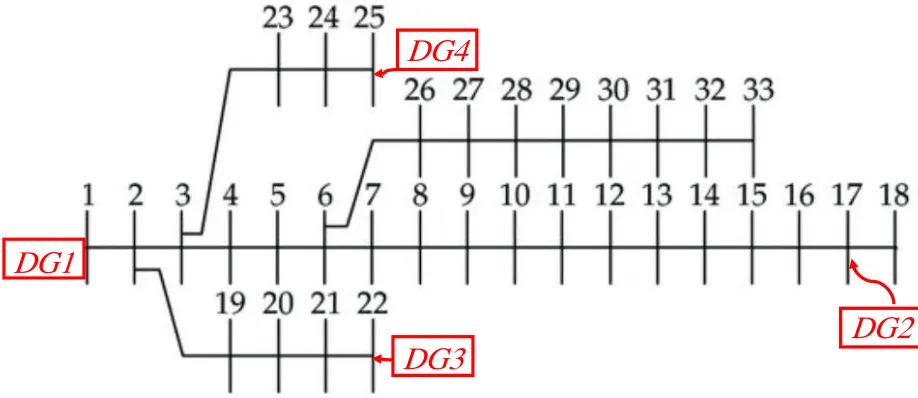
Figure 1 shows the single line diagram of the tested model, which is contains four
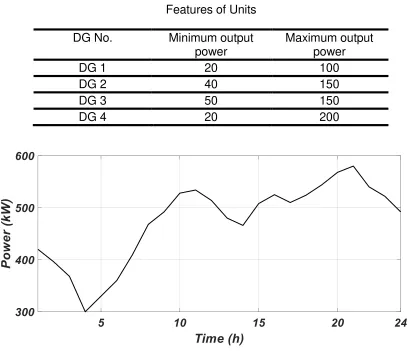
distributed generators (DGs). The features of the DGs have been explained in Table 1.
[image:5.612.75.534.415.614.2]Also, day-ahead load demand has been demonstrated in figure 2.
Fig. 1. Tested model single line model
DG1
DG2
DG3
Table I Features of Units
DG No. Minimum output power
Maximum output power
DG 1 20 100
DG 2 40 150
DG 3 50 150
DG 4 20 200
Fig. 2. Day-ahead load demand
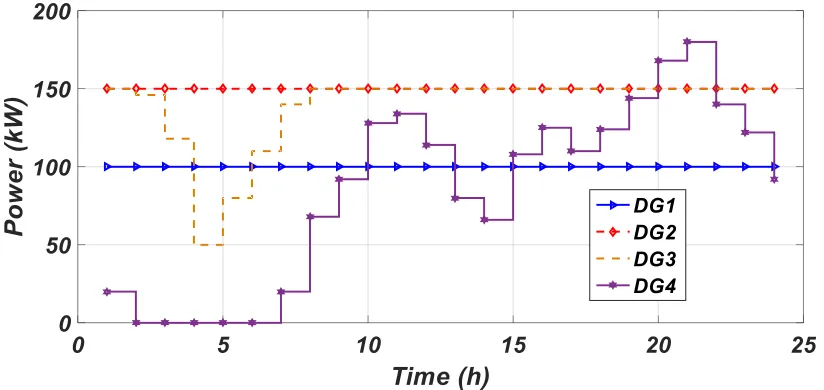
Fig. 2 presents the DGs output power. The results demonstrate the effectiveness of the
Fig. 4. The output power of Units
Total operation cost of the proposed method has been compared with the well-known
algorithms such as particle swarm optimization (PSO) and genetic algorithm (GA)
methods. The results are reported in Table II, that show the cost effectiveness of the
[image:7.612.94.506.82.277.2]proposed method.
Table II Operation cost
Operation cost ($) Computational Time (second)
PSO 9648.7 15.6
GA 9234.5 14.4
Proposed method 7643.2 12.2
IV. CONCLUSION
In this paper, a new method has been developed for the economic operation of the
self-sustained (islanded) microgrid. The results show the high speed, as well as the lower
operation cost, compared to the well-known methods such as PSO and GA. It is worth
Reference
[1] Dabbaghjamanesh, Morteza. "Stochastic Energy Management of Reconfigurable
Power Grids in the Presence of Renewable Energy by Considering Practical Limitations." (2019).
[2] Tajalli, Seyede Zahra, Seyed Ali Mohammad Tajalli, Abdollah Kavousi-Fard, Taher Niknam, Morteza Dabbaghjamanesh, and Shahab Mehraeen. "A Secure Distributed Cloud-Fog Based Framework for Economic Operation of Microgrids." In 2019 IEEE Texas Power and Energy Conference (TPEC), pp. 1-6. IEEE, 2019.
[3] Zhang, Yan, Fanlin Meng, Rui Wang, Behzad Kazemtabrizi, and Jianmai Shi. "Uncertainty-resistant Stochastic MPC Approach for Optimal Operation of CHP Microgrid." Energy(2019).
[4] Chen, Yahong, Changhong Deng, Weiwei Yao, Ning Liang, Pei Xia, Peng Cao, Yiwang Dong et al. "Impacts of stochastic forecast errors of renewable energy generation and load demands on microgrid operation." Renewable Energy 133 (2019): 442-461.
[5] Pourbehzadi, Motahareh, Taher Niknam, Jamshid Aghaei, Geev Mokryani, Miadreza Shafie-khah, and João PS Catalão. "Optimal operation of hybrid AC/DC microgrids
under uncertainty of renewable energy resources: A comprehensive
review." International Journal of Electrical Power & Energy Systems 109 (2019): 139-159.
[6] Taherzadeh, Erfan, Shahram Javadi, and Morteza Dabbaghjamanesh. "New Optimal Power Management Strategy for Series Plug-In Hybrid Electric Vehicles." International Journal of Automotive Technology 19, no. 6 (2018): 1061-1069.
[7] Razavi Arab Azadeh, Danehkar, A., Monavari, S. M., Haghshenas S. A. (2013):
Monitoring Coral Ecosystems in Naiband Bay, the Persian Gulf, Caspian Journal of Applied Sciences Research, Vol. 2, No. 9, pp. 7 - 9, ISSN 2251-9114.
[8] Razavi Arab, Azadeh, Danehkar A., Haghshenas S. A. (2012): Assessment of Coastal Development Impacts on Coral Ecosystems in Naiband Bay, the Persian
Gulf, 33rd Coastal Eng. Conf., ASCE, Santander, Spain.
[9] Dabbaghjamanesh, Morteza, Abdollah Kavousi-Fard, and Shahab Mehraeen. "Effective scheduling of reconfigurable microgrids with dynamic thermal line rating." IEEE Transactions on Industrial Electronics 66, no. 2 (2019): 1552-1564.
[11] Dabbaghjamanesh, Morteza, Shahab Mehraeen, Abdollah Kavousi-Fard, and Farzad Ferdowsi. "A New Efficient Stochastic Energy Management Technique for Interconnected AC Microgrids." In 2018 IEEE Power & Energy Society General Meeting (PESGM), pp. 1-5. IEEE, 2018.
[12] Tsikalakis, Antonis G., and Nikos D. Hatziargyriou. "Centralized control for optimizing microgrids operation." In 2011 IEEE power and energy society general meeting, pp. 1-8. IEEE, 2011.
[13] Dimeas, Aris L., and Nikos D. Hatziargyriou. "Operation of a multiagent system for microgrid control." IEEE Transactions on Power systems 20, no. 3 (2005): 1447-1455.
[14] Olivares, Daniel E., Ali Mehrizi-Sani, Amir H. Etemadi, Claudio A. Cañizares, Reza Iravani, Mehrdad Kazerani, Amir H. Hajimiragha et al. "Trends in microgrid control." IEEE Transactions on smart grid 5, no. 4 (2014): 1905-1919.
[15] Ferdowsi, Farzad, Hesan Vahedi, Chris S. Edrington, and Touria El-Mezyani. "Dynamic Behavioral Observation in Power Systems Utilizing Real-Time Complexity Computation." IEEE Transactions on Smart Grid 9, no. 6 (2017): 6008-6017
[16] Ferdowsi, F., Vahedi, H., & Edrington, C. S. (2017, February). High impedance fault detection utilizing real-time complexity measurement. In 2017 IEEE Texas Power and Energy Conference (TPEC) (pp. 1-5). IEEE
[17] Ferdowsi, F. (2016). Real-time dynamic behavioral observation in power systems utilizing nonlinear time-series analysis (Doctoral dissertation, The Florida State University)
[18] Dabbaghjamanesh, Morteza, Boyu Wang, Abdollah Kavousi-Fard, Shahab
Mehraeen, Nikos D. Hatziargyriou, Dimitris Trakas, and Farzad Ferdowsi. "A Novel Two-Stage Multi-Layer Constrained Spectral Clustering Strategy for Intentional Islanding of Power Grids." IEEE Transactions on Power Delivery (2019).
[19] Afrasiabi, S., Afrasiabi, M., Rastegar, M., Mohammadi, M., Parang, B., & Ferdowsi, F. (2019, February). Ensemble Kalman Filter based Dynamic State Estimation of PMSG-based Wind Turbine. In 2019 IEEE Texas Power and Energy Conference (TPEC) (pp. 1-4). IEEE.
[20] Basak, Prasenjit, A. K. Saha, S. Chowdhury, and S. P. Chowdhury. "Microgrid: Control techniques and modeling." In 2009 44th International Universities Power Engineering Conference (UPEC), pp. 1-5. IEEE, 2009.
[21] Ramin Mehdizad Tekiyeh, Mohsen Najafi, Saeid Shahraki. “Machinability of AA7075
-T6/carbon nanotube surface composite fabricated by friction stir processing”,
[22] Reza Bagherian Azhiri, Abolfazl Salmani Bideskan, Farid Javidpour, Ramin
Mehdizad Tekiyeh, “Study on material removal rate, surface quality, and residual
stress of AISI D2 tool steel in electrical discharge machining in presence of ultrasonic
vibration effect”, The International Journal of Advanced Manufacturing Technology,
April 2019, Volume 101, Issue 9–12, pp 2849–2860
[23] Reza Bagherian Azhiri, Jalal Fathi Sola, Ramin Mehdizad Tekiyeh, Farid Javidpour,
Abolfaz Salmani Bideskan, “Analyzing of joint strength, impact energy, and angular
distortion of the ABS friction stir welded joints reinforced by nanosilica addition”, The International Journal of Advanced Manufacturing Technology, February 2019, Volume
100, Issue 9–12, pp 2269–2282.
[24] Dabbaghjamanesh, Morteza, Abdollah Kavousifard, Shahab Mehraeen, Jie Zhang, and Zhao Yang Dong. "Sensitivity Analysis of Renewable Energy Integration on Stochastic Energy Management of Automated Reconfigurable Hybrid AC-DC Microgrid Considering DLR Security Constraint." IEEE Transactions on Industrial Informatics (2019).
[25] Ghaffari, Saeed, and Maryam Ashkaboosi. "Applying Hidden Markov Model Baby Cry Signal Recognition Based on Cybernetic Theory." IJEIR 5: 243-247.
[26] Ashkaboosi, Maryam, Farnoosh Ashkaboosi, and Seyed Mehdi Nourani. "The Interaction of Cybernetics and Contemporary Economic Graphic Art as" Interactive Graphics"." (2016).
[27] Ghaffari, Saeed, and M. Ashkaboosi. "Applying Hidden Markov M Recognition Based on C." (2016).
[28] Carvalho, Rodrigo de, Rodney Rezende Saldanha, B. N. Gomes, Adriano Chaves Lisboa, and A. X. Martins. "A multi-objective evolutionary algorithm based on decomposition for optimal design of Yagi-Uda antennas." IEEE Transactions on Magnetics 48, no. 2 (2012): 803-806.
[29] Razavi Arab, Azadeh, Haghshenas, S. A. (2014): Applying a Combination of Numerical Simulations, Tracing Sediment Indicators and Satellite Imagery Analysis to Investigate Morphodynamic Changes in Mond Coastal Area, the Persian Gulf, 17th Physics of Estuaries and Coastal Seas (PECS) Conference, Porto de Galinhas, Pernambuco, Brazil, 19-24 October 2014.
[30] Wang, Boyu, Morteza Dabbaghjamanesh, Abdollah Kavousi Fard, and Shahab Mehraeen. "Cybersecurity Enhancement of Power Trading Within the Networked Microgrids Based on Blockchain and Directed Acylic Graph Approach." IEEE Transactions on Industry Applications (2019).
Iranian coastline of the Oman Sea, the 16th Iranian Geophysics Conference – GC16, Tehran, Iran.
[32] Taherzadeh, Erfan, Morteza Dabbaghjamanesh, Mohsen Gitizadeh, and Akbar Rahideh. "A new efficient fuel optimization in blended charge depletion/charge sustenance control strategy for plug-in hybrid electric vehicles." IEEE Transactions on Intelligent Vehicles 3, no. 3 (2018): 374-383.
[33] Dabbaghjamanesh, Morteza, Shahab Mehraeen, Abdollah Kavousifard, and Mosayeb Afshari Igder. "Effective scheduling operation of coordinated and uncoordinated wind-hydro and pumped-storage in generation units with modified JAYA algorithm." In 2017 IEEE Industry Applications Society Annual Meeting, pp. 1-8. IEEE, 2017.
[34] Erdinc, Ozan, Nikolaos G. Paterakis, Tiago DP Mendes, Anastasios G. Bakirtzis, and João PS Catalão. "Smart household operation considering bi-directional EV and ESS utilization by real-time pricing-based DR." IEEE Transactions on Smart Grid 6, no. 3 (2014): 1281-1291.
[35] Shahidehpour, Mohammad, Hatim Yamin, and Zuyi Li. Market operations in electric power systems: forecasting, scheduling, and risk management. John Wiley & Sons, 2003.