Available online: https://edupediapublications.org/journals/index.php/IJR/ P a g e | 2223
Web Based Information Services: A Study of University
Libraries of Punjab
Sukhpreet Singh
Assistant Librarian, Gobindgarh Public College, Alour, Khanna
Abstract: The present research paper examines the extent of web based
information services provided by
university Libraries in Punjab. The sample for the study consists of 5 universities of Punjab. The websites of libraries of the sample universities are browsed for the collection of data. The study shows that all sample universities have not maintained separate websites for libraries. The average disclosure score of universities is 52.17 per cent. Disclosure index has been prepared covering 23 items to measure the
item-wise disclosure by university
libraries.
1. INTRODUCTION
Emergence and widespread use of internet have completely revolutionized the library system and services. With this advent, libraries are being shifted from traditional to digital environment. Till now, the universities, colleges and schools have been providing information services manually mainly contained in print media such as books and journals etc. The tremendous growth of information and rapid development in scientific research has necessitated the change and
improvement in library services and systems. Internet can assist libraries in providing better services to the users. There are huge services that can be offered to users by library system. These services include online database, online bibliography, E-journals, user’s education programmes and reference services etc. The library professionals should examine the expectations of information seekers and its use by users. The main objective of information service is to provide complete information to the users in most convenient manner so as to ensure the best use of library services. To communicate information to users, internet has no equal. Now days university libraries have started developing their own websites to communicate information to users. The websites provide information to users at a single click. It is the fastest vehicle in the hands of information seekers to reach to the information in most convenient manner. The libraries have started providing information on web due to benefits of low cost and wide reach. The libraries disclose information on web voluntarily as there is not standardized
Available online: https://edupediapublications.org/journals/index.php/IJR/ P a g e | 2224
content and format yet to provide library services on internet.
2. REVIEW OF LITERATURE
Harmanpreet (2016) in her research examined the extent of web based disclosure practices by Indian companies. The data was collected from the websites of 28 Indian companies listed on BSE index. It was found in the research that all companies were having their own websites. There was variation in the extent and type of financial and non financial disclosure. The study highlighted that Indian companies have not fully utilised the prospects of internet. The disclosure score of FMCG companies was highest and overall disclosure of service sector was better as compared to manufacturing sector companies. The research also revealed that company characteristics such as sixe of company, profitability, leverage and liquidity had no influence on disclosure practices on web.
It has been in the research that corporate reporting on internet should be standardized. Indian accounting standards should be converged with international accounting standards. Also, the companies should disclose important information at their home page.
Das and Ninan (2014) made an attempt to determine the changing roles and responsibilities of PG College and libraries in 21st century. The academic libraries have to expand their horizons to make libraries as leading players in information industry and major provider of I formation services with the use of latest and advanced information technology.
The new challenges for library professionals were information explosion, escalating cost of printed documents, dwindling library budgets, new patterns of scholarly publishing and development of digital and hybrid libraries, ICT revolution etc. These challenges lead to reorientation, reengineering and great changes in the information environment and roles of information service professionals. To cope with these challenges the professionals must develop expert technological competencies.
TK (2004) made a study on the computerisation of university libraries in Kerala. The study identified and compared the application of computers in housekeeping operations in libraries and websites of university libraries. The study disclosed that digital collections of university libraries were negligible and subscription to online database was very low. The libraries were not adequately
Available online: https://edupediapublications.org/journals/index.php/IJR/ P a g e | 2225
equipped with latest technology. Also, they did not have skilled and qualified staff. The users were not aware about OPAC and actively using it to find the documents from the libraries. The research also revealed that majority of users were not getting education services and awareness of users on modern library and information services was very poor. It was suggested that collection of libraries should be developed in balanced manner. Libraries should subscribe to online journals and database. The university libraries should follow uniform international standards for technical processing of the collection and make computer application in all areas. Users education programme, current awareness services, multimedia service and CD/DVD based services should be provided by university libraries.
3. OBJECTIVES OF THE STUDY
The objectives of the study were:
1. To check the presence of websites of libraries of sample universities. 2. To examine the extent of disclosure
on Library websites of universities. 3. To provide suggestions to the
university libraries.
4. RESEARCH METHODOLOGY
The study covers randomly selected five university libraries of Punjab namely Punjabi University, Patiala, Punjab University, Chandigarh, Chitkara University, Guru Nanak Dev University and Chandigarh University.
For the purpose of study, data has been collected from the library websites of the respective university. To measure the extent of voluntary information services provided on web by university libraries, an index constituting 23 items has been prepared. The selection of items for the construction of index is based on review of literature. For the purpose of analysis, the items have been classified into two categories such as:
1. General Information 2. Specialized Information For scoring of items in the index, unweighted scoring method has been used. If a university library provided an item on their website, then score one is given and if not disclosed, zero score is given.
RESULTS & ANALYSIS GENERAL INFORMATION
Available online: https://edupediapublications.org/journals/index.php/IJR/ P a g e | 2226
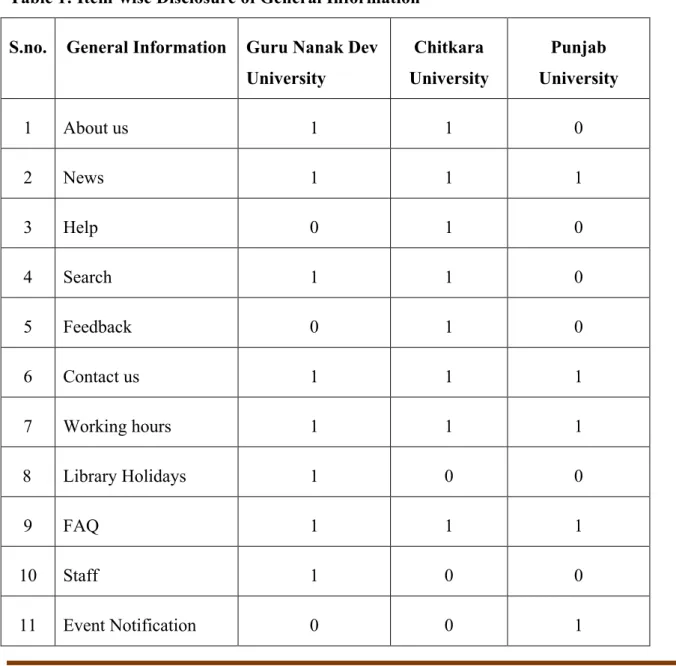
The table 1 shows that all sample University Libraries provide information on their websites related to Library working hours, latest news, contact us and frequently asked questions to provide additional information to user. Only Chitkara University provide the users with help and feedback option. About library and Search option is available on website of GNDU and Chitkara University. Guru Nanak Dev University provided the
maximum general information and is the only university which provided information related to Library holidays, staff of library and photos/ video. Event notification is provided by Punjab University only. Guru Nanak Dev University provided maximum general information to the users. The overall average of provider of general information is 61 per cent.
Table 1: Item-wise Disclosure of General Information S.no. General Information Guru Nanak Dev
University Chitkara University Punjab University 1 About us 1 1 0 2 News 1 1 1 3 Help 0 1 0 4 Search 1 1 0 5 Feedback 0 1 0 6 Contact us 1 1 1 7 Working hours 1 1 1 8 Library Holidays 1 0 0 9 FAQ 1 1 1 10 Staff 1 0 0 11 Event Notification 0 0 1
Available online: https://edupediapublications.org/journals/index.php/IJR/ P a g e | 2227
12 Photos/ Videos 1 0 0
Total 9 8 5
SPECIALIZED INFORMATION
(SERVICES)
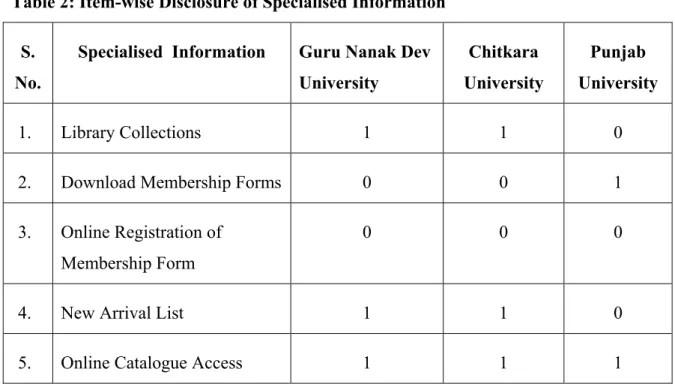
Table 2 shows the item-wise Specialised information of sample universities. The table shows that online catalogue access is the only service provided by all sample university libraries. Online registration of membership and reservation of documents service is not provided by any of the university. The service to download membership form is provided by Punjab University only. Library collections and new arrival list is provided on the websites by GNDU and Chitkara University
whereas library rules are given by Chitkara University and Punjab University. The other specialised services such as Book lost form, link to other universities, book requisition form and renewal of borrowed items are provided by only Chitkara University. The overall average of specialised information provided by university Libraries on their websites comes to 45.2 per cent. There is variation among university Libraries in providing specialised services on web. Chitkara University is leading in providing specialised services to public on web with huge difference.
Table 2: Item-wise Disclosure of Specialised Information S.
No.
Specialised Information Guru Nanak Dev University Chitkara University Punjab University 1. Library Collections 1 1 0
2. Download Membership Forms 0 0 1
3. Online Registration of Membership Form
0 0 0
4. New Arrival List 1 1 0
Available online: https://edupediapublications.org/journals/index.php/IJR/ P a g e | 2228
6. Reservation of Documents 0 0 0
7. Renewal of Borrowed Items 0 1 0
8. Link to other Libraries 0 1 0
9. Library Rules 0 1 1
10. Book Requisition form 0 1 0
11. Book Lost Form 0 1 0
Total 3 8 3
Total of General and Specialised Information
12 16 8
Overall Percentage 52 69.5 39
CONCLUSIONS
The study highlighted that Universities in Punjab have not completely utilized the potentials of internet for providing library services to the public. Only few universities in Punjab have their official website for Library sciences. Under study, out of five universities, two universities namely Punjabi University Patiala and Chandigarh University do not have their own library website. Libraries have provided their general information as well as specialised services to users but only to limited extent. There is variation in the type and extent of information disclosed on web among University Libraries.
Online catalogue access is provided by all universities whereas specialised information such as Renewal of Borrowed items, Books lost form and Book requisite form is provided by only Chitkara University. Guru Nanak Dev University provided more of General Information Whereas Chitkara university provided more of specialised information. Overall Chitkara University is leading in providing information Services on websites with 69.5 per cent. The average disclosure score is 52.17 per cent, which is not satisfactory.
Available online: https://edupediapublications.org/journals/index.php/IJR/ P a g e | 2229
1. The reporting of information services on website should be standardized.
2. The University Libraries should provide more of specialized services on their websites so that users can get the real benefits of information provided on websites.
3. The University Libraries should provide important information at the home page level. This will provide ease to the user.
4. The University Libraries should disseminate information on their websites in both English and the national language (Hindi). As it will help local users to understand the information provided. 5. The universities Libraries are recommended to make websites technologically sound. Also, there is need of interactive and user friendly websites.
Bibliography
TK (2004), “Computerisation of University Libraries in Kerala”, CH Mohammed Koya Library, University of Calicut
Das and Ninan (2014), “PG College Libraries in the 21st Century: Changing Roles and Responsibilities” PEARL- A
Journal of Library and Information Science, Vol. 8, pp. 138-144
Kaur (2014), “Information Seeking Behaviour Pattern of Nursing Students in Digital Environment: A case study of Desh Bhagat University School of Nursing, Mandi Gobindgarh, Central Library, Desh Bhagat University, Gobindgarh
Harmanpreet, (2016) “Web Based Corporate Disclosure Practices in Indian Corporate Sector”, Bhai Kahan Singh Nabha Library, Punjabi University Patiala Websites
www.Library.puchd.ac.in www.Library.gndu.ac.in