Proceedings of the 57th Annual Meeting of the Association for Computational Linguistics, pages 2704–2713 2704
Multi-hop Reading Comprehension across Multiple Documents by
Reasoning over Heterogeneous Graphs
Ming Tu, Guangtao Wang, Jing Huang, Yun Tang, Xiaodong He, Bowen Zhou
JD AI Research
{ming.tu,guangtao.wang,jing.huang,yun.tang,xiaodong.he,bowen.zhou}@jd.com
Abstract
Multi-hop reading comprehension (RC) across documents poses new challenge over single-document RC because it requires reasoning over multiple documents to reach the final answer. In this paper, we propose a new model to tackle the multi-hop RC problem. We introduce a heterogeneous graph with different types of nodes and edges, which is named as Heterogeneous Document-Entity (HDE) graph. The advantage of HDE graph is that it contains different granularity lev-els of information including candidates, doc-uments and entities in specific document con-texts. Our proposed model can do reasoning over the HDE graph with nodes representation initialized with co-attention and self-attention based context encoders. We employ Graph Neural Networks (GNN) based message pass-ing algorithms to accumulate evidences on the proposed HDE graph. Evaluated on the blind test set of the Qangaroo WIKIHOP data set, our HDE graph based single model delivers competitive result, and the ensemble model achieves the state-of-the-art performance.
1 Introduction
Being able to comprehend a document and out-put correct answer given a query/question about content in the document, often referred as machine reading comprehension (RC) or question answer-ing (QA), is an important and challenganswer-ing task in natural language processing (NLP). Plenty of data sets have been constructed to facilitate research on this topic, such as SQuAD (Rajpurkar et al.,2016, 2018), NarrativeQA (Koˇcisk`y et al., 2018) and CoQA (Reddy et al.,2018). Many neural models have been proposed to tackle the machine RC/QA problem (Seo et al.,2016;Xiong et al.,2016;Tay et al.,2018), and great success has been achieved, especially after the release of the BERT (Devlin et al.,2018).
Query:record labelget ready
Support doc 1: Mason Durell Betha (born August 27, 1977), better known by stage nameMase(formerly often stylized Ma$e or MA$E), is an American hip hop record-ing artist and minister. He is best known for berecord-ing signed to Sean “Diddy” Combs’s labelBad Boy Records. . . .
Support doc 2: “Get Ready” was the only single re-leased fromMase’ssecond album, Double Up. It was released on May 25, 1999, produced by Sean “Puffy” Combs, Teddy Riley and Andreao “Fanatic” Heard and featured R&B group, Blackstreet, it contains a sample of “A Night to Remember”, performed by Shalamar. . . .
Support doc 3:Bad Boy Entertainment (also known as Bad Boy Records) is an American record label founded in 1993 bySean Combs. . . .
Candidates: bad boy records, record label, rock music, . . .
Answer:bad boy records
Figure 1: A WIKIHOPexample. Words with different colors indicate the evidences across documents.
However, current research mainly focuses on machine RC/QA on a single document or para-graph, and still lacks the ability to do reasoning across multiple documents when a single docu-ment is not enough to find the correct answer. To promote the study for multi-hop RC over mul-tiple documents, two data sets are recently pro-posed: WIKIHOP (Welbl et al., 2018) and Hot-potQA (Yang et al.,2018). These two data sets re-quire multi-hop reasoning over multiple support-ing documents to find the answer. In Figure1, we show an excerpt from one sample in WIKIHOP de-velopment set to illustrate the need for multi-hop reasoning.
gener-ated coreference annotations. Adding this layer to the neural RC models improved performance on multi-hop tasks. Recently, an attention based sys-tem (Zhong et al.,2019) utilizing both document-level and entity-document-level information achieved state-of-the-art results on WIKIHOP data set, proving that techniques like co-attention and self-attention widely employed in single-document RC tasks are also useful in multi-document RC tasks.
The second type of research work is based on graph neural networks (GNN) for multi-hop rea-soning. The study in Song et al.(2018) adopted two separate name entity recognition (NER) and coreference resolution systems to locate entities in support documents. Those entities serve as nodes in GNN to enable multi-hop reasoning across doc-uments. Work in De Cao et al. (2018) directly used mentions of candidates (found in documents by simple exact matching strategy) as GNN nodes and calculate classification scores over mentions of candidates.
In this paper, we propose a new method to solve the hop RC problem across multi-ple documents. Inspired by the success of GNN based methods (Song et al., 2018;De Cao et al., 2018) for multi-hop RC, we introduce a new type of graph, called Heterogeneous Document-Entity (HDE) graph. Our proposed HDE graph has the following advantages:
• Instead of graphs with single type of nodes (Song et al.,2018;De Cao et al., 2018), the HDE graph contains different types of query-aware nodes representing different granular-ity levels of information. Specifically, instead of only entity nodes as in (Song et al.,2018; De Cao et al., 2018), we include nodes cor-responding to candidates, documents and en-tities. In addition, following the success of Coarse-grain Fine-grain Coattention (CFC) network (Zhong et al.,2019), we apply both co-attention and self-attention to learn query-aware node representations of candidates, documents and entities;
• The HDE graph enables rich information in-teraction among different types of nodes thus facilitate accurate reasoning. Different types of nodes are connected with different types of edges to highlight the various structural in-formation presented among query, document and candidates.
Through ablation studies, we show the effec-tiveness of our proposed HDE graph for multi-hop multi-document RC task. Evaluated on the blind test set of WIKIHOP, our proposed end-to-end trainedsingle neural model beats the cur-rent published state-of-the-art results in (Zhong et al., 2019) and is the 2nd best model on the WIKIHOPleaderboard. Meanwhile, ourensemble model ranks 1st place on the WIKIHOPleadrboard and surpasses the human performance (as reported in (Welbl et al.,2018)) on this data set by 0.2%1. This is achieved without using pretrained contex-tual ELMo embedding (Peters et al.,2018).
2 Related Work
The study presented in this paper is directly re-lated to existing research on multi-hop reading comprehension across multiple documents ( Dhin-gra et al.,2018;Song et al.,2018;De Cao et al., 2018;Zhong et al.,2019;Kundu et al.,2018). The method presented in this paper is similar to pre-vious studies using GNN for multi-hop reason-ing (Song et al.,2018;De Cao et al.,2018). Our novelty is that we propose to use a heterogeneous graph instead of a graph with single type of nodes to incorporate different granularity levels of infor-mation. The co-attention and self-attention based encoding of multi-level information presented in each input is also inspired by the CFC model (Zhong et al.,2019) because they show the effec-tiveness of attention mechanisms. Our model is very different from the other two studies (Dhingra et al.,2018;Kundu et al.,2018): these two studies both explicitly score the possible reasoning paths with extra NER or coreference resolution systems while our method does not require these modules and we do multi-hop reasoning over graphs. Be-sides these studies, our work is also related to the following research directions.
Multi-hop RC: There exist several different data sets that require reasoning in multiple steps in literature, for example bAbI (Weston et al., 2015), MultiRC (Khashabi et al.,2018) and Open-BookQA (Mihaylov et al., 2018). A lot of sys-tems have been proposed to solve the multi-hop RC problem with these data sets (Sun et al.,2018; Wu et al., 2019). However, these data sets re-quire multi-hop reasoning over multiple sentences or multiple common knowledge while the problem
1By May 30th 2019, http://qangaroo.cs.ucl.
we want to solve in this paper requires collecting evidences across multiple documents.
GNN for NLP: Recently, there is considerable amount of interest in applying GNN to NLP tasks and great success has been achieved. For exam-ple, in neural machine translation, GNN has been employed to integrate syntactic and semantic in-formation into encoders (Bastings et al., 2017; Marcheggiani et al., 2018); Zhang et al. (2018) applied GNN to relation extraction over pruned dependency trees; the study by Yao et al. (2018) employed GNN over a heterogeneous graph to do text classification, which inspires our idea of the HDE graph;Liu et al.(2018) proposed a new con-textualized neural network for sequence learning by leveraging various types of non-local contex-tual information in the form of information pass-ing over GNN. These studies are related to our work in the sense that we both use GNN to im-prove the information interaction over long con-text or across documents.
3 Methodology
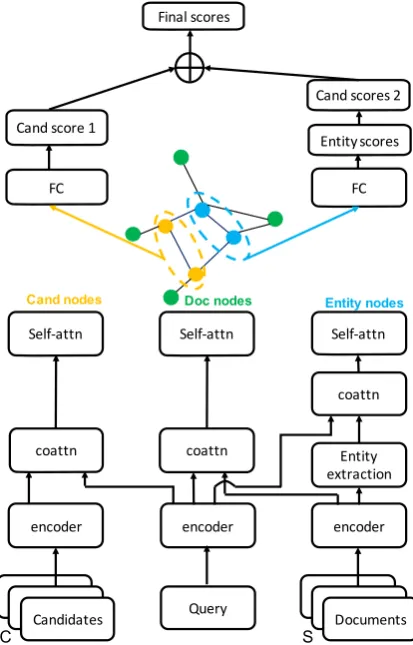
In this section, we describe different modules of the proposed Heterogeneous Document-Entity (HDE) graph-based multi-hop RC model. The overall system diagram is shown in Figure2. Our model can be roughly categorized into three parts: initializing HDE graph nodes with co-attention and self-attention based context encoding, reason-ing over HDE graph with GNN based message passing algorithms and score accumulation from updated HDE graph nodes representations.
3.1 Context encoding
Given a query q with the form of (s,r,?) which represents subject, relation and unknown object respectively, a set of support documentsSq and a
set of candidatesCq, the task is to predict the
cor-rect answer a∗ to the query. To encode informa-tion including in the text of query, candidates and support documents, we use a pretrained embed-ding matrix (Pennington et al., 2014) to convert word sequences to sequences of vectors. LetXq∈
Rlq×d,Xis ∈Rl i
s×dandXjc ∈Rl j
c×drepresent the
embedding matrices of query,i-th supporting doc-ument andj-th candidate of a sample, wherelq,lis
andlcjare the numbers of words in query,i-th
sup-porting document andj-th candidate respectively.
d is the dimension of the word embedding. We use bidirectional recurrent neural networks (RNN)
Candidates Query Documents encoder encoder encoder
C S
coattn coattn
coattn
Entity extraction Self-attn Self-attn Self-attn Cand nodes Doc nodes Entity nodes
Entityscores
FC FC
Final scores
Cand score 1
[image:3.595.313.520.62.385.2]Cand scores 2
Figure 2: System diagram. S andC are the number of support documents and candidates respectively. We use yellow nodes to represent query-aware candidate representation, blue nodes to represent extracted query-aware entity representation and green nodes to repre-sent query-aware document reprerepre-sentation.
with gated recurrent unit (GRU) (Cho et al.,2014) to encode the contextual information present in the query, supporting documents and candidates sepa-rately. The output of query, document and candi-date encoders areHq ∈ Rlq×h,His ∈ Rl
i s×h and
Hjc ∈ Rl
j
c×h. h denotes the output dimension of
RNN encoders.
Entity extraction: entities play an import role in bridging multiple documents and connecting a query and the corresponding answer as shown in figure 1. For example, the entity “get ready” in query and two entities “Mase” and “Sean Combs” co-occur in the 2nd support document, and both “Mase” and “Sean Combs” can lead to the correct answer “bad boy records”. Based on this observa-tion, we propose to extract mentions of both query subjectsand candidatesCqfrom documents. We
Zhong et al.,2019) to find the locations of men-tions of query subject and candidates, i.e. we need the start and end positions of each mention. Each mention is treated as an entity. Then, representa-tions of entities can be taken out from thei-th doc-ument encodingHis. We denote an entity’s repre-sentation asM∈Rlm×hwherel
mis the length of
the entity.
Co-attention: Co-attention has achieved great success for single document reading comprehen-sion tasks (Seo et al., 2016; Xiong et al., 2016), and recently was applied to multiple-hop read-ing comprehension (Zhong et al., 2019). Co-attention enables the model to combine learned query contextual information attended by docu-ment and docudocu-ment contextual information at-tended by query, with inputs of one query and one document. We follow the implementation of co-attention in (Zhong et al.,2019).
We use the co-attention between a query and a supporting document for illustration. Same op-erations can be applied to other documents, or between the query and extracted entities. Given RNN-encoded sequences of the query Hq ∈
Rlq×h and a document His ∈ Rl i
s×h, the affinity
matrix between the query and document can be calculated as
Aiqs=His(Hq)|∈Rl
i
s×lq, (1)
where| denotes matrix transpose. Each entry of the matrix Aiqs indicates how related two words are, one from the query and one from the docu-ment. For simplification, in later context, we ig-nore the superscripti which indicates the opera-tion on thei-th document.
Next we derive the attention context of the query and document as follows:
Cq=sof tmax(A|qs)Hs ∈Rlq×h, (2)
Cs=sof tmax(Aqs)Hq ∈Rls×h. (3)
sof tmax(·) denotes column-wise
normaliza-tion. We further encode the co-attended document context using a bidirectional RNNf with GRU:
Ds=f(sof tmax(Aqs)Cq)∈Rls×h. (4)
The final co-attention context is the column-wise concatenation ofCsandDs:
Sca = [Cs;Ds]∈Rls×2h. (5)
We expect Sca carries query-aware contextual
information of supporting documents as shown by Zhong et al.(2019). The same co-attention mod-ule can also be applied to query and candidates, and query and entities (as shown in Figure 2) to get Cca and Eca. Note that we do not do
co-attention between query and entities correspond-ing to query subject because query subject is al-ready a part of the query. To keep the dimensional-ity consistent, we apply a single-layer multi-layer perceptron (MLP) with tanh activation function to increase the dimension of the query subject en-tities to2h.
Self-attentive pooling: while co-attention yields a query-aware contextual representation of documents, self-attentive pooling is designed to convert the sequential contextual representation to a fixed dimensional non-sequential feature vec-tor by selecting important query-aware informa-tion (Zhong et al., 2019). Self-attentive pooling summarizes the information presented in the co-attention output by calculating a score for each word in the sequence. The scores are normalized and a weighted sum based pooling is applied to the sequence to get a single feature vector as the summarization of the input sequence. Formally, the self-attention module can be formulated as the following operations givenScaas input:
as=sof tmax(M LP(Sca))∈Rls×1, (6)
ssa=a|sSca ∈R1×2h, (7)
whereM LP(·)is a two-layer MLP withtanhas activation function. Similarly, after self-attentive pooling, we can getcsaandesafor each candidate
and entity.
Our context encoding module is different from the one used in Zhong et al.(2019) in following aspects: 1) we compute the co-attention between query and candidates which is not presented in the CFC model. 2) For entity word sequences, we first calculate co-attention with query and then use self-attention to summarize each entity word sequence whileZhong et al.(2019) first do self-attention on entity word sequences to get a sequence of entity vectors in each documents. Then, they apply co-attention with query.
3.2 Reasoning over HDE graph
our proposed HDE graph based model, we treat each document, candidate and entity extracted from documents as nodes in the HDE graph, i.e., each document (candidate/entity) corresponds to one node in the HDE graph. These nodes rep-resent different granularity levels of query-aware information: document nodes encode document-level global information regarding to the query; candidate nodes encode query-aware information in candidates; entity nodes encode query-aware information in specific document context or the query subject. The HDE graph is built to en-able graph-based reasoning. It exploits useful structural information among query, support doc-uments and candidates. We expect our HDE graph could perform multi-hop reasoning to locate the answer nodes or entity nodes of answers given a query.
Self-attentive pooling generates vector repre-sentations for each candidate, document and en-tity, which can be directly employed to initialize the node representationsV. For edge connections E, we define the following types of edges between pairs of nodes to encode various structural infor-mation in the HDE graph:
1. an edge between a document node and a can-didate node if the cancan-didate appear in the document at least one time.
2. an edge between a document node and an en-tity node if the enen-tity is extracted from the document.
3. an edge between a candidate node and an en-tity node if the enen-tity is a mention of the can-didate.
4. an edge between two entity nodes if they are extracted from the same document.
5. an edge between two entity nodes if they are mentions of the same candidate or query sub-ject and they are extracted from different doc-uments.
6. all candidate nodes connect with each other.
7. entity nodes that do not meet previous condi-tions are connected.
[image:5.595.354.482.64.209.2]Type 4, 5, 7 edges are also employed in (De Cao et al.,2018) where the authors show the effective-ness of those different types of edges. Similarly,
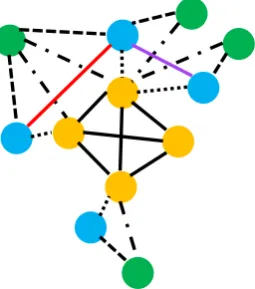
Figure 3: A toy example of HDE graph. The dash dot lines connecting documents (green nodes) and candi-dates (yellow nodes) correspond to type 1 edge. The normal dash lines connecting documents and entities (blue nodes) correspond to type 2 edge. The square dot lines connecting entities and candidates correspond to type 3 edge. The red solid line connecting two entities correspond to type 4 edge. The purple solid line corre-spond to type 5 edge. The black solid lines connecting two candidates correspond to type 6 edge. For good visualization, we ignore the type 7 edge in this figure.
we treat these different edges differently to make information propagate differently over these seven different types of edges. More details will be in-troduced in next paragraph about message passing over the HDE graph. In Figure3, we illustrate a toy example of the proposed HDE graph.
Message passing: we define how information propagates over the graph in order to do reasoning over the HDE graph. Different variants of GNN have different implementations of message pass-ing strategies. In this study, we follow the mes-sage passing design in GCN (Kipf and Welling, 2016;De Cao et al.,2018) as it gives good perfor-mance on validation set compared to other strate-gies (Veliˇckovi´c et al., 2017; Xu et al., 2018). Generally, the message passing over graphs can be achieved in two steps: aggregation and com-bination (Hamilton et al.,2017), and this process can be conducted multiple times (usually referred as layers or hops in GNN literature). Here, we give the aggregation and combination formulation of the message passing over the proposed HDE graph. The first step aggregates information from neighbors of each node, which can be formulated as
zki =X
r∈R
1
|Nr
i |
X
j∈Nr
i
where R is the set of all edge types, Nr i is the
neighbors of nodeiwith edge typerandhkj is the node representation of nodejin layerk(h0j initial-ized with self-attention outputs). |·|indicates the size of the neighboring set. fr defines a
transfor-mation on the neighboring node representations, and can be implemented with a MLP.zki represents the aggregated information in layerk for node i, and can be combined with the transformed nodei
representation:
uki =fs(hki) +zki, (9)
wherefscan also be implemented with a MLP.
It has been shown that GNN suffers from the smoothing problem if the number of layers is large (Kipf and Welling, 2016). The smoothing prob-lem can result in similar nodes representation and lose the discriminative ability when doing classi-fication on nodes. To tackle this problem, we add a gating mechanism (Gilmer et al., 2017) on the combined informationuki.
gki =sigmoid(fg([uki;hki])) (10)
hki+1 =tanh(uki)gik+hki (1−gki) (11)
sigmoid(·)denotes the sigmoid function on
trans-formed concatenation of uki and hki. gki is then applied to the combined information to control the amount information from computed update or from the original node representation. tanh(·)
functions as a non-linear activation function. denotes element-wise multiplication.
In this study,fr,fs andfg are all implemented
with single-layer MLPs, the output dimension of which is2h. AfterK times message passing, all candidate, document and entity nodes will have their final updated node representation.
3.3 Score accumulation
The final node representations of candidate and entity nodes corresponding to mentions of can-didates are used to calculate classification scores. This procedure can be formulated as
a=fC(HC) +ACCmax(fE(HE)), (12)
whereHC ∈
RC×2his the node representation of all candidate nodes andCis the number of candi-dates.HE ∈RM×2his the node representation of
all entity nodes that correspond to candidates, and
M is the number of those nodes. ACCmax is an
operation that takes the maximum over scores of entities that belong to the same candidate. fC and fE are implemented with two-layer MLPs with tanhactivation function. The hidden layer size is half of the input dimension, and the output dimen-sion is 1. We directly sum the scores from can-didate nodes and entity nodes as the final scores over multiple candidates. Thus, the output score vectora∈RC×1gives a distribution over all can-didates. Since the task is multi-class classifica-tion, we use cross-entropy loss as training objec-tive which takesaand the labels as input.
4 Experiments
4.1 Dataset
We use WIKIHOP (Welbl et al., 2018) to vali-date the effectiveness of our proposed model. The query of WIKIHOPis constructed with entities and relations from WIKIDATA, while supporting doc-uments are from WIKIREADING (Hewlett et al., 2016). A bipartite graph connecting entities and documents is first built and the answer for each query is located by traversal on this graph. Candi-dates that are type-consistent with the answer and share the same relation in query with the answer are included, resulting in a set of candidates. Thus, WIKIHOPis a multi-choice style reading compre-hension data set. There are totally about 43K sam-ples in training set, 5K samsam-ples in development set and 2.5K samples in test set. The test set is not provided and can only be evaluated on blindly. The task is to predict the correct answer given a query and multiple supporting documents. In the experiment, we train our proposed model on all training samples in WIKIHOP, and tune model hy-perparameters on all samples in development set. We only evaluate our proposed model on the un-masked version of WIKIHOP.
4.2 Experimental settings
Single models Accuracy (%)
Dev Test
BiDAF - 42.9
Coref-GRU(Dhingra et al.,2018) 56.0 59.3
MHQA-GRN(Song et al.,2018) 62.8 65.4
Entity-GCN(De Cao et al.,2018) 64.8 67.6
CFC(Zhong et al.,2019) 66.4 70.6
Kundu et al.(2018) 67.1
-DynSAN* - 71.4
Proposed 68.1 70.9
Ensemble models
Entity-GCN(De Cao et al.,2018) 68.5 71.2
DynSAN* - 73.8
Proposed 70.9 74.3
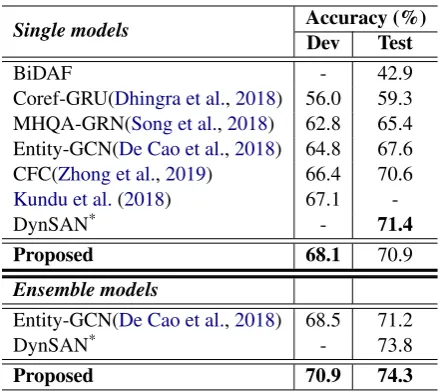
Table 1: Performance comparison among different models on WIKIHOP development and test set. The results of “BiDAF” are presented in the paper byWelbl et al.(2018). Models annotated with “*” are unpub-lished but available on WIKIHOPleaderboard. “-” in-dicates unavailable numbers.
character n-gram embeddings (Hashimoto et al., 2017) are used to convert words into 400-dimensional vector representations. Out of vocab-ulary words are initialized with random vectors. The embedding matrices are not updated during training. The proposed model is implemented with PyTorch (Paszke et al.,2017). More details about experimental and hyperparameter settings can be found in supplementary materials. The perfor-mance on development set is measured after each training epoch, and the model with the highest ac-curacy is saved and submitted to be evaluated on the blind test set. We will make our code publicly available after the review process.
We also prepared an ensemble model consist-ing of 15 models with different hyperparameter settings and random seeds. We used the simple majority voting strategy to fuse the candidate pre-dictions of different models together.
4.3 Results
In Table 1, we show the results of the our pro-posed HDE graph based model on both develop-ment and test set and compare it with previously published results. We show that our proposed HDE graph based model improves the published state-of-the-art accuracy on development set from 67.1% (Kundu et al.,2018) to 68.1%, on the blind test set from 70.6% (Zhong et al.,2019) to 70.9%. Compared to the best single model “DynSAN”
Model Accuracy (%) Dev ∆
Full model 68.1
-- HDE graph 65.5 2.6
- different edge types 66.7 1.4 - candidate nodes scores 67.1 1.0 - entity nodes scores 66.6 1.5
- candidate nodes 66.2 1.9
- document nodes 67.6 0.5
[image:7.595.71.293.60.256.2]- entity nodes 63.6 4.5
Table 2: Ablation results on the WIKIHOPdev set.
[image:7.595.314.518.61.208.2]Model Single-follow Multi-follow With HDE graph 67.8 71.0 Without HDE graph 66.7 67.0
Table 3: Accuracy(%) comparison under different types of samples.
(unpublished) on WIKIHOPleaderboard, our pro-posed model is still 0.5% worse. Compared to two previous studies using GNN for multi-hop reading comprehension (Song et al., 2018;De Cao et al., 2018), our model surpasses them by a large mar-gin even though we do not use better pre-trained contextual embedding ELMo (Peters et al.,2018). For the ensemble models, our proposed system achieves the state-of-the-art performance, which is also 0.2% higher than the reported human perfor-mance (Welbl et al.,2018). Even though our sin-gle model is a little worse than the “DynSAN”, our ensemble model is better than both the ensembled “DynSAN” and the ensembled “Entity-GCN”.
4.4 Ablation studies
In order to better understand the contribution of different modules to the performance, we conduct several ablation studies on the development set of WIKIHOP.
If we remove the proposed HDE graph and di-rectly use the representations of candidates and entities corresponding to mentions of candidates (equation7) for score accumulation, the accuracy on WIKIHOP development set drops 2.6% abso-lutely. This proves the efficacy of the proposed HDE graph on hop reasoning across multi-ple documents.
differ-ent types of edges is also important to retain good performance; If only scores of entity nodes (right part of equation 12) are considered in score ac-cumulation, the accuracy on dev set degrades by 1.0%; if only scores of candidates nodes (left part of equation 12) are considered, the accuracy de-grades by 1.5%. This means that the scores on entity nodes contribute more to the classification, which is reasonable because entities carry context information in the document while candidates do not.
We also investigate the effect of removing dif-ferent types of nodes. Note that removing nodes is not the same as removing scores from candi-date/entity nodes — it means we do not use the scores on these nodes during score accumulation but nodes still exist during message passing on the HDE graph. However, removing one type of nodes means the nodes and corresponding edges do not exist in the HDE graph. The ablation shows that removing entity nodes results in the largest degra-dation of performance while removing document nodes result in the least degradation. This find-ing is consistent with the study by (De Cao et al., 2018) where they emphasize the importance of en-tities in multi-hop reasoning. The small contribu-tion of document nodes is probably caused by too much information loss during self-attentive pool-ing over long sequences. Better ways are needed to encode document information into graph. More ablation studies are included in the supplementary materials due to space constraint.
4.5 Result analysis
To investigate how the HDE graph helps multi-hop reasoning, we conduct experiments on WIKIHOP development set where we discard the HDE graph and only use the candidate and entity representa-tions output by self-attention. In Table3, “Single-follow” (2069 samples in the dev set) means a single document is enough to answer the query, while “Multi-follow” (2601 samples) means mul-tiple documents are needed. These information is provided in (Welbl et al., 2018). We observe in Table2that the performance is consistently better for “with HDE graph” in both cases. In “Single-follow” case the absolute accuracy improvement is 1.1%, while a significant 4.0% improvement is achieved in the “Multi-follow” case, which has even more samples than “Single-follow” case. This proves that the proposed HDE graph is good
0 5 10 15 20 25 30
Number of support docments. 50
100 150 200 250 300
Number of samples in dev set
0 20 40 60 80 100
[image:8.595.308.524.60.216.2]Accuracy (%)
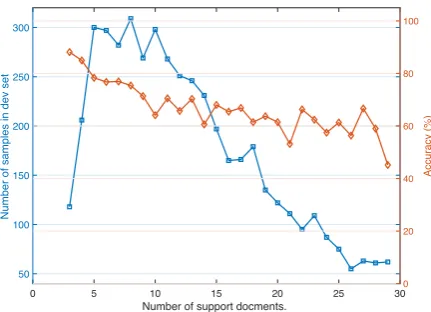
Figure 4: Plots between number of support documents (x-axis) and number of examples (left y-axis), and between number of support documents and accuracy (right y-axis).
0 5 10 15 20 25 30 35 40 45 Number of candidates.
50 100 150 200 250 300
Number of samples in dev set
0 20 40 60 80 100
[image:8.595.308.525.275.429.2]Accuracy (%)
Figure 5: Plots between number of candidates (x-axis) and number of examples (left y-axis), and between number of candidates and accuracy (right y-axis).
at reasoning over multiple documents.
similar trend (when the number of candidates are less than 20) with the increasing number of can-didates, which we believe is partly caused by the larger HDE graph. Also, more candidates cause more confusion in the selection.
5 Conclusion
We propose a new GNN-based method for multi-hop RC across multiple documents. We intro-duce the HDE graph, a heterogeneous graph for multiple-hop reasoning over nodes representing different granularity levels of information. We use co-attention and self-attention to encode can-didates, documents, entities of mentions of candi-dates and query subjects into query-aware repre-sentations, which are then employed to initialize graph node representations. Evaluated on WIKI-HOP, our end-to-end trained single neural model delivers competitive results while our ensemble model achieves the state-of-the-art performance. In the future, we would like to investigate explain-able GNN for this task, such as explicit reasoning path in (Kundu et al., 2018), and work on other data sets such as HotpotQA.
6 Acknowledgements
We would like to thank Johannes Welbl from Uni-versity College London for running evaluation on our submitted model.
References
Joost Bastings, Ivan Titov, Wilker Aziz, Diego Marcheggiani, and Khalil Simaan. 2017. Graph convolutional encoders for syntax-aware neural ma-chine translation. InProceedings of the 2017 Con-ference on Empirical Methods in Natural Language Processing, pages 1957–1967.
Kyunghyun Cho, B van Merrienboer, Caglar Gulcehre, F Bougares, H Schwenk, and Yoshua Bengio. 2014. Learning phrase representations using rnn encoder-decoder for statistical machine translation. In Con-ference on Empirical Methods in Natural Language Processing (EMNLP 2014).
Nicola De Cao, Wilker Aziz, and Ivan Titov. 2018. Question answering by reasoning across documents with graph convolutional networks. arXiv preprint arXiv:1808.09920.
Jacob Devlin, Ming-Wei Chang, Kenton Lee, and Kristina Toutanova. 2018. Bert: Pre-training of deep bidirectional transformers for language understand-ing. arXiv preprint arXiv:1810.04805.
Bhuwan Dhingra, Qiao Jin, Zhilin Yang, William Co-hen, and Ruslan Salakhutdinov. 2018. Neural mod-els for reasoning over multiple mentions using coref-erence. InProceedings of the 2018 Conference of the North American Chapter of the Association for Computational Linguistics: Human Language Tech-nologies, Volume 2 (Short Papers), volume 2, pages 42–48.
Justin Gilmer, Samuel S Schoenholz, Patrick F Riley, Oriol Vinyals, and George E Dahl. 2017. Neural message passing for quantum chemistry. In Pro-ceedings of the 34th International Conference on Machine Learning-Volume 70, pages 1263–1272. JMLR. org.
Will Hamilton, Zhitao Ying, and Jure Leskovec. 2017. Inductive representation learning on large graphs. InAdvances in Neural Information Processing Sys-tems, pages 1024–1034.
Kazuma Hashimoto, Yoshimasa Tsuruoka, Richard Socher, et al. 2017. A joint many-task model: Grow-ing a neural network for multiple nlp tasks. In Pro-ceedings of the 2017 Conference on Empirical Meth-ods in Natural Language Processing, pages 1923– 1933.
Daniel Hewlett, Alexandre Lacoste, Llion Jones, Illia Polosukhin, Andrew Fandrianto, Jay Han, Matthew Kelcey, and David Berthelot. 2016. Wikireading: A novel large-scale language understanding task over wikipedia.arXiv preprint arXiv:1608.03542.
Daniel Khashabi, Snigdha Chaturvedi, Michael Roth, Shyam Upadhyay, and Dan Roth. 2018. Looking beyond the surface:a challenge set for reading com-prehension over multiple sentences. InProceedings of North American Chapter of the Association for Computational Linguistics (NAACL).
Thomas N Kipf and Max Welling. 2016. Semi-supervised classification with graph convolutional networks. arXiv preprint arXiv:1609.02907.
Tom´aˇs Koˇcisk`y, Jonathan Schwarz, Phil Blunsom, Chris Dyer, Karl Moritz Hermann, G´aabor Melis, and Edward Grefenstette. 2018. The narrativeqa reading comprehension challenge. Transactions of the Association of Computational Linguistics, 6:317–328.
Souvik Kundu, Tushar Khot, and Ashish Sabhar-wal. 2018. Exploiting explicit paths for multi-hop reading comprehension. arXiv preprint arXiv:1811.01127.
Pengfei Liu, Shuaichen Chang, Xuanjing Huang, Jian Tang, and Jackie Chi Kit Cheung. 2018. Contextu-alized non-local neural networks for sequence learn-ing.arXiv preprint arXiv:1811.08600.
Diego Marcheggiani, Joost Bastings, and Ivan Titov. 2018. Exploiting semantics in neural machine trans-lation with graph convolutional networks. In Pro-ceedings of the 2018 Conference of the North Amer-ican Chapter of the Association for Computational Linguistics: Human Language Technologies, Vol-ume 2 (Short Papers), volume 2, pages 486–492.
Todor Mihaylov, Peter Clark, Tushar Khot, and Ashish Sabharwal. 2018. Can a suit of armor conduct elec-tricity? a new dataset for open book question an-swering. arXiv preprint arXiv:1809.02789.
Adam Paszke, Sam Gross, Soumith Chintala, Gre-gory Chanan, Edward Yang, Zachary DeVito, Zem-ing Lin, Alban Desmaison, Luca Antiga, and Adam Lerer. 2017. Automatic differentiation in pytorch.
Jeffrey Pennington, Richard Socher, and Christopher Manning. 2014. Glove: Global vectors for word representation. InProceedings of the 2014 confer-ence on empirical methods in natural language pro-cessing (EMNLP), pages 1532–1543.
Matthew Peters, Mark Neumann, Mohit Iyyer, Matt Gardner, Christopher Clark, Kenton Lee, and Luke Zettlemoyer. 2018. Deep contextualized word repre-sentations. InProceedings of the 2018 Conference of the North American Chapter of the Association for Computational Linguistics: Human Language Technologies, Volume 1 (Long Papers), volume 1, pages 2227–2237.
Pranav Rajpurkar, Robin Jia, and Percy Liang. 2018. Know what you dont know: Unanswerable ques-tions for squad. InProceedings of the 56th Annual Meeting of the Association for Computational Lin-guistics (Volume 2: Short Papers), volume 2, pages 784–789.
Pranav Rajpurkar, Jian Zhang, Konstantin Lopyrev, and Percy Liang. 2016. Squad: 100,000+ questions for machine comprehension of text. InProceedings of the 2016 Conference on Empirical Methods in Nat-ural Language Processing, pages 2383–2392.
Siva Reddy, Danqi Chen, and Christopher D Manning. 2018. Coqa: A conversational question answering challenge. arXiv preprint arXiv:1808.07042.
Minjoon Seo, Aniruddha Kembhavi, Ali Farhadi, and Hannaneh Hajishirzi. 2016. Bidirectional attention flow for machine comprehension. arXiv preprint arXiv:1611.01603.
Linfeng Song, Zhiguo Wang, Mo Yu, Yue Zhang, Radu Florian, and Daniel Gildea. 2018. Exploring graph-structured passage representation for multi-hop reading comprehension with graph neural net-works. arXiv preprint arXiv:1809.02040.
Kai Sun, Dian Yu, Dong Yu, and Claire Cardie. 2018. Improving machine reading comprehension with general reading strategies. arXiv preprint arXiv:1810.13441.
Yi Tay, Anh Tuan Luu, Siu Cheung Hui, and Jian Su. 2018. Densely connected attention propagation for reading comprehension. InAdvances in Neural In-formation Processing Systems, pages 4911–4922.
Petar Veliˇckovi´c, Guillem Cucurull, Arantxa Casanova, Adriana Romero, Pietro Lio, and Yoshua Bengio. 2017. Graph attention networks. arXiv preprint arXiv:1710.10903.
Johannes Welbl, Pontus Stenetorp, and Sebastian Riedel. 2018. Constructing datasets for multi-hop reading comprehension across documents. Transac-tions of the Association of Computational Linguis-tics, 6:287–302.
Jason Weston, Antoine Bordes, Sumit Chopra, Alexan-der M Rush, Bart van Merri¨enboer, Armand Joulin, and Tomas Mikolov. 2015. Towards ai-complete question answering: A set of prerequisite toy tasks.
arXiv preprint arXiv:1502.05698.
Chien-Sheng Wu, Richard Socher, and Caiming Xiong. 2019. Global-to-local memory pointer net-works for task-oriented dialogue. arXiv preprint arXiv:1901.04713.
Caiming Xiong, Victor Zhong, and Richard Socher. 2016. Dynamic coattention networks for question answering. arXiv preprint arXiv:1611.01604.
Keyulu Xu, Weihua Hu, Jure Leskovec, and Stefanie Jegelka. 2018. How powerful are graph neural net-works? arXiv preprint arXiv:1810.00826.
Zhilin Yang, Peng Qi, Saizheng Zhang, Yoshua Ben-gio, William Cohen, Ruslan Salakhutdinov, and Christopher D Manning. 2018. Hotpotqa: A dataset for diverse, explainable multi-hop question answer-ing. InProceedings of the 2018 Conference on Em-pirical Methods in Natural Language Processing, pages 2369–2380.
Liang Yao, Chengsheng Mao, and Yuan Luo. 2018. Graph convolutional networks for text classification.
arXiv preprint arXiv:1809.05679.
Yuhao Zhang, Peng Qi, and Christopher D Manning. 2018. Graph convolution over pruned dependency trees improves relation extraction. InProceedings of the 2018 Conference on Empirical Methods in Nat-ural Language Processing, pages 2205–2215.