Munich Personal RePEc Archive
Multiple Days Ahead Realized Volatility
Forecasting: Single, Combined and
Average Forecasts
Degiannakis, Stavros
Department of Economic and Regional Development, Panteion
University, 136 Syggrou Av., Athens, 176 71, Greece
2018
Online at
https://mpra.ub.uni-muenchen.de/96272/
1
M u l t i p l e D a y s A h e a d R e a l i z e d V o l a t i l i t y F o r e c a s t i n g :
S i n g l e , C o m b i n e d a n d A v e r a g e F o r e c a s t s
Stavros Degiannakis
Department of Economic and Regional Development, Panteion University, 136 Syggrou Av., Athens, 176 71, Greece, email: [email protected]
A b s t r a c t
The task of this paper is the enhancement of realized volatility forecasts. We investigate
whether a mixture of predictions (either the combination or the averaging of forecasts) can
provide more accurate volatility forecasts than the forecasts of a single model.We estimate
long-memory and heterogeneous autoregressive models under symmetric and asymmetric
distributions for the major European Union stock market indices and the exchange rates of
the Euro.
The majority of models provide qualitatively similar predictions for the next trading day’s
volatility forecast. However, with regard to the one-week forecasting horizon, the
heterogeneous autoregressive model is statistically superior to the long-memory framework.
Moreover, for the two-weeks-ahead forecasting horizon, the combination of realized
volatility predictions increases the forecasting accuracy and forecast averaging provides
superior predictions to those supplied by a single model. Finally, the modeling of volatility
asymmetry is important for the two-weeks-ahead volatility forecasts.
K e y w o r d s :averaging forecasts, combining forecasts, heterogeneous autoregressive,
intra-day data, long memory, model confidence set, predictive ability, realized volatility, ultra-high
frequency.
2
1. Introduction
Undoubtedly, ultra-high frequency financial data have been valuable in estimating
and forecasting volatility more accurately. The long-memory autoregressive and the
heterogeneous autoregressive models are representative methods of volatility forecasting.
The literature provides strong evidence that ARFIMA models introduced by Granger
(1980), produce superior forecasts relative to those produced by conditional volatility
GARCH models that are based on daily returns. Due both to the long memory property of
volatility as well as its high persistence, the ARFIMA specification is suitable for estimating
realized volatility. Among others, Andersen et al. (2003), Chiriac and Voev (2011), Deo et al.
(2005), Koopman et al. (2005), Martens and Zein (2002), Pong et al. (2004) have applied
various extensions of ARFIMA models to ultra-high frequency-based volatility measures.
The structure of the Heterogeneous Autoregressive model of realized volatility is
based on the heterogeneous market hypothesis (Müller et al., 1997), which states that in
financial markets, investors (ultra-high frequency algorithmic traders, inter-day investors,
institutional investors trading on a monthly basis, etc.) interact at different frequencies. Thus,
the HAR model is able to accommodate the heterogeneous beliefs of traders; different types
of market participants drive volatility at different frequencies. Andersen et al. (2007) show
that volatility for equity and bond futures is adequately expressed by a HAR-GARCH model.
In forecasting ultra-high frequency constructed volatility, various extensions of the HAR
model have been applied by Chen and Ghysels (2011), Clements et al. (2008), Corsi and
Reno (2012), Hua and Manzan (2013), Prokopczuk et al. (2015), Sevi (2014) and
Degiannakis and Filis (2017). In general, the literature provides evidence in favor of the HAR
model compared to other models such as the plain autoregressive model, the MIDAS model
of Ghysels et al. (2007), the HEAVY model of Shephard and Sheppard (2010), the ARFIMA
model, etc.
Apart from modelling information of realized volatility from the past, an alternative
approach is to extract the predictive information from the futures market. Such techniques
have been employed mainly by policy institutions1, which are looking for the market expectations of the exogenous variables required for their macroeconomic model
frameworks. Alquist and Kilian (2010) provided an interesting analysis of oil price forecasts
based on futures prices. Their study showed that futures are not the most accurate predictor of
the spot price of crude oil; even no-change forecasts tend to be more accurate.
1The interested reader is referred to Svensson (2005) for the European Central Bank, and to the IMF (2007) for
3
Additionally, the implied volatility extracted from the option prices has been
considered as an alternative source of measuring investor sentiment with regard to market
volatility. Koopman et al. (2005) showed that models based on realized volatility (i.e.
ARFIMA models) outperform models based on implied volatility. On the other hand,
Fleming et al. (1995), Christensen and Prabhala (1998), Fleming (1998), Blair et al. (2001),
Giot (2003), Degiannakis (2008) and Frijns et al. (2010) provided evidence that implied
volatility is more informative when stock market volatility is being investigated.
Although model-averaging methods for forecasting purposes date back to the works of
Bates and Granger (1969), Granger and Newbold (1977) and Granger and Ramanathan
(1984), the combination of volatility forecasts has not been broadly studied. Liu and Maheu
(2009) and Wang et al. (2016) have investigated the impact of model averaging on realized
volatility prediction accuracy, while Amendola and Storti (2008) and Hu and Tsoukalas
(1999) have examined the performance of combining forecasts estimated from conditional
volatility models (i.e. based on daily data). However, the performance of combined forecasts
has not been explored for ultra-high frequency based volatility estimates.
This paper studies whether the combination or the averaging of realized volatility
predictions increases forecasting accuracy. It brings to light two strands of mixed predictions
(i) selecting forecasts from a set of candidate models according to an evaluation criterion; and
(ii) the averaging of forecasts.
This forecasting evaluation exercise is not limited to one-day-ahead forecasts, as
multiple-days-ahead forecasts (i.e. one-week and two-weeks-ahead forecasting horizons)
gather investor interest as well. Moreover, we investigate the predictive accuracy under four
different distributions for the standardized unpredictable component of the models. Briefly,
our results conclude that: 1) The heterogeneous autoregressive framework works better than
the long memory framework. 2) The averaged models provide superior forecasts compared to
those of single models. 3) The modeling of volatility asymmetry is crucial in forecasting the
ten-days-ahead realized volatility. 4) The combination of volatility forecasts according to the
statistical properties of forecast errors provides us with more accurate two-weeks-ahead
volatility forecasts compared to forecasts from a single model.
The remainder of this study is structured as follows. Section 2 describes the
estimation of the realized volatility measures, section 3 provides information for the dataset
of the 3 stock market indices and the 3 exchange rates, while sections 4 and 5 demonstrate the
ARFIMA and HAR estimated models and the relative forecast specifications for one-day and
4 according to model selection criteria and methods of computing the model-average forecasts,
respectively. Section 8 describes a unified framework for the evaluation of all predictive
methods. Section 9 reports the empirical results and suggests when we should apply the
volatility forecasts of a single model, a combination of models, or the average forecast from a
set of models. Section 10 concludes the paper and suggests areas for further research.
2. The Realized Volatility Measure
The financial literature assumes that the instantaneous logarithmic price
p
t
of an assetfollows a diffusion process
d
log
p
t
t
dW
t
, where
t
is volatility andW
t
is the Wiener process. The integrated variance IVt t
2 , 1
is the actual, but unobservable, variance over
the interval
t1,t for which we seek a proxy measure to estimate. Assuming that the numberof points in time tends to infinity,
, we are able to approximate the integrated varianceas
t
t t
t t
t IV b
a t dt t dt t dt
1 3
2 2
1
2 2
2 2
, ... . The realized volatility for the time
interval
t1,t which is partitioned in
equidistance points,
1
2
, 1
1t j
log
tlog
tt
P
jP
jRV
converges in probability towards the integrated volatility2,orp
RV t t
t IVt 2,
, 1
1
lim
. Accuracy improves as the number of sub-intervals increases, or as
, but on the other hand, at a high sampling frequency, such as sf 0, market frictionis a source of noise due to market microstructure features (i.e. discreteness of the data,
transaction costs, properties of the trading mechanism, bid-ask spreads, etc.). Thus, realized
volatility is constructed in the highest sampling frequency which the intra-day autocovariance
minimizes3; see e.g. Andersen et al. (2006), and Degiannakis and Floros (2015). The
2The p
t is the latent efficient price, whereas j tP is the observed price. The unobserved distance between p
tand Ptjis the market microstructure noise. There exist a number of estimators for the integrated volatility that
possess asymptotical properties which are robust for microstructure noise and jumps. However, Sévi (2014) and Prokopczuk et al. (2015) provided empirical evidence that the modelling of jumps does not improve the forecast accuracy of the simple HAR-RV model. Thus, we construct the realized volatility estimates without taking into consideration the presence of jumps.
3 The inter-day variance can be decomposed into the intra-day variance,
t
RV , and the intra-day autocovariancesytiytij:
1
1 1
2
2
j i j ti ti j t
t RV y y
5 sequence of the sampling prices is constructed according to the previous tick method4 of
Wasserfallen and Zimmermann (1985).
In order to incorporate estimates of asset prices during the hours that the stock
markets are closed to volatility, we take into consideration Hansen and Lunde's (2005)
method of combining intraday volatility with closed-to-open inter-day volatility. Hansen and
Lunde proposed the construction of the realized volatility measure as a weighted combination
of RVt,t
1 with inter-day volatility during the time that the market is closed;
21
log log
1 t
t P
P . Hence, we estimate
1
2 2
2 1
1
log
t1log
t jlog
tlog
t 1t
P
P
P
jP
jRV
, such as
2 ,
2, 1
2 1
min IV
t t t
RV
E
. As
the IV t t
2 , 1
is unobservable, Hansen and Lunde (2005) provide the analytic solution of
1, 2
V
RV
tmin
instead of
2 ,
2, 1
2 1
min IV
t t t
RV
E
, as both functions lead to the same solution.
Hence, we minimize the squared distance between the realized volatility measure and
integrated volatility, avoiding the need to define a specific relation betweenefficient prices
and market microstructure noise.
3. Dataset - FTSE100, DAX30, CAC40 and Euro Exchange Rates
The database is made up of the three most liquid euro exchange rates (with the Pound, the
Dollar and the Yen) and the three major European stock indices (FTSE100, DAX30,
CAC40). The Euro, the Pound, the Dollar and the Yen are the four most tradable currencies.
The blue-chip FTSE 100 from the London Stock Exchange, has a market cap of €1.8 trillion,
the DAX30 (a market cap of €1 trillion) from the Deutsche Boerse group, is Germany's prime
index featuring many of Europe's biggest companies, and the CAC40 (market cap of €1.2
trillion) represents a capitalization-weighted measure of the 40 most significant companies
listed on the Euronext Paris (formerly Paris Bourse).
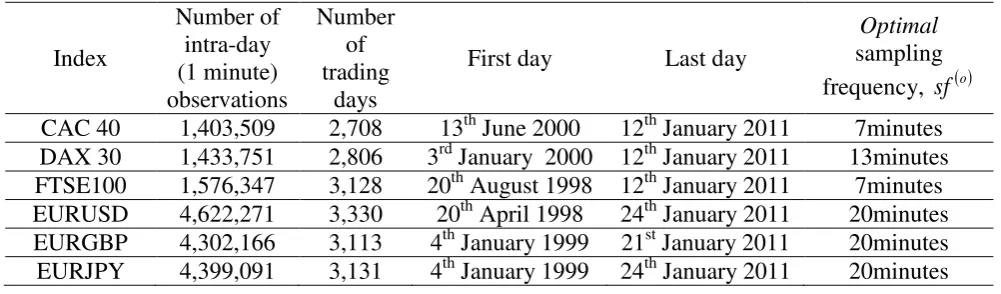
Table 1 presents information for the one-minute intra-day data of the FTSE100,
DAX30, and CAC40 indices, as well as for the exchange rates of Euro with the British
Pound, the US Dollar and the Japanese Yen. The data are filtered for detecting data errors due
to computer technical failures, typing errors, sequences of zero or non-available prices due to
databases crashes, etc. Weekends and fixed and moving holidays with thin trading activity
have been deleted. The selection of the optimal sampling frequency sf o , is based on a
4 Based on the previous tick method (e.g. employ the most recently published price), we obtain a volatility
6 off between accuracy and potential biases due to market microstructure frictions (last column
of Table 1)5. The interday adjustment of Hansen and Lunde (2005) is taken into
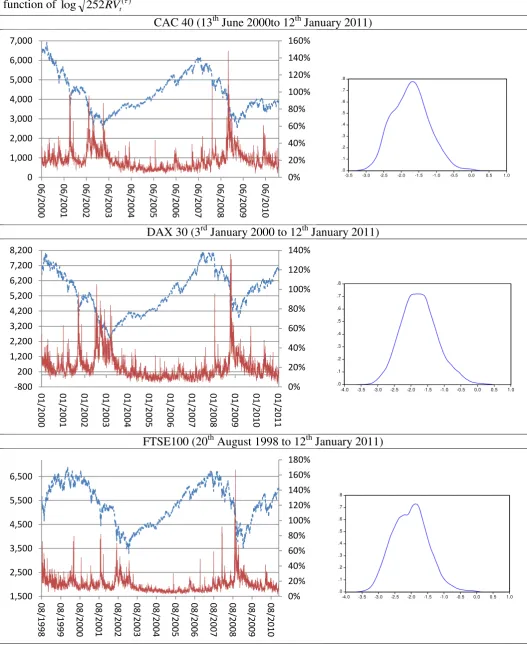
consideration. Figure 1 plots the annualized realized volatilities, 252RVt and the
empirical density functions of log 252RVt .
[Insert Table 1 about here]
[Insert Figure 1 About here]
The logarithmic transformation of realized volatility has an ogive empirical
distribution which approximates the Gaussian distribution. The average value of the
annualized standard deviation for the three stock indices is 18.8% (see Table 2). The mean of
the annualized standard deviation for the three euro exchange rates is 10.1%. The maximum
annualized volatility observed for the FTSE100 index was 167%, on Friday, October 10,
2008 (Global financial crisis of October 2008). On Friday, October 10, the stock markets
crashed across Europe and Asia. London, Paris and Frankfurt dropped 10% in the first hour
of trading and this also happened when Wall Street opened for trading. Since 1987, global
markets have experienced some of their worst weeks in memory, and indeed in some cases,
since the Wall Street Crash of 1929. The median value of annualized volatility ranges from
13.3% for the FTSE100 to 17.8% for the CAC40. On the other hand, realized standard
deviations of exchange rates do not fluctuate over time at a similar magnitude. The median
value of annualized volatility ranges from 7.5% for the Euro/Pound rate to 10.2% for the
Euro/Yen rate. Maximum annualized volatility is observed for the Euro/Yen exchange rate to
74%, on October 24, 2008 (when recession fears caused great turbulence in the Euro/Yen
rate). Table 3 provides descriptive statistics of the annualized logarithmic realized volatility.
Sample skewness is positive in all cases. The average of the skewness of log-standard
deviations across the stock indices decreases to 0.3 compared to 2.9 for the realized standard
deviations. As far as kurtosis is concerned, the average value for the log-volatilities, across
the stock indices, is 3.1 compared to 19.5 for the realized standard deviations. Therefore,
although the kurtosis of the indices exceeds the normal value of three, the logarithmic
transformation case is obviously much closer to the assumption of normality. Normality
approximation is very good for the log-volatilities of the exchange rates as well.
[Insert Table 2 about here]
[Insert Table 3 about here]
7
4. Estimation of the Models
We proceed to an estimation of two widely accepted model frameworks for the
annualized logarithmic realized volatility, log 252RVt . The first framework is the
Autoregressive Fractionally Integrated Moving Average, or the ARFIMA model with
time-varying conditional innovations. The ARFIMA, initially developed by Granger (1980) and
Granger and Joyeux (1980), captures the long-memory property of dependent variables. The
time-variation and clustering that the volatility of realized volatility exhibits is modeled by
extending the ARFIMA to the ARFIMA-GARCH framework proposed by Baillie et al.
(1996). The ARFIMA(k,d,l)-GARCH(p,q) model for log 252RVt is defined as:
0,1;
, ~ 1 252 log 1 1 2 2 0 2 0 θ f z h L B L A a h z h L D RV L L C t t t t t t t t t d (1)where
k i i iL c L C 1 ,
l i i iL d L D 1 ,
q i i iL a L A 1 ,
p i i iL b L B 1are polynomials,
f
.
isthe density function of zt (with E
zt 0, V
zt 1, θis the vector of the parameters whichdefine f ) and d,0,c1,...,ck,d1,...,dl,a1,...,aq,b1,...,bp,θare the parameters to be estimated.
The 2
t
h can be considered as an estimate of the integrated quarticity t2 IQ .6
The second framework is the Heterogeneous Autoregressive, or HAR model with
time-varying conditional innovations; e.g. of Corsi et al. (2008) and Corsi (2009). The basic
idea is that market participants have a different perspective of their investment horizon. The
HAR-RV-GARCH(p,q) model is an autoregressive structure of the volatilities realized over
different interval sizes:
6 The asymptotic volatility of volatility,
t IQt 2
, 1
, is termed integrated quarticity:
t t IQ t
t t dt
1 4 2
,
1 2 , as
2
0,1 14 1
2 ,
1 tdt t dt N
RV d t t t t t
t
8
0,1,;
, ~ , , 252 log 22 252 log 5 252 log 252 log 2 2 0 2 22 1 1 3 5 1 1 2 1 1 0 θ f z h L B L A a h z h RV w RV w RV w w RV t t t t t t t t j j t j j t t t
(2)where
q i i iL a L A 1 ,
p i i iL b L B 1are polynomials and w0,...,w3,a1,...,aq,b1,...,bp,θare the
parameters to be estimated.
For the 3 stock market indices and the 3 exchange rates, the
ARFIMA(0,d,1)-GARCH(1,1), ARFIMA(1,d,1)-ARFIMA(0,d,1)-GARCH(1,1), GARCH(1,1) and
HAR-RV-GARCH(0,1) model specifications with innovations (i.e. unexplained component of
conditional mean equation) that are i) normally distributed; zt ~ N
0,1ii) Student tdistributed; zt ~t
0,1;v
,iii) GED distributed zt ~Ged
0,1;v
, and iv) skewed Student tdistributed; zt ~skT
0,1;v,g
, are estimated. For zt ~ N
0,1 , the density function is
2 exp 2 1 2 t t N z z f . Under the assumption of conditional Student t distributed
innovations zt ~t
0,1;v
, the density function is:
2 1 2 2 1 2 2 2 1 ; t t t z zf , for 2,7 (3)
where
.
is the gamma function. With conditional GED (Generalized Error Distribution orExponential Power distribution) distributed innovations
zt Tt1~Ged
0,1;v
, the densityfunction is:
1 1 1 2 5 . 0 exp ; v v t t GED z zf , 0, (4)
wherev is the tail-thickness parameter and 22
1 /31 .8For zt ~skT
0,1;v,g
the density function is:97θ
v .8 For more technical details on the GED, readers are referred to Box and Tiao (1973) and Johnson et al. (1995). 9 The skewed Student t distribution has been introduced by Fernandez and Steel (1998). Degiannakis (2004),
9
, , 2 1 2 2 2 2 1 2 1 2 2 2 2 1 , ; 1 1 2 1 1 1 2 1 1 s z s z if if g sz g g s g sz g g s g z f t t t t t skT (5)whereg and
are the asymmetry and tail parameters, respectively, of the distribution10
1
1
2 2
2
1
g g
, and s g2 g221.
For each of the six time-series, 16 models are estimated; four model specifications
combined with four distributional assumptions. The lag orders k,d,l,p,q of the models have
been selected according to Schwarz's (1978) Bayesian information criterion.11Each of the 16
models is re-estimated every trading day t, for
T
~
days, whereT
~
1686, 1784, 2106, 2308, 2091, 2108 for the CAC40, DAX30, FTSE100, EURUSD, EURGBP and EURJPY realizedvolatility series, respectively based on a rolling sample of constant size
T
=1000 days. Forthe ARFIMA(1,d,1)-GARCH(1,1) model, the parameter vector to be estimated at each point
in time t is
0 t,
c
1t,
d
t,
d
1t,
a
0t,
a
1t,
b
1t
. Thus, for each model the vector of parameters is re-estimated every trading day, fortT,T1,...,TT~1 days, based on a rolling sample ofconstant size T.
5. Realised Volatility Forecasting
The one-day-ahead adjusted logarithmic realized volatility,log
RVt 1|t
, and the ht1|tfor the ARFIMA(1,d,1)-GARCH(1,1) model are computed as
tt t j j t t t t j j t t t t t t t t d L j d d j L j d d j RV c c RV | 1 0 | 1 1 1 1 0 | 1 1 1 252 log 1 252 log
(6) And 2 | 1 2 | 1 0 |
1 tt
t t t t t t
t
a
a
b
h
h
.The log
RVt1|t
for the ARFIMA(0,d,1)-GARCH(1,1) model is computed from eq.(6) for 0
1 t
c . For the HAR-RV-GARCH(1,1) model we have:
10θ
v,g'.11
10
, 252 log 22 252 log 5 252 log 252 log | 22 1 1 1 3 5 1 1 1 2 1 0 | 1 t t j j t t j j t t t t t t t RV w RV w RV w w RV
(7) and 2 | 1 2 | 1 0 |
1 tt
t t t t t t
t
a
a
b
h
h
.The ht1|t for the HAR-RV-GARCH(0,1) model is computed from eq.(7) for
0
1 t
b .In
ARFIMA-GARCH and HAR-RV-GARCH frameworks, the dependent variable is
conditionally distributed as log 252RVt |It 1~ f
t,ht2;θ
, for It denoting the information
set available at time t and t referring to the conditional mean given It. Therefore, the
one-trading-day-ahead annualized realized volatility equals
1| 1| 21|
2 1 252
log exp
252RVt t RVt t ht t .
The formulas for multiple-days-ahead realized volatility forecasts (n2) are constructed recursively based on Degiannakis et al. (2014). For example,log
RVtn|t
, and htn|t arecomputed as: ARFIMA(1,d,1)-GARCH(1,1) model:
t n t t t t t nt c c RV
RV | 0 1 1 1 log 252 |
252
log (8)
2 | 1 1 2 | 1 1 0
| t n t
t t n t t t t n
t
a
a
b
h
h
. HAR-RV-GARCH(1,1) model:
log
252
5 log
252
22 log
252
,252 log 22 1 1 3 5 1 1 2 | 1 1 0 |
j j n t t j j n t t t n t t t t n t RV w RV w RV w w RV (9)
and
2 | 1 1 2 | 1 1 0
| t n t
t t n t t t t n
t
a
a
b
h
h
.6. Combining Forecasts
In this section, we will investigate whether the combination of predictions can provide
more accurate volatility forecasts compared to the use of a specific single model. Let us
define that we have a set of M competing models. At each point in time we forecast the next
day’s volatility based on the model with the minimum forecast error. Specifically, we
investigate two rules (evaluation functions) for model selection based on the most recent
one-step-ahead forecast error, or t|t1 log
252RVt
log 252RVt|t1
11 one-step-ahead standardized forecast error, or
1 | 1 | 1 | t t t t t t h
z . In other words, on day t1 we
estimate the M competing models, and for day t we compute the one-step-ahead forecasts.
For day t1 we forecast the volatility based on the model m with:
mt t M m 2 1 | ,..., 1
min (10)
or
mt t M m z 2 1 | ,..., 1
min . (11)
The predicted squared forecast error, in eq. (10), is the most widely accepted criterion for
evaluating forecasting ability. The eq. (11) is the standardized predicted squared forecast
error, whose properties have been investigated by Degiannakis and Xekalaki (2005).
Consider a model with the generic form, which incorporates the models in eq. (1) and
eq. (2):
,
, 2 1 j t j t t t t t t t t g z y η β x (12)where η12 is a vector of parameters to be estimated, ~
0,1. . . N z d i i
t ,
.2
t
represents the
conditional variance of t , and g
. is the functional form of the conditional variance. Underthe assumption of constancy of parameters over time, η1 η2 ...ηT η , the zt\t1 has an
asymptotic standard normal distribution, where
11 | 1 | 1 | t tt tt t
t y y
z , 1
1 1 |
t t t
t
y x β and
1 |t t
is the one-step-ahead conditional standard deviation.
If we have m1,2,...,Mcompeting models, we may compute the m
t t z|1.
Krishnamoorthy and Parthasarathy (1951) showed that if M variables jointly follow the
standard normal distribution, then the joint distribution of
M
t t t t tt z z
z | 1
2 1 | 1
1
| , ,..., is the
Multivariate Gamma. Then the distribution function of
M
t t t t t t M
m z z z
z | 1
2 1 | 1 1 | ,..., 1
1 min , ,..., can be
used to compare the predictability of the M models. The cumulative distribution function of
1
z is the minimum multivariate gamma (MMG) distribution (see Xekalaki and Degiannakis,
2005 and 2010). The single models are based on the statistical assumption that the
standardized residuals are i) normally, ii) Student t, iii) GED or iv) skewed Student t
12
distributed. On the other hand, the combined forecasts according to the
mt t M
m z
2 1 | ,..., 1
min criterion
for normally distributed standardized residuals have a known and explicitly derived
distribution form; the minimum multivariate gamma. Based on simulated evidence,
Degiannakis and Livada (2016) expanded the research on the non-normally distributed
standardized residuals. However, the combined forecasts according to the
m
t t M m
2 1 | ,..., 1
min
criterion do not have a known distribution function, despite the fact that almost all the
forecasting evaluations conducted in the financial literature, are based on the
non-standardized residuals, t|t1. Hence, the combined forecasts according to the
m t t Mm z
2 1 | ,..., 1
min
criterion are compatible with the assumptions behind the each of the models that comprise it,
whereas this is not the case for the
m
t t M m2 1 | ,..., 1
min criterion.
7. Averaging Forecasts
Next, we proceed with model-average forecasts in order to assess whether the average
forecast could improve forecasting accuracy. We consider the model-average forecasts of all
the models with the same distributional assumption:
M
m
m t n t distr
t n
t M RV
AV
1
| 1
| 252 , (13)
whereM 4 and distrN,t,Ged,skT denotes the conditional distribution of the models. In addition, we construct the overall average forecast of all the competing models and
residual distributions.
M
m
m t n t t
n
t M RV
AV
1
| 1
| 252 , (14)
where M 16.
8. Evaluating Model Predictability
The 16 models are re-estimated every trading day t, for
T
~
days, whereT
~
1686, 1784, 2106, 2308, 2091, 2108 for the CAC40, DAX30, FTSE100, EURUSD, EURGBP andEURJPY realized volatility series. The rolling window approach with a fixed window length
13 The total number of observations is T T~T. The forecasting accuracy of the models is measured with the mean predictive squared error (MPSE)13:
T
t
n t m
t n t m
n T RV RV
MPSE
~
1
2 |
1
252 252
~
. (15)
The superscript
m denotes the model m1,2,...,M and the subscript
n denotes the n -days-ahead forecast for n1,5,10. Patton (2011) argues that the use of proxies for true volatility induces distortions in the model ranking for certain loss functions. He proposes thatmean squared error is a loss function which is robust to noisy volatility proxies and will lead
to an unbiased model ordering. Therefore, we report the results under the MPSE loss
function.
Beyond the 16 models, we have defined 2 methods of combining forecasts (in section
6). Each method is applied to the models with i) normally; ii) Student t; iii) GED; and iv)
skewed Student t distributed innovations. Hence, 8 techniques of combining forecasts are
investigated in total.
Additionally, in section 7, we have constructed 5 model-average forecasts. These are the
model-average forecasts of the 4 models with the same distributional assumption, as well as
the overall average forecast of all 16 competing models.
Among the statistical methods which evaluate the predictions from a variety of models,
the most widely accepted are: The Diebold and Mariano (1995) test for pairwise
comparisons, the Equal Predictive Accuracy test of Clark and West (2007) for nested models,
and the Reality Check for Data Snooping (White, 2000) and the Superior Predictive Ability
test (Hansen, 2005) for multiple comparisons against a benchmark model. Recently, Hansen
et al. (2011) introduced the Model Confidence Set (MCS) test, which evaluates a number of
forecasting models simultaneously, not against a benchmark model. The MCS method does
not assume the existence of any predefined true data generating process. Its major advantage
is the comparison of forecasts, not necessarily estimated by models, which acknowledges the
limitations of the data. Thus, uninformative data yield a confidence set with many models
whereas informative data yield a set of just a few models.The MCS is employed in order to
determine the set of models that is made up of the best ones. The term “best” is defined
according to our evaluation function MPSE. The MCS compares the prediction accuracy of
13 The mean predictive absolute error,
T
t
n t m
t n t m
n T RV RV
MPAE
~
1
| 1
252 252
~
14 an initial set of M0 models and investigates, at a predefined level of significance,
which models survive the elimination algorithm. For m
t
L denoting the evaluation functions
of model m on day t, and m
t m t m m
t L L
d , being the evaluation differential for m,mM0, the hypothesis that is being tested is:
0: ,
,
0
m m t
M Ed
H , (16)
for m,mM, 0
M
M against the alternative 1, :
m,m
0t
M Ed
H for some m,mM.
For example, in the case of the MPSE evaluation function,
252 m| 252 t n
2t n t m
t RV RV
L .
The elimination algorithm based on an equivalence test and an elimination rule employs the
former to investigate the H0,M for
0
M
M
and the latter to identify the model m to be
removed from Min case H0,M is rejected.
9. Investigating Predictive Accuracy
The main purpose of our study is to explore the possible sources that help us enhance our
realized volatility forecasts. Let us keep in mind that we have investigated the predictive
accuracy of model frameworks with different autoregressive structures (i.e. long-memory
autoregressive against heterogeneous autoregressive), and different distributions for the
standardized residuals (i.e. normal against skewed Student t). Then, we explore whether the
use of a single model can be improved upon by the implementation of a method that
combines forecasts (section 6) or by the averaging of forecasts (section 7). To sum up, the
hypotheses that we investigate are: 1) The heterogeneous autoregressive (HAR) framework is
expected to work better than the long memory (ARFIMA) framework. 2) The averaged
models are expected to provide superior forecasts compared to those of the single models;
either HAR or ARFIMA. 3) Is the modeling of volatility asymmetry crucial in forecasting
realized volatility? 4) Does the combination of volatility forecasts according to the statistical
properties of forecast errors provide more accurate volatility forecasts? The forecasting
evaluation exercise is not limited to the one-day-ahead forecasts, as we also explore the
predictive ability for the 5-days and10-days-ahead horizons.
9.1.One-day-ahead Predictive Accuracy
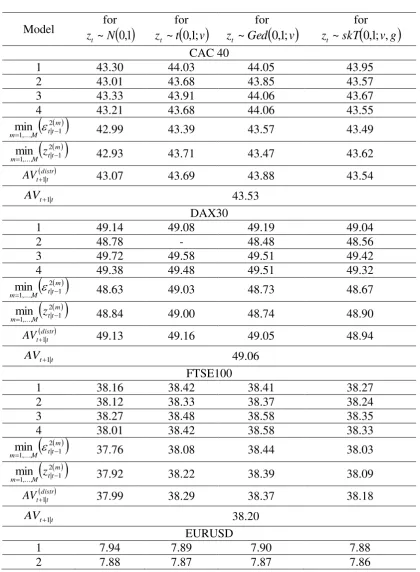
Table 4 provides the values of the mean predictive squared error, m
MPSE1
3
10 . For
each one of the stock indices and the exchange rates, the first four rows provide the
m
MPSE1
3
15 (sixth) row presents the MPSE 1distr statistics from combining the forecasts of the four models
under the same distribution according to the criterion
mt t M m
2 1 | ,..., 1
min (
tt mM
m z
2 1 | ,..., 1
min ). The seventh
row presents the distr t t
AV1| statistics resulting from averaging the forecasts of the four models
under the same distribution, whereas the last row provides the overall averaging forecast,
t t
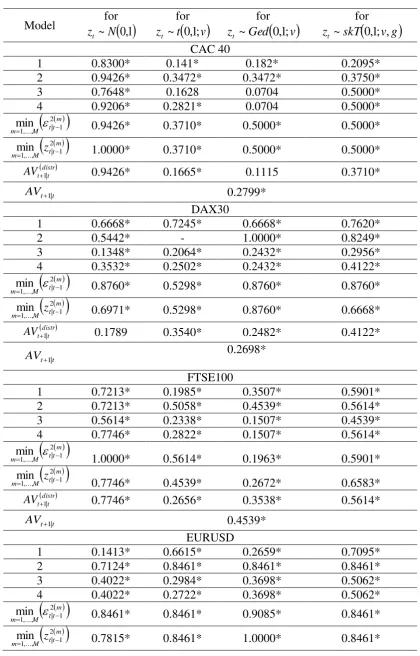
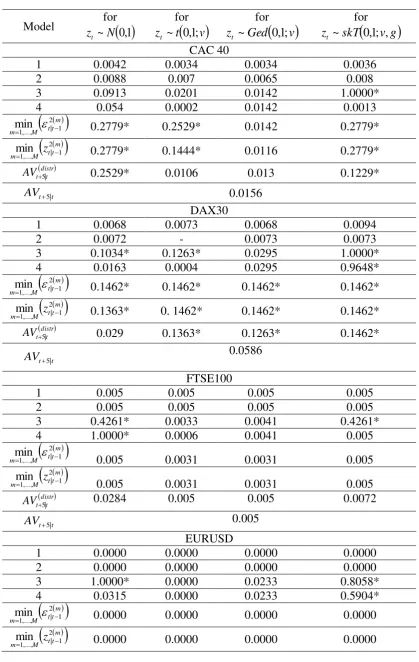
AV1| . The relative p-values of the MCS test are presented in Table 5. For each of the
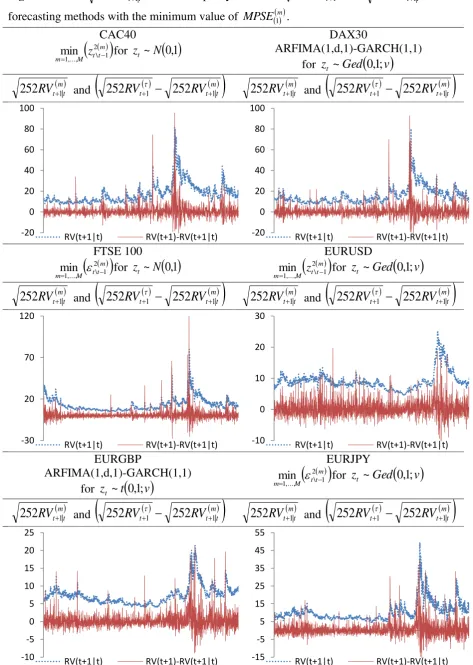
realized volatility series, Figure 2 plots the
252
RV
t m1|t and the discrepancy between
1
252RVt and
m t t
RV
1|252
for the forecast methods with the minimum value of mMPSE1 .
Overall, we cannot infer in favor of a specific method of constructing one-day-ahead realized
volatility forecasts. The p-values in Table 5 conclude that most of the prediction methods
(single models, combined forecasts and averaged models) belong to the confidence set of the
best performing models. The lowest value of the m
MPSE1 statistic is achieved by a single
model, the ARFIMA(1,d,1)-GARCH(1,1), in the case of the DAX30 and the Euro/Pound
rate, whereas one of the combined methods has the lowest m
MPSE1 value for the other four
indices.
[Insert Table 4 about here]
[Insert Table 5 about here]
[Insert Figure 2 About here]
9.2.Five-days-ahead Predictive Accuracy
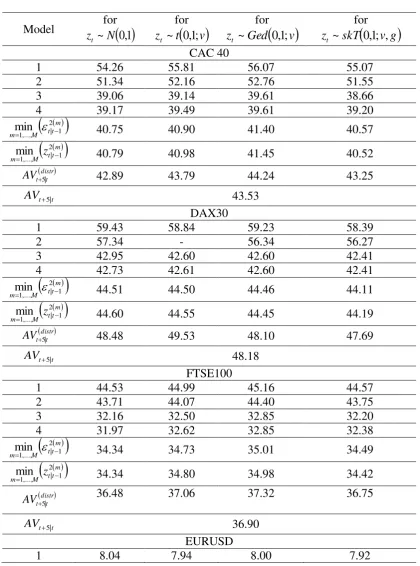
Table 6 shows the mean predictive squared forecast error, or MPSE 5m 3
10 for the
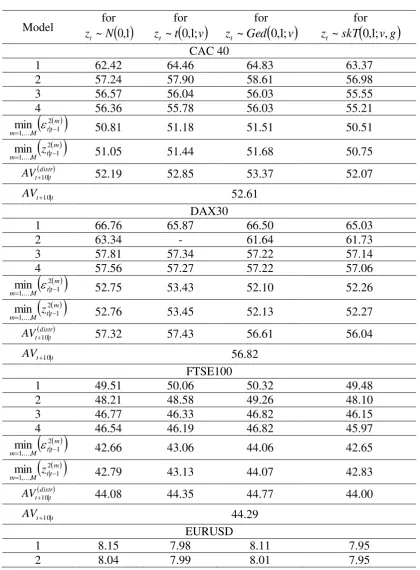
five-trading-days-ahead realized volatility forecasts. According to Table 7, which presents the
MCS p-values, the picture is clearer in the case of one-calendar-week-ahead forecasting. A
limited number of prediction methods belong to the confidence set of the best performing
models. Specifically, for the DAX30 index, just one model, the HAR-RV-GARCH(1,1)-skT,
belongs to the set of confidence models (for a 20% level of significance). A similar case
holds for the Euro/Pound rate, with the same model under the normal distribution
(HAR-RV-GARCH(1,1)-n) constructing the most accurate volatility forecasts. For the FTSE100 stock
index and the Euro/Dollar exchange rate, the MCS is comprised of three models, all of which
have a heterogeneous autoregressive form. In general, for five-trading-days volatility
forecasting, the heterogeneous autoregressive model is superior to the long memory
16 superior volatility forecasts for the one-calendar-week-ahead forecasting horizon (only for the
CAC40 index and the Euro/Yen rate, the
mt t M m
2 1 | ,..., 1
min or
tt mM
m z
2 1 | ,..., 1
min methods of combined
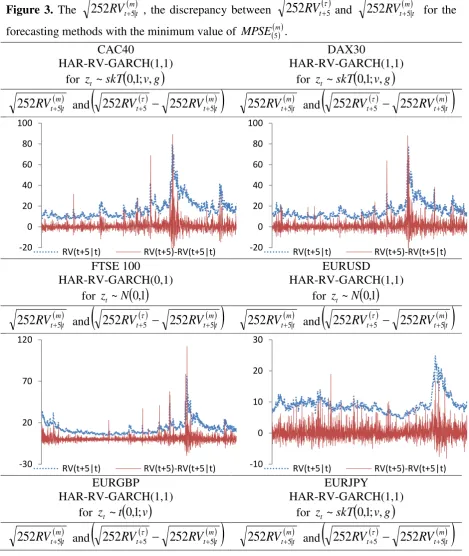
forecasts belong to the MCS). Figure 3 plots the
252
RV
t m5|t , and the forecast error
m
t t
t
RV
RV
5252
5|252
for the predictive methods with the minimum mMPSE5 .
[Insert Table 6 about here]
[Insert Table 7 about here]
[Insert Figure 3 About here]
9.3.Ten-days-ahead Predictive Accuracy
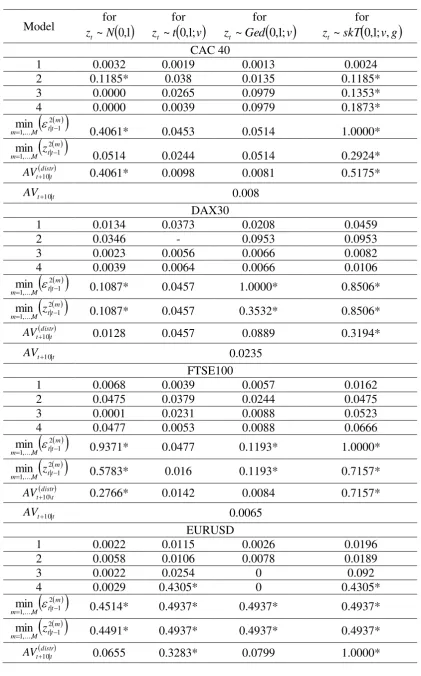
Tables 8 and 9 illustrate the relative information for the two-calendar-weeks-ahead
forecasts. Overall, in the ten-days-ahead forecasting horizon, the necessity for employing
combined forecasts and averaged models arises. According to Table 9, for all the realized
volatility series under investigation the combined forecasts according to the
mt t M m
2 1 | ,..., 1
min
and
mt t M
m z
2 1 | ,..., 1
min
criteria belong to the confidence set of the best performing methods of
forecasting. Moreover, the estimation of the models with skewed Student t distributed
standardized residuals is crucial in providing superior realized volatility forecasts. The
financial literature has delivered strong evidence in favor of modeling the asymmetric and
leptokurtic character of the log-returns distribution (see for example Degiannakis et al.,
2014). For multiple-steps-ahead forecasting, the asymmetric character of realized volatility
must be considered as well. From the different behavior of the leptokurtic distributions
(Student t and GED) and the asymmetric and leptokurtic one (the skewed Student t), we
observe that the modeling of volatility asymmetry is important for longer forecasting
horizons. For each of the six realized volatility series, Figure 4 plots the
252
RV
t m10|t , andthe discrepancy between
252
RV
t 10 and m t t
RV
10|252
for the forecast methods with theminimum value of m
MPSE10 .
[Insert Table 8 about here]
[Insert Table 9 about here]
[Insert Figure 4 About here]
For purposes of robustness, we have investigated the forecasting performance based on
17 report the Tables with the values of the evaluation function and the relevant MCS p-values,
which are available to the readers upon request.
10.Conclusion
Our major task is to investigate whether we can enhance our realized volatility
forecasts. The forecasting evaluation is conducted for one-day-ahead,
one-calendar-week-ahead and two-calendar-weeks-one-calendar-week-ahead horizons. The ARFIMA-GARCH and
HAR-RV-GARCH models are estimated for the major European Union stock market indices
(FTSE100, DAX30, CAC40) and for the exchange rates of the Euro with the British Pound,
the US Dollar and the Japanese Yen under the assumption that the standardized innovations
are i) normally; ii) Student t; ii) GED; and iv) skewed Student t distributed. Additionally, we
explore whether the use of a single model can be improved upon through the implementation
of a method that combines forecasts or by the averaging of the forecasts.
The overall findings can be summarized as follows. For one-day-ahead volatility
forecasts, most prediction methods (single models, combined forecasts and averaged models)
belong to the confidence set of the best performing models. For five-trading-days-ahead
forecasting horizon, the heterogeneous autoregressive model is superior to the long-memory
framework model. Moreover, the combined forecasts and the averaged models fail to provide
superior volatility forecasts. For the ten-trading-days-ahead forecasting horizon, the
mt t M m
2 1 | ,..., 1
min and
tt mM
m z
2 1 | ,..., 1
min criteria deliver the most accurate volatility forecasts. Also, the
averaged models provide superior forecasts compared to those of single models.
Additionally, the modeling of volatility asymmetry (the use of the skewed Student t
distribution) is important for the ten-days-ahead volatility forecasts.
Thus, for longer forecasting horizons, more complicated forecasting frameworks are
required. Combined forecasts and averaged models are methods considered to be adequate
for volatility forecasting purposes; a crucial finding for investors, portfolio managers, risk
managers, policy makers, etc.
Avenues for future research may include the enrichment of the methods under
comparison (i.e. weights anti-proportional to the forecasting errors) or the confirmation of the
findings for other datasets, i.e. commodities, non-European stock indices, etc. It would also
be interesting to explore whether we can enhance the forecasting accuracy for other measures
of volatility, such as the realized kernels and bi-power variation, or from information
18 Acknowledgements
The author acknowledges the support from the European Community’s Seventh
Framework Programme (Marie Curie FP7-PEOPLE-IEF & FP7-PEOPLE-RG) funded under
grant agreements no. PIEF-GA-2009-237022 & PERG08-GA-2010-276904. The author is
solely responsible for any remaining errors and deficiencies.
References
Alquist, R. & Kilian, L. (2010). What do we learn from the price of crude oil futures?
Journal of Applied Econometrics, 25(4), 539-573.
Amendola, A. & Storti G. (2008). A GMM procedure for combining volatility forecasts.
Computational Statistics and Data Analysis, 52(6), 3047–3060.
Andersen, T. G., Bollerslev, T., Diebold, F. X. & Labys, P. (2003). Modeling and
forecasting realized volatility. Econometrica, 71(2), 579–625.
Andersen, T., Bollerslev, T., Christoffersen, P. & Diebold, F.X. (2006). Volatility and
Correlation Forecasting. In Elliott, G. Granger, C.W.J. and Timmermann, A. (Eds.)
Handbook of Economic Forecasting, North Holland Press, Amsterdam.
Andersen, T., Bollerslev, T. & Diebold, F. (2007). Roughing it up: including jump
components in the measurement, modelling and forecasting of return volatility. Review of
Economics and Statistics, 89(4), 701–720.
Baillie, R.T., Bollerslev, T. & Mikkelsen, H.O. (1996). Fractionally Integrated Generalized
Autoregressive Conditional Heteroskedasticity. Journal of Econometrics, 74, 3-30.
Bates, J., & Granger, C.W.J. (1969). The Combination of Forecasts. Operations Research
Quarterly, 20, 451-468.
Blair, B.J., Poon, S-H & Taylor S.J. (2001).Forecasting S&P100 Volatility: The
Incremental Information Content of Implied Volatilities and High-Frequency Index
Returns. Journal of Econometrics, 105, 5-26.
Box, G.E.P. & Tiao, G.C. (1973). Bayesian Inference in Statistical Analysis (Vol.40).
Addison-Wesley, Reading.
Chen, X. & E. Ghysels (2011). News-good or bad-and its impact on volatility forecasts over
multiple horizons. Review of Financial Studies, 24, 46–81.
Chiriac, R. & Voev, V. (2011). Modelling and Forecasting Multivariate Realized Volatility.
Journal of Econometrics, 26(6), 922-947.
Christensen, B.J., & Prabhala, N.R. (1998).The relation between implied and realised
19
Clark, T.E., & West, K.D. (2007). Approximately normal tests for equal predictive accuracy
in nested models. Journal of Econometrics, 138, 291–311.
Clements, M. P., Galvão, A. B., & Kim, J. H. (2008). Quantile forecasts of daily exchange rate returns from forecasts of realized volatility. Journal of Empirical Finance, 15(4),
729-750.
Corsi, F. (2009). A Simple Approximate Long-Memory Model of Realized Volatility.
Journal of Financial Econometrics, 7(2), 174-196.
Corsi, F. & Reno, R. (2012). Discrete-time volatility forecasting with persistent
leverageeffect and the link with continuous-time volatility modeling. Journal of
Businessand Economic Statistics, 30(3), 368-380.
Corsi, F., Mittnik, S. Pigorsch, C. & Pigorsch, U. (2008). The Volatility of Realised
Volatility. Econometric Reviews, 27(1-3), 46-78.
Degiannakis, S. (2004). Volatility Forecasting: Evidence from a Fractional Integrated
Asymmetric Power ARCH Skewed-t Model. Applied Financial Economics, 14,
1333-1342.
Degiannakis, S. (2008). Forecasting VIX. Journal of Money, Investment and Banking, 4,
5-19.
Degiannakis, S. & Xekalaki, E. (2005). Predictability and Model Selection in the Context of
ARCH Models. Journal of Applied Stochastic Models in Business and Industry, 21, 55-82.
Degiannakis, S. & Floros, C. (2015). Modelling and Forecasting High Frequency Financial
Data, Palgrave - MacMillan Ltd., Hampshire.
Degiannakis, S. & Livada, A. (2016). Evaluation of Realized Volatility Predictions from
Models with Leptokurtically and Asymmetrically Distributed Forecast Errors. Journal of
Applied Statistics, 43(5), 871-892.
Degiannakis, S. & Filis, G. (2017). Forecasting oil price realized volatility using information
channels from other asset classes. Journal of International Money and Finance, 76, 28-49.
Degiannakis, S., Floros, C. & Dent, P. (2014). A Monte Carlo Simulation Approach to
Forecasting Multi-period Value-at-Risk and Expected Shortfall Using the FIGARCH-skT
Specification. The Manchester School, 82(1), 71-102.
Deo, R., Hurvich, C. & Lu, Y. (2005). Forecasting realized volatility using a long-memory
stochastic volatility model: Estimation, prediction and seasonal adjustment. Journal of
Econometrics, 131, 29–58
Diebold, F. X., & Mariano, R. S. (1995). Comparing predictive accuracy. Journal of
20
Fernandez, C. & Steel, M. (1998). On Bayesian Modeling of Fat Tails and Skewness.
Journal of the American Statistical Association, 93, 359-371.
Fleming, J. (1998). The quality of market volatility forecast implied by S&P 100 index
option prices. Journal of Empirical Finance, 5, 317– 345.
Fleming, J., Ostdiek, B. & Whaley, R.E. (1995). Predicting Stock Market Volatility: A
New Measure. Journal of Futures Markets, 15, 265-302.
Frijns, B., Tallau, C., & Tourani‐Rad, A. (2010). The information content of implied
volatility: Evidence from Australia. Journal of Futures Markets, 30(2), 134-155.
Ghysels, E., Sinko, A., & Valkanov, R. (2007). MIDAS regressions: Further results and
new directions. Econometric Reviews, 26(1), 53-90.
Giot, P. (2003).The information content of implied volatility in agricultural commodity
markets. Journal of Futures Markets, 23, 441–454.
Giot, P. & Laurent, S. (2003). Value-at-Risk for Long and Short Trading Positions. Journal
of Applied Econometrics, 18, 641-664.
Granger, C.W.J. (1980). Long Memory Relationships and the Aggregation of Dynamic
Models. Journal of Econometrics, 14, 227-238.
Granger, C.W.J. & Newbold, P. (1977). Forecasting Economic Time Series. Academic
Press, New York.
Granger, C.W.J. & Joyeux, R. (1980). An Introduction to Long Memory Time Series
Models and Fractional Differencing. Journal of Time Series Analysis, 1, 15-39.
Granger, C.W.J. & Ramanathan, R. (1984). Improved methods of combining forecasts.
Journal of Forecasting, 3(2), 197-204.
Hansen, P.R., (2005). A test for superior predictive ability. Journal of Business and
Economic Statistics. 23, 365–380.
Hansen, P.R. & Lunde, A. (2005). A Realized Variance for the Whole Day Based on
Intermittent High-Frequency Data. Journal of Financial Econometrics, 3(4), 525-554.
Hansen, P.R. & Lunde, A. (2006). Realized Variance and Market Microstructure Noise.
Journal of Business and Economic Statistics, 24(2), 127-161.
Hansen, P.R., Lunde, A. & Nason, J.M. (2011). The model confidence set. Econometrica,
79, 456–497.
Hu, M.Y. & Tsoukalas, C. (1999). Combining conditional volatility forecasts using neural
networks: an application to the EMS exchange rates. Journal of International Financial
21
Hua, J. & Manzan, S. (2013). Forecasting the return distribution using high-frequency
volatility measures. Journal of Banking and Finance, 37(11), 4381-4403.
International Monetary Fund (2007).World Economic Outlook. Washington, DC.
Johnson, N.L., Kotz, S. & Balakrishnan, N. (1995). Continuous Univariate Distributions,
(Vol. 2) 2nd edition, John Wiley and Sons, New York.
Koopman, S. J., Jungbacker, B. & Hol, E. (2005). Forecasting daily variability of the S&P
100 stock index using historical, realised and implied volatility measurements. Journal of
Empirical Finance, 12, 445–475.
Krishnamoorthy, A.S. & Parthasarathy, M. (1951). A Multivariate Gamma - Type
Distribution. Annals of Mathematical Statistics, 22(4), 549-557.
Lambert, P. & Laurent, S. (2001). Modeling Financial Time Series Using GARCH-Type
Models and a Skewed Student Density.Universite de Liege, Mimeo.
Liu, C. & Maheu, J.M., (2009). Forecasting realized volatility: a Bayesian model‐averaging
approach. Journal of Applied Econometrics, 24(5), 709-733.
Martens, M. & Zein, J. (2002). Predicting financial volatility: High-frequency time-series
forecasts vis-`a-vis implied volatility. Journal of Futures Markets, 24(11), 1005–1028.
Müller, U.A., Dacorogna, M.M., Davé, R.D., Olsen, R.B., Pictet, O.V. &
VonWeizsäcker, J.E. (1997). Volatilities of Different Time Resolutions – Analyzing the
Dynamics of Market Components. Journal of Empirical Finance, 4, 213-239.
Patton, A.J., (2011). Volatility forecast comparison using imperfect volatility proxies.
Journal of Econometrics, 160(1), 246-256.
Pong, S., Shackleton, M. B., Taylor, S. J. & Xu, X. (2004). Forecasting currency volatility:
A comparison of implied volatilities and AR(FI)MA models. Journal of Banking and
Finance, 28(10), 2541-2563.
Prokopczuk, M., Symeonidis, L., & Wese Simen, C. (2015). Do Jumps Matter for
Volatility Forecasting? Evidence from Energy Markets. Journal of Futures Markets, 1-35.
Schwarz, G. (1978). Estimating the Dimension of a Model. Annals of Statistics, 6, 461-464.
Sévi, B. (2014). Forecasting the volatility of crude oil futures using intraday data. European Journal of Operational Research, 235(3), 643-659.
Shephard N, & Sheppard, K. (2010). Realising the future: forecasting with high frequency
based volatility(HEAVY) models. Journal of Applied Econometrics, 25, 197–231.
Svensson LEO (2005). Oil prices and ECB monetary policy.Department of Economics,
22
Wang, Y., Ma, F., Wei, Y. & Wu, C., (2016). Forecasting realized volatility in a changing
world: A dynamic model averaging approach. Journal of Banking and Finance, 64,
136-149.
Wasserfallen, W. & Zimmermann, H. (1985). The behavior of intra-daily exchange rates.
Journal of Banking and Finance, 9, 55-72.
White, H. (2000). A Reality Check for Data Snooping.Econometrica, 68, 1097–1126.
Xekalaki, E. & Degiannakis, S. (2005). Evaluating Volatility Forecasts in Option Pricing in
the Context of a Simulated Options Market. Computational Statistics and Data Analysis,
49(2), 611-629.
Xekalaki, E. & Degiannakis, S. (2010). ARCH Models for Financial Applications, John
23
[image:24.595.64.565.113.260.2]Tables
Table 1. Information for the intra-day data.
Index
Number of intra-day (1 minute) observations
Number of trading
days
First day Last day
Optimal sampling frequency, sf o
CAC 40 1,403,509 2,708 13th June 2000 12th January 2011 7minutes
DAX 30 1,433,751 2,806 3rd January 2000 12th January 2011 13minutes
FTSE100 1,576,347 3,128 20th August 1998 12th January 2011 7minutes
EURUSD 4,622,271 3,330 20th April 1998 24th January 2011 20minutes
EURGBP 4,302,166 3,113 4th January 1999 21st January 2011 20minutes
EURJPY 4,399,091 3,131 4th January 1999 24th January 2011 20minutes
Table 2. Descriptive statistics of annualized one-trading-day inter-day adjusted realized daily
volatility, 252RVt .
Index Mean1 Median1 Maximum1 Minimum1 Std.Dev1 Skewness Kurtosis
CAC 40 20.6 17.8 148.1 4.1 12.5 2.5 14.6
DAX 30 20.4 17.0 136.2 3.3 13.3 2.6 14.3
FTSE100 15.4 13.3 166.9 2.9 10.2 3.5 29.7
EURUSD 10.2 9.5 67.5 1.8 4.4 2.2 16.0
EURGBP 8.2 7.5 41.1 2.4 3.6 2.2 13.1
EURJPY 11.9 10.2 74.2 2.6 6.7 2.6 14.5
1
The numbers are expressed in percentages.
Table 3. Descriptive statistics of annualized inter-day adjusted logarithmic realized
volatility, log 252RVt .
Index Mean Median Maximum Minimum Std.Dev Skewness Kurtosis
CAC 40 2.88 2.88 5.00 1.40 0.52 0.27 3.01
DAX 30 2.85 2.83 4.91 1.18 0.55 0.34 3.16
FTSE100 2.58 2.59 5.12 1.05 0.54 0.29 3.18
EURUSD 2.25 2.25 4.21 0.56 0.39 0.13 3.65
EURGBP 2.02 2.01 3.72 0.86 0.39 0.37 3.37
[image:24.595.60.512.500.601.2]24
Table 4. The mean predictive squared error m
MPSE1
3
10 , of the four models for
conditionally i) normally; ii) Student t
;
ii) GED;
and iv) skewed Student t distributed innovations. The MPSE 1distri) from combining the forecasts of the fourmodels under the same distribution according to the criteria
mt t M m 2 1 | ,..., 1
min and
mt t M m z 2 1 | ,..., 1 min
; ii) from averaging the forecasts of the four models under the same
distribution ( distr t t
AV1| ); and iii) of the overall averaging forecast (AVt1|t).
Model z ~forN
0,1t
for
v
t zt ~ 0,1;
for
v