Proceedings of the 57th Annual Meeting of the Association for Computational Linguistics, pages 504–515 504
An Interactive Multi-Task Learning Network for End-to-End
Aspect-Based Sentiment Analysis
Ruidan He†‡, Wee Sun Lee†, Hwee Tou Ng†, and Daniel Dahlmeier‡ †
Department of Computer Science, National University of Singapore
‡SAP Innovation Center Singapore
†{ruidanhe,leews,nght}@comp.nus.edu.sg ‡[email protected]
Abstract
Aspect-based sentiment analysis produces a list of aspect terms and their corresponding sentiments for a natural language sentence. This task is usually done in a pipeline man-ner, with aspect term extraction performed first, followed by sentiment predictions to-ward the extracted aspect terms. While eas-ier to develop, such an approach does not fully exploit joint information from the two sub-tasks and does not use all available sources of training information that might be helpful, such as document-level labeled sentiment cor-pus. In this paper, we propose an interactive multi-task learning network (IMN) which is able to jointly learn multiple related tasks si-multaneously at both the token level as well as the document level. Unlike conventional multi-task learning methods that rely on learn-ing common features for the different tasks, IMN introduces a message passing architec-ture where information is iteratively passed to different tasks through a shared set of latent variables. Experimental results demonstrate superior performance of the proposed method against multiple baselines on three benchmark datasets.
1 Introduction
Aspect-based sentiment analysis (ABSA) aims to determine people’s attitude towards specific as-pects in a review. This is done by extracting ex-plicit aspect mentions, referred to as aspect term extraction (AE), and detecting the sentiment ori-entation towards each extracted aspect term, re-ferred to as aspect-level sentiment classification (AS). For example, in the sentence “Great food
but the serviceis dreadful”, the aspect terms are “food”and“service”, and the sentiment orienta-tions towards them are positive and negative re-spectively.
In previous works, AE and AS are typically
treated separately and the overall task is performed in a pipeline manner, which may not fully ex-ploit the joint information between the two tasks. Recently, two studies (Wang et al., 2018; Li
et al., 2019) have shown that integrated models
can achieve comparable results to pipeline meth-ods. Both works formulate the problem as a sin-gle sequence labeling task with a unified tagging scheme1. However, in their methods, the two tasks are only linked through unified tags, while the correlation between them is not explicitly mod-eled. Furthermore, the methods only learn from aspect-level instances, the size of which is usu-ally small, and do not exploit available informa-tion from other sources such as related document-level labeled sentiment corpora, which contain useful sentiment-related linguistic knowledge and are much easier to obtain in practice.
In this work, we propose an interactive multi-task learning network (IMN), which solves both tasks simultaneously, enabling the interactions be-tween both tasks to be better exploited. Further-more, IMN allows AE and AS to be trained to-gether with related document-level tasks, exploit-ing the knowledge from larger document-level corpora. IMN introduces a novel message passing mechanism that allows informative interactions between tasks. Specifically, it sends useful infor-mation from different tasks back to a shared la-tent representation. The information is then com-bined with the shared latent representation and made available to all tasks for further process-ing. This operation is performed iteratively, allow-ing the information to be modified and propagated across multiple links as the number of iterations increases. In contrast to most multi-task learning schemes which share information through learning
1{B, I}-{POS, NEG, NEU}denotes the beginning and
a common feature representation, IMN not only allows shared features, but also explicitly models the interactions between tasks through the mes-sage passing mechanism, allowing different tasks to better influence each other.
In addition, IMN allows fined-grained token-level classification tasks to be trained together with document-level classification tasks. We in-corporated two document-level classification tasks – sentiment classification (DS) and domain classi-fication (DD) – to be jointly trained with AE and AS, allowing the aspect-level tasks to benefit from document-level information. In our experiments, we show that the proposed method is able to out-perform multiple pipeline and integrated baselines on three benchmark datasets2.
2 Related Work
Aspect-Based Sentiment Analysis. Existing ap-proaches typically decompose ABSA into two subtasks, and solve them in a pipeline setting. Both AE (Qiu et al.,2011;Yin et al.,2016;Wang et al., 2016a,2017;Li and Lam,2017;He et al.,
2017; Li et al., 2018b; Angelidis and Lapata,
2018) and AS (Dong et al.,2014;Nguyen and Shi-rai,2015;Vo and Zhang,2015;Tang et al.,2016a;
Wang et al., 2016b; Zhang et al., 2016; Liu and
Zhang,2017;Chen et al.,2017;Cheng et al.,2017;
Tay et al.,2018;Ma et al.,2018;He et al.,2018a,b;
Li et al., 2018a) have been extensively studied in
the literature. However, treating each task inde-pendently has several disadvantages. In a pipeline setting, errors from the first step tend to be propa-gated to the second step, leading to a poorer over-all performance. In addition, this approach is un-able to exploit the commonalities and associations between tasks, which may help reduce the amount of training data required to train both tasks.
Some previous works have attempted to de-velop integrated solutions. Zhang et al. (2015) proposed to model the problem as a sequence la-beling task with a unified tagging scheme. How-ever, their results were discouraging. Recently, two works (Wang et al.,2018;Li et al.,2019) have shown some promising results in this direction with more sophisticated network structures. How-ever, in their models, the two subtasks are still only linked through a unified tagging scheme, while the interactions between them are not explicitly
mod-2Our source code can be obtained from https://
github.com/ruidan/IMN-E2E-ABSA
eled. To address this issue, a better network struc-ture allowing further task interactions is needed.
Multi-Task Learning. One straightforward ap-proach to perform AE and AS simultaneously is multi-task learning, where one conventional framework is to employ a shared network and two task-specific network to derive a shared feature space and two task-specific feature spaces. Multi-task learning frameworks have been employed successfully in various natural language process-ing (NLP) tasks (Collobert and Weston,2008; Lu-ong et al.,2015a;Liu et al.,2016). By learning se-mantically related tasks in parallel using a shared representation, multi-task learning could capture the correlations between tasks and improve the model generalization ability in certain cases. For ABSA, He et al. (2018b) have shown that aspect-level sentiment classification can be significantly improved through joint training with document-level sentiment classification. However, conven-tional multi-task learning still does not explicitly model the interactions between tasks – the two tasks only interact with each other through error back-propoagation to contribute to the learned fea-tures and such implicit interactions are not con-trollable. Unlike existing methods, our proposed IMN not only allows the representations to be shared, but also explicitly models the interactions between tasks, by using an iterative message pass-ing scheme. The propagated information con-tributes to both learning and inference to boost the overall performance of ABSA.
Message Passing Architectures.Networked rep-resentations for message passing graphical model inference algorithms have been studied in com-puter vision (Arnab et al.,2018) and NLP (
Gorm-ley et al.,2015). Modeling the execution of these
message passing algorithms as a network results in recurrent neural network architectures. We simi-larly propagate information in a network and learn the update operators, but the architecture is de-signed for solving multi-task learning problems. Our algorithm can similarly be viewed as a recur-rent neural network since each iteration uses the same network to update the shared latent variables.
3 Proposed Method
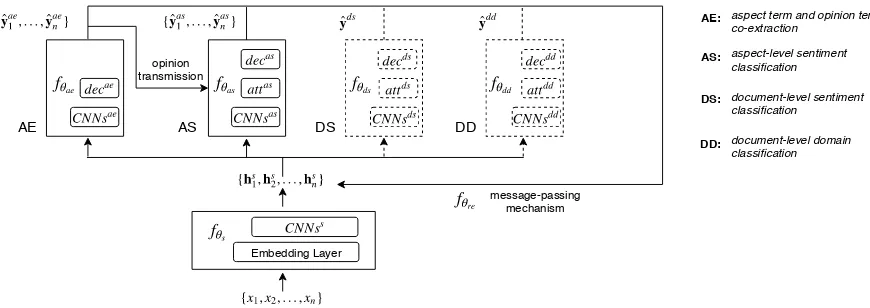
The IMN architecture is shown in Figure 1. It accepts a sequence of tokens{x1, . . . , xn}as
Embedding Layer
message-passing mechanism opinion
transmission
AE AS DS DD
aspect term and opinion term co-extraction
aspect-level sentiment classification
document-level sentiment classification
document-level domain classification
AE:
AS:
DS:
[image:3.595.78.513.64.218.2]DD:
Figure 1: The overall architecture of IMN.
shared among all tasks. This component consists of a word embedding layer followed by a few fea-ture extraction layers. Specifically, we employms layers of CNNs after the word embedding layer in fθs.
The output of fθs is a sequence of latent
vec-tors {hs1,hs2, ...,hsn} shared among all the tasks. After initialization by fθs, this sequence of
la-tent vectors is later updated by combining infor-mation propagated from different task components through message passing. We denotehsi(t) as the value of the shared latent vector corresponding to xi after t rounds of message passing, with hsi(0)
denoting the value after initialization.
The sequence of shared latent vectors3
{hs1,hs2, ...,hsn} is used as input to the different task-specific components. Each task-specific component has its own sets of latent and output variables. The output variables correspond to a label sequence in a sequence tagging task; in AE, we assign to each token a label indicating whether it belongs to any aspect or opinion4 term, while in AS, we label each word with its sentiment. In a classification task, the output corresponds to the label of the input instance: the sentiment of the document for the sentiment classification task (DS), and the domain of the document for the domain classification task (DD). At each iteration, appropriate information is passed back to the shared latent vectors to be combined; this could be the values of the output variables or the latent variables, depending on the task. In addition, we also allow messages to be passed between the
3
We omit the iteration superscripttin the description for simplicity.
4e.g. “
great” and “dreadful” in “Great food but the service is dreadful” are the opinion terms.
components in each iteration. Specifically for this problem, we send information from the AE task to the AS task as shown in Figure 1. After T iterations of message passing, which allows information to be propagated through multiple hops, we use the values of the output variables as predictions. For this problem, we only use the outputs for AE and AS during inference as these are the end-tasks, while the other tasks are only used for training. We now describe each component and how it is used in learning and inference.
3.1 Aspect-Level Tasks
AE aims to extract all the aspect and opinion terms5 appearing in a sentence, which is formu-lated as a sequence tagging problem with the BIO tagging scheme. Specifically, we use five class labels: Yae = {BA, IA, BP, IP, O}, indicating
the beginning of and inside of an aspect term, the beginning of and inside of an opinion term, and other words, respectively. We also formu-late AS as a sequence tagging problem with la-belsYas={pos, neg, neu}, indicating the token-levelpositive,negative, andneutralsentiment ori-entations. Table 1 shows an example of aspect-level training instance with gold AE and AS labels. In aspect-level datasets, only aspect terms get sen-timent annotated. Thus, when modeling AS as a sequence tagging problem, we label each token that is part of an aspect term with the sentiment label of the corresponding aspect term. For
exam-5
Input The fish is fresh but the variety of fish is nothing out of ordinary .
AE O BA O BP O O BA IA IA O O O O BP O
AS - pos - - - - neg neg neg - - -
-Table 1: An aspect-level training instance with gold AE and AS labels.
ple, as shown in Table 1, we label “fish” as pos, and label “variety”, “of”, “fish” as neg, based on the gold sentiment labels of the two aspect terms “fish” and “varity of fish” respectively. Since other tokens do not have AS gold labels, we ignore the predictions on them when computing the training loss for AS.
The AE component fθae is parameterized by
θae and outputs {yˆae1 , ...,yˆnae}. The AS
com-ponent fθas is parameterized by θas and outputs
{yˆas1 , ...,yˆasn}. The AE and AS encoders con-sist of mae and mas layers of CNNs
respec-tively, and they map the shared representations to
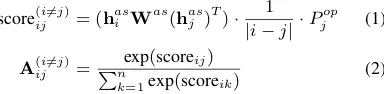
{hae1 ,hae2 , ...,haen}and{has1 ,has2 , ...,hasn } respec-tively. For the AS encoder, we employ an ad-ditional self-attention layer on top of the stacked CNNs. As shown in Figure 1, we make yˆaei , the outputs from AE available to AS in the self-attention layer, as the sentiment task could bene-fit from knowing the predictions of opinion terms. Specifically, the self-attention matrixA ∈ Rn×n
is computed as follows:
score(iji6=j)= (hiasWas(hasj )T)· 1
|i−j|·P
op
j (1)
A(iji6=j)=Pnexp(scoreij) k=1exp(scoreik)
(2)
where the first term in Eq.(1) indicates the seman-tic relevance between hasi and hasj with param-eter matrix Was, the second term is a distance-relevant factor, which decreases with increasing distance between theith token and thejth token, and the third termPjopdenotes the predicted prob-ability that the jth token is part of any opinion term. The probability Pjop can be computed by summing the predicted probabilities on opinion-related labels BP and IP inyˆaej . In this way, AS is directly influenced by the predictions of AE. We set the diagonal elements inAto zeros, as we only consider context words for inferring the sentiment of the target token. The self-attention layer out-puts h0ias = Pn
j=1Aijhasj . In AE, we
concate-nate the word embedding, the initial shared rep-resentationhsi(0), and the task-specific representa-tionhae
i as the final representation of theith token.
In AS, we concatenatehsi(0) andh0iasas the final
representation. For each task, we employ a fully-connected layer with softmax activation as the de-coder, which maps the final token representation to probability distributionyˆaei (yˆasi ).
3.2 Document-Level Tasks
To address the issue of insufficient aspect-level training data, IMN is able to exploit knowledge from document-level labeled sentiment corpora, which are more readily available. We intro-duce two document-level classification tasks to be jointly trained with AE and AS. One is document-level sentiment classification (DS), which pre-dicts the sentiment towards an input document. The other is document-level domain classification (DD), which predicts the domain label of an input document.
As shown in Figure 1, the task-specific op-eration fθo consists of m
o layers of CNNs that
map the shared representations {hs1, ...,hsn} to
{ho1, ...,hon}, an attention layer atto, and a decod-ing layer deco, whereo∈ {ds, dd}is the task sym-bol. The attention weight is computed as:
aoi = exp(h
o iWo)
Pn
k=1exp(hokWo)
(3)
where Wo is a parameter vector. The final document representation is computed as ho =
Pn
i=1aoihoi. We employ a fully-connected layer
with softmax activation as the decoding layer, which mapshotoyˆo.
3.3 Message Passing Mechanism
To exploit interactions between different tasks, the message passing mechanism aggregates predic-tions of different tasks from the previous iteration, and uses this knowledge to update the shared la-tent vectors {hs1, ...,hsn} at the current iteration. Specifically, the message passing mechanism inte-grates knowledge fromyˆiae,yˆasi ,yˆds,adsi , andaddi computed on an input{x1, ..., xn}, and the shared
hidden vectorhs
i is updated as follows:
hsi(t)=fθre(h
s(t−1)
i : ˆy
ae(t−1)
i : ˆy
as(t−1)
i :
ˆ
yds(t−1):aids(t−1):addi (t−1))
[image:4.595.97.289.454.501.2]wheret >0and[:]denotes the concatenation op-eration. We employ a fully-connected layer with ReLu activation as the re-encoding functionfθre.
To update the shared representations, we incorpo-rateyˆiae(t−1) andyˆasi (t−1), the outputs of AE and AS from the previous iteration, such that these in-formation are available for both tasks in current round of computation. We also incorporate infor-mation from DS and DD.yˆdsindicates the overall sentiment of the input sequence, which could be helpful for AS. The attention weightsadsi andaddi generated by DS and DD respectively reflect how sentiment-relevant and domain-relevant theith to-ken is. A toto-ken that is more sentiment-relevant or domain-relevant is more likely to be an opinion word or aspect word. This information is useful for the aspect-level tasks.
3.4 Learning
Instances for aspect-level problems only have aspect-level labels while instances for document-level problems only have document labels. IMN is trained on aspect-level and document-level in-stances alternately.
When trained on aspect-level instances, the loss function is as follows:
La(θs,θae, θas, θds, θdd, θre) =
1 Na
Na X
i=1 1 ni
ni X
j=1 (
l(yaei,j,yˆaei,j(T)) +l(yasi,j,yˆasi,j(T)))
(5)
where T denotes the maximum number of itera-tions in the message passing mechanism,Na
de-notes the total number of aspect-level training in-stances, ni denotes the number of tokens
con-tained in theith training instance, andyae i,j (yasi,j)
denotes the one-hot encoding of the gold label for AE (AS).lis the cross-entropy loss applied to each token. In aspect-level datasets, only aspect terms have sentiment annotations. We label each token that is part of any aspect term with the sentiment of the corresponding aspect term. During model training, we only consider AS predictions on these aspect term-related tokens for computing the AS loss and ignore the sentiments predicted on other tokens6.
When trained on document-level instances, we
6Letl(yas i,j,yˆ
as(T)
i,j ) = 0in Eq.(5) ify ae
i,jis not BA or IA
Algorithm 1Pseudocode for training IMN
Require: Da = {(xai, yiae, yias)Na
i=1}, Dds =
{(xdsi , ydsi )Nds
i=1}andDdd ={(xddi , yidd) Ndd
i=1}
Require: Integer r >0
fore∈[1,max-pretrain-epochs]do forminibatchBds,BddinDds,Ddddo
computeLdbased onBdsandBdd
updateθs,θds,θdd
end for end for
fore∈[1,max-epochs]do
forb∈[1,batches-per-epoch]do
sampleBafromDa
computeLabased onBa
updateθs,θae,θas,θre
ifbis divisible byrthen
sampleBds,BddfromDds,Ddd computeLdbased onBds andBdd
updateθs,θds,θdd
end if end for end for
minimize the following loss:
Ld(θs, θds, θdd) =
1
Nds Nds
X
i=1
l(ydsi ,yˆids)
+ 1
Ndd Ndd
X
i=1
l(yddi ,yˆddi ) (6)
whereNdsandNdddenote the number of training
instances for DS and DD respectively, andydsi and
yddi denote the one-hot encoding of the gold la-bel. Message passing iterations are not used when training document-level instances.
For learning, we first pretrain the network on the document-level instances (minimizeLd) for a few
epochs, such that DS and DD can make reasonable predictions. Then the network is trained on aspect-level instances and document-aspect-level instances alter-nately with ratior, to minimizeLa andLd. The
overall training process is given in Algorithm 1. Da, Dds, and Ddd denote the aspect-level train-ing set and the traintrain-ing sets for DS, DD respec-tively.DdsandDaare from similar domains.Ddd
contains review documents from at least two do-mains withyids denoting the domain label, where one of the domains is similar to the domains ofDa
Datasets Train Test aspect opinion aspect opinion D1 Restaurant14 3699 3484 1134 1008 D2 Laptop14 2373 2504 654 674 D3 Restaurant15 1199 1210 542 510
Table 2: Dataset statistics with numbers of aspect terms and opinion terms
they are semantically relevant. We fixθds andθdd
when updating parameters forLa, since we do not
want them to be affected by the small number of aspect-level training instances.
4 Experiments
4.1 Experimental Settings
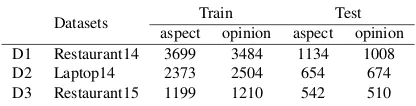
Datasets. Table 2 shows the statistics of the aspect-level datasets. We run experiments on three benchmark datasets, taken from Se-mEval2014 (Pontiki et al., 2014) and SemEval 2015 (Pontiki et al.,2015). The opinion terms are annotated by Wang et al. (2016a). We use two document-level datasets from (He et al., 2018b). One is from the Yelp restaurant domain, and the other is from the Amazon electronics domain. Each contains 30k instances with exactly balanced class labels ofpos,neg, andneu. We use the con-catenation of the two datasets with domain labels asDdd. We use the Yelp dataset asDdswhenDa
is either D1 or D3, and use the electronics dataset asDdswhenDais D2.
Network details. We adopt the multi-layer-CNN structure from (Xu et al., 2018) as the CNN-based encoders in our proposed network. See Appendix A for implementation details. For word embedding initialization, we concate-nate a general-purpose embedding matrix and a domain-specific embedding matrix7 following
(Xu et al.,2018). We adopt their released
domain-specific embeddings for restaurant and laptop do-mains with 100 dimensions, which are trained on a large domain-specific corpus using fastText. The general-purpose embeddings are pre-trained Glove vectors (Pennington et al.,2014) with 300 dimensions.
One set of important hyper-parameters are the number of CNN layers in the shared encoder and the task-specific encoders. To decide the values ofms, mae, mas, mds, mdd, we first investigate
7For DD, we only look at the general-purpose embeddings
by masking out the domain-specific embeddings.
how many layers of CNNs would work well for each of the task when training it alone. We de-note co as the optimal number of CNN layers in this case, where o ∈ {ae, as, ds, dd} is the task indicator. We perform AE, AS separately on the training set of D1, and perform DS, DD separately on the document-level restaurant corpus. Cross-validation is used for selectingco, which yields 4, 2, 2, 2 forcae,cas,cds,cdd. Based on this observa-tion, we madems,mae,mas,mds,mddequals to 2, 2, 0, 0, 0 respectively, such thatms+mo=co. Note that there are other configurations satisfying the requirement, for example,ms,mae,mas,mds, mddequals to 1, 3, 1, 1, 1. we select our setting as it involves the smallest set of parameters.
We tune the maximum number of iterationsT in the message passing mechanism by training IMN−d via cross validation on D1. It is set to 2. WithT fixed as 2, we then tuner by training IMN via cross validation on D1 and the relevant document-level datasets. It is set to 2 as well.
We use Adam optimizer with learning rate set to 10−4, and we set batch size to 32. Learning rate and batch size are set to conventional values without specific tuning for our task.
At training phase, we randomly sample 20% of the training data from the aspect-level dataset as the development set and only use the remaining 80% for training. We train the model for a fix num-ber of epoches, and save the model at the epoch with the best F1-I score on the development set for evaluation.
Evaluation metrics. During testing, we extract aspect (opinion) terms, and predict the sentiment for each extracted aspect term based onyˆae(T)and
ˆ
yas(T). Since the extracted aspect term may con-sist of multiple tokens and the sentiment predic-tions on them could be inconsistent in AS, we only output the sentiment label of the first token as the predicted sentiment for any extracted aspect term. We employ five metrics for evaluation, where two measure the AE performance, two measure the AS performance, and one measures the over-all performance. Following existing works for
AE (Wang et al., 2017;Xu et al., 2018), we use
F1 to measure the performance of aspect term ex-traction and opinion term exex-traction, which are denoted as F1-a andF1-o respectively. Follow-ing existFollow-ing works for AS (Chen et al., 2017;He
et al.,2018b), we adopt accuracy and macro-F1 to
as acc-sand F1-s. Since we are solving the in-tegrated task without assuming that gold aspect terms are given, the two metrics are computed based on the correctly extracted aspect terms from AE. We compute the F1 score of the integrated task denoted asF1-Ifor measuring the overall per-formance. To compute F1-I, an extracted aspect term is taken as correct only when both the span and the sentiment are correctly identified. When computing F1-a, we consider all aspect terms, while when computing acc-s, F1-s, and F1-I, we ignore aspect terms withconflictsentiment labels.
4.2 Models under Comparison
Pipeline approach. We select two
top-performing models from prior works for each of AE and AS, to construct 2 × 2 pipeline base-lines. For AE, we use CMLA (Wang et al.,
2017) and DECNN (Xu et al., 2018). CMLA was proposed to perform co-extraction of as-pect and opinion terms by modeling their inter-dependencies. DECNN is the state-of-the-art model for AE. It utilizes a multi-layer CNN structure with both general-purpose and domain-specific embeddings. We use the same struc-ture as encoders in IMN. For AS, we use ATAE-LSTM (denoted as AATAE-LSTM for short) (Wang
et al., 2016b) and the model from (He et al.,
2018b) which we denote as dTrans. ALSTM
is a representative work with an attention-based LSTM structure. We compare with dTrans as it also utilizes knowledge from document corpora for improving AS performance, which achieves state-of-the-art results. Thus, we compare with the following pipeline methods:
CMLA-ALSTM, CMLA-dTrans, DECNN-ALSTM,
andDECNN-dTrans. We also compare with the pipeline setting of IMN, which trains AE and AS independently (i.e., without parameter sharing, in-formation passing, and document-level corpora). We denote it as PIPELINE. The network struc-ture for AE in PIPELINE is the same as DECNN. During testing of all methods, we perform AE in the first step, and then generate AS predictions on the correctly extracted aspect terms.
Integrated Approach. We compare with two re-cently proposed methods that have achieved state-of-the-art results among integrated approaches:
MNN(Wang et al.,2018) and the model from (Li
et al., 2019) which we denote asINABSA
(inte-grated network for ABSA). Both methods model
the overall task as a sequence tagging problem with a unified tagging scheme. Since during test-ing, IMN only outputs the sentiment on the first token of an extracted aspect term to avoid sen-timent inconsistency, to enable fair comparison, we also perform this operation on MNN and IN-ABSA. We also show results for a version of IMN that does not use document-level corpora, denoted as IMN−d. The structure of IMN−d is shown as the solid lines in Figure1. It omits the information
ˆ
yds,adsi , andaddi propagated from the document-level tasks in Eq.(4).
4.3 Results and Analysis
Main results. Table 3shows the comparison re-sults. Note that IMN performs co-extraction of as-pect and opinion terms in AE, which utilizes ad-ditional opinion term labels during training, while the baseline methods except CMLA do not con-sider this information in their original models. To enable fair comparison, we slightly modify those baselines to perform co-extraction as well, with opinion term labels provided. Further details on model comparison are provided in AppendixB.
From Table3, we observe that IMN−dis able to significantly outperform other baselines on F1-I. IMN further boosts the performance and outper-forms the best F1-I results from the baselines by 2.29%, 1.77%, and 2.61% on D1, D2, and D3. Specifically, for AE (F1-a and F1-o), IMN−d per-forms the best in most cases. For AS (acc-s and F1-s), IMN outperforms other methods by large margins. PIPELINE, IMN−d, and the pipeline methods with dTrans also perform reasonably well on this task, outperforming other baselines by moderate margins. All these models utilize knowl-edge from larger corpora by either joint training of document-level tasks or using domain-specific embeddings. This suggests that domain-specific knowledge is very helpful, and both joint train-ing and domain-specific embeddtrain-ings are effective ways to transfer such knowledge.
Methods CMLA-ALSTM CMLA-dT
rans
DECNN-ALSTM DECNN-dT
rans
PIPELINE MNN IN
ABSA
IMN
−
d
w
o
DE
IMN
−
d
IMN
w
o
DE
IMN
D1
F1-a 82.45 82.45 83.94 83.94 83.94 83.05 83.92 83.95 84.01 83.50 83.33 F1-o 82.67 82.67 85.60 85.60 85.60 84.55 84.97 85.21 85.64 84.62 85.61 acc-s 77.46 79.58 77.79 80.04 79.56 77.17 79.68 79.65 81.56∗ 83.17∗ 83.89∗ F1-s 68.70 72.23 68.50 73.31 69.59 68.45 68.38 69.32 71.90 73.44 75.66 F1-I 63.87 65.34 65.26 67.25 66.53 63.87 66.60 66.96 68.32∗ 69.11∗ 69.54∗
D2
F1-a 76.80 76.80 78.38 78.38 78.38 76.94 77.34 76.96 78.46 76.87 77.96 F1-o 77.33 77.33 78.81 78.81 78.81 77.77 76.62 76.85 78.14 77.04 77.51 acc-s 70.25 72.38 70.46 73.10 72.29 70.40 72.30 72.89 73.21 74.31∗ 75.36∗ F1-s 66.67 69.52 66.78 70.63 68.12 65.98 68.24 67.26 69.92 70.76 72.02∗ F1-I 53.68 55.56 55.05 56.60 56.02 53.80 55.88 56.25 57.66∗ 57.04∗ 58.37∗
D3
[image:8.595.105.497.61.265.2]F1-a 68.55 68.55 68.32 68.32 68.32 70.24 69.40 69.23 69.80 68.23 70.04 F1-o 71.07 71.07 71.22 71.22 71.22 69.38 71.43 68.39 72.11∗ 70.09 71.94 acc-s 81.03 82.27 80.32 82.65 82.27 80.79 82.56 81.64 83.38 85.90∗ 85.64∗ F1-s 58.91 66.45 57.25 69.58 59.53 57.90 58.81 57.51 60.65 71.67∗ 71.76∗ F1-I 54.79 56.09 55.10 56.28 55.96 56.57 57.38 56.80 57.91∗ 58.82∗ 59.18∗
Table 3: Model comparison. Average results over 5 runs with random initialization are reported. ∗indicates the proposed method is significantly better than the other baselines (p <0.05) based on one-tailed unpaired t-test.
Model variants D1 D2 D3 Vanilla model 66.66 55.63 56.24 +Opinion transmission 66.98 56.03 56.65 +Message passing-a (IMN−d) 68.32 57.66 57.91 +DS 68.48 57.86 58.03 +DD 68.65 57.50 58.26 +Message passing-d (IMN) 69.54 58.37 59.18
Table 4: F1-I scores of different model variants. Aver-age results over 5 runs are reported.
without domain-specific embeddings, while it still outperforms all other baselines except DECNN-dTrans. DECNN-dTrans is a very strong base-line as it exploits additional knowledge from larger corpora for both tasks. IMN−dwo DE is compet-itive with DECNN-dTrans even without utilizing additional knowledge, which suggests the effec-tiveness of the proposed network structure.
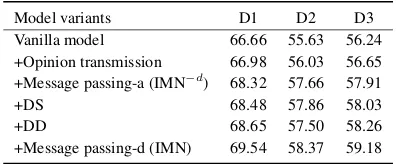
Ablation study. To investigate the impact of dif-ferent components, we start with a vanilla model which consists offθs,fθae, andfθas only without
any informative message passing, and add other components one at a time. Table4shows the re-sults of different model variants. +Opinion trans-mission denotes the operation of providing addi-tional information Pjop to the self-attention layer as shown in Eq.(1). +Message passing-a denotes propagating the outputs from aspect-level tasks only at each message passing iteration. +DS and +DD denote adding DS and DD with parameter sharing only. +Message passing-d denotes involv-ing the document-level information for message
passing. We observe that +Message passing-a and +Message passing-d contribute to the performance gains the most, which demonstrates the effective-ness of the proposed message passing mechanism. We also observe that simply adding document-level tasks (+DS/DD) with parameter sharing only marginally improves the performance of IMN−d. This again indicates that domain-specific knowl-edge has already been captured by domain embed-dings, while knowledge obtained from DD and DS via parameter sharing could be redundant in this case. However, +Message passing-d is still help-ful with considerable performance gains, showing that aspect-level tasks can benefit from knowing predictions of the relevant document-level tasks.
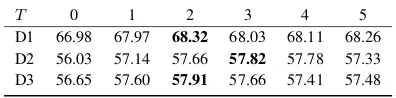
Impact ofT.We have demonstrated the effective-ness of the message passing mechanism. Here, we investigate the impact of the maximum number of iterationsT. Table6shows the change of F1-I on the test sets asT increases. We find that conver-gence is quickly achieved within two or three iter-ations, and further iterations do not provide con-siderable performance improvement.
Case study. To better understand in which condi-tions the proposed method helps, we examine the instances that are misclassified by PIPELINE and INABSA, but correctly classified by IMN.
[image:8.595.83.281.319.401.2]Examples PIPELINE INABSA IMN Opinion Aspect Opinion Aspect Opinion Aspect 1.Strong[build]posthough which really
adds to its [durability]pos. Strong [durability]pos Strong [durability]pos Strong [build]pos, [durability]pos
2.Curioni’s Pizza has been around since
the 1920’s None [Pizza]neu None [Pizza]pos None None 3. The [battery]posislonger longer [battery]neg longer [battery]neg longer [battery]pos
4. The [potato balls]poswere notdryat all dry [potato balls]neg dry [potato balls]neg dry [potato balls]pos
5.That’s agoodthing, but it’s made from [aluminum]negthatscratches easily.
good,
easily [aluminum]pos good,
easily [aluminum]pos good,
[image:9.595.75.522.63.156.2]scratches easily [aluminum]neg
Table 5: Case analysis. The “Examples” column contains instances with gold labels. ’The “opinion” and “aspect” columns present the opinion terms and aspect terms with sentiments, generated by the corresponding model.
T 0 1 2 3 4 5
[image:9.595.83.281.211.260.2]D1 66.98 67.97 68.32 68.03 68.11 68.26 D2 56.03 57.14 57.66 57.82 57.78 57.33 D3 56.65 57.60 57.91 57.66 57.41 57.48
Table 6: F1 scores with different T values using IMN−d. Average results over 5 runs are reported.
Table5, PIPELINE and INABSA fail to recognize “build” as it is an uncommon aspect term in the training set while IMN is able to correctly rec-ognize it. We find that when no message pass-ing iteration is performed, IMN also fails to rec-ognize “build”. However, when we analyze the predicted sentiment distribution on each token in the sentence, we find that except “durability”, only “build” has a strong positive sentiment, while the sentiment distributions on the other tokens are more uniform. This is an indicator that “build” is also an aspect term. IMN is able to aggregate such knowledge with the message passing mechanism, such that it is able to correctly recognize “build” in later iterations. Due to the same reason, the mes-sage passing mechanism also helps to avoid ex-tracting terms on which no opinion is expressed. As observed in example 2, both PIPELINE and INABSA extract “Pizza”. However, since no opin-ion is expressed in the given sentence, “Pizza” should not be considered as an aspect term. IMN avoids extracting this kind of terms by aggregating knowledge from opinion prediction and sentiment prediction.
For aspect-level sentiment, since IMN is trained on larger document-level labeled corpora with balanced sentiment classes, in general it better captures the meaning of domain-specific opinion words (example 3), better captures sentiments of complex expressions such as negation (example 4), and better recognizes minor sentiment classes in the aspect-level datasets (negative and neutral in our cases). In addition, we find that knowledge
propagated by the document-level tasks through message passing is helpful. For example, the sentiment-relevant attention weights are helpful for recognizing uncommon opinion words, and which further help on correctly predicting the sen-timents of the aspect terms. As observed in ex-ample 5, PIPELINE and INABSA are unable to recognize “scratches easily” as the opinion term, and they also make wrong sentiment prediction on the aspect term “aluminum”. IMN learns that “scratches” is sentiment-relevant through knowl-edge from the sentiment-relevant attention weights aggregated via previous iterations of message passing, and is thus able to extract “scratches eas-ily”. Since the opinion predictions from AE are sent to the self-attention layer in the AS compo-nent, correct opinion predictions further help to in-fer the correct sentiment towards “aluminum”.
5 Conclusion
We propose an interactive multi-task learning net-work IMN for jointly learning aspect and opin-ion term co-extractopin-ion, and aspect-level sentiment classification. The proposed IMN introduces a novel message passing mechanism that allows in-formative interactions between tasks, enabling the correlation to be better exploited. In addition, IMN is able to learn from multiple training data sources, allowing fine-grained token-level tasks to benefit from document-level labeled corpora. The proposed architecture can potentially be applied to similar tasks such as relation extraction, semantic role labeling, etc.
Acknowledgments
References
Stefanos Angelidis and Mirella Lapata. 2018. Summa-rizing opinions: Aspect extraction meets sentiment prediction and they are both weakly supervised. In Conference on Empirical Methods in Natural Lan-guage Processing.
Anurag Arnab, Shuai Zheng, Sadeep Jayasumana, Bernardino Romera-Paredes, M˚ans Larsson, Alexander Kirillov, Bogdan Savchynskyy, Carsten Rother, Fredrik Kahl, and Philip HS Torr. 2018. Conditional random fields meet deep neural net-works for semantic segmentation: Combining probabilistic graphical models with deep learning for structured prediction. IEEE Signal Processing Magazine, 35(1):37–52.
Peng Chen, Zhongqian Sun, Lidong Bing, and Wei Yang. 2017. Recurrent attention network on mem-ory for aspect sentiment analysis. InConference on Empirical Methods in Natural Language Process-ing.
Jiajun Cheng, Shenglin Zhao, Jiani Zhang, Irwin King, Xin Zhang, and Hui Wang. 2017. Aspect-level sen-timent classification with heat (hierarchical atten-tion) network. InACM on Conference on Informa-tion and Knowledge Management.
Ronan Collobert and Jason Weston. 2008. A unified architecture for natural language processing: Deep neural networks with multitask learning. In Interna-tional Conference on Machine Learning.
Li Dong, Furu Wei, Chuanqi Tan, Duyu Tang, Ming Zhou, and Ke Xu. 2014. Adaptive recursive neural network for target-dependent Twitter sentiment clas-sification. InAnnual Meeting of the Association for Computational Linguistics.
Matthew R Gormley, Mark Dredze, and Jason Eisner. 2015. Approximation-aware dependency parsing by belief propagation. Transactions of the Association for Computational Linguistics, 3:489–501.
Ruidan He, Wee Sun Lee, Hwee Tou Ng, and Daniel Dahlmeier. 2017. An unsupervised neural attention model for aspect extraction. In Annual Meeting of the Association for Computational Linguistics.
Ruidan He, Wee Sun Lee, Hwee Tou Ng, and Daniel Dahlmeier. 2018a. Effective attention modeling for aspect-level sentiment classification. In Interna-tional Conference on ComputaInterna-tional Linguistics.
Ruidan He, Wee Sun Lee, Hwee Tou Ng, and Daniel Dahlmeier. 2018b. Exploiting document knowledge for aspect-level sentiment classification. InAnnual Meeting of the Association for Computational Lin-guistics.
Xin Li, Lidong Bing, Wai Lam, and Bei Shi. 2018a. Transformation networks for target-oriented senti-ment classification. In Annual Meeting of the As-sociation for Computational Linguistics.
Xin Li, Lidong Bing, Piji Li, and Wai Lam. 2019. A unified model for opinion target extraction and tar-get sentiment prediction. In AAAI Conference on Artificial Intelligence.
Xin Li, Lidong Bing, Piji Li, Wai Lam, and Zhimou Yang. 2018b. Aspect term extraction with history attention and selective transformation. In Interna-tional Joint Conference on Artificial Intelligence.
Xin Li and Wai Lam. 2017. Deep multi-task learn-ing for aspect term extraction with memory interac-tion. InConference on Empirical Methods in Natu-ral Language Processing.
Jiangming Liu and Yue Zhang. 2017. Attention model-ing for target sentiment. InConference of the Euro-pean Chapter of the Association for Computational Linguistics.
Yang Liu, Sujian Li, Xiaodong Zhang, and Zhifang Sui. 2016. Implicit discourse relation classification via multi-task neural networks. InAAAI Conference on Artificial Intelligence.
Minh-Thang Luong, Quoc V. Le, Ilya Sutskever, Oriol Vinyals, and Lukasz Kaiser. 2015a. Multi-task se-quence to sese-quence learning. InInternational Con-ference on Learning Representation.
Yukun Ma, Haiyun Peng, and Erik Cambira. 2018. Targeted aspect-based sentiment analysis via em-bedding commonsense knowledge into an attentive LSTM. In AAAI Conference on Artificial Intelli-gence.
Thien Hai Nguyen and Kiyoaki Shirai. 2015. PhraseRNN: Phrase recursive neural network for aspect-based sentiment analysis. InConference on Empirical Methods in Natural Language Process-ing.
Jeffrey Pennington, Richard Socher, and Christopher D Manning. 2014. GloVe: Global vectors for word representation. In Conference on Empirical Meth-ods in Natural Language Processing.
Maria Pontiki, Dimitrios Galanis, Haris Papageorgiou, Suresh Manandhar, and Ion Androutsopoulos. 2015. SemEval-2015 task 12: Aspect based sentiment analysis. In International Workshop on Semantic Evaluation.
Maria Pontiki, Dimitrios Galanis, John Pavlopou-los, Haris Papageorgiou, Ion AndroutsopouPavlopou-los, and Suresh Manandhar. 2014. SemEval-2014 task 4: Aspect based sentiment analysis. InInternational Workshop on Semantic Evaluation.
Duyu Tang, Bing Qin, Xiaocheng Feng, and Ting Liu. 2016a. Effective LSTMs for target-dependent senti-ment classification. InInternational Conference on Computational Linguistics.
Yi Tay, Luu Anh Tuan, and Siu Cheung Hui. 2018. Learning to attend via word-aspect associative fu-sion for aspect-based sentiment analysis. In AAAI Conference on Artificial Intelligence.
Duy-Tin Vo and Yue Zhang. 2015. Target-dependent Twitter sentiment classification with rich automatic features. InInternational Joint Conference on Arti-ficial Intelligence.
Feixiang Wang, Man Lan, and Wenting Wang. 2018. Towards a one-stop solution to both aspect extrac-tion and sentiment analysis tasks with neural multi-task learning. InInternational Joint Conference on Neural Networks.
Wenya Wang, Sinno Jialin Pan, Daniel Dahlmeier, and Xiaokui Xiao. 2016a. Recursive neural conditional random fields for aspect-based sentiment analysis. In Conference on Empirical Methods in Natural Language Processing.
Wenya Wang, Sinno Jialin Pan, Daniel Dahlmeier, and Xiaokui Xiao. 2017. Coupled multi-layer attentions for co-extraction of aspect and opinion terms. In AAAI Conference on Artificial Intelligence.
Yequan Wang, Minlie Huang, Li Zhao, and Xiaoyan Zhu. 2016b. Attention-based LSTM for aspect-level sentiment classification. In Conference on Empiri-cal Methods in Natural Language Processing.
Hu Xu, Bing Liu, Lei Shu, and Philip S. Yu. 2018. Double embeddings and CNN-based sequence la-beling for aspect extraction. In Annual Meeting of the Association for Computational Linguistics.
Yichun Yin, Furu Wei, Li Dong, Kaimeng Xu, Ming Zhang, and Ming Zhou. 2016. Unsupervised word and dependency path embeddings for aspect term extraction. InInternational Joint Conference on Ar-tificial Intelligence.
Meishan Zhang, Yue Zhang, and Duy-Tin Vo. 2015. Neural networks for open domain targeted senti-ment. InConference on Empirical Methods in Nat-ural Language Processing.
Meishan Zhang, Yue Zhang, and Duy-Tin Vo. 2016. Gated neural networks for targeted sentiment analy-sis. InAAAI Conference on Artificial Intelligence.
A Implementation Details
CNN-based Encoder
We adopt the multi-layer-CNN structure from (Xu
et al.,2018) as the CNN-based encoders for both
the shared CNNs and the task-specific ones in the
proposed network. Each CNN layer has many 1D-convolution filters, and each filter has a fixed ker-nel sizek= 2c+ 1, such that each filter performs convolution operation on a window ofkword rep-resentations, and compute the representation for theith word along with 2cnearby words in its con-text.
Following the settings in the original paper, the first CNN layer in the shared encoder has 128 fil-ters with kernel sizesk = 3and 128 filters with kernel sizes k = 5. The other CNN layers in the shared encoder and the CNN layers in each task-specific encoder have 256 filters with kernel sizesk = 5per layer. ReLu is used as the acti-vation function for each CNN layer. Dropout with p = 0.5 is employed after the embedding layer and each CNN layer.
Opinion Transmission
To alleviate the problem of unreliable predictions of opinion labels in the early stage of training, we adopt scheduled sampling for opinion transmis-sion at training phase. We send gold opinion la-bels rather than the predicted ones generated by AE to AS in the probability of i. The
probabil-ity i depends on the number of epochs i during
training, for which we employ an inverse sigmoid decayi= 5/(5 + exp(i/5)).
B Model Comparison Details
For CMLA8, ALSTM9, dTrans10, and INABSA11, we use the officially released source codes for experiments. For MNN, we re-implement the model following the descriptions in the paper as the source code is not available. We run each base-line multiple times with random initializations and save their predicted results. We use an unified evaluation script for measuring the outputs from different baselines as well as the proposed method. The proposed IMN performs co-extraction of aspect terms and opinion terms in AE, which uti-lizes additional opinion term labels during model training. In the baselines, the two integrated ods MNN and INABSA, and the pipeline meth-ods with DECNN as the AE component do not
8https://github.com/happywwy/
Coupled-Multi-layer-Attentions
9
https://www.wangyequan.com/ publications/
10
https://github.com/ruidan/ Aspect-level-sentiment
11https://github.com/lixin4ever/
Methods D1 D2 D3
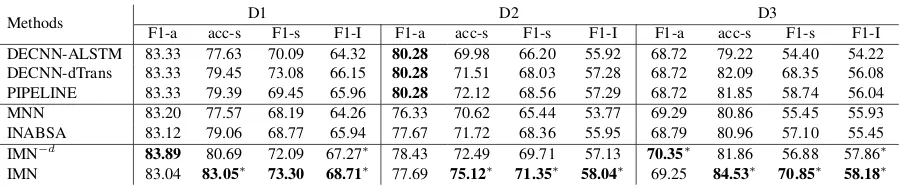
[image:12.595.76.526.64.158.2]F1-a acc-s F1-s F1-I F1-a acc-s F1-s F1-I F1-a acc-s F1-s F1-I DECNN-ALSTM 83.33 77.63 70.09 64.32 80.28 69.98 66.20 55.92 68.72 79.22 54.40 54.22 DECNN-dTrans 83.33 79.45 73.08 66.15 80.28 71.51 68.03 57.28 68.72 82.09 68.35 56.08 PIPELINE 83.33 79.39 69.45 65.96 80.28 72.12 68.56 57.29 68.72 81.85 58.74 56.04 MNN 83.20 77.57 68.19 64.26 76.33 70.62 65.44 53.77 69.29 80.86 55.45 55.93 INABSA 83.12 79.06 68.77 65.94 77.67 71.72 68.36 55.95 68.79 80.96 57.10 55.45 IMN−d 83.89 80.69 72.09 67.27∗ 78.43 72.49 69.71 57.13 70.35∗ 81.86 56.88 57.86∗ IMN 83.04 83.05∗ 73.30 68.71∗ 77.69 75.12∗ 71.35∗ 58.04∗ 69.25 84.53∗ 70.85∗ 58.18∗
Table 7: Model comparison in a setting without opinion term labels. Average results over 5 runs with random initialization are reported. ∗ indicates the proposed method is significantly better than the other baselines (p <
0.05) based on one-tailed unpaired t-test.
take take opinion information during training. To make fair comparison, we add labels {BP, IP}
to the original label sets of MNN, INABSA, and DECNN, indicating the beginning of and inside of an opinion term. We train those models on train-ing sets with both aspect and opinion term labels to perform co-extraction as well. In addition, for pipeline methods, we also make the gold opin-ion terms available to the AS models (ALSTM and dTrans) during training. To make ALSTM and dTrans utilize the opinion label information, we modify their attention layer to assign higher weights to tokens that are more likely to be part of an opinion term. This is reasonable since the ob-jective of the attention mechanism in an AS model is to find the relevant opinion context. The atten-tion weight of theith token before applying soft-max normalization in an input sentence is modi-fied as:
a0i =ai∗Piop (7)
where ai denotes the attention weight computed
by the original attention layer, popi denotes the probability that the ith token belongs to any opinion term. a0i denotes the modified attention weights. At the training phase, since the gold opinion terms are provided, popi = 1 for the to-kens that are part of the gold opinion terms, while popi = 0for the other tokens. At the testing phase, popi is computed based on the predictions from the AE model in the pipeline method. It is computed by summing up the predicted probabilities on the opinion-related labels BP and IP for theith token. We also present the comparison results in a setting without using opinion term labels in Ta-ble 712. In this setting, we modify the proposed IMN and IMN−d to recognize aspect terms only
12We exclude the results of the pipeline methods with
CMLA, as CMLA relies on opinion term labels during train-ing. It is difficult to modify it.
in AE. The opinion transmission operation, which sends the opinion term predictions from AE to AS, is omitted as well.