Proceedings of the 55th Annual Meeting of the Association for Computational Linguistics, pages 1116–1126 Vancouver, Canada, July 30 - August 4, 2017. c2017 Association for Computational Linguistics Proceedings of the 55th Annual Meeting of the Association for Computational Linguistics, pages 1116–1126
Vancouver, Canada, July 30 - August 4, 2017. c2017 Association for Computational Linguistics
Towards an Automatic Turing Test:
Learning to Evaluate Dialogue Responses
Ryan Lowe♥∗ Michael Noseworthy♥∗ Iulian V. Serban♦
Nicolas A.-Gontier♥ Yoshua Bengio♦‡ Joelle Pineau♥‡
♥Reasoning and Learning Lab, School of Computer Science, McGill University ♦ Montreal Institute for Learning Algorithms, Universit´e de Montr´eal
‡CIFAR Senior Fellow
Abstract
Automatically evaluating the quality of di-alogue responses for unstructured domains is a challenging problem. Unfortunately, existing automatic evaluation metrics are biased and correlate very poorly with hu-man judgements of response quality. Yet having an accurate automatic evaluation procedure is crucial for dialogue research, as it allows rapid prototyping and testing of new models with fewer expensive human evaluations. In response to this challenge, we formulate automatic dialogue evalua-tion as a learning problem. We present an evaluation model (ADEM) that learns to pre-dict human-like scores to input responses, using a new dataset of human response scores. We show that theADEMmodel’s predictions correlate significantly, and at a level much higher than word-overlap met-rics such as BLEU, with human judge-ments at both the utterance and system-level. We also show thatADEMcan gener-alize to evaluating dialogue models unseen during training, an important step for auto-matic dialogue evaluation.
1 Introduction
Building systems that can naturally and meaning-fully converse with humans has been a central goal of artificial intelligence since the formulation of the Turing test (Turing, 1950). Research on one type of such systems, sometimes referred to as non-task-oriented dialogue systems, goes back to the mid-60s with Weizenbaum’s famous program
ELIZA: a rule-based system mimicking a Roge-rian psychotherapist by persistently either rephras-ing statements or askrephras-ing questions (Weizenbaum,
∗Indicates equal contribution.
Context of Conversation
Speaker A: Hey, what do you want to do tonight? Speaker B: Why don’t we go see a movie?
Model Response
Nah, let’s do something active.
Reference Response
Yeah, the film about Turing looks great!
Figure 1: Example where word-overlap scores fail for dialogue evaluation; although the model response is reasonable, it has no words in common with the reference response, and thus would be given low scores by metrics such as BLEU.
1966). Recently, there has been a surge of inter-est towards building large-scale non-task-oriented dialogue systems using neural networks (Sordoni et al.,2015b;Shang et al.,2015;Vinyals and Le, 2015;Serban et al.,2016a;Li et al.,2015). These models are trained in an end-to-end manner to op-timize a single objective, usually the likelihood of generating the responses from a fixed corpus. Such models have already had a substantial im-pact in industry, including Google’s Smart Reply system (Kannan et al.,2016), and Microsoft’s Xi-aoice chatbot (Markoff and Mozur,2015), which has over 20 million users.
One of the challenges when developing such sys-tems is to have a good way of measuring progress, in this case the performance of the chatbot. The Turing test provides one solution to the evaluation of dialogue systems, but there are limitations with its original formulation. The test requires live hu-man interactions, which is expensive and difficult to scale up. Furthermore, the test requires carefully designing the instructions to the human interlocu-tors, in order to balance their behaviour and ex-pectations so that different systems may be ranked accurately by performance. Although unavoidable, these instructions introduce bias into the evaluation measure. The more common approach of having
humans evaluate the quality of dialogue system responses, rather than distinguish them from hu-man responses, induces similar drawbacks in terms of time, expense, and lack of scalability. In the case of chatbots designed for specific conversation domains, it may also be difficult to find sufficient human evaluators with appropriate background in the topic (Lowe et al.,2015).
Despite advances in neural network-based mod-els, evaluating the quality of dialogue responses automatically remains a challenging and under-studied problem in the non-task-oriented setting. The most widely used metric for evaluating such dialogue systems is BLEU (Papineni et al.,2002), a metric measuring word overlaps originally devel-oped for machine translation. However, it has been shown that BLEU and other word-overlap metrics are biased and correlate poorly with human judge-ments of response quality (Liu et al.,2016). There are many obvious cases where these metrics fail, as they are often incapable of considering the se-mantic similarity between responses (see Figure1). Despite this, many researchers still use BLEU to evaluate their dialogue models (Ritter et al.,2011; Sordoni et al.,2015b;Li et al.,2015;Galley et al., 2015;Li et al.,2016a), as there are few alternatives available that correlate with human judgements. While human evaluation should always be used to evaluate dialogue models, it is often too expensive and time-consuming to do this for every model specification (for example, for every combination of model hyperparameters). Therefore, having an accurate model that can evaluate dialogue response quality automatically — what could be considered anautomatic Turing test— is critical in the quest for building human-like dialogue agents.
To make progress towards this goal, we make the simplifying assumption that a ‘good’ chatbot is one whose responses are scored highly on ap-propriateness by human evaluators. We believe this is sufficient for making progress as current dialogue systems often generate inappropriate re-sponses. We also find empirically that asking evaluators for other metrics results in either low inter-annotator agreement, or the scores are highly correlated with appropriateness (see supp. mate-rial). Thus, we collect a dataset of appropriateness scores to various dialogue responses, and we use this dataset to train anautomatic dialogue evalu-ation model(ADEM). The model is trained in a semi-supervised manner using a hierarchical
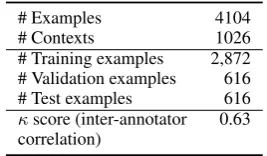
recur-# Examples 4104
# Contexts 1026
[image:2.595.349.483.62.140.2]# Training examples 2,872 # Validation examples 616 # Test examples 616 κscore (inter-annotator 0.63 correlation)
Table 1: Statistics of the dialogue response evalua-tion dataset. Each example is in the form(context, model response, reference response, human score).
rent neural network (RNN) to predict human scores. We show thatADEMscores correlate significantly with human judgement at both the utterance-level and system-level. We also show thatADEMcan of-ten generalize to evaluating new models, whose responses were unseen during training, making ADEM a strong first step towards effective auto-matic dialogue response evaluation.1
2 Data Collection
To train a model to predict human scores to dia-logue responses, we first collect a dataset of human judgements (scores) of Twitter responses using the crowdsourcing platform Amazon Mechanical Turk (AMT).2The aim is to have accurate human scores for a variety of conversational responses — con-ditioned on dialogue contexts — which span the full range of response qualities. For example, the responses should include both relevant and irrel-evant responses, both coherent and non-coherent responses and so on. To achieve this variety, we use candidate responses from several different models. Following (Liu et al.,2016), we use the following 4 sources of candidate responses: (1) a response selected by a TF-IDF retrieval-based model, (2) a response selected by the Dual Encoder (DE) (Lowe et al.,2015), (3) a response generated using the hier-archical recurrent encoder-decoder (HRED) model (Serban et al.,2016a), and (4) human-generated responses. It should be noted that the human-generated candidate responses arenotthe reference responses from a fixed corpus, but novel human responses that are different from the reference. In addition to increasing response variety, this is nec-essary because we want our evaluation model to learn to compare the reference responses to the candidate responses. We provide the details of our
1Code and trained model parameters are available online:
https://github.com/mike-n-7/ADEM.
2All data collection was conducted in accordance with the
AMT experiments in the supplemental material, in-cluding additional experiments suggesting that sev-eral other metrics are currently unlikely to be useful for building evaluation models. Note that, in order to maximize the number of responses obtained with a fixed budget, we only obtain one evaluation score per dialogue response in the dataset.
To train evaluation models on human judge-ments, it is crucial that we obtain scores of re-sponses that lie near the distribution produced by advanced models. This is why we use the Twitter Corpus (Ritter et al.,2011), as such models are pre-trained and readily available. Further, the set of topics discussed is quite broad — as opposed to the very specific Ubuntu Dialogue Corpus (Lowe et al.,2015) — and therefore the model may also be suited to other chit-chat domains. Finally, since it does not require domain specific knowledge (e.g. technical knowledge), it should be easy for AMT workers to annotate.
3 Technical Background 3.1 Recurrent Neural Networks
Recurrent neural networks (RNNs) are a type of neural network with time-delayed connections be-tween the internal units. This leads to the formation of ahidden stateht, which is updated for every
in-put:ht=f(Whhht−1+Wihxt), whereWhhand
Wihare parameter matrices,f is a non-linear acti-vation function such as tanh, andxtis the input at timet. The hidden state allows for RNNs to better
model sequential data, such as language.
In this paper, we consider RNNs augmented with long-short term memory (LSTM) units (Hochre-iter and Schmidhuber,1997). LSTMs add a set of gates to the RNN that allow it to learn how much to update the hidden state. LSTMs are one of the most well-established methods for dealing with the vanishing gradient problem in recurrent net-works (Hochreiter,1991;Bengio et al.,1994).
3.2 Word-Overlap Metrics
One of the most popular approaches for automati-cally evaluating the quality of dialogue responses is by computing their word overlapwith the ref-erence response. In particular, the most popular metrics are the BLEU and METEOR scores used for machine translation, and the ROUGE score used for automatic summarization. While these metrics tend to correlate with human judgements in their target domains, they have recently been shown to
highly biased and correlate very poorly with human judgements for dialogue response evaluation (Liu et al.,2016). We briefly describe BLEU here, and provide a more detailed summary of word-overlap metrics in the supplemental material.
BLEU BLEU (Papineni et al.,2002) analyzes the co-occurrences of n-grams in the reference and the proposed responses. It computes the n-gram preci-sion for the whole dataset, which is then multiplied by a brevity penalty to penalize short translations. For BLEU-N, N denotes the largest value of
n-grams considered (usuallyN = 4).
Drawbacks One of the major drawbacks of
word-overlap metrics is their failure in capturing the semantic similarity (and other structure) be-tween the model and reference responses when there are few or no common words. This problem is less critical for machine translation; since the set of reasonable translations of a given sentence or document is rather small, one can reasonably infer the quality of a translated sentence by only measuring the word-overlap between it and one (or a few) reference translations. However, in dialogue, the set of appropriate responses given a context is much larger (Artstein et al.,2009); in other words, there is a very highresponse diversitythat is un-likely to be captured by word-overlap comparison to a single response.
Further, word-overlap scores are computed di-rectly between the model and reference responses. As such, they do not consider the context of the conversation. While this may be a reasonable as-sumption in machine translation, it is not the case for dialogue; whether a model response is an ade-quate substitute for the reference response is clearly context-dependent. For example, the two responses in Figure1are equally appropriate given the con-text. However, if we simply change the context to:
“Have you heard of any good movies recently?”, the model response is no longer relevant while the reference response remains valid.
4 An Automatic Dialogue Evaluation
Model (ADEM)
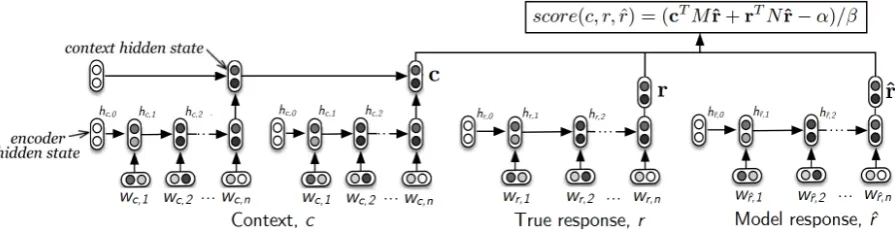
Figure 2: TheADEMmodel, which uses a hierarchical encoder to produce the context embeddingc.
call this evaluation modelADEM.
ADEMlearns distributed representations of the context, model response, and reference response using a hierarchical RNN encoder. Given the dia-logue contextc, reference responser, and model
responserˆ,ADEMfirst encodes each of them into vectors (c,ˆr, andr, respectively) using the RNN
encoder. Then,ADEMcomputes the score using a dot-product between the vector representations of
c,r, andrˆin a linearly transformed space: :
score(c, r,rˆ) = (cTMˆr+rTNˆr−α)/β (1)
whereM, N ∈Rnare learned matrices initialized to the identity, andα, βare scalar constants used to
initialize the model’s predictions in the range[1,5].
The model is shown in Figure2.
The matrices M and N can be interpreted as
linear projections that map the model responseˆr
into the space of contexts and reference responses, respectively. The model gives high scores to re-sponses that have similar vector representations to the context and reference response after this projec-tion. The model is end-to-end differentiable; all the parameters can be learned by backpropagation. In our implementation, the parametersθ={M, N}
of the model are trained to minimize the squared error between the model predictions and the human score, with L2-regularization:
L= X i=1:K
[score(ci, ri,rˆi)−humani]2+γ||θ||2
(2) whereγ is a scalar constant. The simplicity of our
model leads to both accurate predictions and fast evaluation (see supp. material), which is important to allow rapid prototyping of dialogue systems.
The hierarchical RNN encoder in our model con-sists of two layers of RNNs (El Hihi and Bengio, 1995;Sordoni et al.,2015a). The lower-level RNN, theutterance-level encoder, takes as input words
from the dialogue, and produces a vector output at the end of each utterance. Thecontext-level en-coder takes the representation of each utterance as input and outputs a vector representation of the context. This hierarchical structure is useful for incorporating information from early utterances in the context (Serban et al.,2016a). Following pre-vious work, we take the last hidden state of the context-level encoder as the vector representation of the input utterance or context. The parameters of the RNN encoder are pretrained and are not learned from the human scores.
An important point is that theADEMprocedure aboveis not a dialogue retrieval model: the funda-mental difference is thatADEMhas access to the reference response. Thus, ADEMcan compare a model’s response to a known good response, which is significantly easier than inferring response qual-ity from solely the context.
Pre-training with VHRED We would like an
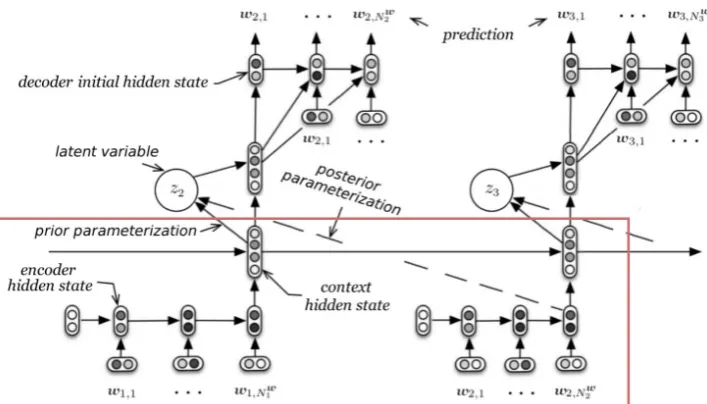
evaluation model that can make accurate predic-tions from few labeled examples, since these exam-ples are expensive to obtain. We therefore employ semi-supervised learning, and use a pre-training procedure to learn the parameters of the encoder. In particular, we train the encoder as part of a neu-ral dialogue model; we attach a thirddecoder RNN
that takes the output of the encoder as input, and train it to predict the next utterance of a dialogue conditioned on the context.
Gaus-Figure 3: The VHRED model used for pre-training. The hierarchical structure of the RNN encoder is shown in the red box around the bottom half of the figure. After training using the VHRED procedure, the last hidden state of the context-level encoder is used as a vector representation of the input text.
sian variable that is used to condition the decoder (see supplemental material for further details). Af-ter training VHRED, we use the last hidden state of the context-level encoder, whenc,r, andrˆare fed as input, as the vector representations forc,r,
andˆr, respectively. We use representations from
the VHRED model as it produces more diverse and coherent responses compared to HRED.
5 Experiments
5.1 Experimental Procedure
In order to reduce the effective vocabulary size, we use byte pair encoding (BPE) (Gage,1994; Sen-nrich et al., 2015), which splits each word into sub-words or characters. We also use layer normal-ization (Ba et al.,2016) for the hierarchical encoder, which we found worked better at the task of dia-logue generation than the related recurrent batch normalization (Ioffe and Szegedy, 2015; Cooij-mans et al., 2016). To train the VHRED model, we employed several of the same techniques found in (Serban et al.,2016b) and (Bowman et al.,2016): we drop words in the decoder with a fixed rate of 25%, and we anneal the KL-divergence term lin-early from 0 to 1 over the first 60,000 batches. We use Adam as our optimizer (Kingma and Ba,2014).
When training ADEM, we also employ a sub-sampling procedure based on the model response length. In particular, we divide the training exam-ples into bins based on the number of words in a
response and the score of that response. We then over-sample from bins across the same score to ensure thatADEMdoes not use response length to predict the score. This is because humans have a tendency to give a higher rating to shorter responses than to longer responses (Serban et al.,2016b), as shorter responses are often more generic and thus are more likely to be suitable to the context. Indeed, the test set Pearson correlation between response length and human score is 0.27.
For training VHRED, we use a context em-bedding size of 2000. However, we found the ADEMmodel learned more effectively when this embedding size was reduced. Thus, after train-ing VHRED, we use principal component analysis (PCA) (Pearson,1901) to reduce the dimensional-ity of the context, model response, and reference response embeddings ton. We found
experimen-tally thatn= 50provided the best performance. When training our models, we conduct early stopping on a separate validation set. For the eval-uation dataset, we split the train/ validation/ test sets such that there is no context overlap (i.e. the contexts in the test set are unseen during training).
5.2 Results
Utterance-level correlations We first present new utterance-level correlation results3for existing
3We present both the Spearman correlation (computed on
[image:5.595.122.476.62.264.2](a) BLEU-2 (b) ROUGE (c)ADEM
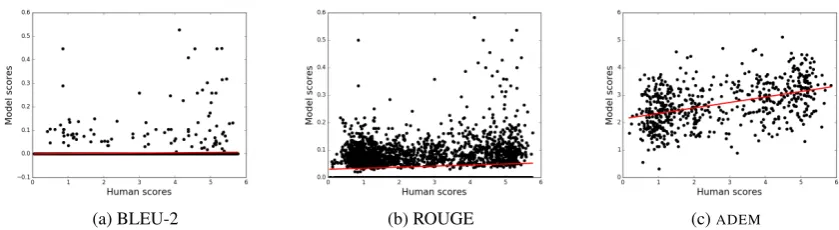
Figure 4: Scatter plot showing model against human scores, for BLEU-2 and ROUGE on the full dataset, andADEMon the test set. We add Gaussian noise drawn fromN(0,0.3)to the integer human scores to better visualize the density of points, at the expense of appearing less correlated.
Full dataset Test set
Metric Spearman Pearson Spearman Pearson
BLEU-2 0.039 (0.013) 0.081 (<0.001) 0.051 (0.254) 0.120 (<0.001) BLEU-4 0.051 (0.001) 0.025 (0.113) 0.063 (0.156) 0.073 (0.103) ROUGE 0.062 (<0.001) 0.114 (<0.001) 0.096 (0.031) 0.147 (<0.001) METEOR 0.021 (0.189) 0.022 (0.165) 0.013 (0.745) 0.021 (0.601) T2V 0.140 (<0.001) 0.141 (<0.001) 0.140 (<0.001) 0.141 (<0.001) VHRED -0.035 (0.062) -0.030 (0.106) -0.091 (0.023) -0.010 (0.805)
Validation set Test set
C-ADEM 0.338 (<0.001) 0.355 (<0.001) 0.366 (<0.001) 0.363 (<0.001) R-ADEM 0.404 (<0.001) 0.404 (<0.001) 0.352 (<0.001) 0.360 (<0.001)
ADEM(T2V) 0.252 (<0.001) 0.265 (<0.001) 0.280 (<0.001) 0.287 (<0.001)
ADEM 0.410 (<0.001) 0.418 (<0.001) 0.428 (<0.001) 0.436 (<0.001)
Table 2: Correlation between metrics and human judgements, with p-values shown in brackets. ‘ADEM (T2V)’ indicatesADEMwith tweet2vec embeddings (Dhingra et al.,2016), and ‘VHRED’ indicates the dot product of VHRED embeddings (i.e.ADEMat initialization). C- and R-ADEMrepresent theADEM model trained to only compare the model response to the context or reference response, respectively. We compute the baseline metric scores (top) on the full dataset to provide a more accurate estimate of their scores (as they are not trained on a training set).
word-overlap metrics, in addition to results with embedding baselines andADEM, in Table2. The baseline metrics are evaluated on the entire dataset of 4,104 responses to provide the most accurate estimate of the score.4We measure the correlation for ADEM on the validation and test sets, which constitute 616 responses each.
We also conduct an analysis of the response data from (Liu et al.,2016), where the pre-processing is standardized by removing ‘<first speaker>’
to-kens at the beginning of each utterance. The results are detailed in the supplemental material. We can observe from both this data, and the new data in Table2, that the correlations for the word-overlap metrics are even lower than estimated in previous
scores.
4Note that our word-overlap correlation results in Table
2are also lower than those presented in (Galley et al.,2015). This is because Galley et al. measure corpus-level correlation, i.e. correlation averaged across different subsets (of size 100) of the data, and pre-filter for high-quality reference responses.
studies (Liu et al., 2016;Galley et al.,2015). In particular, this is the case for BLEU-4, which has frequently been used for dialogue response evalu-ation (Ritter et al.,2011;Sordoni et al.,2015b;Li et al.,2015;Galley et al.,2015;Li et al.,2016a).
We can see from Table2thatADEMcorrelates far better with human judgement than the word-overlap baselines. This is further illustrated by the scatterplots in Figure4. We also compare with ADEMusing tweet2vec embeddings (Dhingra et al., 2016). In this case, instead of using the VHRED pre-training method presented in Section4, we use off-the-shelf embeddings forc,r, andˆr, and
fine-tuneMandNon our dataset. These tweet2vec
Figure 5: Scatterplots depicting the system-level correlation results forADEM, BLEU-2, BLEU-4,and ROUGE on the test set. Each point represents the average scores for the responses from a dialogue model (TFIDF, DE, HRED, human). Human scores are shown on the horizontal axis, with normalized metric scores on the vertical axis. The ideal metric has a perfectly linear relationship.
System-level correlations We show the system-level correlations for various metrics in Table 3, and present it visually in Figure5. Each point in the scatterplots represents a dialogue model; hu-mans give low scores to TFIDF and DE responses, higher scores to HRED and the highest scores to other human responses. It is clear that existing word-overlap metrics are incapable of capturing this relationship for even 4 models. This renders them completely deficient for dialogue evaluation. However,ADEMproduces almost the same model ranking as humans, achieving a significant Pearson correlation of 0.954.5 Thus,ADEMcorrelates well with humans both at the response and system level.
Generalization to previously unseen models
When ADEM is used in practice, it will take as input responses from a new model that it has not seen during training. Thus, it is crucial thatADEM correlates with human judgements for new models. We testADEM’s generalization ability by perform-ing a leave-one-out evaluation. For each dialogue model that was the source of response data for trainingADEM(TF-IDF, Dual Encoder, HRED, hu-mans), we conduct an experiment where we train on all model responsesexceptthose from the cho-sen model, and test onlyon the model that was unseen during training.
The results are given in Table 4. We observe that theADEMmodel is able to generalize for all models except the Dual Encoder. This is partic-ularly surprising for the HRED model; in this case, ADEM was trained only on responses that were written by humans (from retrieval models or human-generated), but is able to generalize to responses produced by a generative neural net-work model. When testing on the entire test set,
5For comparison, BLEU achieves a system-level
correla-tion of 0.99 on 5 models in the translacorrela-tion domain (Papineni et al.,2002).
Metric Pearson
BLEU-1 -0.079 (0.921) BLEU-2 0.308 (0.692) BLEU-3 -0.537 (0.463) BLEU-4 -0.536 (0.464) ROUGE 0.268 (0.732)
ADEM 0.954 (0.046)
Table 3: System-level correlation, with the p-value in brackets.
the model achieves comparable correlations to the ADEM model that was trained on 25% less data selected at random.
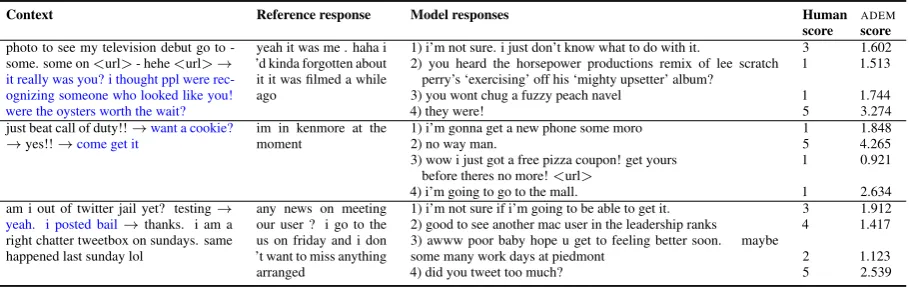
Qualitative Analysis To illustrate some
strengths and weaknesses of ADEM, we show human andADEMscores for each of the responses to various contexts in Table5. There are several instances where ADEM predicts accurately: in particular, ADEMis often very good at assigning low scores to poor responses. This seen in the first two contexts, where most of the responses given a score of 1 from humans are given scores less than 2 byADEM. The single exception in response (4) for the second context seems somewhat appropriate and should perhaps have been scored higher by the human evaluator. There are also several instances where the model assigns high scores to suitable responses, as in the first two contexts.
[image:7.595.363.468.212.290.2]Test on full dataset Test on removed model responses
Data Removed Spearman Pearson Spearman Pearson
TF-IDF 0.406 (<0.001) 0.409 (<0.001) 0.186 (0.021) 0.196 (0.015) Dual Encoder 0.364 (<0.001) 0.373 (<0.001) 0.026 (0.749) 0.027 (0.736) HRED 0.393 (<0.001) 0.396 (<0.001) 0.151 (0.060) 0.148 (<0.070) Human 0.292 (<0.001) 0.298 (<0.001) 0.216 (<0.010) 0.148 (<0.070)
Average 0.364 0.369 0.145 0.130
[image:8.595.122.475.64.150.2]25% at random 0.378 (<0.001) 0.384 (<0.001) — —
Table 4: Correlation forADEMwhen various model responses are removed from the training set. The left two columns show performance on the entire test set, and the right two columns show performance on responses only from the dialogue model not seen during training. The last row (25% at random) corresponds to theADEMmodel trained on all model responses, but with the same amount of training data as the model above (i.e. 25% less data than the full training set).
Context Reference response Model responses Human
score scoreADEM photo to see my television debut go to
-some. some on<url>- hehe<url>→ it really was you? i thought ppl were rec-ognizing someone who looked like you! were the oysters worth the wait?
yeah it was me . haha i ’d kinda forgotten about it it was filmed a while ago
1) i’m not sure. i just don’t know what to do with it.
2) you heard the horsepower productions remix of lee scratch perry’s ‘exercising’ off his ‘mighty upsetter’ album? 3) you wont chug a fuzzy peach navel
4) they were!
3 1
1 5
1.602 1.513
1.744 3.274 just beat call of duty!!→want a cookie?
→yes!!→come get it im in kenmore at themoment 1) i’m gonna get a new phone some moro2) no way man. 3) wow i just got a free pizza coupon! get yours
before theres no more!<url>
4) i’m going to go to the mall.
1 5 1
1
1.848 4.265 0.921
2.634 am i out of twitter jail yet? testing→
yeah. i posted bail→thanks. i am a right chatter tweetbox on sundays. same happened last sunday lol
any news on meeting our user ? i go to the us on friday and i don ’t want to miss anything arranged
1) i’m not sure if i’m going to be able to get it. 2) good to see another mac user in the leadership ranks 3) awww poor baby hope u get to feeling better soon. maybe some many work days at piedmont
4) did you tweet too much?
3 4
2 5
1.912 1.417
1.123 2.539
Table 5: Examples of scores given by theADEMmodel.
in the supplemental material.
6 Related Work
Related to our approach is the literature on novel methods for the evaluation of machine translation systems, especially through the WMT evaluation task (Callison-Burch et al.,2011;Mach´acek and Bojar,2014;Stanojevic et al., 2015). In particu-lar, (Albrecht and Hwa,2007;Gupta et al.,2015) have proposed to evaluate machine translation sys-tems using Regression and Tree-LSTMs respec-tively. Their approach differs from ours as, in the dialogue domain, we must additionally condition our score on the context of the conversation, which is not necessary in translation.
There has also been related work on estimating the quality of responses in chat-oriented dialogue systems. (DeVault et al.,2011) train an automatic dialogue policy evaluation metric from 19 struc-tured role-playing sessions, enriched with para-phrases and external referee annotations. (Gandhe and Traum,2016) propose a semi-automatic eval-uation metric for dialogue coherence, similar to BLEU and ROUGE, based on ‘wizard of Oz’ type
data.6 (Xiang et al.,2014) propose a framework to predict utterance-level problematic situations in a dataset of Chinese dialogues using intent and sen-timent factors. Finally, (Higashinaka et al.,2014) train a classifier to distinguish user utterances from system-generated utterances using various dialogue features, such as dialogue acts, question types, and predicate-argument structures.
Several recent approaches use hand-crafted re-ward features to train dialogue models using rein-forcement learning (RL). For example, (Li et al., 2016b) use features related to ease of answering and information flow, and (Yu et al., 2016) use metrics related to turn-level appropriateness and conversational depth. These metrics are based on hand-crafted features, which only capture a small set of relevant aspects; this inevitably leads to sub-optimal performance, and it is unclear whether such objectives are preferable over retrieval-based cross-entropy or word-level maximum log-likelihood ob-jectives. Furthermore, many of these metrics are computed at the conversation-level, and are not available for evaluating single dialogue responses.
6In ‘wizard of Oz’ scenarios, humans play the role of the
[image:8.595.75.530.240.384.2]The metrics that can be computed at the response-level could be incorporated into our framework, for example by adding a term to equation1consisting of a dot product between these features and a vector of learned parameters.
There has been significant work on evaluation methods for task-oriented dialogue systems, which attempt to solve a user’s task such as finding a restaurant. These methods include the PARADISE framework (Walker et al.,1997) and MeMo (M¨oller et al., 2006), which consider a task completion signal. PARADISE in particular is perhaps the first work on learning an automatic evaluation func-tion for dialogue, accomplished through linear re-gression. However, PARADISE requires that one can measure task completion and task complexity, which are not available in our setting.
7 Discussion
We use the Twitter Corpus to train our models as it contains a broad range of non-task-oriented conver-sations and it has been used to train many state-of-the-art models. However, our model could easily be extended to other general-purpose datasets, such as Reddit, once similar pre-trained models become publicly available. Such models are necessary even for creating a test set in a new domain, which will help us determine ifADEMgeneralizes to related di-alogue domains. We leave investigating the domain transfer ability ofADEMfor future work.
The evaluation model proposed in this paper favours dialogue models that generate responses that are rated as highly appropriate by humans. It is likely that this property does not fully capture the desired end-goal of chatbot systems. For example, one issue with building models to approximate hu-man judgements of response quality is the problem of generic responses. Since humans often provide high scores to generic responses due to their appro-priateness for many given contexts (Shang et al., 2016), a model trained to predict these scores will exhibit the same behaviour. An important direc-tion for future work is modifyingADEMsuch that it is not subject to this bias. This could be done, for example, by censoringADEM’s representations (Edwards and Storkey, 2016) such that they do not contain any information about length. Alterna-tively, one can combine this with anadversarial evaluation model(Kannan and Vinyals,2017;Li et al.,2017) that assigns a score based on how easy it is to distinguish the dialogue model responses
from human responses. In this case, a model that generates generic responses will easily be distin-guishable and obtain a low score.
An important direction of future research is building models that can evaluate the capability of a dialogue system to have an engaging and mean-ingful interaction with a human. Compared to eval-uating a single response, this evaluation is arguably closer to the end-goal of chatbots. However, such an evaluation is extremely challenging to do in a completely automatic way. We view the evaluation procedure presented in this paper as an important step towards this goal; current dialogue systems are incapable of generating responses that are rated as highly appropriate by humans, and we believe our evaluation model will be useful for measuring and facilitating progress in this direction.
References
Joshua Albrecht and Rebecca Hwa. 2007. Regression for sentence-level mt evaluation with pseudo refer-ences. InACL.
Ron Artstein, Sudeep Gandhe, Jillian Gerten, Anton Leuski, and David Traum. 2009. Semi-formal eval-uation of conversational characters. In Languages: From Formal to Natural, Springer, pages 22–35.
Jimmy Lei Ba, Jamie Ryan Kiros, and Geoffrey E Hin-ton. 2016. Layer normalization. arXiv preprint arXiv:1607.06450.
Yoshua Bengio, Patrice Simard, and Paolo Frasconi. 1994. Learning long-term dependencies with gradi-ent descgradi-ent is difficult.IEEE transactions on neural networks5(2):157–166.
Samuel R Bowman, Luke Vilnis, Oriol Vinyals, An-drew M Dai, Rafal Jozefowicz, and Samy Ben-gio. 2016. Generating sentences from a continuous space. COLING.
Chris Callison-Burch, Philipp Koehn, Christof Monz, and Omar F Zaidan. 2011. Findings of the 2011 workshop on statistical machine translation. In Pro-ceedings of the Sixth Workshop on Statistical Ma-chine Translation. Association for Computational Linguistics, pages 22–64.
Tim Cooijmans, Nicolas Ballas, C´esar Laurent, and Aaron Courville. 2016. Recurrent batch normaliza-tion. arXiv preprint arXiv:1603.09025.
Bhuwan Dhingra, Zhong Zhou, Dylan Fitzpatrick, Michael Muehl, and William W Cohen. 2016. Tweet2vec: Character-based distributed repre-sentations for social media. arXiv preprint arXiv:1605.03481.
Harrison Edwards and Amos Storkey. 2016. Censoring representations with an adversary. ICLR.
Salah El Hihi and Yoshua Bengio. 1995. Hierarchical recurrent neural networks for long-term dependen-cies. InNIPS. Citeseer, volume 400, page 409. Philip Gage. 1994. A new algorithm for data
compres-sion.The C Users Journal12(2):23–38.
Michel Galley, Chris Brockett, Alessandro Sordoni, Yangfeng Ji, Michael Auli, Chris Quirk, Mar-garet Mitchell, Jianfeng Gao, and Bill Dolan. 2015. deltableu: A discriminative metric for generation tasks with intrinsically diverse targets. arXiv preprint arXiv:1506.06863.
Sudeep Gandhe and David Traum. 2016. A semi-automated evaluation metric for dialogue model coherence. In Situated Dialog in Speech-Based Human-Computer Interaction, Springer, pages 217– 225.
Rohit Gupta, Constantin Orasan, and Josef van Gen-abith. 2015. Reval: A simple and effective machine translation evaluation metric based on recurrent neu-ral networks. In Proceedings of the 2015 Confer-ence on Empirical Methods in Natural Language Processing (EMNLP).
Ryuichiro Higashinaka, Toyomi Meguro, Kenji Ima-mura, Hiroaki Sugiyama, Toshiro Makino, and Yoshihiro Matsuo. 2014. Evaluating coherence in open domain conversational systems. In INTER-SPEECH. pages 130–134.
Sepp Hochreiter. 1991. Untersuchungen zu dynamis-chen neuronalen netzen. Diploma, Technische Uni-versit¨at M¨unchenpage 91.
Sepp Hochreiter and J¨urgen Schmidhuber. 1997. Long short-term memory. Neural computation9(8):1735– 1780.
Sergey Ioffe and Christian Szegedy. 2015. Batch nor-malization: Accelerating deep network training by reducing internal covariate shift. arXiv preprint arXiv:1502.03167.
Anjuli Kannan, Karol Kurach, Sujith Ravi, Tobias Kaufmann, Andrew Tomkins, Balint Miklos, Greg Corrado, L´aszl´o Luk´acs, Marina Ganea, Peter Young, et al. 2016. Smart reply: Automated re-sponse suggestion for email. InProceedings of the ACM SIGKDD Conference on Knowledge Discovery and Data Mining (KDD). volume 36, pages 495– 503.
Anjuli Kannan and Oriol Vinyals. 2017. Adversar-ial evaluation of dAdversar-ialogue models. arXiv preprint arXiv:1701.08198.
Diederik Kingma and Jimmy Ba. 2014. Adam: A method for stochastic optimization. arXiv preprint arXiv:1412.6980.
Jiwei Li, Michel Galley, Chris Brockett, Jianfeng Gao, and Bill Dolan. 2015. A diversity-promoting objec-tive function for neural conversation models. arXiv preprint arXiv:1510.03055.
Jiwei Li, Michel Galley, Chris Brockett, Jianfeng Gao, and Bill Dolan. 2016a. A persona-based neural con-versation model. arXiv preprint arXiv:1603.06155 .
Jiwei Li, Will Monroe, and Dan Jurafsky. 2017. Learn-ing to decode for future success. arXiv preprint arXiv:1701.06549.
Jiwei Li, Will Monroe, Alan Ritter, and Dan Jurafsky. 2016b. Deep reinforcement learning for dialogue generation.arXiv preprint arXiv:1606.01541.
Chia-Wei Liu, Ryan Lowe, Iulian V Serban, Michael Noseworthy, Laurent Charlin, and Joelle Pineau. 2016. How not to evaluate your dialogue system: An empirical study of unsupervised evaluation met-rics for dialogue response generation. arXiv preprint arXiv:1603.08023.
Ryan Lowe, Nissan Pow, Iulian Serban, and Joelle Pineau. 2015. The ubuntu dialogue corpus: A large dataset for research in unstructured multi-turn dia-logue systems. arXiv preprint arXiv:1506.08909.
Matouˇs Mach´acek and Ondrej Bojar. 2014. Results of the wmt14 metrics shared task. InProceedings of the Ninth Workshop on Statistical Machine Transla-tion. Citeseer, pages 293–301.
J. Markoff and P. Mozur. 2015. For sympathetic ear, more chinese turn to smartphone program. NY Times.
Sebastian M¨oller, Roman Englert, Klaus-Peter Engel-brecht, Verena Vanessa Hafner, Anthony Jameson, Antti Oulasvirta, Alexander Raake, and Norbert Re-ithinger. 2006. Memo: towards automatic usability evaluation of spoken dialogue services by user error simulations. InINTERSPEECH.
Kishore Papineni, Salim Roukos, Todd Ward, and Wei-Jing Zhu. 2002. Bleu: a method for automatic eval-uation of machine translation. In Proceedings of the 40th annual meeting on association for compu-tational linguistics. Association for Computational Linguistics, pages 311–318.
Karl Pearson. 1901. Principal components analysis. The London, Edinburgh and Dublin Philosophical Magazine and Journal6(2):566.
Rico Sennrich, Barry Haddow, and Alexandra Birch. 2015. Neural machine translation of rare words with subword units. arXiv preprint arXiv:1508.07909.
Iulian Vlad Serban, Alessandro Sordoni, Yoshua Ben-gio, Aaron Courville, and Joelle Pineau. 2016a. Building end-to-end dialogue systems using gener-ative hierarchical neural network models. InAAAI. pages 3776–3784.
Iulian Vlad Serban, Alessandro Sordoni, Ryan Lowe, Laurent Charlin, Joelle Pineau, Aaron Courville, and Yoshua Bengio. 2016b. A hierarchical latent variable encoder-decoder model for generating dia-logues.arXiv preprint arXiv:1605.06069.
Lifeng Shang, Zhengdong Lu, and Hang Li. 2015. Neu-ral responding machine for short-text conversation. arXiv preprint arXiv:1503.02364.
Lifeng Shang, Tetsuya Sakai, Zhengdong Lu, Hang Li, Ryuichiro Higashinaka, and Yusuke Miyao. 2016. Overview of the ntcir-12 short text conversation task. Proceedings of NTCIR-12pages 473–484.
Alessandro Sordoni, Yoshua Bengio, Hossein Vahabi, Christina Lioma, Jakob Grue Simonsen, and Jian-Yun Nie. 2015a. A hierarchical recurrent encoder-decoder for generative context-aware query sugges-tion. InProceedings of the 24th ACM International on Conference on Information and Knowledge Man-agement. ACM, pages 553–562.
Alessandro Sordoni, Michel Galley, Michael Auli, Chris Brockett, Yangfeng Ji, Margaret Mitchell, Jian-Yun Nie, Jianfeng Gao, and Bill Dolan. 2015b. A neural network approach to context-sensitive gen-eration of conversational responses. arXiv preprint arXiv:1506.06714.
Miloˇs Stanojevic, Amir Kamran, Philipp Koehn, and Ondrej Bojar. 2015. Results of the wmt15 metrics shared task. InProceedings of the Tenth Workshop on Statistical Machine Translation. pages 256–273.
Alan M Turing. 1950. Computing machinery and intel-ligence. Mind59(236):433–460.
Oriol Vinyals and Quoc Le. 2015. A neural conversa-tional model. arXiv preprint arXiv:1506.05869.
Marilyn A Walker, Diane J Litman, Candace A Kamm, and Alicia Abella. 1997. Paradise: A framework for evaluating spoken dialogue agents. InProceedings of the eighth conference on European chapter of the Association for Computational Linguistics. Associa-tion for ComputaAssocia-tional Linguistics, pages 271–280.
J. Weizenbaum. 1966. ELIZAa computer program for the study of natural language communication be-tween man and machine. Communications of the ACM9(1):36–45.
Yang Xiang, Yaoyun Zhang, Xiaoqiang Zhou, Xiao-long Wang, and Yang Qin. 2014. Problematic situa-tion analysis and automatic recognisitua-tion for chi-nese
online conversational system. Proc. CLPpages 43– 51.