Proceedings of the 55th Annual Meeting of the Association for Computational Linguistics, pages 974–984 Vancouver, Canada, July 30 - August 4, 2017. c2017 Association for Computational Linguistics Proceedings of the 55th Annual Meeting of the Association for Computational Linguistics, pages 974–984
Vancouver, Canada, July 30 - August 4, 2017. c2017 Association for Computational Linguistics
Joint Modeling of Content and Discourse Relations in Dialogues
Kechen Qin1 Lu Wang1 Joseph Kim2
1College of Computer and Information Science, Northeastern University
2Computer Science and Artificial Intelligence Laboratory,
Massachusetts Institute of Technology
1[email protected],[email protected] 2joseph [email protected]
Abstract
We present a joint modeling approach to iden-tify salient discussion points in spoken meet-ings as well as to label the discourse rela-tions between speaker turns. A variation of our model is also discussed when discourse relations are treated as latent variables. Ex-perimental results on two popular meeting cor-pora show that our joint model can outperform state-of-the-art approaches for both phrase-based content selection and discourse rela-tion predicrela-tion tasks. We also evaluate our model on predicting the consistency among team members’ understanding of their group decisions. Classifiers trained with features constructed from our model achieve signif-icant better predictive performance than the state-of-the-art.
1 Introduction
Goal-oriented dialogues, such as meetings, nego-tiations, or customer service transcripts, play an important role in our daily life. Automatically ex-tracting the critical points and important outcomes from dialogues would facilitate generating sum-maries for complicated conversations, understand-ing the decision-makunderstand-ing process of meetunderstand-ings, or analyzing the effectiveness of collaborations.
We are interested in a specific type of dia-logues — spoken meetings, which is a common way for collaboration and idea sharing. Previ-ous work (Kirschner et al., 2012) has shown that discourse structure can be used to capture the main discussion points and arguments put forward during problem-solving and decision-making pro-cesses in meetings. Indeed, content of different speaker turns do not occur in isolation, and should be interpreted within the context of discourse. Meanwhile, content can also reflect the purpose of speaker turns, thus facilitate with discourse rela-tion understanding. Take the meeting snippet from
D: Three different types of batteries. Um can either use a hand dynamo, or the kinetic type ones, you know that they use in watches, or else uh a solar powered one.
B: Um the bat uh the batteryfor a a watch wouldn't require a lot of power, would be my one query. Is a
kinetic onegoing to be able to supply enough power? D: Yeah, I don't think it would.
C: Yeah.
D: We should probably just use conventional batteries. B: Which I suppose as well would allow us to go off the shelf again, you'd say ?
D: Yeah.
Uncertain
[image:1.595.310.522.222.354.2]Option
Figure 1:A sample clip from AMI meeting corpus. B, C, and D denotes different speakers. Here we highlight salient phrases (initalics) that are relevant to the major topic discussed, i.e., “which type of battery to use for the remote control”. Arrows indicate discourse struc-ture between speaker turns. We also show some of the discourse relations for illustration.
AMI corpus (Carletta et al., 2006) in Figure1 as an example. This discussion is annotated with dis-course structure based on the Twente Argumenta-tion Schema (TAS) byRienks et al.(2005), which focuses on argumentative discourse information. As can be seen, meeting participants evaluate dif-ferent options by showing doubt (UNCERTAIN), bringing up alternative solution (OPTION), or giv-ing feedback. The discourse information helps with the identification of the key discussion point, i.e., “which type of battery to use”, by revealing the discussion flow.
To date, most efforts to leverage discourse in-formation to detect salient content from dialogues have focused on encoding gold-standard discourse relations as features for use in classifier train-ing (Murray et al.,2006;Galley,2006;McKeown et al.,2007;Bui et al.,2009). However, automatic discourse parsing in dialogues is still a challenging problem (Perret et al.,2016). Moreover, acquiring human annotation on discourse relations is a time-consuming and expensive process, and does not
scale for large datasets.
In this paper, we propose a joint modeling ap-proach to select salient phrases reflecting key dis-cussion points as well as label the discourse re-lations between speaker turns in spoken meet-ings. We hypothesize that leveraging the inter-action between content and discourse has the po-tential to yield better prediction performance on bothphrase-based content selectionanddiscourse relation prediction. Specifically, we utilize argu-mentative discourse relations as defined in Twente Argument Schema (TAS) (Rienks et al., 2005), where discussions are organized into tree struc-tures with discourse relations labeled between nodes (as shown in Figure1). Algorithms for joint learning and joint inference are proposed for our model. We also present a variation of our model to treat discourse relations as latent variables when true labels are not available for learning. We en-vision that the extracted salient phrases by our model can be used as input to abstractive meeting summarization systems (Wang and Cardie,2013;
Mehdad et al., 2014). Combined with the pre-dicted discourse structure, a visualization tool can be exploited to display conversation flow to sup-port intelligent meeting assistant systems.
To the best of our knowledge, our work is the first to jointly model content and discourse relations in meetings. We test our model with two meeting corpora — the AMI corpus ( Car-letta et al., 2006) and the ICSI corpus (Janin et al., 2003). Experimental results show that our model yields an accuracy of 63.2 on phrase selec-tion, which is significantly better than a classifier based on Support Vector Machines (SVM). Our discourse prediction component also obtains bet-ter accuracy than a state-of-the-art neural network-based approach (59.2 vs. 54.2). Moreover, our model trained with latent discourse outperforms SVMs on both AMI and ICSI corpora for phrase selection. We further evaluate the usage of se-lected phrases as extractive meeting summaries. Results evaluated by ROUGE (Lin and Hovy,
2003) demonstrate that our system summaries ob-tain a ROUGE-SU4 F1 score of 21.3 on AMI corpus, which outperforms non-trivial extractive summarization baselines and a keyword selection algorithm proposed inLiu et al.(2009).
Moreover, since both content and discourse structure are critical for building shared under-standing among participants (Mulder et al.,2002;
Mercer,2004), we further investigate whether our learned model can be utilized to predict the con-sistency among team members’ understanding of their group decisions. This task is first defined asconsistency of understanding(COU) prediction byKim and Shah(2016), who have labeled a por-tion of AMI discussions with consistency or in-consistency labels. We construct features from our model predictions to capture different discourse patterns and word entrainment scores for discus-sion with different COU level. Results on AMI discussions show that SVM classifiers trained with our features significantly outperform the state-of-the-art results (Kim and Shah,2016) (F1: 63.1 vs. 50.5) and non-trivial baselines.
The rest of the paper is structured as follows: we first summarize related work in Section2. The joint model is presented in Section 3. Datasets and experimental setup are described in Section4, which is followed by experimental results (Sec-tion5). We then study the usage of our model for predicting consistency of understanding in groups in Section6. We finally conclude in Section7.
2 Related Work
Our model is inspired by research work that lever-ages discourse structure for identifying salient content in conversations, which is still largely reliant on features derived from gold-standard discourse labels (McKeown et al., 2007; Mur-ray et al., 2010; Bokaei et al., 2016). For in-stance, adjacency pairs, which are paired utter-ances with question-answer or offer-accept rela-tions, are found to frequently appear in meeting summaries together and thus are utilized to extract summary-worthy utterances by Galley (2006). There is much less work that jointly predicts the importance of content along with the discourse structure in dialogus. Oya and Carenini (2014) employs Dynamic Conditional Random Field to recognize sentences in email threads for use in summary as well as their dialogue acts. Only local discourse structures from adjacent utterances are considered. Our model is built on tree structures, which captures more global information.
Our work is also in line with keyphrase identifi-cation or phrase-based summarization for conver-sations. Due to the noisy nature of dialogues, re-cent work focuses on identifying summary-worthy phrases from meetings (Fern´andez et al., 2008;
et al., 2014). For instance, Wang and Cardie
(2012) treat the problem as an information extrac-tion task, where summary-worthy content repre-sented as indicator and argument pairs is identi-fied by an unsupervised latent variable model. Our work also targets at detecting salient phrases from meetings, but focuses on the joint modeling of crit-ical discussion points and discourse relations held between them.
For the area of discourse analysis in dialogues, a significant amount of work has been done in pre-dicting local discourse structures, such as recog-nizing dialogue acts or social acts of adjacent ut-terances from phone conversations (Stolcke et al.,
2000;Kalchbrenner and Blunsom,2013;Ji et al.,
2016), spoken meetings (Dielmann and Renals,
2008), or emails (Cohen et al.,2004). Although discourse information from non-adjacent turns has been studied in the context of online discussion fo-rums (Ghosh et al.,2014) and meetings ( Hakkani-Tur,2009), none of them models the effect of dis-course structure on content selection, which is a gap that this work fills in.
3 The Joint Model of Content and Discourse Relations
In this section, we first present our joint model in Section 3.1. The algorithms for learning and in-ference are described in Sections3.2and3.3, fol-lowed by feature description (Section3.4).
3.1 Model Description
Our proposed model learns to jointly perform phrase-based content selection and discourse re-lation prediction by making use of the interac-tion between the two sources of informainterac-tion. As-sume that a meeting discussion is denoted as x,
wherexconsists of a sequence of discourse units x={x1, x2,· · · , xn}. Each discourse unit can be a complete speaker turn or a part of it. As demon-strated in Figure1, a tree-structured discourse dia-gram is constructed for each discussion with each discourse unitxias a node of the tree. In this work, we consider the argumentative discourse structure by Twente Argument Schema (TAS) (Rienks et al.,
2005). For each nodexi, it is attached to another nodexi0 (i0 < i) in the discussion, and a discourse relationdiis hold on the linkhxi, xi0i(diis empty if xi is the root). Let t denote the set of links
hxi, xi0i in x. Following previous work on dis-course analysis in meetings (Rienks et al., 2005;
Hakkani-Tur, 2009), we assume that the attach-ment structure between discourse units are given during both training and testing.
A set of candidate phrases are extracted from each discourse unitxi, from which salient phrases that contain gist information will be identified. We obtain constituent and dependency parses for ut-terances using Stanford parser (Klein and Man-ning,2003). We restrict eligible candidate to be a noun phrase (NP), verb phrase (VP), prepositional phrase (PP), or adjective phrase (ADJP) with at most 5 words, and its head word cannot be a stop word.1 If a candidate is a parent of another can-didate in the constituent parse tree, we will only keep the parent. We further merge a verb and a candidate noun phrase into one candidate if the later is the direct object or subject of the verb. For example, from utterance “let’s use a rubber case as well as rubber buttons”, we can identify can-didates “use a rubber case” and “rubber buttons”. Forxi, the set of candidate phrases are denoted as ci ={ci,1, ci,2,· · · , ci,mi}, wheremiis the
num-ber of candidates.ci,jtakes a value of1if the cor-responding candidate is selected as salient phrase; otherwise,ci,jis equal to0. All candidate phrases in discussionxare represented asc.
We then define a log-linear model with feature parameterswfor the candidate phrasescand
dis-course relationsdinxas:
p(c,d|x,w)∝exp[w·Φ(c,d,x)]
∝exp[w·
n X
i=1,<xi,xi0>∈t
φ(ci, di, di0,x)]
∝exp[
n X
i=1,<xi,xi0>∈t (wc·
mi
X
j=1
φc(ci,j,x)
+wd·φd(di, di0,x) +wcd·
mi
X
j=1
φcd(ci,j, di,x))]
(1)
Here Φ(·) and φ(·) denote feature vectors.
We utilize three types of feature functions: (1) content-only featuresφc(·), which capture the im-portance of phrases, (2) discourse-only features φd(·), which characterize the (potentially higher-order) discourse relations, and (3) joint features of content and discourseφcd(·), which model the in-teraction between the two. wc,wd, andwcdare
corresponding feature parameters. Detailed fea-ture descriptions can be found in Section3.4. Discourse Relations as Latent Variables.As we mentioned in the introduction, acquiring labeled training data for discourse relations is a time-consuming process since it would require human annotators to inspect the full discussions. There-fore, we further propose a variation of our model where it treats the discourse relations as latent variables, so thatp(c|x,w) = Pdp(c,d|x,w). Its learning algorithm is slightly different as de-scribed in the next section.
3.2 Joint Learning for Parameter Estimation For learning the model parameters w, we
em-ploy an algorithm based on SampleRank ( Rohan-imanesh et al.,2011), which is a stochastic struc-ture learning method. In general, the learning al-gorithm constructs a sequence of configurations for sample labels as a Markov chain Monte Carlo (MCMC) chain based on a task-specific loss func-tion, where stochastic gradients are distributed across the chain.
The full learning procedure is described in Al-gorithm1. To start with, the feature weightswis
initialized with each value randomly drawn from
[−1,1]. Multiple epochs are run through all
sam-ples. For each sample, we randomly initialize the assignment of candidate phrases labelscand
dis-course relationsd. Then an MCMC chain is
con-structed with a series of configurationsσ = (c,d):
at each step, it first samples a discourse structure
d based on the proposal distribution q(d0|d,x), and then samples phrase labels conditional on the new discourse relations and previous phrase labels based on q(c0|c,d0,x). Local search is used for both proposal distributions.2 The new configu-ration is accepted if it improves on the score by ω(σ0). The parametersware updated accordingly. For the scorer ω, we use a weighted combina-tion of F1 scores of phrase seleccombina-tion (F1c) and
discourse relation prediction (F1d): ω(σ) = α· F1c+ (1−α)·F1d. We fixαto0.1.
When discourse relations are treated as latent, we initialize discourse relations for each sample with a label in{1,2, . . . , K} if there areK rela-tions indicated, and we only useF1cas the scorer.
2For future work, we can explore other proposal distribu-tions that utilize the conditional distribution of salient phrases given sampled discourse relations.
Input :X={x}: discussions in the training set, η: learning rate,: number of epochs, δ: number of sampling rounds,
ω(·): scoring function,Φ(·): feature functions
Output:feature weights 1
|W|
P w∈Ww Initializew;
W ← {w};
fore= 1todo
forxinXdo
// Initialize configuration for x
Initializecandd; σ= (c,d);
fors= 1toδdo
// New configuration via local search
d0∼qd(·|x,d);
c0∼qd(·|x,c,d0);
σ0= (c0,d0); σ+= arg max
˜
σ∈{σ,σ0}ω(˜σ);
σ−= arg min
˜
σ∈{σ,σ0}ω(˜σ);
ˆ
∇= Φ(σ+)−Φ(σ−); ∆ω=ω(σ+)
−ω(σ−); // Update parameters
ifw·∇ˆ <∆ω&∆ω6= 0then w←w+η·∇ˆ;
AddwinW;
end
// Accept or reject new configuration
ifσ+==σ0then σ=σ0
end end end end
Algorithm 1:SampleRank-based joint learning.
3.3 Joint Inference for Prediction
Given a new samplexand learned parametersw,
we predict phrase labels and discourse relations as
arg maxc,dp(c,d|x,w).
Dynamic programming can be employed to carry out joint inference, however, it would be time-consuming since our objective func-tion has a large search space for both content and discourse labels. Hence we propose an alternating optimizing algorithm to search for
c and d iteratively. Concretely, for each it-eration, we first optimize on d by
maximiz-ing Pn
i=1,<xi,x0i>∈t(wd ·φd(di, di0,x) + wcd ·
Pmi
j=1φcd(ci,j, di,x)). Message-passing (Smith
and Eisner,2008) is used to find the bestd. In the second step, we search for c that
max-imizes Pn
i=1,<xi,x0i>∈t(wc ·
Pmi
problem.3 We optimize our objective function un-der constraints: (1)ci,j =ci0,j0 ifci,j andci0,j0are in the same cluster, and (2)ci,j ∈ {0,1},∀i, j.
The inference process is the same for models trained with latent discourse relations.
3.4 Features
We use features that characterize content, dis-course relations, and the combination of both. Content Features. For modeling the salience of content, we calculate the minimum, maximum, and average of TF-IDF scores of words and
number of content wordsin each phrase
based on the intuition that important phrases tend to have more content words with high TF-IDF scores (Fern´andez et al., 2008). We also consider whether the head word of the phrase has beenmentioned in preceding turn, which implies the focus of a discus-sion. The size of the cluster each phrase belongs to is also included. Number of
POS tags and phrase types are counted
to characterize the syntactic structure. Previous work (Wang and Cardie, 2012) has found that a discussion usually ends with decision-relevant information. We thus identify the absolute
and relative positions of the turn
con-taining the candidate phrase in the discussion. Finally, we record whether the candidate phrase
is uttered by the main speaker, who
speakers the most words in the discussion.
Discourse Features. For each discourse unit, we collect the dialogue act typesof the cur-rent unit and its pacur-rent node in discourse tree, whether there is anyadjacency pairheld be-tween the two nodes (Hakkani-Tur, 2009), and
theJaccard similaritybetween them. We
record whether two turns areuttered by the
same speaker, for example,ELABORATIONis
commonly observed between the turns from the same participant. We also calculate thenumber
of candidate phrasesbased on the
obser-vation that OPTION and SPECIALIZATION tend to contain more informative words than POSI -TIVE feedback. Length of the discourse unit is also relevant. Therefore, we compute the time
spanandnumber of words. To incorporate
global structure features, we encode the depth
of the node in the discourse tree and the
3We use lpsolve: http://lpsolve.
sourceforge.net/5.5/.
number of its siblings. Finally, we
in-clude an order-2 discourse relation
feature that encodes the relation between current discourse unit and its parent, and the relation be-tween the parent and its grandparent if it exists. Joint Features. For modeling the interaction be-tween content and discourse, the discourse rela-tion is added to each content feature to compose a joint feature. For example, if candidatecin discus-sion x has a content feature φ[avg−T F IDF](c,x)
with a value of0.5, and its discourse relationdis POSITIVE, then the joint feature takes the form of φ[avg−T F IDF,P ositive](c, d,x) = 0.5.
4 Datasets and Experimental Setup Meeting Corpora. We evaluate our joint model on two meeting corpora with rich annotations: the AMI meeting corpus (Carletta et al.,2006) and the ICSI meeting corpus (Janin et al., 2003). AMI corpus consists of 139 scenario-driven meetings, and ICSI corpus contains 75 naturally occurring meetings. Both of the corpora are annotated with dialogue acts, adjacency pairs, and topic segmen-tation. We treat each topic segment as one dis-cussion, and remove discussions with less than 10 turns or labeled as “opening” and “chitchat”. 694 discussions from AMI and 1139 discussions from ICSI are extracted, and these two datasets are henceforth referred as AMI-FULL and ICSI-FULL.
Acquiring Gold-Standard Labels.Both corpora contain human constructed abstractive summaries and extractive summaries on meeting level. Short abstracts, usually in one sentence, are constructed by meeting participants —participant summaries, and external annotators —abstractive summaries. Dialogue acts that contribute to important output of the meeting, e.g. decisions, are identified and used as extractive summaries, and some of them are also linked to the corresponding abstracts.
Since the corpora do not contain phrase-level importance annotation, we induce gold-standard labels for candidate phrases based on the follow-ing rule. A candidate phrase is considered as a positive sample if its head word is contained in any abstractive summary or participant summary. On average, 71.9 candidate phrases are identified per discussion for AMI-FULLwith 31.3% labeled as positive, and 73.4 for ICSI-FULL with 24.0% of them as positive samples.
AMI-FULL are annotated with discourse structure and relations based on Twente Argumentation Schema (TAS) byRienks et al.(2005)4. A tree-structured argument diagram (as shown in Figure 1) is cre-ated for each discussion or a part of the discussion. The nodes of the tree contain partial or complete speaker turns, and discourse relation types are la-beled on the links between the nodes. In total, we have 129 discussions annotated with discourse la-bels. This dataset is called AMI-SUBhereafter.
Experimental Setup. 5-fold cross validation is used for all experiments. All real-valued features are uniformly normalized to [0,1]. For the joint learning algorithm, we use 10 epochs and carry out 50 sampling for MCMC for each training sample. The learning rate is set to 0.01. We run the learn-ing algorithm for 20 times, and use the average of the learned weights as the final parameter values. For models trained with latent discourse relations, we fix the number of relations to9.
Baselines and Comparisons. For both phrase-based content selection and discourse relation pre-diction tasks, we consider a baseline that always predicts the majority label (Majority). Previous work has shown that Support Vector Machines (SVMs)-based classifiers achieve state-of-the-art performance for keyphrase selection in meet-ings (Fern´andez et al., 2008; Wang and Cardie,
2013) and discourse parsing for formal text ( Her-nault et al., 2010). Therefore, we compare with linear SVM-based classifiers, trained with the same feature set of content features or discourse features. We fix the trade-off parameter to 1.0
for all SVM-based experiments. For discourse re-lation prediction, we use one-vs-rest strategy to build multiple binary classifiers.5 We also com-pare with a state-of-the-art discourse parser (Ji et al., 2016), which employs neural language model to predict discourse relations.
5 Experimental Results
5.1 Phrase Selection and Discourse Labeling Here we present the experimental results on phrase-based content selection and discourse re-lation prediction. We experiment with two vari-ations of our joint model: one is trained on gold-standard discourse relations, the other is trained by 4There are 9 types of relations in TAS:POSITIVE,NEG
-ATIVE, UNCERTAIN, REQUEST, SPECIALIZATION,ELABO
-RATION,OPTION,OPTION EXCLUSION, andSUBJECT-TO.
5Multi-class classifier was also experimented with, but gave inferior performance.
Acc F1
Comparisons
Baseline (Majority) 60.1 37.5
SVM (w content features in§3.4) 57.8 54.6
Our Models
Joint-Learn + Joint-Inference 63.2∗ 62.6∗ Joint-Learn + Separate-Inference 57.9 57.8
Separate-Learn 53.4 52.6
Our Models (Latent Discourse)
w/ True Attachment Structure
Joint-Learn + Joint-Inference 60.3∗ 60.3∗ Joint-Learn + Separate-Inference 56.4 56.2 w/o True Attachment Structure
[image:6.595.307.525.60.221.2]Joint-Learn + Joint-Inference 56.4 56.4 Joint-Learn + Separate-Inference 52.7 52.3 Table 1: Phrase-based content selection performance on AMI-SUB with accuracy (acc) and F1. We
dis-play results of our models trained with gold-standard discourse relation labels and with latent discourse re-lations. For the later, we also show results based on
True Attachment Structure, where the gold-standard at-tachments are known, and without theTrue Attachment Structure. Our models that significantly outperform SVM-based model are highlighted with∗ (p < 0.05,
pairedt-test). Best result for each column is inbold.
Acc F1
Comparisons
Baseline (Majority) 51.2 7.5 SVM (w discourse features in§3.4) 51.2 22.8
Ji et al.(2016) 54.2 21.4
Our Models
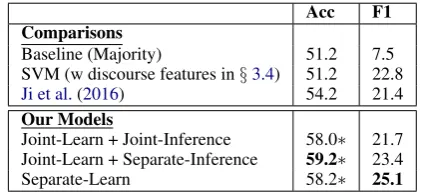
Joint-Learn + Joint-Inference 58.0∗ 21.7 Joint-Learn + Separate-Inference 59.2∗ 23.4
Separate-Learn 58.2∗ 25.1
Table 2:Discourse relation prediction performance on AMI-SUB. Our models that significantly outperform
SVM-based model andJi et al.(2016) are highlighted with∗(p < 0.05, pairedt-test). Best result for each column is inbold.
treating discourse relations as latent models as de-scribed in Section 3.1. Remember that we have gold-standard argument diagrams on the AMI-SUBdataset, we can thus conduct experiments by assuming theTrue Attachment Structure is given for latent versions. When argument diagrams are not available, we build a tree among the turns in each discussion as follows. Two turns are attached if there is any adjacency pair between them. If one turn is attached to more than one previous turns, the closest one is considered. For the rest of the turns, they are attached to the preceding turn. This construction is applied on AMI-FULLand ICSI-FULL.
[image:6.595.310.521.362.460.2]per-AMI-FULL ICSI-FULL
Acc F1 Acc F1 Comparisons
Baseline (Majority) 61.8 38.2 75.3 43.0
SVM (with content features in§3.4) 58.6 56.7 66.2 53.1
Our Models (Latent Discourse)
Joint-Learn + Joint-Inference 63.4∗ 63.0∗ 73.5∗ 61.4∗
[image:7.595.308.523.60.235.2]Joint-Learn + Separate-Inference 57.7 57.5 70.0∗ 62.7∗
Table 3: Phrase-based content selection performance on AMI-FULL and ICSI-FULL. We display results
of our models trained with latent discourse relations. Results that are significantly better than SVM-based model are highlighted with∗(p <0.05, pairedt-test).
formance. We consider joint learning with sepa-rate inference, where only content features or dis-course features are used for prediction (Separate-Inference). We further study learning separate classifiers for content selection and discourse re-lations without joint features (Separate-Learn).
We first show the phrase selection and discourse relation prediction results on AMI-SUB in Ta-bles 1 and2. As shown in Table1, our models, trained with gold-standard discourse relations or latent ones with true attachment structure, yield significant better accuracy and F1 scores than SVM-based classifiers trained with the same fea-ture sets for phrase selection (paired t-test, p <
0.05). Our joint learning model with separate inference also outperforms neural network-based discourse parsing model (Ji et al.,2016) in Table2. Moreover, Tables1and2demonstrate that joint learning usually produces superior performance for both tasks than separate learning. Combined with joint inference, our model obtains the best ac-curacy and F1 on phrase selection. This indicates that leveraging the interplay between content and discourse boost the prediction performance. Sim-ilar results are achieved on AMI-FULLand ICSI-FULL in Table3, where latent discourse relations without true attachment structure are employed for training.
5.2 Phrase-Based Extractive Summarization We further evaluate whether the prediction of the content selection component can be used for sum-marizing the key points on discussion level. For each discussion, salient phrases identified by our model are concatenated in sequence for use as the summary. We consider two types of gold-standard summaries. One is utterance-level extractive sum-mary, which consists of human labeled summary-worthy utterances. The other is abstractive
sum-Extractive Summaries as Gold-Standard
ROUGE-1 ROUGE-SU4
Len Prec Rec F1 Prec Rec F1
Longest DA 30.9 64.4 15.0 23.1 58.6 9.3 15.3
Centroid DA 17.5 73.9 13.4 20.8 62.5 6.9 11.3
SVM 49.8 47.1 24.1 27.5 22.7 10.7 11.8
Liu et al.(2009) 62.4 40.4 39.2 36.2 15.5 15.2 13.5 Our Model 66.6 45.4 44.7 41.1∗ 24.1∗ 23.4∗ 20.9∗
Our Model-latent 85.9 42.9 49.3 42.4∗ 21.6 25.7∗ 21.3∗
Abstractive Summaries as Gold-Standard
ROUGE1 ROUGE-SU4
Len Prec Rec F1 Prec Rec F1
Longest DA 30.9 14.8 5.5 7.4 4.8 1.4 1.9
Centroid DA 17.5 24.9 5.6 8.5 11.6 1.4 2.2
SVM 49.8 13.3 9.7 9.5 4.4 2.4 2.4
Liu et al.(2009) 62.4 10.3 16.7 11.3 2.7 4.5 2.8
Our Model 66.6 12.6 18.9 13.1∗ 3.8 5.5∗ 3.7∗
[image:7.595.75.290.62.139.2]Our Model-latent 85.9 11.4 20.0 12.4∗ 3.3 6.1∗ 3.5∗
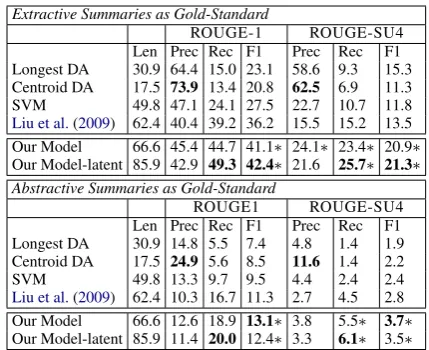
Table 4: ROUGE scores for phrase-based extractive summarization evaluated against human-constructed utterance-level extractive summaries and abstractive summaries. Our models that statistically significantly outperform SVM andLiu et al.(2009) are highlighted with∗(p <0.05, pairedt-test). Best ROUGE score for each column is inbold.
mary, where we collect human abstract with at least one link from summary-worthy utterances.
We calculate scores based on ROUGE (Lin and Hovy, 2003), which is a popular tool for eval-uating text summarization (Gillick et al., 2009;
Liu and Liu, 2010). ROUGE-1 (unigrams) and ROUGE-SU4 (skip-bigrams with at most 4 words in between) are used. Following previous work on meeting summarization (Riedhammer et al.,
2010;Wang and Cardie, 2013), we consider two dialogue act-level summarization baselines: (1) LONGESTDA in each discussion is selected as the summary, and (2)CENTROIDDA, the one with the highest TF-IDF similarity with all DAs in the dis-cussion. We also compare with an unsupervised keyword extraction approach byLiu et al.(2009), where word importance is estimated by its TF-IDF score, POS tag, and the salience of its correspond-ing sentence. With the same candidate phrases as in our model, we extend Liu et al.(2009) by scoring each phrase based on its average score of the words. Top phrases, with the same number of phrases output by our model, are included into the summaries. Finally, we compare with summaries consisting of salient phrases predicted by an SVM classifier trained with our content features.
out-Meeting Clip:
D: can we uh power a light in this? can we get a strong enough battery to power a light?
A: um i think we could because the lcd panel requires power, and the lcd is a form of a light so that. . .
D:. . .it’s gonna have to have something high-tech about it and that’s gonna take battery power. . .
D: illuminate the buttons. yeah it glows.
D: well m i’m thinking along the lines of you’re you’re in the dark watching a dvd and you um you find the thing in the dark and you go like this. . .oh where’s the volume button in the dark, and uh y you just touch it. . .and it lights up or something.
Abstract by Human:
What sort of battery to use. The industrial designer pre-sented options for materials, components, and batteries and discussed the restrictions involved in using certain materi-als.
Longest DA:
well m i’m thinking along the lines of you’re you’re in the dark watching a dvd and you um you find the thing in the dark and you go like this.
Centroid DA:
can we uh power a light in this?
Our Method:
- power a light, a strong enough battery, - requires power, a form,
- a really good battery, battery power, - illuminate the buttons, glows,
- watching a dvd, the volume button, lights up or something Figure 2: Sample summaries output by different sys-tems for a meeting clip from AMI corpus (less relevant utterances in between are removed). Salient phrases by our system output are displayed for each turn of the clip, with duplicated phrases removed for brevity.
performs the SVM-based classifiers when evalu-ated on ROUGE recall and F1, while achieving comparable precision. Compared to Liu et al.
(2009), our system also yields better results on all metrics.
Sample summaries by our model along with two baselines are displayed in Figure 2. Utterance-level extract-based baselines unavoidably contain disfluency and unnecessary details. Our phrase-based extractive summary is able to capture the key points from both the argumentation process and important outcomes of the conversation. This implies that our model output can be used as input for an abstractive summarization system. It can also facilitate the visualization of decision-making processes.
5.3 Further Analysis and Discussions
Features Analysis. We first discuss salient fea-tures with top weights learned by our joint model. For content features, main speaker tends to utter more salient content. Higher TF-IDF scores also
indicate important phrases. If a phrase is men-tioned in previous turn and repeated in the current turn, it is likely to be a key point. For discourse features, structure features matter the most. For instance, jointly modeling the discourse relation of the parent node along with the current node can lead to better inference. An example is that giv-ing more details on the proposal (ELABORATION) tends to lead to POSITIVE feedback. Moreover, REQUESTusually appears close to the root of the argument diagram tree, whilePOSITIVEfeedback is usually observed on leaves. Adjacency pairs also play an important role for discourse predic-tion. For joint features, features that compos-ite “phrase mentioned in previous turn” and rela-tionPOSITIVEfeedback orREQUESTyield higher weight, which are indicators for both key phrases and discourse relations. We also find that main speaker information composite with ELABORA -TION and UNCERTAIN are associated with high weights.
Error Analysis and Potential Directions.Taking a closer look at our prediction results, one major source of incorrect prediction for phrase selection is based on the fact that similar concepts might be expressed in different ways, and our model pre-dicts inconsistently for different variations. For example, participants use both “thick” and “two centimeters” to talk about the desired shape of a remote control. However, our model does not group them into the same cluster and later makes different predictions. For future work, semantic similarity with context information can be lever-aged to produce better clustering results. Fur-thermore, identifying discourse relations in dia-logues is still a challenging task. For instance, “I wouldn’t choose a plastic case” should be labeled asOPTION EXCLUSION, if the previous turns talk about different options. Otherwise, it can be la-beled asNEGATIVE. Therefore, models that better handle semantics and context need to be consid-ered.
6 Predicting Consistency of Understanding
As discussed in previous work (Mulder et al.,
under-standing of their group decisions, which is defined as consistency of understanding (COU) in Kim and Shah(2016).
Kim and Shah (2016) establish gold-standard COU labels on a portion of AMI discussions, by comparing participant summaries to determine whether participants report the same decisions. If all decision points are consistent, the associated topic discussion is labeled as consistent; other-wise, the discussion is identified as inconsistent. Their annotation covers the AMI-SUB dataset. Therefore, we run the prediction experiments on AMI-SUB by using the same annotation. Out of total 129 discussions in AMI-SUB, 86 discussions are labeled as consistent and 43 are inconsistent.
We construct three types of features by us-ing our model’s predicted labels. Firstly, we learn two versions of our model based on the “consistent” discussions and the “inconsistent” ones in the training set, with learned parame-ters wcon and wincon. For a discussion in the test set, these two models output two probabili-tiespcon= maxc,dP(c,d|x,wcon)andpincon = maxc,dP(c,d|x,wincon). We usepcon−pincon as a feature.
Furthermore, we consider discourse relations of length one and two from the discourse struc-ture tree. Intuitively, some discourse relations, e.g., ELABORATION followed by multiple POSI -TIVEfeedback, imply consistent understanding.
The third feature is based on word entrainment, which has been shown to correlate with task suc-cess for groups (Nenkova et al., 2008). Using the formula in Nenkova et al. (2008), we com-pute the average word entrainment between the main speaker who utters the most words and all the other participants. The content words in the salient phrases predicted by our model is consid-ered for entrainment computation.
Results. Leave-one-out is used for experiments. For training, our features are constructed from gold-standard phrase and discourse labels. Pre-dicted labels by our model is used for constructing features during testing. SVM-based classifier is used for experimenting with different sets of fea-tures output by our model. A majority class base-line is constructed as well. We also consider an SVM classifier trained with ngram features (uni-grams and bi(uni-grams). Finally, we compare with the state-of-the-art method in Kim and Shah (2016), where discourse-relevant features and head
ges-Acc F1
Comparisons
Baseline (Majority) 66.7 40.0
Ngrams (SVM) 51.2 50.6
Kim and Shah(2016) 60.5 50.5
Features from Our Model
Consistency Probability (Prob) 52.7 52.1 Discourse Relation (Disc) 63.6 57.1∗ Word Entrainment (Ent) 60.5∗ 57.1∗ Prob + Disc+ Ent 68.2∗ 63.1∗
Oracles
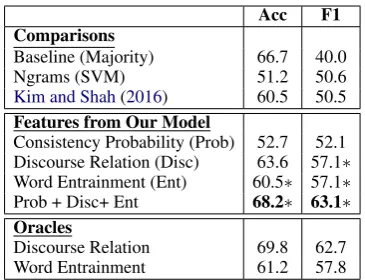
[image:9.595.325.508.60.200.2]Discourse Relation 69.8 62.7 Word Entrainment 61.2 57.8 Table 5:Consistency of Understanding (COU) predic-tion results on AMI-SUB. Results that statistically
sig-nificantly outperform ngrams-based baseline andKim
and Shah (2016) are highlighted with ∗ (p < 0.05,
paired t-test). For reference, we also show the pre-diction performance based on gold-standard discourse relations and phrase selection labels.
ture features are utilized in Hidden Markov Mod-els to predict the consistency label.
The results are displayed in Table5. All SVMs trained with our features surpass the ngrams-based baseline. Especially, the discourse features, word entrainment feature, and the combination of the three, all significantly outperform the state-of-the-art system byKim and Shah(2016).6
7 Conclusion
We presented a joint model for performing phrase-level content selection and discourse relation pre-diction in spoken meetings. Experimental results on AMI and ICSI meeting corpora showed that our model can outperform state-of-the-art methods for both tasks. Further evaluation on the task of pre-dicting consistency-of-understanding in meetings demonstrated that classifiers trained with features constructed from our model output produced supe-rior performance compared to the state-of-the-art model. This provides an evidence of our model be-ing successfully applied in other prediction tasks in spoken meetings.
Acknowledgments
This work was supported in part by National Sci-ence Foundation Grant IIS-1566382 and a GPU gift from Nvidia. We thank three anonymous re-viewers for their valuable suggestions on various aspects of this work.
References
Mohammad Hadi Bokaei, Hossein Sameti, and Yang Liu. 2016. Extractive Summarization of Multi-party Meetings Through Discourse Segmentation. Natu-ral Language Engineering22(01):41–72.
Trung H. Bui, Matthew Frampton, John Dowding, and Stanley Peters. 2009. Extracting Decisions from Multi-party Dialogue Using Directed Graph-ical Models and Semantic Similarity. In Proceed-ings of the SIGDIAL 2009 Conference: The 10th Annual Meeting of the Special Interest Group on Discourse and Dialogue. Association for Computa-tional Linguistics, Stroudsburg, PA, USA, SIGDIAL ’09, pages 235–243.
Jean Carletta, Simone Ashby, Sebastien Bourban, Mike Flynn, Mael Guillemot, Thomas Hain, Jaroslav Kadlec, Vasilis Karaiskos, Wessel Kraaij, Melissa Kronenthal, Guillaume Lathoud, Mike Lincoln, Agnes Lisowska, Iain McCowan, Wilfried Post, Dennis Reidsma, and Pierre Wellner. 2006. The AMI Meeting Corpus: A Pre-announcement. In
Proceedings of the Second International Conference on Machine Learning for Multimodal Interaction. Springer-Verlag, Berlin, Heidelberg, MLMI’05, pages 28–39.
William W. Cohen, Vitor R. Carvalho, and Tom M. Mitchell. 2004. Learning to Classify Email into “Speech Acts” . In Dekang Lin and Dekai Wu, edi-tors,Proceedings of the 2004 Conference on Empir-ical Methods in Natural Language Processing. As-sociation for Computational Linguistics, Barcelona, Spain, pages 309–316.
Alfred Dielmann and Steve Renals. 2008. Recogni-tion of Dialogue Acts in Multiparty Meetings Us-ing a SwitchUs-ing DBN. IEEE transactions on audio, speech, and language processing16(7):1303–1314. Raquel Fern´andez, Matthew Frampton, John Dowding, Anish Adukuzhiyil, Patrick Ehlen, and Stanley Pe-ters. 2008. Identifying Relevant Phrases to Sum-marize Decisions in Spoken Meetings. In INTER-SPEECH. pages 78–81.
Michel Galley. 2006. A Skip-chain Conditional Ran-dom Field for Ranking Meeting Utterances by Im-portance. In Proceedings of the 2006 Conference on Empirical Methods in Natural Language Pro-cessing. Association for Computational Linguistics, Stroudsburg, PA, USA, EMNLP ’06, pages 364– 372.
Debanjan Ghosh, Smaranda Muresan, Nina Wacholder, Mark Aakhus, and Matthew Mitsui. 2014. Analyz-ing Argumentative Discourse Units in Online Inter-actions. In Proceedings of the First Workshop on Argumentation Mining. pages 39–48.
Dan Gillick, Korbinian Riedhammer, Benoit Favre, and Dilek Hakkani-Tur. 2009. A Global Opti-mization Framework for Meeting Summarization. In Acoustics, Speech and Signal Processing, 2009.
ICASSP 2009. IEEE International Conference on. IEEE, pages 4769–4772.
Dilek Hakkani-Tur. 2009. Towards Automatic Argu-ment Diagramming of Multiparity Meetings. In
Acoustics, Speech and Signal Processing, 2009. ICASSP 2009. IEEE International Conference on. IEEE, pages 4753–4756.
Hugo Hernault, Helmut Prendinger, David A. duVerle, and Mitsuru Ishizuka. 2010. HILDA: A Discourse Parser Using Support Vector Machine Classification.
Dialogue & Discourse1(3):1–33.
Adam Janin, Don Baron, Jane Edwards, Dan Ellis, David Gelbart, Nelson Morgan, Barbara Peskin, Thilo Pfau, Elizabeth Shriberg, Andreas Stolcke, et al. 2003. The ICSI Meeting Corpus. In Acous-tics, Speech, and Signal Processing, 2003. Proceed-ings.(ICASSP’03). 2003 IEEE International Confer-ence on. IEEE, volume 1, pages I–I.
Yangfeng Ji, Gholamreza Haffari, and Jacob Eisen-stein. 2016. A Latent Variable Recurrent Neu-ral Network for Discourse-Driven Language Mod-els. In Proceedings of the 2016 Conference of the North American Chapter of the Association for Computational Linguistics: Human Language Tech-nologies. Association for Computational Linguis-tics, San Diego, California, pages 332–342.
Nal Kalchbrenner and Phil Blunsom. 2013. Recurrent Convolutional Neural Networks for Discourse Com-positionality. In Proceedings of the Workshop on Continuous Vector Space Models and their Compo-sitionality. Association for Computational Linguis-tics, Sofia, Bulgaria, pages 119–126.
Joseph Kim and Julie A Shah. 2016. Improving Team’s Consistency of Understanding in Meet-ings. IEEE Transactions on Human-Machine Sys-tems46(5):625–637.
Paul A Kirschner, Simon J Buckingham-Shum, and Chad S Carr. 2012. Visualizing Argumentation: Software Tools for Collaborative and Educational Sense-making. Springer Science & Business Media. Dan Klein and Christopher D. Manning. 2003. Accu-rate Unlexicalized Parsing. In Proceedings of the 41st Annual Meeting on Association for Computa-tional Linguistics - Volume 1. Association for Com-putational Linguistics, Stroudsburg, PA, USA, ACL ’03, pages 423–430.
Feifan Liu, Deana Pennell, Fei Liu, and Yang Liu. 2009. Unsupervised Approaches for Automatic Keyword Extraction Using Meeting Transcripts. In
Proceedings of Human Language Technologies: The 2009 Annual Conference of the North American Chapter of the Association for Computational Lin-guistics. Association for Computational Linguistics, Boulder, Colorado, pages 620–628.
Jialu Liu, Jingbo Shang, Chi Wang, Xiang Ren, and Ji-awei Han. 2015. Mining quality phrases from mas-sive text corpora. InProceedings of the 2015 ACM SIGMOD International Conference on Management of Data. ACM, pages 1729–1744.
Vanessa Loza, Shibamouli Lahiri, Rada Mihalcea, and Po-Hsiang Lai. 2014. Building a Dataset for Sum-marization and Keyword Extraction from Emails. In
LREC. pages 2441–2446.
Kathleen McKeown, Lokesh Shrestha, and Owen Ram-bow. 2007. Using Question-answer Pairs in Extrac-tive Summarization of Email Conversations. In In-ternational Conference on Intelligent Text Process-ing and Computational LProcess-inguistics. Springer, pages 542–550.
Yashar Mehdad, Giuseppe Carenini, and Raymond T. Ng. 2014. Abstractive Summarization of Spo-ken and Written Conversations Based on Phrasal Queries. InProceedings of the 52nd Annual Meet-ing of the Association for Computational LMeet-inguis- Linguis-tics (Volume 1: Long Papers). Association for Com-putational Linguistics, Baltimore, Maryland, pages 1220–1230.
Neil Mercer. 2004. Sociocultural Discourse Analysis.
Journal of applied linguistics1(2):137–168.
Ingrid Mulder, Janine Swaak, and Joseph Kessels. 2002. Assessing Group Learning and Shared Under-standing in Technology-mediated Interaction. Edu-cational Technology & Society5(1):35–47.
Gabriel Murray, Giuseppe Carenini, and Raymond Ng. 2010. Generating and Validating Abstracts of Meet-ing Conversations: A User Study. InProceedings of the 6th International Natural Language Generation Conference. Association for Computational Linguis-tics, Stroudsburg, PA, USA, INLG ’10, pages 105– 113.
Gabriel Murray, Steve Renals, Jean Carletta, and Jo-hanna Moore. 2006. Incorporating Speaker and Dis-course Features into Speech Summarization. In Pro-ceedings of the main conference on Human Lan-guage Technology Conference of the North Amer-ican Chapter of the Association of Computational Linguistics. Association for Computational Linguis-tics, pages 367–374.
Ani Nenkova, Agustin Gravano, and Julia Hirschberg. 2008. High Frequency Word Entrainment in Spoken Dialogue. InProceedings of the 46th annual meet-ing of the association for computational lmeet-inguistics
on human language technologies: Short papers. As-sociation for Computational Linguistics, pages 169– 172.
Tatsuro Oya and Giuseppe Carenini. 2014. Extrac-tive Summarization and Dialogue Act Modeling on Email Threads: An Integrated Probabilistic Ap-proach. In15th Annual Meeting of the Special In-terest Group on Discourse and Dialogue. page 133. J´er´emy Perret, Stergos Afantenos, Nicholas Asher, and Mathieu Morey. 2016. Integer Linear Programming for Discourse Parsing. In Proceedings of the 2016 Conference of the North American Chapter of the Association for Computational Linguistics: Human Language Technologies. Association for Computa-tional Linguistics, San Diego, California, pages 99– 109.
Korbinian Riedhammer, Benoit Favre, and Dilek Hakkani-T¨ur. 2010. Long Story Short - Global Un-supervised Models for Keyphrase Based Meeting Summarization. Speech Commun.52(10):801–815. Rutger Rienks, Dirk Heylen, and E. van der Weijden.
2005. Argument Diagramming of Meeting Conver-sations. In A. Vinciarelli and J-M. Odobez, editors,
International Workshop on Multimodal Multiparty Meeting Processing, MMMP 2005, part of the 7th International Conference on Multimodal Interfaces, ICMI 2005.
Khashayar Rohanimanesh, Kedar Bellare, Aron Cu-lotta, Andrew McCallum, and Michael L Wick. 2011. Samplerank: Training Factor Graphs with Atomic Gradients. InProceedings of the 28th Inter-national Conference on Machine Learning (ICML-11). pages 777–784.
David A Smith and Jason Eisner. 2008. Dependency Parsing by Belief Propagation. InProceedings of the Conference on Empirical Methods in Natural Lan-guage Processing. Association for Computational Linguistics, pages 145–156.
Andreas Stolcke, Klaus Ries, Noah Coccaro, Eliz-abeth Shriberg, Rebecca Bates, Daniel Jurafsky, Paul Taylor, Rachel Martin, Carol Van Ess-Dykema, and Marie Meteer. 2000. Dialogue Act Mod-eling for Automatic Tagging and Recognition of Conversational Speech. Computational linguistics
26(3):339–373.
Lu Wang and Claire Cardie. 2012. Focused Meeting Summarization via Unsupervised Relation Extrac-tion. In Proceedings of the 13th Annual Meeting of the Special Interest Group on Discourse and Di-alogue. Association for Computational Linguistics, Seoul, South Korea.