Proceedings of the 57th Annual Meeting of the Association for Computational Linguistics, pages 5985–5996 5985
Towards Comprehensive Description Generation from Factual
Attribute-value Tables
Tianyu Liu1, Fuli Luo1, Pengcheng Yang1, Wei Wu1, Baobao Chang1,2 and Zhifang Sui1,2 1MOE Key Lab of Computational Linguistics, School of EECS, Peking University
2Peng Cheng Laboratory, Shenzhen, China
{tianyu0421, luofuli, yang pc, wu.wei, chbb, szf}@pku.edu.cn
Abstract
The comprehensive descriptions for factual attribute-value tables, which should be accu-rate, informative and loyal, can be very helpful for end users to understand the structured data in this form. However previous neural gen-erators might suffer fromkey attributes miss-ing,less informativeandgroundless informa-tionproblems, which impede the generation of high-quality comprehensive descriptions for tables. To relieve these problems, we first pro-pose force attention (FA) method to encour-age the generator to pay more attention to the uncovered attributes to avoid potentialkey at-tributes missing. Furthermore, we propose re-inforcement learning for information richness to generatemore informativeas well as more loyal descriptions for tables. In our experi-ments, we utilize the widely usedWIKIBIO
dataset as a benchmark. Additionally we
cre-ate WB-filterbased onWIKIBIO to test
our model in the simulated user-oriented sce-narios, in which the generated descriptions should accord with particular user interests. Experimental results show that our model out-performs the state-of-the-art baselines on both automatic and human evaluation.
1 Introduction
Generating descriptions for the factual attribute-value tables has attracted widely interests among NLP researchers especially in a neural end-to-end fashion (e.g.Lebret et al.(2016);Liu et al.(2018);
Sha et al. (2018); Bao et al. (2018); Puduppully et al. (2018); Li and Wan (2018); Nema et al.
(2018)) as shown in Fig1a. For broader potential applications in this field, we also simulate user-oriented generation, whose goal is to provide com-prehensive generation for the selected attributes
according to particular user interests like Fig1b. However, we find that previous models might miss key information and generate less
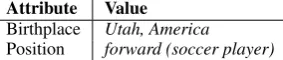
informa-Attribute Value
Birthplace Utah, America Position forward (soccer player)
Comprehensive: AUtah soccer playerwho plays asforward
Missing Key Attri.: Asoccer playerwho plays asforward
Groundless info: AUtah forwardin the national team
[image:1.595.346.488.223.253.2]Less Informative: AnAmerican forward
Table 1: An example for comprehensive generation. Suppose we only have two attribute-value tuples, the underlined content isgroundless informationnot men-tioned in source tables.
tive and groundless content in its generated de-scriptions towards source tables. For example, in Table 1, the ‘missing key attribute’ case doesn’t mention where the player comes from (birthplace) while the ‘less informative’ one choosesAmerican
rather thanUtah. The case with groundless infor-mation contains ‘in the national team’ which is not mentioned in the source attributes. Although the ‘key points missing’ problem exists in many text-to-text and data-to-text datasets, for large-scale structured tables with vast heterogeneous tributes such as Wikipedia infoboxes, ‘Key at-tribute missing’ and ‘less informative’ problems might be even more challenging. As the key at-tributes, like the ‘position’ of a basketball player or the ‘political party’ of a senator, are very likely to be unique features to particular tables, which usually appear much less frequently and are sel-domly mentioned than the common attributes like ‘Name’ and ‘Birthdate’. The ‘groundless infor-mation’, which is also known as the ‘hallucina-tion’ problem, remains a long-standing problem in NLG.
un-Attribute Value
Name Dillon Sheppard
Birthdate 27 Feb 1979
Birthplace Durban, South Africa
Current Club Bidvest Wits
Number 29
Height 1.80 m (5 ft 11 in)
Position Left-winger
(a) End-to-end (neural) Table-to-text Generation
Table Encoder Description Decoder
… …
(
) (
( ( )
(b) User-oriented Description Generation for the Tables
User interests
Attributes selected by users :
Name;Current Club ; Position
Description Generation
Nameplayed as a
Position in Current Club
Wikipedia Infobox
Figure 1: The end-to-end (a) and user-oriented table-to-text generation (b) for an infobox (left) inWIKIBIO.
covered attributes to avoid potentialkey attributes missing by both stepwise and global constraints. In addition, we define the ‘information richness’ measurement of the generated descriptions to the source tables. Based on that, we use the rein-forcement learning to encourage the generator to cover infrequent and rarely mentioned attributes as well as generatemore informativedescriptions withless groundless content.
We test our models on two settings:
1) For neural table-to-text generation like Fig
1a, we test our model onWIKIBIO(Lebret et al.,
2016), a crawled dataset from Wikipedia with paired infoboxes and associated descriptions. It is a widely used benchmark dataset for description generation for factual attribute-value tables and also a quite meaningful testbed in the real-world scenarios with vast and heterogenous attributes.
2) To test our model in the user-oriented set-ting, we filterWIKIBIOto formWB-filter. In this setting, we suppose all attributes in the source tables ofWB-filter are selected by users that should be covered in the corresponding descrip-tions. We try to make sure the gold descriptions in
WB-filtercover all the attributes of the source
tables in this condition. Details in Sec4.
Both automatic and human evaluation show that our model relieves the 3 problems (Table 1) and helps the generator to produce accurate, informa-tive and loyal descriptions. We also achieve the state-of-the-art performance on the end-to-end ta-ble description and the user-oriented generation tasks.
The remainder of this paper is organized as fol-lows. We first introduce how we formulate table-to-text generation into encoder-decoder frame-work in Sec 2. After that, we discuss force-attention method (Sec 3.1) and richness-oriented reinforcement learning (Sec3.2), which are moti-vated by the three goals we set up for
comprehen-sive table descriptions (Table1). Then we demon-strate how and why we create WB-filter(Sec
4.1) as well as evaluations (Sec4.2), experimental configurations (Sec4.3and4.4), case studies and visualizations (Sec 4.5) and error analysis (Sec
4.6).
2 Background: Table-to-Description
2.1 Table Encoder
Given a structured table like Fig1(left), we model the attribute-value tuples in the table as a sequence of words with related attribute names. After seri-alizing all the words in the ‘Value’ columns, for the i-th word in the tablexaki whose attribute is ak (the k-th attribute), we use the attribute name
ak and the word’s position in that tuple to
lo-cate the word (Lebret et al., 2016). Specifically we utilize a triple zaki = {ak, paki+, p
ak
i−} to
rep-resent the structure information for word xaki , in whichpaki+andpaki−are the positions ofxaki counted from the beginning and end of ak, respectively.
For example, for the ‘Birthplace’ attribute in Fig
1 (left), we can use triples {birthplace,1,4} and {birthplace,4,1} to represent the structure infor-mation for the words ‘Durban’1and ‘Africa’. We concatenate the wordxtand its structure
represen-tation zt at the t-th time step and feed them into
LSTM (Hochreiter and Schmidhuber, 1997) unit to encode the table. ht = LSTM([xt;zt], ht−1)
is thet-th hidden state among the encoder states H={ht}Tt=1. In the following sections, we might
omit the superscript ofxak
i if it is not necessary.
2.2 Description Decoder
For the generated descriptiony∗, the generated to-ken y∗t at thet-th time step is predicted based on all the previously generated tokensy<t∗ beforey∗t and the hidden statesHof the table encoder:
P(yt∗|H, y∗<t) = softmax(Wstanh(Wt[st, ct]))
(1) where is element-wise product, st =
LSTM(yt∗−1, st−1)is the t-th hidden state of the
decoder. ct = PTi=1αtihi is the context
vec-tor, which is the weighted sum of encoder hid-den states according to the attention matrix α.
αit ∝ eg(st,hi) is the attention element of the
t-th decoder state st and the i-th encoder state hi.
1More concretely, ‘
whereg(st, hi)is a relevance score betweenstand
hi. We use Bahdanau-style attention mechanism
(Bahdanau et al.,2014) to calculateg(st, hi).
g(st, hi) =tanh(Wphi+Wqst+b) (2)
Ws, Wt, Wp, Wqare learnable parameters.
3 Comprehensive Table Description
The problems listed in Table 1 not only prevent the generators to produce comprehensive descrip-tions for selected entries in the tables (Fig1b), but also prevent the generator to produce informative, accurate and loyal table descriptions (Fig1a). So we propose two methods:force-attention(FA) and
richness-oriented reinforcement learning to pro-duce accurate, informative and loyal descriptions.
3.1 Force-Attention Module
For ‘missing key attributes’ problem (Table1), we find that the generator usually focuses on partic-ular attributes while the other attributes have rel-atively low attention values in the entire decod-ing procedure. So force attention method is pro-posed to guide the decoder to pay more attention to the previous uncovered attributes with low at-tention values to avoid potential key attribute miss-ing. Note that FA method focuses on attribute-level coverage rather than word-attribute-level coverage (Tu et al.,2016) as our goal is to reduce the ‘missing key attributes’ phenomenons instead of building rigid word-by-word alignment between tables and descriptions.
Stepwise Forcing Attention: We define attribute-level attentionβtak = avg(P
xi∈akαit) at thet-th
step for attribute ak as the average value of the
word-level attention values for the words in that attribute. The word-level coverage is defined as the sum of attention vector before the t-th step θi
t = θit−1 +αit (Tu et al., 2016). In the
sim-ilar way, we define the attribute-level coverage γak
t = γ
ak
t−k + β
ak
t as the overall attention for
attribute ak before the t-th time step. The
av-erage word-level and attribute-level covav-erage are θi
t=θit/tandγ ak
t =γ
ak
t /t, respectively.
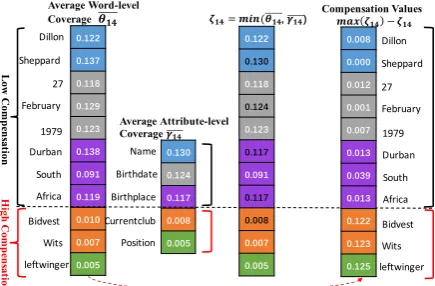
Then we propose stepwise attention forcing, which explicitly guides the decoder to pay more attention on the uncovered attributes by calculat-ing a new context vector ect = πct + (1−π)vt
to make compensation for the ignored attributes in the previous time steps. π is a learnable vector.
Dillon Sheppard 27 February 1979 Durban South Africa Bidvest Wits leftwinger Dillon Sheppard 27 February 1979 Durban South Africa Bidvest Wits leftwinger
Decoder at 14thtime step:Dillon Sheppard born27 february 1979,
Durban South Africa is a
Average Word-level
Coverage!"#
$"#
%"#= '()(!"#+"# Compensation Values',- %"# − %"#
[image:3.595.308.526.62.205.2]Name Birthdate Birthplace Currentclub Position Average Attribute-level Coverage+"# H igh C om p en sat ion L ow C om p en sat ion
Figure 2: Stepwise forcing attention at the 14-th step for the filtered version of the original infobox in Fig
1in theWB-filterdataset (The next word is ‘left-winger’). The uncovered attributes like ‘currentclub’ and ‘position’ (marked in orange and green) get high attention compensation (rightmost). Note that word ‘Sheppard’ does not get any compensation (rightmost) because it has got high attention in the previous steps.
vtis a compensation vector for the low-coverage
attributes:
vt= T
X
i=1
(max(ζt)−ζti)hi;ζti = min(θit, γ ak
t )
(3) ζtis the modified average word-level coverage
re-garding the average attribute-level coverage as the upper bound to avoid excessive compensation.
Fig2shows a running example. The motivation behind is that we want the decoder to pay enough attention to all the attributes in the whole decoding process, which prevents missing key attributes be-cause of the low attention value on them. Thus we make compensation for the previous uncovered at-tributes (like ‘currentclub’ and ‘position’ in Fig2
) byvtat thet-th time step.
Global Forcing Attention: Inspired by the soft-attention constraint of (Xu et al.,2015) which en-courages the generator to pay equal attention to every part of the image while generating image captions, we propose global forcing attention to avoid insufficient or excessive attention on certain attributes by adding the following loss to the prime seq2seq loss.
LF A =λ K
X
k=1
[γ−ak1−1/K]2 (4)
on evaluations on the validation data. γ−ak1 is the average attribute-level coverage for attributeakat
the last time step.
3.2 Reinforced Richness-oriented Learning
We also propose a reinforcement learning frame-work which encourages the generator to cover rare and seldom mentioned words and attributes in the table. The experiments and case studies show its effectiveness to deal with the ‘groundless informa-tion’ and ‘less informative’ problems in Table1.
3.2.1 Information Richness
The information richness (Eq5) is the multiplica-tion of the attribute-level and word-level richness of the descriptions towards the source tables.
Attribute-level Information Richness:Different tables which describe different objects are always featured by the unique attributes in the table. For example, a sportsman often has the attributes like ‘position’, ‘debutyear’. The information in the unique attributes is harder to capture than that in the common attributes like ‘name’, ‘birthdate’ as the latters are very frequent in the training set. We define the information richness for an attributeai
as f(ak) = [f req(ak)]−1 by calculating its
fre-quency in the training set.
Word-level Information Richness: The unique words in the tables are more likely to be informa-tive, such as a specific location, name or book. To calculate the word-level information richness, we firstly lemmatize all the words in the tables and filter the words with a stop-words list which in-cluding prepositions, symbols and numbers, etc. Then we randomly sample 5 synonyms of the cer-tain word from WordNet (Miller, 1995). Finally, we calculate the word-level richness w(xaki ) for thei-th word in attributeakby averaging the tf-idf
values ofxaki and its synonyms in the training set. For a generated description y∗, we lemmatize all the words iny∗to gety∗. Then we calculate the information richness based on the related source table withT words and the gold descriptiony, re-spectively.
Rich(y∗) =
PT
i=1[f(ak)·w(x
ak
i )·1{x˜
ak
i ∈y∗}]
PT
i=1[f(ak)·w(x
ak
i )]
(5)
in whichx˜ak
i represents any word amongx ak
i and
its synonyms in the table. The information rich-ness measures the ratio of covered information in the table by the description.
3.2.2 Reinforcement Learning
Reward Function: Different from previous mod-els which only measures how well the generated sentences match the target sentences, we design a mixed reward Rmix which contains both the
BLEU-4 scores and the information richness of the generated descriptions towards the source tables.
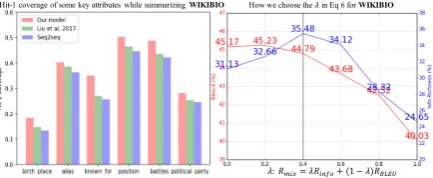
Rmix=λRinf o+ (1−λ)RBLEU (6)
λ is set to 0.4 and 0.6 for WIKIBIO and
WB-filterbased on evaluations on the
valida-tion data. Fig6shows how we chooseλ.
Training Algorithm: We use the REINFORCE algorithm (Williams, 1992) to learn an agent to maximize the reward function Rmix. The
train-ing loss of sequence generation is defined as the negative expected reward.
LRL =−Eys∼pφ[r(ys)·log(Pφ(ys))] (7)
wherePφ(ys)is the agent’s policy, i.e. the word
distribution of description decoder (Eq1), andr(·)
is the reward function defined in Eq6. In the im-plementation, ys is a sequence that can be sam-pled from Pφ by Monte-Carlo sampling ys =
{ys
1, ys2,· · ·, y|sY|}. The policy gradients for Eq 7
can be calculated as:
∇φLRL =λ∇φRinf o+ (1−λ)∇φRBLEU (8)
We use self-critical sequence training method (Rennie et al.,2017;Paulus et al.,2017) to reduce the variance of gradients by subtracting a baseline reward for the mix reward in Eq6.
∇φRBLEU ≈ −[B(ys, y)−B(yg, y)]∇φlog(Pφ(ys)) (9)
where B(a, b) is the BLEU score of sequence a compared with sequence b,yg is a generated
se-quence using greedy search. To calculate the in-formation richness reward Rinf o for the
lemma-tized sampled sequenceys, we use the information
richness (Eq5) of the related lemmatized gold de-scriptionytowards the source table as the baseline reward.
∇φRinf o≈ −[Rich(ys)−Rich(y)]∇φlog(Pφ(ys)) (10)
For more technical details, we refer the interested readers to (Williams,1992;Ranzato et al., 2015;
Dataset WIKIBIO WB-filter
# instances 728321 88287
# Tokens per Bio
26.1 30.2
# Tokens per Table
53.1 20.8
# Attri. per Table
19.7 6.3
# Word overlap
[image:5.595.72.292.61.176.2]9.5 12.1
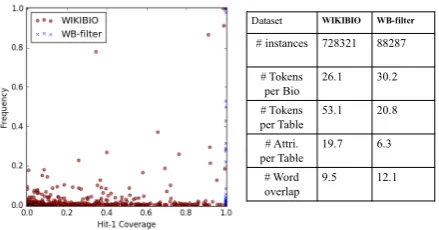
Figure 3: The ‘coverage-frequency’ figure (left) (each point represents an attribute) shows that many at-tributes have very low coverage and low frequency in the WIKIBIO dataset. Due to our filtering, the at-tributes in WB-filter have 100% Hit-1 coverage (Sec4.2) and more overlapping words with the origi-nal tables as shown in the data statistics (right).
4 Experiments
4.1 Datasets
We use two datasets to test our model in the con-text of end-to-end table description generation and comprehensive generation for selected attributes in user-oriented scenario.
For end-to-end description generation, we use
WIKIBIO dataset (Lebret et al., 2016) as the
benchmark dataset, which contains 728,321 arti-cles from English Wikipedia (Sep 2015) and uses the first sentence of each article as the description. To test our model in the user-oriented scenario, we filtered the WIKIBIO dataset to form a new dataset WB-filter. To simulate the user inter-ests, we first select the top 100 frequent2attributes
inWIKIBIO. After that we manually filter
irrel-evant attributes (like ’caption’, ’website’ or ’sig-nature’) and merge identical attributes (like ’ar-ticle title’ and ’name’) to avoid repetition. Then we leave out all the remaining attributes in the ta-bles and filter the instances in WIKIBIO whose descriptions can not cover the selected attributes to formWB-filter. To achieve this, we firstly lemmatize all the tokens in the infoboxes as well as those in the related gold biographies and filter them by a stop-words list, then we randomly re-trieve 5 synonyms for every word in the infoboxes from WordNet. Finally we make sure the gold bi-ographies cover at least one word (or its synonym) for every attribute-value tuple among the chosen attributes and filter the unqualified instances in
2In this setup, the reason of choosing high
fre-quent attributes is to ensure enough training instances in
WB-filterfor data-driven methods.
WIKIBIO.
The ‘frequency-coverage’ figure in Fig3shows 1) The filtering ensures that the WB-filter
dataset achieves 100% Hit-1 coverage. 2) The
WIKIBIO dataset suffers from both ‘low
fre-quency’ and ‘low coverage’ problems, which means some key attributes in the tables are sel-dom mentioned by the descriptions. The cause of ‘low coverage’ problem is the loosely alignment between structured data and related descriptions. The two datasets are divided in to training (80%), testing (10%) and validation (10%) sets.
4.2 Evaluation Metrics
Automatic Metrics:Following the previous work (Lebret et al., 2016; Sha et al., 2018;Liu et al.,
2018), we use BLEU-4 (Papineni et al.,2002) and ROUGE-4 (F measure) (Lin,2004) for automatic evaluation. Furthermore, to evaluate how the gen-erated biographies cover the key points in the in-foboxes, we also use information richness (Eq5) as one of our automatic evaluation. ‘Hit at least 1 word’ for an attribute means that a biography has at least one overlapping word with the words (or their synonyms) in that attribute, which are lem-matized and filtered by a stop-words list like the way we getWB-filterin Sec4.1. ‘HIT-1 cov-erage’ for an attribute is the ratio of the instances involving that attribute whose biographies ‘Hit at least 1 word’ in that attribute.
Human Evaluation:Since automatic evaluations like BLEU may not be reliable for NLG sys-tems (Callison-Burch et al.,2006;Reiter and Belz,
re-spectively.
4.3 Experimental Details
Following previous work (Liu et al., 2018). For
WIKIBIO We select the most frequent 20,000
words and 1480 attributes in the training set as the word and attribute vocabulary. We tune the hyper-parameters based on the model perfor-mance on the validation set. The dimensions of word embedding, attribute embedding, posi-tion embedding and hidden unit are 500, 50, 600, 10 respectively. The batch size, learning rate and optimizer for both two datasets are 32, 5e-4 and Adam (Kingma and Ba, 2014), respec-tively. We use Xavier initialization (Glorot and Bengio,2010) for all the parameters in our model. The global constraint of force-attention (Eq 4) is adapted after 4 and 1.5 epochs of training to avoid hurting the primary loss for the WIKIBIO
and WB-filter datasets, respectively. Before
the richness-oriented reinforced training, the neu-ral generator is pre-trained 8 and 4 epochs for
theWIKIBIOandWB-filterdatasets (with or
without force-attention module), respectively. We replace UNK tokens with the most relevant token in the source table according to the attention ma-trix (Jean et al.,2015).
4.4 Baselines
KN & Template KN:A template-based Kneser-Ney (KN) language model (Heafield et al.,2013) The extracted template for Table 1 is “name 1 name 2(bornbirthdate 1· · ·”. During inference, the decoder is constrained to emit words from the vocabulary or the special tokens in the tables.
Table NLM:Lebret et al.(2016) proposed a neu-ral language model Table NLM taking the attribute information into consideration.
Order-planning: Sha et al. (2018) proposed a link matrix to model the order for the attribute-value tuples while generating biographies.
Struct-aware: Liu et al. (2018) proposed a structure-aware model using a modified LSTM unit and a specific attention mechanism to incor-porate the attribute information.
Word & Attribute level Coverage: we also im-plement the implicit coverage method (Tu et al.,
2016) for comparison. For word-level coverage, we replace Eq2 with g(st, hi) = tanh(Wphi +
Wqst+Wmθt+b). For attribute-level coverage,
we replace Eq2 with g(st, hi) = tanh(Wphi +
Models BLEU ROUGE
KN 2.21 0.38
Template KN 19.80 10.70
[image:6.595.314.520.60.341.2]NLM 4.17 1.48
Table NLM 34.70 25.80 Order-planning 43.91 37.15 Struct-aware 44.89 41.21 Word-level Coverage* 43.44 39.84 Attri-level Coverage* 42.87 38.95
Seq2seq 43.51 39.61
+ Force-Attention 44.46 40.58 + Richness RL† 45.47 41.54
(a) Automatic evaluation onWIKIBIO
Models BLEU ROUGE
Struct-aware* 40.81 36.52 Word-level Coverage* 38.85 35.11 Attri-level Coverage* 38.34 34.92
Seq2seq 39.17 35.39
+ Force Attention 41.21 36.71 + Richness RL† 42.03 37.55
(b) Automatic evaluation onWB-filter
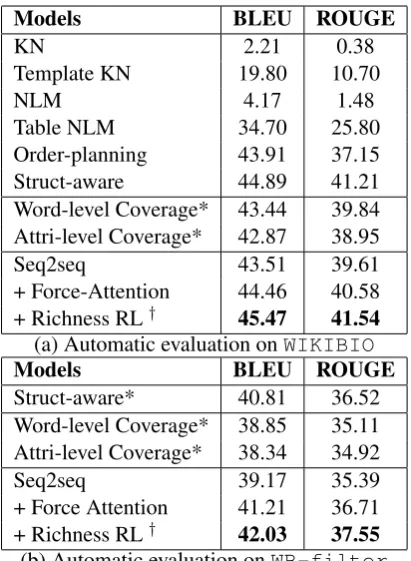
Table 2: BLEU and ROUGE scores on theWIKIBIO
andWB-filterdatasets. The baselines with * are
based on our implementation while the others are re-ported by their authors. Models with† are trained us-ing the RL criterion specified in Sec3.2.2 while the remaining models are trained using the maximum like-lihood estimate (MLE).
Wqst+Wmγt+b). θtandγtare the word-level
and attribute-level coverage defined in Sec3.1.
4.5 Analysis of Experimental Results
Automatic evaluations are shown in Table 2 for
WIKIBIOandWB-filter. The proposed
force-attention module achieves 1.11/0.98 and 2.04/1.32 BLEU/ROUGE increases on the WIKIBIO and
WB-filterdatasets, respectively. Although the
con-Models Fluency Coverage Correctness Seq2seq 1.87 1.99 1.95 Struct-aware 1.61 1.80 1.71 Our best 1.54 1.46 1.61
(a) Human evaluation on WIKIBIO
Models Fluency Coverage Correctness
Seq2seq 2.02 1.88 1.93 Struct-aware 1.58 1.52 1.65 Our best 1.54 1.39 1.54
[image:7.595.81.282.61.166.2](b) Human evaluation onWB-filter
Table 3: Average ranking (lower is better) of 3 systems. We calculate the Pearson correlation to show the inter-annotator agreement.
Models BLEU Rich
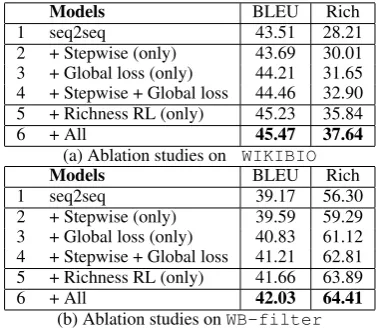
1 seq2seq 43.51 28.21 2 + Stepwise (only) 43.69 30.01 3 + Global loss (only) 44.21 31.65 4 + Stepwise + Global loss 44.46 32.90 5 + Richness RL (only) 45.23 35.84
6 + All 45.47 37.64
(a) Ablation studies on WIKIBIO
Models BLEU Rich
1 seq2seq 39.17 56.30 2 + Stepwise (only) 39.59 59.29 3 + Global loss (only) 40.83 61.12 4 + Stepwise + Global loss 41.21 62.81 5 + Richness RL (only) 41.66 63.89
6 + All 42.03 64.41
(b) Ablation studies onWB-filter
Table 4: The ablation studies for our model. Models 2-4 are from the force-attention method. ‘Rich’ is the ‘information richness’ defined in Eq5.
tain information beyond the tables. Although this phenomenon also occurs in WIKIBIO, the filter-ing ofWB-filter magnifies this issue. Human evaluations in Table 3 show our model achieves better generation coverage and correctness than all the baselines. Table4shows that the ablation stud-ies of our model.
As demonstrated in Table 5, we select an in-fobox from WIKIBIOand WB-filter respec-tively for case studies. By observing the gen-erated description in WIKIBIO, we find that 1) compared with the vanilla seq2seq model, our force-attention module can cover the information in the ‘Notableworks’ attribute. 2) The richness-oriented module further helps our model to cover the ‘Alma mater’ and ‘Notableworks’ attributes as they are infrequent attributes (more informative) in the dataset. Additionally, due to the rareness of the word ‘kiev’, our model is able to cover the related information. Similarly, the generated description
forWB-filtercovers the information from ‘
Or-ganization’ and ‘Birthplace’ with the help of
seq2seq seq2seq+Force-attention
struct-aware [Liu et al. 2017] coverage-oriented (ours)
Name Dillon Sheppard
Birthdate 27 February 1979
Birthplace Durban , South Africa
Currentclub Bidvest Wits
Position left-winger
Name Dillon Sheppard
Birthdate 27 February 1979
Birthplace Durban , South Africa
Currentclub Bidvest Wits
Position left-winger
Name DillonSheppard
Birthdate 27February1979
Birthplace Durban,SouthAfrica
Currentclub Bidvest Wits
Position left-winger Name DillonSheppard
Birthdate 27February1979
Birthplace Durban,SouthAfrica
Currentclub Bidvest Wits
Position left-winger
S2S+cover: Dillon Sheppard ( born 27 february 1979 ) is a soccer who plays for Bidvest Wits.
Sha et al. 2017: Dillon Sheppard ( born 27 february 1979 ) is a soccer who plays for Bidvest Wits.
Liu et al. 2017: Dillon Sheppard ( born 27 february 1979 ) is a South African soccer who plays for Bidvest Wits.
Ours: Dillon Sheppard ( born 27 february 1979, Durban South Africa ) is a footballer who plays as left-winger for Bidvest Wits.
seq2seq: Dillon Sheppard (born 27 february 1979) is a soc-cer who plays for Bidvest Wits.
seq2seq+FA: Dillon Sheppard (born 27 february 1979,
[image:7.595.307.526.62.148.2]Durban South Africa) is a left-winger in Bidvest Wits.
Figure 4: The average attribute-level (green) and word-level (red) coverage of the seq2seq models with or without force-attention module for an infobox in
WB-filter(higher values are darker) in the last de-coding step. The vanilla seq2seq model ignores the ‘birthplace’ and ‘position’ attributes as the low cover-age on them while the FA module attracts enough at-tention on them while decoding.
Figure 5: Hit-1 coverage (Sec4.2) for attributes on the test setsofWIKIBIOandWB-filter. For better vi-sualization, we first select the attributes whose frequen-cies are larger than 0.1%, then rank the Hit-1 coverage of these attributes (214 attributes inWIKIBIO; 26 at-tributes inWB-filter) in the descending ordering.
posed model.
Fig 4 shows the effectiveness of the force-attention module. The decoder is guided to pay more attention to the uncovered attributes (‘ birth-place’ and ‘position’) while decoding. Fig 5
shows that both two proposed modules can boost the attribute-level coverage on the two datasets. Fig 6(left) explains why our model can also im-prove end-to-end table description generation. At-tributes like ‘position’, ‘battles’ and ‘political party’ are key information to describe the in-foboxes for sportsmen, soldiers and politicians. Fig6(right) shows the effects ofλin Eq6.
4.6 Error Analysis
[image:7.595.86.278.229.393.2] [image:7.595.311.527.313.400.2]ex-Name:Ivan Ohienko Metropolitan Ilarion;Birthdate:2 January 1882;Birthplace:Brusilov, Kiev governorate, Russian empire;Deathdate:29 March 1972;Deathplace:Winnipeg, Canada;Occupation:cleric, historian, ethnographer, and scholar, writer, and translator;Language:Ukrainian;Nationality:Ukrainian;Alma mater:Kiev university
Notableworks:translation of the bible into ukrainianArticle title:Ilarion Ohienko
Seq2seq: Ivan Ohienko Metropolitan ( January 2 , 1882 – March 29 , 1972 ) was a Ukrainian cleric , historian , ethnogra-pher, writer , linguist , writer and scolar.
+Force-Attention: Ivan Ohienko Metropolitan Ilarion ( 2 January 1882 in Brusilov – 29 march 1972 in Winnipeg ) was a
Ukrainian linguist , ethnographer , and scholar , best known for his translation of the bible into ukrainian .
+Richness-oriented RL: Ivan Ohienko Metropolitan Ilarion ( 2 January 1882 , Krusilov , Kiev governorate– 29 march
1972 , Winnipeg ) was a Ukrainian cleric, historian , ethnographer , and scholar of Kiev university , best known for his translation of the bible into ukrainian .
Name:Rajendra Singh;Birthdate:06 August 1959;Birthplace:Daula, Bagpat District, Uttar Pradesh;Nationality: Indian;Organization:Tarun Bharat Sangh;Occupation:water conservationistAlma mater:Allahabad University
Seq2seq: Rajendra Singh is an Indian water conservationist.
+Force-Attention: Rajendra Singh (born 6 August 1959) is an Indian conservationist and a senior fellow of the Tarun Bharat Sangh.
[image:8.595.74.291.334.423.2]+Richness-oriented RL: Rajendra Singh (born 6 august 1959, Uttar Pradesh) is an Indian water conservationist and a member of the Tarun Bharat Sangh.
Table 5: The generated cases inWIKIBIO(above) andWB-filter(below) datasets. The underlined texts, which are the key information of the source tables, are ignored by seq2seq model.
Hit-1 coverage of some key attributes while summarizingWIKIBIO How we choose the!in Eq 6 forWIKIBIO
!: $%&'= !$&)*++ (1 − !)$1234
Figure 6: Hit-1 Coverage (Sec 4.2) for some key at-tributes (left) on the test setof WIKIBIOshows that our model can help to cover some key attributes while describing the tables. The right figure is the analysis of
λ(Eq6) for ‘Seq2seq + RL’ model on thevalidation set of WIKIBIO.
ample, a biography about a football player might contain ‘in the national football league’ although the related infobox does not mention this piece of information as the similar expression exists in many instances of the training set. Although our model could largely relieve this problem as shown in human evaluation (Table 3), it is still a gen-eral problem in NLG. As for the ability to cover important information in the tables, although our model is able to cover much more comprehensive information than the previous models (Table2and
3). Some implicitly expressed (like if a person is retired or not) or rarely covered (like ‘spouse’ or ‘high school’) attributes in the source tables might still be ignored in the descriptions generated by our model. Furthermore, those pieces of informa-tion which need some form of inference across
several attributes (like a time span) may not be well represented by our model.
5 Related Work
Data-to-text a language generation task to gener-ate text for structured data. Table-to-text belongs to the data-to-text generation (Reiter and Dale,
2000). Many previous work (Barzilay and Lapata,
2005,2006;Liang et al.,2009) treated the task as a pipelined systems, which viewed content selec-tion and surface realizaselec-tion as two separate tasks.
Duboue and McKeown (2002) proposed a clus-tering approach in the biography domain by scor-ing the semantic relevance of the text and paired knowledge base. In a similar vein, Barzilay and Lapata(2005) modeled the dependencies between the American football records and identified the bits of information to be verbalized. Liang et al.
(2009);Angeli et al.(2010) extended the work of
Barzilay and Lapata(2005) to soccer and weather domains by learning the alignment between data and text using hidden variable models. Androut-sopoulos et al.(2013) andDuma and Klein(2013) focused on generating descriptive language for Ontologies and RDF triples. Most recent work utilize neural networks on data-to-text generation (Mahapatra et al., 2016; Wiseman et al., 2017;
Laha et al.,2018;Kaffee et al.,2018;Freitag and Roy, 2018;Qader et al., 2018; Dou et al., 2018;
Yeh et al.,2018;Jhamtani et al.,2018;Jain et al.,
Duˇsek et al.,2019).
Some closely relevant work also focused on the table-to-text generation. Mei et al. (2016) proposed an encoder-aligner-decoder framework for generating weather broadcast. Hachey et al.
(2017) used a table-text and text-table auto-encoder framework for table-to-text generation.
Nema et al.(2018) proposed gated orthogonaliza-tion to avoid repetiorthogonaliza-tions. Wiseman et al. (2018) used neural semi-HMM to generate template-like descriptions for structured data. Our work some-what shares similar goals asKiddon et al.(2016);
Tu et al. (2016); Liu et al. (2017a); Gong et al.
(2018) in the sense that they emphasis easily ig-nored (usually less frequent) features or bits of in-formation in the training procedure by smoothing or regularization. The greatest difference between our work and theirs is that our method is tailored for covering the key information embedded in the attributes (entries) of the key-value tables rather than single words or labels. Although the deficient score of Tu et al.(2016) in Table 2 has demon-strated that word-level coverage oriented methods may not still be suitable to the structured tables, we assume other word-level constraints may easily transfer to the structured tables without losing ef-ficiency. We leave the recognition of potential ap-plicable word-level constraints to the future work. This paper focused on generating one-sentence biographies for infoboxes like many previous works (Lebret et al., 2016; Hachey et al., 2017;
Liu et al., 2018; Bao et al., 2018; Nema et al.,
2018;Puduppully et al., 2018;Cao et al., 2018).
Perez-Beltrachini and Lapata(2018) used the first paragraph of the wikipedia pages as the gold biographies aiming at generating longer biogra-phies. We tried the same setting and unfortu-nately found most generated biographies contain
too much groundless information compared with the source infoboxes. This is because the related gold biographies from first paragraph contain too much groundless information beyond the source infoboxes.
6 Conclusion and Future Work
We set up 3 goals for comprehensive description generation for attribute-value factual tables: ac-curate, informative and loyal. To achieve these goals, we propose force-attention method, which encourages the generator to pay more attention to previous uncovered attributes to avoid
poten-tial key attribute missing. Richness-oriented re-inforcement learning is proposed to cover more informative contents in source tables, which help the generator to generate informative and accurate descriptions. The experiments on the WIKIBIO
andWB-filterdatasets show the merits of our
model. In the future, we will explore the repre-sentation for the implicit information like whether a man is retired or not or how long a sportsman’s career is given starting and ending years, in the ta-ble by including some inference strategies.
Acknowledgments
We would like to thank the anonymous review-ers for their valuable suggestions. This work is supported by the National Science Founda-tion of China under Grant No. 61876004, No. 61772040. The corresponding authors of this pa-per are Baobao Chang and Zhifang Sui.
References
Ion Androutsopoulos, Gerasimos Lampouras, and Dimitrios Galanis. 2013. Generating natural lan-guage descriptions from owl ontologies: the natu-ralowl system. Journal of Artificial Intelligence Re-search, 48:671–715.
Gabor Angeli, Percy Liang, and Dan Klein. 2010. A simple domain-independent probabilistic approach to generation. InEMNLP 2010, pages 502–512.
Dzmitry Bahdanau, Kyunghyun Cho, and Yoshua Bengio. 2014. Neural machine translation by
jointly learning to align and translate. CoRR,
abs/1409.0473.
Jun-Wei Bao, Duyu Tang, Nan Duan, Zhao Yan, Yuan-hua Lv, Ming Zhou, and Tiejun Zhao. 2018. Table-to-text: Describing table region with natural
lan-guage. In Proceedings of the Thirty-Second AAAI
Conference on Artificial Intelligence, (AAAI-18), the 30th innovative Applications of Artificial Intel-ligence (IAAI-18), and the 8th AAAI Symposium on Educational Advances in Artificial Intelligence (EAAI-18), New Orleans, Louisiana, USA, February 2-7, 2018, pages 5020–5027.
Regina Barzilay and Mirella Lapata. 2005. Collective content selection for concept-to-text generation. In Proceedings of the conference on Human Language Technology and Empirical Methods in Natural Lan-guage Processing, pages 331–338. Association for Computational Linguistics.
Chris Callison-Burch, Miles Osborne, and Philipp Koehn. 2006. Re-evaluation the role of bleu in ma-chine translation research. InEACL 2006.
Juan Cao, Junpeng Gong, and Pengzhou Zhang. 2018. Open-domain table-to-text generation based on seq2seq. In Proceedings of the 2018 Interna-tional Conference on Algorithms, Computing and Artificial Intelligence, page 72. ACM.
Longxu Dou, Guanghui Qin, Jinpeng Wang, Jin-Ge Yao, and Chin-Yew Lin. 2018. Data2text studio: Automated text generation from structured data. In Proceedings of the 2018 Conference on Empirical Methods in Natural Language Processing: System Demonstrations, pages 13–18.
Pablo A Duboue and Kathleen R McKeown. 2002. Content planner construction via evolutionary algo-rithms and a corpus-based fitness function. In Pro-ceedings of INLG 2002, pages 89–96.
Daniel Duma and Ewan Klein. 2013. Generating nat-ural language from linked data: Unsupervised tem-plate extraction. In Proceedings of the 10th Inter-national Conference on Computational Semantics (IWCS 2013)–Long Papers, pages 83–94.
Ondˇrej Duˇsek, Jekaterina Novikova, and Verena Rieser. 2019. Evaluating the state-of-the-art of end-to-end natural language generation: The e2e nlg challenge. arXiv preprint arXiv:1901.07931.
Markus Freitag and Scott Roy. 2018. Unsupervised natural language generation with denoising autoen-coders.arXiv preprint arXiv:1804.07899.
Xavier Glorot and Yoshua Bengio. 2010. Understand-ing the difficulty of trainUnderstand-ing deep feedforward neu-ral networks. InProceedings of the Thirteenth In-ternational Conference on Artificial Intelligence and Statistics, pages 249–256.
Chengyue Gong, Xu Tan, Di He, and Tao Qin. 2018. Sentence-wise smooth regularization for sequence to sequence learning. arXiv preprint arXiv:1812.04784.
Ben Hachey, Will Radford, and Andrew Chisholm. 2017. Learning to generate one-sentence
biogra-phies from wikidata. In Proceedings of the 15th
Conference of the European Chapter of the Asso-ciation for Computational Linguistics, EACL 2017, Valencia, Spain, April 3-7, 2017, Volume 1: Long Papers, pages 633–642.
Kenneth Heafield, Ivan Pouzyrevsky, Jonathan H Clark, and Philipp Koehn. 2013. Scalable modified kneser-ney language model estimation. InACL (2), pages 690–696.
Sepp Hochreiter and J¨urgen Schmidhuber. 1997.
Long short-term memory. Neural Computation,
9(8):1735–1780.
Parag Jain, Anirban Laha, Karthik Sankaranarayanan, Preksha Nema, Mitesh M Khapra, and Shreyas Shetty. 2018. A mixed hierarchical attention based encoder-decoder approach for standard table sum-marization.arXiv preprint arXiv:1804.07790.
S´ebastien Jean, KyungHyun Cho, Roland Memisevic, and Yoshua Bengio. 2015. On using very large
target vocabulary for neural machine translation.
In Proceedings of the 53rd Annual Meeting of the Association for Computational Linguistics and the 7th International Joint Conference on Natural Lan-guage Processing of the Asian Federation of Natural Language Processing, ACL 2015, July 26-31, 2015, Beijing, China, Volume 1: Long Papers, pages 1–10.
Harsh Jhamtani, Varun Gangal, Eduard Hovy, Gra-ham Neubig, and Taylor Berg-Kirkpatrick. 2018. Learning to generate move-by-move commentary for chess games from large-scale social forum data. In Proceedings of the 56th Annual Meeting of the Association for Computational Linguistics (Volume 1: Long Papers), volume 1, pages 1661–1671.
Lucie-Aim´ee Kaffee, Hady ElSahar, Pavlos Vou-giouklis, Christophe Gravier, Fr´ed´erique Laforest, Jonathon S. Hare, and Elena Simperl. 2018. Learn-ing to generate wikipedia summaries for
under-served languages from wikidata. InProceedings of
the 2018 Conference of the North American Chap-ter of the Association for Computational Linguistics: Human Language Technologies, NAACL-HLT, New Orleans, Louisiana, USA, June 1-6, 2018, Volume 2 (Short Papers), pages 640–645.
Chlo´e Kiddon, Luke Zettlemoyer, and Yejin Choi. 2016.Globally coherent text generation with neural
checklist models. InEMNLP 2016, pages 329–339.
Diederik P Kingma and Jimmy Ba. 2014. Adam: A method for stochastic optimization. arXiv preprint arXiv:1412.6980.
Anirban Laha, Parag Jain, Abhijit Mishra, and Karthik Sankaranarayanan. 2018. Scalable micro-planned
generation of discourse from structured data.CoRR,
abs/1810.02889.
R´emi Lebret, David Grangier, and Michael Auli. 2016.
Neural text generation from structured data with
ap-plication to the biography domain. InEMNLP 2016,
pages 1203–1213.
Liunian Li and Xiaojun Wan. 2018. Point precisely: Towards ensuring the precision of data in generated texts using delayed copy mechanism. In Proceed-ings of the 27th International Conference on Com-putational Linguistics, pages 1044–1055.
Chin-Yew Lin. 2004. Rouge: A package for auto-matic evaluation of summaries. Text Summarization Branches Out.
Tianyu Liu, Fuli Luo, Qiaolin Xia, Shuming Ma, Baobao Chang, and Zhifang Sui. 2019. Hierarchical encoder with auxiliary supervision for neural table-to-text generation: Learning better representation for tables. InProceedings of AAAI.
Tianyu Liu, Kexiang Wang, Baobao Chang, and Zhi-fang Sui. 2017a. A soft-label method for noise-tolerant distantly supervised relation extraction. In Proceedings of the 2017 Conference on Empirical Methods in Natural Language Processing, pages 1790–1795.
Tianyu Liu, Kexiang Wang, Lei Sha, Baobao Chang, and Zhifang Sui. 2018. Table-to-text generation
by structure-aware seq2seq learning. In
Proceed-ings of the Thirty-Second AAAI Conference on Ar-tificial Intelligence, (AAAI-18), the 30th innovative Applications of Artificial Intelligence (IAAI-18), and the 8th AAAI Symposium on Educational Advances in Artificial Intelligence (EAAI-18), New Orleans, Louisiana, USA, February 2-7, 2018, pages 4881– 4888.
Tianyu Liu, Bingzhen Wei, Baobao Chang, and Zhi-fang Sui. 2017b. Large-scale simple question
gen-eration by template-based seq2seq learning. In
Nat-ural Language Processing and Chinese Computing - 6th CCF International Conference, NLPCC 2017, Dalian, China, November 8-12, 2017, Proceedings, pages 75–87.
Joy Mahapatra, Sudip Kumar Naskar, and Sivaji Bandyopadhyay. 2016. Statistical natural language generation from tabular non-textual data. In Pro-ceedings of the 9th International Natural Language Generation conference, pages 143–152.
Hongyuan Mei, Mohit Bansal, and Matthew R. Walter. 2016. What to talk about and how? selective
gener-ation using lstms with coarse-to-fine alignment. In
NAACL HLT 2016, pages 720–730.
George A Miller. 1995. Wordnet: a lexical database for english. Communications of the ACM, 38(11):39– 41.
Preksha Nema, Shreyas Shetty, Parag Jain, Anirban Laha, Karthik Sankaranarayanan, and Mitesh M Khapra. 2018. Generating descriptions from struc-tured data using a bifocal attention mechanism and gated orthogonalization. InProceedings of the 2018 Conference of the North American Chapter of the Association for Computational Linguistics: Human Language Technologies, Volume 1 (Long Papers), volume 1, pages 1539–1550.
Kishore Papineni, Salim Roukos, Todd Ward, and Wei-Jing Zhu. 2002. Bleu: a method for automatic eval-uation of machine translation. InACL2002, pages 311–318.
Romain Paulus, Caiming Xiong, and Richard Socher. 2017. A deep reinforced model for abstractive sum-marization.arXiv preprint arXiv:1705.04304.
Hao Peng, Ankur P. Parikh, Manaal Faruqui, Bhuwan Dhingra, and Das Dipanjan. 2019. Text generation with exemplar-based adaptive decoding. In Pro-ceedings of the Conference of the North American Chapter of the Association for Computational Lin-guistics: Human Language Technologies.
Laura Perez-Beltrachini and Mirella Lapata. 2018.
Bootstrapping generators from noisy data. In
Pro-ceedings of the 2018 Conference of the North American Chapter of the Association for Compu-tational Linguistics: Human Language Technolo-gies, NAACL-HLT 2018, New Orleans, Louisiana, USA, June 1-6, 2018, Volume 1 (Long Papers), pages 1516–1527.
Ratish Puduppully, Li Dong, and Mirella Lapata. 2018. Data-to-text generation with content selection and planning. arXiv preprint arXiv:1809.00582.
Raheel Qader, Khoder Jneid, Franc¸ois Portet, and Cyril Labb´e. 2018. Generation of company descriptions using concept-to-text and text-to-text deep models: dataset collection and systems evaluation. In Pro-ceedings of the 11th International Conference on Natural Language Generation, pages 254–263.
Marc’Aurelio Ranzato, Sumit Chopra, Michael Auli, and Wojciech Zaremba. 2015. Sequence level
training with recurrent neural networks. CoRR,
abs/1511.06732.
Ehud Reiter. 2018. A structured review of the validity of bleu.Computational Linguistics, 44(3):393–401.
Ehud Reiter and Anja Belz. 2009. An investigation into the validity of some metrics for automatically evalu-ating natural language generation systems. Compu-tational Linguistics, 35(4):529–558.
Ehud Reiter and Robert Dale. 2000. Building natural language generation systems. Cambridge university press.
Steven J Rennie, Etienne Marcheret, Youssef Mroueh, Jarret Ross, and Vaibhava Goel. 2017. Self-critical sequence training for image captioning. InCVPR, volume 1, page 3.
Lei Sha, Lili Mou, Tianyu Liu, Pascal Poupart, Su-jian Li, Baobao Chang, and Zhifang Sui. 2018.
Order-planning neural text generation from
struc-tured data. In Proceedings of the Thirty-Second
Zhaopeng Tu, Zhengdong Lu, Yang Liu, Xiaohua Liu, and Hang Li. 2016. Modeling coverage for neural
machine translation. InACL 2016, Volume 1: Long
Papers.
Ronald J Williams. 1992. Simple statistical gradient-following algorithms for connectionist reinforce-ment learning. In Reinforcement Learning, pages 5–32. Springer.
Sam Wiseman, Stuart M. Shieber, and Alexander M. Rush. 2017. Challenges in data-to-document
gener-ation. In Proceedings of the 2017 Conference on
Empirical Methods in Natural Language Process-ing, EMNLP 2017, Copenhagen, Denmark, Septem-ber 9-11, 2017, pages 2253–2263.
Sam Wiseman, Stuart M. Shieber, and Alexander M. Rush. 2018. Learning neural templates for text
gen-eration. InProceedings of the 2018 Conference on
Empirical Methods in Natural Language Process-ing, Brussels, Belgium, October 31 - November 4, 2018, pages 3174–3187.
Kelvin Xu, Jimmy Ba, Ryan Kiros, Kyunghyun Cho, Aaron Courville, Ruslan Salakhudinov, Rich Zemel, and Yoshua Bengio. 2015. Show, attend and tell: Neural image caption generation with visual at-tention. In International Conference on Machine Learning, pages 2048–2057.