3909
Miss Tools and Mr Fruit: Emergent communication in agents learning
about object affordances
Diane Bouchacourt1and Marco Baroni1,2 1Facebook A.I. Research
2ICREA
{dianeb,mbaroni}@fb.com
Abstract
Recent research studies communication emer-gence in communities of deep network agents assigned a joint task, hoping to gain insights on human language evolution. We propose here a new task capturing crucial aspects of the human environment, such as natural ob-ject affordances, and of human conversation, such as full symmetry among the participants. By conducting a thorough pragmatic and se-mantic analysis of the emergent protocol, we show that the agents solve the shared task through genuine bilateral, referential commu-nication. However, the agents develop mul-tiple idiolects, which makes us conclude that full symmetry is not a sufficient condition for a common language to emerge.
1 Introduction
The advent of powerful deep learning architec-tures has revived research in simulations of lan-guage emergence among computational agents that must communicate to accomplish a task (e.g.,
Jorge et al.,2016;Havrylov and Titov,2017; Kot-tur et al.,2017;Lazaridou et al.,2017;Lee et al.,
2017; Choi et al., 2018; Evtimova et al., 2018;
Lazaridou et al., 2018). The nature of the emer-gent communication code should provide insights on questions such as to what extent compara-ble functional pressures could have shaped hu-man language, and whether deep learning models can develop human-like linguistic skills. For such inquiries to be meaningful, the designed setup should reflect as many aspects of human commu-nication as possible. Moreover, appropriate tools should be applied to the analysis of emergent com-munication, since, as several recent studies have shown, agents might succeed at a task without truly relying on their communicative channel, or by means of ad-hoc communication techniques
overfitting their environment (Kottur et al.,2017;
Bouchacourt and Baroni,2018;Lowe et al.,2019). We contribute on both fronts. We introduce a game meeting many desiderata for a natural communication environment. We further propose a two-pronged analysis of emerging communica-tion, at the pragmatic and semantic levels. At the pragmatic level, we study communicative acts from a functional perspective, measuring whether the messages produced by an agent have an im-pact on the subsequent behaviour of the other. At the semantic level, we decode which aspects of the extra-linguistic context the agents refer to, and how such reference acts differ between agents. Some of our conclusions are positive. Not only do the agents solve the shared task, but genuine bi-lateral communication helps them to reach higher reward. Moreover, their referential acts are mean-ingful given the task, carrying the semantics of their input. However, we also find that even per-fectly symmetric agents converge to distinct idi-olects instead of developing a single, shared code.
2 The fruit and tools game
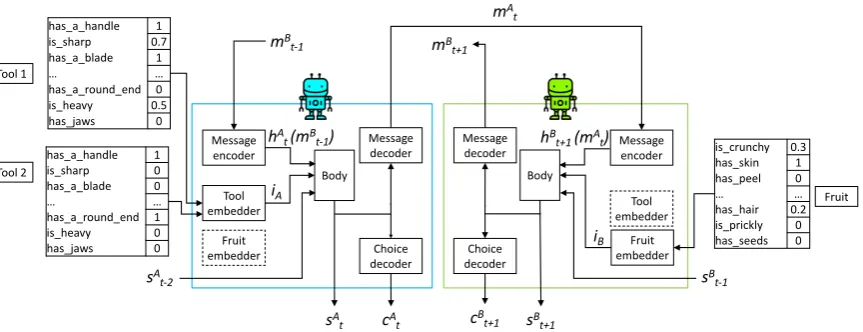
Figure 1: Our game. One agent receives a fruit, another two tools. Each agent sends a message in turn, until an agent ends the episode by choosing a tool. The agents are rewarded if the tool choice is optimal given the fruit.
the agents must decide whether to pick one of the two tools and stop, or to continue, in which case the message it utters is passed to the other agent, and the game proceeds. Currently, for ease of analysis, messages are single discrete symbols se-lected from a vocabulary of size10, but extension to symbol sequences is trivial (although it would of course complicate the analysis). As soon as an agent picks a tool, the game ends. The agents re-ceive a binary reward of 1 if they picked the better tool for the fruit at hand, 0 otherwise. The best choice is computed by a utility function that takes into account the interaction between tool and fruit instance properties (e.g., as in Fig.1, a tool with a round edge might be particularly valuable if the fruit has a pit). Utility is relative: given a peach, the axe is worse than the spoon, but it would be the better tool when the alternative is a hammer.
Here are some desirable properties of our setup, as a simplified simulation of human interactions. The agents are fully symmetric and cannot special-ize to a fixed role or turn-taking scheme. The num-ber of turns is open and determined by the agents. In pure signaling/referential games (Lewis,1969), the aim is successful communication itself. In our game, reward depends instead on tool and fruit affordances. Optimal performance can only be achieved by jointly reasoning about the proper-ties of the tools and how they relate to the fruit. Humans are rewarded when they use language to solve problems of this sort, and not for success-ful acts of reference per se. Finally, as we use commonsense descriptions of everyday objects to build our dataset (see below), the distribution of their properties possesses the highly skewed char-acteristics encountered everywhere in the human environment (Li, 2002). For example, if the ma-jority of fruits requires to be cut, a knife is intrin-sically more useful than a spoon. Note that the agents do not have any a priori knowledge of the tools utility. Yet, baseline agents are able to
dis-cover context-independent tool affordances and al-ready reach high performance. We believe that this scenario, in which communication-transmitted in-formation complements knowledge that can be di-rectly inferred by observing the world, is more in-teresting than typical games in which language is the only information carrier.
Game ingredients and utility We picked 16 tool and 31 fruit categories from McRae et al.
(2005) and Silberer et al. (2013), who provide subject-elicited property-based commonsense de-scriptions of objects, with some extensions. We used 11 fruit and 15 tool features from these databases to represent the categories. We rescaled the elicitation-frequency-based property values provided in the norms to lie in the [0,1] range, and manually changed some counter-intuitive val-ues. An object instance is a property vector sam-pled from the corresponding category as follows. For binary properties such as has a pit, we use Bernoulli sampling with p equaling the category value. For continuous properties such asis small, we sample uniformly from[µ−0.1, µ+0.1], where
µis the category value. We then devised a func-tion returning an utility score for any fruit-tool property vector pair. The function maps proper-ties to a reduced space of abstract functional fea-tures (such asbreakfor tools, andhardfor fruits). Details are in Supplementary Section1. For exam-ple, an apple withis crunchy=0.7value gets a high hardfunctional feature score. A knife with has a blade=1gets a highcutscore, and therefore high utility for thehardapple. Some features, e.g.,has a handlefor tools, have no impact on utility. They only represent realistic aspects of objects and act as noise. Our dataset with full category property vectors will be publicly released along with code.
parti-Tool 2 Tool 1
Message encoder
Tool embedder
Body Message decoder
Choice decoder Fruit
embedder
Message encoder
Tool embedder
Fruit embedder Message
decoder
Choice decoder
Body
Fruit
sAt sA
t-2
sBt+1
sB t-1
cAt cB t+1 mBt-1
mA t
has_a_handle 1 is_sharp 0.7 has_a_blade 1
… …
has_a_round_end 0 is_heavy 0.5 has_jaws 0
has_a_handle 1 is_sharp 0 has_a_blade 0
… …
has_a_round_end 1 is_heavy 0 has_jaws 0
is_crunchy 0.3 has_skin 1 has_peel 0
… …
has_hair 0.2 is_prickly 0 has_seeds 0
iA hA
t(mBt-1) hBt+1 (mAt)
iB mB
[image:3.595.79.511.68.234.2]t+1
Figure 2: Two turns of dialogue. Dashed boxes are not used in this game episode due to the agent roles (the blue/left agent is Tool Player, the green/right one is Fruit player). The flow is explained in detail in the text.
tions. We train agents on the in-domain train par-tition and monitor convergence on the validation set. We report test performance on the in-domain test partition and on the transfer set. For example, thepeachcategory is in-domain, meaning that dis-tinct peach instances will be seen at training and in-domain testing time. Thenectarinecategory is in the transfer set, so nectarine instances will only be seen at test time. This scheme tests the gener-alization abilities of the agents (that can general-ize to new fruits since they are all are described in the same feature space). We generate210,000 in-domain training samples and25,000samples for the other sets, balanced across fruits and tools (that are common across the sets).
Game dynamics and agent architecture At the beginning of a game episode, two neural net-work agents A and B receive, randomly, either a pair of tools(tool1, tool2) (always sampled from
different categories) or af ruit. The agent receiv-ing the tools (respectively the fruit) will be Tool Player (respectively Fruit Player) for the episode.1 The agents are also randomly assigned positions, and the one in position 1 starts the game. Figure2
shows two turns of the game in which A (blue/left) is Tool Player and in position 1. The first turn is in-dexedt= 0, therefore A will act on even turns, B on odd turns. At game opening, each agent passes its input (tool pair or fruit) through a linear layer followed by a tanh nonlinearity, resulting in em-bedding iA (resp. iB). Then, at each turn t, an
agent, for example A, receives the messagemBt−1
from agent B, and accesses its own previous inter-nal statesAt−2 (we refer to “memory” the addition
1
Agents must learn to recognize the assigned role.
of the agent’s previous state). The messagemBt−1
is processed by a RNN, and the resulting hidden statehAt (mBt−1)is concatenated with the agent pre-vious internal statesAt−2and the input embedding
iA. The concatenated vector is fed to the Body
module, composed of a linear layer followed by tanh. The output of the Body module is the new A state,sAt, fed to Message and Choice decoders.
The Message decoder is an RNN with hidden state initialized assAt, and outputting a probability distributionp(mAt|sAt )over possible A messages. At training time, we sample a messagemAt; at test time we take the most probable one. The Choice decoder is a linear layer processing sAt and out-putting a softmax-normalized vector of size3. The latter represents the probabilities p(cAt |sAt) over A’s possible choices: (i)cAt = 0to continue play-ing, (ii)cAt = 1to choose tooltool1 and stop (iii)
cAt = 2 to choose tool tool2 and stop. Again,
we sample at training and argmax at test time. If
cAt = 0, the game continues. B receives message
mAt , its previous statesBt−1 and input embedding
iB, and it outputs the tuple (mBt+1,cBt+1,sBt+1) etc.,
until an agent stops the game, or the maximum number of turnsTmax= 20is reached.
When an agent stops by choosing a tool, for example tool1, we compute the two
util-ities U(tool1, f ruit) and U(tool2, f ruit). If
U(tool1, f ruit) ≥ U(tool2, f ruit), that is the
best tool was chosen, shared reward is R = 1. If U(tool1, f ruit) < U(tool2, f ruit) or if the
agents reachTmaxturns without choosing,R= 0.2
During learning, the reward is back-propagated
2We also tried directly using raw or normalized scalar
with Reinforce (Williams,1992). When the game starts at t = 0, we feed the agent in position
1 a fixed dummy message m0, and the previous states of the agents sAt−2 and sBt−1 are initialized with fixed dummys0. In the no-memory ablation, previous internal states are always replaced bys0. When we block communication, agent messages are replaced bym0. Supplementary Section2 pro-vides hyperparameter and training details.
3 Measuring communication impact
Message Effect is computed on single turns and uses causal theory (Pearl et al.,2016) to quantify how much what an agent utters impacts the other, compared to the counterfactual scenario in which the speaking agent said something else.
Consider messagemAt uttered by A at turnt. If
cAt = 0(that is, A continues the game),mAt is pro-cessed by B, along withsBt−1andiB. At the next
turn, B outputs a choicecBt+1and a messagemBt+1
drawn fromp(cBt+1, mBt+1|sBt+1). B’s statesBt+1is deterministically determined bymAt, cAt, sBt−1, iB,
so we can equivalently write that cBt+1 andmBt+1
are drawn from p(cBt+1, mBt+1|mAt, cAt , sBt−1, iB). Conditioning oncA
t , sBt−1, iB ensures there are no
confounders when we analyze the influence from
mAt (Pearl et al.,2016). Supplementary FigureA1
shows the causal graph supporting our assump-tions. We will not from here onwards write the conditioning oncAt , sBt−1, iBexplicitly.
We define zB
t+1 = (cBt+1, mBt+1). We want to
estimate how much the message from A,mAt, in-fluences the next-turn behaviour (choice and mes-sage) of B,zB
t+1. We thus measure the discrepancy
between the conditional distribution p(ztB+1|mAt)
and the marginal distribution p(zBt+1) not taking
mA
t into account. However, we want to assess
agent B’s behaviour underother possible received messages mAt. To do so, when we compute the marginal of agent B’s p(zB
t+1), we intervene on
mAt and draw the messages from the interven-tion distribuinterven-tion. We definep˜(zBt+1), the marginal computed with counterfactual messagesm0At , as:
˜
p(ztB+1) =X mA
t
p(ztB+1|mt0A)˜p(m0At ) (1)
wherep˜(m0At )is the intervention distribution, dif-ferent fromp(mA
t|sAt). If at turnt, A continues the
game, we define the Message Effect (ME) from agent A’s message mAt on agent B’s choice and
Given the messagemAt from agent A. 1 SampleK pairsztB+1,k ∼p(ztB+1|mAt). 2 SampleJ counterfactualsm0At,j ∼p˜(m0At ). 3 For eachzBt+1,k, do
˜
p(ztB+1,k) = J
X
j=1
p(ztB+1,k|m0At,j)˜p(m0At,j).
4 Return
MEA→Bt = 1
K
K
X
k=1
logp(z B
t+1,k|mAt) ˜
p(zB t+1,k)
.
Algorithm 1Computation of MEA→Bt .
message pair,ztB+1as:
MEA→Bt =KLp(zBt+1|mAt)||p˜(ztB+1) (2)
where KL is the Kullback-Leibler divergence, and
˜
p(ztB+1) is computed as in Eq.1. This allows us to measure how much the conditional distribution differs from the marginal. Algorithm1shows how we estimate MEA→Bt . In our experiments, we
drawK = 10samplesztB+1,k, and use a uniform intervention distribution p˜(m0At ) with J = 10. This kind of counterfactual reasoning is explored in depth by Bottou et al. (2013). Jaques et al.
(2018) andLowe et al.(2019) present related mea-sures of causal impact based on the Mutual Infor-mation (MI) between influencing and influenced agents. We discuss in Supplementary Section 3
possible issues with the MI-based approach. Bilateral communicationIntuitively, there has been a proper dialogue if, in the course of a conversation, each agent has said at least one thing that influenced the other. We operational-ize this through ourbilateral communication mea-sure. This is a binary, per-game score, that is pos-itive only if in the game there has been at least one turn with significant message effect in both directions, i.e., ∃ t, t0 s.t. MEA→Bt > θ and MEB→At0 > θ. We setθ= 0.1.3
3
4 Results
We first confirm that the agents succeed at the task, and communication improves their performance. Second, we study theirpragmatics, looking at how ablating communication and memory affect their interaction. Finally, we try to interpret the seman-ticsof the agents’ messages.
4.1 Performance and pragmatics
We report mean and standard error of the mean (SEM) over successful training seeds.4 Each agent A or B can be eitherF (Fruit Player) orT (Tool Player) and in position1 or 2, depending on the test game. We measure to what extent Tool Player influences Fruit Player (MET→F) andvice versa (MEF→T). Similarly, we evaluate position im-pact by computing ME1→2 and ME2→1. We av-erage ME values over messages sent during each test game, and report averages over test games. Note that we also intervene on the dummy initial-ization message used att = 0, which is received by the agent in position1. This impacts the value of ME2→1. If the agent in position 1has learned to rely on the initialization message to understand that the game is beginning, an intervention on this message will have an influence we want to take into account.5 Similarly, in the no-communication ablation, when computing ME values, we replace the dummy fixed message the agents receive with a counterfactual. Finally, we emphasize that the computation of ME values does not interfere with game dynamics and does not affect performance.
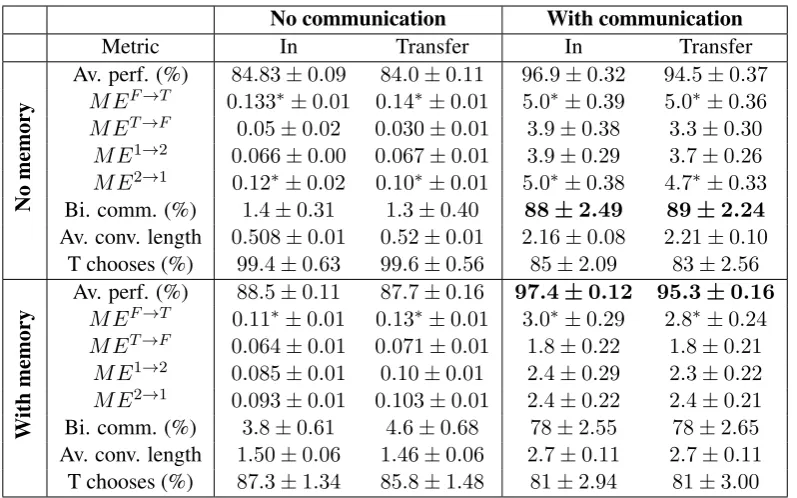
Both communication and memory help Ta-ble 1 shows that enabling the agents to com-municate greatly increases performance compared to the no-communication ablation, both with and without memory, despite the high baseline set by agents that learn about tool usefulness without communicating (see discussion below). Agents equipped with memory perform better than their no-memory counterparts, but the gain in perfor-mance is smaller compared to the gain attained from communication. The overall best perfor-mance is achieved with communicationand mem-ory. We also see that the agents generalize well, with transfer-fruit performance almost matching that on in-domain fruits. Next, we analyze in detail
4
That is, training seeds leading to final validation perfor-mance above85%.
5Conversely, we ignore the messages agents send when
stopping the game, as they are never heard.
the impact of each factor (communication, mem-ory) on agent performance and strategies.
No-communication, no-memory We start by looking at how the game unfolds when commu-nication and agent memory are ablated (top left quadrant of Table1). Performance is largely above chance (≈ 50%), because, as discussed in Sec-tion 2, some tools are intrinsically better on av-erage across fruits than others. Without commu-nication, the agents exploit this bias and learn a strategy where (i) Fruit Player never picks the tool but always continues the game and (ii) Tool Player picks the tool according to average tool usefulness. Indeed, Tool Player makes the choice in more than
99%of the games. Conversation length is0if Tool Player starts and1if it is the second agent, requir-ing the startrequir-ing Fruit Player to pass its turn. Reas-suringly, ME values are low, confirming the relia-bility of this communication score, and indicating that communication-deprived agents did not learn to rely on the fixed dummy message (e.g., by us-ing it as a constant bias). Still, we observe that, across the consistently low values, Fruit Player ap-pears to affect Tool Player significantly more than the reverse (MEF→T > MET→F). This is gener-ally observed in all configurations, and we believe it due to the fact that Tool Player takes charge of most of the reasoning in the game. We come back to this later in our analysis. We also observe that the second player impacts the first more than the reverse (ME2→1 >ME1→2). We found this to be an artifact of the strategy adopted by the agents. In the games in which Tool Player starts and imme-diately stops the game, we can only compute ME for the Tool/position-1 agent, by intervening on the initialization. The resulting value, while tiny, is unlikely to be exactly 0. In the games where Fruit Player starts and Tool Player stops at the sec-ond turn, we compute instead two tiny MEs, one per agent. Hence, the observed asymmetry. We verified this hypothesis by removing single-turn games: the influence of the second player on the first indeed disappears.
No communication With communication
Metric In Transfer In Transfer
No
memory
Av. perf. (%) 84.83±0.09 84.0±0.11 96.9±0.32 94.5±0.37
M EF→T 0.133∗±0.01 0.14∗±0.01 5.0∗±0.39 5.0∗±0.36
M ET→F 0.05±0.02 0.030±0.01 3.9±0.38 3.3±0.30
M E1→2 0.066±0.00 0.067±0.01 3.9±0.29 3.7±0.26
M E2→1 0.12∗±0.02 0.10∗±0.01 5.0∗±0.38 4.7∗±0.33
Bi. comm. (%) 1.4±0.31 1.3±0.40 88±2.49 89±2.24 Av. conv. length 0.508±0.01 0.52±0.01 2.16±0.08 2.21±0.10
T chooses (%) 99.4±0.63 99.6±0.56 85±2.09 83±2.56
W
ith
memory
Av. perf. (%) 88.5±0.11 87.7±0.16 97.4±0.12 95.3±0.16
M EF→T 0.11∗±0.01 0.13∗±0.01 3.0∗±0.29 2.8∗±0.24
M ET→F 0.064±0.01 0.071±0.01 1.8±0.22 1.8±0.21
M E1→2 0.085±0.01 0.10±0.01 2.4±0.29 2.3±0.22
M E2→1 0.093±0.01 0.103±0.01 2.4±0.22 2.4±0.21
Bi. comm. (%) 3.8±0.61 4.6±0.68 78±2.55 78±2.65
Av. conv. length 1.50±0.06 1.46±0.06 2.7±0.11 2.7±0.11
[image:6.595.101.500.60.309.2]T chooses (%) 87.3±1.34 85.8±1.48 81±2.94 81±3.00
Table 1: Test performance and pragmatic measures mean and SEM in different settings. “Av. perf.” (average performance) denotes%of samples where best tool was chosen, “Bi. comm.” denotes%of games with bilateral communication taking place. “Av. conv. length” is average conversation length in turns. “T chooses” denotes% of games ended by Tool Player. Values of ME with an asterisk ∗are statistically significantly higher than their reverse (e.g. MEF→T >MET→F). Best “Av. perf.” and “Bi. comm.” in bold.
a new channel (Lowe et al.,2019). ME and aver-age number of turns also increase. Fruit Player is the more influential agent. This effect is not due to the artifact we found in the no-communication ablation, because almost all conversations, includ-ing those started by Tool Player, are longer than one turn, so we can compute both MEF→T and MET→F. We believe the asymmetry to be due to the fact that Tool Player is the agent that demands more information from the other, as it is the one that sees the tools, and that in the large majority of cases makes the final choice. Supplementary Ta-ble A4shows that the gap between the influence of the Fruit Player on the Tool player and its re-verse is greater when the Fruit Player is in posi-tion2. This, then, explains ME2→1 >ME1→2 as an epiphenomenon of Fruit Player being more in-fluential.
Is memory ablation necessary for commu-nication to matter? An important observation from previous research is that depriving at least one agent of memory might be necessary to de-velop successful multi-turn communication ( Kot-tur et al.,2017;Cao et al.,2018;Evtimova et al.,
2018). This is undesirable, as obviously language should not emerge simply as a surrogate for
mem-ories of amnesiac agents. The performance and communicative behaviours results in the bottom right quadrant of Table1 show that, in our game, genuine linguistic interaction (as cued by ME and bilateral communication scores) is present even when both agents are equipped with memory. It is interesting however to study how adding memory affects the game dynamics independently of com-munication. In the bottom left quadrant, we see that memory leads to some task performance im-provement for communication-less agents. Man-ual inspection of example games reveals that such agents are developing turn-based strategies. For example, Tool Player learns to continue the game at turntiftool1 has a round end. Att+ 1, Fruit
val-Messages Fruit Tool 1 Tool 2 Both 37±1.70 31±1.21 24±1.07
F 37±1.75 23.3±0.66 16.7±0.51
T 14.1±0.79 32±1.17 25±1.04
[image:7.595.84.283.61.113.2]Stats. (%) 5.786±0.00 8.76±0.01 7.682±0.01
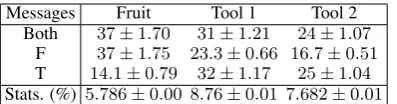
Table 2: Semantic classifier % accuracy mean and SEM over successful training seeds.
ues and bilateral communication compared to the no-memory ablation. Finally, the respective posi-tions of the agents in the conversation no longer impact ME (ME1→2 ≈ ME2→1). This might be because, with memory, the starting agent can iden-tify whether it is at turn t = 0, where it almost always chooses to continue the game to send and receive more information via communication. In-tervening on the dummy initialization message has a lower influence, resulting in lower ME2→1.
4.2 Conversation semantics
Having ascertained that our agents are conduct-ing bidirectional conversations, we next try to de-code what are thecontentsof such conversations. To do this, we train separate classifiers to pre-dict, from the message exchanges in successful in-domain test game, what are Fruit, Tool 1, Tool 2 in the game.6 Consider for example a game in which fruit is apple and tools 1 and 2 knife and spoon, respectively. If the message-based classi-fiers are, say, able to successfully decodeapplebut not knife/spoon, this suggests that the messages are about the fruit but not the tools. For each pre-diction task, we train classifiers (i) on the whole conversation, i.e., both agents’ utterances (Both), and (ii) on either Player’s utterances: Fruit (F) or Tool only (T). For comparison, we also report accuracy of a baseline that makes guesses based on the train category distribution (Stats), which is stronger than chance. We report mean accuracy and SEM across successful training seeds. Sup-plementary Section 5 provides further details on classifier implementation and training.
The first row of Table2shows that the conversa-tion as a whole carries informaconversa-tion about any ob-ject. The second and third show that the agents are mostly conveying information about their respec-tive objects (which is very reasonable), but also, to a lesser extent, but still well above baseline-level,
6We focus on the in-domain set as there are just 5 transfer
fruit categories. We also tried predicting triples at once with a single classifier, that consistently reached above-baseline but very low accuracies.
about the other agent’s input. This latter obser-vation is intriguing. Further work should ascer-tain if it is an artifact of fruit-tool correlations, or pointing in the direction of more interesting lin-guistic phenomena (e.g., asking “questions”). The asymmetry between Tool 1 and 2 would also de-serve further study, but importantly the agents are clearly referring to both tools, showing they are not adopting entirely degenerate strategies.7
We tentatively conclude that the agents did de-velop the expected semantics, both being able to refer to all objects in the games. Did they however developedsharedconventions to refer to them, as in human language? This would not be an unrea-sonable expectation, since the agents are symmet-ric and learn to play both roles and in both posi-tions. Following up on the idea of “self-play” of
Graesser et al.(2019), after a pair of agents A and B are trained, we replace at test time agent B’s em-bedders and modules with those in A, that is, we let one agent play with a copy of itself. If A and B are speaking the same language, this should not affect test performance. Instead, we find that with self-play average game performance drops down to 67% and 65% in in-domain and transfer test sets, respectively. This suggests that the agents de-veloped their own idiolects. The fact that perfor-mance is still above chance could be due to the fact that the latter are at least partially exchangeable, or simply to the fact that agents can still do reason-ably well by relying on knowledge of average tool usefulness (self-play performance is below that of the communication-less agents in Table 1). To decide between these interpretations, we trained the semantic classifier on conversations where A is the Fruit Player and B the Tool Player, testing on conversations about the same inputs, but where the roles are inverted. The performance drops down to the levels of the Stats baseline (Supple-mentary TableA5), supporting the conclusion that non-random performance is due to knowledge ac-quired by the agents independently of communica-tion, and not partial similarity among their codes.
5 Related work
GamesAmong the long history of early works that model language evolution between agents (e.g.
7
Steels, 2003; Brighton et al., 2003), Reitter and Lebiere (2011) simulate human language evolu-tion with a Picevolu-tionary type task. Most recently, with the advent of neural network architectures, literature focuses on simple referential games with a sender sending a single message to a receiver, and reward depending directly on communication success (e.g., Lazaridou et al., 2017; Havrylov and Titov, 2017; Lazaridou et al., 2018). Evti-mova et al. (2018) extend the referential game presenting the sender and receiver with referent views in different modalities, and allowing mul-tiple message rounds. Still, reward is given di-rectly for referential success, and the roles and turns of the agents are fixed. Das et al. (2017) generalize Lewis’ signaling game (Lewis, 1969) and propose a cooperative image guessing game between two agents, a question bot and an answer bot. They find that grounded language emerges without supervision.Cao et al.(2018) (expanding onLewis et al.,2017) propose a setup where two agents see the same set of items, and each is pro-vided with arbitrary, episode-specific utility func-tions for the object. The agents must converge in multi-turn conversation to a decision about how to split the items. The fundamental novelty of our game with respect to theirs is that our rewards de-pend on consistent, realistic commonsense knowl-edge that is stable across episodes (hammers are good to break hard-shell fruits, etc.). Mordatch and Abbeel (2018) (see also Lowe et al., 2017) study emergent communication among multiple (> 2) agents pursuing their respective goals in a maze. In their setup, fully symmetric agents are encouraged to use flexible, multi-turn communi-cation as a problem-solving tool. However, the independent complexities of navigation make the environment somewhat cumbersome if the aim is to study emergent communication.
Communication analysis Relatively few pa-pers have focused specifically on the analysis of the emergent communication protocol. Among the ones more closely related to our line of inquiry,
Kottur et al. (2017) analyze a multi-turn signal-ing game. One important result is that, in their game, the agents only develop a sensible code if the sender is deprived of memory across turns. Ev-timova et al.(2018) study the dynamics of agent confidence and informativeness as a conversation progresses. Cao et al. (2018) train probe classi-fiers to predict, from the messages, each agent
util-ity function and the decided split of items. Most directly related to our pragmatic analysis, Lowe et al.(2019), who focus on simple matrix commu-nication games, introduce the notions of positive signaling (an agent sends messages that are related to its state) and positive listening (an agent’s be-haviour is influenced by the message it receives). They show that positive signaling does not en-tail positive listening, and commonly used metrics might not necessarily detect the presence of one or the other. We build on their work, by focus-ing on the importance of mutual positive listenfocus-ing in communication (our “bilateral communication” measure). We further refine the causal approach to measuring influence they introduce. Jaques et al.
(2018) also use the notion of causal influence, both directly as a term in the agent cost function, and to analyze their behaviour.
6 Discussion
We introduced a more challenging and arguably natural game to study emergent communication in deep network agents. Our experiments show that these agents do develop genuine communication even when (i) successful communicationper seis not directly rewarded; (ii) the observable environ-ment already contains stable, reliable information helping to solve the task (object affordances); and (iii) the agents are not artificially forced to rely on communication by erasing their memory. The lin-guistic exchanges of the agents are not only lead-ing to significantly better task performance, but can be properly pragmatically characterized as di-alogues, in the sense that the behaviour of each agent is affected by what the other agent says. Moreover, they use language, at least in part, to denote the objects in their environment, showing primitive hallmarks of a referential semantics.
groups. Conversely, equipping the agents with a feedback loop in which they also receive their own messages as input might encourage shared codes across speaker and listener roles.
In the current paper, we limited ourselves to one-symbol messages, facilitating analysis but greatly reducing the spectrum of potentially emer-gent linguistic phenomena to study. Another im-portant direction for future work is thus to endow agents with the possibility of producing, at each turn, a sequence of symbols, and analyze how this affects conversation dynamics and the communi-cation protocol. Finally, having shown that agents succeed in our setup, we intend to test them with larger, more challenging datasets, possibly involv-ing more realistic perceptual input.
Acknowledgments
We thank Rahma Chaabouni, Evgeny Kharitonov, Emmanuel Dupoux, Maxime Oquab and Jean-R´emi King for their useful discussions and in-sights. We thank David Lopez-Paz and Christina Heinze-Deml for their feedback on the causal in-fluence of communication. We also thank Fran-cisco Massa for his help on setting up the experi-ments.
References
L´eon Bottou, Jonas Peters, Joaquin Qui˜nonero-Candela, Denis X. Charles, D. Max Chickering, Elon Portugaly, Dipankar Ray, Patrice Simard, and Ed Snelson. 2013. Counterfactual reasoning and learning systems: The example of computational ad-vertising. Journal of Machine Learning Research, 14:3207–3260.
Diane Bouchacourt and Marco Baroni. 2018. How agents see things: On visual representations in an emergent language game. In Proceedings of EMNLP, pages 981–985, Brussels, Belgium.
Henry Brighton, Simon Kirby, and Kenneth Smith. 2003.Situated cognition and the role of multi-agent models in explaining language structure., volume 2636, pages 88–109. Springer-Verlag GmbH.
Kris Cao, Angeliki Lazaridou, Marc Lanctot, Joel Z. Leibo, Karl Tuyls, and Stephen Clark. 2018. Emer-gent communication through negotiation. In Pro-ceedings of ICLR.
Edward Choi, Angeliki Lazaridou, and Nando de Fre-itas. 2018. Compositional obverter communication learning from raw visual input. InProceedings of ICLR Conference Track, Vancouver, Canada. Pub-lished online: https://openreview.net/
group?id=ICLR.cc/2018/Conference.
Abhishek Das, Satwik Kottur, Jos´e M. F. Moura, Ste-fan Lee, and Dhruv Batra. 2017. Learning coop-erative visual dialog agents with deep reinforcement learning. In2017 IEEE International Conference on Computer Vision (ICCV).
Katrina Evtimova, Andrew Drozdov, Douwe Kiela, and Kyunghyun Cho. 2018. Emergent com-munication in a multi-modal, multi-step refer-ential game. In Proceedings of ICLR Con-ference Track, Vancouver, Canada. Published online: https://openreview.net/group?
id=ICLR.cc/2018/Conference.
Laura Graesser, Kyunghyun Cho, and Douwe Kiela. 2019. Emergent linguistic phenomena in multi-agent communication games.CoRR.
Serhii Havrylov and Ivan Titov. 2017. Emergence of language with multi-agent games: Learning to com-municate with sequences of symbols. In Proceed-ings of NIPS, pages 2149–2159, Long Beach, CA, USA.
Natasha Jaques, Angeliki Lazaridou, Edward Hughes, C¸ aglar G¨ulc¸ehre, Pedro A. Ortega, DJ Strouse, Joel Z. Leibo, and Nando de Freitas. 2018. Intrinsic social motivation via causal influence in multi-agent RL.CoRR, abs/1810.08647.
Emilio Jorge, Mikael K˚ageb¨ack, and Emil Gustavsson. 2016. Learning to play Guess Who? and invent-ing a grounded language as a consequence. In Pro-ceedings of the NIPS Deep Reinforcement Learn-ing Workshop, Barcelona, Spain. Published on-line: https://sites.google.com/site/
deeprlnips2016/.
Satwik Kottur, Jos´e Moura, Stefan Lee, and Dhruv Ba-tra. 2017. Natural language does not emerge ‘nat-urally’ in multi-agent dialog. In Proceedings of EMNLP, pages 2962–2967, Copenhagen, Denmark.
Angeliki Lazaridou, Karl Moritz Hermann, Karl Tuyls, and Stephen Clark. 2018. Emergence of linguistic communication from referential games with sym-bolic and pixel input. In Proceedings of ICLR Conference Track, Vancouver, Canada. Published online: https://openreview.net/group?
id=ICLR.cc/2018/Conference.
Angeliki Lazaridou, Alexander Peysakhovich, and Marco Baroni. 2017. Multi-agent cooperation and the emergence of (natural) language. InProceedings of ICLR Conference Track, Toulon, France. Pub-lished online: https://openreview.net/
group?id=ICLR.cc/2017/conference.
Sang-Woo Lee, Yu-Jung Heo, and Byoung-Tak Zhang. 2017. Answerer in questioner’s mind for goal-oriented visual dialogue. https://arxiv.
org/abs/1802.03881.
Mike Lewis, Denis Yarats, Yann Dauphin, Devi Parikh, and Dhruv Batra. 2017. Deal or no deal? End-to-end learning of negotiation dialogues. InProceedings of EMNLP, pages 2443–2453, Copenhagen, Denmark.
Wentian Li. 2002. Zipf’s law everywhere. Glottomet-rics, 5:14–21.
Ryan Lowe, Jakob Foerster, Y-Lan Boureau, Joelle Pineau, and Yann Dauphin. 2019. Measuring emer-gent communication is tricky. InProceedings of AA-MAS, Montreal, Canada. In press.
Ryan Lowe, Yi Wu, Aviv Tamar, Jean Harb, Pieter Abbeel, and Igor Mordatch. 2017. Multi-agent actor-critic for mixed cooperative-competitive envi-ronments. InNIPS, pages 6382–6393.
Ken McRae, George Cree, Mark Seidenberg, and Chris McNorgan. 2005. Semantic feature production norms for a large set of living and nonliving things.
Behavior Research Methods, 37(4):547–559.
Igor Mordatch and Pieter Abbeel. 2018. Emergence of grounded compositional language in multi-agent populations. In AAAI, pages 1495–1502. AAAI Press.
Judea Pearl, Madelyn Glymour, and Nicholas Jewell. 2016. Causal Inference in Statistics: A Primer. John Wiley & Sons.
David Reitter and Christian Lebiere. 2011. How groups develop a specialized domain vocabulary: A cognitive multi-agent model. Cognitive Systems Re-search, 12:175–185.
Carina Silberer, Vittorio Ferrari, and Mirella Lapata. 2013. Models of semantic representation with visual attributes. In Proceedings of ACL, pages 572–582, Sofia, Bulgaria.
Luc Steels. 2003. Evolving grounded communication for robots. Trends in cognitive sciences, 7:308–312.
Michael Tomasello. 2014. A Natural History of Human Thinking. Harvard University Press, Cambridge, MA.