3816
Learning to Abstract
for Memory-augmented Conversational Response Generation
Zhiliang Tian,1,3∗ Wei Bi,2 Xiaopeng Li,1,3 Nevin L. Zhang1,3 1Department of Computer Science and Engineering,
The Hong Kong University of Science and Technology, Hong Kong
2Tencent AI Lab, Shenzhen, China
3HKUST-Xiaoi Joint Lab, Hong Kong
[email protected] [email protected] {xlibo,lzhang}@cse.ust.hk
Abstract
Neural generative models for open-domain chit-chat conversations have become an ac-tive area of research in recent years. A criti-cal issue with most existing generative models is that the generated responses lack informa-tiveness and diversity. A few researchers at-tempt to leverage the results of retrieval mod-els to strengthen the generative modmod-els, but these models are limited by the quality of the retrieval results. In this work, we pro-pose a memory-augmented generative model, which learns to abstract from the training cor-pus and saves the useful information to the memory to assist the response generation. Our model clusters query-response samples, ex-tracts characteristics of each cluster, and learns to utilize these characteristics for response generation. Experimental results show that our model outperforms other competitive base-lines.
1 Introduction
Automatic human-computer dialogue / conversa-tion is a core topic in natural language process-ing. There is a boom in research on open-domain chit-chat dialogue systems due to the availability of vast conversational data online. Most existing models of dialogue systems can be divided into retrieval-based models and generative models.
Given a query, retrieval-based (Jiet al.,2014) models search for the most similar query stored in the training corpus and directly copy its cor-responding response as the result. These mod-els cannot create new replies customized for the given queries. Generative models (Shang et al.,
2015) learn a query-response mapping to generate responses by maximizingP(r|q), where q is the input query andris the response. The most popu-lar generative model is the Sequence-to-Sequence
∗
Work done while Zhiliang Tian was collaborating with Tencent AI Lab.
Query Response
Memory
Wheredid you gofor holiday? Fine weather todayin Chicago! I like the weather today. There are many placesfor tour.
Which cityto travelnext time?
I traveled toTibet. Sure, sunny in Chicago. It is too hot for me. Yes, especiallymuseums. Maybe New York.
(weather, today) (sunny, hot) Learn to Abstract
Any places for traveling
this weekend?
Travel toNew York’s
museumfor this weekend.
Training corpus
Input Output
(place, travel) (Tibet, New York, museum)
key1 value1
key2 𝑘?@ 𝑘A@ 𝑘@@ 𝑘B@ value2 𝑣?@ 𝑣A@ 𝑣@@ 𝑣B@
𝑘?A 𝑘AA 𝑘@A . . . 𝑘BA 𝑣?A 𝑣AA 𝑣@A . . . 𝑣BA
[image:1.595.308.525.224.389.2]. . . .
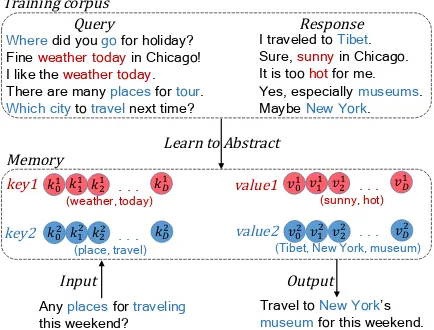
Figure 1: An example of abstracting training corpus and memorizing their characteristics in the form of key vectors and value vectors. Redandblueindicate two clusters. The input query matches theblueone and gen-erates the response assisted by information collected from the last two training samples.
(Seq2Seq) model (Sutskeveret al., 2014), which generates new utterances tailored for queries and achieves high coherence between queries and gen-erated utterances. However, existing generative models often generate uninformative and univer-sal responses (Liet al.,2016a).
To address these issues, several researchers leverage retrieved resultsR to augment the infor-mation used in generative models. Such methods are called retrieval-augmented generative models and their objectives are to maximize P(r|q, R), whereRis one or a few (at most 3 in practice) re-trieved results. Particularly, some researchers (Li
et al.,2017;Zhuanget al.,2017;Songet al.,2018) build the combination of retrieval and generative models, which retrieve one or a few responsesr+, and then feeds both the query q and r+ into the generative model to maximize P(r|q, R = r+).
number of retrieved results due to their model ar-chitecture. Wuet al.(2018) edit the retrieved re-sponser+ with the Seq2Seq model based on the lexical differences between the input queryq and its retrieved queryq+, whose objective is to max-imize P(r|q, R = hr+, q+i). It edits retrieved responses r+ to make them relevant to queries, but their edited results rely heavily on the sen-tence pattern ofr+. Generally, the responses from such models are more informative and diverse than those from plain generative models, while main-tain better relevance than the retrieved responses.
Although current retrieval-augmented genera-tive models have achieved promising results, they still have following weaknesses: Firstly, they are limited by the quality of the retrieved results. Retrieval results are less coherent and relevant with query than generative models’ (Song et al.,
2018). Irrelevant retrieved results would mislead the response generation. Secondly, these models can only utilize individual retrieved results, which makes the generation sensitive to those results, leading to a high variance in the performance. Moreover, the information from very few retrieved results may not be sufficient to enrich the response generation.
In this paper, we propose a memory-augmented generative model that memorizes and utilizes the common characteristics M of groups of query-response (q-r) pairs to enhance the response gen-eration by maximizingP(r|q, M). The advantage is that our model is less sensitive to the quality of individualq-r pairs and hence increases the ro-bustness of response generation.
In particular, we divide the training corpus into multiple groups by clustering, extract common characteristics of each group, and learn to utilize the characteristics to assist generation. The idea is illustrated in Figure1(top), the training corpus is divided into two sets of closely related queries and their responses. We abstract query-response relationship hidden in those q-r pairs, save them to the memory (Figure 1 bottom), and use those relationships for response generation.
Our contributions can be summaried as:
1. We are the first to extract information from clusters of query-response pairs using a learnable memory, and to use the information to enhance the performance of conversation systems.
2. We propose a novel framework where the Seq2Seq, autoencoder and clustering model are
jointly trained to abstract the training corpus and generate responses.
3. Our model outperforms state-of-the-art gen-erative models and retrieval-augmented gengen-erative models in single-round conversation scenarios.
2 Related Work
Generative models build dialogue systems via end-to-end training.Ritteret al.(2011) first regard response generation as query-to-response transla-tion. Following that, Shang et al.(2015) imple-ment an end-to-end dialogue system borrowing the Seq2Seq model, whileLiet al.(2016b) replace the maximum likelihood criterion with maximum mu-tual information (MMI) to deal with the universal response issue of the seq2seq.
The retrieval-based models are another branch in building dialogue systems. Jiet al.(2014) pro-pose to apply information retrieval techniques to search for related queries and replies. Zhouet al.
(2016) andYanet al.(2016) improve it by neural networks.
Recently, several researchers (Songet al.,2018;
Li et al., 2017; Zhuang et al., 2017) propose to merge retrieval-based models and generative mod-els. Caiet al.(2018) generate the response ton from the retrieved results and revise the skele-tons to get the response. Guu et al. (2018) use the Seq2Seq model to edit a prototype from the retrieved results for text generation andWuet al.
(2018) leverage context lexical differences to edit prototypes for conversation.
There are some other directions to enhance gen-erative models by adding additional information. Some of them introduce the knowledge base to conversation models, which provide task-specific knowledge (Madottoet al.,2018;Wuet al.,2019) or lexical knowledge to text generation (Younget al.,2018;Parthasarathi and Pineau,2018). Some other directions are to maintain sample-level tem-porary memory.Westonet al.(2014),Shanget al.
(2015),Serbanet al.(2016),Tianet al.(2017) and
Leet al.(2018) memorize the previous utterances
3 Models
3.1 Model Architecture
Our model consists of two components: a ory module and a generative model. The mem-ory module divides the training corpus into multi-ple groups of query-response pairs, and it extracts and memorizes the essential query-response cor-respondence information hidden in each group of pairs. The generative model generates responses for input queries and, while doing so, takes in-formation stored in the memory module into con-sideration. It also learns the representations of queries and responses that are used in the memory module.
3.2 Query-Response Memory Module
Our memory module consists ofK memory slots, and each memory slot is a pair containing a key cell and its corresponding value cell. Given a query, we search for the most similar key and out-put its corresponding value. Both the keys and the values are real-value vectors. They are called key embeddings and value embeddings respectively, and denoted askiandvi.
We group queries in the training corpus intoK
clusters. Each query is embedded as a vector. So, it makes sense to talk about the centerki of each query clusteri. The centerki is used as a key in our memory module. The corresponding valuevi is a vector that captures the common characteris-tics of the responses to queries in clusteri. We will say more aboutkiandvilater.
Read Operation.In our model, the input of Read
Operation is the current query’s representationeq
from the generative model. Given theeq, the Read
Operation addresses the memory by the similar-ity between the current queryeqand every
memo-rized key embeddingki, in which we apply a dot-product operation to measure the similarity.
We design two modes to fetch the value: Soft Read is a weighted summation over all K value embeddings in the whole memory according to the normalized similarity scores (Eq.1). Hard Read
is to fetch the value embedding whose key embed-ding is most similar to the current queryeq(Eq.2).
Finally, it returns the value as the output of the
read operation.
SoftRead(eq) =
K
X
i=1
αivi,
αi =sof tmax(ki•eq).
(1)
HardRead(eq) ={vi|i= K argmax
i=1
(ki•eq)}. (2)
Write Operation. We collect the query
represen-tationeq’s and the response representationer’s of
all the training samples from the generative model, and then conductK class K-Means clustering us-ingeq’s. We let the center of thei-th clusterCibe key embeddingki, and let the average of the rep-resentations of the responses to queries in Ci be value embeddingvi(Eq.3).
vi=
P
j∈Cierj |Ci|
. (3)
In this way, each key embeddingkigathers sim-ilar queries together and obtains their represen-tative information by fetching their cluster cen-ter. Each value embedding vi retains the com-mon characteristics of a group of responses er
whose queries are similar. Hence, the pairhki,vii can be regarded as an abstraction of the query-response correspondence relationship hidden in thei-th cluster of queries and their responses. We can control the granularity of the abstraction by varying the number of clustersK.
In an extreme setting, if we set the memory size
K equal to the training corpus size and use the hard read operation, our model nearly degener-ates into a retrieval-augmented generative model. In this case, the generation relies on only one re-trieved sample, the generated response becomes sensitive to the quality of that single sample and is restrained by the pattern of the single sample.
3.3 Memory-Augmented Response
Generative Model
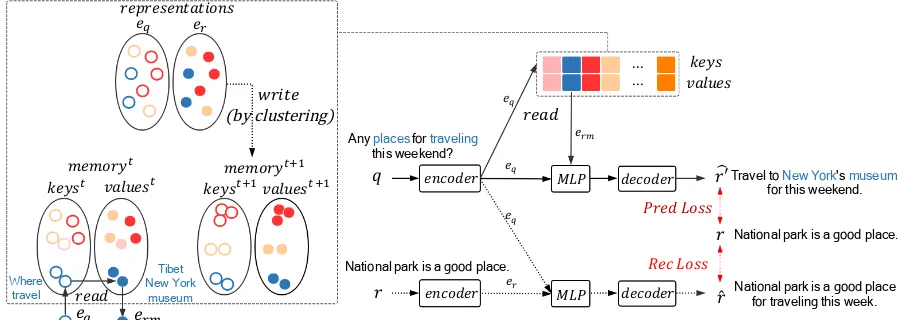
Our overall model consists of two branches (Fig-ure 2). The top branch is a memory-augmented Seq2Seq (M-Seq2Seq) model that is used for re-sponse generation. The lower branch is a condi-tional autoencoder (CAE) that is used to learn re-sponse representations necessary for the memory writing.
The input to the M-Seq2Seq branch is a query
𝑞
𝑟
𝑒$% Any places for traveling
this weekend?
National park is a good place. 𝑟𝑒𝑎𝑑
𝑒( 𝑒$%
𝑤𝑟𝑖𝑡𝑒 (by clustering)
𝑟𝑒𝑎𝑑 Where
travel
Tibet New York
museum 𝑟̂
𝑟′=
𝑟
Travel toNew York'smuseum for this weekend.
National park is a good place for traveling this week. National park is a good place. 𝑃𝑟𝑒𝑑 𝐿𝑜𝑠𝑠
𝑅𝑒𝑐 𝐿𝑜𝑠𝑠
𝑒$ 𝑒( 𝑒( 𝑒( 𝑒( 𝑒$
𝑟𝑒𝑝𝑟𝑒𝑠𝑒𝑛𝑡𝑎𝑡𝑖𝑜𝑛𝑠
𝑘𝑒𝑦𝑠H 𝑣𝑎𝑙𝑢𝑒𝑠H 𝑘𝑒𝑦𝑠HLM𝑣𝑎𝑙𝑢𝑒𝑠HLM 𝑒𝑛𝑐𝑜𝑑𝑒𝑟
𝑒𝑛𝑐𝑜𝑑𝑒𝑟 𝑑𝑒𝑐𝑜𝑑𝑒𝑟 𝑑𝑒𝑐𝑜𝑑𝑒𝑟 𝑀𝐿𝑃
𝑀𝐿𝑃 𝑚𝑒𝑚𝑜𝑟𝑦HLM
𝑚𝑒𝑚𝑜𝑟𝑦H
[image:4.595.71.521.64.224.2]𝑘𝑒𝑦𝑠 𝑣𝑎𝑙𝑢𝑒𝑠
Figure 2: The architecture of our model. Solid arrows show both the training and generation (testing) processes; dashed arrows show the training process. The left part shows how to read memory att-th step and write to update the memory fromt-th to(t+1)-th step, wheretindicates the step of updating the memory. The callout illustrates that a query matches the blue memory slot and reads its value“Tibet”,“New York”, and“museum”to promote its response generation. “Pred Loss” and “Rec Loss” mean the prediction and reconstruction loss respectively.
representationeq =Encoder(q). The memory is
then read using eq as the key, and the output of
the memory read iserm. After that,eq anderm
are merged by an MLP (multi-layer perceptron), and then the merged results are fed into the de-coder to decode the final responserˆ0, which is the
generated response for the queryq. The objective function for this branch is the first term of Eq.8
During training, we feed hq, ri pairs to our model. The query q is fed to the M-Seq2Seq branch, while the corresponding responseris fed to the CAE branch. Similar to the previous case,
r is first pushed through to get a representation er = Encoder(r). Then both eq ander are fed
to an MLPand then a decoder. The output is rˆ, a reconstructed version of r. The reconstruction loss is the second term of Eq. 8. We formalize the operations of M-Seq2Seq and CAE by Eq.4to Eq.7.
Note thateqis feed to the CAE for two reasons.
First, it makes the embeddinger ofr dependent
on the embeddingeq ofq. Second, it makes the
two branches work in a similar fashion so that the representaions learnt by CAE is adaptive to M-Seq2Seq. The CAE branch tries to reconstruct ˆr
fromerandeq, while the M-Seq2Seq tries to
gen-erate an appropriate responserˆ0frome
qanderm.
erm can be viewed as a rough estimation of er
and hence is helpful in improving the quality of the generated response.
eq =Encode(q), er =Encode(r), (4)
erm =Read(eq), (5)
z=M LP([er,eq]), z0=M LP([erm, eq]),
(6)
ˆ
r=Decode(z), rˆ0=Decode(z0). (7)
The overall objective function contains two parts as shown in Eq.8: the prediction loss (first term) is derived from the general objective of the retrieval- or memory-augmented generative mod-elsmaxP(r|q, M), where we setM = erm for
our model. The reconstruction loss (second term) is for learning the representations by reconstruct-ingr, whose target is to improve the memory mod-ule so as to improve the erm for enhancing the
generative model. In addition,λis a factor to bal-ance the losses.
L=Eq,r∼DlogP(ˆr|q,erm)
+λ·Eq,r∼DlogP(ˆr|q, r).
(8)
3.4 Joint Training and Generation
In the generative model training phase, we train and update the model while keeping the memory module read-only. The generative model reads from the memory, trains to update itself, and col-lects representations eq’s ander’s in preparation
for memory writing. In the memory writing phase, parameters of the generative model are fixed. We conduct the clustering over all representationseq’s
ander’s collected from generative model training,
and then write the results into the memory. For response generation (testing) phase, we only rely on the M-Seq2Seq branch and the mem-ory module in the read-only mode, since we can-not observe ther during generation. As indicated by the solid lines in Figure2, it encodesq to ac-quireeq, reads out estimated responseermby the
Read Operation, and goes through the MLP and decoder to generaterˆ.
4 Experimental Settings
4.1 Dataset
In our experiments, we validate the performance of our model on the context-independent (single-round) conversation task setting in which each sample is a query-response (q-r) pair. We utilize the benchmark dataset (Shanget al.,2015), which collects about 4 millionsq-r pairs from a popular Chinese social network website, Weibo.1 For both testing set and validation set, we randomly select 900 queries, and then select randomly 5 responses under each query, thus both our testing set and val-idation set consist of 4.5k samples. Sentences are tokenized into word sequences with the Jieba word segmentation tool.2The vocabulary consists of the top 50k tokens (a mixture of Chinese words and characters), covering 99.98% words in this corpus, and all the out-of-vocabulary words are replaced withhUNKi.
4.2 Implementation Details
We implement the query and response encoder with a one-layer bi-directional GRU, and the de-coder with a one-layer GRU and attention mecha-nism (Bahdanau et al.,2015). We apply the idea of variantial autoencoder (Kingma and Welling,
2014;Zhao et al., 2017) into our model: before
the MLP, we use the neural network to estimate the distribution of response vector, sample the vec-tor by reparameterization, then feed it into MLP.
1
www.weibo.com 2github.com/fxsjy/jieba
Parameters of the query encoder and response en-coder are not shared; the two MLP components in M-Seq2Seq branch and CAE branch also do not share parameters. The dimension of all hidden vectors and embeddings are 620 and the batch size is 64. We employ the Adam optimizer (Kingma and Ba,2014) with the initial learning rate 0.0001 and gradient clipping 5. For generation, we apply a beam search with the size of 10. The memory size K is 1000, and the loss factorλis 0.1. We implement our model on PyTorch. The implemen-tation details can be found in our codes3.
4.3 Baselines
We compare two versions of our proposed memory-augmented generative model (MemGM), i.e. MemGM with SoftRead (MemGM-S) and MemGM with HardRead (MemGM-H), with the following methods:
1. Seq2Seq. The standard Seq2Seq with the
at-tention mechanism (Bahdanauet al.,2015) in the decoder and the beam search during generation.
2. MMI (Li et al., 2016b). We implement
the MMI-bidi model that re-ranks the candidate responses by the maximum mutual information (MMI) criterion in the beam search to promote re-sponse diversity.
3. CVAE. The conditional variational autoen-coders applied in conversation systems (Zhao et al.,2017). We follow the their implementation and adapt it in our single-round conversation setting.
4. EditRetrieve (Wu et al., 2018). The
state-of-the-art retrieval-augmented generative model, which uses the information of the top-1 retrieved response to guide the response generation.
4.4 Evaluation Metric
Following previous work on response genera-tion (Liet al.,2016b;Yaoet al.,2017), we evalu-ate all competing methods by both automatic rics and human evaluations. The automatic met-rics are::
1. Bleu 1-4. Bleu N(Papineniet al.,2002) mea-sures theN-gram matching between generated re-sponses with the ground-truth rere-sponses.
Automatic Metrics Human Annotate Bleu1,Bleu2,Bleu3,Bleu4 Sim-A, Sim-M Dist1,Dist2 Entropy Quality Info Seq2Seq 39.98 14.68 6.452 3.227 0.291 0.911 0.043 0.153 7.609 2.33 1.71 MMI 40.08 14.71 6.467 3.236 0.288 0.910 0.053 0.183 7.724 2.39 1.63 CVAE 39.85 14.80 6.318 3.012 0.294 0.919 0.044 0.156 7.569 2.42 1.71 EditRetrieve 37.67 10.73 3.437 1.111 0.294 0.932 0.057 0.187 7.586 2.41 1.72 MemGM-S 41.29 15.94 8.0844.911 0.303 0.936 0.059 0.214 7.576 2.49 1.70 MemGM-H 41.40 16.06 8.2894.872 0.300 0.935 0.062 0.218 7.684 2.56 1.75
Table 1: The overall performance for all competing methods on quality, relevance, diversity and informativeness.
2. Sim-A, Sim-M. They measure the relevance between the query and its response by their word embedding cosine similarity. Sim-Ais the similar-ity between two sentence-level embeddings com-posed by averaging all word embeddings, while Sim-Mis maximal word-word similarity among all the words of two sentences as (Liuet al.,2016).
3. Dist 1-2. Distinct-1 and Distinct-2 (Liet al.,
2016b) are the metrics to evaluate the diversity of generated responses, which count the percentage of unique unigrams and bigrams among all test re-sponses.
4. Entropy. It measures the informativeness of generated responses proposed by (Mou et al.,
2016), which is computed by averaging over all the character-level entropy within responses.
For human evaluations, we hire five annotators from a commercial annotation company to an-notate 250 randomly selected test samples. Re-sponses generated by different models are shuffled for each annotator. The annotators evaluate these samples on two aspects: the overall quality ( Qual-ity) and the informativeness (Info). We conduct a 5-scale rating onQuality: 1 point for a response ir-relevant to the query, 3 points for a valid but mean-ingless response, 5 points for a coherent and ap-propriate response without typos. Points of 2 and 4 are for decision dilemmas. We also conduct a 3-scale rating on Info: 1 point for the universal response or the response containing no more than three unique words, 2 points for a normal response of a single clause or a single topic, and 3 points for an informative response including at least two clauses of different topics, which transfer the cur-rent conversation to another scenario (For exam-ple, the query is “How’s the weather?”; and re-sponse “It’s fine today, let’s play basketball” trans-fers the weather topic to sports, which should be marked as 3 points).
5 Experimental Results and Analysis
5.1 Overall Performance
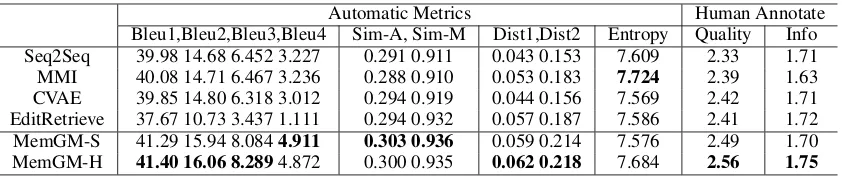
We report both the automatic metrics and hu-man evaluation results of MemGM compared with other methods in Table 1. MMI scores higher than Seq2Seq onDist-1&2owing to its re-ranking mechanism to promote the response diversity. CVAE has a similar performance to the Seq2Seq model. EditRetrieve outperforms Seq2Seq, MMI and CVAE on most metrics. But EditRetrieve un-derperforms on Bleu scores since retrieval mod-els do not learn a query-to-response mapping and their ability of matching with the ground-truth is naturally lower.
MemGM gets the highest scores under most metrics, indicating that our model outperforms current methods on quality, relevance, diver-sity and informativeness. The improvement of MemGM-H’s Bleu-3&4(+28.2% and +48.6% in comparison with Seq2Seq) indicates the memory module can extract and memorize trigram and 4-gram response patterns to enhance the generated responses.
For the two versions of our models, HardRead outperforms SoftRead on most metrics. This phe-nomenon indicates that fetching a single top mem-orized piece of information would be more help-ful than fetching a mixture of multiple memory slots with multiple topics for generative models. Thus, in MemGM, HardRead is the proper mode for reading memory.
5.2 Impact of Memory Size
To investigate how the memory capacity influ-ences the performance of MemGM, we carry out experiments on MemGM-H with a various mem-ory sizeKand show the results in Table2 (omit-tingBleu-3&4andSim-Mdue to limited space).
them individually. The difference between them is that K = |D| reads the memory based on the simple similarity between two vectors eq and ki instead of searching the corpus via mature infor-mation retrieval technique, which is usually an en-semble of several text matching methods includ-ing similarity of query embeddinclud-ings. That makes the query matching ofK =|D|less accurate and unstable, thus its relevance and quality are weaker than EditRetrieval (Table1) but does better on di-versity. We treat K = |D| and other results in Table2as the comparison between individual and groupedq-r pairs on memory-augmented frame-work.
Bleu1,Bleu2 Sim-A Dist1,Dist2 Entropy K=10 42.06 15.11 0.301 0.042 0.140 7.478
K=100 42.7515.42 0.300 0.043 0.141 7.526
K=1k 41.4016.06 0.300 0.062 0.218 7.684 K=10k 41.22 15.37 0.296 0.057 0.200 7.659
K=|D| 34.89 9.764 0.265 0.094 0.412 9.241
Table 2: The performance of MemGM-H with different memory sizeK, whereK = |D| means the extreme setting that each sample occupies a memory slot.
MemGM with a large memory size (K ≥10k) performs poorly on the response quality ( Bleu-1&2) and the relevance (Sim-A) compared with the MemGMs with small memory. Too large of the memory size leads to too small of the sample size under each memory slot, which increases the instability and lower the quality of each memory slot. Especially, the performance of K = |D| il-lustrates the individual retrieval results are not re-liable and usually lead to irrelevant results as the observation we will discuss in Sec5.4.
However, large memory MemGMs (K ≥1k) performs well on diversity (Dist-1&2) and infor-mativeness (Entropy), since the training corpus is partitioned into more memory slots and each slots contains more specific topics. And small memory MemGMs (K ≤10) result in low response diver-sity and informativeness. In conclusion,K=1k is the appropriate memory size to balance all aspects.
5.3 Contents of Memory
Our model is expected to cluster similar queries together to leverage the information of their re-sponses. In addition, each memory slot should own a group of closely related queries. To ver-ify the quality of the memory slots, we pick up the queries from the same memory slot and check the similarity between these queries.
General Topic Related
Entity
Overlap Total
|m| ≥1,000 350∼1,000 ≤350 –
[image:7.595.309.526.62.123.2]Cluster # 14 205 781 1,000 Query # 18,291 114,454 81,003 213,748 Query % 8.4% 54.4% 37.2% 100%
Table 3: The statistics on the size of memory slots (|m|), cluster number (Cluster #), query number (Query #), and query proportion over all queries (Query %) for the three memory slot types.
5 Queries under this Memory Slot
Case1: Topic Related Memory Slot
昨天在吉他店里,我们合作了一曲《猜谜到老》 (We play the ”guess forever” in guitar store yesterday)
快来听我唱的”至少还有你”。
(Listen to the “at least I have you” sung by me!) 天空之城吉他独奏,最好听的一个版本
(”Castle in the Sky”guitar solo, the best version to hear) 艾薇儿出道十年12首风靡全球的单曲超赞
(12 world-renowned songs since Avril debuted) 夕阳醉了,太好听了。
(”the Setting Sun is Drunk”. pleasant to hear.)
Case2: Entity Overlap Memory Slot
十年前的米米米兰兰兰,AC米兰
(Milan10 years ago, AC Milan)
摩纳哥600万打包报价沙拉维+博阿滕—-米米米兰兰兰体育 (Monaco offers 600 millions$
for Shaarawy and Boateng—-MilanSprots.)
全场比赛结束,乌迪内斯2 - 1米米米兰兰兰 (The whole match was over, Udinese 2:1Milan)
又是一件卡卡米米米兰兰兰时期的队服
(Another Kaka’s team uniform when he was inMilan) PPTV这俩解说一直在黑米米米兰兰兰啊
(The two PPTV’s commentators depreciatedMilan)
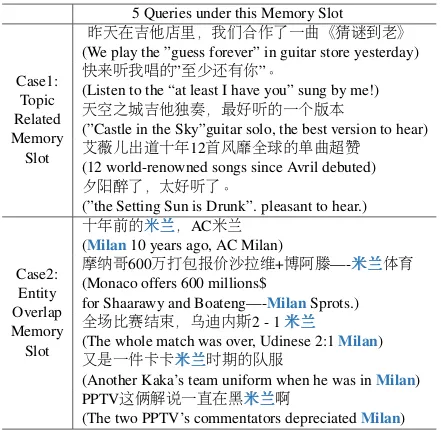
Table 4: Five randomly selected queries under each ex-ample of memory slots.
We find that the status of memory slots are dif-ferent under the difdif-ferent size of memory slot|m|, where |m| means how many queries are memo-rized in this memory slot. We divide the memory slots into three types by their size |m|and show their statistics information in Table3.
Topic-related Memory Slot (with size 350 <
|m|<1000roughly) has a clear topic and the top-ics of its queries are highly related. For example, the queries under the memory slot shown in Case1 (Table 4) are related to the music topic. There are 205 such slots covering 54.4% queries, which can supply helpful information within the same topic for response generation.
[image:7.595.308.530.193.408.2]slot, it can read the information from that mem-ory slot, which summarizes a group of utterances closely related to that entity.
General Memory Slot (|m| ≥1000) means the memory slot owning too many queries to have a clear topic, whose clustered queries have various topics and are not similar to each other. Fortu-nately, there are only 14 such slots influencing 8.4% queries.
In summary, most of the memory slots are of good quality and store useful information as we expect, which cover 91.6% of the queries.
5.4 Case Study
In this section, we first compare the cases from MemGM and EditRetrieve to analyze how MemGM exceeds the retrieval-augmented model. Then, we show two examples over all the methods to reveal the characteristics of different methods.
For the comparison between MemGM and Ed-itRetrieve, we analyze the good/bad cases where MemGM-H outperforms/underperforms EditRe-trieve and investigate the reasons.
4 10
8
0 2 4 6 8 10 12 14 16
Good Cases
Relevance(Misled by Word Overlap) Relevance(Topic Matching) Informativeness(Meaningful Words)
6
3 6
0 2 4 6 8 10 12 14 16
Bad Cases Relevance(Topic Matching) Quality(Advanced Words) Informativeness(Long Sentence)
Good Cases
(MemGM outperforms EditRetrieve) (MemGM underperforms EditRetrieve)Bad Cases
Figure 3: The reasons that MemGM outper-forms/underperforms EditRetrieve on human annotated cases.
We collect the good/bad cases from human an-notation results by this criterion: If more than four annotators marked the MemGM-H’sQuality score higher/lower than EditRetrieve’s by 2 points, this sample is the good/bad case. From all anno-tated samples, we obtain 22 good cases and 15 bad cases, and summarize the reasons in Figure3.
There are 3 reasons for the good cases where MemGM outperforms EditRetrieve, shown in the left side of Figure 3. Firstly, we observe a phe-nomenon from EditRetrieve’s results that the Ed-itRetrieve’s response has the word overlap with its query but is not related to the query at seman-tic level. The reason is that retrieval systems are highly reliant on the word matching, so they may retrieve fake results with high lexical similarity
but indeed low relevance. Therefore, that phe-nomenon is due to “misled by word overlap” and it leads to EditRetrieve’s irrelevant results on 4 cases where MemGM performs well. It indicates the re-trieval quality limits the performance of rere-trieval- retrieval-augmented models. Secondly, EditRetrieve’s re-sults mismatch the topics of given queries in 10 cases, where MemGM can generate relevant re-sponses. Thirdly, MemGM outperforms EditRe-trieve in 8 cases due to containing more meaning-ful words in MemGM’s responses, where mean-ingful words means the notional words carrying the specific topic information.
To summarize the good cases, the major ad-vantage of MemGM is the high relevance with queries compared with EditRetrieve. The per-formance onSim-A andSim-M(Table 1) verifies that MemGM exceeds EditRetrieve on relevance. Note that the retrieval-augmented models are sen-sitive to the quality of retrieved results; if retrieved query-response pairs are irrelevant to the query, utilizing such information would lead to topic drift and the generation of irrelevant responses.
There are 3 reasons for MemGM underperform-ing EditRetrieve (Figure3right). Firstly, MemGM also suffers from irrelevant responses due to mis-matching the topic of queries. However, in terms of the relevance, the number of the MemGM’s bad cases (6 cases) is much fewer than its good cases’ (14 cases). Secondly, 3 cases of EditRetrieve are of higher quality owing to the suitable use of ad-vanced and low-frequency words. Thirdly, 6 re-sponses from EditRetrieve are longer and carry more information.
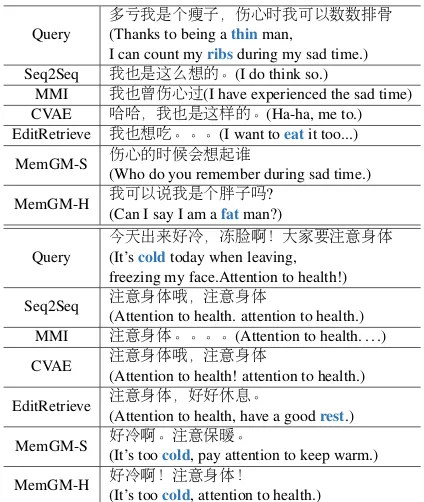
Two examples in Table 5show the model per-formance. In the first case, EditRetrieve is misled by “ribs”; it treats “ribs of human” as “pork ribs” and responds an utterance related to “food” topic. MemGMs understand the topic and generate in-formative responses. In the second case, Seq2Seq, CVAE and MMI only respond by simply repeat-ing the query. EditRetrieve can brrepeat-ing in a new word ”rest” related to the query. MemGMs cap-ture the “cold” from the given query and respond utterances related to both “cold” and “health”.
6 Conclusion
individ-Query
多亏我是个瘦子,伤心时我可以数数排骨 (Thanks to being athinman,
I can count myribsduring my sad time.) Seq2Seq 我也是这么想的。(I do think so.)
MMI 我也曾伤心过(I have experienced the sad time) CVAE 哈哈,我也是这样的。(Ha-ha, me to.) EditRetrieve 我也想吃。。。(I want toeatit too...)
MemGM-S 伤心的时候会想起谁
(Who do you remember during sad time.)
MemGM-H 我可以说我是个胖子吗? (Can I say I am afatman?)
Query
今天出来好冷,冻脸啊!大家要注意身体 (It’scoldtoday when leaving,
freezing my face.Attention to health!)
Seq2Seq 注意身体哦,注意身体
(Attention to health. attention to health.) MMI 注意身体。。。。(Attention to health. . . .)
CVAE 注意身体哦,注意身体
(Attention to health! attention to health.)
EditRetrieve 注意身体,好好休息。
(Attention to health, have a goodrest.)
MemGM-S 好冷啊。注意保暖。
(It’s toocold, pay attention to keep warm.)
MemGM-H 好冷啊!注意身体!
[image:9.595.75.287.60.311.2](It’s toocold, attention to health.)
Table 5: The case study among all competing methods.
ual retrieval results. It clusters the training corpus into multiple groups, extracts and memorizes com-mon characteristics of each group for generation. Compared with retrieval-augmented models, our model makes improvements on the quality, rele-vance and informativeness of response generation.
7 Acknowledgments
We would like to acknowledge Zhourong Chen and Xingjian Shi for their constructive advices and the anonymous reviewers for their insightful com-ments. Research on this article was supported by Hong Kong Research Grants Council under grants 16202118 and 16212516.
References
Dzmitry Bahdanau, KyungHyun Cho, and Yoshua Bengio. Neural machine translation by jointly learn-ing to align and translate.ICLR, 2015.
Deng Cai, Yan Wang, Victoria Bi, Zhaopeng Tu, Xiao-jiang Liu, Wai Lam, and Shuming Shi. Skeleton-to-response: Dialogue generation guided by retrieval memory.arXiv preprint arXiv:1809.05296, 2018.
Kelvin Guu, Tatsunori B Hashimoto, Yonatan Oren, and Percy Liang. Generating sentences by editing prototypes. Transactions of the Association of Com-putational Linguistics, 6:437–450, 2018.
Zongcheng Ji, Zhengdong Lu, and Hang Li. An infor-mation retrieval approach to short text conversation.
arXiv preprint arXiv:1408.6988, 2014.
Diederik P Kingma and Jimmy Ba. Adam: A method for stochastic optimization. arXiv preprint arXiv:1412.6980, 2014.
Diederik P Kingma and Max Welling. Auto-encoding variational bayes. stat, 1050:10, 2014.
Hung Le, Truyen Tran, Thin Nguyen, and Svetha Venkatesh. Variational memory encoder-decoder. InAdvances in Neural Information Processing Sys-tems, pages 1515–1525, 2018.
Jiwei Li, Michel Galley, Chris Brockett, Jianfeng Gao, and Bill Dolan. A diversity-promoting objective function for neural conversation models. In NAACL-HLT, pages 110–119, 2016.
Jiwei Li, Michel Galley, Chris Brockett, Jianfeng Gao, and Bill Dolan. A diversity-promoting objective function for neural conversation models. In Pro-ceedings of the 2016 Conference of the North Amer-ican Chapter of the Association for Computational Linguistics: Human Language Technologies, pages 110–119, 2016.
Feng-Lin Li, Minghui Qiu, Haiqing Chen, Xiong-wei Wang, Xing Gao, Jun Huang, JuXiong-wei Ren, Zhongzhou Zhao, Weipeng Zhao, Lei Wang, et al. Alime assist: an intelligent assistant for creating an innovative e-commerce experience. InProceedings of the 2017 ACM on Conference on Information and Knowledge Management, pages 2495–2498. ACM, 2017.
Chia-Wei Liu, Ryan Lowe, Iulian V Serban, Michael Noseworthy, Laurent Charlin, and Joelle Pineau. How not to evaluate your dialogue system: An empirical study of unsupervised evaluation metrics for dialogue response generation. arXiv preprint arXiv:1603.08023, 2016.
Andrea Madotto, Chien-Sheng Wu, and Pascale Fung. Mem2seq: Effectively incorporating knowledge bases into end-to-end task-oriented dialog systems. InProceedings of the 56th Annual Meeting of the As-sociation for Computational Linguistics (Volume 1: Long Papers), volume 1, pages 1468–1478, 2018.
Lili Mou, Yiping Song, Rui Yan, Ge Li, Lu Zhang, and Zhi Jin. Sequence to backward and for-ward sequences: A content-introducing approach to generative short-text conversation. arXiv preprint arXiv:1607.00970, 2016.
Kishore Papineni, Salim Roukos, Todd Ward, and Wei-Jing Zhu. Bleu: a method for automatic evalua-tion of machine translaevalua-tion. In Proceedings of the 40th annual meeting on association for computa-tional linguistics, pages 311–318. Association for Computational Linguistics, 2002.
Alan Ritter, Colin Cherry, and William B Dolan. Data-driven response generation in social media. In
EMNLP, pages 583–593, 2011.
Iulian V Serban, Alessandro Sordoni, Yoshua Bengio, Aaron Courville, and Joelle Pineau. Building end-to-end dialogue systems using generative hierarchi-cal neural network models. In AAAI, pages 3776– 3783, 2016.
Lifeng Shang, Zhengdong Lu, and Hang Li. Neural responding machine for short-text conversation. In
ACL-IJCNLP, pages 1577–1586, 2015.
Yiping Song, Cheng-Te Li, Jian-Yun Nie, Ming Zhang, Dongyan Zhao, and Rui Yan. An ensem-ble of retrieval-based and generation-based human-computer conversation systems. In Proceedings of the 27th International Joint Conference on Artificial Intelligence, pages 4382–4388. AAAI Press, 2018.
Ilya Sutskever, Oriol Vinyals, and Quoc V Le. Se-quence to seSe-quence learning with neural networks. InNIPS, pages 3104–3112, 2014.
Zhiliang Tian, Rui Yan, Lili Mou, Yiping Song, Yan-song Feng, and Dongyan Zhao. How to make con-text more useful? an empirical study on concon-text- context-aware neural conversational models. Annual Meet-ing of the Association for Computational LMeet-inguis- Linguis-tics, 2:231–236, 2017.
Jason Weston, Sumit Chopra, and Antoine Bordes. Memory networks. arXiv preprint arXiv:1410.3916, 2014.
Yu Wu, Furu Wei, Shaohan Huang, Zhoujun Li, and Ming Zhou. Response generation by context-aware prototype editing. arXiv preprint arXiv:1806.07042, 2018.
Chien-Sheng Wu, Richard Socher, and Caiming Xiong. Global-to-local memory pointer net-works for task-oriented dialogue. arXiv preprint arXiv:1901.04713, 2019.
Rui Yan, Yiping Song, and Hua Wu. Learning to re-spond with deep neural networks for retrieval-based human-computer conversation system. In SIGIR, pages 55–64, 2016.
Lili Yao, Yaoyuan Zhang, Yansong Feng, Dongyan Zhao, and Rui Yan. Towards implicit content-introducing for generative short-text conversation systems. InProceedings of the 2017 Conference on Empirical Methods in Natural Language Process-ing, pages 2190–2199, 2017.
Tom Young, Erik Cambria, Iti Chaturvedi, Hao Zhou, Subham Biswas, and Minlie Huang. Augment-ing end-to-end dialogue systems with commonsense knowledge. InThirty-Second AAAI Conference on Artificial Intelligence, 2018.
Tiancheng Zhao, Ran Zhao, and Maxine Eskenazi. Learning discourse-level diversity for neural dialog models using conditional variational autoencoders. In Proceedings of the 55th Annual Meeting of the Association for Computational Linguistics (Volume 1: Long Papers), volume 1, pages 654–664, 2017.
Xiangyang Zhou, Daxiang Dong, Hua Wu, Shiqi Zhao, Dianhai Yu, Hao Tian, Xuan Liu, and Rui Yan. Multi-view response selection for human-computer conversation. In Proceedings of the 2016 Confer-ence on Empirical Methods in Natural Language Processing, pages 372–381, 2016.