Proceedings of the 57th Annual Meeting of the Association for Computational Linguistics: System Demonstrations, pages 87–92
87
NeuralClassifier: An Open-source Neural Hierarchical Multi-label Text
Classification Toolkit
Liqun Liu∗, Funan Mu∗, Pengyu Li, Xin Mu, Jing Tang, Xingsheng Ai, Ran Fu, Lifeng Wang, Xing Zhou
Advertising and Marketing Services, Tencent Inc. {liqunliu, marvinmu, perrypyli, anmarsmu, jamesjtang,
felixai, ranfu, fandywang, leostarzhou}@tencent.com
Abstract
In this paper, we introduceNeuralClassifier, a toolkit for neural hierarchical multi-label text classification. NeuralClassifier is designed for quick implementation of neural models for hierarchical multi-label classification task, which is more challenging and common in real-world scenarios. A salient feature is that
NeuralClassifiercurrently provides a variety of text encoders, such as FastText, TextCNN, TextRNN, RCNN, VDCNN, DPCNN, DRNN, AttentiveConvNet and Transformer encoder, etc. It also supports other text classification scenarios, including binary-class and multi-class multi-classification. Built on PyTorch1, the core operations are calculated in batch, mak-ing the toolkit efficient with the acceleration of GPU. Experiments show that models built in our toolkit achieve comparable performance with reported results in the literature.
1 Introduction
Text classification is an important task in Natu-ral Language Processing with many applications, such as web search, information retrieval, rank-ing and document classification (Deerwester et al.,
1990;Pang et al.,2008). As a result of the great success of deep neural networks, a series of clas-sification models based on neural networks that achieve very good performance in practice have been proposed (Kim,2014;Lai et al.,2015;Joulin et al.,2016;Conneau et al.,2016;Liu et al.,2016;
Johnson and Zhang, 2017; Vaswani et al., 2017;
Yin and Sch¨utze, 2017; Wang, 2018;Qiao et al.,
2018;Guo et al.,2019).
The problem of Hierarchical Multi-label Classi-fication (HMC) is a branch of classiClassi-fication lem. It is a more challenging classification prob-lem in real-world scenarios. Unlike traditional flat
∗
Equal contribution
1https://pytorch.org/
Figure 1: Configuration file segment.
and single-label text classification, it aims at con-sidering the interrelationships among labels and classifying the text document into multiple labels, which are organized into a hierarchical structure of tree or DAG (Directed Acyclic Graph). Regu-larizing the deep architecture with the dependency among labels adopted by the existing solutions (Gopal and Yang,2013;Peng et al.,2018) is more naturally for solving hierarchical multi-label text classification problem, especially for large scale datasets. It has a wide variety of real-world ap-plications such as question answering (Qu et al.,
2012), online advertising (Agrawal et al., 2013), and scientific literature organization (Peng et al.,
2016).
There exist several open-source statistical hier-archical or multi-label text classification toolkits, such as scikit-multilearn2, sklearn-hierarchical-classification3, which provide users with various hierarchical or multi-label classification modules based on scikit-learn’s interfaces and conventions. On the other hand, there is limited choice for neural hierarchical multi-label text classification toolkits. Although many researchers have released their codes along with their hierarchical or
multi-2
https://github.com/scikit-multilearn/scikit-multilearn
3
Toolkits Neural Multi-label Hierarchical Feature Richness Model Richness
scikit-multilearn × X × × X
sklearn-hierarchical-classification × X X × X
HDLTex X × X × ×
HR-DGCNN X X X × ×
[image:2.595.83.515.61.128.2]NeuralClassifier X X X X X
[image:2.595.71.296.69.315.2]Table 1: Toolkit Comparison.
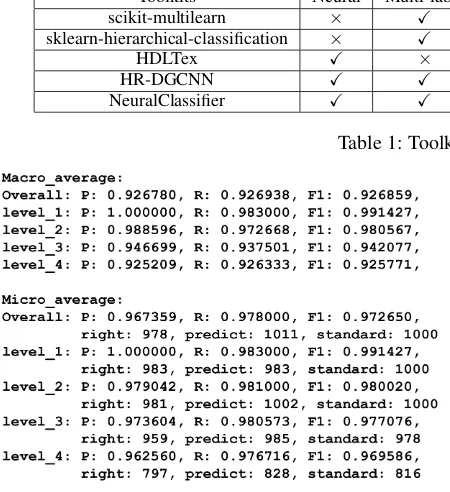
Figure 2: An illustration of evaluation outputs. “level 1” to “4” are the results of each level in hierarchical classification. Evaluation metrics are macro and micro.
label text classification papers (Kowsari et al.,
2017;Peng et al.,2018), but the implementations are mostly focused on specific model structures and specific tasks, which greatly limit their exten-sions for other similar tasks.
In this paper, we introduce an open-source toolkit, NeuralClassifier4, a neural hierarchical
multi-label text classification toolkit based on PyTorch. It is designed for solving the hier-archical multi-label text classification problem with effective and efficient neural models. It provides a variety of models and features, users can utilize a comfortable configuration file with neural feature design and utilization. We take the layerwise implementation, which includes input layer, embedding layer, encoder layer and output layer. To our best knowledge, our work is the first neural hierarchical multi-label text classification toolkit with rich models. For the details, we give a summary comparison with existing toolkits in Table1.NeuralClassifieris:
• Rich in models and features: An important feature of our work is that, compared with existing toolkits, NeuralClassifier reimplements a very large number of the state-of-the-art text encoders, including FastText (Joulin et al.,2016), TextCNN
4Code is available at https://github.com/
liqunhit/NeuralClassifier
(Kim,2014), TextRNN (Liu et al.,2016), RCNN (Lai et al., 2015) , VDCNN (Conneau et al.,
2016), DPCNN (Johnson and Zhang, 2017) , AttentiveConvNet (Yin and Sch¨utze, 2017), DRNN (Wang, 2018), Transformer encoder (Vaswani et al., 2017), Star-Transformer encoder (Guo et al.,2019). Meanwhile,NeuralClassifier
involves a variety of useful features or widgets, i.e., word-based and char-based input, optimizers, loss functions, embedding methods and attention mechanisms, etc. All those above can be config-ured through a configuration file. Figure1shows a segment of configuration file. Note that users can configure different text encoders and features through the configuration file, and can easily modify the source code to achieve more advanced developments.
• Suitable for almost all text classification tasks:NeuralClassifieris designed for hierarchi-cal and multi-label classification, which naturally also supports binary-class and multi-class clas-sification, so it can be considered a universal toolkit for text classification tasks. Especially in hierarchical multi-label classification task, the taxonomy can be organized in the form of a tree or DAG, and instances are multi-labeled during training and testing. It also provides a complete evaluation mechanism. An illustration with results is shown in Figure2. Users can choose their task types only through a comfortable configuration file without any code work.
• Effective and efficient: We conduct the ex-periments based on a variety of models and fea-tures provided byNeuralClassifier. Experiments show models built in our toolkit output compara-ble performance with reported results in the lit-erature. Furthermore,NeuralClassifier is imple-mented using batch calculation that can be accel-erated using GPU. Our experiments demonstrate thatNeuralClassifieris an effective and efficient toolkit.
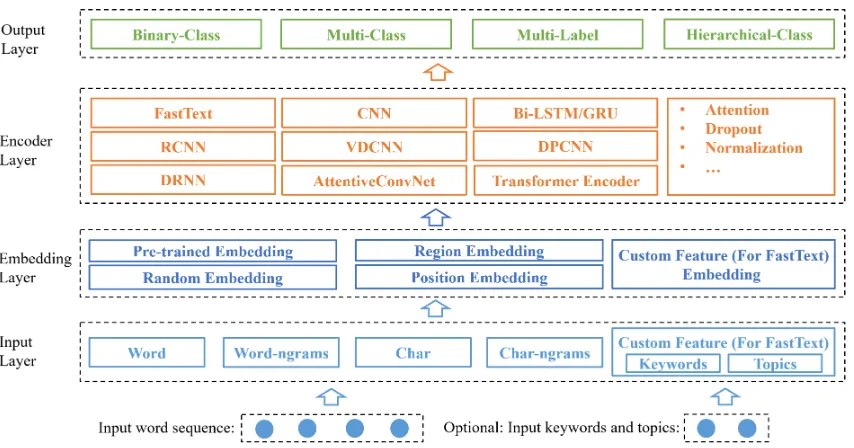
Figure 3: Architecture ofNeuralClassifier. There are four layers: an input layer, an embedding layer, an encoder layer and output layer.
NeuralClassifier. The experimental evaluations and results are discussed in Section 3. Finally, Section4concludes this paper.
2 NeuralClassifier Architecture
The framework of NeuralClassifier is shown in Figure 3. It is composed of four layers: input layer,embedding layer,encoder layerandoutput layer. At the first layer (input layer), the input word sequence will be organized and processed as words, characters, or corresponding n-grams. For FastText, custom features such as keywords and topics are also supported. The embedding of in-put data will be generated at the embedding layer, subsequently be encoded at encoder layer. On top of the system, the different loss functions are constructed in the output layer to serve the differ-ent real-world tasks, i.e., binary-class, multi-class, multi-label and hierarchical multi-label classifica-tion. The user can deploy it through a comfortable configuration file without any code work. Note that a salient feature is that users can easily utilize and integrate any widgets in theNeuralClassifier
to construct their own structure to satisfy any re-quirements.
The following will describe the pertinent details of the four layers and the user interface.
2.1 Layer Units
• Input Layer. The input text sequence will be processed at input layer. Input text sequence in the form of token (word) can be processed into
Figure 4: An example of input data. Multiple levels of hierarchy are separated with ’--’.
words and characters, along with their n-grams. Custom feature inputs such as keywords and top-ics are also supported when the text encoder is FastText. All the above can be flexibly configured by the users. Besides, reading input data can be accelerated with multiple processes. See Figure4
for an example of input data.
• Encoder Layer. We reimplement a very large number of state-of-the-art text encoders at en-coder layer, including FastText, TextCNN, Tex-tRNN, RCNN, VDCNN, DPCNN, DRNN, Trans-former encoder, Star-TransTrans-former encoder and At-tentiveConvNet. Each encoder has its own hyper-parameters that can be configured by users.
• Output Layer. This layer determines the spe-cific classification tasks, including binary-class, multi-class, multi-label and hierarchical-class. For the single-label (binary-class and multi-class) classification task, we provide three candidate loss functions, which are SoftmaxCrossEntopy,
BCLoss and SoftmaxFocalLoss (Lin et al., 2017). For the hierarchical multi-label classification task, we use BCELoss or
SigmodFocalLoss as the loss function for multi-label classification and add a recursive regularization (Gopal and Yang,2013;Peng et al.,
2018) for hierarchical classification. Using this regularization framework, we can incorporate the hierarchical dependencies between the class-labels into the regularization structure of the parameters thereby encouraging classes nearby in the hierarchy to share similar model parameters. In addition, such a regularization approach is more suitable for large-scale hierarchical multi-label classification task. Users can easily use above functions through the configuration file.
2.2 User Interface
NeuralClassifier provides abundant configura-tion interfaces, including the common settings, input settings, training settings and network structure settings. Through the configuration file, users can construct most state-of-the-art neural hierarchical multi-label text classification models.
JSONis used as the configuration file format. The configuration file has four major parts:
• Common settingsinclude the type of classifi-cation tasks, which are single-labeled and multi-labeled, whether it is hierarchical (task info), which running device to use (device), the spec-ified model (model name), directories of input and output data (data), how many subprocesses to use for data loading (num worker), etc.
• Input settings include various configura-tions about input data, such as maximum input sequence length (max token len), mini-mum input token count (min token count), dictionary size (max token dict size),
pre-trained embeddings of input data (token pretrained file), etc.
• Training settings include the batch size (batch size), type of loss function (loss type), optimizer (optimizer type), learning rate (learning rate), number of epochs (num epochs), which GPUs to use (visible device list), etc.
• Network structure settingsspecify which text encoders to use, such as TextCNN, TextRNN, RCNN, Transformer, etc. For each text encoder, there are corresponding hyperparameters that can be configured. Take TextCNN as an example, users can configure the size and number of convolution kernels and the number of tops in the pooling (kernel sizes, num kernels,
top k max pooling).
2.3 Extension
Users can write their own custom modules on all those layers, and self-defined modules can be inte-grated into the toolkit easily. For example, if a user wants to implement a new classifier model, he/she only needs to implement the part at encoder layer. All the other network structures can be used and controlled through the configuration file.
3 Evaluation
In this section, we conduct several experiments to evaluate the performance ofNeuralClassifier us-ing datasets from two public benchmarks, namely, RCV1 (Lewis et al.,2004) and Yelp5. The exper-iments consist of three parts: (1) Results of using rich models and features in Section3.1; (2) influ-ence of hierarchical information in Section3.2; (3) speed with batch size in Section3.3.
3.1 Results of using rich models and features
We use the ability of various models and features provided by our toolkit to illustrate the perfor-mance ofNeuralClassifieron hierarchical multi-label text classification problem. Concretely, we select a best model through coarse-grained exper-iments on each of the two benchmarks and fix it, and then fine-tune the features and hyperparam-eters, such as model structures, input represen-tations, activation functions, optimizers, learning rate, etc. The best performance models6 are as
5
https://www.yelp.com/dataset/challenge
6Note that the released settings are preliminary attempt so
Models RCV1 Yelp
Micro-F1 Micro-F1 HR-DGCNN (Peng et al.,2018) 0.7610 – HMCN (Wehrmann et al.,2018) 0.8080 0.6640
Our best models 0.8099 0.6704
Table 2: Results on the two benchmarks.
Encoders RCV1 Yelp
Micro-F1 Macro-F1 Micro-F1 Macro-F1
TextCNN 0.7608 0.4649 0.6179 0.3851
TextRNN 0.7883 0.4972 0.6704 0.4059
RCNN 0.8099 0.5332 0.6569 0.3951
FastText 0.6887 0.2701 0.5386 0.1817
DRNN 0.7601 0.4523 0.6174 0.3835
DPCNN 0.7439 0.4141 0.5671 0.2393
VDCNN 0.7263 0.3860 0.6079 0.3427
AttentiveConvNet 0.7533 0.4373 0.6367 0.4040
Region embedding 0.7780 0.4888 0.6601 0.4514
Transformer 0.7603 0.4274 0.6533 0.4121
[image:5.595.309.531.64.211.2]Star-Transformer 0.7668 0.4840 0.6293 0.3977
Table 3: Results of different text encoders.
follows: (1) RCNN with two-layers Bi-GRU and one-layer CNN for RCV1 dataset (input = word, optimizer = Adam, learning rate = 0.008); (2) Tex-tRNN with one-layer Bi-GRU for Yelp dataset (in-put = word, optimizer = Adam, learning rate = 0.008). Table2shows the results of the best mod-els on the two benchmarks. The best modmod-els can achieve comparable results with the state-of-the-art HMC models. The results shows the effective-ness of our implementation, and usability of a va-riety of models and features. Table3 shows per-formances of different text encoders. In particular, we can use different combinations of strategies to guide the setup of model for better performance in the real applications.
3.2 Influence of hierarchical information
Hierarchical classification problems can also be solving by flat methods, which regard the hier-archical classification as a flat classification, re-gardless of the hierarchical relationship between labels. As mentioned before, our toolkit is config-urable, we can easily set different loss functions by configuration. In this section, we discuss the in-fluence of hierarchical information. Table4shows the results of setting the HMC loss function (Hier-archical) and the traditional multi-label loss func-tion (Flat). As can been seen from the results, hi-erarchical information can greatly improve perfor-mance. It also demonstrates the effectiveness of
Encoders Hierarchical Flat
Micro-F1 Macro-F1 Micro-F1 Macro-F1
TextCNN 0.7608 0.4649 0.7367 0.4224
TextRNN 0.7883 0.4972 0.7546 0.4505
RCNN 0.8099 0.5332 0.7955 0.5123
FastText 0.6887 0.2701 0.6865 0.2816
DRNN 0.7601 0.4523 0.7506 0.4450
DPCNN 0.7439 0.4141 0.7423 0.4261
VDCNN 0.7263 0.3860 0.7110 0.3593
AttentiveConvNet 0.7533 0.4373 0.7511 0.4286
Region embedding 0.7780 0.4888 0.7640 0.4617
Transformer 0.7603 0.4274 0.7602 0.4339
[image:5.595.311.527.268.384.2]Star-Transformer 0.7668 0.4840 0.7618 0.4745
Table 4: Results of hierarchical and flat classification on RCV1.
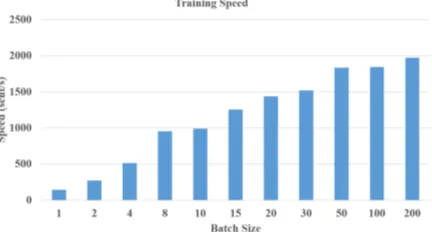
Figure 5: Results of speed with batch size.
our implementation.
3.3 Speed with Batch Size
As NeuralClassifier is implemented on bathed calculation, it can be greatly accelerated through parallel computing through GPU. We test the sys-tem speed on training process on RCV1 using a Nvidia Tesla P40 GPU. As shown in Figure 5, the training speed can be significantly accelerated through a large batch size, demonstrating the effi-ciency of our implementation.
4 Conclusion
References
Rahul Agrawal, Archit Gupta, Yashoteja Prabhu, and Manik Varma. 2013. Multi-label learning with millions of labels: Recommending advertiser bid phrases for web pages. InProceedings of the 22nd International Conference on World Wide Web, pages 13–24.
Alexis Conneau, Holger Schwenk, Lo¨ıc Barrault, and Yann Lecun. 2016. Very deep convolutional networks for text classification. arXiv preprint arXiv:1606.01781.
Scott Deerwester, Susan T Dumais, George W Fur-nas, Thomas K Landauer, and Richard Harshman. 1990. Indexing by latent semantic analysis. Jour-nal of the American Society for Information Science, 41(6):391–407.
Siddharth Gopal and Yiming Yang. 2013. Recursive regularization for large-scale classification with hi-erarchical and graphical dependencies. In Proceed-ings of the 19th ACM SIGKDD International Con-ference on Knowledge Discovery and Data Mining, pages 257–265.
Qipeng Guo, Xipeng Qiu, Pengfei Liu, Yunfan Shao, Xiangyang Xue, and Zheng Zhang. 2019. Star-transformer.arXiv preprint arXiv:1902.09113.
Rie Johnson and Tong Zhang. 2017. Deep pyramid convolutional neural networks for text categoriza-tion. InProceedings of the 55th Annual Meeting of the Association for Computational Linguistics (Vol-ume 1: Long Papers), pages 562–570.
Armand Joulin, Edouard Grave, Piotr Bojanowski, and Tomas Mikolov. 2016. Bag of tricks for efficient text classification. arXiv preprint arXiv:1607.01759.
Yoon Kim. 2014. Convolutional neural net-works for sentence classification. arXiv preprint arXiv:1408.5882.
Kamran Kowsari, Donald E Brown, Mojtaba Hei-darysafa, Kiana Jafari Meimandi, Matthew S Ger-ber, and Laura E Barnes. 2017. Hdltex: Hierarchi-cal deep learning for text classification. In2017 16th IEEE International Conference on Machine Learn-ing and Applications (ICMLA), pages 364–371.
Siwei Lai, Liheng Xu, Kang Liu, and Jun Zhao. 2015. Recurrent convolutional neural networks for text classification. In29th AAAI Conference on Artificial Intelligence.
David D Lewis, Yiming Yang, Tony G Rose, and Fan Li. 2004. Rcv1: A new benchmark collection for text categorization research. Journal of Machine Learning Research, 5:361–397.
Tsung-Yi Lin, Priya Goyal, Ross Girshick, Kaiming He, and Piotr Doll´ar. 2017. Focal loss for dense object detection. In Proceedings of the IEEE In-ternational Conference on Computer Vision, pages 2980–2988.
Pengfei Liu, Xipeng Qiu, and Xuanjing Huang. 2016. Recurrent neural network for text classi-fication with multi-task learning. arXiv preprint arXiv:1605.05101.
Bo Pang, Lillian Lee, et al. 2008. Opinion mining and sentiment analysis. Foundations and TrendsR in
In-formation Retrieval, 2(1–2):1–135.
Hao Peng, Jianxin Li, Yu He, Yaopeng Liu, Mengjiao Bao, Lihong Wang, Yangqiu Song, and Qiang Yang. 2018. Large-scale hierarchical text classification with recursively regularized deep graph-cnn. In Pro-ceedings of the 2018 World Wide Web Conference on World Wide Web, pages 1063–1072.
Shengwen Peng, Ronghui You, Hongning Wang, Chengxiang Zhai, Hiroshi Mamitsuka, and Shan-feng Zhu. 2016. Deepmesh: deep semantic repre-sentation for improving large-scale mesh indexing.
Bioinformatics, 32(12):i70–i79.
Chao Qiao, Bo Huang, Guocheng Niu, Daren Li, Dax-iang Dong, Wei He, Dianhai Yu, and Hua Wu. 2018. A new method of region embedding for text classi-fication. In International Conference on Learning Representations.
Bo Qu, Gao Cong, Cuiping Li, Aixin Sun, and Hong Chen. 2012. An evaluation of classification mod-els for question topic categorization. Journal of the American Society for Information Science and Tech-nology, 63(5):889–903.
Ashish Vaswani, Noam Shazeer, Niki Parmar, Jakob Uszkoreit, Llion Jones, Aidan N Gomez, Łukasz Kaiser, and Illia Polosukhin. 2017. Attention is all you need. InAdvances in Neural Information Pro-cessing Systems, pages 5998–6008.
Baoxin Wang. 2018. Disconnected recurrent neural networks for text categorization. InProceedings of the 56th Annual Meeting of the Association for Com-putational Linguistics (Volume 1: Long Papers), pages 2311–2320.
Jonatas Wehrmann, Ricardo Cerri, and Rodrigo Bar-ros. 2018. Hierarchical multi-label classification networks. InInternational Conference on Machine Learning, pages 5225–5234.