62
Results of the WMT19 Metrics Shared Task:
Segment-Level and Strong MT Systems Pose Big Challenges
Qingsong Ma
Tencent-CSIG, AI Evaluation Lab [email protected]
Johnny Tian-Zheng Wei UMass Amherst, CICS
Ondřej Bojar
Charles University, MFF ÚFAL [email protected]
Yvette Graham
Dublin City University, ADAPT [email protected]
Abstract
This paper presents the results of the
WMT19 Metrics Shared Task.
Par-ticipants were asked to score the out-puts of the translations systems compet-ing in the WMT19 News Translation Task with automatic metrics. 13 research groups submitted 24 metrics, 10 of which are reference-less “metrics” and constitute submissions to the joint task withWMT19
Quality Estimation Task, “QE as a Met-ric”. In addition, we computed 11 baseline metrics, with 8 commonly applied base-lines (BLEU, SentBLEU, NIST, WER, PER, TER, CDER, and chrF) and 3 reim-plementations (chrF+, sacreBLEU-BLEU, and sacreBLEU-chrF). Metrics were evalu-ated on the system level, how well a given metric correlates with the WMT19 offi-cial manual ranking, and segment level, how well the metric correlates with human judgements of segment quality. This year, we use direct assessment (DA) as our only form of manual evaluation.
1 Introduction
To determine system performance in machine translation (MT), it is often more practical to use an automatic evaluation, rather than a manual one. Manual/human evaluation can be costly and time consuming, and so an au-tomatic evaluation metric, given that it suffi-ciently correlates with manual evaluation, can be useful in developmental cycles. In studies involving hyperparameter tuning or architec-ture search, automatic metrics are necessary as the amount of human effort implicated in manual evaluation is generally prohibitively large. As objective, reproducible quantities, metrics can also facilitate cross-paper
compar-isons. The WMT Metrics Shared Task1
annu-ally serves as a venue to validate the use of existing metrics (including baselines such as BLEU), and to develop new ones; see Koehn and Monz (2006) through Ma et al.(2018).
In the setup of our Metrics Shared Task, an automatic metric compares an MT sys-tem’s output translations with manual ref-erence translations to produce: either (a) system-level score, i.e. a single overall score for the given MT system, or (b)segment-level scores for each of the output translations, or both.
This year we teamed up with the organizers of the QE Task and hosted “QE as a Metric” as a joint task. In the setup of the Quality Esti-mation Task (Fonseca et al.,2019), no human-produced translations are provided to estimate the quality of output translations. Quality es-timation (QE) methods are built to assess MT output based on the source or based on the translation itself. In this task, QE developers were invited to perform the same scoring as standard metrics participants, with the excep-tion that they refrain from using a reference translation in production of their scores. We then evaluate the QE submissions in exactly the same way as regular metrics are evalu-ated, see below. From the point of view of correlation with manual judgements, there is no difference in metrics using or not using ref-erences.
The source, reference texts, and MT sys-tem outputs for the Metrics task come from the News Translation Task (Barrault et al., 2019, which we denote as Findings 2019). The texts were drawn from the news domain and involve translations of English (en) to/from
1http://www.statmt.org/wmt19/metrics-task.
Czech (cs), German (de), Finnish (fi), Gu-jarati (gu), Kazakh (kk), Lithuanian (lt), Rus-sian (ru), and Chinese (zh), but excluding cs-en (15 language pairs). Three other language pairs not including English were also manu-ally evaluated as part of the News Translation Task: German→Czech and German↔French. In total, metrics could participate in 18 lan-guage pairs, with 10 target lanlan-guages.
In the following, we first give an overview of the task (Section 2) and summarize the base-line (Section3) and submitted (Section4) met-rics. The results for system- and segment-level evaluation are provided in Sections 5.1 and 5.2, respectively, followed by a joint discussion Section6.
2 Task Setup
This year, we provided task participants with one test set for each examined language pair, i.e. a set of source texts (which are commonly ignored by MT metrics), corresponding MT outputs (these are the key inputs to be scored) and a reference translation (held out for the participants of “QE as a Metric” track).
In the system-level, metrics aim to corre-late with a system’s score which is an aver-age over many human judgments of segment translation quality produced by the given sys-tem. In the segment-level, metrics aim to produce scores that correlate best with a hu-man ranking judgment of two output trans-lations for a given source segment (more on the manual quality assessment in Section2.3). Participants were free to choose which lan-guage pairs and tracks (system/segment and reference-based/reference-free) they wanted to take part in.
2.1 Source and Reference Texts
The source and reference texts we use are newstest2019 from this year’s WMT News Translation Task (see Findings 2019). This set contains approximately 2,000 sentences for each translation direction (except Gujarati, Kazakh and Lithuanian which have approx-imately 1,000 sentences each, and German to/from French which has 1701 sentences).
The reference translations provided in new-stest2019 were created in the same direc-tion as the MT systems were translating.
The exceptions are German→Czech where both sides are translations from English and German↔French which followed last years’ practice. Last year and the years before, the dataset consisted of two halves, one originat-ing in the source language and one in the tar-get language. This however lead to adverse artifacts in MT evaluation.
2.2 System Outputs
The results of the Metrics Task are affected by the actual set of MT systems participating in a given translation direction. On one hand, if all systems are very close in their transla-tion quality, then even humans will struggle to rank them. This in turn will make the task for MT metrics very hard. On the other hand, if the task includes a wide range of systems of varying quality, correlating with humans should be generally easier, see Section 6.1 for a discussion on this. One can also expect that if the evaluated systems are of different types, they will exhibit different error patterns and various MT metrics can be differently sensi-tive to these patterns.
This year, all MT systems included in the Metrics Task come from the News Translation Task (see Findings 2019). There are however still noticeable differences among the various language pairs.
• Unsupervised MT Systems. The
German→Czech research systems were trained in an unsupervised fashion, i.e. without the access to parallel Czech-German texts (except for a couple of thousand sentences used primarily for val-idation). We thus expect the research German-Czech systems to be “more cre-ative” and depart further away from the references. The online systems in this language directions are however standard MT systems so the German-Czech evalu-ation could be to some extent bimodal.
• EU Election. The French↔German
translation was focused on a sub-domain of news, namely texts related EU Elec-tion. Various MT system developers may have invested more or less time to the do-main adaptation.
are all the other MT systems in the evaluation; differing in whether they are trained only on WMT provided data (“Constrained”, or “Unconstrained”) as in the previous years. All the freely avail-able web services (online MT systems) are deemed unconstrained.
Overall, the results are based on 233 systems across 18 language pairs.2
2.3 Manual Quality Assessment
Direct Assessment (DA, Graham et al.,2013, 2014a,2016) was employed as the source of the “golden truth” to evaluate metrics again this year. The details of this method of human evaluation are provided in Findings 2019.
The basis of DA is to collect a large number of quality assessments (a number on a scale of 1–100, i.e. effectively a continuous scale) for the outputs of all MT systems. These scores are then standardized per annotator.
In the past years, the underlying man-ual scores were reference-based (human judges had access to the same reference translation as the MT quality metric). This year, the of-ficial WMT19 scores are reference-based (or “monolingual”) for some language pairs and reference-free (or “bilingual”) for others.3
Due to these different types of golden truth collection, reference-based language pairs are in a closer match with the standard reference-based metrics, while the reference-free lan-guage pairs are better fit for the “QE as a metric” subtask.
Note that system-level manual scores are different than those of the segment-level. Since for segment-level evaluation, collecting enough DA judgements for each segment is infeasible, so we resort to converting DA judgements to
2This year, we do not use the artificially constructed
“hybrid systems” (Graham and Liu,2016) because the confidence on the ranking of system-level metrics is suf-ficient even without hybrids.
3Specifically, the reference-based language pairs
were those where the anticipated translation quality was lower or where the manual judgements were ob-tained with the help of anonymous crowdsourcing. Most of these cases were translations into English (fi-en, gu-(fi-en, kk-(fi-en, lt-(fi-en, ru-en and zh-en) and then the language pairs not involving English (de-cs, de-fr and fr-de). The reference-less (bilingual) evaluations were those where mainly MT researchers themselves were involved in the annotations: en-cs, en-de, en-fi, en-gu, en-kk, en-lt, en-ru, en-zh.
golden truth expressed as relative rankings, see Section2.3.2.
The exact methods used to calculate corre-lations of participating metrics with the golden truth are described below, in the two sections for system-level evaluation (Section 5.1) and segment-level evaluation (Section 5.2).
2.3.1 System-level Golden Truth: DA
For the system-level evaluation, the collected continuous DA scores, standardized for each annotator, are averaged across all assessed seg-ments for each MT system to produce a scalar rating for the system’s performance.
The underlying set of assessed segments is different for each system. Thanks to the fact that the system-level DA score is an average over many judgments, mean scores are consis-tent and have been found to be reproducible (Graham et al., 2013). For more details see Findings 2019.
2.3.2 Segment-level Golden Truth: daRR
Starting fromBojar et al. (2017), when WMT fully switched to DA, we had to come up with a solid golden standard for segment-level judge-ments. Standard DA scores are reliable only when averaged over sufficient number of judg-ments.4
Fortunately, when we have at least two DA scores for translations of the same source in-put, it is possible to convert those DA scores into a relative ranking judgement, if the dif-ference in DA scores allows conclusion that one translation is better than the other. In the following, we denote these re-interpreted DA judgements as “daRR”, to distinguish it clearly from the relative ranking (“RR”) golden truth used in the past years.5
4For segment-level evaluation, one would need to
collect many manual evaluations of the exact same seg-ment as produced by each MT system. Such a sampling would be however wasteful for the evaluation needed by WMT, so only some MT systems happen to be evalu-ated for a given input sentence. In principle, we would like to return to DA’s standard segment-level evalua-tion in future, where a minimum of 15 human judge-ments of translation quality are collected per transla-tion and combined to get highly accurate scores for translations, but this would increase annotation costs.
5Since the analogue rating scale employed by DA is
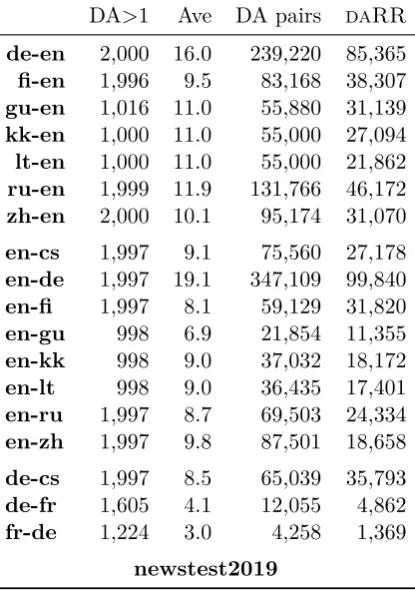
DA>1 Ave DA pairs daRR
de-en 2,000 16.0 239,220 85,365
fi-en 1,996 9.5 83,168 38,307
gu-en 1,016 11.0 55,880 31,139
kk-en 1,000 11.0 55,000 27,094
lt-en 1,000 11.0 55,000 21,862
ru-en 1,999 11.9 131,766 46,172
zh-en 2,000 10.1 95,174 31,070
en-cs 1,997 9.1 75,560 27,178
en-de 1,997 19.1 347,109 99,840
en-fi 1,997 8.1 59,129 31,820
en-gu 998 6.9 21,854 11,355
en-kk 998 9.0 37,032 18,172
en-lt 998 9.0 36,435 17,401
en-ru 1,997 8.7 69,503 24,334
en-zh 1,997 9.8 87,501 18,658
de-cs 1,997 8.5 65,039 35,793
de-fr 1,605 4.1 12,055 4,862
fr-de 1,224 3.0 4,258 1,369
[image:4.595.78.286.65.361.2]newstest2019
Table 1: Number of judgements for DA converted to daRR data; “DA>1” is the number of source input sentences in the manual evaluation where at least two translations of that same source input segment received a DA judgement; “Ave” is the average number of translations with at least one DA judgement available for the same source input sentence; “DA pairs” is the number of all possi-ble pairs of translations of the same source input resulting from “DA>1”; and “daRR” is the num-ber of DA pairs with an absolute difference in DA scores greater than the 25 percentage point mar-gin.
From the complete set of human assess-ments collected for the News Translation Task, all possible pairs of DA judgements attributed to distinct translations of the same source were converted into daRR better/worse judge-ments. Distinct translations of the same source input whose DA scores fell within 25 percentage points (which could have been deemed equal quality) were omitted from the evaluation of segment-level metrics. Conver-sion of scores in this way produced a large set of daRR judgements for all language pairs, rely on judgements collected from known-reliable vol-unteers and crowd-sourced workers who passed DA’s quality control mechanism. Any inconsistency that could arise from reliance on DA judgements collected from low quality crowd-sourcing is thus prevented.
shown in Table 1 due to combinatorial ad-vantage of extractingdaRR judgements from all possible pairs of translations of the same source input. We see that only German-French and esp. French-German can suffer from in-sufficient number of these simulated pairwise comparisons.
The daRR judgements serve as the golden standard for segment-level evaluation in
WMT19.
3 Baseline Metrics
In addition to validating popular metrics, in-cluding baselines metrics serves as comparison and prevents “loss of knowledge” as mentioned by Bojar et al.(2016).
Moses scorer6 is one of the MT evaluation
tools that aggregated several useful metrics over the time. Since Macháček and Bojar (2013), we have been using Moses scorer to provide most of the baseline metrics and kept encouraging authors of well-performing MT metrics to include them in Moses scorer.7
The baselines we report are:
BLEU and NIST The metrics BLEU
(Papineni et al., 2002) and NIST
(Doddington, 2002) were computed using mteval-v13a.pl8 from the OpenMT Evaluation Campaign. The tool includes its own tokeniza-tion. We run mteval with the flag
--international-tokenization.9
TER, WER, PER and CDER.The
met-rics TER (Snover et al., 2006), WER,
PER and CDER (Leusch et al., 2006) were produced by the Moses scorer, which is used in Moses model optimization. We used the standard tokenizer script as available in Moses toolkit for tokeniza-tion.
sentBLEU.The metricsentBLEUis
com-puted using the script sentence-bleu, a part of the Moses toolkit. It is a
6https://github.com/moses-smt/mosesdecoder/
blob/master/mert/evaluator.cpp
7If you prefer standard BLEU, we recommend
sacre-BLEU (Post, 2018a), found at https://github.com/
mjpost/sacreBLEU.
8http://www.itl.nist.gov/iad/mig/tools/
9International tokenization is found to perform
smoothed version of BLEU for scoring at the segment-level. We used the stan-dard tokenizer script as available in Moses toolkit for tokenization.
chrF and chrF+. The metrics chrF and
chrF+ (Popović, 2015, 2017) are
com-puted using their original Python im-plementation, see Table 2. We ran
chrF++.pywith the parameters-nw 0 -b
3 to obtain the chrF score and with
-nw 1 -b 3 to obtain the chrF+ score.
Note thatchrFintentionally removes all spaces before matching then-grams, deto-kenizing the segments but also concate-nating words.10
sacreBLEU-BLEU and
sacreBLEU-chrF. The metrics sacreBLEU-BLEU
and sacreBLEU-chrF (Post, 2018a)
are re-implementation of BLEU and chrF respectively. We ransacreBLEU-chrF
with the same parameters as chrF, but their scores are slightly different. The sig-nature strings produced by sacreBLEU for BLEU and chrF respectively are
BLEU+case.lc+lang.de-en+numrefs.1+ smooth.exp+tok.intl+version.1.3.6
and chrF3+case.mixed+lang.de-en
+numchars.6+numrefs.1+space.False+
tok.13a+version.1.3.6.
The baselines serve in system and segment-level evaluations as customary: BLEU,TER,
WER, PER, CDER, sacreBLEU-BLEU
andsacreBLEU-chrFfor system-level only;
sentBLEUfor segment-level only and chrF
for both.
Chinese word segmentation is unfortunately not supported by the tokenization scripts men-tioned above. For scoring Chinese with base-line metrics, we thus pre-processed MT out-puts and reference translations with the script
tokenizeChinese.py11 by Shujian Huang,
which separates Chinese characters from each other and also from non-Chinese parts.
10We originally planned to use thechrF
implemen-tation which was recently made available in Moses Scorer but it mishandles Unicode characters for now.
11http://hdl.handle.net/11346/WMT17-TVXH
4 Submitted Metrics
Table 2 lists the participants of the WMT19
Shared Metrics Task, along with their metrics and links to the source code where available. We have collected 24 metrics from a total of 13 research groups, with 10 reference-less “met-rics” submitted to the joint task “QE as a Met-rich” with WMT19 Quality Estimation Task.
The rest of this section provides a brief sum-mary of all the metrics that participated.
4.1 BEER
BEER (Stanojević and Sima’an, 2015) is a trained evaluation metric with a linear model that combines sub-word feature indicators (character n-grams) and global word order fea-tures (skip bigrams) to achieve a language ag-nostic and fast to compute evaluation metric. BEER has participated in previous years of the evaluation task.
4.2 BERTr
BERTr (Mathur et al., 2019) uses contextual word embeddings to compare the MT output with the reference translation.
The BERTr score of a translation is the average recall score over all tokens, us-ing a relaxed version of token matchus-ing based on BERT embeddings: namely, com-puting the maximum cosine similarity be-tween the embedding of a reference to-ken against any toto-ken in the MT out-put. BERTr uses bert_base_uncased em-beddings for the to-English language pairs,
andbert_base_multilingual_cased
embed-dings for all other language pairs.
4.3 CharacTER
CharacTER (Wang et al., 2016b,a),
dis-tance between them is below a threshold value. The Levenshtein distance between the refer-ence and the shifted hypothesis sequrefer-ence is computed on the character level. In addition, the lengths of hypothesis sequences instead of reference sequences are used for normalizing the edit distance, which effectively counters the issue that shorter translations normally achieve lower TER.
Similarly to other character-level metrics,
CharacTER is generally applied to
non-tokenized outputs and references, which also holds for this year’s submission with one ex-ception. This year tokenization was carried out for en-ru hypotheses and references be-fore calculating the scores, since this results in large improvements in terms of correlations. For other language pairs, no tokenizer was used for pre-processing.
4.4 EED
EED (Stanchev et al., 2019) is a character-based metric, which builds upon CDER. It is defined as the minimum number of opera-tions of an extension to the conventional edit distance containing a “jump” operation. The edit distance operations (insertions, deletions and substitutions) are performed at the char-acter level and jumps are performed when a blank space is reached. Furthermore, the cov-erage of multiple characters in the hypothesis is penalised by the introduction of a coverage penalty. The sum of the length of the refer-ence and the coverage penalty is used as the normalisation term.
4.5 ESIM
Enhanced Sequential Inference Model (ESIM; Chen et al., 2017; Mathur et al., 2019) is a neural model proposed for Natural Language Inference that has been adapted for MT evalu-ation. It uses cross-sentence attention and sen-tence matching heuristics to generate a repre-sentation of the translation and the reference, which is fed to a feedforward regressor. The metric is trained on singly-annotated Direct Assessment data that has been collected for evaluating WMT systems: all WMT 2018 to-English data for the to-to-English language pairs, and all WMT 2018 data for all other language pairs.
4.6 hLEPORb_baseline, hLEPORa_baseline
The submitted metrichLEPOR_baselineis a metric based on the factor combination of length penalty, precision, recall, and position difference penalty. The weighted harmonic mean is applied to group the factors together with tunable weight parameters. The system-level score is calculated with the same formula but with each factor weighted using weight es-timated at system-level and not at segment-level.
In this submitted baseline version,
hLE-POR_baseline was not tuned for each
lan-guage pair separately but the default weights were applied across all submitted language pairs. Further improvements can be achieved by tuning the weights according to the devel-opment data, adding morphological informa-tion and applying n-gram factor scores into it (e.g. part-of-speech, n-gram precision and n-gram recall that were added into LEPOR in WMT13.). The basic model factors and further development with parameters setting were described in the paper (Han et al.,2012) and (Han et al.,2013).
For sentence-level score, only
hLE-PORa_baseline was submitted with scores
calculated as the weighted harmonic mean of all the designed factors using default parameters.
For system-level score, both
hLEPORa_baseline and
hLE-PORb_baseline were submitted, where
hLEPORa_baseline is the the average
score of all sentence-level scores, and
hLE-PORb_baseline is calculated via the same
sentence-level hLEPOR equation but replac-ing each factor value with its system-level counterpart.
4.7 Meteor++_2.0 (syntax), Meteor++_2.0 (syntax+copy)
Meteor++ 2.0 (Guo and Hu, 2019) is
they perform badly when reference-hypothesis pairs contain skip n-gram paraphrases.
Me-teor++ 2.0extracts the knowledge from the
Paraphrase Database (PPDB; Bannard and Callison-Burch, 2005) and integrates it into Meteor-based metrics.
4.8 PReP
PReP(Yoshimura et al.,2019) is a method for filtering pseudo-references to achieve a good match with a gold reference.
At the beginning, the source sentence is translated with some off-the-shelf MT sys-tems to create a set of pseudo-references. (Here the MT systems were Google Translate and Microsoft Bing Translator.) The pseudo-references are then filtered using BERT ( De-vlin et al., 2019) fine-tuned on the MPRC corpus (Dolan and Brockett, 2005), estimat-ing the probability of the paraphrase between gold reference and pseudo-references. Thanks to the high quality of the underlying MT sys-tems, a large portion of their outputs is indeed considered as a valid paraphrase.
The final metric score is calculated sim-ply with SentBLEU with these multiple ref-erences.
4.9 WMDO
WMDO(Chow et al.,2019b) is a metric based on distance between distributions in the se-mantic vector space. Matching in the seman-tic space has been investigated for translation evaluation, but the constraints of a transla-tion’s word order have not been fully explored. Building on the Word Mover’s Distance metric and various word embeddings,WMDO intro-duces a fragmentation penalty to account for fluency of a translation. This word order ex-tension is shown to perform better than stan-dard WMD, with promising results against other types of metrics.
4.10 YiSi-0, YiSi-1, YiSi-1_srl, YiSi-2,
YiSi-2_srl
YiSi (Lo,2019) is a unified semantic MT qual-ity evaluation and estimation metric for lan-guages with different levels of available re-sources.
YiSi-1 is a MT evaluation metric that mea-sures the semantic similarity between a ma-chine translation and human references by
aggregating the idf-weighted lexical semantic similarities based on the contextual embed-dings extracted from BERT and optionally in-corporating shallow semantic structures (de-noted as YiSi-1_srl).
YiSi-0 is the degenerate version of YiSi-1 that is ready-to-deploy to any language. It uses longest common character substring to measure the lexical similarity.
YiSi-2 is the bilingual, reference-less version for MT quality estimation, which uses the con-textual embeddings extracted from BERT to evaluate the crosslingual lexical semantic simi-larity between the input and MT output. Like YiSi-1, YiSi-2 can exploit shallow semantic structures as well (denoted as YiSi-2_srl).
4.11 QE Systems
In addition to the submitted standard metrics, 10 quality estimation systems were submitted to the “QE as a Metric” track. The submitted QE systems are evaluated in the same settings as metrics to facilitate comparison. Their de-scriptions can be found in the Findings of the WMT 2019 Shared Task on Quality Estima-tion (Fonseca et al.,2019).
5 Results
We discuss system-level results for news task systems in Section 5.1. The segment-level re-sults are in Section5.2.
5.1 System-Level Evaluation
As in previous years, we employ the Pearson correlation (r) as the main evaluation measure for system-level metrics. The Pearson correla-tion is as follows:
r=
∑n
i=1(Hi−H)(Mi−M)
√∑n
i=1(Hi−H)2√∑ni=1(Mi−M)2
(1)
where Hi are human assessment scores of all systems in a given translation direction, Mi are the corresponding scores as predicted by a given metric. H and M are their means, respectively.
Since some metrics, such as BLEU, aim to achieve a strong positive correlation with hu-man assessment, while error metrics, such as
de-en fi-en gu-en kk-en lt-en ru-en zh-en
n 16 12 11 11 11 14 15
Correlation |r| |r| |r| |r| |r| |r| |r|
BEER 0.906 0.993 0.952 0.986 0.947 0.915 0.942
BERTr 0.926 0.984 0.938 0.990 0.948 0.971 0.974
BLEU 0.849 0.982 0.834 0.946 0.961 0.879 0.899
CDER 0.890 0.988 0.876 0.967 0.975 0.892 0.917
CharacTER 0.898 0.990 0.922 0.953 0.955 0.923 0.943
chrF 0.917 0.992 0.955 0.978 0.940 0.945 0.956
chrF+ 0.916 0.992 0.947 0.976 0.940 0.945 0.956
EED 0.903 0.994 0.976 0.980 0.929 0.950 0.949
ESIM 0.941 0.971 0.885 0.986 0.989 0.968 0.988
hLEPORa_baseline − − − 0.975 − − 0.947
hLEPORb_baseline − − − 0.975 0.906 − 0.947
Meteor++_2.0(syntax) 0.887 0.995 0.909 0.974 0.928 0.950 0.948
Meteor++_2.0(syntax+copy) 0.896 0.995 0.900 0.971 0.927 0.952 0.952
NIST 0.813 0.986 0.930 0.942 0.944 0.925 0.921
PER 0.883 0.991 0.910 0.737 0.947 0.922 0.952
PReP 0.575 0.614 0.773 0.776 0.494 0.782 0.592
sacreBLEU.BLEU 0.813 0.985 0.834 0.946 0.955 0.873 0.903
sacreBLEU.chrF 0.910 0.990 0.952 0.969 0.935 0.919 0.955
TER 0.874 0.984 0.890 0.799 0.960 0.917 0.840
WER 0.863 0.983 0.861 0.793 0.961 0.911 0.820
WMDO 0.872 0.987 0.983 0.998 0.900 0.942 0.943
YiSi-0 0.902 0.993 0.993 0.991 0.927 0.958 0.937
YiSi-1 0.949 0.989 0.924 0.994 0.981 0.979 0.979
YiSi-1_srl 0.950 0.989 0.918 0.994 0.983 0.978 0.977
QE as a Metric:
ibm1-morpheme 0.345 0.740 − − 0.487 − −
ibm1-pos4gram 0.339 − − − − − −
LASIM 0.247 − − − − 0.310 −
LP 0.474 − − − − 0.488 −
UNI 0.846 0.930 − − − 0.805 −
UNI+ 0.850 0.924 − − − 0.808 −
YiSi-2 0.796 0.642 0.566 0.324 0.442 0.339 0.940
YiSi-2_srl 0.804 − − − − − 0.947
[image:9.595.93.501.188.587.2]newstest2019
en-cs en-de en-fi en-gu en-kk en-lt en-ru en-zh
n 11 22 12 11 11 12 12 12
Correlation |r| |r| |r| |r| |r| |r| |r| |r|
BEER 0.990 0.983 0.989 0.829 0.971 0.982 0.977 0.803
BLEU 0.897 0.921 0.969 0.737 0.852 0.989 0.986 0.901
CDER 0.985 0.973 0.978 0.840 0.927 0.985 0.993 0.905
CharacTER 0.994 0.986 0.968 0.910 0.936 0.954 0.985 0.862
chrF 0.990 0.979 0.986 0.841 0.972 0.981 0.943 0.880
chrF+ 0.991 0.981 0.986 0.848 0.974 0.982 0.950 0.879
EED 0.993 0.985 0.987 0.897 0.979 0.975 0.967 0.856
ESIM − 0.991 0.957 − 0.980 0.989 0.989 0.931
hLEPORa_baseline − − − 0.841 0.968 − − −
hLEPORb_baseline − − − 0.841 0.968 0.980 − −
NIST 0.896 0.321 0.971 0.786 0.930 0.993 0.988 0.884
PER 0.976 0.970 0.982 0.839 0.921 0.985 0.981 0.895
sacreBLEU.BLEU 0.994 0.969 0.966 0.736 0.852 0.986 0.977 0.801
sacreBLEU.chrF 0.983 0.976 0.980 0.841 0.967 0.966 0.985 0.796
TER 0.980 0.969 0.981 0.865 0.940 0.994 0.995 0.856
WER 0.982 0.966 0.980 0.861 0.939 0.991 0.994 0.875
YiSi-0 0.992 0.985 0.987 0.863 0.974 0.974 0.953 0.861
YiSi-1 0.962 0.991 0.971 0.909 0.985 0.963 0.992 0.951
YiSi-1_srl − 0.991 − − − − − 0.948
QE as a Metric:
ibm1-morpheme 0.871 0.870 0.084 − − 0.810 − −
ibm1-pos4gram − 0.393 − − − − − −
LASIM − 0.871 − − − − 0.823 −
LP − 0.569 − − − − 0.661 −
UNI 0.028 0.841 0.907 − − − 0.919 −
UNI+ − − − − − − 0.918 −
USFD − 0.224 − − − − 0.857 −
USFD-TL − 0.091 − − − − 0.771 −
YiSi-2 0.324 0.924 0.696 0.314 0.339 0.055 0.766 0.097
YiSi-2_srl − 0.936 − − − − − 0.118
[image:10.595.104.497.204.571.2]newstest2019
de-en fi-en gu-en Y iSi.1_sr l Y iSi.1 ESIM BER T r chrF chrF . sacreBLEU.chrF
BEEREEDYiSi.0
Char acTER Meteor .._2.0.syntax.cop y. CDER Meteor .._2.0.syntax. PER TER WMDOWER UNI. BLEU
UNI sacreBLEU.BLEU NIST Y iSi.2_sr l Y iSi.2 PRePLP.1 ibm1.mor pheme ibm1.pos4gr am LASIM LASIM ibm1.pos4gram ibm1.morpheme LP.1 PReP YiSi.2 YiSi.2_srl NIST sacreBLEU.BLEU UNI BLEU UNI. WER WMDO TER PER Meteor.._2.0.syntax. CDER Meteor.._2.0.syntax.copy. CharacTER YiSi.0 EED BEER sacreBLEU.chrF chrF. chrF BERTr ESIM YiSi.1 YiSi.1_srl Meteor .._2.0.syntax.cop y. Meteor .._2.0.syntax. EED
BEER YiSi.0 chrF
. chrF PER Char acTER sacreBLEU.chrF Y iSi.1_sr l Y iSi.1
CDER WMDONIST
sacreBLEU.BLEU
TER
BER
T
r
WER BLEU ESIMUNI UNI.
ibm1.mor
phemeYiSi.2PReP
PReP YiSi.2 ibm1.morpheme UNI. UNI ESIM BLEU WER BERTr TER sacreBLEU.BLEU NIST WMDO CDER YiSi.1 YiSi.1_srl sacreBLEU.chrF CharacTER PER chrF chrF. YiSi.0 BEER EED Meteor.._2.0.syntax. Meteor.._2.0.syntax.copy. Y iSi.0 WMDO EEDchrF sacreBLEU.chrF BEERchrF . BER T r
NISTYiSi.1
Char acTER Y iSi.1_sr l PER Meteor .._2.0.syntax. Meteor .._2.0.syntax.cop y.
TERESIMCDERWERBLEU
sacreBLEU.BLEU
PRePYiSi.2
YiSi.2 PReP sacreBLEU.BLEU BLEU WER CDER ESIM TER Meteor.._2.0.syntax.copy. Meteor.._2.0.syntax. PER YiSi.1_srl CharacTER YiSi.1 NIST BERTr chrF. BEER sacreBLEU.chrF chrF EED WMDO YiSi.0
kk-en lt-en ru-en
WMDOY iSi.1 Y iSi.1_sr l Y iSi.0 BER T r
ESIM BEEREED chrF chrF
.
hLEPORa_baseline hLEPORb_baseline Meteor
.._2.0.syntax. Meteor .._2.0.syntax.cop y. sacreBLEU.chrF CDER Char acTER BLEU sacreBLEU.BLEU
NIST TER WER PReP PER YiSi.2
YiSi.2 PER PReP WER TER NIST sacreBLEU.BLEU BLEU CharacTER CDER sacreBLEU.chrF Meteor.._2.0.syntax.copy. Meteor.._2.0.syntax. hLEPORb_baseline hLEPORa_baseline chrF. chrF EED BEER ESIM BERTr YiSi.0 YiSi.1_srl YiSi.1 WMDO ESIM Y iSi.1_sr l Y iSi.1
CDER BLEUWER TER
sacreBLEU.BLEU Char acTER BER T r PER
BEER NISTchrF
. chrF sacreBLEU.chrF EED Meteor .._2.0.syntax. Meteor .._2.0.syntax.cop y. Y iSi.0 hLEPORb_baseline WMDOPReP ibm1.mor phemeY iSi.2 YiSi.2 ibm1.morpheme PReP WMDO hLEPORb_baseline YiSi.0 Meteor.._2.0.syntax.copy. Meteor.._2.0.syntax. EED sacreBLEU.chrF chrF chrF. NIST BEER PER BERTr CharacTER sacreBLEU.BLEU TER WER BLEU CDER YiSi.1 YiSi.1_srl ESIM Y iSi.1 Y iSi.1_sr l BER T r
ESIM YiSi.0
Meteor
.._2.0.syntax.cop
y.
Meteor
.._2.0.syntax.
EED chrF chrF
. WMDO NIST Char acTER PER sacreBLEU.chrF TER
BEER WER CDER BLEU
sacreBLEU.BLEU
UNI. UNIPRePLP.1YiSi.2LASIM
LASIM YiSi.2 LP.1 PReP UNI UNI. sacreBLEU.BLEU BLEU CDER WER BEER TER sacreBLEU.chrF PER CharacTER NIST WMDO chrF. chrF EED Meteor.._2.0.syntax. Meteor.._2.0.syntax.copy. YiSi.0 ESIM BERTr YiSi.1_srl YiSi.1
zh-en en-cs en-de
ESIM YiSi.1
Y iSi.1_sr l BER T r chrF . chrF sacreBLEU.chrF PER Meteor .._2.0.syntax.cop y. EED Meteor .._2.0.syntax. hLEPORb_baseline hLEPORa_baseline Y iSi.2_sr l WMDO Char
acTER BEERYiSi.2YiSi.0 NISTCDER
sacreBLEU.BLEU
BLEUTER WER PReP
PReP WER TER BLEU sacreBLEU.BLEU CDER NIST YiSi.0 YiSi.2 BEER CharacTER WMDO YiSi.2_srl hLEPORa_baseline hLEPORb_baseline Meteor.._2.0.syntax. EED Meteor.._2.0.syntax.copy. PER sacreBLEU.chrF chrF chrF. BERTr YiSi.1_srl YiSi.1 ESIM sacreBLEU.BLEU Char
acTER EED YiSi.0 chrF
.
BEER chrF CDER
sacreBLEU.chrF
WER TER PER YiSi.1 BLEU NIST
ibm1.mor
pheme YiSi.2 UNI
UNI YiSi.2 ibm1.morpheme NIST BLEU YiSi.1 PER TER WER sacreBLEU.chrF CDER chrF BEER chrF. YiSi.0 EED CharacTER sacreBLEU.BLEU
ESIM YiSi.1
Y
iSi.1_sr
l
Char
acTEREEDYiSi.0BEERchrF
. chrF sacreBLEU.chrF CDERPER sacreBLEU.BLEU TER WER Y iSi.2_sr l Y iSi.2 BLEU LASIM ibm1.mor
phemeUNI LP.1
ibm1.pos4gr am NIST USFD USFD.TL USFD.TL USFD NIST ibm1.pos4gram LP.1 UNI ibm1.morpheme LASIM BLEU YiSi.2 YiSi.2_srl WER TER sacreBLEU.BLEU PER CDER sacreBLEU.chrF chrF chrF. BEER YiSi.0 EED CharacTER YiSi.1_srl YiSi.1 ESIM
en-fi en-gu en-kk
BEER EED YiSi.0 chrF chrF
.
PER TER
sacreBLEU.chrF
WER CDER YiSi.1 NIST BLEU
Char
acTER
sacreBLEU.BLEU
ESIM UNI YiSi.2
ibm1.mor pheme ibm1.morpheme YiSi.2 UNI ESIM sacreBLEU.BLEU CharacTER BLEU NIST YiSi.1 CDER WER sacreBLEU.chrF TER PER chrF. chrF YiSi.0 EED BEER Char acTER Y iSi.1 EED TER YiSi.0 WER chrF
.
sacreBLEU.chrF
chrF
hLEPORa_baseline hLEPORb_baseline CDER PER BEER NIST BLEU
sacreBLEU.BLEU Y iSi.2 YiSi.2 sacreBLEU.BLEU BLEU NIST BEER PER CDER hLEPORb_baseline hLEPORa_baseline chrF sacreBLEU.chrF chrF. WER YiSi.0 TER EED YiSi.1 CharacTER Y
iSi.1ESIM EED chrF
. Y iSi.0 chrF BEER hLEPORa_baseline hLEPORb_baseline sacreBLEU.chrF TER WER Char
acTER NIST CDER PER
sacreBLEU.BLEU
BLEUYiSi.2
YiSi.2 BLEU sacreBLEU.BLEU PER CDER NIST CharacTER WER TER sacreBLEU.chrF hLEPORb_baseline hLEPORa_baseline BEER chrF YiSi.0 chrF. EED ESIM YiSi.1
en-lt en-ru en-zh
TERNIST WER ESIM BLEU
sacreBLEU.BLEU
CDER PER BEER chrF
.
chrF
hLEPORb_baseline
EED YiSi.0
sacreBLEU.chrF Y iSi.1 Char acTER ibm1.mor phemeY iSi.2 YiSi.2 ibm1.morpheme CharacTER YiSi.1 sacreBLEU.chrF YiSi.0 EED hLEPORb_baseline chrF chrF. BEER PER CDER sacreBLEU.BLEU BLEU ESIM WER NIST TER
TERWER CDERYiSi.1ESIMNISTBLEU
Char
acTER
sacreBLEU.chrF
PER
sacreBLEU.BLEU
BEER EEDYiSi.0chrF
.
chrFUNI UNI.USFD
LASIM USFD.TL Y iSi.2 LP.1 LP.1 YiSi.2 USFD.TL LASIM USFD UNI. UNI chrF chrF. YiSi.0 EED BEER sacreBLEU.BLEU PER sacreBLEU.chrF CharacTER BLEU NIST ESIM YiSi.1 CDER WER TER Y iSi.1 Y iSi.1_sr l
ESIM CDER BLEU PER NIST chrF chrF
.
WER
Char
acTER Y iSi.0 EED TER
[image:11.595.114.482.66.692.2]BEER sacreBLEU.BLEU sacreBLEU.chrF Y iSi.2_sr l Y iSi.2 YiSi.2 YiSi.2_srl sacreBLEU.chrF sacreBLEU.BLEU BEER TER EED YiSi.0 CharacTER WER chrF. chrF NIST PER BLEU CDER ESIM YiSi.1_srl YiSi.1
given metric’s correlation with human assess-ment.
5.1.1 System-Level Results
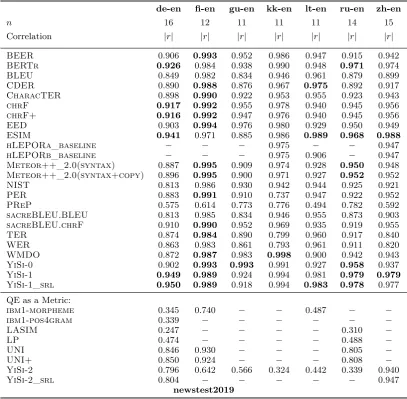
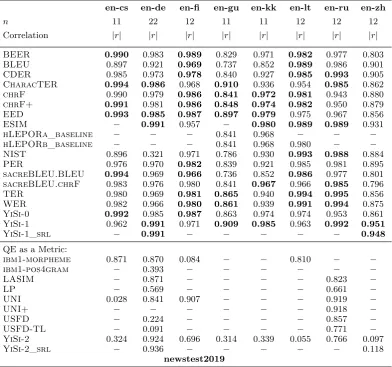
Tables3,4and5provide the system-level cor-relations of metrics evaluating translation of newstest2019. The underlying texts are part of the WMT19 News Translation test set (new-stest2019) and the underlying MT systems are all MT systems participating in the WMT19 News Translation Task.
As recommended by Graham and Bald-win (2014), we employ Williams significance test (Williams, 1959) to identify differences in correlation that are statistically significant. Williams test is a test of significance of a dif-ference in dependent correlations and there-fore suitable for evaluation of metrics. Corre-lations not significantly outperformed by any other metric for the given language pair are highlighted in bold in Tables 3,4and 5.
Since pairwise comparisons of metrics may be also of interest, e.g. to learn which metrics significantly outperform the most widely em-ployed metric BLEU, we include significance test results for every competing pair of metrics including our baseline metrics in Figure1and Figure 2.
This year, the increased number of systems participating in the news tasks has provided a larger sample of system scores for testing met-rics. Since we already have sufficiently con-clusive results on genuine MT systems, we do not need to generate hybrid system results as in Graham and Liu (2016) and past metrics tasks.
5.2 Segment-Level Evaluation
Segment-level evaluation relies on the man-ual judgements collected in the News Trans-lation Task evaluation. This year, again we were unable to follow the methodology out-lined inGraham et al.(2015) for evaluation of segment-level metrics because the sampling of sentences did not provide sufficient number of assessments of the same segment. We there-fore convert pairs of DA scores for compet-ing translations todaRRbetter/worse prefer-ences as described in Section 2.3.2.
We measure the quality of metrics’ segment-level scores against thedaRRgolden truth us-ing a Kendall’s Tau-like formulation, which is
an adaptation of the conventional Kendall’s Tau coefficient. Since we do not have a to-tal order ranking of all translations, it is not possible to apply conventional Kendall’s Tau (Graham et al.,2015).
Our Kendall’s Tau-like formulation,τ, is as follows:
τ = |Concordant| − |Discordant|
|Concordant|+|Discordant| (2)
whereConcordantis the set of all human com-parisons for which a given metric suggests the same order and Discordant is the set of all human comparisons for which a given metric disagrees. The formula is not specific with re-spect to ties, i.e. cases where the annotation says that the two outputs are equally good.
The way in which ties (both in human and metric judgement) were incorporated in com-puting Kendallτ has changed across the years of WMT Metrics Tasks. Here we adopt the version used in WMT17 daRR evaluation. For a detailed discussion on other options, see also Macháček and Bojar(2014).
Whether or not a given comparison of a pair of distinct translations of the same source in-put, s1 and s2, is counted as a concordant
(Conc) or disconcordant (Disc) pair is defined by the following matrix:
Metric
s1 <s2 s1 =s2 s1 >s2
Human
s1 <s2 Conc Disc Disc
s1 =s2 − − −
s1 >s2 Disc Disc Conc
In the notation of Macháček and Bojar (2014), this corresponds to the setup used in WMT12 (with a different underlying method of manual judgements, RR):
Metric WMT12 < = >
Human
< 1 -1 -1
= X X X
> -1 -1 1
de-cs de-fr fr-de
n 11 11 10
Correlation |r| |r| |r|
BEER 0.978 0.941 0.848
BLEU 0.941 0.891 0.864
CDER 0.864 0.949 0.852
CharacTER 0.965 0.928 0.849
chrF 0.974 0.931 0.864
chrF+ 0.972 0.936 0.848
EED 0.982 0.940 0.851
ESIM 0.980 0.950 0.942
hLEPORa_baseline 0.941 0.814 − hLEPORb_baseline 0.959 0.814 −
NIST 0.954 0.916 0.862
PER 0.875 0.857 0.899
sacreBLEU-BLEU 0.869 0.891 0.869
sacreBLEU-chrF 0.975 0.952 0.882
TER 0.890 0.956 0.895
WER 0.872 0.956 0.894
YiSi-0 0.978 0.952 0.820
YiSi-1 0.973 0.969 0.908
YiSi-1_srl − − 0.912
QE as a Metric:
ibm1-morpheme 0.355 0.509 0.625
ibm1-pos4gram − 0.085 0.478
YiSi-2 0.606 0.721 0.530
[image:13.595.194.403.103.400.2]newstest2019
Table 5: Absolute Pearson correlation of system-level metrics for language pairs not involving English with DA human assessment in newstest2019; correlations of metrics not significantly outperformed by any other for that language pair are highlighted in bold.
de-cs de-fr fr-de
EED ESIM YiSi.0BEER
sacreBLEU.chrF
chrF
Y
iSi.1 chrF
.
Char
acTER
hLEPORb_baseline
NISTBLEU
hLEPORa_baseline
TERPER WER
sacreBLEU.BLEU
CDER YiSi.2
ibm1.mor
pheme
ibm1.morpheme YiSi.2 CDER sacreBLEU.BLEU WER PER TER hLEPORa_baseline BLEU NIST hLEPORb_baseline CharacTER chrF. YiSi.1 chrF sacreBLEU.chrF BEER YiSi.0 ESIM EED
Y
iSi.1WERTER YiSi.0
sacreBLEU.chrF
ESIMCDERBEER EEDchrF
.
chrF
Char
acTERNISTBLEU
sacreBLEU.BLEU
PER
hLEPORb_baselinehLEPORa_baseline
Y
iSi.2
ibm1.mor
pheme
ibm1.pos4gr
am
ibm1.pos4gram ibm1.morpheme YiSi.2 hLEPORa_baseline hLEPORb_baseline PER sacreBLEU.BLEU BLEU NIST CharacTER chrF chrF. EED BEER CDER ESIM sacreBLEU.chrF YiSi.0 TER WER YiSi.1
ESIM
Y
iSi.1_sr
l
Y
iSi.1PER TER WER
sacreBLEU.chrF
sacreBLEU.BLEU
chrF BLEU NIST CDER EED
Char
acTER BEER chrF
.
Y
iSi.0
ibm1.mor
phemeY
iSi.2
ibm1.pos4gr
am
ibm1.pos4gram YiSi.2 ibm1.morpheme YiSi.0 chrF. BEER CharacTER EED CDER NIST BLEU chrF sacreBLEU.BLEU sacreBLEU.chrF WER TER PER YiSi.1 YiSi.1_srl ESIM
[image:13.595.116.482.536.662.2]de-en fi-en gu-en kk-en lt-en ru-en zh-en
Human Evaluation daRR daRR daRR daRR daRR daRR daRR
n 85,365 38,307 31,139 27,094 21,862 46,172 31,070
BEER 0.128 0.283 0.260 0.421 0.315 0.189 0.371
BERTr 0.142 0.331 0.291 0.421 0.353 0.195 0.399
CharacTER 0.101 0.253 0.190 0.340 0.254 0.155 0.337
chrF 0.122 0.286 0.256 0.389 0.301 0.180 0.371
chrF+ 0.125 0.289 0.257 0.394 0.303 0.182 0.374
EED 0.120 0.281 0.264 0.392 0.298 0.176 0.376
ESIM 0.167 0.337 0.303 0.435 0.359 0.201 0.396
hLEPORa_baseline − − − 0.372 − − 0.339
Meteor++_2.0(syntax) 0.084 0.274 0.237 0.395 0.291 0.156 0.370
Meteor++_2.0(syntax+copy) 0.094 0.273 0.244 0.402 0.287 0.163 0.367
PReP 0.030 0.197 0.192 0.386 0.193 0.124 0.267
sentBLEU 0.056 0.233 0.188 0.377 0.262 0.125 0.323
WMDO 0.096 0.281 0.260 0.420 0.300 0.162 0.362
YiSi-0 0.117 0.271 0.263 0.402 0.289 0.178 0.355
YiSi-1 0.164 0.347 0.312 0.440 0.376 0.217 0.426
YiSi-1_srl 0.199 0.346 0.306 0.442 0.380 0.222 0.431
QE as a Metric:
ibm1-morpheme −0.074 0.009 − − 0.069 − −
ibm1-pos4gram −0.153 − − − − − −
LASIM −0.024 − − − − 0.022 −
LP −0.096 − − − − −0.035 −
UNI 0.022 0.202 − − − 0.084 −
UNI+ 0.015 0.211 − − − 0.089 −
YiSi-2 0.068 0.126 −0.001 0.096 0.075 0.053 0.253
YiSi-2_srl 0.068 − − − − − 0.246
[image:14.595.93.506.233.542.2]newstest2019
en-cs en-de en-fi en-gu en-kk en-lt en-ru en-zh Human Evaluation daRR daRR daRR daRR daRR daRR daRR daRR
n 27,178 99,840 31,820 11,355 18,172 17,401 24,334 18,658
BEER 0.443 0.316 0.514 0.537 0.516 0.441 0.542 0.232
CharacTER 0.349 0.264 0.404 0.500 0.351 0.311 0.432 0.094
chrF 0.455 0.326 0.514 0.534 0.479 0.446 0.539 0.301
chrF+ 0.458 0.327 0.514 0.538 0.491 0.448 0.543 0.296
EED 0.431 0.315 0.508 0.568 0.518 0.425 0.546 0.257
ESIM − 0.329 0.511 − 0.510 0.428 0.572 0.339
hLEPORa_baseline − − − 0.463 0.390 − − −
sentBLEU 0.367 0.248 0.396 0.465 0.392 0.334 0.469 0.270
YiSi-0 0.406 0.304 0.483 0.539 0.494 0.402 0.535 0.266
YiSi-1 0.475 0.351 0.537 0.551 0.546 0.470 0.585 0.355
YiSi-1_srl − 0.368 − − − − − 0.361
QE as a Metric:
ibm1-morpheme −0.135 −0.003 −0.005 − − −0.165 − −
ibm1-pos4gram − −0.123 − − − − − −
LASIM − 0.147 − − − − −0.24 −
LP − −0.119 − − − − −0.158 −
UNI 0.060 0.129 0.351 − − − 0.226 −
UNI+ − − − − − − 0.222 −
USFD − −0.029 − − − − 0.136 −
USFD-TL − −0.037 − − − − 0.191 −
YiSi-2 0.069 0.212 0.239 0.147 0.187 0.003 −0.155 0.044
YiSi-2_srl − 0.236 − − − − − 0.034
newstest2019
Table 7: Segment-level metric results for out-of-English language pairs in newstest2019: absolute Kendall’s Tau formulation of segment-level metric scores with DA scores; correlations of metrics not significantly outperformed by any other for that language pair are highlighted in bold.
de-cs de-fr fr-de Human Evaluation daRR daRR daRR
n 35,793 4,862 1,369
BEER 0.337 0.293 0.265
CharacTER 0.232 0.251 0.224
chrF 0.326 0.284 0.275
chrF+ 0.326 0.284 0.278
EED 0.345 0.301 0.267
ESIM 0.331 0.290 0.289
hLEPORa_baseline 0.207 0.239 −
sentBLEU 0.203 0.235 0.179
YiSi-0 0.331 0.296 0.277
YiSi-1 0.376 0.349 0.310
YiSi-1_srl − − 0.299
QE as a Metric:
ibm1-morpheme 0.048 −0.013 −0.053
ibm1-pos4gram − −0.074 −0.097
YiSi-2 0.199 0.186 0.066
[image:15.595.89.504.66.350.2]newstest2019
Table 8: Segment-level metric results for language pairs not involving English in newstest2019: ab-solute Kendall’s Tau formulation of segment-level metric scores with DA scores; correlations of met-rics not significantly outperformed by any other for that language pair are highlighted in bold.
is deemed substantially different and no ties in human judgements arise, it makes sense to penalize ties in metrics’ predictions in order to promote discerning metrics.
Note that the penalization of ties makes our evaluation asymmetric, dependent on whether the metric predicted the tie for a pair where humans predicted <, or >. It is now impor-tant to interpret the meaning of the compar-ison identically for humans and metrics. For error metrics, we thus reverse the sign of the metric score prior to the comparison with hu-man scores: higher scores have to indicate bet-ter translation quality. In WMT19, the origi-nal authors did this for CharacTER.
To summarize, the WMT19 Metrics Task for segment-level evaluation:
• ensures that error metrics are first con-verted to the same orientation as the hu-man judgements, i.e. higher score indi-cating higher translation quality,
• excludes all human ties (this is already implied by the construction of daRR
[image:15.595.73.292.441.655.2]de-en fi-en gu-en
Y
iSi.1_sr
l
ESIMYiSi.1BER
T
r
BEERchrF
.
chrFEEDYiSi.0
Char acTERWMDO Meteor .._2.0.syntax.cop y. Meteor .._2.0.syntax. Y iSi.2 Y iSi.2_sr l sentBLEU
PRePUNIUNI.
LASIM ibm1.mor pheme LP ibm1.pos4gr am ibm1−pos4gram LP ibm1−morpheme LASIM UNI+ UNI PReP sentBLEU YiSi−2_srl YiSi−2 Meteor++_2.0(syntax) Meteor++_2.0(syntax+copy) WMDO CharacTER YiSi−0 EED chrF chrF+ BEER BERTr YiSi−1 ESIM YiSi−1_srl Y iSi.1 Y iSi.1_sr l ESIMBER T r chrF . chrF BEERWMDO EED Meteor .._2.0.syntax. Meteor .._2.0.syntax.cop y. Y iSi.0 Char acTER sentBLEU UNI. UNI PRePYiSi.2
ibm1.mor pheme ibm1−morpheme YiSi−2 PReP UNI UNI+ sentBLEU CharacTER YiSi−0 Meteor++_2.0(syntax+copy) Meteor++_2.0(syntax) EED WMDO BEER chrF chrF+ BERTr ESIM YiSi−1_srl YiSi−1 Y iSi.1 Y iSi.1_sr l ESIM BER T r
EED YiSi.0 WMDO BEER chrF . chrF Meteor .._2.0.syntax.cop y. Meteor .._2.0.syntax. PReP Char acTER sentBLEU Y iSi.2 YiSi−2 sentBLEU CharacTER PReP Meteor++_2.0(syntax) Meteor++_2.0(syntax+copy) chrF chrF+ BEER WMDO YiSi−0 EED BERTr ESIM YiSi−1_srl YiSi−1
kk-en lt-en ru-en
Y
iSi.1_sr
l
Y
iSi.1 ESIM BER
T
r
BEER WMDO Y
iSi.0 Meteor .._2.0.syntax.cop y. Meteor .._2.0.syntax. chrF .
EED chrFPReP
sentBLEU
hLEPORa_baseline
Char
acTER YiSi.2
YiSi−2 CharacTER hLEPORa_baseline sentBLEU PReP chrF EED chrF+ Meteor++_2.0(syntax) Meteor++_2.0(syntax+copy) YiSi−0 WMDO BEER BERTr ESIM YiSi−1 YiSi−1_srl Y iSi.1_sr l Y
iSi.1 ESIM BER
T r BEER chrF . chrF WMDO EED Meteor .._2.0.syntax. Y iSi.0 Meteor .._2.0.syntax.cop y. sentBLEU Char
acTER PRePYiSi.2
ibm1.mor pheme ibm1−morpheme YiSi−2 PReP CharacTER sentBLEU Meteor++_2.0(syntax+copy) YiSi−0 Meteor++_2.0(syntax) EED WMDO chrF chrF+ BEER BERTr ESIM YiSi−1 YiSi−1_srl Y iSi.1_sr l Y iSi.1ESIM BER T r BEERchrF .
chrFYiSi.0EED
Meteor .._2.0.syntax.cop y. WMDO Meteor .._2.0.syntax.Char acTER sentBLEU
PRePUNI.UNIYiSi.2LASIM
LP LP LASIM YiSi−2 UNI UNI+ PReP sentBLEU CharacTER Meteor++_2.0(syntax) WMDO Meteor++_2.0(syntax+copy) EED YiSi−0 chrF chrF+ BEER BERTr ESIM YiSi−1 YiSi−1_srl
zh-en en-cs en-de
Y iSi.1_sr l Y iSi.1 BER T r
ESIMEED chrF
. BEERchrF Meteor .._2.0.syntax. Meteor .._2.0.syntax.cop y. WMDO Y iSi.0 hLEPORa_baseline Char acTER sentBLEU
PReP YiSi.2
Y iSi.2_sr l YiSi−2_srl YiSi−2 PReP sentBLEU CharacTER hLEPORa_baseline YiSi−0 WMDO Meteor++_2.0(syntax+copy) Meteor++_2.0(syntax) chrF BEER chrF+ EED ESIM BERTr YiSi−1 YiSi−1_srl Y iSi.1 chrF . chrF
BEER EED YiSi.0
sentBLEU Char acTER Y iSi.2 UNI ibm1.mor pheme ibm1−morpheme UNI YiSi−2 CharacTER sentBLEU YiSi−0 EED BEER chrF chrF+ YiSi−1 Y iSi.1_sr l Y
iSi.1 ESIM chrF
.
chrF
BEER EED YiSi.0
Char
acTER
sentBLEU YiSi.2_sr
l Y iSi.2 LASIM UNI ibm1.mor pheme USFD USFD.TL LP ibm1.pos4gr am ibm1−pos4gram LP USFD−TL USFD ibm1−morpheme UNI LASIM YiSi−2 YiSi−2_srl sentBLEU CharacTER YiSi−0 EED BEER chrF chrF+ ESIM YiSi−1 YiSi−1_srl
en-fi en-gu en-kk
Y
iSi.1 chrF
.
BEER chrF ESIM EED YiSi.0
Char acTER sentBLEU UNI Y iSi.2 ibm1.mor pheme ibm1−morpheme YiSi−2 UNI sentBLEU CharacTER YiSi−0 EED ESIM chrF BEER chrF+ YiSi−1
EED YiSi.1
Y iSi.0 chrF . BEER chrF Char acTER sentBLEU hLEPORa_baseline Y iSi.2 YiSi−2 hLEPORa_baseline sentBLEU CharacTER chrF BEER chrF+ YiSi−0 YiSi−1 EED Y iSi.1 EED BEER ESIM YiSi.0 chrF
. chrF sentBLEU hLEPORa_baseline Char acTER Y iSi.2 YiSi−2 CharacTER hLEPORa_baseline sentBLEU chrF chrF+ YiSi−0 ESIM BEER EED YiSi−1
en-lt en-ru en-zh
Y
iSi.1 chrF
.
chrF
BEER ESIM EED YiSi.0
sentBLEU Char acTER Y iSi.2 ibm1.mor pheme ibm1−morpheme YiSi−2 CharacTER sentBLEU YiSi−0 EED ESIM BEER chrF chrF+ YiSi−1 Y
iSi.1 ESIM EED chrF
.
BEER chrF YiSi.0
sentBLEU
Char
acTER
UNI UNI.
USFD.TL
USFD YiSi.2
LP LASIM LASIM LP YiSi−2 USFD USFD−TL UNI+ UNI CharacTER sentBLEU YiSi−0 chrF BEER chrF+ EED ESIM YiSi−1 Y iSi.1_sr l Y
iSi.1 ESIM chrF chrF
[image:16.595.110.489.66.705.2]. sentBLEU Y iSi.0 EED BEER Char acTER Y iSi.2 Y iSi.2_sr l YiSi−2_srl YiSi−2 CharacTER BEER EED YiSi−0 sentBLEU chrF+ chrF ESIM YiSi−1 YiSi−1_srl
de-cs de-fr fr-de
Y
iSi.1 EED BEER ESIM YiSi.0 chrF
.
chrF
Char
acTER
hLEPORa_baseline
sentBLEU
Y
iSi.2
ibm1.mor
pheme
ibm1−morpheme YiSi−2 sentBLEU hLEPORa_baseline CharacTER chrF chrF+ YiSi−0 ESIM BEER EED YiSi−1
Y
iSi.1 EED YiSi.0 BEER ESIM chrF
.
chrF
Char
acTER
hLEPORa_baseline
sentBLEU
Y
iSi.2
ibm1.mor
pheme
ibm1.pos4gr
am
ibm1−pos4gram ibm1−morpheme YiSi−2 sentBLEU hLEPORa_baseline CharacTER chrF chrF+ ESIM BEER YiSi−0 EED YiSi−1
Y
iSi.1
Y
iSi.1_sr
l
ESIM chrF
.
Y
iSi.0 chrF EED
BEER
Char
acTER
sentBLEU
Y
iSi.2
ibm1.mor
pheme
ibm1.pos4gr
am
[image:17.595.123.479.61.188.2]ibm1−pos4gram ibm1−morpheme YiSi−2 sentBLEU CharacTER BEER EED chrF YiSi−0 chrF+ ESIM YiSi−1_srl YiSi−1
Figure 4: daRR segment-level metric significance test results for German to Czech, German to French and French to German (newstest2019): Green cells denote a significant win for the metric in a given row over the metric in a given column according bootstrap resampling.
• counts metric’s ties as aDiscordantpairs.
We employ bootstrap resampling (Koehn, 2004;Graham et al., 2014b) to estimate con-fidence intervals for our Kendall’s Tau for-mulation, and metrics with non-overlapping 95% confidence intervals are identified as hav-ing statistically significant difference in perfor-mance.
5.2.1 Segment-Level Results
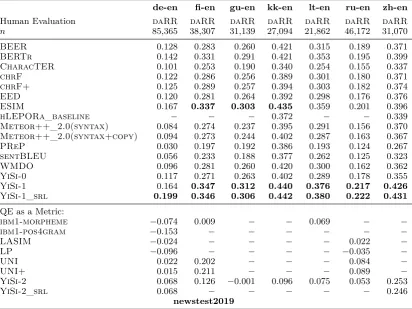
Results of the segment-level human evaluation for translations sampled from the News Trans-lation Task are shown in Tables 6, 7 and 8, where metric correlations not significantly out-performed by any other metric are highlighted in bold. Head-to-head significance test results for differences in metric performance are in-cluded in Figures3 and4.
6 Discussion
This year, human data was collected from reference-based evaluations (or “monolin-gual”) and reference-free evaluations (or “bilingual”). The reference-based (mono-lingual) evaluations were obtained with the help of anonymous crowdsourcing, while the reference-less (bilingual) evaluations were mainly from MT researchers who committed their time contribution to the manual evalua-tion for each submitted system.
6.1 Stability across MT Systems
The observed performance of metrics depends on the underlying texts and systems that par-ticipate in the News Translation Task (see Sec-tion2). For the strongest MT systems, distin-guishing which system outputs are better is
4 6 8 10 12 14 16 18 20
[image:17.595.354.480.255.349.2]sacreBLEU-BLEU
Figure 5: Pearson correlations of sacreBLEU-BLEU for English-German system-level evalua-tion for all systems (left) down to only top 4 sys-tems (right). The y-axis spans from -1 to +1, base-line metrics for the language pair in grey.
hard, even for human assessors. On the other hand, if the systems are spread across a wide performance range, it will be easier for metrics to correlate with human judgements.
To provide a more reliable view, we created plots of Pearson correlation when the under-lying set of MT systems is reduced to top n ones. One sample such plot is in Figure 5, all language pairs and most of the metrics are in AppendixA.
As the plot documents, the official correla-tions reported in Tables 3 to 5 can lead to wrong conclusions. sacreBLEU-BLEU cor-relates at .969 when all systems are considered, but as we start considering only the topn sys-tems, the correlation falls relatively quickly. With 10 systems, we are below .5 and when only the top 6 or 4 systems are considered, the correlation falls even to the negave val-ues. Note that correlations point estimates (the value in the y-axis) become noiser with the decreasing number of the underlying MT systems.
0.15 0.2 0.25
0.3 0.35
0.4 0.45
0.5
-2 -1.5 -1 -0.5 0 0.5
Sacr
eBLEU-BLEU
DA
Top 4 Top 6 Top 8 Top 10 Top 12 Top 15 All systems
Figure 6
trates the sensitivity of the observed correla-tions to the exact set of systems. On the full set of systems, the single outlier (the worst-performing system calleden_de_task) helps to achieve a great positive correlation. The majority of MT systems however form a cloud with Pearson correlation around .5 and the top 4 systems actually exhibit a negative corre-lation of the human score and
sacreBLEU-BLEU.
In AppendixA, baseline metrics are plotted in grey in all the plots, so that their trends can be observed jointly. In general, most baselines have similar correlations, as most baselines use similar features (n-gram or word-level features, with the exception of chrF). In a number of language pairs (de-en, de-fr, en-de, en-kk, lt-en, ru-lt-en, zh-en), baseline correlations tend to-wards 0 (no correlation) or even negative Pear-son correlation. For a widely applied metric such assacreBLEU-BLEU, our analysis re-veals weak correlation in comparing top state-of-the-art systems in these language pairs, es-pecially in en-de, de-en, ru-en, and zh-en.
We will restrict our analysis to those lan-guage pairs where the baseline metrics have an obvious downward trend (de-en, de-fr, en-de, en-kk, lt-en, ru-en, zh-en). Examining the top-ncorrelation in the submitted metrics (not in-cluding QE systems), most metrics show the same degredation in correlation as the base-lines. We note BERTr as the one exception consistently degrading less and retaining pos-itive correlation compared to other submitted metrics and baselines, in the language pairs where it participated.
For QE systems, we noticed that in some in-stances, QE systems have upward correlation trends when other metrics and baselines have downward trends. For instance,LP,UNI, and
UNI+ in the de-en language pair, YiSi-2 in en-kk, and UNI and UNI+ in ru-en. These results suggest that QE systems such as UNI
and UNI+perform worse on judging systems of wide ranging quality, but better for top per-forming systems, or perhaps for systems closer in quality.
If our method of human assessment is sound, we should believe that BLEU, a widely ap-plied metric, is no longer a reliable metric for judging our best systems. Future investiga-tions are needed to understand when BLEU
applies well, and why BLEU is not effective for output from our state of the art models.
Metrics and QE systems such as BERTr,
ESIM, YiSi that perform well at judging our best systems often use more semantic features compared to our n-gram/char-gram based baselines. Future metrics may want to explore a) whether semantic features such as contextual word embeddings are achieving se-mantic understanding and b) whether seman-tic understanding is the true source of a met-ric’s performance gains.
It should be noted thatsomelanguage pairs do not show the strong degrading pattern with top-nsystems this year, for instance cs, en-gu, en-ru, or kk-en. English-Chinese is partic-ularly interesting because we see a clear trend towards better correlations as we reduce the set of underlying systems to the top scoring ones.
6.2 Overall Metric Performance
6.2.1 System-Level Evaluation
In system-level evaluation, the series of YiSi
metrics achieve the highest correlations in sev-eral language pairs and it is not significantly outperformed by any other metrics (denoted as a “win” in the following) for almost all lan-guage pairs.
The new metric ESIM performs best on 5 language languages (18 language pairs) and obtains 11 “wins” out of 16 language pairs in which ESIMparticipated.
En-glish compared to into-EnEn-glish language pairs, achieving 7 out of 11 “wins” there.
6.2.2 Segment-Level Evaluation
For segment-level evaluation, most language pairs are quite discerning, with only one or two metrics taking the “winner” position (of not being significantly surpassed by others). Only French-German differs, with all metrics performing similarly except the significantly worsesentBLEU.
YiSi-1_srl stands out as the “winner” for
all language pairs in which it participated. The excluded language pairs were probably due to the lack of semantic information re-quired by YiSi-1_srl. YiSi-1 participated all language pairs and its correlations are com-parable with those of YiSi-1_srl.
ESIM obtain 6 “winners” out of all 18 lan-guages pairs.
Both YiSi and ESIM are based on neu-ral networks (YiSi via word and phrase em-beddings, as well as other types of available resources, ESIM via sentence embeddings). This is a confirmation of a trend observed last year.
6.2.3 QE Systems as Metrics
Generally, correlations for the standard reference-based metrics are obviously better than those in “QE as a Metric” track, both when using monolingual and bilingual golden truth.
In system-level evaluation, correlations for “QE as a Metric” range from 0.028 to 0.947 across all language pairs and all metrics but they are very unstable. Even for a single metric, take UNI for example, the correla-tions range from 0.028 to 0.930 across language pairs.
In segment-level evaluation, correlations for QE metrics range from -0.153 to 0.351 across all language pairs and show the same instabil-ity across language pairs for a given metric.
In either case, we do not see any pattern that could explain the behaviour, e.g. whether the manual evaluation was monolingual or bilingual, or the characteristics of the given language pair.
6.3 Dependence on Implementation
As it already happened in the past, we had multiple implementations for some metrics,
BLEU andchrF in particular.
The detailed configuration of BLEU and
sacreBLEU-BLEU differ and hence their
scores and correlation results are different.
chrFandsacreBLEU-chrFuse the same
parameters and should thus deliver the same scores but we still observe some differences, leading to different correlations. For instance for German-French Pearson correlation,chrF
obtains 0.931 (no win) but sacreBLEU-chrFreaches 0.952, tying for a win with other metrics.
We thus fully support the call for clarity by Post(2018b) and invite authors of metrics to include their implementations either in Moses scorer or sacreBLEU to achieve a long-term assessment of their metric.
7 Conclusion
This paper summarizes the results ofWMT19
shared task in machine translation evaluation, the Metrics Shared Task. Participating met-rics were evaluated in terms of their correla-tion with human judgement at the level of the whole test set (system-level evaluation), as well as at the level of individual sentences (segment-level evaluation).
We reported scores for standard metrics re-quiring the reference as well as quality estima-tion systems which took part in the track “QE as a metric”, joint with the Quality Estimation task.
For system-level, best metrics reach over 0.95 Pearson correlation or better across sev-eral language pairs. As expected, QE sys-tems are visibly in all language pairs but they can also reach high system-level correlations, up to .947 (Chinese-English) or .936 (English-German) byYiSi-1_srl or over .9 for multi-ple language pairs byUNI.
partic-ipating in the news task, the metrics results can be overly optimistic compared to what we get when evaluating state-of-the-art systems.
In terms of segment-level Kendall’s τ re-sults, the standard metrics correlations varied between 0.03 and 0.59, and QE systems ob-tained even negative correlations.
The results confirm the observation from the last year, namely metrics based on word or sentence-level embeddings (YiSi and ESIM), achieve the highest performance.
Acknowledgments
Results in this shared task would not be pos-sible without tight collaboration with organiz-ers of the WMT News Translation Task. We would like to thank Marcin Junczys-Dowmunt for the suggestion to examine metrics perfor-mance across varying subsets of MT systems, as we did in AppendixA.
This study was supported in parts by the grants 19-26934X (NEUREM3) of the Czech Science Foundation, ADAPT Centre for Dig-ital Content Technology (www.adaptcentre. ie) at Dublin City University funded un-der the SFI Research Centres Programme (Grant 13/RC/2106) co-funded under the European Regional Development Fund, and Charles University Research Programme “Pro-gres” Q18+Q48.
References
Colin Bannard and Chris Callison-Burch. 2005. Paraphrasing with bilingual parallel corpora. In
Proceedings of the 43rd Annual Meeting on Asso-ciation for Computational Linguistics, ACL ’05, pages 597–604, Stroudsburg, PA, USA. Associ-ation for ComputAssoci-ational Linguistics.
Loïc Barrault, Ondřej Bojar, Marta R. Costa-jussà, Christian Federmann, Mark Fishel, Yvette Graham, Barry Haddow, Matthias Huck, Philipp Koehn, Shervin Malmasi, Christof Monz, Mathias Müller, Santanu Pal, Matt Post, and Marcos Zampieri. 2019. Findings of the 2019 Conference on Machine Translation (WMT19). In Proceedings of the Fourth Con-ference on Machine Translation, Florence, Italy. Association for Computational Linguistics.
Ondřej Bojar, Christian Federmann, Barry Had-dow, Philipp Koehn, Matt Post, and Lucia Spe-cia. 2016. Ten Years of WMT Evaluation Cam-paigns: Lessons Learnt. In Proceedings of the LREC 2016 Workshop “Translation Evaluation
– From Fragmented Tools and Data Sets to an Integrated Ecosystem”, pages 27–34, Portorose, Slovenia.
Ondřej Bojar, Yvette Graham, and Amir Kamran. 2017. Results of the WMT17 metrics shared task. In Proceedings of the Second Confer-ence on Machine Translation, Volume 2: Shared Tasks Papers, Copenhagen, Denmark. Associa-tion for ComputaAssocia-tional Linguistics.
Qian Chen, Xiaodan Zhu, Zhen-Hua Ling, Si Wei, Hui Jiang, and Diana Inkpen. 2017. Enhanced lstm for natural language inference. In Proceed-ings of the 55th Annual Meeting of the Associ-ation for ComputAssoci-ational Linguistics (Volume 1: Long Papers), pages 1657–1668.
Julian Chow, Pranava Madhyastha, and Lucia Specia. 2019a. Wmdo: Fluency-based word mover’s distance for machine translation eval-uation. In Proceedings of Fourth Conference on Machine Translation.
Julian Chow, Lucia Specia, and Pranava Mad-hyastha. 2019b. WMDO: Fluency-based Word Mover’s Distance for Machine Translation Eval-uation. InProceedings of the Fourth Conference on Machine Translation, Florence, Italy. Asso-ciation for Computational Linguistics.
Michael Denkowski and Alon Lavie. 2014. Meteor Universal: Language Specific Translation Evalu-ation for Any Target Language. In Proceedings of the Ninth Workshop on Statistical Machine Translation, pages 376–380, Baltimore, Mary-land, USA. Association for Computational Lin-guistics.
Jacob Devlin, Ming-Wei Chang, Kenton Lee, and Kristina Toutanova. 2019. BERT: Pre-training of deep bidirectional transformers for language understanding. InProceedings of the 2019 Con-ference of the North American Chapter of the Association for Computational Linguistics: Hu-man Language Technologies, Volume 1 (Long and Short Papers), pages 4171–4186, Minneapo-lis, Minnesota. Association for Computational Linguistics.
George Doddington. 2002. Automatic Evalua-tion of Machine TranslaEvalua-tion Quality Using N-gram Co-occurrence Statistics. In Proceedings of the Second International Conference on Hu-man Language Technology Research, HLT ’02, pages 138–145, San Francisco, CA, USA. Mor-gan Kaufmann Publishers Inc.
William B. Dolan and Chris Brockett. 2005. Au-tomatically constructing a corpus of sentential paraphrases. In Proceedings of the Third Inter-national Workshop on Paraphrasing (IWP2005).
Task on Quality Estimation. In Proceedings of the Fourth Conference on Machine Translation, Florence, Italy. Association for Computational Linguistics.
Yvette Graham and Timothy Baldwin. 2014. Test-ing for Significance of Increased Correlation with Human Judgment. In Proceedings of the 2014 Conference on Empirical Methods in Natural Language Processing (EMNLP), pages 172–176, Doha, Qatar. Association for Computational Linguistics.
Yvette Graham, Timothy Baldwin, Alistair Mof-fat, and Justin Zobel. 2013. Continuous Mea-surement Scales in Human Evaluation of Ma-chine Translation. InProceedings of the 7th Lin-guistic Annotation Workshop & Interoperability with Discourse, pages 33–41, Sofia, Bulgaria. As-sociation for Computational Linguistics.
Yvette Graham, Timothy Baldwin, Alistair Mof-fat, and Justin Zobel. 2014a. Is Machine Trans-lation Getting Better over Time? In Proceed-ings of the 14th Conference of the European Chapter of the Association for Computational Linguistics, pages 443–451, Gothenburg, Swe-den. Association for Computational Linguistics.
Yvette Graham, Timothy Baldwin, Alistair Mof-fat, and Justin Zobel. 2016. Can machine trans-lation systems be evaluated by the crowd alone.
Natural Language Engineering, FirstView:1–28.
Yvette Graham and Qun Liu. 2016. Achieving Ac-curate Conclu