424
Microsoft Research Asia’s Systems for WMT19
Yingce Xia, Xu Tan, Fei Tian, Fei Gao,
Weicong Chen, Yang Fan, Linyuan Gong, Yichong Leng, Renqian Luo, Yiren Wang, Lijun Wu, Jinhua Zhu,
Tao Qin∗, Tie-Yan Liu
Microsoft Research Asia
Abstract
We Microsoft Research Asia made submis-sions to 11 language directions in the WMT19 news translation tasks. We won the first place for 8 of the 11 directions and the sec-ond place for the other three. Our basic sys-tems are built on Transformer, back transla-tion and knowledge distillatransla-tion. We integrate several of our rececent techniques to enhance the baseline systems: multi-agent dual learn-ing (MADL), masked sequence-to-sequence pre-training (MASS), neural architecture opti-mization (NAO), and soft contextual data aug-mentation (SCA).
1 Introduction
We participated in the WMT19 shared news translation task in 11 translation direc-tions. We achieved first place for 8 direc-tions: German↔English, German↔French, Chinese↔English, English→Lithuanian, English→Finnish, and Russian→English, and three other directions were placed second (ranked by teams), which included Lithuanian→English, Finnish→English, and English→Kazakh.
Our basic systems are based on Transformer, back translation and knowledge distillation. We experimented with several techniques we pro-posed recently. In brief, the innovations we intro-duced are:
Multi-agent dual learning (MADL) The core idea of dual learning is to leverage the duality be-tween the primal task (mapping from domainX to domain Y) and dual task (mapping from domain Y toX ) to boost the performances of both tasks. MADL (Wang et al.,2019) extends the dual learn-ing (He et al.,2016;Xia et al.,2017a) framework by introducing multiple primal and dual models. It was integrated into our submitted systems for
*Corresponding author. This work was conducted at Mi-crosoft Research Asia.
German↔English and German↔French transla-tions.
Masked sequence-to-sequence pretraining (MASS) Pre-training and fine-tuning have achieved great success in language understanding. MASS (Song et al.,2019), a pre-training method designed for language generation, adopts the encoder-decoder framework to reconstruct a sentence fragment given the remaining part of the sentence: its encoder takes a sentence with randomly masked fragment (several consecutive tokens) as input, and its decoder tries to predict this masked fragment. It was integrated into our submitted systems for Chinese→English and English→Lithuanian translations.
Neural architecture optimization (NAO) As well known, the evolution of neural network ar-chitecture plays a key role in advancing neural ma-chine translation. Neural architecture optimization (NAO), our newly proposed method (Luo et al.,
2018), leverages the power of a gradient-based method to conduct optimization and guide the cre-ation of better neural architecture in a continuous and more compact space given the historically ob-served architectures and their performances. It was applied in English↔Finnish translations in our submitted systems.
Soft contextual data augmentation (SCA) While data augmentation is an important trick to boost the accuracy of deep learning methods in computer vision tasks, its study in natural lan-guage tasks is relatively limited. SCA (Zhu et al.,
2 Our Techniques
2.1 Multi-agent dual learning (MADL)
MADL is an enhanced version of dual learn-ing (He et al., 2016;Wang et al.,2018). It lever-ages N primal translation models fi andN dual
translation modelsgj for training, and eventually
outputs onef0and oneg0for inference, wherefi :
X 7→ Y, gj : Y 7→ X, i, j ∈ {0,1,· · · , N −1}.
All these models are pre-trained on bilingual data . The i-th primal model fi has a non-negative
weightαi and the j-th dual modelgi has a
non-negative weightβj. All theα·’s andβ·’s are hyper-parameters. LetFα denote a combined translation
model fromX toY, andGβ a combined
transla-tion model fromY toX,
Fα= N−1
X
i=0
αifi, Gβ = N−1
X
j=0
βjgj;
s.t.
N−1
X
i=0
αi = 1; N−1
X
j=0
βj = 1.
(1)
Fα andGβ work as follows: for anyx ∈ X and y∈ Y,
Fα(x) : ˆy=argmaxy˜∈Y
N−1
X
i=0
αilogP(˜y|x;fi);
Gα(y) : ˆx=argmax˜x∈X
N−1
X
j=0
βjlogP(˜x|y;gj).
Let B denote the bilingual dataset. Let Mx and
Mydenote the monolingual data ofXandY. The training objective function of MADL can be writ-ten as follows:
min f0, g0
− 1 |B|
X
(x,y)∈B
logP(y|x;f0)
− 1 |B|
X
(x,y)∈B
logP(x|y;g0)
− 1 |Mx|
X
x∈Mx
logP(x|Gβ(Fα(x)))
− 1 |My|
X
y∈My
logP(y|Fα(Gβ(y))).
(2)
Note thatf>0 andg>0 will not be optimized dur-ing traindur-ing and we eventually outputf0andg0for translation. More details can be found in (Wang et al.,2019).
2.2 Masked sequence-to-sequence pre-training (MASS)
MASS is a pre-training method for language gen-eration. For machine translation, it can leverage monolingual data in two languages to pre-train a translation model. Given a sentencex ∈ X, we denote x\u:v as a modified version of x where its fragment from position u to v are masked,
0< u < v < mandmis the number of tokens of sentencex. We denotek=v−u+ 1as the num-ber of tokens being masked from positionutov. We replace each masked token by a special sym-bol[M], and the length of the masked sentence is not changed. xu:v denotes the sentence fragment
ofxfromutov.
MASS pre-trains a sequence to sequence model by predicting the sentence fragment xu:v taking the masked sequence x\u:v as input. We use the log likelihood as the objective function:
L(θ;X) = 1
|X |Σx∈XlogP(x
u:v|x\u:v;θ),
L(θ;Y) = 1
|Y|Σy∈YlogP(y
u:v|y\u:v;θ),
(3)
whereX,Y denote the source and target domain. We also extend MASS to supervised setting where bilingual sentence pair (x, y) ∈ (X,Y) can be leveraged for pre-training. The log likelihood in the supervised setting is as follows:
L(θ; (X,Y)) = Σ(x,y)∈(X,Y)(logP(y|x\u:v;θ)
+ logP(x|y\u:v;θ)
+ logP(xu:v|[x\u:v;y\u:v];θ) + logP(yu:v|[x\u:v;y\u:v];θ)
+ logP(yu:v|x\u:v;θ) + logP(xu:v|y\u:v;θ)).
(4) where [·;·] represents the concatenation oper-ation. P(y|x\u:v;θ) and P(x|y\u:v;θ) denote the probability of translating a masked sequence to another language, which encourage the en-coder to extract meaningful representations of unmasked input tokens in order to predict the masked output sequence. P(xu:v|[x\u:v;y\u:v];θ)
sequence in another language. More details about MASS can be found in Song et al.(2019).
2.3 Neural architecture optimization (NAO)
NAO (Luo et al., 2018) is a gradient based neu-ral architecture search (NAS) method. It contains three key components: an encoder, an accuracy predictor, and a decoder, and optimizes a network architecture as follows. (1) The encoder maps a network architecturexto an embedding vectorex
in a continuous spaceE. (2) The predictor, a func-tionf, takesex ∈ E as input and predicts the dev
set accuracy of the architecturex. We perform a gradient ascent step, i.e., movingexalong the
di-rection specified via the gradient ∂e∂f
x, and get a
new embedding vectorex0:
ex0 =ex+η∂f
∂ex, (5)
whereηis the step size. (3) The decoder is used to mapex0 back to the corresponding architecturex0. The new architecturex0is assumed to have better performance compared with the original onexdue to the property of gradient ascent. NAO repeats the above three steps, and sequentially generates better and better architectures.
To learn high-quality encoder, decoder and per-formance prediction function, it is essential to have a large quantity of paired training data in the form of (x, y), where y is the dev set accuracy of the architecture x. To reduce computational cost, we share weights among different architec-tures (Pham et al.,2018) to aid the generation of such paired training data.
We use NAO to search powerful neural sequence-to-sequence architectures. The search space is illustrated in Fig. 1. Specifically, each networkis composed ofN encoder layers andN
decoder layers. We setN = 6in our experiments. Each encoder layer further contains2 nodes and each decoder layer contains 3 nodes. The node has two branches, respectively taking the output of other node as input, and applies a particular operator (OP), for example, identity, self-attention and convolution, to generate the output. The out-puts of the two branches are added together as the output of the node. Each encoder layer contains two nodes while each decoder layer has three. For each layer, we search: 1) what is the operator at each branch of every node. For a comprehen-sive list of different OPs, please refer to the Ap-pendix of this paper; 2) the topology of connection
between nodes within each layer. In the middle part of Fig.1, we plot possible connections within the nodes of a layer specified by all candidate ar-chitectures, with a particular highlight of Trans-former (Vaswani et al.,2017).
To construct the final network, we do not adopt the typically used way of stacking the same layer multiple times. Instead we assume that layers in encoder/decoder could have different architectures and directly search such personalized architecture for each layer. We found that such a design signif-icantly improves the performance due to the more flexibility.
2.4 Soft contextual data augmentation (SCA)
SCA is a data augmentation technology for NMT (Zhu et al.,2019), which replaces a randomly cho-sen word in a cho-sentence with itssoft version. For any word w ∈ V, its soft version is a distribu-tion over the vocabulary of|V|words: P(w) = (p1(w), p2(w), ..., p|V|(w)), wherepj(w)≥0and P|V|
j=1pj(w) = 1.
Given the distribution P(w), one may simply sample a word from this distribution to replace the original wordw. Different from this method, we directly use this distribution vector to replace the randomly chosen word w from the original sen-tence. SupposeE is the embedding matrix of all the|V|words. The embedding of the soft version ofwis
ew=P(w)E =
|V|
X
j=0
pj(w)Ej, (6)
which is the expectation of word embeddings over the distribution.
In our systems, we leverage a pre-trained lan-guage model to computeP(w) and condition on all the words preceding w. That is, for the t-th wordxtin a sentence, we have
pj(xt) =LM(vj|x<t),
whereLM(vj|x<t)denotes the probability of the j-th wordvj in the vocabulary appearing after the
sequence x1, x2,· · · , xt−1. The language model is pre-trained using the monolingual data.
3 Submitted Systems
3.1 English↔German
Layer
Layer
Input 1 Input 2Layer
Node 2
Node 1 Node 3
Node Input 1 Input 2
Branch 1: Self-Attention
Branch 2: Identity Add
N ×
N ×
Encoder Layer Decoder Layer
Emb Emb Emb Emb Emb x1 x2 x3 x4 x5
y1 y2 y3 y4 y5
[image:4.595.95.502.66.199.2]Network
Figure 1: Visualization of different levels of the search space, from thenetwork, to thelayer, to thenode. For each of the different layers, we search its uniquelayer space. The lines in the middle part denote all possible connections between the three nodes (constituting thelayerspace) as specified via each architecture, while among them the deep black lines indicate the particular connection inTransformer. The right part similarly contains the two branches used in Node2 ofTransformer.
Dataset We concatenate “Europarl v9”, “News Commentary v14”, “Common Crawl corpus” and “Document-split Rapid corpus” as the ba-sic bilingual dataset (denoted as B0). Since “Paracrawl” data is noisy, we select 20M bilin-gual data from this corpus using the script filter interactive.py1. The two parts of bilingual data are concatenated together (denoted asB1). We cleanB1by normalizing the sentences, removing non-printable characters, and tokeniza-tion. We share a vocabulary for the two languages and apply BPE for word segmentation with35000
merge operations. (We tried different BPE merge operations but found no significant differences.) For monolingual data, we use120M English sen-tences (denoted asMen) and120M German sen-tences (denoted as Mde) from Newscrawl, and preprocess them in the same way as bilingual data. We use newstest 2016 and the validation set and newstest 2018 as the test set.
Model Configuration We use the PyTorch im-plementation of Transformer2. We choose the Transformer big setting, in which both the en-coder and deen-coder are of six layers. The dropout rate is fixed as0.2. We set the batchsize as4096
and the parameter--update-freqas16. We apply Adam (Kingma and Ba, 2015) optimizer with learning rate5×10−4.
Training Pipeline The pipeline consists of three steps:
1. Pre-train two English→German trans-lation models (denoted as f¯1 and f¯2) and
1
Scripts athttps://tinyurl.com/yx9fpoam
2https://github.com/pytorch/fairseq
two German→English translation models (de-noted as ¯g1 and ¯g2) on B1; pre-train an-other English→German (denoted as f¯3) and German→English (denoted asg¯3) onB0.
2. Apply back translation following (Sennrich et al., 2016a; Edunov et al., 2018). We back-translate Men and Mde using f¯3 and g¯3 with beam search, add noise to the translated sen-tences (Edunov et al., 2018), merge the synthetic data with B1, and train one English→German modelf0 and one German→English modelg0for seven days on eight V100 GPUs.
3. Apply MADL to f0 and g0. That is, the
Fα in Eqn.(2) is specified as the combination of f0,f¯1,f¯2 with equal weights; andGβ consists of g0,g¯1,g¯2. During training, we will only updatef0 andg0. To speed up training, we randomly select
20M monolingual English and German sentences fromMen andMde respectively instead of using all monolingual sentences. The eventual output models are denoted asf1andg1respectively. This step takes3days on four P40 GPUs.
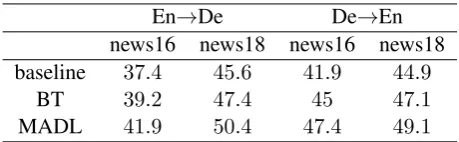
Table 1: Results of English↔German by sacreBLEU.
En→De De→En news16 news18 news16 news18 baseline 37.4 45.6 41.9 44.9
BT 39.2 47.4 45 47.1
MADL 41.9 50.4 47.4 49.1
Results The results are summarized in Table1, which are evaluated by sacreBLEU3. The baseline
[image:4.595.306.536.631.702.2]is the average accuracy of models using only bi-text, i.e.,f¯1 andf¯2 for English→German transla-tion and¯g1 and¯g2 for German→English, and BT is the accuracy of the model after back-translation training. As can be seen, back translation im-proves accuracy. For example, back-translation boosts the BLEU score from 45.6 to 47.4 on news18 English→German translation, which is
1.8 point improvement. MADL further boosts BLEU to 50.4, obtaining another 3-point im-provement, demonstrating the effectiveness of our method.
For the final submission, we accumulate many translation models (trained using bitext, back translation, and MADL, with different random seeds) and do knowledge distillation on the source sentences from WMT14 to WMT19 test sets. Take English→German translation as an example. De-note the English inputs asT ={si}Ni=1T, whereNT
is the size of the test set. For eachsinT, we trans-latestod0usingM English→German models and eventually obtain
E={(si, f(j)(si))|s∈ T }i,j, i∈[NT], j ∈[M],
where f(j) is the j-th translation model we ac-cumulated, T is the combination of inputs from WMT14 to WMT19. After obtaining E, we ran-domly select NTM bitext pairs (denoted as B2) fromB1and finetune modelf1onB2∪ E. We stop tuning when the BLEU scores of WMT16 (i.e., the validation set) drops.
We eventually obtain 44.9 BLEU score for English→German and42.8for German→English on WMT19 test sets and are ranked in the first place in these two translation tasks.
3.2 German↔French
For German↔French translation, we fol-low a similar process as the one used to English↔German tasks introduced in Section3.1. We merge the “commoncrawl”, “europarl-v7” and part of “de-fr.bicleaner07” selected by filter interactive.py as the bilingual data. We collect20M monolingual sentences for French and 20M for German from newscrawl. The data pre-processing rule and training pro-cedure are the same as that used in Section 3.1. We split9ksentences from the “dev08 14” as the validation set and use the remaining ones as the test set.
The results of German↔French translation on the test set are summarized in Table2.
Table 2: Results of German↔French by sacreBLEU.
De→Fr Fr→De baseline 29.5 23.4
MADL 31.5 24.9
Again, our method achieves significant im-provement over the baselines. Specifically, MADL boosts the baseline of German→French and French→German by2and1.5points respec-tively.
Our submitted German→French is a single sys-tem trained by MADL, achieving37.3 BLEU on WMT19. The French→German is an ensemble of three independently trained models, achiev-ing 35.0 BLEU score. Our systems are ranked in the first place for both German→French and French→German in the leaderboard.
3.3 Chinese→English
Dataset For Chinese→English translation, we use all the bilingual and monolingual data pro-vided by the WMT official website, and also extra bilingual and monolingual data crawled from the web. We filter the total 24M bilingual pairs from WMT using the script filter interactive.py as described in Section 3.1and get 18M sentence pairs. We use the Chinese monolingual data from XMU mono-lingual corpus4 and English monolingual data from News Crawl as well as the English sentences from all English-XX language pairs in WMT. We use 100M additional parallel sentences drawn from UN data, Open Subtitles and Web crawled data, which is filtered using the same filter rule described above, as well as fast align and in/out-domain filter. Finally we get 38M bilingual pairs. We also crawled 80M additional Chinese mono-lingual sentences from Sougou, China News, Xin-hua News, Sina News, Ifeng News, and 2M En-glish monolingual sentences from China News and Reuters. We use newstest2017 and newstest2018 on Chinese-English as development datasets.
We normalize the Chinese sentence from SBC case to DBC case, remove non-printable charac-ters and tokenize with both Jieba5 and PKUSeg6 to increase diversity. For English sentences, we re-move non-printable characters and tokenize with
4
http://nlp.nju.edu.cn/cwmt-wmt/ 5
https://github.com/fxsjy/jieba
Moses tokenizer7. We follow previous prac-tice (Hassan et al.,2018) and apply Byte-Pair En-coding (BPE) (Sennrich et al., 2016b) separately for Chinese and English, each with 40K vocabu-lary.
MASS Pre-training We pre-train MASS (Transfomer big) with both monolingual and bilingual data. We use 100M Chinese and 300M English monolingual sentences for the unsuper-vised setting (Equation 3), and with a total of 56M bilingual sentence pairs for the supervised setting (Equation 4). We share the encoder and decoder for all the losses in Equation 3 and 4. We then fine-tune the MASS pre-trained model on both 18M and 56M bilingual sentence pairs to get the baseline translation model for both Chinese→English and English→Chinese.
Back Translation and Knowledge Distillation We randomly choose 40M monolingual sentences for Chinese and English respectively for back translation following (Sennrich et al., 2016a;He et al.,2016) and sequence-level knowledge distil-lation following (Kim and Rush,2016). We iterate back translation and knowledge distillation multi-ple times, to gradually boost the performance of the model.
Results The results on newstest2017 and new-stest2018 are shown in Table 3. We list two baseline Transformer big systems which use 18M bilingual data (constraint) and 56M bilingual data (unconstraint) respectively. The pre-trained model achieves about 1 BLEU point improvement after fine-tuning on both 18M and 56M bilingual data. After iterative back translation (BT) and knowl-edge distillation (KD), as well as re-ranking, our system achieves 30.8 and 30.9 BLEU points on newstest2017 and newstest2018 respectively.
System newstest17 newstest18
Baseline (18M) 24.2 24.5 + MASS (18M) 25.2 25.4 Baseline (56M) 26.9 27.0 + MASS (56M) 28.0 27.8 + Iterative BT/KD 30.4 30.5
+ Reranking 30.8 30.9
Table 3: BLEU scores on Chinese→English test sets.
7https://github.com/moses-smt/mosesdecoder/blob/maste r/scripts/tokenizer/tokenizer.perl
WMT19 Submission For the WMT19 submis-sion, we conduct fine-tuning and speculation to further boost the accuracy by using the source sen-tences in the WMT19 test set. We first filter the bilingual as well as pseudo-generated data accord-ing to the relevance to the source sentences. We use the filter method in Deng et al. (2018) and continue to train the model on the filtered data. Second, we conduct speculation on the test source sentences following the practice in Deng et al.
(2018). The final BLEU score of our submission is 39.3, ranked in the first place in the leaderboard.
3.4 English↔Lithuanian
For English↔Lithuanian translation, we follow the similar process as that for Chinese→English task introduced in Section 3.3. We use all the WMT bilingual data, which is 2.24M after filtra-tion. We use the same English monolingual data as used in Chinese-English. We select 100M Lithua-nian monolingual data from official commoncrawl and use all the wiki and news Lithuanian mono-lingual data provided by WMT. In addition, we crawl 5M Lithuanian news data from LRT web-site8. We share the BPE vocabulary between En-glish and Lithuanian, and the vocabulary size is 65K.
All the bilingual and monolingual data are used for MASS pre-training, and all the bilingual data are used for fine-tuning. For iterative back trans-lation and knowledge distiltrans-lation, we split 24M English monolingual data as well as 12M Lithua-nian monolingual data into 5 parts through sam-pling with replacement, to get different models independently so as to increase diversity in re-ranking/ensemble. Each model uses 8M English monolingual data and 6M Lithuanian monolingual data. For our WMT19 submission, different from zh-en, speculation technology is not used.
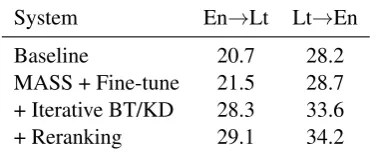
The BLEU scores on newsdev19 are shown in Table 4. Our final submissions for WMT19 achieves 20.1 BLEU points for English→Lithuanian translation (ranked in the first place) and 35.6 for Lithuanian→English translation (ranked in the second place).
3.5 English↔Finnish
Preprocess We use the official English-Finnish data from WMT19, including both bilingual data and monolingual data. After de-duplicating, the
System En→Lt Lt→En
Baseline 20.7 28.2
[image:7.595.88.276.64.141.2]MASS + Fine-tune 21.5 28.7 + Iterative BT/KD 28.3 33.6 + Reranking 29.1 34.2
Table 4: BLEU scores for English↔Lithuanian on the newsdev19 set.
bilingual data contains 8.8M aligned sentence pairs. We share the vocabulary for English and Finnish with46kBPE units. We use the WMT17 and WMT18 English-Finnish test sets as two de-velopment datasets, and tune hyper-parameters based on the concatenation of them.
Architecture search We use NAO to search sequence-to-sequence architectures for English-Finnish translation tasks, as introduced in subsec-tion 2.3. We use PyTorch for our implementa-tions. Due to time limitations, we are not targeting at finding better neural architectures than Trans-former; instead we target at models with com-parable performance to Transformer, while pro-viding diversity in the reranking process. The whole search process takes 2.5 days on 16 P40 GPU cards and the discovered neural architecture, named as NAONet, is visualized in the Appendix.
Train single models The final system for English-Finnish is obtained through reranking of three strong model checkpoints, respectively from the Transformer model decoding from left to right (L2R Transformer), the Transformer model de-coding from right to left (R2L Transformer) and NAONet decoding from left to right. All the mod-els have 6-6 layers in encoder/decoder, and are ob-tained using the same process which is detailed as below.
Step 1: Base models. Train two models
P1(x|y) and P1(y|x) based on all the bilingual dataset (8.8M), respectively for English→Finnish and Finnish→English translations.
Step 2: Back translation. Do the normal back translation (Sennrich et al.,2016a;He et al.,2016) using P1 and P2. Specifically we choose 10M monolingual English corpus, useP1(y|x) to gen-erate the 10M pseudo bitext with beam search (beam size is set to 5), and mix it with the bilin-gual data to continue the training ofP1(x|y). The ratio of mixing is set as1 : 1through up-sampling. The model obtained through such a process is
de-noted asP2(x|y). The same process is applied to the opposite direction and the new modelP2(y|x) is attained.
Step 3: Back translation + knowledge distilla-tion. In this step we generate more pseudo bi-text by sequence level knowledge distillation (Kim and Rush,2016) apart from using back translation. To be more concrete, as the first step, similar to Step 2, we choose15M monolingual English and Finnish corpus, and generate the translations us-ingP2(y|x)andP2(x|y), respectively. The result-ing pseudo bitext is respectively denoted asDx→y
andDy→x. Then we concatenate all the bilingual
data,Dx→y andDy→x, and use the whole corpus
to train a new English-Finnish modelfrom scratch. The attained model is denoted asP3(y|x).
Step 4: Finetune. In this step we try a very simple data selection method to handle the do-main mismatch problem in WMT. We remove all the bilingual corpus from Paracrawl which is generally assumed to be quite noisy ( Junczys-Dowmunt,2018) and use the remaining bilingual corpus (4.5M) to finetuneP3(y|x)for one epoch. The resulting model is denoted asP4(y|x)which is set as the final model checkpoint.
newstest17 newstest18 Baseline 26.09 16.07
+BT 28.84 18.54
+BT & KD 29.76 19.13 +Finetune 30.19 19.46
Table 5: BLEU scores of L2R Transformer on English→Finnish test sets.
newstest17 newstest18 L2R Transformer 30.19 19.46 R2L Transformer 30.40 19.73
NAONet 30.54 19.58
Table 6: The final BLEU scores on English→Finnish test sets, for the three models: L2R Transformer, R2L Transformer and NAONet, after the four steps of train-ing.
The similar results for Finnish-English translation are shown in Table7.
newstest17 newstest18 L2R Transformer 35.66 25.56 R2L Transformer 35.31 25.56
NAONet 36.18 26.38
Table 7: The final BLEU scores on Finnish→English test sets, for the three models: L2R Transformer, R2L Transformer and NAONet, after the four steps of train-ing.
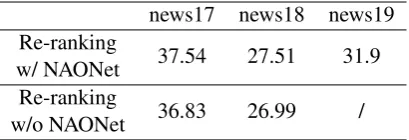
Re-ranking We use n-best re-ranking to deliver the final translation results using the three model checkpoints introduced in the last subsection. The beam size is set as 12. The weights of the three models, as well as the length penalty in generation, are tuned on the WMT-18 test sets. The results are shown in the second row of Table8.
We would also like to investigate what is the influence of the NAONet to the ranking re-sults. To achieve that, in re-ranking we replace NAONet with another model from L2R Trans-former, trained with the same process in subsec-tion3.5with the difference only in random seeds, while maintain the other two models unchanged. The results are illustrated in the last row of Ta-ble 8. From the comparison of the two rows in Table8, we can see the new architecture NAONet discovered via NAO brings more diversity in the ranking, thus leading to better results. We also re-port the similar results for Finnish-English tasks in Table9.
Our systems achieve 27.4 for and 31.9 for English→Finnish and Finnish→English, ranked in the first place and second place (by teams), re-spectively.
3.6 Russian→English
Dataset We use the bitext data from the several corpora: ParaCrawl, Common Crawl, News Com-mentary, Yandex Corpus, and UN Parallel Corpus.
news17 news18 news19 Re-ranking
w/ NAONet 31.48 21.21 27.4 Re-ranking
[image:8.595.308.513.62.132.2]w/o NAONet 30.82 20.79 /
Table 8: English→Finnish BLEU scores of re-ranking using the three models. “news” is short for “newstest”.
news17 news18 news19 Re-ranking
w/ NAONet 37.54 27.51 31.9 Re-ranking
w/o NAONet 36.83 26.99 /
Table 9: Finnish→English BLEU scores of re-ranking using the three models.
We also use News Crawl corpora as monolingual data. The data is filtered by rules such as sentence length, language identification, resulting a training dataset with 16M bilingual pairs and 40M mono-lingual sentences (20M for English and 20M for Russian). We use WMT17 and WMT18 test set as development data. The two languages use sep-arate vocabularies, each with 50K BPE merge op-erations.
Our system Our final system for Russian→English translation is a combina-tion of Transformer network (Vaswani et al.,
2017), back translation (Sennrich et al., 2016a), knowledge distillation (Kim and Rush,2016), soft contextual data augmentation (Zhu et al., 2019), and model ensemble. We use Transformer big as network architecture. We first train two models, English→Russian and Russian→English respec-tively, on bilingual pairs as baseline model. Based on these two models, we perform back translation and knowledge distillation on monolingual data, generating 40M synthetic data. Combining both bilingual and synthetic data, we get a large train corpus with 56M pairs in total. We upsample the bilingual pairs and shuffle the combined corpus to ensure the balance between bilingual and syn-thetic data. Finally, we train the Russian→English model from scratch. During the training, we also use soft contextual data augmentation to further enhance training. Following the above procedures, 5 different models are trained and ensembled for final submission.
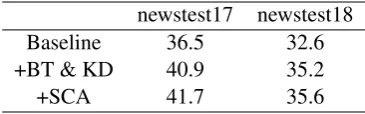
Results Our final submission achieves 40.1 BLEU score, ranked first in the leaderboard. Table
10reports the results of our system on the devel-opment set.
3.7 English→Kazakh
[image:8.595.72.282.99.155.2]newstest17 newstest18 Baseline 36.5 32.6 +BT & KD 40.9 35.2
[image:9.595.89.272.62.119.2]+SCA 41.7 35.6
Table 10: Russian→English BLEU scores.
(1) We crawl all news articles from inform. kz, a Kazakh-English news website. Then we match an English new article to a Kazakh one by matching their images with image hashing. In this way, we find 10K pairs of bilingual news articles. We use their title as additional parallel data. These data are in-domain and useful in training.
(2) We crawl 140K parallel sentence pairs from glosbe.com. Although most of these sentences are out-of-domain, they significantly extended the size of our parallel dataset and lead to better re-sults.
Because most of our parallel training data are noisy, we filter these data with some rules: (1) For the KazakhTV dataset, we remove any sentence pair with an alignment score less than 0.05. (2) For the Wiki Titles dataset, we remove any sen-tence pair that starts with User or NGC. (3) For all datasets, we remove any sentence pair in which the English sentence contains no lowercase alpha-bets. (4) For all datasets, we remove any sentence pair where the length ratio is greater than 2.5:1.
We tokenize all our data using the Moses De-coder. We learn a shared BPE (Sennrich et al.,
2016b) from all our data (including all WMT19 parallel data, WMT19 monolingual data9, glosbe, inform.kz news titles, and inform.kz news con-tents) and get a shared vocabulary of 49,152 to-kens. Finally, our dataset consists of 300K bilin-gual sentence pairs, 700K Kazakh monolinbilin-gual sentences, and many English monolingual sen-tences.
Our system Our model is based on the Trans-former (Vaswani et al.,2017). We vary the hyper-parameters to increase the diversity of our model. Our models usually have 6 encoder layers, 6/7 de-coder layers, ReLU/GELU (Hendrycks and Gim-pel,2016) activation function, and an embedding dimension of 640.
We train 4 English-Kazakh models and 4 Kazakh-English models with different random
9When we learn BPE, English monolingual data is down-sampled to make the number of English sentences roughly the same as the number of Kazakh sentences.
seeds and hyper-parameters. Then we apply back-translation (Edunov et al., 2018) and knowledge distillation (Kim and Rush,2016) for 6 rounds. In each round, we
1. Sample 4M sentences from English monolin-gual data and back-translate them to Kazakh with the best EN-KK model (on the dev set) in the pre-vious round.
2. Back-translate all Kazakh monolingual data to English with the best KK-EN model in the pre-vious round.
3. Sample 200K sentences from English mono-lingual data and translate them to Kazakh using the ensemble of all EN-KK models in the previ-ous round.
4. Train 4 English-Kazakh models with BT data from step 2 and KD data from step 3. We up-sample bilingual sentence pairs by 2x.
5. Train 4 Kazakh-English models with BT data from step 1. We up-sample bilingual sentence pairs by 3x.
Result Our final submission achieves 10.6 BLEU score, ranked second by teams in the leaderboard.
4 Conclusions
This paper describes Microsoft Research Asia’s neural machine translation systems for the WMT19 shared news translation tasks. Our sys-tems are built on Transformer, back translation and knowledge distillation, enhanced with our recently proposed techniques: multi-agent dual learning (MADL), masked sequence-to-sequence pre-training (MASS), neural architecture opti-mization (NAO), and soft contextual data aug-mentation (SCA). Due to time and GPU limita-tions, we only apply each technique to a subset of translation tasks. We believe combining them together will further improve the translation accu-racy and will conduct experiments in the future. Furthermore, some other techniques such as de-liberation learning (Xia et al., 2017b), adversar-ial learning (Wu et al.,2018b), and reinforcement learning (He et al.,2017;Wu et al.,2018a) could also hep and are worthy of exploration.
Acknowledgments
References
Yongchao Deng, Shanbo Cheng, Jun Lu, Kai Song, Jingang Wang, Shenglan Wu, Liang Yao, Guchun Zhang, Haibo Zhang, Pei Zhang, et al. 2018. Alibaba’s neural machine translation systems for wmt18. In Proceedings of the Third Conference on Machine Translation: Shared Task Papers, pages 368–376.
Sergey Edunov, Myle Ott, Michael Auli, and David Grangier. 2018. Understanding back-translation at scale. 2018 Conference on Empirical Methods in Natural Language Processing.
Hany Hassan, Anthony Aue, Chang Chen, Vishal Chowdhary, Jonathan Clark, Christian Feder-mann, Xuedong Huang, Marcin Junczys-Dowmunt, William Lewis, Mu Li, et al. 2018. Achieving hu-man parity on automatic chinese to english news translation. arXiv preprint arXiv:1803.05567.
Di He, Hanqing Lu, Yingce Xia, Tao Qin, Liwei Wang, and Tie-Yan Liu. 2017. Decoding with value net-works for neural machine translation. InAdvances in Neural Information Processing Systems, pages 178–187.
Di He, Yingce Xia, Tao Qin, Liwei Wang, Nenghai Yu, Tie-Yan Liu, and Wei-Ying Ma. 2016. Dual learn-ing for machine translation. InAdvances in Neural Information Processing Systems, pages 820–828.
Dan Hendrycks and Kevin Gimpel. 2016. Bridging nonlinearities and stochastic regularizers with gaus-sian error linear units.CoRR, abs/1606.08415.
Marcin Junczys-Dowmunt. 2018. Microsoft’s submis-sion to the wmt2018 news translation task: How i learned to stop worrying and love the data. In Pro-ceedings of the Third Conference on Machine Trans-lation (WMT), Volume 2: Shared Task Papers, pages 429–434.
Yoon Kim and Alexander M. Rush. 2016. Sequence-level knowledge distillation. InProceedings of the 2016 Conference on Empirical Methods in Natu-ral Language Processing, pages 1317–1327, Austin, Texas. Association for Computational Linguistics.
Diederik P Kingma and Jimmy Ba. 2015. Adam: A method for stochastic optimization. International Conference on Learning Representation (ICLR).
Renqian Luo, Fei Tian, Tao Qin, Enhong Chen, and Tie-Yan Liu. 2018. Neural architecture optimiza-tion. In S. Bengio, H. Wallach, H. Larochelle, K. Grauman, N. Cesa-Bianchi, and R. Garnett, ed-itors, Advances in Neural Information Processing Systems 31, pages 7816–7827. Curran Associates, Inc.
Hieu Pham, Melody Y. Guan, Barret Zoph, Quoc V. Le, and Jeff Dean. 2018. Efficient neural architecture search via parameters sharing. international confer-ence on machine learning, pages 4092–4101.
Rico Sennrich, Barry Haddow, and Alexandra Birch. 2016a. Improving neural machine translation mod-els with monolingual data. In Proceedings of the 54th Annual Meeting of the Association for Compu-tational Linguistics (Volume 1: Long Papers), vol-ume 1, pages 86–96.
Rico Sennrich, Barry Haddow, and Alexandra Birch. 2016b. Neural machine translation of rare words with subword units. 54th Annual Meeting of the As-sociation for Computational Linguistics (ACL).
Kaitao Song, Xu Tan, Tao Qin, Jianfeng Lu, and Tie-Yan Liu. 2019. Mass: Masked sequence to se-quence pre-training for language generation. In In-ternational Conference on Machine Learning, pages 5926–5936.
Ashish Vaswani, Noam Shazeer, Niki Parmar, Jakob Uszkoreit, Llion Jones, Aidan N Gomez, Łukasz Kaiser, and Illia Polosukhin. 2017. Attention is all you need. InAdvances in neural information pro-cessing systems, pages 5998–6008.
Yijun Wang, Yingce Xia, Li Zhao, Jiang Bian, Tao Qin, Guiquan Liu, and Tie-Yan Liu. 2018. Dual transfer learning for neural machine translation with marginal distribution regularization. In Thirty-Second AAAI Conference on Artificial Intelligence.
Yiren Wang, Yingce Xia, Tianyu He, Fei Tian, Tao Qin, ChengXiang Zhai, and Tie-Yan Liu. 2019. Multi-agent dual learning. InInternational Conference on Learning Representations.
Lijun Wu, Fei Tian, Tao Qin, Jianhuang Lai, and Tie-Yan Liu. 2018a. A study of reinforcement learning for neural machine translation. In Proceedings of the 2018 Conference on Empirical Methods in Nat-ural Language Processing, pages 3612–3621.
Lijun Wu, Yingce Xia, Fei Tian, Li Zhao, Tao Qin, Jianhuang Lai, and Tie-Yan Liu. 2018b. Adversarial neural machine translation. InAsian Conference on Machine Learning, pages 534–549.
Yingce Xia, Tao Qin, Wei Chen, Jiang Bian, Neng-hai Yu, and Tie-Yan Liu. 2017a. Dual supervised learning. In Proceedings of the 34th International Conference on Machine Learning-Volume 70, pages 3789–3798. JMLR. org.
Yingce Xia, Fei Tian, Lijun Wu, Jianxin Lin, Tao Qin, Nenghai Yu, and Tie-Yan Liu. 2017b. Deliberation networks: Sequence generation beyond one-pass de-coding. InAdvances in Neural Information Process-ing Systems, pages 1784–1794.