Proceedings of the 7th Joint Conference on Lexical and Computational Semantics (*SEM), pages 245–254
Measuring Frame Instance Relatedness
Valerio Basile University of Turin
Italy
Roque Lopez Condori Université Côte d’Azur, Inria, CNRS, I3S, France [email protected]
Elena Cabrio Université Côte d’Azur, Inria, CNRS, I3S, France
Abstract
Frame semantics is a well-established framework to represent the meaning of nat-ural language in computational terms. In this work, we aim to propose a quantita-tive measure of relatedness between pairs of frame instances. We test our method on a dataset of sentence pairs, highlighting the correlation between our metric and hu-man judgments of sehu-mantic similarity. Fur-thermore, we propose an application of our measure for clustering frame instances to extract prototypical knowledge from natu-ral language.
1 Introduction
Frame Semanticshas been a staple of artificial intelligence and cognitive linguistics since its first formulation in the ’70s (Fillmore,1976). In particular, frame semantics has been widely adopted as a theoretical backbone for the inter-pretation of natural language, in order to repre-sent its meaning with formal structures suited for computation. In a nutshell, according to frame semantics, the meaning of a sentence can be represented as a set of situations (frames) and the entities involved in them (frame ele-ments), each with their own role.
Several approaches have proposed in the past years to automatically interpret natural language in terms of frame semantics (Gildea and Jurafsky, 2002; Thompson et al., 2003;
Erk and Padó, 2006, among others). How-ever, the vast majority of these approaches fo-cuses on the extraction of the structure of the frames evoked in the natural language fragment (frames and roles), while leaving the frame el-ements either underspecified or simply repre-senting them as spans of the original text. In this work, we propose to fully represent the meaning of a natural language sentence with
instantiated frames, where the frame elements are nodes in a knowledge graph.
Moreover, while a great deal of effort has been directed towards the extraction of frames from natural language, not many systems pro-cess frames further, to solve downstream tasks in NLP and AI — an example is Sentilo ( Recu-pero et al.,2015), a sentiment analysis system built on top of the frame-based machine read-ing tool FRED byPresutti et al.(2012).
In this paper we define a quantitative mea-sure to compute the semantic relatedness of a pair of frame instances, and apply it to the task of creating a commonsense knowledge base.
The main contributions of this paper are:
• A novel measure of relatedness between frame instances (Section3).
• A high-quality data set of natural lan-guage sentences aligned to the frame in-stances evoked by them (Sections 4 and
5).
• A pilot study on the extraction of pro-totypical knowledge based on frame in-stance clustering (Section6).
Before introducing the novel contributions, we describe related work (Section 2), while Sec-tion7summarizes our conclusions.
2 Related Work
the same or similar contexts (e.g., measured by pointwise mutual information or distribu-tional semantic models); iii) hierarchy-based measures, which leverage the FrameNet hier-archy, assuming that frames are likely related if they are close in the network structure of FrameNet. The results of their experimental tests show high correlation between some of these measures and a dataset of human judg-ments of semantic similarity.
Subsequent works have taken the measures presented by Pennacchiotti and Wirth (2009) as basis to implement more refined measures.
Kim et al.(2013) proposes SynRank, a func-tion to calculate frame relatedness which uses three measures: i) content similarity, based on the overlapping of the terms that evoke the frames, ii) context similarity, defined by neigh-bor frames within a window in its document, and iii) corpus-based word similarity, which uses the corpus-specific information.
Virk et al.(2016) presented a supervised ap-proach to enrich FrameNet’s relational struc-ture with new frame-to-frame relations. To cre-ate these new relations, the authors propose to use features based on frame network structure and frame elements (role names similarity by overlap). In addition to these features, the over-lap among content words (nouns, verbs, adjec-tives and adverbs) occurring in verbal defini-tions of each frame of FrameNet is also used.
More recently, Alam et al.(2017) proposed three measures to compute the semantic relat-edness between two frames using the hierar-chical structure of the FrameNet graph. These measures are i) path similarity, based on the shortest path between two nodes in the tax-onomy, ii) Leacock-Chodorow similarity ( Lea-cock and Chodorow, 1998), which considers the shortest path between two nodes and the depth of the taxonomy and iii) Wu-Palmer sim-ilarity (Wu and Palmer, 1994), based on the depths of two nodes in the taxonomy and their least common subsumer. In (Shah et al.) a word sense-based similarity metric is used as a proxy to frame instance relatedness in order to cluster frame instances.
Our method presupposes a formalization of the frame element structure including the en-tities that fill the semantic roles, akin to the work of (Scheffczyk et al.,2006), which seeks
to give the slot fillers semantic type constraints by linking them to a top-level ontology.
To our knowledge, our approach is the first to address the relatedness of instantiated frames that include disambiguated concepts in their frame elements.
3 A Quantitative Measure of Frame Instance Relatedness
In the theory of frame semantics, a frame is a prototypical situation uniquely defined by a name, e.g.,Driving_vehicle, an event in-volving a vehicle, someone who controls it, the area where the motion takes place, and so on. Frames have frame elements, identified by therolethey play in the frame. Following the example above, Driver and Vehicle
are some of the frame elements expected to be present in aDriving_vehiclesituation.
Most NLP works on frame semantics are based on FrameNet (Baker et al.,1998), a lex-ical semantic resource which contains descrip-tions and annotadescrip-tions of frames. In FrameNet, each frame type defines its own set of frame el-ements and associated words (known aslexical units) which can evoke the frame. FrameNet also lists a set of frame-to-frame relations (e.g. subframe_of,is_causative_of) according to how they are organized with re-spect to each other.
We propose a method to compute a nu-meric score indicating the relatedness of a pair of frame instances. Formally, we define a frame instance f i as a tuple
(ft,{(r1, e1), ...,(rn, en)}), ft ∈ T, r ∈ R, e∈E, whereT is the set of frame types,R is the set of semantic roles, andEis the vocab-ulary of entities that could fill any given role.
The relatedness between two frame in-stances f i1 and f i2 is computed as a linear
combination of the relatedness between the two frame types and the distance between the frame elements contained in the frame instances:
f irel(f i1, f i2) =
=αf trel(f i1, f i2)+(1−α)f erel(f i1, f i2)
(1)
The relatednessf irel(f i1, f i2)is therefore
the α parameter controls the extent to which the relatedness is weighted towards the frame types or the frame elements. The frame type relatednessf treland the frame element relat-ednessf erelcan be computed in several ways, which we detail in the remainder of this sec-tion.
3.1 Implementation Details
The method to compute the relatedness of frame instances that we propose is independent from the actual vocabulary of frames, roles and concepts — although for some of the steps pre-cise characteristics of the frame definition are needed, e.g., a set of lexical units. In prac-tice, we use the frame type and element inven-tory of FrameNet 1.5, containing 1,230 frames, 11,829 lexical units and 173,018 example sen-tences. As concept inventory, we select Ba-belNet, a large scale multilingual dictionary and semantic network (Navigli and Ponzetto,
2012). Words in BabelNet belong to one or many BabelNet synsets, each synset defines a sense, thus it represents a potential semantic role filler in a frame element.
3.2 Frame Type Relatedness
Pennacchiotti and Wirth (2009) surveys a number of methods to compute a relatedness score between frames. We implemented the best performing algorithm for frame related-ness among those introduced in the aforemen-tioned paper, namely the co-occurrence mea-sure(f trelocc). This algorithm is based on an estimate of the point-wise mutual information (pmi) between the two frames, computed on the basis of their occurrence in an annotated corpus.
Given two frame types f t1 andf t2, and a
corpus C, the measure is defined as:
f trelocc(f i1, f i2) =log2 |
Cf t1,f t2|
|Cft1||Cft2| (2)
where Cf t1 and Cf t2 indicate the subsets of
contexts in which f t1 and f t2 occur
respec-tively, and Cf t1,f t2 the subset of contexts
where both frame types occur.
Since a large corpus of frame-annotated nat-ural language is hard to come by and very ex-pensive to produce, the occurrence of a frame
typef ti in a contextcis defined as the occur-rence of at least one of the lexical unitslf ti as-sociated to that frame type in FrameNet in that particular context:
Cf ti ={c∈C:∃lf ti ∈c}
Cf t1,f t2 ={c∈C:∃lf t1 ∈c∧ ∃lf t2 ∈c}
While the original method only considers the word part of the lexical units, we computed the occurrence counts on SEMCOR (Landes et al.,
1998), a corpus of manually sense-labeled En-glish text (words are annotated with part-of-speech tags and senses from WordNet). By using a disambiguated corpus, we are able to match the lexical units from FrameNet to the sense labels of SEMCOR, overcoming the am-biguity of polysemous words.
We also implement an alternative measure of frame type relatedness, based on distribu-tional semantics (f treldistinspired by another of the measures in the same paper by Pennac-chiotti and Wirth (2009)). We created vector representations for each frame type by merg-ing the representations of their lexical units in a pre-trained word space model. For each frame type, we compute the average of the vectors in GloVe6B (Pennington et al.,2014), a large word embedding model of English words, cor-responding to each lexical unit in the frame. The measure of distributional frame type relat-edness between two frame typesf t1andf t2is
then given by the cosine similarity between the two respective frame vectorsf t~1 andf t~2:
f treldist(f i1, f i2) =
~ f t1·f t~2
||f t~1||||f t~2||
(3)
3.3 Frame Elements Relatedness
The second half of equation 1 corresponds to the relatedness measured between two sets of frame elements, therefore an aggregation step is needed. For each concept corresponding to the frame elements f ei ∈ f i1, we
com-pute all the similarity scores with respect to the concepts corresponding to the frame ele-ments f ej ∈ f i2, and select the best match.
rather than averaging the similarities of all the possible combinations. The resulting similari-ties are averaged over all the frame elements. Since this process is asymmetrical, we com-pute it in both directions and take the average of the results:
f erel(f i1, f i2) = = 1
2
1
|f i1| X
f ei∈f i1
max
f ej∈f i2
csim(f ei, f ej) +
+ 1
|f i2| X
f ei∈f i2
max
f ej∈f i1
csim(f ei, f ej)
(4)
The function csim(f ei, f ej) between con-cepts is again computed as cosine simi-larity between vector representations. In this case we leverage the semantic resource NASARI (Camacho-Collados et al., 2016), a concept space model built on top of the Babel-Net semantic network. Each vector in NASARI represents a BabelNet synset in a dense 300-dimensional space. The reason to use a differ-ent vector space model than the one used for f treldist is that NASARI provides represen-tations of disambiguated concepts, which we have from KNEWS, while GloVe6B is a word-based model and the lexical units are not dis-ambiguated.
Note that in equation4the semantic roles of the elements are ignored in the computation of the relatedness between frame elements. We therefore extend the definition of frame ele-ment relatedness by adding the extra parame-terroles, acting as a filter: when activated, it sets the relatedness score of a pair of frame ele-ments to zero if they do not share the same role in the frame instance.
4 Evaluation by Text Similarity
To our knowledge, there is no manually anno-tated dataset of frame instances and their relat-edness. In order to circumvent this shortcom-ing, we propose an indirect methodology for the evaluation of the frame instance relatedness measures we introduced in Section3. The key idea of our evaluation approach is to measure the relatedness of frame instances extracted from pairs of short texts, for which a gold stan-dard pairwise similarity score is given.
We parse the text with a knowledge extrac-tion system to extract all the frame instances. We then measure the semantic relatedness of the extracted frame instances and compare the outcome with a judgment of pairwise seman-tic similarity given on the original sentences. The aim of this experiment is to show that our measure of frame instance relatedness corre-lates with the semantic relatedness of the text that evokes the frame. In other words, we use textual similarity as a proxy for human judg-ment of relatedness between frame instances.
4.1 Data
The dataset we selected to carry out this exper-iment is provided by the shared task on Seman-tic Text Similarity (STS) held at SemEval 2017 (task 1, track 5 English-English) (Cer et al.,
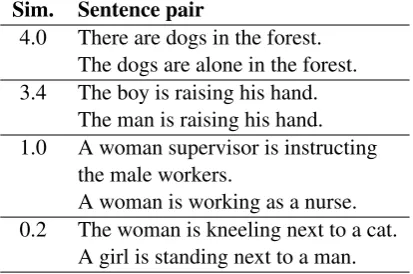
[image:4.595.306.513.469.606.2]2017). The set is composed of 250 pairs of short English sentences, manually annotated with a numerical score from 1 to 5 indicating their degree of semantic relatedness. Examples of sentence pairs from the gold standard set, along with their human judgments of semantic similarity, are shown in Table1.
Table 1: Examples of the sentence pairs in the Se-mEval 2017 STS dataset, with numbers indicating their semantic similarity on a scale from 1 to 5.
Sim. Sentence pair
4.0 There are dogs in the forest. The dogs are alone in the forest. 3.4 The boy is raising his hand.
The man is raising his hand. 1.0 A woman supervisor is instructing
the male workers.
A woman is working as a nurse. 0.2 The woman is kneeling next to a cat.
A girl is standing next to a man.
4.2 Knowledge Extraction
by Semafor (Das et al., 2014). KNEWS in-tegrates the Word Sense Disambiguation tool Babelfy (Moro et al., 2014) to extract con-cept and entities from the input sentences, and maps them to the frame roles provided by Semafor, creating frame instances where the frame types are from FrameNet 1.5 and the frame roles are filled with concepts from Ba-belNet. An example of the extraction of frame instances from natural language performed by KNEWS is shown in Figure1. In the exam-ple, three frame instances are extracted from the sentence “two men sit on a bench”, with frame typesPeople,Cardinal_numbers
andBeing_located. The frame elements are completed with BabelNet synset identi-fiers, e.g., the Theme of Being_located
is bn:00001533n (man, adult male, male:
An adult person who is male (as opposed to a woman)1) and the Location of the same
frame instance isbn:00009850n(bench: A long seat for more than one person2).
We ran KNEWS on the 500 sentences from the STS dataset and extracted 1,650 frame in-stances of 178 different frame types. Each frame instance has on average 1.2 frame ele-ments, for a total of 2,107 roles filled by 457 different types of concepts.
4.3 Frame-based Sentence Similarity Our aim in this experiment is to assess the re-latedness ofsentencesby measuring the relat-edness of their corresponding frame instances. Since we have defined (in Section3) a method to compute the relatedness offrame instances, an extra step of aggregation is needed in order to reconcile the measurement for the evalua-tion. We define the similarityssim(s1, s2)
be-tween two sentencess1 = {f i11, ..., f i1n} and
s2 ={f i21, ..., f i2m}as follows:
ssim(s1, s2) = = 1
2 1
|s1| X
f i1 i∈s1
max
f i2 j∈s2
f irel(f i1i, f i2j) +
+ 1
|s2| X
f i2 i∈s2
max
f i1 j∈s1
f irel(f i1i, f i2j) (5)
1http://babelnet.org/synset?word=
bn:00001533n
2http://babelnet.org/synset?word=
bn:00009850n
Table 2: Pearson correlation between sentence pair similarity scores predicted by frame instance relat-edness and the SemEval STS reference set.
without role filter with role filter
ftrel: occ dist occ dist
alpha
1.0 0.526 0.455 0.526 0.455
0.9 0.529 0.465 0.536 0.477
0.8 0.529 0.471 0.544 0.495
0.7 0.525 0.473 0.550 0.510
0.6 0.517 0.471 0.555 0.522
0.5 0.503 0.463 0.558 0.531
0.4 0.484 0.451 0.558 0.538
0.3 0.461 0.436 0.557 0.542
0.2 0.436 0.418 0.554 0.544
0.1 0.410 0.400 0.550 0.545
0.0 0.381 0.381 0.543 0.543
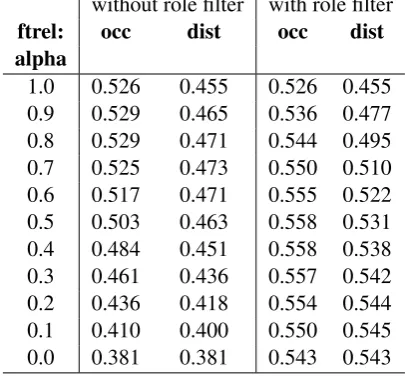
We tested the effect of theαparameter, the frame type relatedness measures f trelocc and f treldist, and the filter on semantic roles to in-vestigate their impact on the quality of the re-latedness measurement. The result is given in Table2in terms of Pearson correlation between the gold standard relatedness scores and the re-latedness scores predicted by our method.
Overall, the occ measure of frame type re-latedness produces better results thandist. We find that both halves of equation 1 contribute to the final result, with a sweet stop around α = 0.4 that achieves the best performance
on this benchmark with f trel = occ and the filter on the semantic roles. Indeed, enforcing the matching constraint on the semantic roles proves to be a successful strategy. The differ-ence in terms of adherdiffer-ence to the text similarity scores with and without such constraint is sig-nificant and consistent across every variation of the other parameters.
4.4 Discussion
[image:5.595.306.509.114.302.2]@prefix fbfi: <http://framebase.org/ns/fi->
@prefix fbframe: <http://framebase.org/ns/frame-> @prefix fbfe: <http://framebase.org/ns/fe->
@prefix rdfs: <http://www.w3.org/1999/02/22-rdf-syntax-ns\#> @prefix bn: <http://babelnet.org/rdf/>
fbfi:People_01b52400 rdfs:type fbframe:People. fbfi:People_01b52400 fbfe:Person bn:00001533n.
fbfi:Cardinal_numbers_3faa6c9c rdfs:type fbframe:Cardinal_numbers. fbfi:Cardinal_numbers_3faa6c9c fbfe:Entity bn:00001533n.
fbfi:Being_located_079aed4d rdfs:type fbframe:Being_located. fbfi:Being_located_079aed4d fbfe:Theme bn:00001533n.
fbfi:Being_located_079aed4d fbfe:Location bn:00009850n.
Figure 1: Frame instances extracted by KNEWS from the sentence “two men sit on a bench”.
in practice, despite the inevitable shortcom-ings of the frame extraction process, i.e., wrong and/or missing classifications of frames, roles and concepts. The STS dataset has a strong bias towards people-centric frames. In fact, the most frequent frame type in our collec-tion is People (345 occurrences in 1,650 frame instances), and the most frequent concept is
bn:00001533n(man, adult male, male, 226 occurrences in 2,107 frame elements).
5 Evaluation on Gold Standard Frame Instances
The evaluation conducted in the first experi-ment has the advantage of being fully auto-mated. However, measuring frame instance re-latedness indirectly through text similarity en-tails that two distinct effects are measured at once: 1) the relatedness of the frame instances extracted from the text, and 2) the accuracy of the frame instance extraction process. In this section we propose a revised methodology for the evaluation of the frame instance relatedness measure that focuses only on measuring the ef-fect (1), canceling the interference of (2). In short, we manually correct the frame instances extracted with KNEWS from the STS sentence pairs and re-run the evaluation process as de-scribed in Section4. As by-products, we cre-ate a gold standard dataset of frame instances aligned with the text that evokes them3, and we
provide an evaluation of the performance of the KNEWS knowledge extraction system.
3We will release the dataset after the review period.
5.1 Manual correction
We corrected each frame instance individually. For the frame types, they were either confirmed or marked as wrong. In the latter case, the frame instance is discarded from the data set without further process. This was also the pro-cedure applied when an entity was not filling any role for a particular frame instance, due to a parsing mistake. If the frame type was confirmed by the annotator, then the role and sense labels were checked and possibly cor-rected by replacing them with the correct ones from FrameNet and BabelNet respectively.
We split the STS dataset (250 sentence pairs) in three parts and assigned each of them to an annotator. A subset of 37 frame instances ex-tracted from 10 sentences was annotated by all three annotators in order to compute a measure of inter-coder reliability, resulting in a Fleiss’ Kappa of 0.81 on the annotation of frame types, 0.76 for roles, and 0.90 for concepts. Note that the annotation of roles and concepts is only considered when frame types are not discarded by the annotators as wrong.
biased towards the most dominant frame for ambiguous forms. The final gold standard set comprises 1,261 frame instances and 1,579 frame elements.
5.2 Text Similarity Experiment with Gold Standard Frame Instances
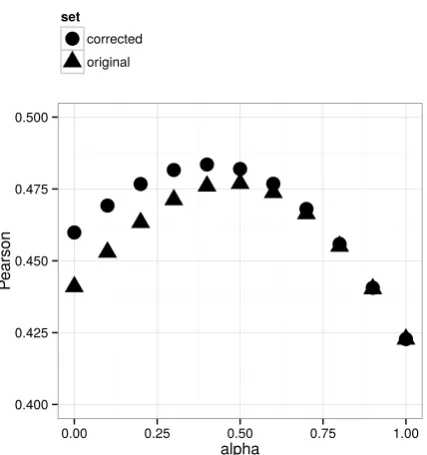
We repeated the experiment in 4.3, this time computing the pair-wise frame relatedness on the manually corrected frame instances. To provide a fair comparison, we removed the frame instances from the original set corre-sponding to the frame instances removed dur-ing the manual correction. We used the filter on semantic roles described in4.3andf trelocc (the performance patterns we observed were the same as in the original experiment). The results of the experiment are shown in Fig-ure 2. The overall performance is slightly lower than the previous experiment. This can be explained by observing that in this version of the experiment we are using less data, al-though of higher quality. Due to the struc-ture of the correlation-based evaluation, incor-rect frame instances extracted from a pair of sentences contribute to their relatedness score more than missing some frame instances. Also, the dominance bias could play a role, in that we mostly discarded low-frequency frames, for which the relatedness metric we defined could perform less than optimally. An in-depth anal-ysis of this phenomenon (i.e., how does lexical ambiguity interplay with the variance in relat-edness scores?) is left for future work.
6 Clustering Frame Instances to Extract Prototypical Knowledge
In the previous sections, we proved that our method for computing a relatedness score be-tween two frame instances correlates well with human judgments of semantic similarity based on the natural language expression of such in-stances. What we presented is a kind of intrin-sic evaluation, which, while helpful in assess-ing the quality of the solution, does not pro-vide an insight into the motivation to imple-ment a measure of frame instance relatedness, and what open problems could benefit from our approach down the line. To fill this gap, we propose a pilot study on the application of the method introduced in this paper to a
down-● down-● ●
● ●
● ●
●
●
●
●
0.400 0.425 0.450 0.475 0.500
0.00 0.25 0.50 0.75 1.00
alpha
Pearson
set
●corrected
[image:7.595.307.521.65.293.2]original
Figure 2: Pearson correlation between sentence pair similarity scores predicted by frame instance relat-edness on corrected frame instances and the Se-mEval STS reference set.
stream task, namely the extraction of common sense knowledge from text, in line with the pro-totypical knowledge building method in (Shah et al.).
We start by observing that defining a quan-titative distance metric between homogeneous instances allows us to apply a clustering algo-rithm. The result of such clustering is a par-tition of the original set into subsets that can be either overlapping (soft clustering) or non-overlapping (hard clustering). Moreover, clus-ters have a definite shape, with one of the el-ements being the most central one (called the
clustroid), and the others being more or less far from the center. We perform a hard clus-tering of the frame instances collected from the STS dataset and used for the experiment in Section4.3, and formulate three hypotheses: i) elements close to the center of their respec-tive clusters are the best candidates to repre-sent prototypical frame instances; ii) elements near the border of their respective clusters are less likely to represent prototypical frame in-stances, and therefore can be filtered out; iii) the size of each cluster influences the prototyp-icality degree of the elements in its central re-gion, with larger clusters containing more pro-totypical frame instances near its center.
Table 3: Random sample of frame instances extracted from the STS dataset.
Cluster size 5
Frame type Noise_makersmusical effect) (the Noise_maker is an artifact used to produce sound, especially for Role Noise_maker(this FE identifies the entity or substance that is designed to produce sound)
Concept Guitar(a stringed instrument usually having six strings; played by strumming or plucking)
Cluster size 40
Frame type Substance(this frame concerns internally undifferentiated Substances)
Role Substance(the undifferentiated entity which is presented as having a permanent existence)
Concept Sand(a loose material consisting of grains of rock or coral)
Cluster size 3
Frame type Part_inner_outeror edge of the object (This frame concerns Parts of objects that are defined relative to the center
Role Part
Concept Center(an area that is approximately central within some larger region)
Role Whole(an undivided entity having all its Parts)
[image:8.595.87.514.80.283.2]Concept Pond(a small lake)
Table 4: Clustroids of randomly selected clusters from the STS dataset.
Cluster size 8
Frame type Vehicle(the frame concerns the vehicles that human beings use for the purpose of transportation) Role Vehicle(is the transportation device that the human beings use to travel)
Concept Boat(a small vessel for travel on water)
Cluster size 5
Frame type Biological_areasmaller locations characterized by the type of life present)(this frame contains words that denote large ecological areas as well as Role Locale(this FE identifies a stable bounded area)
Concept Forest(the trees and other plants in a large densely wooded area)
Cluster size 35
Frame type Roadwaysthe Source and the Goal)(This frame involves stable Roadways which connect two stable Endpoints, Role Roadway(the Roadway is the roadway that connects locations)
Concept Road(a way or means to achieve something)
Table 5: Clustroids of the three largest clusters in the dataset.
Cluster size 418
Frame type People(this frame contains general words for Individuals, i.e. humans)
Role Person(the Person is the human being)
Concept Man(an adult person who is male -as opposed to a woman-)
Cluster size 51
Frame type Clothingconventionally wear)(this frame refers to clothing and its characteristics, including anything that people Role Garment(this FE identifes the clothing worn)
Concept Shirt(a garment worn on the upper half of the body)
Cluster size 50
Frame type Kinship(this frame contains words that denote kinship relations)
Role Alter(the person who fills the role named by the Kinship term with respect to the Ego)
Concept Child(a young person of either sex)
the hierarchical clustering approach, because the number of clusters is not necessary to be known a priori. In particular, we used the ver-sion implemented in the SciPy library4. We
tested different linkage methods for
hierar-4https://www.scipy.org/
measure (the distance metric for the clustering) according to the experiments in Section4.
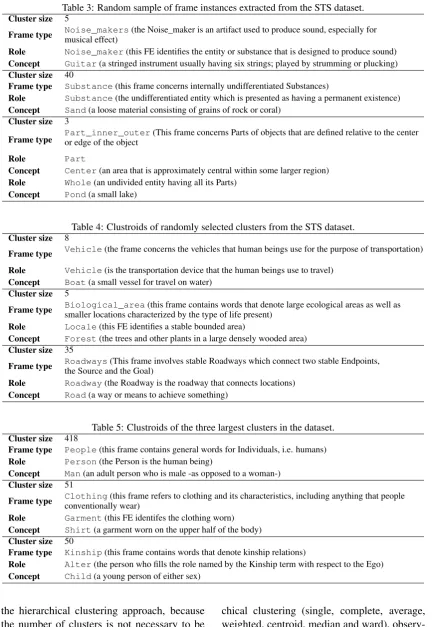
While giving an objective assessment about the prototypicality of a frame instance is some-what hard, we observe different behavior in line with our hypothesis. The examples re-ported in Table3include quite arbitrary, albeit correct, frame instances. On the other hand, the examples in Table 5are indeed highly proto-typical, e.g., a shirt is a prototypical piece of clothing, while the examples in Table4can be placed somewhere in the middle of the proto-typicality scale.
7 Conclusion and Future Work
We presented a novel method to compute a quantitative relatedness measure between frame instances, that takes into account the type of the frames, the semantic role of the frame elements, and the entities involved in the frame instances. Based on a test conducted on a gold standard set of sentence pairs, the mea-sure we defined correlates positively with hu-man judgments of sehu-mantic similarity. We fur-ther apply the relatedness measure to the task of extracting prototypical knowledge from nat-ural language.
One clear bottleneck of our experimental setup is given by the automatic parsing, that does not always reach optimal performances. We believe that a stable measure of relatedness between frame instances will in fact boost the performance of a disambiguation system, act-ing as a coherence measure for an all-word dis-ambiguation approach. We intend to test such strategy in future work.
The experiment on frame instance cluster-ing for prototypical knowledge extraction pre-sented in Section6showed promising results. In future work, we plan to conduct a large-scale experiment following the same principles in-cluding an extensive systematic evaluation of the quality of the resulting dataset.
References
Mehwish Alam, Diego Reforgiato Recupero, Mis-ael Mongiovì, Aldo Gangemi, and Petar Ris-toski. 2017. Event-based Knowledge Reconcili-ation using Frame Embeddings and Frame Simi-larity. Knowledge-Based Systems, 135:192–203.
Collin F. Baker, Charles J. Fillmore, and John B. Lowe. 1998.The Berkeley FrameNet Project. In
Proceedings of the 36th Annual Meeting of the Association for Computational Linguistics and 17th International Conference on Computational Linguistics - Volume 1, ACL ’98, pages 86–90, Stroudsburg, PA, USA. Association for Compu-tational Linguistics.
Valerio Basile, Elena Cabrio, and Claudia Schon. 2016. KNEWS: Using Logical and Lexical Se-mantics to Extract Knowledge from Natural Lan-guage. InProceedings of the European Confer-ence on Artificial IntelligConfer-ence (ECAI) 2016.
José Camacho-Collados, Mohammad Taher Pile-hvar, and Roberto Navigli. 2016. Nasari: Inte-grating explicit knowledge and corpus statistics for a multilingual representation of concepts and entities.Artificial Intelligence, 240:36–64.
Daniel Cer, Mona Diab, Eneko Agirre, Inigo Lopez-Gazpio, and Lucia Specia. 2017. Semeval-2017 task 1: Semantic textual sim-ilarity multilingual and crosslingual focused evaluation. In Proceedings of the 11th Inter-national Workshop on Semantic Evaluation (SemEval-2017), Vancouver, Canada.
Dipanjan Das, Desai Chen, André F. T. Martins, Nathan Schneider, and Noah A. Smith. 2014. Frame-semantic parsing. Computational Lin-guistics, 40:1:9–56.
Katrin Erk and Sebastian Padó. 2006. SHAL-MANESER - A Toolchain For Shallow Semantic Parsing. InProceedings of LREC 2006.
Charles J. Fillmore. 1976. Frame semantics and the nature of language. Annals of the New York Academy of Sciences: Conference on the Ori-gin and Development of Language and Speech, 280(1):20–32.
Daniel Gildea and Daniel Jurafsky. 2002. Auto-matic labeling of semantic roles. Comput. Lin-guist., 28(3):245–288.
H. Kim, X. Ren, Y. Sun, C. Wang, and J. Han. 2013.
Semantic Frame-Based Document Representa-tion for Comparable Corpora. InProceedings of the 13th International Conference on Data Min-ing, pages 350–359.
Shari Landes, Claudia Leacock, and Randee I Tengi. 1998. Building semantic concordances.
WordNet: An electronic lexical database, 199(216):199–216.
Andrea Moro, Alessandro Raganato, and Roberto Navigli. 2014. Entity Linking meets Word Sense Disambiguation: a Unified Approach. Transac-tions of the Association for Computational Lin-guistics (TACL), 2:231–244.
Roberto Navigli and Simone Paolo Ponzetto. 2012. BabelNet: The automatic construction, evalua-tion and applicaevalua-tion of a wide-coverage multi-lingual semantic network.Artificial Intelligence, 193:217–250.
Marco Pennacchiotti and Michael Wirth. 2009.
Measuring Frame Relatedness. In Proceedings of the 12th Conference of the European Chapter of the Association for Computational Linguis-tics, EACL ’09, pages 657–665, Stroudsburg, PA, USA. Association for Computational Lin-guistics.
Jeffrey Pennington, Richard Socher, and Christo-pher D. Manning. 2014. Glove: Global vec-tors for word representation. InEmpirical Meth-ods in Natural Language Processing (EMNLP), pages 1532–1543.
Valentina Presutti, Francesco Draicchio, and Aldo Gangemi. 2012. Knowledge extraction based on discourse representation theory and linguistic frames. InKnowledge Engineering and Knowl-edge Management, pages 114–129, Berlin, Hei-delberg. Springer Berlin HeiHei-delberg.
Diego Reforgiato Recupero, Valentina Presutti, Ser-gio Consoli, Aldo Gangemi, and Andrea Gio-vanni Nuzzolese. 2015. Sentilo: Frame-based sentiment analysis. Cognitive Computation, 7(2):211–225.
Jan Scheffczyk, Adam Pease, and Michael Ellsworth. 2006. Linking framenet to the sug-gested upper merged ontology. In Proceed-ings of the 2006 Conference on Formal Ontol-ogy in Information Systems: Proceedings of the Fourth International Conference (FOIS 2006), pages 289–300, Amsterdam, The Netherlands, The Netherlands. IOS Press.
Avijit Shah, Valerio Basile, Elena Cabrio, and Sowmya Kamath S. Frame instance extraction and clustering for default knowledge building. pages 1–10.
Cynthia A Thompson, Roger Levy, and Christo-pher D Manning. 2003. A generative model for semantic role labeling. InEuropean Conference on Machine Learning, pages 397–408. Springer.
Shafqat Mumtaz Virk, Philippe Muller, and Juli-ette Conrath. 2016. A Supervised Approach for Enriching the Relational Structure of Frame Se-mantics in FrameNet. InProceedings of the 26th International Conference on Computational Lin-guistics: Technical Papers, pages 3542–3552, Osaka, Japan. The COLING 2016 Organizing Committee.