Proceedings of the 7th Joint Conference on Lexical and Computational Semantics (*SEM), pages 148–153
Exploiting Partially Annotated Data for Temporal Relation Extraction
Qiang Ning,1Zhongzhi Yu,2 Chuchu Fan,1 Dan Roth1,2,3
1Department of Electrical and Computer Engineering,2Department of Computer Science University of Illinois at Urbana-Champaign, Urbana, IL 61801, USA
3Department of Computer Science, University of Pennsylvania, Philadelphia, PA 19104, USA
{qning2,zyu19,cfan10}@illinois.edu, [email protected]
Abstract
Annotating temporal relations (TempRel) be-tween events described in natural language is known to be labor intensive, partly because the total number of TempRels is quadratic in the number of events. As a result, only a small number of documents are typically an-notated, limiting the coverage of various lexi-cal/semantic phenomena. In order to improve existing approaches, one possibility is to make use of the readily available, partially annotated data (P as in partial) that cover more docu-ments. However, missing annotations inP are known to hurt, rather than help, existing sys-tems. This work is a case study in exploring various usages ofP for TempRel extraction. Results show that despite missing annotations,
P is still a useful supervision signal for this task within a constrained bootstrapping learn-ing framework. The system described in this system is publicly available.1
1 Introduction
Understanding the temporal information in natu-ral language text is an important NLP task ( Ver-hagen et al., 2007, 2010;UzZaman et al., 2013;
Minard et al.,2015;Bethard et al.,2016,2017). A crucial component is temporal relation (TempRel; e.g.,beforeorafter) extraction (Mani et al.,2006;
Bethard et al., 2007; Do et al., 2012; Chambers et al.,2014;Mirza and Tonelli,2016;Ning et al.,
2017,2018a,b).
The TempRels in a document or a sentence can be conveniently modeled as a graph, where the nodes are events, and the edges are labeled by TempRels. Given all the events in an instance, TempRel annotation is the process of manually la-beling all the edges – a highly labor intensive task due to two reasons. One is that many edges re-quire extensive reasoning over multiple sentences
1https://cogcomp.org/page/publication_
view/832
and labeling them is time-consuming. Perhaps more importantly, the other reason is that #edges is quadratic in #nodes. If labeling an edge takes 30 seconds (already an optimistic estimation), a typi-cal document with 50 nodes would take more than 10 hours to annotate. Even if existing annotation schemes make a compromise by only annotating edges whose nodes are from a same sentence or adjacent sentences (Cassidy et al., 2014), it still takes more than 2 hours to fully annotate a typ-ical document. Consequently, the only fully an-notated dataset, TB-Dense (Cassidy et al.,2014), contains only 36 documents, which is rather small compared with datasets for other NLP tasks.
A small number of documents may indicate that the annotated data provide a limited coverage of various lexical and semantic phenomena, since a document is usually “homogeneous” within it-self. In contrast to the scarcity of fully annotated datasets (denoted by F as in full), there are
ac-tually some partially annotated datasets as well (denoted byP as inpartial); for example,
Time-Bank (Pustejovsky et al., 2003) and AQUAINT (Graff, 2002) cover in total more than 250 docu-ments. Since annotators are not required to label all the edges in these datasets, it is less labor inten-sive to collectP than to collectF. However, ex-isting TempRel extraction methods only work on one type of datasets (i.e., eitherF orP), without
taking advantage of both. No one, as far as we know, has explored ways to combine both types of datasets in learning and whether it is helpful.
This work is a case study in exploring various usages ofP in the TempRel extraction task. We empirically show that P is indeed useful within a (constrained) bootstrapping type of learning ap-proach. This case study is interesting from two perspectives. First,incidental supervision(Roth,
2017). In practice, supervision signals may not al-ways be perfect: they may be noisy, only partial,
based on different annotation schemes, or even on different (but relevant) tasks; incidental supervi-sion is a general paradigm that aims at making use of the abundant, naturally occurring data, as supervision signals. As for the TempRel extrac-tion task, the existence of many partially annotated datasetsP is a good fit for this paradigm and the
result here can be informative for future investi-gations involving other incidental supervision sig-nals. Second, TempRel data collection. The fact thatP is shown to provide useful supervision sig-nals poses some further questions: What is the op-timal data collection scheme for TempRel extrac-tion, fully annotated, partially annotated, or a mix-ture of both? For partially annotated data, what is the optimal ratio of annotated edges to unanno-tated edges? The proposed method in this work can be readily extended to study these questions in the future, as we further discuss in Sec.5.
2 Existing Datasets and Methods
TimeBank (Pustejovsky et al., 2003) is a classic TempRel dataset, where the annotators were given a whole article and allowed to label TempRels be-tween any pairs of events. Annotators in this setup usually focus only on salient relations but overlook some others. It has been reported that many event pairs in TimeBank should have been annotated with a specific TempRel but the annotators failed to look at them (Chambers, 2013;Cassidy et al.,
2014;Ning et al.,2017). Consequently, we cate-gorize TimeBank as a partially annotated dataset (P). The same argument applies to other datasets that adopted this setup, such as AQUAINT (Graff,
2002), CaTeRs (Mostafazadeh et al., 2016) and RED (O’Gorman et al.,2016). Most existing sys-tems make use ofP, including but not limited to,
(Mani et al., 2006;Bramsen et al., 2006; Cham-bers et al., 2007; Bethard et al., 2007; Verhagen and Pustejovsky, 2008; Chambers and Jurafsky,
2008;Denis and Muller, 2011; Do et al., 2012); this applies also to the TempEval workshops sys-tems, e.g., (Laokulrat et al.,2013;Bethard,2013;
Chambers,2013).
To address the missing annotation issue, Cas-sidy et al. (2014) proposed a dense annotation scheme, TB-Dense. Edges are presented one-by-one and the annotator has to choose a label for it (note that there is a vague label in case the TempRel is not clear or does not exist). As a re-sult, edges in TB-Dense are considered as fully annotated in this paper. The first system on
TB-Dense was proposed in Chambers et al. (2014). Two recent TempRel extraction systems (Mirza and Tonelli, 2016; Ning et al., 2017) also re-ported their performances on TB-Dense (F) and on TempEval-3 (P) separately. However, there are no existing systems that jointly train on both. Given that the annotation guidelines of F and P
are obviously different, it may not be optimal to simply treatP andF uniformly and train on their
union. This situation necessitates further investi-gation as we do here.
Before introducing our joint learning approach, we have a few remarks about our choice ofF and P datasets. First, we note that TB-Dense is
actu-ally not fully annotated in thestrictsense because only edges within a sliding, two-sentence window are presented. That is, distant event pairs are in-tentionally ignored by the designers of TB-Dense. However, since such distant pairs are consistently ruled out in the training and inference phase in this paper, it does not change the nature of the problem being investigated here. At this point, TB-Dense is the only fully annotated dataset that can be adopted in this study, despite the aforemen-tioned limitation.
Second, the partial annotations in datasets like TimeBank were not selected uniformly at random from all possible edges. As described earlier, only salient and non-vague TempRels (which may often be those easy ones) are labeled in these datasets. Using TimeBank as P might potentially create
some bias and we will need to keep this in mind when analyzing the results in Sec.4. Recent ad-vances in TempRel data annotation (Ning et al.,
2018c) can be used in the future to collect bothF
andPmore easily.
3 Joint Learning onF andP
In this work, we study two learning paradigms that make use of bothF andP. In the first, we simply treat those edges that are annotated inP as edges inFso that the learning process can be performed on top of the union ofF andP. This is the most
straightforward approach to usingFandP jointly
and it is interesting to see if it already helps. In the second, we use bootstrapping: we useF
as a starting point and learn a TempRel extraction system on it (denoted bySF), and then fill those
missing annotations inPbased onSF(thus obtain
“fully” annotatedP˜); finally, we treatP˜asF and
Algorithm 1:Joint learning fromF andP by bootstrapping
Input:F,P, Learn, Inference
1 SF =Learn(F) 2 InitializeSF+P =SF
3 whileconvergence criteria not satisfieddo 4 P˜ =∅
5 foreachp∈ P do
6 yˆ= Inference(p;SF+P) 7 P˜ = ˜P ∪ {(x,y)ˆ }
8 SF+P =Learn(F+ ˜P) 9 returnSF+P
In Algorithm 1, we consistently use the sparse averaged perceptron algorithm as the “Learn” function. As for “Inference” (Line 6), we fur-ther investigate two different ways: (i) Look at every unannotated edge inp ∈ P and useSF+P
to label it; this local method ignores the exist-ing annotated edges inP and is thus thestandard
bootstrapping. (ii) Perform global inference onP
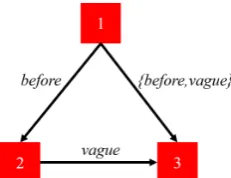
with annotated edges being constraints, which is aconstrainedbootstrapping, motivated by the fact that temporal graphs are structured and annotated edges have influence on the missing edges: In Fig.1, the current annotation for(1,2)and(2,3)
isbefore andvague. We assume that the annota-tion(2,3)=vagueindicates that the relation cannot
be determined even if the entire graph is consid-ered. Then with (1,2)=before and (2,3)=vague, we can see that (1,3) cannot be uniquely de-termined, but it is restricted to be selected from
{bef ore, vague} rather than the entire label set. We believe that global inference makes better use of the information provided by P; in fact, as we
[image:3.595.72.291.82.241.2]show in Sec. 4, it does perform better than local inference.
Figure 1: Nodes 1-3 are three time points and let(i, j)be
the edge from nodeito nodej, where(i, j) ∈{before, af-ter, equal, vague}. Assume the current annotation is(1,2) =
bef oreand(2,3) =vagueand(1,3)is missing. However,
(1,3)cannot beafterbecause it leads to(2,3) =af ter,
con-flicting with their current annotation; similarly,(1,3)cannot
beequal, either.
A standard way to perform global inference is to formulate it as an Integer Linear Programming (ILP) problem(Roth and Yih, 2004) and enforce transitivity rules as constraints. Let R be the TempRel label set2, I
r(ij) ∈ {0,1} be the
indi-cator function of (i, j) = r, andfr(ij) ∈ [0,1]
be the corresponding soft-max score obtained via
SF+P. Then the ILP objective is formulated as
ˆ
I =argmax I
∑
i<j
∑
r∈Rfr(ij)Ir(ij) (1)
s.t. ΣrIr(ij) = 1
(uniqueness) ,
Ir1(ij) +Ir2(jk)−ΣNm=1Irm
3 (ik)≤1,
(transitivity)
where{rm3 }is selected based on the general tran-sitivity proposed in (Ning et al., 2017). With Eq. (1), different implementations of Line6in Al-gorithm1 can be described concisely as follows: (i) Local inference is performed by ignoring “tran-sitivity constraints”. (ii) Global inference can be performed by adding annotated edges inP as ad-ditional constraints. Note that Algorithm1is only for the learning step of TempRel extraction; as for the inference step of this task, we consistently adopt the standard method by solving Eq. (1), as was done by (Bramsen et al.,2006;Chambers and Jurafsky,2008;Denis and Muller,2011;Do et al.,
2012;Ning et al.,2017).
4 Experiments
In this work, we consistently used TB-Dense as the fully annotated dataset (F) and TBAQ as the
partially annotated dataset (P). The corpus statis-tics of these two datasets are provided in Table1. Note that TBAQ is the union of TimeBank and AQUAINT and it originally contained 256 docu-ments, but 36 out of them completely overlapped with TB-Dense, so we have excluded these when constructingP. In addition, the number of edges
shown in Table1only counts the event-event rela-tions (i.e., do not consider the event-time relarela-tions therein), which is the focus of this work.
We also adopted the original split of TB-Dense (22 documents for training, 5 documents for de-velopment, and 9 documents for test). Learning parameters were tuned to maximize their corre-sponding F-metric on the development set. Using the selected parameters, systems were retrained with development set incorporated and evaluated
2In this work, we adopt before, after, includes,
[image:3.595.120.236.598.687.2]Data #Doc #Edges Ratio Type
TB-Dense 36 6.5K 100% F
[image:4.595.88.274.63.94.2]TBAQ 220 2.7K 12% P
Table 1: Corpus statistics of the fully and partially anno-tated dataset used in this work. TBAQ: The union of Time-Bank and AQUAINT, which is the training set provided by the TempEval3 workshop. #Edges: The number of annotated edges. Ratio: The proportion of annotated edges.
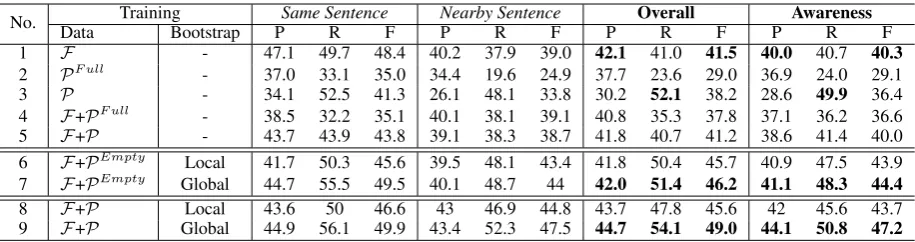
against the test split of TB-Dense (about 1.4K re-lations: 0.6Kvague, 0.4Kbefore, 0.3Kafter, and 0.1K for the rest). Results are shown in Table2, where all systems were compared in terms of their performances on “same sentence” edges (both nodes are from the same sentence), “nearby sen-tence” edges, all edges, and the temporal aware-ness metric used by the TempEval3 workshop.
The first part of Table2(Systems 1-5) refers to the baseline method proposed at the beginning of Sec.3, i.e., simply treatingPasFand training on
their union. PF ull is a variant of P by filling its
missing edges byvague. Since it labels too many
vague TempRels, System 2 suffered from a low recall. In contrast,P does not contain anyvague
training examples, so System 3 would only pre-dict specific TempRels, leading to a low precision. Given the obvious difference inFandPF ull,
Sys-tem 4 expectedly performed worse than SysSys-tem 1. However, when we see that System 5 was still worse than System 1, it is surprising because the annotated edges inP are correct and should have helped. This unexpected observation suggests that simply adding the annotated edges fromP intoF
is not a proper approach to learn from both. The second part (Systems 6-7) serves as an ab-lation study showing the effect of bootstrapping only.PEmptyis another variant ofP we get by
re-moving all the annotated edges (that is, only nodes are kept). Thus, they did not get any information from the annotated edges inP and any
improve-ment came from bootstrapping alone. Specifically, System 6 is the standard bootstrapping and Sys-tem 7 is the constrained bootstrapping.
Built on top of Systems 6-7, Systems 8-9 fur-ther took advantage of the annotations ofP, which
resulted in additional improvements. Compared to System 1 (trained on F only) and System 5
(simply addingP intoF), the proposed System 9 achieved much better performance, which is also statistically significant with p<0.005 (McNemar’s
test). While System 7 can be regarded as a repro-duction of Ning et al. (2017), the original paper ofNing et al.(2017) achieved an overall score of P=43.0, R=46.4, F=44.7 and an awareness score
of P=42.6, R=44.0, and F=43.3, and the proposed System 9 is also better thanNing et al.(2017) on all metrics.3
5 Discussion
While incorporating transitivity constraints in in-ference is widely used, Ning et al. (2017) pro-posed to incorporate these constraints in the learn-ing phase as well. One of the algorithms pro-posed in Ning et al. (2017) is based on Chang et al.(2012)’s constraint-driven learning (CoDL), which is the same as our intermediate System 7 in Table2; the fact that System 7 is better than Sys-tem 1 can thus be considered as a reproduction of
Ning et al.(2017). Despite the technical similar-ity, this work is motivated differently and is set to achieve a different goal:Ning et al.(2017) tried to enforce the transitivity structure, while the current work attempts to use imperfect signals (e.g., par-tially annotated) taken from additional data, and learn in the incidental supervision framework.
The P used in this work is TBAQ, where only
12% of the edges are annotated. In practice, every annotation comes at a cost, either time or the ex-penses paid to annotators, and as more edges are annotated, the marginal “benefit” of one edge is going down (an extreme case is that an edge is of no value if it can be inferred from existing edges). Therefore, a more general question is to find out the optimal ratio of graph annotations.
Moreover, partial annotation is only one type of annotation imperfection. If the annotation is noisy, we can alter the hard constraints derived from P
and use soft regularization terms; if the annotation is for a different but relevant task, we can formu-late corresponding constraints to connect that dif-ferent task to the task at hand. Being able to learn from these “indirect” signals is appealing because indirect signals are usually order of magnitudes larger than datasets dedicated to a single task.
6 Conclusion
Temporal relation (TempRel) extraction is impor-tant but TempRel annotation is labor intensive. While fully annotated datasets (F) are relatively
small, there exist more datasets with partial an-notations (P). This work provides the first inves-tigation of learning from both types of datasets, and this preliminary study already shows promise.
No. Data TrainingBootstrap PSame SentenceR F Nearby SentenceP R F P OverallR F P AwarenessR F
1 F - 47.1 49.7 48.4 40.2 37.9 39.0 42.1 41.0 41.5 40.0 40.7 40.3
2 PF ull - 37.0 33.1 35.0 34.4 19.6 24.9 37.7 23.6 29.0 36.9 24.0 29.1
3 P - 34.1 52.5 41.3 26.1 48.1 33.8 30.2 52.1 38.2 28.6 49.9 36.4
[image:5.595.73.531.61.182.2]4 F+PF ull - 38.5 32.2 35.1 40.1 38.1 39.1 40.8 35.3 37.8 37.1 36.2 36.6 5 F+P - 43.7 43.9 43.8 39.1 38.3 38.7 41.8 40.7 41.2 38.6 41.4 40.0 6 F+PEmpty Local 41.7 50.3 45.6 39.5 48.1 43.4 41.8 50.4 45.7 40.9 47.5 43.9 7 F+PEmpty Global 44.7 55.5 49.5 40.1 48.7 44 42.0 51.4 46.2 41.1 48.3 44.4 8 F+P Local 43.6 50 46.6 43 46.9 44.8 43.7 47.8 45.6 42 45.6 43.7 9 F+P Global 44.9 56.1 49.9 43.4 52.3 47.5 44.7 54.1 49.0 44.1 50.8 47.2
Table 2: Performance of various usages of the partially annotated data in training. F: Fully annotated data. P: Partially annotated data. PF ull:
Pwith missing annotations filled byvague. PEmpty:
Pwith all annotations removed. Bootstrap: referring to specific implementations of Line6in Algorithm1, i.e., local or global. Same/nearby sentence: edges whose nodes appear in the same/nearby sentences in text. Overall: all edges. Awareness: the temporal awareness metric used in the TempEval3 workshop, measuring how useful the predicted graphs are (UzZaman et al.,2013). System 7 can also be considered as a reproduction ofNing et al.(2017) (see the discussion in Sec.5for details).
Two bootstrapping algorithms (standard and con-strained) are analyzed and the benefit of P,
al-though with missing annotations, is shown on a benchmark dataset. This work may be a good starting point for further investigations of inciden-tal supervision and data collection schemes of the TempRel extraction task.
Acknowledgements
We thank all the reviewers for providing insight-ful comments and critiques. This research is sup-ported in part by a grant from the Allen Insti-tute for Artificial Intelligence (allenai.org); the IBM-ILLINOIS Center for Cognitive Computing Systems Research (C3SR) - a research collabo-ration as part of the IBM AI Horizons Network; by DARPA under agreement number FA8750-13-2-0008; and by the Army Research Laboratory (ARL) under agreement W911NF-09-2-0053.
The U.S. Government is authorized to repro-duce and distribute reprints for Governmental purposes notwithstanding any copyright notation thereon. The views and conclusions contained herein are those of the authors and should not be interpreted as necessarily representing the official policies or endorsements, either expressed or im-plied, of DARPA or the U.S. Government. Any opinions, findings, conclusions or recommenda-tions are those of the authors and do not neces-sarily reflect the view of the ARL.
References
Steven Bethard. 2013. ClearTK-TimeML: A minimal-ist approach to TempEval 2013. In Second Joint Conference on Lexical and Computational Seman-tics (* SEM). volume 2, pages 10–14.
Steven Bethard, James H Martin, and Sara Klingen-stein. 2007. Timelines from text: Identification of syntactic temporal relations. InIEEE International Conference on Semantic Computing (ICSC). pages 11–18.
Steven Bethard, Guergana Savova, Wei-Te Chen, Leon Derczynski, James Pustejovsky, and Marc Verhagen. 2016. SemEval-2016 Task 12: Clinical TempEval. In Proceedings of the 10th International Workshop on Semantic Evaluation (SemEval-2016). Associa-tion for ComputaAssocia-tional Linguistics, San Diego, Cal-ifornia, pages 1052–1062.
Steven Bethard, Guergana Savova, Martha Palmer, and James Pustejovsky. 2017. SemEval-2017 Task 12: Clinical TempEval. In Proceedings of the 11th International Workshop on Semantic Evalu-ation (SemEval-2017). Association for Computa-tional Linguistics, pages 565–572.
P. Bramsen, P. Deshpande, Y. K. Lee, and R. Barzilay. 2006. Inducing temporal graphs. InProceedings of the Conference on Empirical Methods for Natural Language Processing (EMNLP). pages 189–198. Taylor Cassidy, Bill McDowell, Nathanel Chambers,
and Steven Bethard. 2014. An annotation frame-work for dense event ordering. In Proceedings of the Annual Meeting of the Association for Computa-tional Linguistics (ACL). pages 501–506.
N. Chambers and D. Jurafsky. 2008. Jointly combining implicit constraints improves temporal ordering. In
Proceedings of the Conference on Empirical Meth-ods for Natural Language Processing (EMNLP). Nate Chambers. 2013. NavyTime: Event and time
or-dering from raw text. In Second Joint Conference on Lexical and Computational Semantics (*SEM), Volume 2: Proceedings of the Seventh International Workshop on Semantic Evaluation (SemEval 2013). Association for Computational Linguistics, Atlanta, Georgia, USA, pages 73–77.
with a multi-pass architecture. Transactions of the Association for Computational Linguistics 2:273– 284.
Nathanael Chambers, Shan Wang, and Dan Juraf-sky. 2007. Classifying temporal relations between events. InProceedings of the 45th Annual Meeting of the ACL on Interactive Poster and Demonstration Sessions. pages 173–176.
M. Chang, L. Ratinov, and D. Roth. 2012. Structured learning with constrained conditional models. Ma-chine Learning88(3):399–431.
Pascal Denis and Philippe Muller. 2011. Predicting globally-coherent temporal structures from texts via endpoint inference and graph decomposition. In
Proceedings of the International Joint Conference on Artificial Intelligence (IJCAI). volume 22, page 1788.
Q. Do, W. Lu, and D. Roth. 2012. Joint inference for event timeline construction. In Proc. of the Con-ference on Empirical Methods in Natural Language Processing (EMNLP).
David Graff. 2002. The AQUAINT corpus of english news text. Linguistic Data Consortium, Philadel-phia.
Natsuda Laokulrat, Makoto Miwa, Yoshimasa Tsu-ruoka, and Takashi Chikayama. 2013. UTTime: Temporal relation classification using deep syntac-tic features. InSecond Joint Conference on Lexical and Computational Semantics (* SEM). volume 2, pages 88–92.
Inderjeet Mani, Marc Verhagen, Ben Wellner, Chong Min Lee, and James Pustejovsky. 2006. Machine learning of temporal relations. In Proceed-ings of the Annual Meeting of the Association for Computational Linguistics (ACL). pages 753–760.
Anne-Lyse Minard, Manuela Speranza, Eneko Agirre, Itziar Aldabe, Marieke van Erp, Bernardo Magnini, German Rigau, Ruben Urizar, and Fon-dazione Bruno Kessler. 2015. SemEval-2015 Task 4: TimeLine: Cross-document event ordering. In
Proceedings of the 9th International Workshop on Semantic Evaluation (SemEval 2015). pages 778–786.
Paramita Mirza and Sara Tonelli. 2016. CATENA: CAusal and TEmporal relation extraction from NAt-ural language texts. InThe 26th International Con-ference on Computational Linguistics. pages 64–75.
Nasrin Mostafazadeh, Alyson Grealish, Nathanael Chambers, James Allen, and Lucy Vanderwende. 2016. CaTeRS: Causal and temporal relation scheme for semantic annotation of event structures. InProceedings of the 4th Workshop on Events: Def-inition, Detection, Coreference, and Representation. pages 51–61.
Qiang Ning, Zhili Feng, and Dan Roth. 2017. A struc-tured learning approach to temporal relation extrac-tion. In Proceedings of the Conference on Em-pirical Methods for Natural Language Processing (EMNLP). Copenhagen, Denmark.
Qiang Ning, Zhili Feng, Hao Wu, and Dan Roth. 2018a. Joint reasoning for temporal and causal rela-tions. InProceedings of the Annual Meeting of the Association for Computational Linguistics (ACL). Qiang Ning, Hao Wu, Haoruo Peng, and Dan Roth.
2018b. Improving temporal relation extraction with a globally acquired statistical resource. In Proceed-ings of the Annual Meeting of the North American Association of Computational Linguistics (NAACL). Association for Computational Linguistics.
Qiang Ning, Hao Wu, and Dan Roth. 2018c. A multi-axis annotation scheme for event temporal relations. InProceedings of the Annual Meeting of the Associ-ation for ComputAssoci-ational Linguistics (ACL).
Tim O’Gorman, Kristin Wright-Bettner, and Martha Palmer. 2016. Richer event description: Integrating event coreference with temporal, causal and bridg-ing annotation. InProceedings of the 2nd Workshop on Computing News Storylines (CNS 2016). Associ-ation for ComputAssoci-ational Linguistics, Austin, Texas, pages 47–56.
James Pustejovsky, Patrick Hanks, Roser Sauri, An-drew See, Robert Gaizauskas, Andrea Setzer, Dragomir Radev, Beth Sundheim, David Day, Lisa Ferro, et al. 2003. The TIMEBANK corpus. In Cor-pus linguistics. volume 2003, page 40.
D. Roth and W. Yih. 2004. A linear programming formulation for global inference in natural language tasks. In Hwee Tou Ng and Ellen Riloff, editors,
Proc. of the Conference on Computational Natural Language Learning (CoNLL). pages 1–8.
Dan Roth. 2017. Incidental supervision: Moving be-yond supervised learning. InAAAI.
Naushad UzZaman, Hector Llorens, James Allen, Leon Derczynski, Marc Verhagen, and James Pustejovsky. 2013. SemEval-2013 Task 1: TempEval-3: Evaluat-ing time expressions, events, and temporal relations. InSecond Joint Conference on Lexical and Compu-tational Semantics. volume 2, pages 1–9.
Marc Verhagen, Robert Gaizauskas, Frank Schilder, Mark Hepple, Graham Katz, and James Pustejovsky. 2007. SemEval-2007 Task 15: TempEval temporal relation identification. InSemEval. pages 75–80. Marc Verhagen and James Pustejovsky. 2008.
Tem-poral processing with the TARSQI toolkit. In22nd International Conference on on Computational Lin-guistics: Demonstration Papers. pages 189–192. Marc Verhagen, Roser Sauri, Tommaso Caselli, and