A Mixture Model for Learning Multi-Sense Word Embeddings
Dai Quoc Nguyen1, Dat Quoc Nguyen2, Ashutosh Modi1, Stefan Thater1, Manfred Pinkal1
1Department of Computational Linguistics, Saarland University, Germany {daiquocn, ashutosh, stth, pinkal}@coli.uni-saarland.de
2Department of Computing, Macquarie University, Australia [email protected]
Abstract
Word embeddings are now a standard technique for inducing meaning represen-tations for words. For getting good repre-sentations, it is important to take into ac-count different senses of a word. In this paper, we propose a mixture model for learning multi-sense word embeddings. Our model generalizes the previous works in that it allows to induce different weights of different senses of a word. The experi-mental results show that our model outper-forms previous models on standard evalu-ation tasks.
1 Introduction
Word embeddings have shown to be useful in var-ious NLP tasks such as sentiment analysis, topic models, script learning, machine translation, se-quence labeling and parsing (Socher et al., 2013; Sutskever et al., 2014; Modi and Titov, 2014; Nguyen et al., 2015a,b; Modi, 2016; Ma and Hovy, 2016; Nguyen et al., 2017; Modi et al., 2017). A word embedding captures the syntac-tic and semansyntac-tic properties of a word by repre-senting the word in a form of a real-valued vector (Mikolov et al., 2013a,b; Pennington et al., 2014; Levy and Goldberg, 2014).
However, usually word embedding models do not take into account lexical ambiguity. For ex-ample, the word bank is usually represented by a single vector representation for all senses in-cludingsloping landandfinancial institution. Re-cently, approaches have been proposed to learn multi-sense word embeddings, where each sense of a word corresponds to a sense-specific em-bedding. Reisinger and Mooney (2010), Huang et al. (2012) and Wu and Giles (2015) proposed methods to cluster the contexts of each word and
then using cluster centroids as vector representa-tions for word senses. Neelakantan et al. (2014), Tian et al. (2014), Li and Jurafsky (2015) and Chen et al. (2015) extended Word2Vec models (Mikolov et al., 2013a,b) to learn a vector repre-sentation for each sense of a word. Chen et al. (2014), Iacobacci et al. (2015) and Flekova and Gurevych (2016) performed word sense induction using external resources (e.g., WordNet, Babel-Net) and then learned sense embeddings using the Word2Vec models. Rothe and Sch¨utze (2015) and Pilehvar and Collier (2016) presented methods us-ing pre-trained word embeddus-ings to learn embed-dings from WordNet synsets. Cheng et al. (2015), Liu et al. (2015b), Liu et al. (2015a) and Zhang and Zhong (2016) directly opt the Word2Vec Skip-gram model (Mikolov et al., 2013b) for learning the embeddings of words and topics on a topic-assigned corpus.
One issue in these previous works is that they assign the same weight to every sense of a word. The central assumption of our work is that each sense of a word given a context, should correspond to a mixture of weights reflecting different asso-ciation degrees of the word with multiple senses in the context. The mixture weights will help to model word meaning better.
In this paper, we propose a new model for learn-ingMulti-SenseWordEmbeddings (MSWE). Our MSWE model learns vector representations of a
word based on a mixture of its sense represen-tations. The key difference between MSWE and
other models is that we induce the weights of senses while jointly learning the word and sense embeddings. Specifically, we train a topic model (Blei et al., 2003) to obtain the topic-to-word and document-to-topic probability distributions which are then used to infer the weights of topics. We use these weights to define a compositional vec-tor representation for each target word to predict
its context words. MSWE thus is different from
the topic-based models (Cheng et al., 2015; Liu et al., 2015b,a; Zhang and Zhong, 2016), in which we do not use the topic assignments when jointly learning vector representations of words and top-ics. Here we not only learn vectors based on the most suitable topic of a word given its context, but we also take into consideration all possible mean-ings of the word.
The main contributions of our study are: (i) We introduce a mixture model for learning word and sense embeddings (MSWE) by inducing mixture
weights of word senses. (ii) We show thatMSWE
performs better than the baseline Word2Vec Skip-gram and other embedding models on the word analogy task (Mikolov et al., 2013a) and the word similarity task (Reisinger and Mooney, 2010).
2 The mixture model
In this section, we present the mixture model for learning multi-sense word embeddings. Here we treat topics as senses. The model learns a repre-sentation for each word using a mixture of its top-ical representations.
Given a number of topics and a corpus D of documentsd={wd,1, wd,2, ..., wd,Md}, we apply
a topic model (Blei et al., 2003) to obtain the topic-to-word Pr(w|t) and document-to-topic Pr(t|d) probability distributions. We then infer a weight for themthwordw
d,mwith topictin documentd:
λd,m,t= Pr(wd,m|t)×Pr(t|d) (1)
We define two MSWEvariants: MSWE-1 learns
vectors for words based on the most suitable topic given document d while MSWE-2 marginalizes
over all senses of a word to take into account all possible senses of the word:
MSWE-1: swd,m = vwd,m+λd,m,t0×vt0 1 +λd,m,t0
MSWE-2: swd,m = vwd,m+
PT
t=1λd,m,t×vt 1 +PTt=1λd,m,t
whereswd,mis the compositional vector
represen-tation of themthwordwd,mand the topics in
doc-umentd;vwis the target vector representation of a
word typewin vocabularyV;vtis the vector
rep-resentation of topict; T is the number of topics;
λd,m,tis defined as in Equation 1, and inMSWE-1
we definet0 = arg max
t λd,m,t.
We learn representations by minimizing the fol-lowing negative log-likelihood function:
L=− P d∈D
MPd
m=1
P
−k≤j≤k j6=0
log Pr(˜vwd,m+j|swd,m) (2)
where themthwordw
d,m in documentdis a
tar-get word while the(m+j)thwordw
d,m+jin
doc-ument d is a context word ofwd,m and k is the
context size. In addition, vw˜ is the context vec-tor representation of the word typew. The proba-bilityPr(˜vwd,m+j|swd,m)is defined using the
soft-max function as follows:
Pr(˜vwd,m+j|swd,m) =
exp(˜vTwd,m+jswd,m)
P
c0∈V exp(˜vTc0swd,m) Since computing log Pr(˜vwd,m+j|swd,m) is
ex-pensive for each training instance, we approximate log Pr(˜vwd,m+j|swd,m) in Equation 2 with the
following negative-sampling objective (Mikolov et al., 2013b):
Od,m,m+j = logσ
˜
vTwd,m+jswd,m
+ XK
i=1
logσ−v˜Tciswd,m
(3)
where each wordciis sampled from a noise
distri-bution.1 In fact,MSWEcan be viewed as a
gener-alization of the well-known Word2Vec Skip-gram model with negative sampling (Mikolov et al., 2013b) where all the mixture weights λd,m,t are
set to zero. The models are trained using Stochas-tic Gradient Descent (SGD).
3 Experiments
We evaluate MSWE on two different tasks: word
similarity and word analogy. We also pro-vide experimental results obtained by the baseline Word2Vec Skip-gram model and other previous works.
Note that not all previous results are mentioned in this paper for comparison because the train-ing corpora used in most previous research work are much larger than ours (Baroni et al., 2014; Li and Jurafsky, 2015; Schwartz et al., 2015; Levy et al., 2015). Also there are differences in the pre-processing steps that could affect the results. We could also improve obtained results by using a
1We use an unigram distribution raised to the 3/4 power
larger training corpus, but this is not central point of our paper. The objective of our paper is that the embeddings of topic and word can be combined into a single mixture model, leading to good im-provements as established empirically.
3.1 Experimental Setup
Following Huang et al. (2012) and Neelakantan et al. (2014), we use the Wesbury Lab Wikipedia corpus (Shaoul and Westbury, 2010) containing over 2M articles with about 990M words for train-ing. In the preprocessing step, texts are lower-cased and tokenized, numbers are mapped to 0, and punctuation marks are removed. We extract a vocabulary of 200,000 most frequent word tokens from the pre-processed corpus. Words not occur-ring in the vocabulary are mapped to a special to-kenUNK, in which we use the embedding ofUNK
for unknown words in the benchmark datasets. We firstly use a small subset extracted from the
WS353 dataset (Finkelstein et al., 2002) to tune
the hyper-parameters of the baseline Word2Vec Skip-gram model for the word similarity task (see Section 3.2 for the task definition). We then directly use the tuned hyper-parameters for our
MSWE variants. Vector size is also a
hyper-parameter. While some approaches use a higher number of dimensions to obtain better results, we fix the vector size to be 300 as used by the baseline for a fair comparison. The vanilla Latent Dirichlet Allocation (LDA) topic model (Blei et al., 2003) is not scalable to a very large corpus, so we explore faster online topic models developed for large cor-pora. We train the online LDA topic model (Hoff-man et al., 2010) on the training corpus, and use the output of this topic model to compute the mix-ture weights as in Equation 1.2 We also use the
same WS353 subset to tune the numbers of
top-icsT ∈ {50,100,200,300,400}. We find that the most suitable numbers areT = 50andT = 200 then used for all our experiments. Here we learn 300-dimensional embeddings with the fixed con-text size k = 5 (in Equation 2) andK = 10(in Equation 3) as used by the baseline. During train-ing, we randomly initialize model parameters (i.e. word and topic embeddings) and then learn them by using SGD with the initial learning rate of 0.01.
2We use default parameters ingensim( ˇReh˚uˇrek and
So-jka, 2010) for the online LDA model.
Dataset Word pairs Reference
WS353 353 Finkelstein et al. (2002)
SIMLEX 999 Hill et al. (2015) SCWS 2003 Huang et al. (2012) RW 2034 Luong et al. (2013) MEN 3000 Bruni et al. (2014)
Table 1: The benchmark datasets. WS353:
WordSimilarity-353. RW: Rare-Words. SIMLEX:
SimLex-999. SCWS: Stanford’s Contextual Word
Similarities. MEN: The MEN Test Collection.
Each dataset contains similarity scores of human judgments for pairs of words.
3.2 Word Similarity
The word similarity task evaluates the quality of word embedding models (Reisinger and Mooney, 2010). For a given dataset of word pairs, the eval-uation is done by calculating correlation between the similarity scores of corresponding word em-bedding pairs with the human judgment scores. Higher Spearman’s rank correlation (ρ) reflects better word embedding model. We evaluateMSWE
on standard datasets (as given in Table 1) for the word similarity evaluation task.
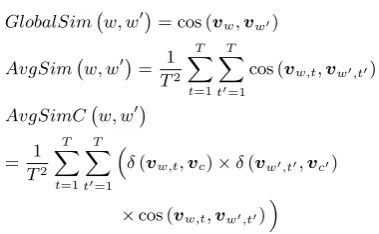
Following Reisinger and Mooney (2010), Huang et al. (2012), Neelakantan et al. (2014), we compute the similarity scores for a pair of words (w, w0) with or without their respective contexts
(c, c0)as:
GlobalSim w, w0
= cos (vw,vw0)
AvgSim w, w0
= 1T2
T
X
t=1
T
X
t0=1
cos (vw,t,vw0,t0)
AvgSimC w, w0
= 1T2XT
t=1
T
X
t0=1
δ(vw,t,vc)×δ(vw0,t0,vc0)
×cos (vw,t,vw0,t0)
wherevw is the vector representation of the word
w,vw,tis the multiple representation of the word wand the topic t, vc is the vector representation
of the context c of the word w. And cos (v,v0) is the cosine similarity between two vectors v
and v0. For our experiments, we set v
w,t = vw⊕(Pr(w|t)×vt)andvc=|1c|Pw∈cvw⊕
(PtPr (t|c)×vt), in which⊕is the
[image:3.595.330.520.478.595.2]Model RW SIMLEX SCWS WS353 MEN
Huang et al. (2012) – – 58.6 71.3 – Luong et al. (2013) 34.36 – 48.48 64.58 – Qiu et al. (2014) 32.13 – 53.40 65.19 – Neelakantan et al. (2014) – – 65.5 69.2 – Chen et al. (2014) – – 64.2 – – Hill et al. (2015) – 41.4 – 65.5 69.9 Vilnis and McCallum (2015) – 32.23 – 65.49 71.31 Schnabel et al. (2015) – – – 64.0 70.7 Rastogi et al. (2015) 32.9 36.7 65.6 70.8 73.9 Flekova and Gurevych (2016) – – – – 74.26 Word2Vec Skip-gram 32.64 38.20 66.37 71.61 75.49
MSWE-150 34.85 38.77 66.83 72.40 76.23
MSWE-1200 35.27 38.70 66.80 72.05 76.05
MSWE-250 34.98 38.79 66.61 71.71 75.90
[image:4.595.312.523.62.247.2]MSWE-2200 35.56? 39.19? 66.65 72.29 76.37?
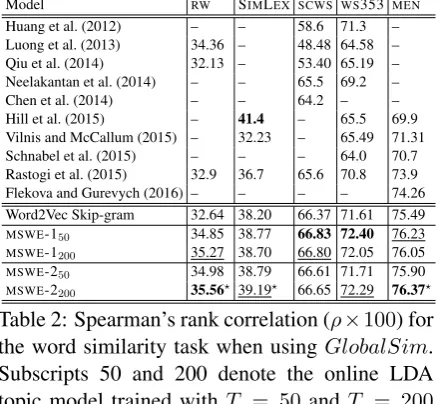
Table 2: Spearman’s rank correlation (ρ×100) for the word similarity task when usingGlobalSim. Subscripts 50 and 200 denote the online LDA topic model trained withT = 50and T = 200 topics, respectively. ? denotes that our best score
is significantly higher than the score of the base-line (with p < 0.05, online toolkit from http: //www.philippsinger.info/?p=347). Scores inbold
and underline are the best and second best scores.
whileAvgSimconsiders multiple representations to capture different meanings (i.e. topics) and us-ages of a word. AvgSimC generalizesAvgSim
by taking into account the likelihoodδ(vw,t,vc) that wordwtakes topictgiven contextc.δ(v,v0) is the inverse of the cosine distance fromv tov0 (Huang et al., 2012; Neelakantan et al., 2014).
3.2.1 Results for word similarity
Table 2 compares the evaluation results ofMSWE
with results reported in prior work on the stan-dard word similarity task when usingGlobalSim. We use subscripts 50 and 200 to denote the topic model trained withT = 50andT = 200topics, respectively. Table 2 shows that our model out-performs the baseline Word2Vec Skip-gram model (in fifth row from bottom). Specifically, on theRW
dataset,MSWE obtains a significant improvement
of2.92in the Spearman’s rank correlation (which is about 8.5% relative improvement).
Compared to the published results, MSWE
ob-tains the highest accuracy on the RW, SCWS, WS353 andMENdatasets, and achieves the second
highest result on the SIMLEX dataset. These
in-dicate thatMSWElearns better representations for
words taking into account different meanings.
3.2.2 Results for contextual word similarity
We evaluate our modelMSWEby usingAvgSim
and AvgSimC on the benchmark SCWS dataset
Model AvgSim AvgSimC
Huang et al. (2012) 62.8 65.7
Neelakantan et al. (2014) 67.3 69.3
Chen et al. (2014) 66.2 68.9
Chen et al. (2015) 65.7 66.4
Wu and Giles (2015) – 66.4
Jauhar et al. (2015) – 65.7
Cheng and Kartsaklis (2015) 62.5 –
Iacobacci et al. (2015) 62.4 –
Cheng et al. (2015) – 65.9
MSWE-150 66.6 66.7
MSWE-1200 66.7 66.6
MSWE-250 66.4 66.6
MSWE-2200 66.6 66.6
Table 3: Spearman’s rank correlation (ρ×100) on
SCWS, usingAvgSimandAvgSimC.
which considers effects of the contextual informa-tion on the word similarity task. As shown in Ta-ble 3,MSWEscores better than the closely related
model proposed by Cheng et al. (2015) and gener-ally obtains good results for this context sensitive dataset. Although we produce better scores than Neelakantan et al. (2014) and Chen et al. (2014) when usingGlobalSim, we are outperformed by them when usingAvgSimandAvgSimC. Nee-lakantan et al. (2014) clustered the embeddings of the context words around each target word to predict its sense and Chen et al. (2014) used pre-trained word embeddings to initialize vector rep-resentations of senses taken from WordNet, while we use a fixed number of topics as senses for words inMSWE.
3.3 Word Analogy
We evaluate the embedding models on the word analogy task introduced by Mikolov et al. (2013a). The task aims to answer questions in the form of “ais tobascis to ?”, denoted as “a : b→ c : ?” (e.g., “Hanoi : Vietnam→Bern : ?”). There are 8,869 semantic and 10,675 syntactic questions grouped into 14 categories. Each question is an-swered by finding the most suitable word closest to “vb−va+vc” measured by the cosine
similar-ity. The answer is correct only if the found closest word is exactly the same as the gold-standard (cor-rect) one for the question.
We report accuracies in Table 4 and show that
MSWE achieves better results in comparison with
the baseline Word2Vec Skip-gram. In particular,
[image:4.595.73.292.65.267.2]Model Accuracy (%) Pennington et al. (2014) 70.3
Baroni et al. (2014) 68.0 Neelakantan et al. (2014) 64.0 Ghannay et al. (2016) 62.3
Word2Vec Skip-gram 68.6
MSWE-150 69.6
MSWE-1200 69.9
MSWE-250 69.7
[image:5.595.82.282.62.206.2]MSWE-2200 69.5
Table 4: Accuracies for the word analogy task. All our results are significantly higher than the result of Word2Vec Skip-gram (with two-tailp <0.001 using McNemar’s test). Pennington et al. (2014) used a larger training corpus of 1.6B words.
which is higher than the accuracy of 68.6% ob-tained by Word2Vec Skip-gram.
4 Conclusions
In this paper, we described a mixture model for learning multi-sense embeddings. Our model in-duces mixture weights to represent a word given context based on a mixture of its sense representa-tions. The results show that our model scores bet-ter than Word2Vec, and produces highly competi-tive results on the standard evaluation tasks. In fu-ture work, we will explore better methods for tak-ing into account the contextual information. We also plan to explore different approaches to com-pute the mixture weights in our model. For exam-ple, if there is a large sense-annotated corpus avail-able for training, the mixture weights could be de-fined based on the frequency (sense-count) distri-butions, instead of using the probability distribu-tions produced by a topic model. Furthermore, it is possible to consider the weights of senses as addi-tional model parameters to be then learned during training.
Acknowledgments
This research was funded by the German Research Foundation (DFG) as part of SFB 1102 “Informa-tion Density and Linguistic Encoding”. We would like to thank anonymous reviewers for their help-ful comments.
References
Marco Baroni, Georgiana Dinu, and Germ´an Kruszewski. 2014. Don’t count, predict! a systematic comparison of context-counting vs. context-predicting semantic vectors. InProceedings of the 52nd Annual Meeting of the Association for Computational Linguistics (Volume 1: Long Papers). pages 238–247.
David M. Blei, Andrew Y. Ng, and Michael I. Jordan. 2003. Latent Dirichlet Allocation. Journal of Ma-chine Learning Research3:993–1022.
Elia Bruni, Nam Khanh Tran, and Marco Baroni. 2014. Multimodal distributional semantics. Journal of Ar-tificial Intelligence Research49:1–47.
Tao Chen, Ruifeng Xu, Yulan He, and Xuan Wang. 2015. Improving distributed representation of word sense via wordnet gloss composition and context clustering. InProceedings of the 53rd Annual Meet-ing of the Association for Computational LMeet-inguistics and the 7th International Joint Conference on Natu-ral Language Processing (Volume 2: Short Papers). pages 15–20.
Xinxiong Chen, Zhiyuan Liu, and Maosong Sun. 2014. A unified model for word sense representation and disambiguation. InProceedings of the 2014 Con-ference on Empirical Methods in Natural Language Processing (EMNLP). pages 1025–1035.
Jianpeng Cheng and Dimitri Kartsaklis. 2015. Syntax-aware multi-sense word embeddings for deep com-positional models of meaning. InProceedings of the 2015 Conference on Empirical Methods in Natural Language Processing. pages 1531–1542.
Jianpeng Cheng, Zhongyuan Wang, Ji-Rong Wen, Jun Yan, and Zheng Chen. 2015. Contextual text under-standing in distributional semantic space. In Pro-ceedings of the 24th ACM International on Confer-ence on Information and Knowledge Management. pages 133–142.
Lev Finkelstein, Evgeniy Gabrilovich, Yossi Matias, Ehud Rivlin, Zach Solan, Gadi Wolfman, and Ey-tan Ruppin. 2002. Placing search in context: The concept revisited. ACM Transactions on Informa-tion Systems20:116–131.
Lucie Flekova and Iryna Gurevych. 2016. Supersense embeddings: A unified model for supersense inter-pretation, prediction, and utilization. In Proceed-ings of the 54th Annual Meeting of the Association for Computational Linguistics (Volume 1: Long Pa-pers). pages 2029–2041.
Felix Hill, Roi Reichart, and Anna Korhonen. 2015. Simlex-999: Evaluating semantic models with gen-uine similarity estimation. Computational Linguis-tics41:665–695.
Matthew Hoffman, Francis R. Bach, and David M. Blei. 2010. Online learning for latent dirichlet al-location. In Advances in Neural Information Pro-cessing Systems 23. pages 856–864.
Eric H. Huang, Richard Socher, Christopher D. Man-ning, and Andrew Y. Ng. 2012. Improving word representations via global context and multiple word prototypes. InProceedings of the 50th Annual Meet-ing of the Association for Computational LMeet-inguis- Linguis-tics: Long Papers - Volume 1. pages 873–882. Ignacio Iacobacci, Mohammad Taher Pilehvar, and
Roberto Navigli. 2015. Sensembed: Learning sense embeddings for word and relational similarity. In Proceedings of the 53rd Annual Meeting of the Association for Computational Linguistics and the 7th International Joint Conference on Natural Lan-guage Processing (Volume 1: Long Papers). pages 95–105.
Sujay Kumar Jauhar, Chris Dyer, and Eduard Hovy. 2015. Ontologically grounded multi-sense repre-sentation learning for semantic vector space models. InProceedings of the 2015 Conference of the North American Chapter of the Association for Computa-tional Linguistics: Human Language Technologies. pages 683–693.
Omer Levy and Yoav Goldberg. 2014. Neural word embedding as implicit matrix factorization. In Ad-vances in Neural Information Processing Systems 27. pages 2177–2185.
Omer Levy, Yoav Goldberg, and Ido Dagan. 2015. Im-proving distributional similarity with lessons learned from word embeddings. Transactions of the Associ-ation for ComputAssoci-ational Linguistics3:211–225. Jiwei Li and Dan Jurafsky. 2015. Do multi-sense
em-beddings improve natural language understanding? In Proceedings of the 2015 Conference on Empiri-cal Methods in Natural Language Processing. pages 1722–1732.
Pengfei Liu, Xipeng Qiu, and Xuanjing Huang. 2015a. Learning context-sensitive word embeddings with neural tensor skip-gram model. InProceedings of the 24th International Conference on Artificial In-telligence. pages 1284–1290.
Yang Liu, Zhiyuan Liu, Tat-Seng Chua, and Maosong Sun. 2015b. Topical word embeddings. In AAAI Conference on Artificial Intelligence. pages 2418– 2424.
Thang Luong, Richard Socher, and Christopher Man-ning. 2013. Better word representations with recur-sive neural networks for morphology. In Proceed-ings of the Seventeenth Conference on Computa-tional Natural Language Learning. pages 104–113.
Xuezhe Ma and Eduard Hovy. 2016. End-to-end se-quence labeling via bi-directional lstm-cnns-crf. In Proceedings of the 54th Annual Meeting of the As-sociation for Computational Linguistics (Volume 1: Long Papers). pages 1064–1074.
Tomas Mikolov, Kai Chen, Greg Corrado, and Jeffrey Dean. 2013a. Efficient estimation of word represen-tations in vector space.CoRRabs/1301.3781. Tomas Mikolov, Ilya Sutskever, Kai Chen, Gregory S.
Corrado, and Jeffrey Dean. 2013b. Distributed rep-resentations of words and phrases and their com-positionality. In Advances in Neural Information Processing Systems 26: 27th Annual Conference on Neural Information Processing Systems 2013. pages 3111–3119.
Ashutosh Modi. 2016. Event embeddings for seman-tic script modeling. InProceedings of the Confer-ence on Computational Natural Language Learning. pages 75–83.
Ashutosh Modi and Ivan Titov. 2014. Inducing neu-ral models of script knowledge. In Proceedings of the Eighteenth Conference on Computational Natu-ral Language Learning. pages 49–57.
Ashutosh Modi, Ivan Titov, Vera Demberg, Asad Say-eed, and Manfred Pinkal. 2017. Modelling seman-tic expectation: Using script knowledge for refer-ent prediction. Transactions of the Association for Computational Linguistics5:31–44.
Arvind Neelakantan, Jeevan Shankar, Alexandre Pas-sos, and Andrew McCallum. 2014. Efficient non-parametric estimation of multiple embeddings per word in vector space. InProceedings of the 2014 Conference on Empirical Methods in Natural Lan-guage Processing (EMNLP). pages 1059–1069. Dat Quoc Nguyen, Richard Billingsley, Lan Du, and
Mark Johnson. 2015a. Improving Topic Models with Latent Feature Word Representations. Trans-actions of the Association for Computational Lin-guistics3:299–313.
Dat Quoc Nguyen, Mark Dras, and Mark Johnson. 2017. A Novel Neural Network Model for Joint POS Tagging and Graph-based Dependency Pars-ing. In Proceedings of the CoNLL 2017 Shared Task: Multilingual Parsing from Raw Text to Uni-versal Dependencies.
Dat Quoc Nguyen, Kairit Sirts, and Mark Johnson. 2015b. Improving Topic Coherence with Latent Feature Word Representations in MAP Estimation for Topic Modeling. In Proceedings of the Aus-tralasian Language Technology Association Work-shop 2015. pages 116–121.
Mohammad Taher Pilehvar and Nigel Collier. 2016. De-conflated semantic representations. In Proceed-ings of the 2016 Conference on Empirical Methods in Natural Language Processing. pages 1680–1690. Siyu Qiu, Qing Cui, Jiang Bian, Bin Gao, and Tie-Yan Liu. 2014. Co-learning of word representations and morpheme representations. InProceedings of COL-ING 2014, the 25th International Conference on Computational Linguistics: Technical Papers. pages 141–150.
Pushpendre Rastogi, Benjamin Van Durme, and Ra-man Arora. 2015. Multiview LSA: Representation Learning via Generalized CCA. In Proceedings of the 2015 Conference of the North American Chap-ter of the Association for Computational Linguistics: Human Language Technologies. pages 556–566. Radim ˇReh˚uˇrek and Petr Sojka. 2010. Software
Frame-work for Topic Modelling with Large Corpora. In Proceedings of the LREC 2010 Workshop on New Challenges for NLP Frameworks. pages 45–50. Joseph Reisinger and Raymond J. Mooney. 2010.
Multi-prototype vector-space models of word mean-ing. InHuman Language Technologies: The 2010 Annual Conference of the North American Chap-ter of the Association for Computational Linguistics. pages 109–117.
Sascha Rothe and Hinrich Sch¨utze. 2015. Autoex-tend: Extending word embeddings to embeddings for synsets and lexemes. In Proceedings of the 53rd Annual Meeting of the Association for Compu-tational Linguistics and the 7th International Joint Conference on Natural Language Processing, Vol-ume 1: Long Papers. pages 1793–1803.
Tobias Schnabel, Igor Labutov, David Mimno, and Thorsten Joachims. 2015. Evaluation methods for unsupervised word embeddings. InProceedings of the Conference on Empirical Methods in Natural Language Processing. pages 298–307.
Roy Schwartz, Roi Reichart, and Ari Rappoport. 2015. Symmetric pattern based word embeddings for im-proved word similarity prediction. InProceedings of CoNLL 2015. pages 258–267.
Cyrus Shaoul and Chris Westbury. 2010. The westbury lab wikipedia corpus. Edmonton, AB: University of Alberta.
Richard Socher, Alex Perelygin, Jean Wu, Jason Chuang, Christopher D. Manning, Andrew Ng, and Christopher Potts. 2013. Recursive deep models for semantic compositionality over a sentiment tree-bank. In Proceedings of the 2013 Conference on Empirical Methods in Natural Language Process-ing. pages 1631–1642.
Ilya Sutskever, Oriol Vinyals, and Quoc V. Le. 2014. Sequence to sequence learning with neural net-works. In Proceedings of the 27th International Conference on Neural Information Processing Sys-tems. pages 3104–3112.
Fei Tian, Hanjun Dai, Jiang Bian, Bin Gao, Rui Zhang, Enhong Chen, and Tie-Yan Liu. 2014. A probabilis-tic model for learning multi-prototype word embed-dings. InProceedings of COLING 2014, the 25th In-ternational Conference on Computational Linguis-tics: Technical Papers. pages 151–160.
Luke Vilnis and Andrew McCallum. 2015. Word rep-resentations via gaussian embedding. International Conference on Learning Representations (ICLR). Zhaohui Wu and C. Lee Giles. 2015. Senaware
se-mantic analysis: A multi-prototype word represen-tation model using wikipedia. InProceedings of the Twenty-Ninth AAAI Conference on Artificial Intelli-gence. pages 2188–2194.