SiTAKA at SemEval-2017 Task 4: Sentiment Analysis in Twitter Based on
a Rich Set of Features
Mohammed Jabreel Antonio Moreno
Intelligent Technologies for Advanced Knowledge Acquisition (ITAKA), Departament d’Enginyeria Inform`atica i Matem`atiques,
Universitat Rovira i Virgili,
Av. Pa¨ısos Catalans, 26, 43007 Tarragona, Spain <first name>.<last name>@urv.cat
Abstract
This paper describes SiTAKA, our system that has been used in task 4A, English and Arabic languages, Sentiment Analysis in Twitter of SemEval2017. The system pro-poses the representation of tweets using a novel set of features, which include a bag of negated words and the information pro-vided by some lexicons. The polarity of tweets is determined by a classifier based on a Support Vector Machine. Our system ranks 2nd among 8 systems in the Arabic language tweets and ranks 8th among 38 systems in the English-language tweets.
1 Introduction
Sentiment analysis in Twitter is the problem of identifying people’s opinions expressed in tweets. It normally involves the classification of tweets into categories such as positive, negative and in some cases, neutral. The main challenges in de-signing a sentiment analysis system for Twitter are the following:
• Twitter limits the length of the message to 140 characters, which leads users to use novel abbreviations and often disregard standard sentence structures.
• The informal language and the numerous spelling errors.
Most of the existing systems are inspired by the work presented in (Pang et al., 2002). Ma-chine Learning techniques have been used to build a classifier from a set of tweets with a manually annotated sentiment polarity. The success of the Machine Learning models is based on two main facts: a large amount of labeled data and the in-telligent design of a set of features that can
distin-guish between the positive, negative and neutral samples.
With this approach, most studies have focused on designing a set of efficient features to obtain a good classification performance (Feldman, 2013; Liu,2012;Pang and Lee,2008). For instance, the authors in (Mohammad et al.,2013) used diverse sentiment lexicons and a variety of hand-crafted features.
This paper proposes the representation of tweets using a novel set of features, which include the in-formation provided by seven lexicons and a bag of negated words (BonW). The concatenation of these features with a set of basic features improves the classification performance. The polarity of tweets is determined by a classifier based on a Support Vector Machine.
The system has been evaluated on the Arabic and English language test sets of the Twitter Sen-timent Analysis Track in SemEval 2017, subtask A (Message Polarity Classification). Our system (SiTAKA) has been ranked 8th over 38 teams in the English language test set and 2nd out of 8 teams in the Arabic language test set.
The rest of the paper is structured as follows. Section2presents the tools and the resources that have been used. In Section3we describe the sys-tem. The experiments and results are presented and discussed in Section4. Finally, in the last sec-tion the conclusions as well as further work are presented.
2 Resources
This section explains the tools and the resources that have been used in the SiTAKA system. Let us denote its Arabic language and English language versions byAr-SiTAKA andEn-SiTAKA, respec-tively.
2.1 Sentiment Lexicons 2.1.1 En-SiTAKA Lexicons
We used for En-SiTAKA five lexicons in this work, namely: General Inquirer (Stone et al., 1968), Hu-Liu opinion lexicon (HL) (Hu and Liu, 2004), NRC hashtags lexicon (Mohammad et al., 2013), SenticNet (Cambria et al.,2014), and TS-Lex (Tang et al.,2014b). More details about each lexicon, such as how it was created, the polarity score for each term, and the statistical distribu-tion of the lexicon, can be found in (Jabreel and Moreno,2016).
2.1.2 Ar-SiTAKA Lexicons
In this version of the SiTAKA system, we used four lexicons created by (Saif M. Mohammad and Kiritchenko,2016): Arabic Hashtag Lexicon, Di-alectal Arabic Hashtag Lexicon, Arabic Bing Liu Lexicon and Arabic Sentiment140 Lexicon. The first two were created manually, whereas the rest were translated to Arabic from the English version using Google Translator.
2.2 Embeddings
We used two pre-trained embedding models in
En-SiTAKA. The first one is word2vec which is provided by Google. It is trained on part of the Google News dataset (about 100 billion words) and it contains 300-dimensional vectors for 3M words and phrases (Mikolov et al., 2013b). The second one is SSWEu, which has been trained to capture the sentiment information of sentences as well as the syntactic contexts of words (Tang et al., 2014c). The SSWEu model contains 50-dimensional vectors for 100K words.
In Ar-SiTAKA we used the model Arabic-SKIP-G300 provided by (Zahran et al., 2015). Arabic-SKIP-G300 has been trained on a large corpus of Arabic text collected from different sources such as Arabic Wikipedia, Arabic Giga-word Corpus, Ksucorpus, King Saud University Corpus, Microsoft crawled Arabic Corpus, etc. It contains 300-dimensional vectors for 6M words and phrases.
3 System Description
This section explains the main steps of the SiTAKA system, the features used to describe a tweet and the classification method.
3.1 Preprocessing and Normalization
Some standard pre-processing methods are ap-plied on the tweets:
• Normalization: Each tweet in English is con-verted to the lowercase. URLs and usernames are omitted. Non-Arabic letters are removed from each tweet in the Arabic-language sets. Words with repeated letters (i.e. elongated) are corrected.
• Tokenization and POS tagging: All English-language tweets are tokenized and tagged us-ing Ark Tweet NLP (Gimpel et al., 2011), while all Arabic-language tweets are tok-enized and tagged using Stanford Tagger (Green and Manning,2010).
• Negation: A negated context can be de-fined as a segment of tweet that starts with a negation word (e.g. no,don’t for English-language,
Ë ð B
for Arabic-language) and ends with a punctuation mark (Pang et al., 2002). Each tweet is negated by adding a suf-fix (” NEG” and ”ù ® JÓ
”) to each word in the negated context.It is necessary to mention that inAr-SiTAKA we did not use all the Arabic negation words due to the ambiguity of some of them. For example, the first word
AÓ
, is a question mark in the following ”? HYg AÓ ú ¯ ½K
@P AÓ
-What do you think about what happened?” and it means ”which/that” in the following exam-ple ”@Yg. Zúæ ÐñJË@ HYg AÓ à@
- The matter that happened today was very bad”.As shown in (Saif et al.,2014), stopwords tend to carry sentiment information; thus, note that they were not removed from the tweets.
3.2 Features Extraction
SiTAKA uses five types of features: basic text,
syntactic, lexicon,clusterandWord Embeddings. These features are described in the following sub-sections:
3.2.1 Basic Features
These basic features are extracted from the text. They are the following:
The presence or absence of contiguous sequences of 1, 2, 3, and 4 tokens are used to represent the tweets.
Bag of Negated Words (BonW): Negated con-texts are important keys in the sentiment analysis problem. Thus, we used the presence or absence of contiguous sequences of 1, 2, 3 and 4 tokens in the negated contexts as a set of features to repre-sent the tweets.
3.2.2 Syntactic Features
Syntactic features are useful to discriminate be-tween neutral and non-neutral texts.
Part of Speech (POS): Subjective and objective texts have different POS tags (Pak and Paroubek, 2010). According to (Zhou et al., 2014), non-neutral terms are more likely to exhibit the fol-lowing POS tags in Twitter: nouns, adjectives, ad-verbs, abbreviations and interjections. The num-ber of occurrences of each part of speech tag is used to represent each tweet.
Bi-tagged: Bi-tagged features are extracted by combining the tokens of the bi-grams with their POS tag e.g. ”feel VBPgood JJ” ”
ÉJÔg.
JJ@Yg.
VBD”. It has been shown in the literature that adjectives and adverbs are subjective in nature and they help to increase the degree of expressiveness (Agarwal et al.,2013;Pang et al.,2002).3.2.3 Lexicon Features
Opinion lexicons play an important role in sen-timent analysis systems, and the majority of the existing systems rely heavily on them (Rosenthal et al., 2014). For each of the chosen lexicons, a tweet is represented by calculating the following features: (1)tweet polarity, (2)the average polar-ity of the positive terms, (3) the average polarity of the negative terms, (4)the score of the last pos-itive term, (5)the score of the last negative term, (6)the maximum positive score and (7)the mini-mum negative score.
The polarity of a tweet T given a lexicon Lis calculated using the equation (1). First, the tweet is tokenized. Then, the number of positive (P) and negative (N) tokens found in the lexicon are counted. Finally, the polarity measure is calcu-lated as follows:
polarity =
1−N
P ;ifP > N
0 ;ifP =N
P
N −1 ;ifP < N
(1)
3.2.4 Cluster Features
We used two set of clusters inEn-SiTAKA to rep-resent the English-language tweets by mapping each tweet to a set of clusters. The first one is the well known set of clusters provided by the Ark Tweet NLP tool which contains 1000 clusters pro-duced with the Brown clustering algorithm from 56M English-language tweets. These 1000 clus-ters are used to represent each tweet by mapping each word in the tweet to its cluster. The second one isWord2vec cluster ngrams, which is provided by (Dong et al., 2015). They used the word2vec tool to learn 40-dimensional word embeddings of 255,657 words from a Twitter dataset and the K-means algorithm to cluster them into 4960 clus-ters. We were not able to find publicly available semantic clusters to be used inAr-SiTAKA.
3.2.5 Embedding Features
Word embeddings are an approach for distribu-tional semantics which represents words as vec-tors of real numbers. Such representation has use-ful clustering properties, since the words that are semantically and syntactically related are repre-sented by similar vectors (Mikolov et al.,2013a). For example, the words ”coffee” and ”tea” will be very close in the created space.
We usedsum,standard-deviation,minandmax
pooling functions (Collobert et al.,2011) to obtain the tweet representation in the embedding space. The result is the concatenation of vectors derived from different pooling functions. More formally, let us consider an embedding matrixE ∈ Rd×|V| and a tweet T = w1, w2, ..., wn, where dis the dimension size, |V| is the length of the vocabu-lary (i.e. the number of words in the embedding model),wiis theith word in the tweet andnis the number of words. First, each wordwi is substi-tuted by the corresponding vectorvijin the matrix
Ewherejis the index of the wordwiin the vocab-ulary. This step ends with the matrixW ∈ Rd×n. The vectorVT,E is computed using the following formula:
VT,E =
[
pool∈{max,min,sum,std}
poolni=1vi (2)
3.3 Classifier
Up to now, Support Vector Machines (SVM) (Cortes and Vapnik,1995) have been used widely and reported as the best classifier in the sentiment analysis problem. Thus, we trained a SVM clas-sifier on the training sets provided by the organiz-ers. For the English-language we combined the training sets of SemEval 13-16 and testing sets of SemEval 13-15, and used them as a training set. Table 1 shows the numerical description of the datasets used in this work. We used the linear ker-nel with the value 0.5 for the cost parameter C. All the parameters and the set of features have been experimentally chosen based on the development sets.
System Training set Dev set
En-SiTAKA 27,700 20,632
Ar-SiTAKA 2684 671
Table 1: Numerical description of the set of tweets
4 Results
The evaluation metrics used by the task organiz-ers were the macroaveraged recall (ρ), the F1 aver-aged across the positives and the negativesF1P N and the accuracy (Acc) (Rosenthal et al.,2017).
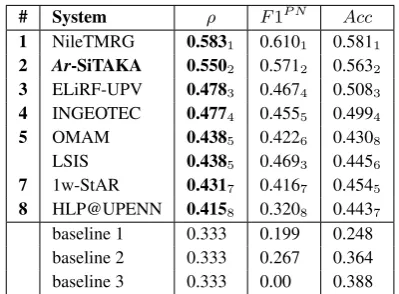
The system has been tested on 12,284 English-language tweets and 6100 Arabic-English-language tweets provided by the organizers. The golden answers of all the test tweets were omitted by the organiz-ers. The official evaluation results of our system are reported along with the top 10 systems and the baseline results in Table 2 and 3. Our sys-tem ranks 8th among 38 syssys-tems in the English-language tweets and ranks 2nd among 8 systems in the Arabic language tweets. The baselines 1, 2 and 3 stand for the cases in which the system classifies all the tweets as positive, negative and neutral respectively.
5 Conclusion
We have presented a new set of rich sentimental features for the sentiment analysis of the messages posted on Twitter. A Support Vector Machine clas-sifier has been trained using a set of basic fea-tures, information extracted from a set of useful and publicly available opinion lexicons, syntactic
# System ρ F1P N Acc
1 DataStories 0.6811 0.6772 0.6515 BB twtr 0.6811 0.6851 0.6583
3 LIA 0.6763 0.6743 0.6612
4 Senti17 0.6744 0.6654 0.6524
5 NNEMBs 0.6695 0.6585 0.6641
6 Tweester 0.6596 0.6486 0.6486
7 INGEOTEC 0.6497 0.6457 0.63311
8 En-SiTAKA 0.6458 0.6289 0.6439
9 TSA-INF 0.6439 0.62011 0.61617
[image:4.595.314.519.61.231.2]10 UCSC-NLP 0.64210 0.62410 0.56530 baseline 1 0.333 0.162 0.193 baseline 2 0.333 0.224 0.323 baseline 3 0.333 0.00 0.483
Table 2: Results for SemEval-2017 Task 4, sub-task A, English.
# System ρ F1P N Acc
1 NileTMRG 0.5831 0.6101 0.5811
2 Ar-SiTAKA 0.5502 0.5712 0.5632
3 ELiRF-UPV 0.4783 0.4674 0.5083
4 INGEOTEC 0.4774 0.4555 0.4994
5 OMAM 0.4385 0.4226 0.4308 LSIS 0.4385 0.4693 0.4456
7 1w-StAR 0.4317 0.4167 0.4545
8 HLP@UPENN 0.4158 0.3208 0.4437 baseline 1 0.333 0.199 0.248 baseline 2 0.333 0.267 0.364 baseline 3 0.333 0.00 0.388
Table 3: Results for SemEval-2017 Task 4, sub-task A, Arabic.
features, clusters and embeddings. Deep learn-ing approaches have recently been used to build supervised, unsupervised or even semi-supervised methods to analyze the sentiment of texts and to build efficient opinion lexicons (Severyn and Mos-chitti,2015;Tang et al.,2014a,c); thus, the authors are considering the possibility of also using this technique to build a sentiment analysis system.
Acknowledgment
This work was partially supported by URV Research Support Funds (2015PFR-URV-B2-60, 2016PFR-URV-B2-60 and Mart´ı i Franqu´es PhD grant).
References
[image:4.595.315.515.275.422.2]Erik Cambria, Daniel Olsher, and Dheeraj Rajagopal. 2014. SenticNet 3: a common and common-sense knowledge base for cognition-driven sentiment anal-ysis. InTwenty-eighth AAAI conference on artificial intelligence.
Ronan Collobert, Jason Weston, L´eon Bottou, Michael Karlen, Koray Kavukcuoglu, and Pavel Kuksa. 2011. Natural language processing (almost) from scratch. Journal of Machine Learning Research
12:2461–2505.
Corinna Cortes and Vladimir Vapnik. 1995. Support vector machine. Machine learning20(3):273–297.
Li Dong, Furu Wei, Yichun Yin, Ming Zhou, and Ke Xu. 2015. Splusplus: A Feature-Rich Two-stage Classifier for Sentiment Analysis of Tweets.
SemEval-2015page 515.
Ronen Feldman. 2013. Techniques and applications for sentiment analysis. Communications of the ACM
56(4):82–89.
Kevin Gimpel, Nathan Schneider, Brendan O’Connor, Dipanjan Das, Daniel Mills, Jacob Eisenstein, Michael Heilman, Dani Yogatama, Jeffrey Flanigan, and Noah A. Smith. 2011. Part-of-speech Tagging for Twitter: Annotation, Features, and Experiments. In Proceedings of the 49th Annual Meeting of the Association for Computational Linguistics: Human Language Technologies: Short Papers - Volume 2. Association for Computational Linguistics, Strouds-burg, PA, USA, HLT ’11, pages 42–47.
Spence Green and Christopher D Manning. 2010. Bet-ter arabic parsing: Baselines, evaluations, and anal-ysis. InProceedings of the 23rd International Con-ference on Computational Linguistics. Association for Computational Linguistics, pages 394–402.
Minqing Hu and Bing Liu. 2004. Mining and summa-rizing customer reviews. InProceedings of the tenth ACM SIGKDD international conference on Knowl-edge discovery and data mining. ACM, pages 168– 177.
Mohammed Jabreel and Antonio Moreno. 2016. Sen-tirich: Sentiment analysis of tweets based on a rich set of features. In Artificial Intelligence Research and Development - Proceedings of the 19th Inter-national Conference of the Catalan Association for Artificial Intelligence, Barcelona, Catalonia, Spain, October 19-21, 2016. pages 137–146.
Bing Liu. 2012. Sentiment analysis and opinion min-ing. Synthesis lectures on human language tech-nologies5(1):1–167.
Tomas Mikolov, Kai Chen, Greg Corrado, and Jef-frey Dean. 2013a. Efficient estimation of word representations in vector space. arXiv preprint arXiv:1301.3781.
Tomas Mikolov, Ilya Sutskever, Kai Chen, Greg S Cor-rado, and Jeff Dean. 2013b. Distributed representa-tions of words and phrases and their compositional-ity. InAdvances in neural information processing systems. pages 3111–3119.
Saif Mohammad, Svetlana Kiritchenko, and Xiaodan Zhu. 2013. NRC-Canada: Building the State-of-the-Art in Sentiment Analysis of Tweets. In Pro-ceedings of the seventh international workshop on Semantic Evaluation Exercises (SemEval-2013). At-lanta, Georgia, USA.
Alexander Pak and Patrick Paroubek. 2010. Twitter as a Corpus for Sentiment Analysis and Opinion Min-ing. In Proceedings of the Seventh conference on International Language Resources and Evaluation (LREC’10). European Language Resources Associ-ation (ELRA), Valletta, Malta.
Bo Pang and Lillian Lee. 2008. Opinion Mining and Sentiment Analysis. Found. Trends Inf. Retr. 2(1-2):1–135.
Bo Pang, Lillian Lee, and Shivakumar Vaithyanathan. 2002. Thumbs Up?: Sentiment Classification Us-ing Machine LearnUs-ing Techniques. InProceedings of the ACL-02 Conference on Empirical Methods in Natural Language Processing - Volume 10. Asso-ciation for Computational Linguistics, Stroudsburg, PA, USA, EMNLP ’02, pages 79–86.
Sara Rosenthal, Noura Farra, and Preslav Nakov. 2017. SemEval-2017 task 4: Sentiment analysis in Twit-ter. InProceedings of the 11th International Work-shop on Semantic Evaluation. Association for Com-putational Linguistics, Vancouver, Canada, SemEval ’17.
Sara Rosenthal, Alan Ritter, Preslav Nakov, and Veselin Stoyanov. 2014. Semeval-2014 task 9: Sen-timent analysis in twitter. In Proceedings of the 8th International Workshop on Semantic Evaluation (SemEval 2014). pages 73–80.
Hassan Saif, Miriam Fern´andez, Yulan He, and Harith Alani. 2014. On stopwords, filtering and data spar-sity for sentiment analysis of Twitter. In Proceed-ings of the 9th language resources and evaluation conference (LREC). Reykjavik, Iceland.
Mohammad Salameh Saif M. Mohammad and Svetlana Kiritchenko. 2016. Sentiment lexicons for arabic so-cial media. In Proceedings of 10th edition of the the Language Resources and Evaluation Conference (LREC). Portoroˇz, Slovenia.
Philip Stone, Dexter C Dunphy, Marshall S Smith, and DM Ogilvie. 1968. The general inquirer: A com-puter approach to content analysis. Journal of Re-gional Science8(1):113–116.
Duyu Tang, Furu Wei, Bing Qin, Ting Liu, and Ming Zhou. 2014a. Coooolll: A Deep Learn-ing System for Twitter Sentiment Classification. In Proceedings of the 8th International Workshop on Semantic Evaluation (SemEval 2014). Asso-ciation for Computational Linguistics and Dublin City University, Dublin, Ireland, pages 208–212. http://www.aclweb.org/anthology/S14-2033. Duyu Tang, Furu Wei, Bing Qin, Ming Zhou, and
Ting Liu. 2014b. Building Large-Scale Twitter-Specific Sentiment Lexicon : A Representation Learning Approach. In Proceedings of COLING 2014, the 25th International Conference on Com-putational Linguistics: Technical Papers. Dublin City University and Association for Computa-tional Linguistics, Dublin, Ireland, pages 172–182. http://www.aclweb.org/anthology/C14-1018.
Duyu Tang, Furu Wei, Nan Yang, Ming Zhou, Ting Liu, and Bing Qin. 2014c. Learning Sentiment-Specific Word Embedding for Twit-ter Sentiment Classification. In Proceedings of the 52nd Annual Meeting of the Associa-tion for ComputaAssocia-tional Linguistics (Volume 1: Long Papers). Association for Computational Lin-guistics, Baltimore, Maryland, pages 1555–1565. http://www.aclweb.org/anthology/P14-1146.
Mohamed A Zahran, Ahmed Magooda, Ashraf Y Mah-goub, Hazem Raafat, Mohsen Rashwan, and Amir Atyia. 2015. Word representations in vector space and their applications for arabic. In International Conference on Intelligent Text Processing and Com-putational Linguistics. Springer, pages 430–443.