Query-based summarization using MDL principle
Natalia Vanetik
Shamoon College of Engineering Beer Sheva
Israel
Marina Litvak
Shamoon College of Engineering Beer Sheva
Israel
Abstract
Query-based text summarization is aimed at extracting essential information that an-swers the query from original text. The answer is presented in a minimal, often predefined, number of words. In this pa-per we introduce a new unsupa-pervised ap-proach for query-based extractive summa-rization, based on the minimum descrip-tion length (MDL) principle that employs Krimp compression algorithm (Vreeken et al., 2011). The key idea of our ap-proach is to select frequent word sets re-lated to a given query that compress doc-ument sentences better and therefore de-scribe the document better. A summary is extracted by selecting sentences that best cover query-related frequent word sets. The approach is evaluated based on the DUC 2005 and DUC 2006 datasets which are specifically designed for query-based summarization (DUC, 2005 2006). It competes with the best results.
1 Introduction
Query-based summarization (QS) is directed to-ward generating a summary most relevant to a given query. It can relate to a single-document or to a multi-document input. Our approach for QS is based on the MDL principle, defining the best summary as the one that leads to thebest compres-sionof the textwith query-related informationby providing its shortest and most concise descrip-tion. The MDL principle is widely useful in com-pression techniques of non-textual data, such as summarization of query results for online analyti-cal processing (OLAP) applications (Lakshmanan et al., 2002; Bu et al., 2005). However, only a few works about text summarization using MDL can
be found in the literature. Nomoto and Matsumoto (2001) used K-means clustering extended with the MDL principle, to find diverse topics in the sum-marized text. Nomoto (2004) also extended the C4.5 classifier with MDL for learning rhetorical relations. In (Nguyen et al., 2015) the problem of micro-review summarization is formulated within the MDL framework, where the authors view the tips as being encoded by snippets, and seek to find a collection of snippets that produces the encoding with the minimum number of bits.
This work proposes a MDL approach where the sentences that are best described by the query-related word sequences are selected to a sum-mary. It is principally different from the men-tioned works by (1) using frequent itemsets and not single words in the description model, (2) compressing entire documents instead of sum-maries, (3) ranking method for sentences, and (4) the description model itself. We tested our ap-proach on DUC 2005 and DUC 2006 data for En-glish query-based summarization.
2 Related Work
Multiple works about QS have been published in recent years. Daum´e III and Marcu (2006) pre-sented BayeSum, a model for sentence extrac-tion in QS. BayeSum is based on the concepts of three models: language model, Bayesian sta-tistical model, and graphical model. Mohamed and Rajasekaran (2006) proposed an approach for QS based on document graphs, which are directed graphs of concepts or entity nodes and relations between them. The work in (Bosma, 2005) in-troduced a graph search algorithm that looks for relevant sentences in the discourse structure rep-resented as a graph. The author used Rhetorical Structure Theory for creating a graph representa-tion of a text document - a weighted graph with
nodes standing for sentences and weighted edges representing a distance between sentences. Con-roy et al. (2005) presented the CLASSY summa-rizer that used a hidden Markov model based on signature terms and query terms for sentence se-lection within a document, and a pivoted question answering algorithm for redundancy removal. Liu et al. (2012) proposed QS with multi-document input using unsupervised deep learning. Schilder and Kondadadi (2008) presented FastSum - a fast query-based multi-document summarizer based solely on word-frequency features of clusters, doc-uments, and topics, where summary sentences are ranked by a regression support vector ma-chine. Tang et al. (2009) proposed two strategies to incorporate the query information into a prob-abilistic model. Park et al. (2006) introduced a method that uses non-negative matrix factoriza-tion to extract query-relevant sentences. Some works deal with domain-specific data (Chen and Verma, 2006) and use domain-specific terms when measuring the distance between sentences and a query. Zhou et al. (2006) describes a query-based multi-document summarizer based on basic ele-ments, a head-modifier-relation triple representa-tion of document content. Recently, many works integrate topic modeling into their summarization models. For example, Li and Li (2014) extend the standard graph ranking algorithm by proposing a two-layer (sentence layer and topic layer) graph-based semi-supervised learning approach graph-based on topic modeling techniques. Wang et al. (2014) present a submodular function-based framework for query-focused opinion summarization. Within their framework, relevance ordering produced by a statistical ranker, and information coverage with respect to topic distribution and diverse viewpoints are both encoded as submodular functions. Some works (Li et al., 2015) use external resources with the goal to better represent the importance of a text unit and its semantic similarity with the given query. Otterbacher et al. (2009) present Biased LexRank method, which represents a text as a graph of passages linked based on their pairwise lexical similarity, identifies passages that are likely to be relevant to a users natural language ques-tion and then perform a random walk on the lexi-cal similarity graph in order to recursively retrieve additional passages that are similar relevant pas-sages. Williams et al. (2014) provides a task-based evaluation of multiple query biased
sum-marization methods for cross-language informa-tion retrieval using relevance predicinforma-tion. In (Lit-vak et al., 2015) we applied the MDL principle to generic summarization, where we considered fre-quent word sets as the means for encoding text. The results demonstrated superiority of the pro-posed method over other methods on DUC data. This paper continues the above work by construct-ing a model where frequent word sets depend on the query.
3 Methodology
3.1 Overview
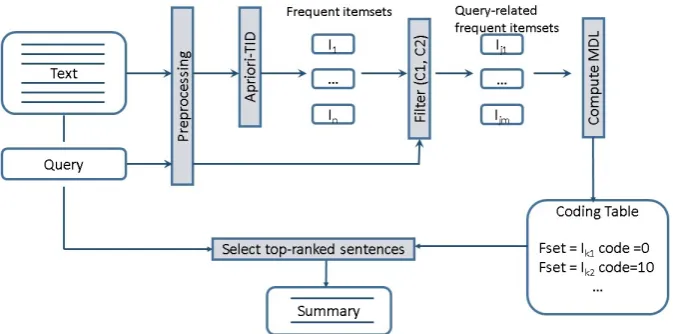
Our approach consists of the following steps: (1) text preprocessing, (2) query-related frequent itemset mining, (3) finding the best MDL model, and (4) sentence ranking for the summary con-struction. The general scheme of our approach is depicted in Figure 1. Details of every step are given in sections below. Section 3.8 contains an example of intermediate and the final (the sum-mary) outputs for one of the document clusters from DUC 2005 dataset.
3.2 Query-based MDL principle
The Minimum Description Length (MDL) Princi-ple is based on the idea that a regularity in the data can be used to compress the data, and this com-pression should use fewer symbols than the data itself. Intuitively, a model is a partial function from data subsets to codes, where the codes size has logarithmic growth.
In general, given a set of models M, a model M ∈ M is considered the best if it minimizes L(M) +L(D|M), whereL(M)is the bit length of description ofM andL(D|M)is the bit length of the datasetD encoded with M. As such, the frequency and the length of the codes that re-place data subsets are the most important fea-tures of the MDL model. Because we aim at query-based summarization, in our approach we seek a query-dependent modelMQthat minimizes L(MQ)+L(D|MQ); it may not be the best model overall but it has to be the best among models for the query Q. Note that the MDL approach does not use the actual codes but only takes into account their bit size.
3.3 Query-based data setup
tokeniza-Figure 1: Query-based MDL summarization
tion, stemming, and stop-words removal. Ad-ditionally, sentences that are too long (over 40 words), too short (less than 5 words), or consist primarily of direct speech (main portion of a sen-tence is contained within quotes), are omitted. The number of these sentences is small and we noted that their inclusion in summaries, although rare, decreases summary quality. No deep linguistic analysis is performed, and therefore this method is suitable for any language with basic tools.
A query is considered to be a set of stemmed to-kens, e.g., terms, even if it contains more than one sentence. A document or a document set (in case of multi-document summarization)Dis treated as a dataset where each sentence is atransactionthat is a set of stemmed tokens. The order of words in a sentence is ignored in our model, because we consider the relation of a sentence to a query to be more important than the order in which a sen-tence utilizes query tokens. Formally, we have sentencesS1, . . . , Snof a document set where ev-ery sentence is a subset of unique terms (stemmed tokens), denoted byT1, . . . , Tm. A queryQ is a subset of unique terms as well.
3.4 Frequent itemsets
In our approach, we refer to text as a transactional dataset, where each sentence is considered to be a singletransactionconsisting ofitems. An item in our case is a term, i.e. stemmed word. Therefore, a sentence is viewed as a set of terms contained in it. A set of items, called anitemset, isfrequentif it is contained (as a set) inSsentences, whereS ≥1
is user-defined parameter.
The paper (Agrawal and Srikant, 1994) has
pro-posed two algorithms–Apriori and Apriori-TID– for processing large databases and mining fre-quent itemsets in efficient time. The Apriori al-gorithm makes multiple passes over the database while Apriori-TID algorithm uses the database only once, in the first pass. In this work, we use the Apriori-TID algorithm for frequent itemset min-ing. While multitude of algorithms performing the same task exist, Apriori-TID is sufficient for our purposes because texts, treated as transactional datasets, are rarely dense, and therefore the num-ber of frequent itemsets found in texts is usually not very large.
3.5 Data encoding
In general MDL approach, a Coding Table is a collection CT of sets from D that are used as a model of our dataset. According to the MDL principle, CT is considered to be the best when it minimizes encoded dataset sizesize(D, CT) =
L(CT) +L(D|CT). In general MDL approach, aCoding Tableis a collectionCT of sets fromD that are used as a model of our dataset. Accord-ing to the MDL principle,CT is considered to be the best when it minimizes encoded dataset size
size(D, CT) =L(CT) +L(D|CT).
[image:3.595.122.459.64.231.2]size|code(I)|when computingsize(D, CT). We use Huffman Coding in the current version, where
|code(I)| = log|I|. General approach of using frequent sets for dataset MDL representation first appeared in (Vreeken et al., 2011); here, we apply it to text and only care about word sets related to a query.
There are two main orders to consider: Standard Candidate Order in which F is kept, whose pur-pose is to build the coding table faster. Itemsets in F are first sorted by increasing support, then by decreasing sequence length, then lexicographi-cally. The Standard Cover Order ofCT keeps its members sorted by first by decreasing sequence length, then by decreasing support, and finally, in lexicographical order. Using this order en-sures that encoding of the dataset withCT indeed produces minimal encoding lengthL(D|CT)for fixed CT. Validity of this approach is proven in (Vreeken et al., 2011).
3.6 Sentence ranking and summary construction
We are interested in the dataset D|CT after it is compressed in the best possible way with the best compressing query-related set CT. The dataset D|CT is obtained by replacing inDevery itemset inCT by its code, and shorter codes are selected first. We use an upper bound on the size ofCT, in order to limit document compression, and select it to be equal to the target summary size, which is denoted bySummarySize. The ideal compression in this case will compress only words most rel-evant to the summary and will ignore everything else; additionally, this limitation speeds up com-putation.
The summary is constructed by iteratively se-lecting the sentences according to the coverage of CT. At each step, a sentence that covers the most important uncovered itemset inCT is added to a summary. Importance of itemsets in CT is de-termined by their order – higher itemsets in CT (those with shorter codes) have higher importance.
3.7 Query-based frequent itemsets and data encoding
In order to direct the summarization process to-wards the given query, we compute and use for encoding only frequent itemsets that are related to the given query. We tested two different types of constraints on frequent itemsets:
• (C1)All terms in a frequent itemsetI must be contained in the query:I ⊆Q.
With this approach, a set of words in a sen-tence is encoded only if these words appear in the query.
• (C2) Every frequent itemset and the query must have a common term:I∩Q̸=∅. Here, a set of words in a sentence is encoded if at least one word in the set appears in the query.
Both methods ensure that only terms related to the query are taken into account. Therefore, instead of all frequent itemsetsF, we only use its subset FCi,i= 1,2. The general Standard Candidate Or-der is used, and members ofFCi are sorted by by increasing support, then by decreasing sequence length, then lexicographically.
Because the coding tableCT can now contain members of FCi only, we modify the Standard Cover Order ofCT accordingly in order to com-press query-related terms first. The order is modi-fied as follows:
• (C1)Because every member ofCT contains
onlyterms used in the query, we sort it first by decreasing sequence length, then by in-creasing support, and then lexicographically. Here, sequence length is precisely the num-ber of query terms contained in a frequent itemset, and itemsets containing more query terms get higher priority.
• (C2) Every member of CT has some com-mon terms with the query, we sortCT first by the number of terms common to an item-set and the query, then by decreasing se-quence length, then by increasing support, and then lexicographically. Here, a prece-dence is given to itemsets that have more in common to the query. Note that we tested other measures for distance between itemsets and the query (Jaccard similarity, cosine sim-ilarity), but this method provided better re-sults.
Detailed description of our query-based summa-rization method Qump (Query-based Krimp) is given in Algorithm 1.
3.8 Example
Algorithm 1:Qump: Query-Based Krimp
Input:
(1) a document or a document setD, preprocessed as in Section 3.3, (2) a queryQpreprocessed
as in Section 3.3,
(3) target summary word limitSummarySize, (4) support boundS,
(5) constraintCxon frequent itemsets as described in Section 3.7.
Output:Extractive summarySummary
/*STEP 1: Query-related frequent set mining*/ (1a)F ←frequent sets of terms from{T1, . . . , Tm}
appearing in at leastSuppfraction of sentences that satisfy constraintCx;
(1b) SortFaccording to Standard Candidate Order; /*STEP 2: Initialize the coding table*/
(2a) Add all termsT1, . . . , Tmand their support to
CT;
(2b) KeepCTalways sorted according to Standard Cover Order;
(2c) Initialize prefix codes according to the order of sets inCT;
/*STEP 3: Find the best encoding*/ (3a)EncodedData←
PrefixEncoding({S1, . . . , Sn}, CT);
(3b)CodeCount ←0;
whileCodeCount <SummarySizeandF̸=∅do
BestCode←arg minc∈FL(CT∪ {c}) +
L(PrefixEncoding({S1, . . . , Sn}, CT∪ {c}));
CT←CT∪ {BestCode}; F←F\ {BestCode};
/*If a code is used, its supercodes cannot appear in the data */
F←F\ {d∈F|BestCode⊂d}; CodeCount++;
end
/*STEP 4: Build the summary*/ Summary ← ∅;
forcodesc∈CT do
importance(c) :=serial number ofcinCT
end
while|Summary|<SummarySizedo forall unselected sentencesSdo
nCov(S)←∑c∈CTimportance(c)/|S|
end
S←arg maxSnCov(S);
Summary←Summary∪ {S}; CT:=CT\ {c}
ford⊂cdo
CT:=CT\ {d}
end end
returnSummary
D301I and the query “International Organized Crime Identify and describe types of organized crime that crosses borders or involves more than one country. Name the countries involved. Also identify the perpetrators involved with each type of crime, including both individuals and organiza-tions if possible.”from the DUC 2005 dataset.
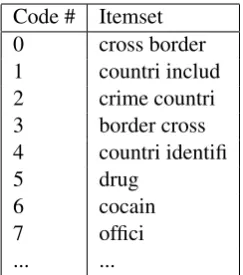
• The coding tableCT (only its top8itemsets
Code # Itemset 0 cross border 1 countri includ 2 crime countri 3 border cross 4 countri identifi
5 drug
6 cocain
[image:5.595.356.478.61.199.2]7 offici ... ...
Table 1:CT example, top records.
with the shortest codes, sorted from the most important to the least) is given in Table 1.
• The sentence“The drugs organisation used intricate methods - including bank accounts, couriers and ships as well as dummy and real companies in many countries - to smuggle co-caine from South America to Europe.” after encoding (replacement of phrases by codes) looks like this: “code#5 code#24 intric method includ code#19 account courier ship dummi real compani mani code#16 code#23 code#6 south america code#40”, and it cov-ers7out of50codes from theCT. Normal-ized by the sentence length, its coverage is the largest among all sentences, and therefore it is selected to the summary.
• The summary contains8following sentences with the highest CT coverage, ordered by their appearance in the summarized docu-ments:
is the story of how western and eastern crimi-nal syndicates secured the former Soviet safe-house, the last piece in constructing a global pax mafiosa. In the pax mafiosa, business is business - the Chinese Triads are partners in crime with the American Mafia; the Italians use the Russians to launder for the Colom-bian cartels, the Japanese Yakuza work hand in hand with the Italians. Last January, after the ouster of Panamanian strongman Manuel A. Noriega, the new government of Panama agreed to U.S. requests for records of bank accounts identified as having been used by cartel money launderers. Cuba’s interior minister, the Cabinet officer in charge of do-mestic law enforcement, was fired Thursday as that nation’s drug purge continued, but the crackdown has failed to touch other leaders who U.S. officials say are involved in traffick-ing.”
4 Experiments
4.1 Dataset
We selected two English corpora of the Doc-ument Understanding Conference (DUC): DUC 2006 and DUC 2005 (DUC, 2005 2006) for our experiments, which are standard datasets used for query-based summarization methods evaluation.
The DUC 2005 dataset contains 50 documents sets of 25-50 related documents each. Average number of words in a document set is 20185. For every document set a short (1-3 sentences) query is supplied. From 4 to 9 gold standard summaries are supplied for every document set, and the target summary size is 250 words.
The DUC 2006 dataset contains 50 documents sets of 25 related document each. Average number of words in a document set is 15293. For every document set a short (1-3 sentences) query is sup-plied. Four gold standard summaries are supplied for every document set, and the target summary size is 250 words.
4.2 Experiment setup
We generated summaries for each set of related documents (by considering each set of documents as one meta-document) in the DUC 2005 and DUC 2006 corpora. The summarization quality was measured by the ROUGE-1 (Lin, 2004) recall
scores1 , with the word limit set to 250, without
stemming and stopword removal. We limited the size of the coding table by 250, as described in Section 3.4, and set support count S = 2 in or-der to take into account all terms repeated twice or more in the text.
4.3 Results
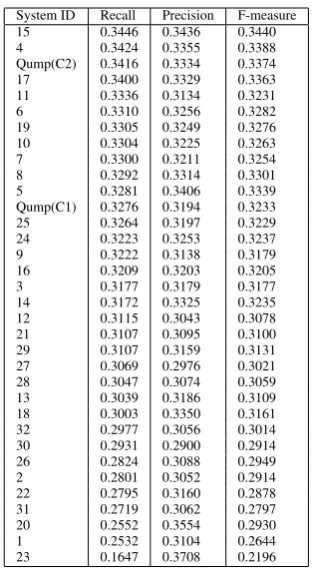
Table 2 shows the ROUGE-1 scores of our al-gorithm comparative to the scores of 32 sys-tems that participated in the DUC 2005 compe-tition. Two options of our algorithm that corre-spond to constraints described in Section 3.7 ap-pear in the ”Systems” column of Table 2, denoted by Qump(C1-C2). Qump(C2) places third on the ROUGE-1 recall and f-measure, and the difference between the top systems (ID=15 and ID=4) and our algorithm is statistically insignificant.
System 15 stands for the NUS summarizer from the National University of Singapore. This sum-marizer is based on the concept link approach (Ye et al., 2005). NUS method uses two features: sen-tence semantic similarity and redundancy mini-mization based on Maximal Marginal Relevance (MMR). The first one is computed as an over-all similarity score between each sentence and the remainder of the document cluster. This overall similarity score reflects the strength of represen-tative power of the sentence in regard to the rest of the document cluster and is used as the pri-mary sentence ranking metric while forming the summary. Then, a module similar to MMR is em-ployed to build the summary incrementally, min-imizing redundancy and maintaining the summa-rys relevance to the query’s topic. In order to reduce the run-time computational cost (required for a scan through all possible pairs of senses for all pairs of concepts), authors pre-computed the semantic similarity between all possible pairs of WordNet entries offline.
System 4 represents the Columbia summarizer from the Columbia University (Blair-Goldensohn, 2005). This is an adaptation of the Def-Scriber question answering (QA) system (Blair-Goldensohn et al., 2004). DefScriber (1) identifies relevant sentences which contain information per-tinent to the target individual or term (i.e. the X in the “Who/What is X?” question); (2) incremen-tally clusters extracted sentences using a cosine
1we used ROUGE-1.5.5 version and the command line
distance metric; then (3) selects sentences for out-put summary using a fitness function which max-imizes inclusion of core definitional predicates, coverage of the highest ranking clusters, and an-swer cohesion; and finally (4) applies reference rewriting techniques to extracted sentences to im-prove readability of summary, using an auxiliary system (Nenkova and McKeown, 2003). The key adaptations made for the DUC 2005 task were in relevant-passage selection (step 1) by combining the following techniques:
1. Term frequency-based weighting for filtering the less relevant terms from the topic state-ment (“topic terms”), based on IDF calcu-lated over a large news corpus;
2. Topic structure for adjustment the topic term weights with the simple heuristic of giving terms in the title double the weight of terms in the extended question/topic body;
3. Stemming for maximize coverage of relevant terms when measuring overlap of topic terms and document sentences;
4. Including content of the nearby-sentences in the determination of a given sentences rele-vance.
Using these techniques, the algorithm made two passes over each document. In the first pass as-signing relevance scores to each sentence based on overlap with topic terms. In the second pass, these scores were adjusted using the first-pass scores of nearby sentences. Finally, the sentences scored above a certain cutoff were selected.
In comparison to the two top systems, our ap-proach does not require any pre-computed data from the external resources (like NUS does), and has a very simple pipeline with a few stages (un-like the Columbia summarizer) which do not in-volve external tools and have a low computational cost.
[image:7.595.338.495.59.351.2]The difference of Qump(C2) from system with ID=17 was statistically insignificant, and the dif-ference from system with ID=11 was statistically significant.
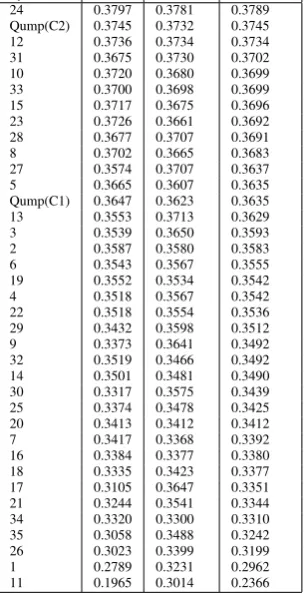
Table 3 shows how the ROUGE-1 scores of our algorithm compare to the scores of35systems that participated in the DUC 2006 competition. Two options of our algorithm that correspond to con-straints described in Section 3.7 appear in the ta-ble, denoted by Qump(C1-C2). Qump(C2) places
System ID Recall Precision F-measure 15 0.3446 0.3436 0.3440 4 0.3424 0.3355 0.3388 Qump(C2) 0.3416 0.3334 0.3374 17 0.3400 0.3329 0.3363 11 0.3336 0.3134 0.3231 6 0.3310 0.3256 0.3282 19 0.3305 0.3249 0.3276 10 0.3304 0.3225 0.3263 7 0.3300 0.3211 0.3254 8 0.3292 0.3314 0.3301 5 0.3281 0.3406 0.3339 Qump(C1) 0.3276 0.3194 0.3233 25 0.3264 0.3197 0.3229 24 0.3223 0.3253 0.3237 9 0.3222 0.3138 0.3179 16 0.3209 0.3203 0.3205 3 0.3177 0.3179 0.3177 14 0.3172 0.3325 0.3235 12 0.3115 0.3043 0.3078 21 0.3107 0.3095 0.3100 29 0.3107 0.3159 0.3131 27 0.3069 0.2976 0.3021 28 0.3047 0.3074 0.3059 13 0.3039 0.3186 0.3109 18 0.3003 0.3350 0.3161 32 0.2977 0.3056 0.3014 30 0.2931 0.2900 0.2914 26 0.2824 0.3088 0.2949 2 0.2801 0.3052 0.2914 22 0.2795 0.3160 0.2878 31 0.2719 0.3062 0.2797 20 0.2552 0.3554 0.2930 1 0.2532 0.3104 0.2644 23 0.1647 0.3708 0.2196
Table 2: DUC 2005. ROUGE-1 scores.
second on the ROUGE-1 recall and f-measure, and the difference between the top system with ID=24 and our algorithm is statistically insignificant.
ID 24 represents the IIITH-Sum system from the International Institute of Information Tech-nology (Jagarlamudi et al., 2006). IIITH-Sum used two features to score the sentences, and then picked the top-scored ones to a summary in the greedy manner. The first feature is a query de-pendent adaptation of the HAL (Jagadeesh et al., 2005) feature, where an additional importance is given to a word/phrase of a query. The second fea-ture calculates query-independent sentence impor-tance, using external resources in the web. First, the Yahoo search engine was used to get a ranked list of retrieved documents, and a unigram lan-guage model was learned on a text content ex-tracted from them. Then, Information Measure (IM), using entropy to compute the information content of a sentence based on the learned unigram model, was used for scoring a sentence. The final sentence ranks were computed as a weighted lin-ear combination of modified HAL feature and IM. In contrast to the IIIHT-Sum, our approach does not require any external resources and is strictly based on the internal content of the analyzed cor-pus. As results, it is also consumes less run-time.
[image:7.595.337.493.68.345.2]System ID Recall Precision F-measure 24 0.3797 0.3781 0.3789 Qump(C2) 0.3745 0.3732 0.3745 12 0.3736 0.3734 0.3734 31 0.3675 0.3730 0.3702 10 0.3720 0.3680 0.3699 33 0.3700 0.3698 0.3699 15 0.3717 0.3675 0.3696 23 0.3726 0.3661 0.3692 28 0.3677 0.3707 0.3691 8 0.3702 0.3665 0.3683 27 0.3574 0.3707 0.3637 5 0.3665 0.3607 0.3635 Qump(C1) 0.3647 0.3623 0.3635 13 0.3553 0.3713 0.3629 3 0.3539 0.3650 0.3593 2 0.3587 0.3580 0.3583 6 0.3543 0.3567 0.3555 19 0.3552 0.3534 0.3542 4 0.3518 0.3567 0.3542 22 0.3518 0.3554 0.3536 29 0.3432 0.3598 0.3512 9 0.3373 0.3641 0.3492 32 0.3519 0.3466 0.3492 14 0.3501 0.3481 0.3490 30 0.3317 0.3575 0.3439 25 0.3374 0.3478 0.3425 20 0.3413 0.3412 0.3412 7 0.3417 0.3368 0.3392 16 0.3384 0.3377 0.3380 18 0.3335 0.3423 0.3377 17 0.3105 0.3647 0.3351 21 0.3244 0.3541 0.3344 34 0.3320 0.3300 0.3310 35 0.3058 0.3488 0.3242 26 0.3023 0.3399 0.3199 1 0.2789 0.3231 0.2962 11 0.1965 0.3014 0.2366
Table 3: DUC 2006. ROUGE-1 scores.
ID=12 was statistically insignificant, and the dif-ference from system with ID=31 was statistically significant. It is not surprising that method C2 per-formed better that C1 as limiting frequent word sets to words appearing in a query only decreases the overall number of frequent word sets. In this case, many repetitive word sets that are related to the query are missed.
The actual running time of our Qump (both ver-sions) was around 1-3 seconds per document sets. We also learned that long sentences do not affect computation cost of our approach.
5 Conclusions
This work introduces Qump, a system following a new MDL-based approach to a query-oriented summarization. Qump extracts sentences that best describe the query-related frequent set of words. The evaluation results show that Qump has an ex-cellent performance. In absolute ranking, it out-performs all but two of participated systems in DUC 2005 competition and all but one of com-peting systems in DUC 2006 contest. Accord-ing to significance test, Qump has the same per-formance as leading systems in both competitions (ID=15,4,7 in 2005 and ID=24,12 in
DUC-2006). In addition, Qump is an efficient algorithm having polynomial complexity. Qump’s runtime is limited by Apriori that is known as a PSPACE-complete problem. However, because it is a rare occasion to have a set of words repeated in more than 4-5 different sentences in the entire docu-ment set, we haveO(n5)frequent itemsets at most wherenis the number of terms. The encoding pro-cess is bound by a number of frequent sets times a number of sentences (m) times a number of words (k). Therefore, we can say that Qump’s runtime is polynomial in the number of terms and is bound byO(m×k×n5). In conclusion, the presented technique has the following advantages over other techniques: (1) It is unsupervised and does not re-quire any external resources (many of the top-rated systems from the DUC competitions are super-vised or use external data); (2) It has efficient time complexity (polynomial in the number of terms); (3) It is language-independent and can be applied on any language, as far as we have a tokenizer for this language (for example, we got excellent re-sults with generic summarization in Chinese with this approach2); (4) Despite its robustness
(inde-pendence on annotated data and language, and its efficiency), its performance is comparable to the one of the top systems.
In future, we intend to enrich this approach with word vectors for better match between a query and a sentence. Also, we plan to integrate it with a novel summarization technique using OLAP rep-resentation, where frequent itemsets of words will represent an additional dimension.
References
Rakesh Agrawal and Ramakrishnan Srikant. 1994. Fast algorithms for mining association rules. In20th International Conference on Very Large Databases, pages 487–499.
Sasha Blair-Goldensohn, Kathleen McKeown, and An-drew H. Schlaikjer, 2004. Answering definitional questions: A hybrid approach, chapter 4. AAAI Press.
Sasha Blair-Goldensohn. 2005. From definitions to complex topics: Columbia university at DUC 2005. InDocument Understanding Conference.
Wauter Bosma, 2005.Query-Based Summarization us-ing Rhetorical Structure Theory, pages 29–44. LOT.
2Litvak, M. and Vanetik, N. and Li, L., 2017,
Shaofeng Bu, Laks V. S. Lakshmanan, and Raymond T. Ng. 2005. Mdl summarization with holes. In
Proceedings of the 31st International Conference on Very Large Data Bases, VLDB ’05, pages 433–444. Ping Chen and Rakesh Verma. 2006. A query-based medical information summarization system using ontology knowledge. In Proceedings of the 19th IEEE Symposium on Computer-Based Medical Sys-tems (CBMS06), pages 37–42.
John M. Conroy, Judith D. Schlesinger, and Jade Gold-stein Stewart. 2005. CLASSY: Query-based multi-document summarization. In DUC 05 Conference Proceedings.
Hal Daum´e III and Daniel Marcu. 2006. Bayesian query-focused summarization. In Proceedings of the 21st International Conference on Computational Linguistics and 44th Annual Meeting of the Associa-tion for ComputaAssocia-tional Linguistics, pages 305–312, Sydney, Australia, July. Association for Computa-tional Linguistics.
DUC. 2005-2006. Document Understanding Confer-ence. http://duc.nist.gov.
Jagarlamudi Jagadeesh, Prasad Pingali, and Vasudeva Varma. 2005. A relevance-based language mod-eling approach to DUC 2005. In Document Un-derstanding Conferences (along with HLT-EMNLP 2005).
Jagadeesh Jagarlamudi, Prasad Pingali, and Vasudeva Varma. 2006. Query independent sentence scoring approach to DUC 2006.
Laks V. S. Lakshmanan, Raymond T. Ng, Chris-tine Xing Wang, Xiaodong Zhou, and Theodore J. Johnson. 2002. The generalized mdl approach for summarization. InProceedings of the 28th Interna-tional Conference on Very Large Data Bases, VLDB ’02, pages 766–777.
Yanran Li and Sujian Li. 2014. Query-focused multi-document summarization: Combining a topic model with graph-based semi-supervised learning. In Pro-ceedings of COLING 2014, the 25th International Conference on Computational Linguistics: Techni-cal Papers, pages 1197–1207, Dublin, Ireland, Au-gust. Dublin City University and Association for Computational Linguistics.
Chen Li, Yang Liu, and Lin Zhao. 2015. Using exter-nal resources and joint learning for bigram weight-ing in ilp-based multi-document summarization. In
Proceedings of the 2015 Conference of the North American Chapter of the Association for Computa-tional Linguistics: Human Language Technologies, pages 778–787, Denver, Colorado, May–June. As-sociation for Computational Linguistics.
Chin-Yew Lin. 2004. ROUGE: A Package for Auto-matic Evaluation of summaries. In Proceedings of the Workshop on Text Summarization Branches Out (WAS 2004), pages 25–26.
Marina Litvak, Mark Last, and Natalia Vanetik. 2015. Krimping texts for better summarization. In Pro-ceedings of the 2015 Conference on Empirical Meth-ods in Natural Language Processing, pages 1931– 1935, Lisbon, Portugal, September. Association for Computational Linguistics.
Yan Liu, Sheng hua Zhong, and Wenjie Li. 2012. Query-oriented multi-document summarization via unsupervised deep learning. InProceedings of the Twenty-Sixth AAAI conference on Artificial Intelli-gence, pages 1699–1705.
Ahmed A. Mohamed and Sanguthevar Rajasekaran. 2006. Query-based summarization based on docu-ment graphs. InProceedings of IEEE International Symposium on Signal Processing and Information Technology, pages 408–410.
Ani Nenkova and Kathleen McKeown. 2003. Refer-ences to named entities: a corpus study. In NAACL-HLT 2003.
Thanh-Son Nguyen, Hady W. Lauw, and Panayiotis Tsaparas. 2015. Review synthesis for micro-review summarization. InProceedings of the Eighth ACM International Conference on Web Search and Data Mining, WSDM’15, pages 169–178.
Tadashi Nomoto and Yuji Matsumoto. 2001. A new approach to unsupervised text summarization. In
Proceedings of the 24th Annual International ACM SIGIR Conference on Research and Development in Information Retrieval, SIGIR ’01, pages 26–34.
Tadashi Nomoto. 2004. Machine Learning Ap-proaches to Rhetorical Parsing and Open-Domain Text Summarization. Ph.D. thesis, Nara Institute of Science and Technology.
Jahna Otterbacher, Gunes Erkan, and Dragomir R. Radev. 2009. Biased lexrank: Passage retrieval us-ing random walks with question-based priors. Infor-mation Processing & Management, 45(1):42–54.
Sun Park, Ju-Hong Lee, Chan-Min Ahn, Jun Sik Hong, and Seok-Ju Chun, 2006. Query Based Summariza-tion Using Non-negative Matrix FactorizaSummariza-tion, vol-ume 4253 of Lecture Notes in Computer Science, pages 84–89.
Frank Schilder and Ravikumar Kondadadi. 2008. Fast-sum: Fast and accurate query-based multi-document summarization. In Proceedings of ACL-08: HLT, Short Papers, pages 205–208, Columbus, Ohio, June. Association for Computational Linguistics.
Jie Tang, Limin Yao, and Dewei Chen. 2009. Multi-topic based query-oriented summarization. InSIAM International Conference Data Mining.
Lu Wang, Hema Raghavan, Claire Cardie, and Vittorio Castelli. 2014. Query-focused opinion summariza-tion for user-generated content. InProceedings of COLING 2014, the 25th International Conference on Computational Linguistics: Technical Papers, pages 1660–1669, Dublin, Ireland, August. Dublin City University and Association for Computational Linguistics.
Jennifer Williams, Sharon Tam, and Wade Shen. 2014. Finding good enough: A task-based evaluation of query biased summarization for cross-language in-formation retrieval. InProceedings of the 2014 Con-ference on Empirical Methods in Natural Language Processing (EMNLP), pages 657–669, Doha, Qatar, October. Association for Computational Linguistics. Shiren Ye, Long Qiu, Tat-Seng Chua, and Min-Yen Kan. 2005. NUS at DUC 2005: understanding doc-uments via concept links. InDocument Understand-ing Conference.