Joint SIGHUM Workshop on Computational Linguistics for Cultural Heritage, Social Sciences, Humanities and Literature. Proceedings,pages 83–88, Vancouver, BC, August 4, 2017. c2017 Association for Computational Linguistics
An Ontology-Based Method for Extracting and Classifying
Domain-Specific Compositional Nominal Compounds
Maria Pia di Buono
TakeLab
Faculty of Electrical Engineering and Computing University of Zagreb, Croatia
Abstract
In this paper, we present our preliminary study on an ontology-based method to ex-tract and classify compositional nominal compounds in specific domains of knowl-edge. This method is based on the assump-tion that, applying a conceptual model to represent knowledge domain, it is possi-ble to improve the extraction and classifi-cation of lexicon occurrences for that do-main in a semi-automatic way. We ex-plore the possibility of extracting and clas-sifying a specific construction type (nom-inal compounds) spanning a specific do-main (Cultural Heritage) and a specific language (Italian).
1 Introduction
In the Cultural Heritage domain, as in many other specific domains of knowledge, phrases and word sequences present recursive formal struc-tures. Some of these structures may form lists of compounds that have specific meanings only when used with reference to that domain and, for this reason, constitute the terminology of that do-main. This means that if such compounds present a certain degree of polysemy, it will be possible to disambiguate usages according to the differ-ent specific domains they belong to. Thus, tak-ing into account a specific domain of knowledge, compounds become unambiguous and clear terms, useful for conceptualizations, which contribute to outline formalizations. In this sense, we can as-sert that domain-specific compounds present two levels of representation, which are separated but interlinked: a conceptual-semantic level, pertain-ing to the knowledge domain and its ontology, and a syntactic-semantic level, pertaining to sentence and word production. We adopt the expression
atomic linguistic units (ALUs) to indicate any kind of lemmatizable terminological compound words which, even being very often semantically compo-sitional, can be lemmatized due to their particular non-ambiguous informational content (Vietri and Monteleone,2013). In this paper, we explore the possibility of extracting and classifying a compo-sitional ALU type (nominal compounds) spanning a specific domain (Cultural Heritage) and a spe-cific language (Italian).
This paper is organized as follows, section 2 de-scribes the background and related work. Our ap-proach is detailed in section 3. The description of testing and results is given in section 4. Section 5 concludes the paper and points to future work.
2 Related Work
The task of dealing with ALUs attracts the inter-est of several researches, due to the issue of con-sistently recognizing those groups of words, able to carry a different semantic expressiveness and charge than single words. Thus, the prediction of these linguistic phenomena in natural language processing (NLP) applications has been investi-gated by several scholars from different point of views. Due to the success for simple words, a growing attention concerns the application of dis-tributional approaches for coping with composi-tional compounds (McCarthy et al.,2003;Reddy et al.,2011;Salehi et al.,2014). Likewise, differ-ent scholars aim at achieving distributed represen-tations of word meanings using word embeddings for various purposes (Mikolov et al., 2013;Patel and Bhattacharyya,2015).
We will see that, being both ontology and dic-tionary based, our identification and classification of ALUs is founded on a systematic and exhaus-tive formalization of natural language.
3 Methodology
Our method lays its foundations in the Lexicon-Grammar (LG) framework (Gross, 1984, 1986). LG considers lexicon as a group of terminal val-ues, in a formal grammar of natural languages, which have to be associated to ordered sequences on the basis of independent combinatory be-haviours and rules. Thus, lexicon is not sepa-rable from syntax, namely every lexical element, occurring in a sentence context, holds a gram-matical function which combines with grammat-ical functions of other constituents. Combina-tory behaviours are driven by co-occurrency and restriction-selection rules. Furthermore, we deal with compositional ALUs also according to se-mantic expansion mechanisms, firstly attested by Harris (1946). These mechanisms are useful to fully account for compositional ALUs, or better for free word groups. Due to the fact that this kind of phenomena may have some possibility to be au-tomatically and successfully parsed by means of regular expressions1.
In our research, we focus on a specific construc-tion type, which may be described and retrieved as ALUs: nominal compounds which present a re-stricted semantic expansion. It means that such ALUs are formed by a head phrase, generally fixed or semi-fixed, followed by variable elements which belong to specific grammatical categories. These variable elements are characterized by a selection restriction, which is determined by the head phrase, which functions as a predicate, and by the semantic provisions which they represent. We define such ALUs as semi-open nominal com-pounds, namely word sequences formed by one or more (semi)fixed elements and a restricted selec-tion of co-occurring elements. As in the example it follows:
(palmetta+semipalmetta+rosetta) + Adjective + Preposition + DNUM (petali + lobi + foglie).
In the previous ALU, we can recognize a re-stricted headpalmetta+semipalmetta+rosetta fol-lowed by an adjective and a preposition, and
1On the contrary, non-compositional ALUs, as the
re-sult of a continuous interaction betweenlangueandparole (De Saussure,1989), are formed according also to linguis-tically motivated, manifold, deep-logic contiguous juxtapo-sitions, and they present unpredictable formation routines. For this reason, they cannot be stochastically coped with, and must be necessary lexicalized if they present the even slight-est non-compositional link among their components.
a numeral, characterized by a high variabil-ity, and a restricted selection of nouns, i.e.,
petali+lobi+foglie.
In other words, in such lexical phenomena the fixed or semi-fixed head defines grammatical and semantic types of all variable elements. This phe-nomenon is mainly observable inside the lexicons of specific knowledge domains, even if it presents features belonging to both common-usage lexicon and terminology. Indeed, such semi-open ALUs are characterized by a variability of non-fixed ele-ments but, at the same time, they are also charac-terized by a non-ambiguous meaning as a result of the compositional process.
In the following sections, we will show how we can recognize and, subsequently, classify by means of a domain ontology, such linguistic phe-nomena through a set of finite state automata (FSA), basing our method on co-occurrence like-lihood of elements in semi-open ALUs.
3.1 Linguistic and Semantic Features
The high variability of non-fixed elements is re-lated to the possibility of selecting elements from non-restraint sets of lexical items, the grammati-cal categories of which are predictable thanks to components constituting the head. On a lexical level, such a feature is correlated to the paradig-matic relationship which indicates words belong-ing to the same part of speech (POS) class. On the other hand, constraints deriving from heads com-ponents are associated to the syntagmatic relation-ship among words, that means to semantic aspects of ALUs. Thus, for example, in the Cultural Her-itage domain, we may observe this phenomenon of semi-open ALUs in Coroplastic descriptions, as the following example shows:
• (1)statua di(statue of) [NPREP]+N
• (2) *statua di(statue of) [NPREP]+A ’Statue of’ represents the head, which determines the type of the element which comes afterwards, that must be a noun (1), and not an adjective (2). Indeed, if the head is composed by a noun, be-longing to a specific semantic category, asstatua
semi-open NP ‘statue of’ may select a proper noun as ‘Silenus’, or a noun as ‘woman’, but not a noun as ‘table’.
As far as syntactic aspects are concerned, some semi-open ALUs, especially referred to Coroplas-tic description, are sentence reductions in which a present participle construction is used. For in-stance,
• (3) statua raffigurante Sileno (statue repre-senting Silenus) is a reduction (Gross,1975; Harris and Gross,1976) of the sentence: (3a) Questa statua raffigura Sileno (This statue represents Silenus)
(3b) [relative] Questa `e una statua che raf-figura Sileno (This is a statue which repre-sents Silenus)
(3c) [pr. part.] Questa `e una statua raffig-urante Sileno (This is a statue representing Silenus)
These semi-open ALUs, which present sentence reductions, may be retrieved using FSA which rec-ognize specific verb role-sets. Therefore, such an FSA recognizes sentence structures as they follow:
• NP(Head)+VP+NP
• NP(Head)+VP+NP+AP
• NP(Head)+VP+AP+NP
• NP(Head)+PREP+NP
• NP(Head)+PREP+NP+AP
• NP(Head)+PREP+AP+NP.
In the previous sample, the noun phrase (NP) which stands for the head of semi-open ALUs is composed by a group of non-restricted nouns re-lated to Coroplastics. It means that in such a group we insert nouns as statue, bust, figure and so on.
As for semantics, we also observe the presence of semi-open ALUs in which the head does not oc-cur in the first position. For example, the open se-riesframmenti di(terracotta+anfora+laterizi+N) (fragments of (clay+amphora+bricks+N)), places the heads at the end of the compounds, being fram-menti used to explicit the notion ‘N0 is a part of N1’.
On the basis of our theoretical premises, and applying these selection restriction rules, we may
identify syntactic and semantic sets of lexical ele-ments which may co-occur in specific semi-open ALUs. Such recursive formal structures allow the development of non-deterministic FSA, suitable to recognize all the elements of a specific open list (di Buono et al.,2013).
3.2 Ontology-based Extraction and Classification
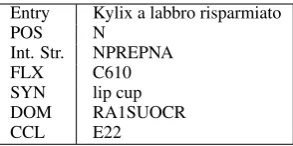
Entry Kylix a labbro risparmiato
POS N
Int. Str. NPREPNA
FLX C610
SYN lip cup
DOM RA1SUOCR
CCL E22
Table 1: Sample of a semantic and taxonomic annotated entry from the Archaeological Italian Electronic Dictionary.
Each entry in the LRs presents taxonomic and on-tological information, as it follows (Table 1):
• Its POS, internal structure and inflectional code (+FLX), which recall a local grammar suitable for generating and recognizing in-flected forms.
• Its variants (VAR) or synonyms (SYN), if any;
• With reference to the taxonomy, the per-taining knowledge domain (DOM), e.g., RA1SUOCR stands for Archaeological Re-mains/Tools/Kitchen Utensil;
• Finally, we insert a tag referring to the on-tological entities derived from the CIDOC CRM, e.g., E22 refers to Man-Made Object class, that is a subclass of E19 Physical Ob-ject.
In order to create the role sets suitable to extract and classify the ALUs, we use these semantic in-formation to apply a series of domain constraints. Thus, we firstly employ information which refer to the domain taxonomic hierarchy. For instance, in the sample (1), our first selection restriction is con-strained by the tag value which indicates Sculp-ture class in the taxonomy. Therefore, we extract all ALUs, labeled with this tag, through a semi-automatic method. Consequently, a manual proce-dure is employed to identify nouns which fit to the meaningful sentence context.
In compounds containing present participle forms, i.e., sample (3), semantic features can be identified using local grammars built on specific verb classes (semantic predicate sets); in such cases, co-occurrence restrictions can be described in terms of lexical forms and syntactic structures. For these occurrences, we apply the specific se-mantic set, descriptive predicates, in order to put
into evidence elements extracted from specific ver-bal classes (i.e., 20A and 47B2). We also employ
grammatical and syntactic constraints referred to tense and number of verb phrase; thus, we select just present 3rd persons singular and plural (sam-ple 3a and 3b) and present partici(sam-ple (sam(sam-ple 3c). Due to the complexity of Coroplastic descriptions, sub-graphs presents many recursive nodes, mainly in noun phrases.
4 Testing and Results
Our methodology has been tested on Italian Cul-tural Heritage texts. The corpus has been built merging different datasets of catalographic data provided by ICCD3. We refer to
Archaeologi-cal Remains datasets, classified according to the guidelines of ICCD and released as open data4.
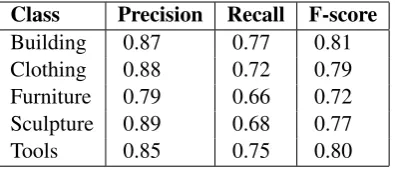
The total amount of the dataset is about 123K records. Each record contains different informa-tion, structured according to the Functional Re-quirements for Authority Data (Patton,2009). An evaluation of the results produced by our approach is given in Table 2. Our method is evaluated by means of Precision, Recall and F-score results in the extraction of the main entity classes, i.e. Build-ing, ClothBuild-ing, Furniture, Sculpture, and Tools. For this evaluation we consider some of the higher classes in the taxonomic classification of ICCD. This choice is justified by the compositional struc-tures of ALUs, which are comparable for the sub-classes related to the same main class. Anyway, the ontological tags used to classify them are fine-grained, so a distinction between these categories is performed any time. As we can notice, the val-ues present a variability with reference to the dif-ferent categories. Generally speaking, the cause of mismatching results can be retrieved in the use of too broad terms, which determines ambiguity hard to solve, i.e.,bitronconico, that can be referred to an askos, belonging to the class of Tools, or to a kind of necklace, an element in the class of Cloth-ing. Furthermore, another source of mismatching is related to the presence of references to the in-ventory number, or other information related to the ICCD classification, merged in the definition field, e.g., description of materials used.
2Classes refer to Italian Lexicon-Grammar Tables,
avail-able at http://dsc.unisa.it/composti/tavole/combo/tavole.asp.
[image:4.595.108.255.61.134.2]Class Precision Recall F-score
Building 0.87 0.77 0.81
Clothing 0.88 0.72 0.79
Furniture 0.79 0.66 0.72
Sculpture 0.89 0.68 0.77
[image:5.595.84.282.62.147.2]Tools 0.85 0.75 0.80
Table 2: Evaluation for the main classes.
5 Conclusion and Future Work
In this paper, we have presented our preliminary study on an ontology-based strategy to extract and classify compositional nominal compounds in the Cultural Heritage domain for Italian. This FSA-based system allows to retrieve a very large amount of expressions and ALUs among those present in the analysed corpus. The highly pro-ductive formal structures are the following ones:
• Noun(Head) + Preposition + Noun + Prepo-sition +Noun, i.e., fibula ad arco a coste
(ribbed-arch fibula), in which the fixed com-ponent is represented byfibula(fibula);
• Noun(Head) + Preposition + Noun + Adjec-tive, i.e.,anello a capi ritorti(twisted-heads ring), the head is represented byanello(ring);
• Noun(Head)+ Preposition + Noun + Adjec-tive + AdjecAdjec-tive, i.e., punta a foglia larga ovale(oval broadleaf point).
The main hypothesis, leading the development of our system, is that the precision and the recall of extraction and classification systems for composi-tional compounds can be improved by represent-ing lrepresent-inguistic and semantic features in a more con-sistent way. We consider the average results quite satisfying, nevertheless we are already planning to enrich our research outcomes with many other im-provements in order to solve ambiguity and clas-sification issues.
Acknowledgments
This work has been funded by the Unity Through Knowledge Fund of the Croatian Science Foun-dation, under the grant 19/15: EVEnt Retrieval Based on semantically Enriched Structures for In-teractive user Tasks (EVERBEST).
References
Ferdinand De Saussure. 1989. Cours de linguistique
g´en´erale: ´Edition critique, volume 1. Otto Harras-sowitz Verlag.
Maria Pia di Buono, Mario Monteleone, and Annibale Elia. 2014. Terminology and knowledge representa-tion. italian linguistic resources for the
archaeologi-cal domain. InWorkshop on Lexical and
Grammat-ical Resources for Language Processing. page 24. Maria Pia di Buono, Mario Monteleone,
Feder-ica Marano, and Johanna Monti. 2013. Knowl-edge management and cultural heritage reposito-ries: Cross-lingual information retrieval strategies. InDigital Heritage International Congress (Digital-Heritage), 2013. IEEE, volume 2, pages 295–302. Martin Doerr. 2003. The cidoc conceptual reference
module: an ontological approach to semantic inter-operability of metadata. AI magazine24(3):75. Annibale Elia, Maurizio Martinelli, and Emilio
D’Agostino. 1981. Lessico e strutture
sintat-tiche: introduzione alla sintassi del verbo italiano. Liguori.
Maurice Gross. 1975. M´ethodes en syntaxe. Hermann.
Maurice Gross. 1984. Lexicon-grammar and the
syn-tactic analysis of french. In Proceedings of the
10th International Conference on Computational Linguistics and 22nd annual meeting on Associa-tion for ComputaAssocia-tional Linguistics. Association for Computational Linguistics, pages 275–282.
Maurice Gross. 1986. Lexicon-grammar: the
represen-tation of compound words. In Proceedings of the
11th coference on Computational linguistics. Asso-ciation for Computational Linguistics, pages 1–6. Zellig S. Harris. 1946. From morpheme to utterance.
Language22(3):161–183.
Zellig S. Harris and Maurice Gross. 1976. Notes de
Cours de Syntaxe: Traduit de l’anglais par Maurice Gross. Seuil.
Diana McCarthy, Bill Keller, and John Carroll. 2003. Detecting a continuum of compositionality
in phrasal verbs. InProceedings of the ACL 2003
workshop on Multiword expressions: analysis, ac-quisition and treatment-Volume 18. Association for Computational Linguistics, pages 73–80.
Tomas Mikolov, Ilya Sutskever, Kai Chen, Greg S Cor-rado, and Jeff Dean. 2013. Distributed representa-tions of words and phrases and their
compositional-ity. InAdvances in neural information processing
systems. pages 3111–3119.
Glenn E. Patton. 2009. Functional requirements for authority data: A conceptual model, volume 34. Walter de Gruyter.
Siva Reddy, Diana McCarthy, and Suresh Manandhar. 2011. An empirical study on compositionality in
compound nouns. InIJCNLP. pages 210–218.
Bahar Salehi, Paul Cook, and Timothy Baldwin. 2014. Using distributional similarity of multi-way transla-tions to predict multiword expression composition-ality. InEACL. pages 472–481.
Max Silberztein. 2008. Nooj v2 manual.
Simona Vietri. 2014. The italian module for nooj. In
Proceedings of the First Italian Conference on Com-putational Linguistics, CLiC-it.
Simona Vietri and Mario Monteleone. 2013. The
en-glish nooj dictionary. InProceedings of NooJ 2013