19
A case study on context-bound referring expression generation
Maurice Langner
Sprachwissenschaftliches Institut Ruhr-Universit¨at Bochum
Abstract
This paper describes and discusses the results of an empirical study on the production of re-ferring expressions in visual fields with differ-ent object configurations of varying complex-ity and different contextual premises for us-ing a referrus-ing expression. The visual fields are set up using data from the TUNA experi-ment with plain random or pragmatically en-riched configurations which allow for target inference. Different categories of the situa-tional contexts, in which the referring expres-sions are produced, provide different degrees of cooperativeness, so that generation quality and its relations to contextual user intention can be observed. The results of the study sug-gest that algorithms for REG must integrate individual generation preference and the co-operativeness of the situational task in order to model the broad variance between speakers more adequately.
1 Introduction
In the past, experiments on the production of re-ferring expressions (REs) produced corpora on domains of different complexity, among those the TUNA corpus (van der Sluis, Gatt, van Deemter, 2006; 2006 online manual), GRE3D3 and GRE3D7 (Viethen & Dale, 2008;2011), ReferIT (Kazemzadeh et al., 2014), Wally (Clarke et al.,2013) and some interlingual experiments re-vealing that the basic concepts of reference are independent from language expertise (e.g. Khan & Siddiqui, 2015). Da Silva Rocha & Paraboni (2018) distinguish two general experimental de-signs in the REG task, related to the speaker-listener configuration: monologue and dialogue. The authors remark that ”both dialogue and mono-logue are of course instances of real language use but, at least from these studies, it is not entirely clear whether the two situations are truly compa-rable” (p.2994). Questionable is still, whether or
not content determination and the resulting gener-ation quality, i.e. underspecificgener-ation, minimality or overgeneration, may differ not only according to the speaker-listener configuration but also ac-cording to the context in which the REG task is situated. This question also includes variance be-tween speakers. The experiment described in this paper builds on its predecessors, focusing on the technical and contextual parameters that may trig-ger differences in generation quality and content determination during production. The goal is to provide empirical data clarifying the influence of the situational context on the generation quality of referring expressions.
2 Methods
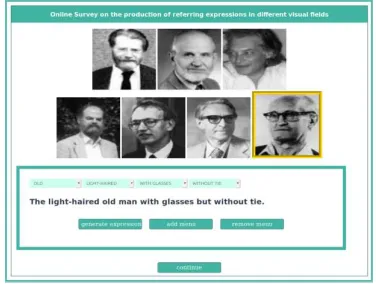
[image:1.595.321.509.577.719.2]The experiment is designed using the TUNA fur-niture corpus and a subset of the TUNA people corpus that has been selected in a balanced way, making each feature value combination unique. It is conducted as a web-based experiment. Data from native speakers of English is collected using the crowdsourcing platform Amazon Mturk. The compiled corpus consists of 1029 production ses-sions from 50 participants.
category context formulation (furniture)
+ You want to buy a very rare and valuable piece of furniture that you have been looking for for a long time. Please describe to the salesman which piece of furniture in his showroom you long for.
− You are talking to friends about the design of your living room. They want to know which piece of furniture you recently sold on the internet. Please tell them.
o You rearrange your living room. Tell your friend
which piece of furniture you want to move to the free space below the windows.
category context formulation (people)
+ You are the victim of a crime. Please describe to the police officer who of the suspects in the inter-rogation room is the criminal.
− You want to buy a car and the sales agent wants to know who of his colleagues in the salesroom gave you advise at your previous visit. Please give a de-scription.
o You work as a waiter. You tell your colleague
[image:2.595.310.521.62.263.2]whom of the guests you still have to bring the bill. Please describe the guest.
Table 1: Situational contexts used in production ses-sions
Production sessions were associated with differ-ent contexts which are represdiffer-entative of differdiffer-ent communicative intents of the dialogue. Contexts are given in table1. Either no contextual text was given and the participants were asked to generate expressions to their liking, or the context type was randomly chosen according to the domain type of the production session.
The contexts marked with + are designed with focus on the speaker’s interest. In these con-texts, the speaker envisages some personal inten-tion for which it is important to convey to the lis-tener which object he/she refers to. Correct iden-tification is important to the speaker. The con-texts marked withOare designed as rather neutral, where correct identification is of equal importance for both speaker and hearer in a collaborative task. The - marker indicates that these contexts focus on the hearer’s interest, implied by the fact that the production task is the answer to the hearer’s question. Correct identification is more important to the hearer than to the speaker.
3 Results
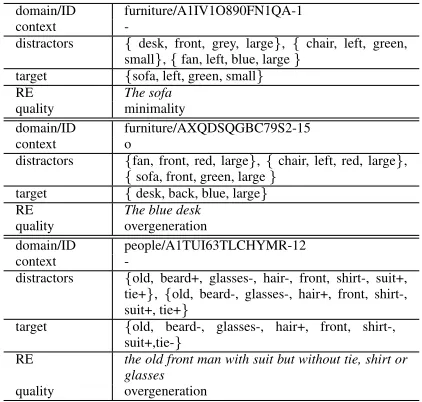
domain/ID furniture/A1IV1O890FN1QA-1 context
-distractors {desk, front, grey, large},{chair, left, green, small},{fan, left, blue, large}
target {sofa, left, green, small}
RE The sofa
quality minimality
domain/ID furniture/AXQDSQGBC79S2-15 context o
distractors {fan, front, red, large},{chair, left, red, large},
{sofa, front, green, large}
target {desk, back, blue, large}
RE The blue desk
quality overgeneration
domain/ID people/A1TUI63TLCHYMR-12 context
-distractors {old, beard+, glasses-, hair-, front, shirt-, suit+, tie+},{old, beard-, glasses-, hair+, front, shirt-, suit+, tie+}
target {old, beard-, glasses-, hair+, front, shirt-, suit+,tie-}
RE the old front man with suit but without tie, shirt or glasses
[image:2.595.76.286.62.251.2]quality overgeneration
Table 2: Examples from the experimental data
The absence of a situational context (NONE condition) results in a nearly equal distribution of overgeneration and minimality (36.3% and 34.2%), while underspecification is slightly lower with a percentage of 29.5% (compare figure2).
In contrast to this, the neutral context marked with O has a significantly higher ratio of min-imal expressions, while overgeneration is close to equal in comparison. Underspecification oc-curs much less frequently (19.8%) than in ses-sions without situational context. The resulting difference between O and NONE is significant (χ2 :5.66; p < 0.05). The + marked context
References
H. Rohde A. D. F. Clarke, M. Elsner. 2013. Wheres wally: the influence of visual salience on referring expression generation. Frontiers in Psychology, 4.
A. Gatt K. van Deemter, I. van der Sluis. 2006a. Build-ing a semantically transparent corpus for the gener-ation of referring expressions. InProceedings of the 4th International Conference on Natural Language Generation, INLG-04, pages 130–132, Sydney, Aus-tralia.
A. Gatt K. van Deemter, I. van der Sluis. 2006b. Man-ual for tuna corpus: Referring expressions in two domains.
A. Gatt K. van Deemter, I. van der Sluis. 2007. Eval-uating algorithms for the generation of referring ex-pressions: Going beyond toy domains. In Proceed-ings of the International Conference on Recent Ad-vances in Natural Language Processing, RANLP-07.
A. Gatt K. van Deemter, I. van der Sluis. 2010. Speaker- dependent variation in content selection for referring expression generation. InProceedings of the 8th Australasian Language Technology Work-shop, pages 81–89.
K. van Deemter. 2016. Computational Models of Re-ferring. MIT Press, Cambridge, UK.
A. Bangerter H. H. Clark. 2004. Changing ideas about reference. In D. Sperber I.Noveck, editor, Experi-mental Pragmatics, pages 25–49. Springer.
M. Siddiqui I. Khan. 2015. Do speakers produce dif-ferent referring expressions in their native language than a non-native language? International Journal of Computational Linguistics Research, 6(2):41–47.
D. da Silva Rocha I. Paraboni. 2018. Reference pro-duction in human-computer interaction: Issues for corpus-based referring expression generation. In
Proceedings of the 11th Language Resources and Evaluation Conference.
M. de Sant’Ana F. Coutinho I. Paraboni, A. Lan. 2017. Effects of cognitive effort on the resolution of over-specified descriptions. Computational Linguistics, 43(2):451–459.
T. C. Ferreira I. Paraboni. 2014. Referring expression generation: Taking speakers’ preferences into ac-count. In I. Kopecek K. Pala P. Spjka, A. Hor´ak, ed-itor,Text, Speech and Dialogue. 17th International Conference, TSD 2014, pages 539–546. Springer In-ternational Publishing, Schweiz.
R. Dale J. Viethen. 2008. Generating relational refer-ences: What makes a difference? InProceedings of the Australasian Language Technology Association Workshop 2008, pages 160–168.
R. Dale J. Viethen. 2011. Gre3d7: A corpus of distin-guishing descriptions for objects in visual scenes. In
Proceedings of the UCNLG+Eval: Language Gen-eration and Evaluation Workshop, pages 12–22.
M. C. Frank N. Goodman. 2016. Pragmatic language interpretation as probabilistic inference. Trends in Cognitive Sciences, 20(11):818–829.
O. Lemon S. Janarthanam. 2010. Adaptive referring expression generation in spoken dialogue systems: Evaluation with real users. In Proceedings of Sig-dial 2010: the 11th Annual Meeting of the special Interest Group on Discourse and Dialogue, pages 124–131.