173
BERT for Question Generation
Ying-Hong Chan
Department of Computer Science National Chung Hsing University
Taichung, Taiwan [email protected]
Yao-Chung Fan
Department of Computer Science National Chung Hsing University
Taichung, Taiwan [email protected]
Abstract
In this study, we investigate the employment of the pre-trained BERT language model to tackle question generation tasks. We introduce two neural architectures built on top of BERT for question generation tasks. The first one is a straightforward BERT employment, which re-veals the defects of directly using BERT for text generation. And, the second one remedies the first one by restructuring the BERT em-ployment into a sequential manner for taking information from previous decoded results. Our models are trained and evaluated on the question-answering dataset SQuAD. Experi-ment results show that our best model yields state-of-the-art performance which advances the BLEU 4 score of existing best models from 16.85 to 21.04.
1 Introduction
Question generation (QG) task, which takes a con-text and an answer as input and generates a ques-tion that targets the given answer, have received tremendous interests in recent years from both in-dustrial and academic communities (Zhao et al.,
2018)(Zhou et al., 2017)(Du et al., 2017). The state-of-the-art models mainly adopt neural ap-proaches by training a neural network based on the sequence-to-sequence framework. So far, the best performing result is reported in (Zhao et al.,
2018), which advances the state-of-the-art results from 13.9 to 16.8 (BLEU 4).
The existing QG models mainly rely on recur-rent neural networks (RNN) augmented by atten-tion mechanisms. However, the inherent sequen-tial nature of the RNN models suffers from the problem of handling long sequences. As a result, the existing QG models (Du et al., 2017)(Zhou et al.,2017) mainly use only sentence-level infor-mation as context. When applied to a paragraph-level context, the existing models show significant
performance degradation. However, as indicated by (Du et al.,2017), providing paragraph-level in-formation can improve QG performance. For han-dling long context, the work (Zhao et al.,2018) in-troduces a maxout pointer mechanism with gated self-attention encoder for processing paragraph-level input. The work reports state-of-the-art per-formance for QG tasks.
Recently, the NLP community has seen excite-ment around neural learning models that make use of pre-trained language models (Devlin et al.,
2018)(Radford et al.,2018). The latest develop-ment is BERT, which has shown significant perfor-mance improvement over various natural language understanding tasks, such as document summa-rization, document classification, etc. In this study, we investigate the employment of the pre-trained BERT language model to tackle question generation tasks. We introduce two neural archi-tectures built on top of BERT for question gen-eration tasks. The first one is a straightforward BERT employment, which reveals the defects of directly using BERT for text generation. As will be shown in the experiment, naive employment of BERT offers poor performance, as, by construc-tion, BERT produces all tokens at a time with-out considering decoding results in previous steps. Thus, we propose a sequential question genera-tion model based on BERT as our second model for taking information from previous decoded re-sults. Our model is simple but effective. We think this is a feature of BERT, as the power of BERT is able to simplify neural architecture design for nat-ural language processing tasks. Our model outper-forms the existing best models (Zhao et al.,2018) and pushes the state-of-the-art result from 16.85 to 21.04 (BLEU 4).
Sec-tion3, we introduce two BERT adaptions for QG tasks. Section 4 provides the performance eval-uation and Section 5 concludes our findings and discuss future works.
2 BERT Overview
The BERT model is built by a stack of multi-layer bidirectional Transformer encoder (Vaswani et al.,
2017). The BERT model has three architecture pa-rameter settings: the number of layers (i.e., trans-former blocks), the hidden size, and the number of self-attention heads in a transformer block. There are two BERT models with different model size released.
• BERTbase: 12 layers, 768 hidden
dimen-sions and 12 attention heads (in transformer) with the total number of 110M parameters.
• BERTlarge: 24 layers, 1024 hidden
dimen-sions and 16 attention heads (in transformer) with the total number of 340M parameters.
For using BERT model, the input is required to be aligned as the BERTs specific input sequence. In general, a special token[CLS] is inserted as the first token for BERT’s input sequence. The fi-nal hidden state of the[CLS] token is designed to be used as a final sequence representation for classification tasks. The input token sequence can be a pack of multiple sentences. To distinguish the information from different sentences, a special token[SEP]is added between the tokens of two consecutive sentences. In addition, a learned em-bedding is added to every token to denote whether it belongs to sentence A or sentence B. For exam-ple, given a sentence pair (si, sj) where si con-tains |si| tokens and sj contains |sj| tokens, the BERT input sequence is formulated as a sequence in the following form:
X= ([CLS], ti,1, ..., ti,|si|,[SEP], tj,1..., tj,|sj|)
[image:2.595.308.526.64.181.2]The input representation of a given token is the sum of three embeddings: the token embeddings, the segmentation embeddings, and the position embeddings. Then the input representation is fed forward into extra layers to perform a fine-tuning procedure. BERT can be employed in three lan-guage modeling tasks: sequence-level classifica-tion, span-level predicclassifica-tion, and token-level predic-tion tasks. The fine-tuning procedure is performed
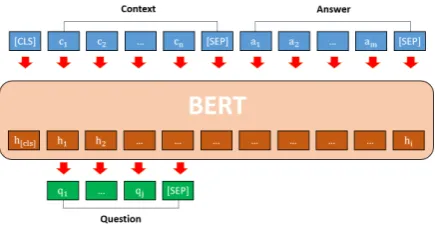
Figure 1: The BERT-QG architecture
in a task-specific manner. The details of our fine-tuning procedure are introduced in the later sub-sections.
3 BERT for Question Generation
3.1 BERT-QG
As an initial attempt, we first adapt the BERT model for QG as follows. First, for a given context paragraphC= [c1, ..., c|C|] and an answer phaseA
= [a1, ..., a|A|], the input sequenceXis aligned as
X= ([CLS], C,[SEP], A,[SEP])
LetBERT()be the BERT model. We first ob-tain the hidden representation H ∈ R|X|×h by
H = BERT(X), where|X|is the length of the input sequence and h is the size of the hidden dimension. Then, H is passed to a dense layer
W ∈ Rh×|V|followed by a softmax function as
follows.
P r(w|xi) =sof tmax(H·W+b),∀xi ∈X
ˆ
qi= argmaxwP r(w|xi)
The softmax is applied along the dimension of the sequence. All the parameters are fine-tuned jointly to maximize the log-probability of the cor-rect tokenqi. The model architecture is illustrated in Figure 1. As shown in the figure, we align a given context paragraph and a given answer as the input sequence and feed the input sequence into the BERT model to generate a sequence of tokens as a generated question.
3.2 BERT-SQG
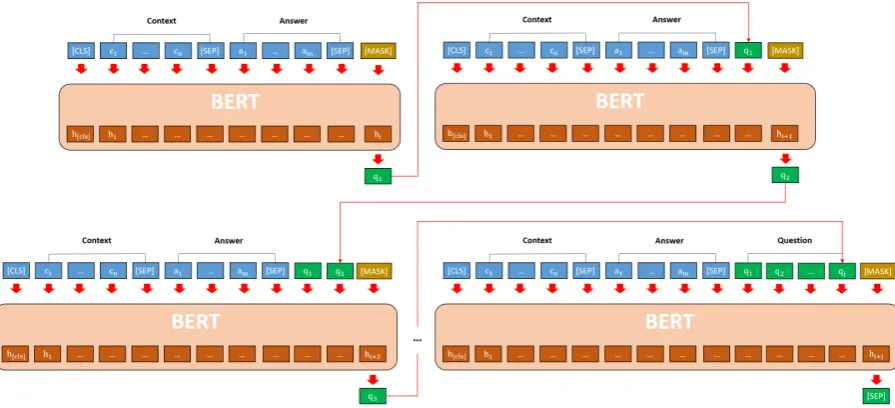
Figure 2: The BERT-SQG architecture
quality of the generated text. However, in BERT-QG, the token generation is performed without previously decoded result information. Due to this consideration, we propose a sequential question generation model based on BERT (called BERT-SQG).
In BERT-SQG, we take into consideration the previous decoded results for decoding a token. We adapt the BERT model for question genera-tion as follows. First, for a given context para-graph C = [c1, ..., c|C|] and an answer phase A
= [a1, ..., a|A|], andQˆ = [ ˆq1, ...,qˆi]the input se-quenceXiis formulated as
Xi=([CLS], C,[SEP], A,[SEP],qˆ1,
...,qˆi,[MASK])
Then, the input sequence Xi is represented by the BERT embedding layers and then travel for-ward into the BERT model. After that, we take the final hidden state of the last token[MASK]in the input sequence. We denote the final hidden vector of[MASK] as h[MASK] ∈ Rh. We adapt BERT model by adding an affine layerWSQG ∈Rh×|V|
to the output of the[MASK]token. We compute the probabilitiesP r(w|Xi) ∈ R|V| by a softmax function as follows.
P r(w|Xi) =sof tmax(h[MASK]·WSQG+bSQG) ˆ
qi= argmaxwP r(w|Xi)
Subsequently, the newly generated token qˆi is appended intoXand the question generation pro-cess is repeated (as illustrated in Figure 2) with
the newX until [SEP]is predicted. We report the generated tokens as the predicted question.
4 Performance Evaluation
4.1 Datasets
The SQuAD dataset contains 536 Wikipedia ar-ticles and around 100K reading comprehension questions (and the corresponding answers) posed about the articles. Answers of the questions are text spans in the articles.
We follow the same data split settings as previ-ous work on the QG tasks (Du et al.,2017)(Zhao et al., 2018) to directly compare the state-of-the-art results on QG tasks. Table1summarizes some statistics for the compared datasets.
• SQuAD 73KIn this set, we follow the same setting as (Du et al., 2017); the accessible parts of the SQuAD training data are ran-domly divided into a training set (80%), a de-velopment set (10%), and a test set (10%). We report results on the 10% test set.
• SQuAD 81KIn this set, we follow the same setting as (Zhao et al., 2018); the accessi-ble SQuAD development data set is divided into a development set (50%), and a test set (50%).
4.2 Implementation Details
We use the PyTorch version of BERT 1 to train our BERT-QG and BERT-SQG models. The
1
Table 1: Dataset statistics: SQuAD 73K is the setting of (Du et al.,2017), and SQuAD 81K is the setting of (Zhao et al.,2018).
Train Test Dev
SQuAD 73K 73240 11877 10570
SQuAD 81K 81577 8964 8964
pre-trained model uses the officially provided
BERTbase model (12 layers, 768 hidden
dimen-sions, and 12 attention heads.) with a vocab of 30522 words. Dropout probability is set to 0.1 be-tween transformer layers. The Adamax optimizer is applied during the training process, with an ini-tial learning rate of 5e-5. The batch size for the update is set at 28. All our models use two TITAN RTX GPUs for 5 epochs training. We use Dev. data for epoch model to make predictions and se-lect the highest accuracy rate as our score evalu-ation model. Also, in our BERT-SQG model, we use the Beam Search strategy for sequence decod-ing. The beam size is set to 3.
4.3 Model Comparison
In this paper, we compare our models with the best performing models (Du et al., 2017)(Zhao et al.,
2018) in the literature. The compared models in the experiment are:
• NQG-RC(Du et al.,2017): A seq2seq ques-tion generaques-tion model based on bidirecques-tional LSTM.
• PLQG (Zhao et al., 2018): A seq2seq net-work which contains a gated self-attention encoder and a maxout pointer decoder to en-able the capability of handling long text in-put. PLQG model is the state-of-the-art mod-els for QG tasks.
4.4 Evaluation Results
Table 2 shows the comparison results using sentence-level context and Table3 shows the re-sults on paragraph level context. We compare the models using standard metric BLEU and ROUGE-L ((Papineni et al.,2002)).
We have the following findings to note about the results. First, as can be observed, BERT-QG of-fers poor performance. In fact, the performance of BERT-QG is far from the results by other mod-els. This result is expected as BERT-QG generates the sentences without considering the previous de-coded results. However, when taking into account
the previous decoded results (BERT-SQG), we ef-fectively utilize the power of BERT and yield the state-of-the-art result compared with the existing RNN variants for QG. As shown in Table2, BERT-SQG outperforms the existing best performing model by 2% on both benchmark datasets.
Second, the results in Table3further show that BERT-SQG successfully processes the paragraph-level contexts and further push the state-of-the-art from 16.85 to 21.04 in terms of BLEU 4 score. Note that NQG-RC and PLQG both use the RNN architecture, and the RNN-based models all suf-fer from the issue of consuming long text input. We see that the BERT model based on transformer blocks effectively addresses the issue of process-ing long text. The results of our BERT-SQG model are consistent in two data set and have achieved the best score at the paragraph level.
5 Conclusion
In this paper, we demonstrate that BERT can be adapted to question generation tasks. We concede that our BERT-SQG model is simple. However, we think this is a feature of BERT, as the power of BERT is able to simplify neural architectures de-sign for specific tasks. While our model is simple, our model achieves state-of-the-art performance at both sentence-level and paragraph-level input and provides strong baselines for future research.
Acknowledgments
This work is supported in part by the Ministry of Science and Technology, Taiwan, under grant No: 107-2221-E-005-064-MY2.
References
Jacob Devlin, Ming-Wei Chang, Kenton Lee, and Kristina Toutanova. 2018. Bert: Pre-training of deep bidirectional transformers for language understand-ing.arXiv preprint arXiv:1810.04805.
Xinya Du, Junru Shao, and Claire Cardie. 2017. Learn-ing to ask: Neural question generation for readLearn-ing comprehension. arXiv preprint arXiv:1705.00106.
Kishore Papineni, Salim Roukos, Todd Ward, and Wei-Jing Zhu. 2002. Bleu: a method for automatic eval-uation of machine translation. In Proceedings of the 40th annual meeting on association for compu-tational linguistics, pages 311–318. Association for Computational Linguistics.
under-Table 2: Comparison between our model and the published methods using sentence level context
Model BLEU 1 BLEU 2 BLEU 3 BLEU 4 METEOR ROUGE-L
NQG-RC 43.09 25.96 17.50 12.28 16.62 39.75 PLQG 43.47 28.23 20.40 15.32 19.29 43.91
SQuAD 73K BERT-QG 34.17 15.52 8.36 4.47 14.78 37.60
BERT-SQG 48.38 33.15 24.75 19.08 22.43 46.94
PLQG 44.51 29.07 21.06 15.82 19.67 44.24
SQuAD 81K BERT-QG 34.18 15.51 8.57 4.97 14.57 37.65
[image:5.595.69.531.83.196.2]BERT-SQG 50.18 35.03 26.60 20.88 23.84 48.37
Table 3: Comparison between our model and the published methods using paragraph level context
Model BLEU 1 BLEU 2 BLEU 3 BLEU 4 METEOR ROUGE-L
NQG-RC 42.54 25.33 16.98 11.86 16.28 39.37 PLQG 45.07 29.58 21.60 16.38 20.25 44.48
SQuAD 73K BERT-QG 37.49 18.32 10.47 6.10 16.80 41.01
BERT-SQG 50.00 34.54 25.98 20.11 23.88 48.12
PLQG 45.69 30.25 22.16 16.85 20.62 44.99
SQuAD 81K BERT-QG 32.61 14.50 7.70 4.08 14.18 37.94
BERT-SQG 50.89 35.49 26.87 21.04 24.25 48.66
standing by generative pre-training. URL https://s3-us-west-2. amazonaws. com/openai-assets/research-covers/languageunsupervised/language under-standing paper. pdf.
Ilya Sutskever, Oriol Vinyals, and Quoc V Le. 2014. Sequence to sequence learning with neural net-works. InAdvances in neural information process-ing systems, pages 3104–3112.
Ashish Vaswani, Noam Shazeer, Niki Parmar, Jakob Uszkoreit, Llion Jones, Aidan N Gomez, Łukasz Kaiser, and Illia Polosukhin. 2017. Attention is all you need. InAdvances in neural information pro-cessing systems, pages 5998–6008.
Yao Zhao, Xiaochuan Ni, Yuanyuan Ding, and Qifa Ke. 2018. Paragraph-level neural question gener-ation with maxout pointer and gated self-attention networks. InProceedings of the 2018 Conference on Empirical Methods in Natural Language Process-ing, pages 3901–3910.
[image:5.595.72.531.227.341.2]