Proceedings of the Fourth Joint Conference on Lexical and Computational Semantics (*SEM 2015), pages 289–298,
A State-of-the-Art Mention-Pair Model for Coreference Resolution
Olga Uryupina1 and Alessandro Moschitti2,1
1Department of Information Engineering and Computer Science, University of Trento, 2Qatar Computing Research Institute
[email protected], [email protected]
Abstract
Most recent studies on coreference resolu-tion advocate accurate yet relatively com-plex models, relying on, for example, entity-mention or graph-based representations. As it has been convincingly demonstrated at the recent CoNLL 2012 shared task, such algo-rithms considerably outperform popular basic approaches, in particular mention-pair mod-els. This study advocates a novel approach that keeps the simplicity of a mention-pair framework, while showing state-of-the-art re-sults. Apart from being very efficient and straightforward to implement, our model fa-cilitates experimental work on the pairwise classifier, in particular on feature engineering. The proposed model achieves the performance level of up to 61.82% (MELA F, v4 scorer) on the CoNLL test data, on par with complex state-of-the-art systems.
1 Introduction
The mention-pair model, as proposed by Soon et al. (2001) has been used for over a decade now. It combines a simple classifier trained to discrimi-nate between coreferent and not-coreferent pairs of mentions (“links”) with fast heuristic procedures for merging the classifier’s decisions at the decoding stage. Several decoding heuristics have been advo-cated in the literature, the most commonly used ones including first-link (Soon et al., 2001) and best-link (Ng and Cardie, 2002).
Most state-of-the-art algorithms for coreference resolution, on the contrary, rely on complex mod-eling, ranging from entity-ranking to structural per-ceptron and other graph-based approaches (for an
overview of state-of-the-art coreference resolvers, see (Ng, 2010; Pradhan et al., 2012)). Such algo-rithms show a clearly superior performance: thus, at the CoNLL-2012 shared task, the best-performing (Soon et al., 2001)-style system loses around 8% to the winning algorithm.
However, more traditional mention-pair ap-proaches still have some important advantages. Thus, a mention-pair model is easy to implement and allows for fast prototyping. It relies on a sim-ple binary classifier making it very fast to train com-pared to state-of-the-art models that are based on complex structural representations (Fernandes et al., 2012; Bj¨orkelund and Kuhn, 2014). This efficiency at the training step allows for straightforward au-tomatic parameter optimization. Most importantly, mention-pair models can be useful for understand-ing low-level system behavior, and, in particular, for feature engineering. This can in turn help improve more complex models, since many of them rely on mention-pairs as their basic building blocks.
In this paper, we advocate a new easy-first mention-pair algorithm (EFMP): while it is based solely on pairs of mentions and does not attempt any global inference, it benefits from the decision propagation strategy to create a coreference parti-tion. Augmented with the sieve-style prefiltering, the system achieves a performance level comparable to the state of the art.
thus propose a procedure for propagating positive and negative links to create the final coreference partition: we start from the most confident among all the classifier’s decisions and iteratively con-struct coreference partitions by merging coreference chains (positive links) or blacklisting future merges (negative links). This decoding strategy is slower than the commonly used best-link model, but con-siderably faster than ILP-based decoding (Finkel and Manning, 2008; Denis and Baldridge, 2009).
Second, we show that our approach, being very fast and easy to implement, can be used for a variety of low-level experiments on coreference resolution, in particular, for studies on feature engineering or selection. Thus, we augment our system with two feature combination techniques, Jaccard Item Min-ing (Segond and Borgelt, 2011) and Entropy Guided Feature Inductions (Fernandes et al., 2012). While the latter has been used for coreference resolution before, Jaccard Item Mining (JIM), to our knowl-edge, has never been applied to any NLP task. The JIM algorithm has been developed within the data mining community and aims at finding combina-tions that tend to occur in a particular set of un-labeled transactions. In this paper, we introduce a post-filtering technique to re-score JIM output w.r.t. the class labels (±coreferent). We show empirically that JIM is more suitable for coreference: it provides smaller and more meaningful feature combinations leading to a better performance level.
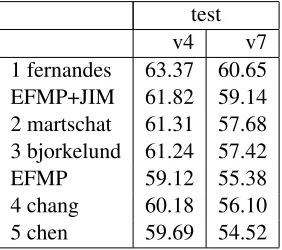
The combination of our decoding approach with the JIM feature induction technique allows us to achieve a performance level of 61.82% on the CoNLL-2012 test data, just 1.5% percent below the (much more complex) winning system and above all the other submissions (cf. Table 4).
2 Related work
An improvement over the original mention-pair model (Soon et al., 2001) has been proposed by Ng and Cardie (2002). Their “best-link” algo-rithm picks the most confident antecedent for each anaphor. Unlike Ng and Cardie (2002), we do not process the input text from left to right incremen-tally, instead, we assess the confidence of all the pro-posed links at the same time (“easy-first”) and keep track of negative assignments.
Our work has been motivated by more complex algorithms using the easy-first strategy, most im-portantly, by Stoyanov and Eisner (2012), Nico-lae and NicoNico-lae (2006) and Bj¨orkelund and Farkas (2012). There are two important differences be-tween these studies and the Easy-First Mention-Pair model (EFMP): (i) EFMP does not evaluate links be-tween entities or clusters, always operating on men-tion pairs instead; (ii) EFMP integrates both positive and negative assignments in its hierarchy of easy-to-hard decisions.
Being conceptually very simple, our algorithm al-lows for a straightforward integration of other tech-niques proposed in the literature, in particular, sieve-style prefiltering (Lee et al., 2011) and feature in-duction. Several recent studies have attempted ex-haustive analysis of features and their impact on the overall performance (Recasens and Hovy, 2009; Uryupina, 2006; Bengtson and Roth, 2008; Dur-rett and Klein, 2013). We refer the reader to (Ng, 2010) for an overview of different features. Kob-dani et al. (2010) create a framework that facilitates the engineering process for complex features. This approach, however, still relies on the human exper-tise for creating meaningful combinations. Versley et al. (2008) use kernel-based similarity as an im-plicit feature induction technique.
The only study we are aware of that investigates an explicit feature combination technique has been conducted by Fernandes et al. (2012). Their al-gorithm for Entropy-based feature induction (EFI), shows substantial improvement on the OntoNotes dataset. In the present work, we propose an al-ternative to EFI, based on the recent advances in Data Mining. We believe that Fernandes et al. (2012) have opened a very important research di-rection with their feature induction approach. We want therefore to evaluate EFI in a simpler and more straightforward mention-pair model—and compare it to our approach.
3 Easy-First Mention-Pair Model
Algorithm 1Easy-first decoding (EFMP)
Require: L ={< anal, antel, labell, confidencel>}: list
of classified mention pairs 1: sortLaccording toconfidence 2: for alll∈Ldo
3: /* don’t override prev. decisions */ 4: ifchain(anal) ==chain(antel)then
5: continue
6: ifunlinked(chain(anal), chain(antel))then
7: continue
8: /* update chains and unlink info */ 9: iflabell==not-coreferentthen
10: unlink(chain(anal), chain(antel))
11: iflabell==coreferentthen
12: UpdateUnlinkInfo({chain(anal), chain(antel))
13: MergeChains({chain(anal), chain(antel))
14: functionUPDATEUNLINKINFO(chain1, chain2) 15: for allcsuch asunlinked(c, chain2)do 16: unlink(c, chain1)
17: functionMERGECHAINS(chain1, chain2) 18: for allm∈chain2do
19: chain(m) =chain1
At the encoding step, we generate mention-pairs in a straightforward exhaustive way: each candidate anaphor is paired with all the preceding candidate antecedents. Following the state-of-the-art, we fil-ter out mention pairs using the same sieve-style ap-proach at both the encoding and the decoding steps (cf. Section 3.2 below).
3.1 Plain EFMP
Our EFMP approach addresses the clustering step of a coreference resolution process: as its input, it as-sumes a set of mention pairs for a given document, labeled as positive (two mentions corefer) or neg-ative (two mentions do not corefer) by an external classifier. We also assume the classifier to output the confidence of its decisions.
The key idea behind EFMP is the processing of all the decisions, both positive and negative ones, in a specific order, according to the classifier’s con-fidence. We start by sorting all the mention pairs by the confidence of the assigned label. We in-stantiate our clustering assigning each mention to its own cluster (“all singletons”), however, we do not prohibit potential links between any of them. Our EFMP module processes all the (sorted) men-tion pairs one-by-one, at each step performing one of the following operations, whenever possible:
• link: merge two clusters (includes propagating unlink information, cf. below)
• unlink: mark two given clusters to prohibit po-tential merge at any future step
These operations, however, are only performed if the system has no information about the possibility of (un)linking the two mentions at the given step.
Let us illustrate the approach with the following example:
(1) [Alice]1 is showing[Zoe]2 [her]3 papers on coreference.
In this snippet, we collect three mentions (“Al-ice” (M1), “Zoe” (M2) and “her” (M3)), form-ing three mention pairs.1 A state-of-the-art
pair-wise coreference classifier would confidently label
< Alice, Zoe >as negative; and less confidently—
< Alice, her > and < Zoe, her > as positive. The score for < Alice, her > would be slightly higher: “Alice” is a subject and a first mention in the sentence. The EFMP module starts from three clusters: C1 = {M1}, C2 = {M2}, C3 = {M3}. At the first step, it registers the information, that
C1 andC2 should never be merged (“unlink”). At the second step, it links M1 and M3, merging C1 and C3, thus producing a partition with two clus-ters: C0
1 = {M1, M3}, C2 = {M2}. It also prop-agates the previously collected unlinking informa-tion, registering the fact thatC0
1andC2should never be merged. At the next step, it tries to linkM2 and
M3. This, however, doesn’t work, since the system has already collected some more reliable evidence that the corresponding clusters shouldn’t be merged. As there are no more mention-pairs left, the system stops and outputs the last partition (C0
1,C2). 3.2 EFMP with Sieves
The plain EFMP approach, as described above, as-sumes that all the mention pairs are labeled by the pairwise classifier. This has several potential issues. First, it requires sorting all the links: when mention-pairs are generated exhaustively, it amounts to the running time of O(n2log(n)), wherenis the total number of mentions. Second, the pairwise classifier has to be trained on a very biased dataset, containing
1We omit other mentions (“her papers” and “coreference”)
too many negative or irrelevant examples; this might decrease the performance and also requires substan-tial tuning of learning parameters.
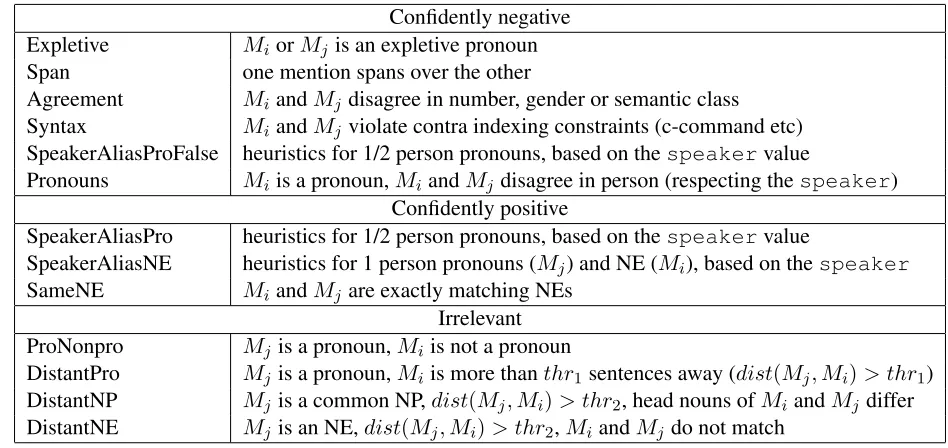
To alleviate the problem, we pre-filter mention pairs aggressively, heuristically eliminating links that are either definitely positive (for example, pairs of same named entities), definitely negative (pairs with incompatible gender values) or “uninforma-tive”. The latter are pairs that we cannot realisti-cally expect to be analyzed by our system, due to the limits of our feature representation. For example, a pair of two noun phrases sharing no common tokens and appearing far apart from each other might be either positive or negative, with the particular deci-sion depending on a lot of factors, starting from the semantic compatibility of the two mentions (“car” and “relativity” can hardly be coreferent), but also including discourse-related factors and some suit-ably represented knowledge of other entities (“car” and “Ferrari” in different parts of a document talking about Formula 1 may refer to different entities). We believe that forcing our pairwise classifier to learn a labeling for such “uninformative” examples with-out providing adequate features might lead to infe-rior performance.
Our pre-filtering approach was inspired by the Stanford sieves algorithm (Lee et al., 2011), where several high-precision rules are applied in a spe-cific order to filter out candidates. This approach has since then been used in several systems, most successfully by Fernandes et al. (2012) to filter out training data for coreference resolution classifiers. The idea of distinguishing between “informative” and “uninformative” instances has been implicitly adopted by many systems, restricting their search to a specific window. This approach is very common for pronominal anaphora, but it’s also used by sev-eral gensev-eral-purpose coreference resolvers (Fernan-des et al., 2012; Stoyanov and Eisner, 2012).
All these rule-based decisions can be integrated into EFMP in a straightforward way. Thus, the un-informative pairs are simply excluded from the fur-ther processing. They do not produce training mate-rial and they are not processed by EFMP at the test time (consequently, mentions from such a pair may end up in the same cluster, as well as in two differ-ent ones, depending on other (un)links established by the system). This allows for a substantial
reduc-tion of the pairs to be processed at the decoding step (for example, in our setting described in Section 5.1 below, around 90% of all the pairs are eliminated as “uninformative”). The pairs, deemed positive or negative by the rule-based pre-filtering, do not con-tribute to the training data. At the test step, they are considered to be very confidently positive/negative instances, outscoring any test pairs, originating from the classifier output. Such pairs do not contribute to speeding up the EFMP part, however, they help im-prove the quality of our pairwise classifier, decreas-ing the bias towards negative instances in the data.
4 Techniques for generating feature combinations
Most state-of-the-art coreference resolution systems combine complex modeling with rich feature sets. While early data-driven approaches were essentially knowledge-poor (for example, the famous system of Soon et al. (2001) is based on 12 shallow features), modern algorithms rely on dozens of carefully engi-neered features, encoding various clues relevant for the task: from different measures of surface similar-ity, to morphological, syntactic, semantic and dis-course properties, and world knowledge.
This study focuses on the automatic feature engi-neering task. We start from atomic features that are already encoded in a state-of-the-art toolkit (BART) and use a data mining technique, Jaccard item min-ing, to boost the system performance through auto-matic induction of complex features.
algo-rithm that is able to overcome these idiosyncrasies and provide meaningful combinations for such a het-erogeneous set of atomic features.
4.1 Jaccard Item Mining
In this study, we adapt the Jaccard Item Mining (JIM) technique (Segond and Borgelt, 2011) to the coreference resolution task. Below we describe the JIM algorithm and our adjustment of JIM to the task of selecting meaningful features.
The Data Mining community has invested sub-stantial efforts into Frequent Item Mining algo-rithms: techniques for finding frequent combina-tions of “items” in a “transaction database”. We as-sume that a database is a set of item sets with some items often appearing together. Several approaches have been proposed to solve the task of enumerat-ing all such frequently occurrenumerat-ing combinations in a fast and efficient way, the most popular ones being Eclat and FP-growth. A typical application would be, for example, the task of finding similarities in shopping lists for different customers. We refer the reader to (Borgelt, 2012) for an overview of relevant approaches.
Frequent Item Mining algorithms output all the combinations with a frequency (“support”) higher than a predefined threshold. If the original items are very heterogeneous, the output might get very noisy: for example, if there are some very frequent items, they will pollute most combinations and the interest-ing item sets will be difficult to find. To overcome this problem, Segond and Borgelt (2011) propose to use the Jaccard index as a measure of the item set quality. For a given set of items I, the Jaccard in-dex JT(I) is defined as a ratio of the set’s support over the number of transactions containing at least one item from the set:
JT(I) = | ∪| ∩i∈IKT({i})| i∈IKT({i})|,
where KT({i}) is a set of transactions, containing the itemi.
It is straightforward to see that JT(I)is an anti-monotone function. Therefore, standard frequent item mining algorithms can be easily adapted to cover the Jaccard index. In our experiments, we use a publicly available JIM implementation.2
2http://www.borgelt.net/jim.html
We recast the feature induction problem as a fre-quent item mining task. We start from atomic fea-tures (string, nominal and binary) and convert them into binary features that represent our items. Since our feature set is very heterogeneous, some items are very rare or, conversely, very frequent. We fil-ter out all the items with the support below or above predefined thresholds. The frequent item mining ap-proaches assume that all the transactions are equal. In our case, however, transactions correspond to training instances—and they come with the class la-bels. Since we are interested in the feature combi-nations that help distinguish between positive and negative examples, we perform two JIM runs, split-ting the training data into the positive and negative parts. For each part, we induce all the combinations with the high Jaccard index (JT+(I)andJT−(I)). Af-ter this step, we have two lists of items, each cor-responding to feature combinations showing a good association strength for positive and negative exam-ples respectively.
Both lists are then reranked, dividing the positive index over the negative one and vice versa:
score+(I) = JT+(I)
J− T(I)
, score−(I) = JT−(I)
J+ T(I)
.
This reranking step helps us to filter out fea-ture combinations that are either redundant or not indicative of coreference. For example, our atomic features already contain some combina-tions (e.g.,NEStringMatch is a combination of
MentionType Coarse andStringED).
With-out the reranking step, we are getting numerous combinations reflecting peculiarities in the feature design. As the final JIM output, we take all the sets
Iwith the scores exceeding some predefined thresh-olds (score+(I) > thr+ orscore−(I) > thr−).
Note that ourscoremeasures are not monotone and cannot therefore be used in a fast Eclat-style al-gorithm (Borgelt, 2012) to directly providescore -optimal combinations.
To better align our approach with the Entropy Guided Feature Induction framework presented be-low, we convert our item sets back to the sets of atomic features, abstracting away from the partic-ular values used for binarization.
thresh-olds (for removing too rare or too common features), the minimal Jaccard index for the JIM algorithm and the thresholds thr+ and thr− for selecting good
item sets after the reranking step. We fit these pa-rameters on the development set.
4.2 Entropy Guided Feature Induction
Fernandes et al. (2012) have proposed using Entropy Guided Feature Induction (EFI) for coreference res-olution and have shown that it significantly improves the performance of their system. Below we provide a brief overview of the EFI approach, referring the reader to the original paper for further details.
The system works at two stages, using two differ-ent machine learning techniques. At thefirst stage, the EFI algorithm relies on a decision tree, generated from the training data, to obtain meaningful feature combinations. In particular, the algorithm extracts all the paths leading from the root of the induced tree to any node. Each node in a tree corresponds to a specific value assigned to some atomic feature and therefore each path corresponds to a conjunction of atomic features with assigned values. Fernandes et al. (2012) abstract over the values, thus, converting each path to a conjunction of atomic features. These conjunctions, or combinations, are then used to gen-erate numerous binary features to be used by a linear classifier at thesecond stage.
Since the induced tree might get very large, the EFI algorithm might lead to conjunctions of too many atomic features, generating, in turn, too many binary features. To address the issue, Fernandes et al. (2012) prune their tree at the depth 5. In our im-plementation, we follow the algorithm of Fernandes et al. (2012) with no adjustments or alterations.
5 Experiments
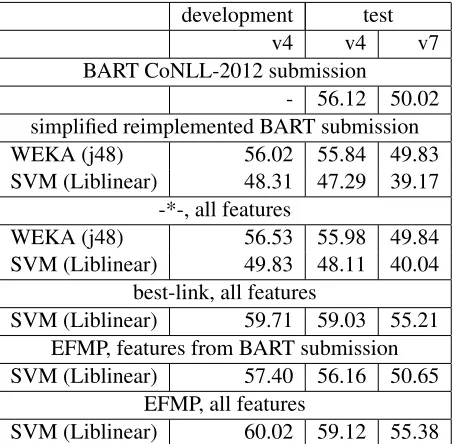
Our first group of experiments assesses the quality of the baseline setting, with no feature combina-tion techniques. We compare against the CoNLL submission of the BART group to make sure that our (Soon et al., 2001)-style mention-pair baseline shows an acceptable performance. We then evalu-ate the EFMP approach to confirm that it provides much higher performance figures and is on par with the state of the art. In our second experiment, we use EFMP to assess the impact of the feature
combina-tion techniques on the performance of a coreference resolution system.
5.1 Experimental Setup
We evaluate our approach on the English portion of the CoNLL-2012 dataset (Pradhan et al., 2012). To asses the system’s performance, we use the official scorer, provided by the CoNLL organizers. How-ever, the version used at the competition time (v4) was later found to contain errors and replaced with another implementation (v7). This procedure re-sulted in a performance drop for all the systems, but didn’t affect their ranking. To facilitate comparison against previous and future studies, we report both v4 and v7 MELA scores. All the experiments are performed on automatically extracted mentions and use no gold information.
For our study, we use the publicly available BART toolkit (Uryupina et al., 2012). We have made several adjustments, starting from the con-figuration, suggested in the BART distribution for the OntoNotes/CoNLL data. Thus, we have mod-ified the mention detection module, improving the treatment of coordinations and eliminating numeric named entities (PERCENT, MONEY etc). We have replaced the originalsplitarchitecture with a single-classifier approach to be able to estimate the impact of our feature combination techniques in a more principled way. We have also re-placed Decision Trees (Weka J48) with the Lib-Linear SVM package, to get a classifier outputting reliable confidence values, as needed by EFMP. We have considerably expanded the feature set, mainly reimplementing features from the winning system of CoNLL-2012 (Fernandes et al., 2012). Altogether, we have around 170 individual fea-tures (string, nominal or binary values), correspond-ing to around 20k features after the binarization step. The full list of our feature templates can be found at http://bart-coref.eu/papers/
sem15-suppl.pdf.
development test
v4 v4 v7
BART CoNLL-2012 submission
- 56.12 50.02 simplified reimplemented BART submission WEKA (j48) 56.02 55.84 49.83 SVM (Liblinear) 48.31 47.29 39.17
-*-, all features
WEKA (j48) 56.53 55.98 49.84 SVM (Liblinear) 49.83 48.11 40.04
best-link, all features
SVM (Liblinear) 59.71 59.03 55.21 EFMP, features from BART submission SVM (Liblinear) 57.40 56.16 50.65
EFMP, all features
[image:7.612.73.300.71.293.2]SVM (Liblinear) 60.02 59.12 55.38
Table 2: Baseline performance vs. plain EFMP: MELA score, different versions of the CoNLL scorer.
module, we have started with the original sieves and the version used by Fernandes et al. (2012). We have changed some sieves and introduced several addi-tional filters (cf. Table 1).
5.2 Baselines vs. EFMP
Table 2 shows the performance levels for different baseline algorithms, learners and features on both CoNLL-2012 development and test sets. Note that the development set was used for parameter tuning and does not therefore provide an accurate estima-tion of the system’s performance.
The results suggest that our simplified version of the BART CONLL-2012 system can be considered an adequate starting point: it only shows a very mi-nor performance drop, compared to the original sub-mission (we believe that this drop can be attributed to the simpler no-splitarchitecture that we are adopting in this study). The (Soon et al., 2001)-style mention-pair model, however, suffers from several problems. First of all, its performance is simply not good enough: thus, the winners of the CoNLL-2012 shared task reported a v4 score of 63.37 on the test data. With a v4 score of 55.84, our sys-tem would have achieved the 12th place in the com-petition (out of 15+1). Second, this approach only works with the decision tree-based classifier: with
SVMs, the performance gets much lower. We be-lieve that this can be caused by several factors: (a) decision trees perform some sort of feature combina-tions, whereas Liblinear only relies on a sum of indi-vidual features for its classification and (b) the (Soon et al., 2001)-style model employs different sampling strategies for training and testing data (in fact, test-ing instance are sampled dynamically, based on the decisions made by the classifier so far), leading to a misfit between the two sets that is more problematic for Liblinear. Third, even with the decision trees, the system performance does not improve substan-tially when we add a lot of manually engineered high-quality features.
The EFMP model, on the contrary, shows promis-ing performance figures. With an F-score of 59.12, the system would have achieved the 8th place in the CoNLL-2012 competition, within the cluster of very similarly performing systems on places 2–8(9). It must be stressed that EFMP is a very simple and fast algorithm, much less complex than any of the high-performing CoNLL systems.
We have also evaluated EFMP against a mention-pair model with the same sieve-style prefiltering and a best-link decoder (Table 2, row 6). As the results suggest, the best-link decoder shows a better perfor-mance level compared to (Soon et al., 2001), since it relies on the most confident positive links. The EFMP decoder, however, brings a further improve-ment, by incorporating and propagating information on confident negative links as well.
5.3 Feature combinations
Confidently negative Expletive MiorMjis an expletive pronoun Span one mention spans over the other
Agreement MiandMjdisagree in number, gender or semantic class Syntax MiandMjviolate contra indexing constraints (c-command etc) SpeakerAliasProFalse heuristics for 1/2 person pronouns, based on thespeakervalue
Pronouns Miis a pronoun,MiandMjdisagree in person (respecting thespeaker) Confidently positive
SpeakerAliasPro heuristics for 1/2 person pronouns, based on thespeakervalue
SpeakerAliasNE heuristics for 1 person pronouns (Mj) and NE (Mi), based on thespeaker SameNE MiandMjare exactly matching NEs
Irrelevant ProNonpro Mjis a pronoun,Mi is not a pronoun
[image:8.612.66.540.70.294.2]DistantPro Mjis a pronoun,Mi is more thanthr1sentences away (dist(Mj, Mi)> thr1) DistantNP Mjis a common NP,dist(Mj, Mi)> thr2, head nouns ofMiandMj differ DistantNE Mjis an NE,dist(Mj, Mi)> thr2,MiandMjdo not match
Table 1: Sieves for pre-filtering of mention pairs: each sieve is applied to a pair of mentions{Mi, Mj}, i < j, where
Miis a candidate antecedent andMjis a candidate anaphor.
EFI and JIM use very different intuitions for com-bining atomic features. It is therefore not surprising, that the outputs of these two algorithms are different. Figure 1 summarizes the distribution of EFI vs. JIM-induced combinations of different lengths, normal-ized by the total number of combinations extracted by each method. EFI outputs around 20 times more sets than JIM (2k vs. 90). Most of them, however, are too long and do not provide good features. By definition, EFI cannot produce a lot of short combi-nations, since all the EFI paths must start from the root. JIM, on the contrary, tends to produce com-binations of smaller lengths that are more likely to yield high-quality features.
Table 3 shows the performance of EFMP, aug-mented with EFI or JIM-induced features. We see that both techniques bring an improvement over the plain EFMP (significant, per-document t-test, p <
0.05). Even though JIM produces much fewer com-binations, it still outperforms EFI (p <0.05).
5.4 EFMP and State of the art
Table 4 compares the performance level of the EFMP approach, plain and enhanced with the JIM-based feature induction module, against the top 5 CoNLL-2012 systems on the CoNLL-2012 test set.
As the results show, the EFMP approach achieves
Figure 1: Normalized combination length for JIM and EFI: number of induced sets of size 1..9, 10+ divided by the total number of induced sets
[image:8.612.320.534.348.478.2]development test
v4 v4 v7
[image:9.612.98.274.70.156.2]EFMP, all features, SVM none 60.02 59.12 55.38 EFI 61.66 60.75 57.56 JIM 62.53 61.82 59.14
Table 3: Feature combinations, JIM vs. EFI: MELA score, different versions of the CoNLL scorer.
test
v4 v7
1 fernandes 63.37 60.65 EFMP+JIM 61.82 59.14 2 martschat 61.31 57.68 3 bjorkelund 61.24 57.42
EFMP 59.12 55.38
4 chang 60.18 56.10 5 chen 59.69 54.52
Table 4: EFMP and top-5 CoNLL-2012 systems: MELA score, systems ranked by the v7 score on the test set.
and Manning, 2008). While these systems have the same training requirements as EFMP, their decod-ing (ILP with binary variables) is known to be NP-complete. In practice, ILP-based approaches incor-porating any forms of global modeling via transitiv-ity constraints (Denis and Baldridge, 2009; Finkel and Manning, 2008) are known to be particularly slow. Our simple decoding algorithm runs inO(p∗
log(p)), where p is the total number of mention pairs: for the plain EFMP,p = n∗(n−1)/2, for the EFMP with sieves,p=const∗n, wherenis the number of mentions in the document.
6 Conclusion
In this study, we advocate an easy-first mention-pair model (EFMP). This approach combines the sim-plicity of mention-pair models with the high perfor-mance level of state-of-the-art systems. We believe that several research lines are open in the field of coreference resolution, ours being simple and allow-ing to focus more on low-level lallow-inguistic phenom-ena. Nevertheless, the approach shows a high per-formance level, despite the lack of any global infer-ence (augmented with a feature induction module,
our system would have achieved the second place at the CoNLL-2012 shared task, outperforming more complex algorithms). This suggests that there is still a lot of potential improvement that can be achieved within more complex frameworks, e.g., structural approaches that attempt at modeling links interde-pendence explicitly. One of our directions for future work involves comparing EFMP against other algo-rithms effectively combining positive and negative links, in particular, ILP-based approaches.
The proposed EFMP model allows for a straight-forward investigation of possibilities for automatic feature induction. We have adapted the Jaccard Item Mining algorithm (JIM) to our task and compared its output against the Entropy-based Feature Induc-tion (EFI) methodology proposed in the literature, showing that both techniques yield meaningful fea-ture combinations and improve the system’s perfor-mance. Yet, the JIM approach outputs smaller com-binations, leading to a larger performance increase.
In our future work, we plan to focus further on the feature induction task, following several research di-rections. First, we want to apply automatic feature induction in a multilingual setting. Second, we plan to investigate other feature induction techniques: (i) comparing various similarity measures alternative to the Jaccard index in a JIM-style setting, (ii) trying to run EFI on different samples of the training set to ob-tain different decision trees and (iii) combining JIM and EFI-induced features. Finally, we want to ver-ify our hypothesis that complex features represent meaningful linguistic combinations and as such can be used to enhance the performance level of more complex algorithms. This again would bridge the work on mention-pair and more advanced models.
Acknowledgments
[image:9.612.116.257.205.330.2]References
Eric Bengtson and Dan Roth. 2008. Understanding the value of features for coreference resolution. In Proceedings of the Conference on Empirical Meth-ods in Natural Language Processing, EMNLP ’08, pages 294–303, Stroudsburg, PA, USA. Association for Computational Linguistics.
Anders Bj¨orkelund and Rich´ard Farkas. 2012. Data-driven multilingual coreference resolution using re-solver stacking. InJoint Conference on EMNLP and CoNLL - Shared Task, pages 49–55, Jeju Island, Ko-rea, July. Association for Computational Linguistics. Anders Bj¨orkelund and Jonas Kuhn. 2014. Learning
structured perceptrons for coreference resolution with latent antecedents and non-local features. In Proceed-ings of the 52nd Annual Meeting of the Association for Computational Linguistics (Volume 1: Long Papers), pages 47–57, Baltimore, Maryland, June. Association for Computational Linguistics.
Christian Borgelt. 2012. Frequent item set mining.Wiley Interdisciplinary Reviews: Data Mining and Knowl-edge Discovery, 2(6):437–456.
Pascal Denis and Jason Baldridge. 2009. Global joint models for coreference resolution and named entity classification. InProcesamiento del Lenguaje Natural 42, Barcelona: SEPLN.
Greg Durrett and Dan Klein. 2013. Easy victories and uphill battles in coreference resolution. In Proceed-ings of the 2013 Conference on Empirical Methods in Natural Language Processing, pages 1971–1982. Eraldo Rezende Fernandes, C´ıcero Nogueira dos Santos,
and Ruy Luiz Milidi´u. 2012. Latent structure per-ceptron with feature induction for unrestricted coref-erence resolution. In Joint Conference on EMNLP and CoNLL - Shared Task, CoNLL ’12, pages 41–48, Stroudsburg, PA, USA. Association for Computational Linguistics.
Jenny Rose Finkel and Christopher D. Manning. 2008. Enforcing transitivity in coreference resolution. In Proceedings of the Annual Meeting of the Association for Computational Linguistics, pages 45–48.
Hamidreza Kobdani, Hinrich Sch¨utze, Andre Burkovski, Wiltrud Kessler, and Gunther Heidemann. 2010. Re-lational feature engineering of natural language pro-cessing. InProceedings of the 19th ACM Conference on Information and Knowledge Management (CIKM), pages 1705–1708.
Heeyoung Lee, Yves Peirsman, Angel Chang, Nathanael Chambers, Mihai Surdeanu, and Dan Jurafsky. 2011. Stanford’s multi-pass sieve coreference resolution sys-tem at the CoNLL-2011 shared task. InProceedings of the Fifteenth Conference on Computational Natu-ral Language Learning: Shared Task, CONLL Shared
Task ’11, pages 28–34, Stroudsburg, PA, USA. Asso-ciation for Computational Linguistics.
Vincent Ng and Claire Cardie. 2002. Improving machine learning approaches to coreference resolution. In Pro-ceedings of the 40th Annual Meeting of the Association for Computational Linguistics, pages 104–111. Vincent Ng. 2010. Supervised noun phrase coreference
research: The first fifteen years. InProceedings of the 48th Annual Meeting of the Association for Computa-tional Linguistics, pages 1396–1411.
Cristina Nicolae and Gabriel Nicolae. 2006. Bestcut: A graph algorithm for coreference resolution. In Pro-ceedings of the 2006 Conference on Empirical Meth-ods in Natural Language Processing, EMNLP ’06, pages 275–283, Stroudsburg, PA, USA. Association for Computational Linguistics.
Sameer Pradhan, Alessandro Moschitti, Nianwen Xue, Olga Uryupina, and Yuchen Zhang. 2012. CoNLL-2012 shared task: Modeling multilingual unrestricted coreference in OntoNotes. In Proceedings of the Sixteenth Conference on Computational Natural Lan-guage Learning (CoNLL’12), Jeju, Korea.
Marta Recasens and Eduard Hovy. 2009. A deeper look into features for coreference resolution. InAnaphora Processing and Applications (DAARC 2009).
Marc Segond and Christian Borgelt. 2011. Item set min-ing based on cover similarity. In Proceedings of the 15th Pacific-Asia Conference on Knowledge Discov-ery and Data Mining (PAKDD 2011).
Wee Meng Soon, Hwee Tou Ng, and Daniel Chung Yong Lim. 2001. A machine learning approach to corefer-ence resolution of noun phrases. Computational Lin-guistic, 27(4):521–544.
Veselin Stoyanov and Jason Eisner. 2012. Easy-first coreference resolution. InProceedings of the 24th In-ternational Conference on Computational Linguistics (COLING), pages 2519–2534.
Olga Uryupina, Alessandro Moschitti, and Massimo Poe-sio. 2012. BART goes multilingual: The UniTN / Es-sex submission to the CoNLL-2012 Shared Task. In Proceedings of the Sixteenth Conference on Computa-tional Natural Language Learning (CoNLL’12). Olga Uryupina. 2006. Coreference resolution with
and without linguistic knowledge. InProceedings of the Language Resources and Evaluation Conference (LREC’06).