Unsupervised Text Segmentation Using
Semantic Relatedness Graphs
Goran Glavaˇs, Federico Nanni, Simone Paolo Ponzetto Data and Web Science Group
University of Mannheim
B6 26, DE-68161 Mannheim, Germany
{goran,federico,simone}@.informatik.uni-mannheim.de
Abstract
Segmenting text into semantically coher-ent fragmcoher-ents improves readability of text and facilitates tasks like text summariza-tion and passage retrieval. In this pa-per, we present a novel unsupervised al-gorithm for linear text segmentation (TS) that exploits word embeddings and a mea-sure of semantic relatedness of short texts to construct asemantic relatedness graph of the document. Semantically coherent segments are then derived from maximal cliques of the relatedness graph. The al-gorithm performs competitively on a stan-dard synthetic dataset and outperforms the best-performing method on a real-world (i.e., non-artificial) dataset of political man-ifestos.
1 Introduction
Despite the fact that in mainstream natural lan-guage processing (NLP) and information retrieval (IR) texts are modeled as bags of unordered words, texts are sequences of semantically coherent seg-ments, designed (often very thoughtfully) to ease readability and understanding of the ideas con-veyed by the authors. Although authors may explic-itly define coherent segments (e.g., as paragraphs), many texts, especially on the web, lack any explicit segmentation.
Linear text segmentation aims to represent texts as sequences of semantically coherent segments. Besides improving readability and understandabil-ity of texts for readers, automated text segmenta-tion is beneficial for NLP and IR tasks such as text summarization (Angheluta et al., 2002; Dias et al., 2007) and passage retrieval (Huang et al., 2003; Dias et al., 2007). Whereas early approaches to unsupervised text segmentation measured the
co-herence of segments via raw term overlaps between sentences (Hearst, 1997; Choi, 2000), more recent methods (Misra et al., 2009; Riedl and Biemann, 2012) addressed the issue of sparsity of term-based representations by replacing term-vectors with vec-tors of latent topics.
A topical representation of text is, however, merely a vague approximation of its meaning. Con-sidering that the goal of TS is to identify seman-ticallycoherent segments, we propose a TS algo-rithm aiming to directly capture the semantic re-latedness between segments, instead of approxi-mating it via topical similarity. We employ word embeddings (Mikolov et al., 2013) and a measure of semantic relatedness of short texts (ˇSari´c et al., 2012) to construct a relatedness graph of the text in which nodes denote sentences and edges are added between semantically related sentences. We then derive segments using the maximal cliques of such similarity graphs.
The proposed algorithm displays competitive performance on the artifically-generated bench-mark TS dataset (Choi, 2000) and, more im-portantly, outperforms the best-performing topic modeling-based TS method on a real-world dataset of political manifestos.
2 Related Work
Automated text segmentation received a lot of at-tention in NLP and IR communities due to its use-fulness for text summarization and text indexing. Text segmentation can be performed in two differ-ent ways, namely (1) with the goal of obtaining linear segmentations (i.e. detecting the sequence of different segments in a text) , or (2) in order to obtain hierarchical segmentations (i.e. defining a structure of subtopics between the detected seg-ments). Like the majority of TS methods (Hearst, 1994; Brants et al., 2002; Misra et al., 2009; Riedl
and Biemann, 2012), in this work we focus on lin-ear segmentation of text, but there is also a solid body of work on hierarchical TS, where each top-level segment is further broken down (Yaari, 1997; Eisenstein, 2009).
Hearst (1994) introduced TextTiling, one of the first unsupervised algorithms for linear text seg-mentation. She exploits the fact that words tend to be repeated in coherent segments and measures the similarity between paragraphs by comparing their sparse term-vectors. Choi (2000) introduced the probabilistic algorithm using matrix-based ranking and clustering to determine similarities between segments. Galley et al. (2003) combined content-based information with acoustic cues in order to detect discourse shifts whereas Utiyama and Isa-hara (2001) and Fragkou et al. (2004) minimized different segmentation cost functions with dynamic programming.
The first segmentation approach based on topic modeling (Brants et al., 2002) employed the proba-bilistic latent semantic analysis (pLSA) to derive latent representations of segments and determined the segmentation based on similarities of segments’ latent vectors. More recent models (Misra et al., 2009; Riedl and Biemann, 2012) employed the la-tent Dirichlet allocation (LDA) (Blei et al., 2003) to compute the latent topics and displayed supe-rior performance to previous models on standard synthetic datasets (Choi, 2000; Galley et al., 2003). Misra et al. (2009) used dynamic programming to find globally optimal segmentation over the set of LDA-based segment representations, whereas Riedl and Biemann (2012) introduced TopicTiling, an LDA-driven extension of Hearst’s TextTiling al-gorithm where segments are, represented as dense vectors of dominant topics of terms they contain (instead of as sparse term vectors). Riedl and Bie-mann (2012) show that TopicTiling outperforms at-that-time state-of-the-art methods for unsuper-vised linear segmentation (Choi, 2000; Utiyama and Isahara, 2001; Galley et al., 2003; Fragkou et al., 2004; Misra et al., 2009) and that it is also faster than other LDA-based methods (Misra et al., 2009).
In the most closely related work to ours, Malioutov and Barzilay (2006) proposed a graph-based TS approach in which they first construct the fully connected graph of sentences, with edges weighted via the cosine similarity between bag-of-words sentence vectors, and then run the
mini-mum normalized multiway cut algorithm to obtain the segments. Similarly, Ferret (2007) builds the similarity graph, only between words instead of between sentences, using sparse co-occurrence vec-tors as semantic representations for words. He then identifies topics by clustering the word similarity graph via the Shared Nearest Neighbor algorithm (Ert¨oz et al., 2004). Unlike these works, we use the dense semantic representations of words and sen-tences (i.e., embeddings), which have been shown to outperform sparse semantic vectors on a range of NLP tasks. Also, instead of looking for mini-mal cuts in the relatedness graph, we exploit the maximal cliques of the relatedness graph between sentences to obtain the topic segments.
3 Text Segmentation Algorithm
Our TS algorithm, dubbed GRAPHSEG, builds a
semantic relatedness graphin which nodes denote sentences and edges are created for pairs of seman-tically related sentences. We then determine the coherent segments by finding maximal cliques of the relatedness graph. The novelty of GRAPHSEG is in the fact that it directly exploits the semantics of text instead of approximating the meaning with topicality.
3.1 Semantic Relatedness of Sentences
The measure of semantic relatedness between sen-tences we use is an extension of a salientgreedy lemma alignmentfeature proposed in a supervised model by ˇSari´c et al. (2012). They greedily align content words between sentences by the similar-ity of their distributional vectors and then sum the similarity scores of aligned word pairs. However, such greedily obtained alignment is not necessarily optimal. In contrast, we compute the optimal align-ment by (1) creating a weighted complete bipartite graph between the sets of content words of the two sentences (i.e., each word from one sentence is con-nected with a relatedness edge to all of the words in the other sentence) and (2) running a bipartite graph matching algorithm known as the Hungarian method (Kuhn, 1955) that has the polynomial com-plexity. The similarities of content words between sentences (i.e., the weights of the bipartite graph) are computed as the cosine of the angle between their corresponding embedding vectors (Mikolov et al., 2013).
sentencesS1andS2, i.e.,A= {(w1, w2) |w1 ∈ S1 ∧w2 ∈ S2}. We then compute the semantic relatedness for two given sentencesS1andS2as follows:
sr(S1, S2) =X
(w1,w2)∈A
cos(v1, v2)·min(ic(w1),ic(w2))
whereviis the embedding vector of the word wi
andic(w) is the information content (IC) of the wordw, computed based on the relative frequency ofwin some large corpusC:
ic(w) =−log freq(w) + 1
|C|+Pw0∈Cfreq(w0).
We utilize the IC weighting of embedding similar-ity because we assume that matches between less frequent words (e.g.,guitarandukulele) contribute more to sentence relatedness than pairs of similar but frequent words (e.g.,doandmake). We used Google Books Ngrams (Michel et al., 2011) as a large corpusCfor estimating relative frequencies of words in a language.
Because there will be more aligned pairs be-tween longer sentences, the relatedness score will be larger for longer sentences merely because of their length (regardless of their actual similarity). Thus, we normalize thesr(S1, S2)score first with the length ofS1 and then with the lengthS2 and we finally average these two normalized scores:
rel(S1, S2) = 12·
sr(S1, S2)
|S1| +
sr(S1, S2)
|S2|
.
3.2 Graph-Based Segmentation
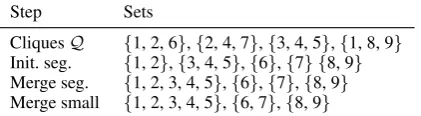
All sentences in a text become nodes of the relat-edness graphG. We then compute the semantic similarity, as described in the previous subsection, between all pairs of sentences in a given document. For each pair of sentences for which the seman-tic relatedness is above some treshold valueτ we add an edge between the corresponding nodes of G. Next, we employ the Bron-Kerbosch algorithm (Bron and Kerbosch, 1973) to compute the setQof all maximal cliques ofG. We then create the initial set of segmentsSG by merging adjacent sentences found in at least one maximal cliqueQ ∈ Qof graphG. Next, we merge the adjacent segments sgi andsgi+1for which there is at least one clique Q∈ Qcontaining at least one sentence fromsgi
and one sentence fromsgi+1. Finally, given the
Step Sets
[image:3.595.313.524.65.123.2]CliquesQ {1, 2, 6},{2, 4, 7},{3, 4, 5},{1, 8, 9} Init. seg. {1, 2},{3, 4, 5},{6},{7} {8, 9} Merge seg. {1, 2, 3, 4, 5},{6},{7},{8, 9} Merge small {1, 2, 3, 4, 5},{6, 7},{8, 9}
Table 1: Creating segments from graph cliques (n = 2). In the third step we merge segments {1, 2, 3} and {4, 5} because the second clique contains sentences 2 (from the left segment) and 4 (from the right segment). In the final step we merge single sentence segments (assuming
segs({1,2,3,4,5},{6}) < segs({6},{7}) and
segs({7},{8,9})<segs({6},{7})).
minimal segment sizen, we merge segmentssgi
with less than nsentences with the semantically more related of the two adjacent segments –sgi−1 orsgi+1. The relatedness between two adjacent
segments (sgr(sgi,sgi+1)) is computed as the aver-age relatedness between their respective sentences:
sgr(SG1,SG2) = |SG 1 1||SG2|
X
S1∈SG1
S2∈SG2
rel(S1, S2).
We exemplify the creation of segments from maxi-mal cliques in Table 1. The complete segmentation algorithm is fleshed out in Algorithm 1.1
4 Evaluation
In this section, we first introduce the two evaluation datasets that we use one being the commonly used synthetic dataset and the other a realistic dataset of politi- cal manifestos. Following, we present the experimental setting and finally describe and discuss the results achieved by our GRAPHSEG algorithm and how it compares to other TS models.
4.1 Datasets
Unsupervised methods for text segmentation have most often been evaluated on synthetic datasets with segments from different sources being con-catenated in artificial documents (Choi, 2000; Gal-ley et al., 2003). Segmenting such artificial texts is easier than segmenting real-world documents. This is why besides on the artificial Choi dataset we also evaluate GRAPHSEGon a real-world dataset of po-litical texts from the Manifesto Project,2,3manually
1We make the GraphSeg tool freely available at the
fol-lowing address:https://[email protected]/ gg42554/graphseg.git
2https://manifestoproject.wzb.eu
3We used the set of six documents manifestos – three
Algorithm 1:Segment(text,τ,n) G←(V ←∅, E ←∅)
S ←sentences(text)
SG ←∅
// constructing the similarity graph
for eachsentenceSi∈ S do
V ←V ∪ {Si}
for eachpair(Si, Sj)|Si, Sj ∈ Sdo ifrel(Si, Sj)> τ do
E←E∪({Si},{Sj})
// creating initial segments from cliques Q ←cliques(G)
for eachcliqueQ∈ Qdo
for each(Si, Sj), Si, Sj ∈Qdo ifj−i= 1do
ifsg(Si) =∅andsg(Sj) =∅do SG ←SG∪ {Si, Sj}
elifsg(Si)6=∅andsg(Sj) =∅do sg(Si)←sg(Si)∪ {Sj}
elifsg(Si) =∅andsg(Sj)6=∅do sg(Sj)←sg(Sj)∪ {Si}
// merging adjacent segments
for eachsegmentsgi ∈SGdo if∃Q∈ Q |(∃Sj, Sk∈Q|
Sj ∈sgi∧Sk∈sgi+1)do
SG←SG\ {sgi,sgi+1}
SG←SG∪(sgi∪sgi+1)
// merging too small segments
for eachsegmentsgi ∈SGdo if|sgi|< ndo
ifsgr(sgi−1,sgi)>sgr(sgi,sgi+1)do SG ←SG\ {sgi−1,sgi}
SG ←SG∪(sgi−1∪sgi) else do
SG ←SG\ {sgi,sgi+1}
SG ←SG∪(sgi∪sgi+1) returnSG
labeled by domain experts with segments of seven different topics (e.g., economy and welfare, quality of life, foreign affairs). The selected manifestos contain between 1000 and 2500 sentences, with segments ranging in length from1to78sentences, which is in sharp contrast to the Choi dataset where all segments are of similar size.
4.2 Experimental Setting
To allow for comparison with previous work, we evaluate GRAPHSEGon four subsets of the Choi dataset, differing in number of sentences the seg-2008, and 2012 U.S. elections
ments contain. For the evaluation on the Choi dataset, the GRAPHSEG algorithm made use of the publicly available word embeddings built from a Google News dataset.4
Both LDA-based models (Misra et al., 2009; Riedl and Biemann, 2012) and GRAPHSEG rely on corpus-derived word representations. Thus, we evaluated on the Manifesto dataset both the domain-adapted and domain-undomain-adapted variants of these methods. The domain-adapted variants of the mod-els used the unlabeled domain corpus – a test set of 466 unlabeled political manifestos – to train the domain-specific word representations. This means that we obtain (1) in-domain topics for the LDA-based TopicTiling model of Riedl and Biemann (2012) and (2) domain-specific embeddings for the GRAPHSEGalgorithm. On the Manifesto dataset we also evaluate a baseline that randomly (50%
chance) starts a new segment at pointsmsentences apart, withmbeing set to half of the average length of gold segments.
We evaluate the performance using two stan-dard TS evaluation metrics –Pk(Beeferman et al.,
1999) and WindowDiff (WD) (Pevzner and Hearst, 2002). Pk is the probability that two randomly
drawn sentences mutually k sentences apart are classified incorrectly – either as belonging to the same segment when they are in different gold seg-ments or as being in different segseg-ments when they are in the same gold segment. Following Riedl and Biemann (2012), we setkto half of the document length divided by the number of gold segments. WindowDiff is a stricter version ofPkas, instead
of only checking if the randomly chosen sentences are in the same predicted segment or not, it com-pares the exact number of segments between the sentences in the predicted segmentation with the number of segments in between the same sentences in the gold standard. Lower scores indicate better performance for both these metrics.
The GRAPHSEGalgorithm has two parameters: (1) the sentence similarity tresholdτ which is used when creating edges of the sentence relatedness graph and (2) the minimal segment sizen, which we utilize to merge adjacent segments that are too small. In all experiments we use grid-search in a folded cross-validation setting to jointly optimize both parameters. In view of comparison with other models, the parameter optimization is justified
be-4https://drive.google.com/file/d/
3-5 6-8 9-11 3-11
Method Pk WD Pk WD Pk WD Pk WD
Choi (2000) 12.0 – 9.0 – 9.0 – 12.0 –
Brants et al. (2002) 7.4 – 8.0 – 6.8 – 10.7 –
Fragkou et al. (2004) 5.5 – 3.0 – 1.3 – 7.0 –
Misra et al. (2009) 23.0 – 15.8 – 14.4 – 16.1 –
GRAPHSEG 5.6 8.7 7.2 9.4 6.6 9.6 7.2 9.0
Misra et al. (2009)* 2.2 – 2.3 – 4.1 – 2.3 –
[image:5.595.130.470.63.176.2]Riedl and Biemann (2012)* 1.2 1.3 0.8 0.9 0.6 0.7 1.0 1.1
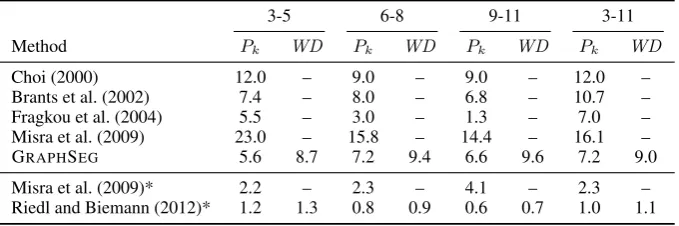
Table 2: Performance on different portions of the Choi dataset (*with domain-adapted topic model).
Method Pk WD
Random baseline 40.60 49.17 Riedl and Biemann (2012) 33.39 38.31
GRAPHSEG 28.09 34.04
Riedl and Biemann (2012)* 32.94 37.59 GRAPHSEG* 28.08 34.00
Table 3: Performance on the Manifesto dataset (*domain-adapted variant).
cause other models, e.g., TopicTiling (Riedl and Biemann, 2012), also have parameters (e.g., num-ber of topics for the topic model) which are opti-mized using cross-validation.
4.3 Results and Discussion
In Table 2 we report the performance of GRAPH -SEGand prominent TS methods on the synthetic Choi dataset. GRAPHSEGperforms competitively, outperforming all methods but (Fragkou et al., 2004) and domain-adapted versions of LDA-based models (Misra et al., 2009; Riedl and Biemann, 2012). However, the approach by (Fragkou et al., 2004) uses the gold standard information – the aver-age gold segment size – as input. On the other hand, the LDA-based models adapt their topic models on parts of the Choi dataset itself. Despite the fact that they use different documents for training the topic models from those used for evaluating segmenta-tion quality, the evaluasegmenta-tion is still tainted because snippets from the original documents appear in multiple artificial documents – some of which be-long to the the training set and others to the test set, as admitted by Riedl and Biemann (2012) and this is why their reported performance on this dataset is overestimated.
In Table 3 we report the results on the Man-ifesto dataset. Results of both TopicTiling and GRAPHSEG indicate that the realistic Manifesto dataset is much more difficult to segment than the artificial Choi dataset. The GRAPHSEGalgorithm
significantly outperforms the TopicTiling method (p <0.05, Student’s t-test). In-domain training of word representations, topics for TopicTiling and word embeddings forGraphSeg, does not signifi-cantly improve the performance for neither of the two models. This result contrasts previous findings (Misra et al., 2009; Riedl and Biemann, 2012) in which the performance boost was credited to the in-domain trained topics and supports our hypothesis that the performance boost of the LDA-based meth-ods’ with in-domain trained topics originates from information leakage between different portions of the synthetic Choi dataset.
5 Conclusion
In this work we presented GRAPHSEG, a novel graph-based algorithm for unsupervised text seg-mentation. GRAPHSEGemploys word embeddings and extends a measure of semantic relatedness to construct a relatedness graph with edges estab-lished between semantically related sentences. The segmentation is then determined by the maximal cliques of the relatedness graph and improved by semantic comparison of adjacent segments.
GRAPHSEGdisplays competitive performance compared to best-performing LDA-based methods on a synthetic dataset. However, we identify and discuss evaluation issues pertaining to LDA-based TS on this dataset. We also performed an evaluation on the real-world dataset of political manifestos and showed that in a realistic setting GRAPHSEG significantly outperforms the state-of-the-art LDA-based TS model.
Acknowledgments
References
Roxana Angheluta, Rik De Busser, and Marie-Francine Moens. 2002. The use of topic segmentation for au-tomatic summarization. InProceedings of the
ACL-2002 Workshop on Automatic Summarization, pages
11–12.
Doug Beeferman, Adam Berger, and John Lafferty. 1999. Statistical models for text segmentation.
Ma-chine learning, 34(1-3):177–210.
David M Blei, Andrew Y Ng, and Michael I Jordan. 2003. Latent dirichlet allocation. the Journal of
ma-chine Learning research, 3:993–1022.
Thorsten Brants, Francine Chen, and Ioannis Tsochan-taridis. 2002. Topic-based document segmentation with probabilistic latent semantic analysis. In
Pro-ceedings of CIKM, pages 211–218. ACM.
Coen Bron and Joep Kerbosch. 1973. Algorithm 457: Finding all cliques of an undirected graph.
Commu-nications of the ACM, 16(9):575–577.
Freddy YY Choi. 2000. Advances in domain inde-pendent linear text segmentation. In Proceedings
of NAACL, pages 26–33. Association for
Computa-tional Linguistics.
Ga¨el Dias, Elsa Alves, and Jos´e Gabriel Pereira Lopes. 2007. Topic segmentation algorithms for text sum-marization and passage retrieval: An exhaustive evaluation. InAAAI, volume 7, pages 1334–1339. Jacob Eisenstein. 2009. Hierarchical text
segmenta-tion from multi-scale lexical cohesion. In
Proceed-ings of HLT-NAACL, pages 353–361. Association
for Computational Linguistics.
Levent Ert¨oz, Michael Steinbach, and Vipin Kumar. 2004. Finding topics in collections of documents: A shared nearest neighbor approach. Clustering and
Information Retrieval, pages 83–103.
Olivier Ferret. 2007. Finding document topics for improving topic segmentation. In ACL, volume 7, pages 480–487. Citeseer.
Pavlina Fragkou, Vassilios Petridis, and Ath Kehagias. 2004. A dynamic programming algorithm for linear text segmentation. Journal of Intelligent
Informa-tion Systems, 23(2):179–197.
Michel Galley, Kathleen McKeown, Eric Fosler-Lussier, and Hongyan Jing. 2003. Discourse seg-mentation of multi-party conversation. In
Proceed-ings of ACL, pages 562–569. Association for
Com-putational Linguistics.
Marti A Hearst. 1994. Multi-paragraph segmentation of expository text. InProceedings of the ACL, pages 9–16. Association for Computational Linguistics. Marti A Hearst. 1997. TextTiling: Segmenting text
into multi-paragraph subtopic passages.
Computa-tional linguistics, 23(1):33–64.
Xiangji Huang, Fuchun Peng, Dale Schuurmans, Nick Cercone, and Stephen E Robertson. 2003. Apply-ing machine learnApply-ing to text segmentation for infor-mation retrieval. Information Retrieval, 6(3-4):333– 362.
Harold W Kuhn. 1955. The hungarian method for the assignment problem. Naval research logistics
quar-terly, 2(1-2):83–97.
Igor Malioutov and Regina Barzilay. 2006. Minimum cut model for spoken lecture segmentation. In
Pro-ceedings of COLING-ACL, pages 25–32.
Associa-tion for ComputaAssocia-tional Linguistics.
Jean-Baptiste Michel, Yuan Kui Shen, Aviva Presser Aiden, Adrian Veres, Matthew K Gray, Joseph P Pickett, Dale Hoiberg, Dan Clancy, Peter Norvig, Jon Orwant, Steven Pinker, Martin A. Nowak, and Aiden Erez Lieberman. 2011. Quantitative analysis of culture using millions of digitized books. Science, 331(6014):176–182.
Tomas Mikolov, Ilya Sutskever, Kai Chen, Greg S Cor-rado, and Jeff Dean. 2013. Distributed representa-tions of words and phrases and their compositional-ity. InProceedings of NIPS, pages 3111–3119. Hemant Misra, Franc¸ois Yvon, Joemon M Jose, and
Olivier Cappe. 2009. Text segmentation via topic modeling: An analytical study. In Proceedings of CIKM, pages 1553–1556. ACM.
Lev Pevzner and Marti A Hearst. 2002. A critique and improvement of an evaluation metric for text segmentation. Computational Linguistics, 28(1):19– 36.
Martin Riedl and Chris Biemann. 2012. TopicTiling: A text segmentation algorithm based on LDA. In
Proceedings of ACL 2012 Student Research Work-shop, pages 37–42. Association for Computational Linguistics.
Frane ˇSari´c, Goran Glavaˇs, Mladen Karan, Jan ˇSnajder, and Bojana Dalbelo Baˇsi´c. 2012. TakeLab: Sys-tems for measuring semantic text similarity. In
Pro-ceedings of SemEval, pages 441–448. Association
for Computational Linguistics.
Masao Utiyama and Hitoshi Isahara. 2001. A statis-tical model for domain-independent text segmenta-tion. InProceedings of ACL, pages 499–506. Asso-ciation for Computational Linguistics.
Yaakov Yaari. 1997. Segmentation of expository texts by hierarchical agglomerative clustering. In