
Neural-based Natural Language Generation in Dialogue
using RNN Encoder-Decoder with Semantic Aggregation
Van-Khanh Tran1,2, Le-Minh Nguyen1,? and Satoshi Tojo1 1Japan Advanced Institute of Science and Technology, JAIST
1-1 Asahidai, Nomi, Ishikawa, 923-1292, Japan
{tvkhanh, nguyenml, tojo}@jaist.ac.jp 2University of Information and Communication Technology, ICTU
Thai Nguyen University, Vietnam [email protected]
Abstract
Natural language generation (NLG) is an important component in spoken dialogue systems. This paper presents a model called Encoder-Aggregator-Decoder which is an extension of an Recurrent Neural Network based Encoder-Decoder architecture. The proposed Semantic Aggregator consists of two components: an Aligner and a Refiner. The Aligner is a conventional attention calculated over the encoded input information, while the Refiner is another attention or gating mechanism stacked over the attentive Aligner in order to further select and aggregate the semantic elements. The proposed model can be jointly trained both text planning and text realization to produce natural language utterances. The model was extensively assessed on four different NLG domains, in which the results showed that the proposed genera-tor consistently outperforms the previous methods on all the NLG domains.
1 Introduction
Natural Language Generation (NLG) plays a crit-ical role in a Spoken Dialogue System (SDS), and its task is to convert a meaning representa-tion produced by the dialogue manager into natu-ral language sentences. Conventional approaches to NLG follow apipelinewhich typically breaks down the task intosentence planningandsurface realization. Sentence planning decides the order and structure of a sentence, followed by a sur-face realizationwhich converts the sentence struc-ture into final utterance. Previous approaches to NLG still rely on extensive hand-tuning templates
?Corresponding author.
and rules that require expert knowledge of lin-guistic representation. There are some common and widely used approaches to solve NLG prob-lems, including rule-based (Cheyer and Guzzoni,
2014), corpus-based n-gram generator (Oh and
Rudnicky, 2000), and a trainable generator (
Rat-naparkhi,2000).
Recurrent Neural Network (RNN)-based ap-proaches have recently shown promising results in NLG tasks. The RNN-based models have been used for NLG as a joint training model (Wen et al.,
2015a,b) and an end-to-end training network (Wen
et al., 2016c). A recurring problem in such
sys-tems requiring annotated corpora for specific dia-logue acts∗ (DAs). More recently, the attention-based RNN Encoder-Decoder (AREncDec) ap-proaches (Bahdanau et al., 2014) have been ex-plored to tackle the NLG problems (Wen et al.,
2016b; Mei et al., 2015; Duˇsek and Jurˇc´ıˇcek,
2016b,a). The AREncDEc-based models have
also shown improved results on various tasks,e.g., image captioning (Xu et al., 2015; Yang et al.,
2016), machine translation (Luong et al., 2015;
Wu et al.,2016).
To ensure that the generated utterance repre-sents the intended meaning of the given DA, the previous RNN-based models were conditioned on a 1-hot vector representation of the DA.Wen et al.
(2015a) proposed a Long Short-Term
Memory-based (HLSTM) model which introduced a heuris-tic gate to guarantee that the slot-value pairs were accurately captured during generation. Subse-quently, Wen et al. (2015b) proposed an LSTM-based generator (SC-LSTM) which jointly learned the controlling signal and language model. Wen
et al.(2016b) proposed an AREncDec based
gen-erator (ENCDEC) which applied attention mecha-nism on the slot-value pairs.
∗A combination of an action type and a set of slot-value pairs).E.g.inform(name=’Piperade’; food=’Basque’).
Table 1: Order issue in natural language generation, in which an incorrect generated sentence has
wrong ordered slots.
Input DA Compare(name=Triton 52; ecorating=A+; family=L7; name=Hades 76; ecorating=C; family=L9) INCORRECT TheTriton 52has anA+ eco rating and is in theL9product family, theHades 76is in theL7product
family and has aCeco rating.
CORRECT TheTriton 52is in theL7product family and has anA+eco rating, theHades 76is in theL9product family and has aCeco rating.
Although these RNN-based generators have worked well, however, they still have some draw-backs, and none of these models significantly out-perform the others in solving NLG tasks. While the HLSTM cannot handle cases such as the bi-nary slots (i.e., yes and no) and slots that take don’t carevalue in which these slots cannot be di-rectly delexicalized, the SCLSTM model is lim-ited to generalize to the unseen domain, and the ENCDEC model has difficulty to prevent undesir-able semantic repetitions during generation.
To address the above issues, we propose a new architecture,Encoder-Aggregator-Decoder, an ex-tension of the AREncDec model, in which the pro-posed Aggregator has two main components: (i) an Aligner which computes the attention over the input sequence, and (ii) a Refiner which are an-other attention or gating mechanisms to further select and aggregate the semantic elements. The proposed model can learn from unaligned data by jointly training the sentence planning and surface realization to produce natural language sentences. We conduct comprehensive experiments on four NLG domains and find that the proposed method significantly outperforms the previous methods re-garding BLEU (Papineni et al.,2002) and slot er-ror rate ERR scores (Wen et al.,2015b). We also found that our generator can produce high-quality utterances with correctly ordered than those in the previous methods (see Table 1). To sum up, we make two key contributions in this paper:
• We present a semantic component called Ag-gregatorwhich is easy integrated into exist-ing (attentive) RNN encoder-decoder archi-tecture, resulting in an end-to-end genera-tor that empirically improved performance in comparison with the previous approaches.
• We present several different choices of at-tention and gating mechanisms which can be effectively applied to the proposed semantic Aggregator.
In Section2, we review related works. The pro-posed model is presented in Section3. Section4
describes datasets, experimental setups and eval-uation metrics. The results and analysis are pre-sented in Section5. We conclude with a brief of summary and future work in Section6.
2 Related Work
Conventional approaches to NLG traditionally di-vide the task into a pipeline of sentence planning and surface realization. The conventional methods still rely on the handcrafted rule-based generators or rerankers.Oh and Rudnicky(2000) proposed a class-based n-gram language model (LM) genera-tor which can learn to generate the sentences for a given dialogue act and then select the best sen-tences using a rule-based reranker. Ratnaparkhi
(2000) later addressed some of the limitation of the class-based LMs by proposing a method based on a syntactic dependency tree. A phrase-based generator based on factored LMs was introduced
byMairesse and Young(2014), that can learn from
a semantically aligned corpus.
Recently, RNNs-based approaches have shown promising results in the NLG domain. Vinyals
et al. (2015); Karpathy and Fei-Fei (2015)
ap-plied RNNs in setting of multi-modal to gener-ate caption for images. Zhang and Lapata(2014) also proposed a generator using RNNs to create Chinese poetry. For task-oriented dialogue sys-tems, Wen et al. (2015a) combined two TNN-based models with a CNN reranker to generate required utterances. Wen et al.(2015b) proposed SC-LSTM generator which proposed an additional ”reading” cell to the traditional LSTM cell to learn the gating mechanism and language model jointly. A recurring problem in such systems lacking of sufficient domain-specific annotated corpora.Wen
et al. (2016a) proposed an out-of-domain model
Lexicalization
dialog act 1-hot representation
Inform(name=Piperade; food=Basque) (0, 1, 0, 0, ..., 0, 0, 1, 0, ..., 0, 1, 0, ... )
ENCODER AGRREGATOR
SLOT_NAME serves SLOT_FOOD
</s> </s>
Piperade serves Basque food
[image:3.595.335.497.60.230.2]</s> </s>
Figure 1: Unfold presentation of the RNN-based neural language generator. The encoder part is subject to various designs, while the decoder is an RNN network.
that the model can obtain a satisfactory results with a small amount of in-domain data by fine-tuning the target-domain on the out-of-domain trained model.
More recently, attentional RNN encoder-decoder based models (Bahdanau et al., 2014) have shown improved results in a variety of tasks.
Yang et al.(2016) presented a review network in
solving the image captioning task, which produces a compact thought vector via reviewing all the input information encoded by the encoder. Mei
et al. (2015) proposed attentional RNN
encoder-decoder based model by introducing two lay-ers of attention to model content selection and surface realization. More close to our work,
Wen et al.(2016b) proposed an attentive
encoder-decoder based generator, which applied the atten-tion mechanism over the slot-value pairs. The model indicated a domain scalability when a very limited proportion of training data is available.
3 Recurrent Neural Language Generator The recurrent language generator proposed in this paper is based on a neural net language generator
(Wen et al.,2016b) which consists of three
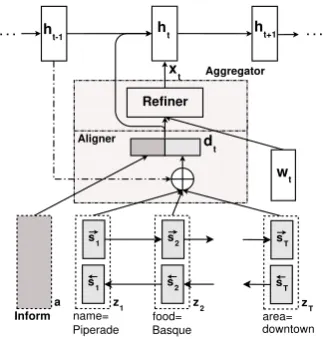
compo-nents: an encoder to incorporate the target mean-ing representation as the model inputs, an aggre-gator to align and control the encoded informa-tion, and a decoder to generate output sentences. The generator architecture is shown in Figure 1. While the decoder typically uses an RNN model, there is a variety of ways to choose the encoder because it depends on the nature of the meaning
Aggregator
Aligner
a Inform
zT z2
s2 s2
sT sT x
t
d
t t+1
h
wt h
t-1
Refiner
h
t
food= Basque
area= downtown
. . . . . .
z1
s1 s1
name= Piperade
Figure 2: The RNN Encoder-Aggregator-Decoder for NLG proposed in this paper. The output side is an RNN network while the input side is a DA embedding with aggregation mechanism. The Ag-gregator consists of two parts: an Aligner and a Refiner. The lower part Aligner is an attention over the DA representation calculated by a Bidi-rectional RNN. Note that the action type embed-dingais not included in the attention mechanism since its task is controlling the style of the sen-tence. The higher part Refiner computes the new input tokenxtbased on the original input tokenwt
and the dialogue act attention dt. There are
sev-eral choices for Refiner,i.e., gating mechanism or attention mechanism.
representation and the interaction between seman-tic elements. The encoder first encodes the input meaning representation, then the aggregator with a feature selecting or an attention-based mechanism is used to aggregate and select the input seman-tic elements. The input to the RNN decoder at each time step is a 1-hot encoding of a token†and the aggregated input vector. The output of RNN decoder represents the probability distribution of the next token given the previous token, the di-alogue act representation, and the current hidden state. At generation time, we can sample from this conditional distribution to obtain the next to-ken in a generated sentence, and feed it as the next input to the RNN decoder. This process finishes when a stop sign is generated (Karpathy and Fei-Fei,2015), or some constraint is reached (Zhang
and Lapata, 2014). The network can generate a
sequence of tokens which can be lexicalized‡ to form the required utterance.
†Input texts are delexicalized in which slot values are re-placed by its corresponding slot tokens.
[image:3.595.101.258.64.229.2]3.1 Gated Recurrent Unit
The encoder and decoder of the proposed model use a Gated Recurrent Unit (GRU) network pro-posed byBahdanau et al.(2014), which maps an input sequenceW= [w1,w2, ..,wT]to a sequence
of statesH= [h1,h2, ..,hT]as follows:
ri=σ(Wrwwi+Wrhhi−1)
ui=σ(Wuwwi+Wuhhi−1) ˜
hi= tanh(Whwwi+riWhhhi−1)
hi=uihi−1+ (1−ui)h˜i
(1)
where: denotes the element-wise multiplica-tion,rianduiare called the reset and update gates
respectively, andh˜i is the candidate activation.
3.2 Encoder
The encoder uses a separate parameterization of the slots and values. It encodes the source in-formation into a distributed vector representation zi which is a concatenation of embedding vector
representation of each slot-value pair, and is com-puted by:
zi=oi⊕vi (2)
where: oi and vi are thei-th slot and value
em-bedding, respectively. Thei index runs over the given slot-value pairs. In this study, we use a Bidi-rectional GRU (Bi-GRU) to encode the sequence of slot-value pairs§embedding. The Bi-GRU con-sists of forward and backward GRUs. The for-ward GRU reads the sequence of slot-value pairs from left-to-right and calculates the forward hid-den states (−→s1, ..,−→sK). The backward GRU reads
the slot-value pairs from right-to-left, resulting in a sequence of backward hidden states (←s−1, ..,←−sK).
We then obtain the sequence of hidden statesS = [s1,s2, ..,sK]wheresiis a sum of the forward
hid-den state−→si and the backward one ←s−i as follows:
si =−→si +←s−i (3)
3.3 Aggregator
The Aggregator consists of two components: an Aligner and a Refiner. The Aligner computes the dialogue act representation while the choices for Refiner can be varied.
§We treat the set of slot-value pairs as a sequence and use the order specified by slot’s name (e.g., slotareacomes first, pricefollowsarea). We have tried treating slot-value pair sequence as natural order as appear in the DA, which even yielded worse results.
Firstly, the Aligner calculates dialogue act em-beddingdtas follows:
dt=a⊕
X
iαt,isi (4)
where: ais vector embedding of the action type,
⊕is vector concatenation, and αt,i is the weight
ofi-th slot-value pair calculated by the attention mechanism:
αt,i= Pexp(et,i) jexp(et,j) et,i=a(si,ht−1)
a(si,ht−1) =v>a tanh(Wasi+Uaht−1)
(5)
where: a(., .) is an alignment model,va,Wa,Ua
are the weight matrices to learn.
Secondly, the Refiner calculates the new input xt based on the original input token wt and the
DA representation. There are several choices to formulate the Refiner such as gating mechanism or attention mechanism. For each input tokenwt,
the selected mechanism module computes the new inputxtbased on the dialog act representationdt
and the input token embeddingwt, and is
formu-lated by:
xt=fR(dt,wt) (6)
where:fRis a refinement function, in which each
input token is refined (or filtered) by the dialogue act attention information before putting into the RNN decoder. By this way, we can represent the whole sentence based on this refined input using RNN model.
Attention Mechanism: Inspired by work of
Cui et al. (2016), in which an
attention-over-attention was introduced in solving reading com-prehension tasks, we place another attention ap-plied for Refiner over the attentive Aligner, result-ing in a model Attentional Refiner over Attention (ARoA).
• ARoA with Vector (ARoA-V): We use a sim-ple attention where each input token repre-sentation is weighted according to dialogue act attention as follows:
βt=σ(V>radt)
fR(dt,wt) =βt∗wt (7)
where: Vra is a refinement attention vector
• ARoA with Matrix (ARoA-M): ARoA-V uses only a vectorVrato weight the DA attention.
It may be better to use a matrix to control the attention information. The Equation7is modified as follows:
Vra=Wawwt βt=σ(V>radt) fR(dt,wt) =βt∗wt
(8)
where:Wawis a refinement attention matrix.
• ARoA with Context (ARoA-C): The atten-tion in ARoA-V and ARoA-M may not cap-ture the relationship between multiple tokens. In order to add context information into the attention process, we modify the attention weights in Equation8with additional history informationht−1:
Vra =Wawwt+Wahht−1
βt=σ(V>radt) fR(dt,wt,ht−1) =βt∗wt
(9)
where: Waw,Wah are parameters to learn,
Vra is the refinement attention vector same
as above, which contains both DA attention and context information.
Gating Mechanism: We use simple element-wise operators (multiplication or addition) to gate the information between the two vectorsdtandwt
as follows:
• Multiplication (GR-MUL): The element-wise multiplication plays a part in word-level matching which learns not only the vec-tor similarity, but also preserve information about the two vectors:
fR(dt,wt) =Wgddtwt (10)
• Addition (GR-ADD):
fR(dt,wt) =Wgddt+wt (11)
3.4 Decoder
The decoder uses a simple GRU model as de-scribed in Section3.1. In this work, we propose to apply the DA representation and the refined inputs deeper into the GRU cell. Firstly, the GRU reset and update gates can be further influenced on the
DA attentive informationdt. The reset and update
gates are modified as follows:
rt=σ(Wrxxt+Wrhht−1+Wrddt)
ut=σ(Wuxxt+Wuhht−1+Wuddt) (12)
where: WrdandWudact like background
detec-tors that learn to control the style of the generating sentence. By this way, the reset and update gates learn not only the long-term dependency but also the attention information from the dialogue act and the previous hidden state. Secondly, the candidate activationh˜tis also modified to depend on the DA
representation as follows:
˜
ht= tanh(Whxxt+rtWhhht−1
+Whddt) + tanh(Wdcdt) (13)
The hidden state is then computed by:
ht=utht−1+ (1−ut)h˜t (14)
Finally, the output distribution is computed by ap-plying a softmax functiong, and the distribution is sampled to obtain the next token,
P(wt+1 |wt, wt−1, ...w0,z) =g(Whoht) wt+1 ∼P(wt+1 |wt, wt−1, ...w0,z) (15)
3.5 Training
The objective function was the negative log-likelihood and simply computed by:
F(θ) =−XT
t=1
y>
t logpt (16)
where: yt is the ground truth word distribution, pt is the predicted word distribution, T is length of the input sequence. The proposed generators were trained by treating each sentence as a mini-batch with l2 regularization added to the
objec-tive function for every 10 training examples. The pre-trained word vectors (Pennington et al.,2014) were used to initialize the model. The generators were optimized by using stochastic gradient de-scent and back propagation through time (Werbos,
1990). To prevent over-fitting, we implemented early stopping using a validation set as suggested
byMikolov(2010).
3.6 Decoding
Table 2: Comparison performance on four datasets in terms of the BLEU and the error rate ERR(%) scores; bold denotes the best anditalic shows the second best model. The results were produced by training each network on 5 random initialization and selected model with the highest validation BLEU score.]denotes the Attention-based Encoder-Decoder model.
[image:6.595.114.484.127.259.2]Model BLEURestaurantERR BLEUHotelERR BLEULaptopERR BLEUTVERR HLSTM 0.7466 0.74% 0.8504 2.67% 0.5134 1.10% 0.5250 2.50% SCLSTM 0.7525 0.38% 0.8482 3.07% 0.5116 0.79% 0.5265 2.31% ENCDEC] 0.7398 2.78% 0.8549 4.69% 0.5108 4.04% 0.5182 3.18% GR-ADD] 0.7742 0.59% 0.8848 1.54% 0.5221 0.54% 0.5348 0.77% GR-MUL] 0.7697 0.47% 0.8854 1.47% 0.5200 1.15% 0.5349 0.65% ARoA-V] 0.7667 0.32% 0.8814 0.97% 0.5195 0.56% 0.5369 0.81% ARoA-M] 0.7755 0.30% 0.8920 1.13% 0.5223 0.50% 0.5394 0.60% ARoA-C] 0.7745 0.45% 0.8878 1.31% 0.5201 0.88% 0.5351 0.63%
Table 3: Comparison performance of variety of the proposed models on four dataset in terms of the BLEU and the error rate ERR(%) scores;bolddenotes the best anditalicshows the second best model. The first two models applied gating mechanism to Refiner component while the last three models used attention over attention mechanism. The results were averaged over 5 randomly initialized networks.
Model BLEURestaurantERR BLEUHotelERR BLEULaptopERR BLEUTVERR GR-ADD 0.7685 0.63% 0.8838 1.67% 0.5194 0.66% 0.5344 0.75% GR-MUL 0.7669 0.61% 0.8836 1.40% 0.5184 1.01% 0.5328 0.73% ARoA-V 0.7673 0.62% 0.8817 1.27% 0.5185 0.73% 0.5336 0.68% ARoA-M 0.7712 0.50% 0.8851 1.14% 0.5201 0.62% 0.5350 0.62% ARoA-C 0.7690 0.70% 0.8835 1.44% 0.5181 0.78% 0.5307 0.64%
DA uses a beam search to generate a set of can-didate responses. In the reranking, the cost of the generator is computed to form the reranking score
Ras follows:
R=−
T
X
t=1
y>t logpt+λERR (17)
where λ is a trade off constant and is set to a large value in order to severely penalize nonsen-sical outputs. The slot error rateERR, which is the number of slots generated that is either redun-dant or missing, and is computed by:
ERR= pN+q (18)
where: N is the total number of slots in DA, and
p,qis the number of missing and redundant slots, respectively. Note that the ERR reranking crite-ria cannot handle arbitrary slot-value pairs such as binaryslots or slots that take thedont carevalue because these slots cannot be delexicalized and matched.
4 Experiments
We conducted an extensive set of experiments to assess the effectiveness of our model using several metrics, datasets, and model architectures, in order to compare to prior methods.
4.1 Datasets
We assessed the proposed models using four dif-ferent NLG domains: finding a restaurant, find-ing a hotel, buyfind-ing a laptop, and buyfind-ing a televi-sion. The Restaurant and Hotel were collected in
(Wen et al.,2015b) which contain around 5K
4.2 Experimental Setups
The generators were implemented using the Ten-sorFlow library (Abadi et al.,2016) and trained by partitioning each of the datasets into training, val-idation and testing set in the ratio 3:1:1. The hid-den layer size was set to be 80 for all cases, and the generators were trained with a70%of dropout rate. We perform 5 runs with different random ini-tialization of the network and the training is termi-nated by using early stopping as described in Sec-tion3.5. We select a model that yields the highest BLEU score on the validation set as shown in Ta-ble2. Since the trained models can differ depend-ing on the initialization, we also report the results which were averaged over 5 randomly initialized networks. Note that, except the results reported in Table2, all the results shown were averaged over 5 randomly initialized networks. The decoder pro-cedure used beam search with a beam width of 10. We set λto 1000 to severely discourage the reranker from selecting utterances which contain either redundant or missing slots. For each DA, we over-generated 20 candidate utterances and se-lected the top 5 realizations after reranking. More-over, in order to better understand the effectiveness of our proposed methods, we (1) trained the mod-els on the Laptop domain with a varied proportion of training data, starting from10%to100% (Fig-ure3), and (2) trained general models by merging all the data from four domains together and tested them in each individual domain (Figure4) .
4.3 Evaluation Metrics and Baselines
The generator performance was assessed by us-ing two objective evaluation metrics: the BLEU score and the slot error rate ERR. Both metrics were computed by adopting code from an open source benchmark NLG toolkit¶. We compared our proposed models against three strong base-lines from the open source benchmark toolkit. The results have been recently published as an NLG benchmarks by the Cambridge Dialogue Systems Group¶, including HLSTM, SCLSTM, andENCDECmodels.
5 Results and Analysis 5.1 Results
We conducted extensive experiments on the pro-posed models with varied setups of Refiner and
¶https://github.com/shawnwun/RNNLG
compared against the previous methods. Overall, the proposed models consistently achieve the bet-ter performances regarding both evaluation met-rics across all domains.
Table 2 shows a comparison between the AREncDecbased models (the models with]
sym-bol) in which the proposed models significantly re-duce the slot error rate across all datasets by a large margin about 2% to 4% that are also improved performances on the BLEU score when compar-ing the proposed models against the previous ap-proaches. Table3further shows the stable strength of our models since the results’ pattern stays un-changed compared to those in Table2. The ARoA-Mmodel shows the best performance over all the four domains, while it is an interesting observa-tion that theGR-ADDmodel with simple addition operator for Refiner obtains the second best per-formance. All these prove the importance of the proposed component Refiner in aggregating and selecting the attentive information.
Figure3 illustrates a comparison of four mod-els (ENCDEC,SCLSTM,ARoA-M, andGR-ADD) which were trained from scratch on the laptop dataset in a variety of proportion of training data, from 10% to 100%. It clearly shows that the BLEU increases while the slot error rate decreases as more training data was provided. Figure 4
presents a comparison performance of general models as described in Section4.2. Not surpris-ingly, the two proposed models still obtain higher the BLEU score, while the ENCDEC has diffi-culties in reducing the ERR score in all cases. Both the proposed models show their ability to generalize in the unseen domains (TV and Lap-top datasets) since they consistently outperform the previous methods no matter how much train-ing data was fed or how traintrain-ing method was used. These indicate the relevant contribution of the proposed component Refiner to the original AREncDec architecture, in which the Refiner with gating or attention mechanism can effectively ag-gregate the information before putting them into the RNN decoder.
Figure 3: Performance comparison of the four models trained on Laptop (unseen) domain.
Figure 4: Performance comparison of the general models on four different domains.
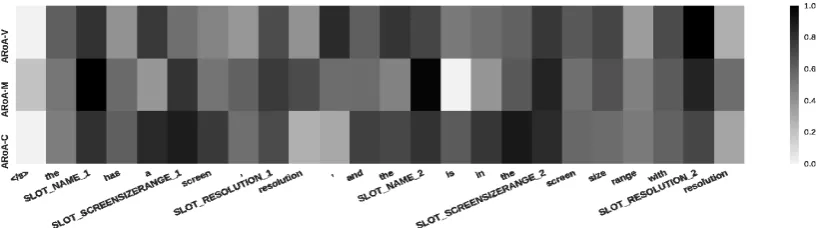
Figure 5: A comparison on attention behavior of three models in a sentence on givenDAwith sequence of slots [Name 1, ScreenSizeRange 1, Resolution 1, Name 2, ScreenSizeRange 2, Resolution 2].
The previous approaches (ENCDEC,HLSTM) still have missing and misplaced information, whereas the proposed models can generate complete and correct-order sentences.
6 Conclusion and Future Work
We present an extension of an Attentional RNN Decoder model named Encoder-Aggregator-Decoder, in which a Refiner compo-nent is introduced to select and aggregate the se-mantic elements produced by the encoder. We also present several different choices of gating and at-tention mechanisms which can be effectively ap-plied to the Refiner. The extension, which is easily integrated into an RNN Encoder-Decoder, shows its ability to refine the inputs and control the flow information before putting them into the RNN de-coder. We evaluated the proposed model on four
domains and compared to the previous generators. The proposed models empirically show consistent improvement over the previous methods in both BLEU and ERR evaluation metrics. In the future, it would be interesting to further investigate hybrid models which integrate gating and attention mech-anisms in order to leverage the advantages of both mechanisms.
Acknowledgements
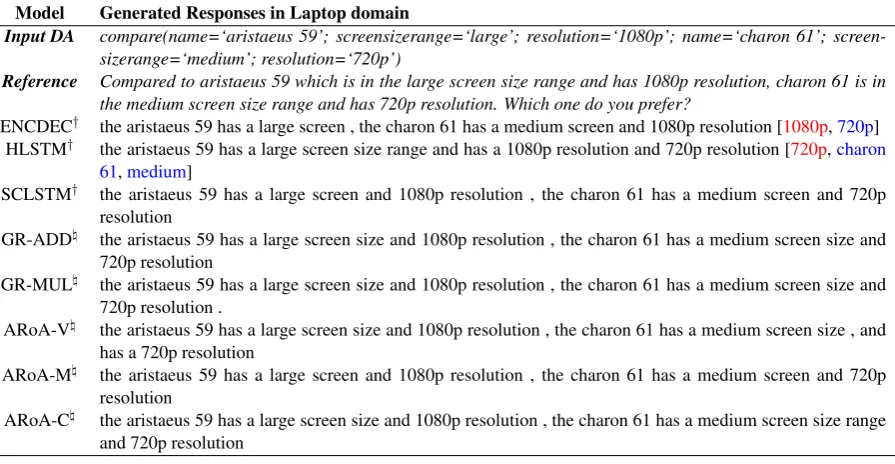
[image:8.595.94.503.345.459.2]Table 4: Comparison of top responses generated for some input dialogue acts between different models. Errors are marked in color (missing, misplaced slot-value pair). †and\ denotes the baselines and the
proposed models, respectively.
Model Generated Responses in Laptop domain
Input DA compare(name=‘aristaeus 59’; screensizerange=‘large’; resolution=‘1080p’; name=‘charon 61’; screen-sizerange=‘medium’; resolution=‘720p’)
Reference Compared to aristaeus 59 which is in the large screen size range and has 1080p resolution, charon 61 is in the medium screen size range and has 720p resolution. Which one do you prefer?
ENCDEC† the aristaeus 59 has a large screen , the charon 61 has a medium screen and 1080p resolution [1080p,720p] HLSTM† the aristaeus 59 has a large screen size range and has a 1080p resolution and 720p resolution [720p,charon
61,medium]
SCLSTM† the aristaeus 59 has a large screen and 1080p resolution , the charon 61 has a medium screen and 720p resolution
GR-ADD\ the aristaeus 59 has a large screen size and 1080p resolution , the charon 61 has a medium screen size and
720p resolution
GR-MUL\ the aristaeus 59 has a large screen size and 1080p resolution , the charon 61 has a medium screen size and
720p resolution .
ARoA-V\ the aristaeus 59 has a large screen size and 1080p resolution , the charon 61 has a medium screen size , and
has a 720p resolution
ARoA-M\ the aristaeus 59 has a large screen and 1080p resolution , the charon 61 has a medium screen and 720p
resolution
ARoA-C\ the aristaeus 59 has a large screen size and 1080p resolution , the charon 61 has a medium screen size range
and 720p resolution
References
Martın Abadi, Ashish Agarwal, Paul Barham, Eugene Brevdo, Zhifeng Chen, Craig Citro, Greg S Corrado, Andy Davis, Jeffrey Dean, Matthieu Devin, et al. 2016. Tensorflow: Large-scale machine learning on heterogeneous distributed systems. arXiv preprint arXiv:1603.04467.
Dzmitry Bahdanau, Kyunghyun Cho, and Yoshua Ben-gio. 2014. Neural machine translation by jointly learning to align and translate. arXiv preprint arXiv:1409.0473.
A. Cheyer and D. Guzzoni. 2014. Method and apparatus for building an intelligent
au-tomated assistant. US Patent 8,677,377.
https://www.google.com/patents/US8677377.
Yiming Cui, Zhipeng Chen, Si Wei, Shijin Wang, Ting Liu, and Guoping Hu. 2016. Attention-over-attention neural networks for reading comprehen-sion.arXiv preprint arXiv:1607.04423.
Ondˇrej Duˇsek and Filip Jurˇc´ıˇcek. 2016a. A context-aware natural language generator for dialogue sys-tems. arXiv preprint arXiv:1608.07076.
Ondˇrej Duˇsek and Filip Jurˇc´ıˇcek. 2016b. Sequence-to-sequence generation for spoken dialogue via deep syntax trees and strings. arXiv preprint arXiv:1606.05491.
Andrej Karpathy and Li Fei-Fei. 2015. Deep visual-semantic alignments for generating image descrip-tions. In Proceedings of the IEEE Conference CVPR. pages 3128–3137.
Minh-Thang Luong, Hieu Pham, and Christopher D Manning. 2015. Effective approaches to attention-based neural machine translation. arXiv preprint arXiv:1508.04025.
Franc¸ois Mairesse and Steve Young. 2014. Stochastic language generation in dialogue using factored lan-guage models. Computational Linguistics.
Hongyuan Mei, Mohit Bansal, and Matthew R Walter. 2015. What to talk about and how? selective gen-eration using lstms with coarse-to-fine alignment.
arXiv preprint arXiv:1509.00838.
Tomas Mikolov. 2010. Recurrent neural network based language model.
Alice H Oh and Alexander I Rudnicky. 2000. Stochas-tic language generation for spoken dialogue sys-tems. In Proceedings of the 2000 ANLP/NAACL Workshop on Conversational systems-Volume 3. As-sociation for Computational Linguistics, pages 27– 32.
Kishore Papineni, Salim Roukos, Todd Ward, and Wei-Jing Zhu. 2002. Bleu: a method for automatic eval-uation of machine translation. InProceedings of the 40th ACL. Association for Computational Linguis-tics, pages 311–318.
Jeffrey Pennington, Richard Socher, and Christopher D Manning. 2014. Glove: Global vectors for word representation. InEMNLP. volume 14, pages 1532– 43.
of the 1st North American Chapter of the Associa-tion for ComputaAssocia-tional Linguistics Conference. As-sociation for Computational Linguistics, Strouds-burg, PA, USA, NAACL 2000, pages 194–201. http://dl.acm.org/citation.cfm?id=974305.974331. Oriol Vinyals, Alexander Toshev, Samy Bengio, and
Dumitru Erhan. 2015. Show and tell: A neural im-age caption generator. In Proceedings of the IEEE Conference on Computer Vision and Pattern Recog-nition. pages 3156–3164.
Tsung-Hsien Wen, Milica Gaˇsi´c, Dongho Kim, Nikola Mrkˇsi´c, Pei-Hao Su, David Vandyke, and Steve Young. 2015a. Stochastic Language Generation in Dialogue using Recurrent Neural Networks with Convolutional Sentence Reranking. InProceedings SIGDIAL. Association for Computational Linguis-tics.
Tsung-Hsien Wen, Milica Gasic, Nikola Mrksic, Lina M Rojas-Barahona, Pei-Hao Su, David Vandyke, and Steve Young. 2016a. Multi-domain neural network language generation for spoken dia-logue systems. arXiv preprint arXiv:1603.01232. Tsung-Hsien Wen, Milica Gaˇsic, Nikola Mrkˇsic,
Lina M Rojas-Barahona, Pei-Hao Su, David Vandyke, and Steve Young. 2016b. Toward multi-domain language generation using recurrent neural networks .
Tsung-Hsien Wen, Milica Gaˇsi´c, Nikola Mrkˇsi´c, Pei-Hao Su, David Vandyke, and Steve Young. 2015b. Semantically conditioned lstm-based natural lan-guage generation for spoken dialogue systems. In
Proceedings of EMNLP. Association for Computa-tional Linguistics.
Tsung-Hsien Wen, David Vandyke, Nikola Mrksic, Milica Gasic, Lina M Rojas-Barahona, Pei-Hao Su, Stefan Ultes, and Steve Young. 2016c. A network-based end-to-end trainable task-oriented dialogue system. arXiv preprint arXiv:1604.04562.
Paul J Werbos. 1990. Backpropagation through time: what it does and how to do it. Proceedings of the IEEE78(10):1550–1560.
Yonghui Wu, Mike Schuster, Zhifeng Chen, Quoc V Le, Mohammad Norouzi, Wolfgang Macherey, Maxim Krikun, Yuan Cao, Qin Gao, Klaus Macherey, et al. 2016. Google’s neural ma-chine translation system: Bridging the gap between human and machine translation. arXiv preprint arXiv:1609.08144.
Kelvin Xu, Jimmy Ba, Ryan Kiros, Kyunghyun Cho, Aaron C Courville, Ruslan Salakhutdinov, Richard S Zemel, and Yoshua Bengio. 2015. Show, attend and tell: Neural image caption generation with visual at-tention. InICML. volume 14, pages 77–81.
Zhilin Yang, Ye Yuan, Yuexin Wu, William W Cohen, and Ruslan R Salakhutdinov. 2016. Review net-works for caption generation. InAdvances in Neural Information Processing Systems. pages 2361–2369.
Xingxing Zhang and Mirella Lapata. 2014. Chinese poetry generation with recurrent neural networks. In

![GABAA Receptor Deficits Predict Recovery in Patients With Disorders of Consciousness: A Preliminary Multimodal [11C]Flumazenil PET and fMRI Study](data:image/gif;base64,R0lGODlhAQABAIAAAP///wAAACH5BAEAAAAALAAAAAABAAEAAAICRAEAOw==)