Combining Predicate-Argument Structure and Operator Projection:
Clause Structure in Role and Reference Grammar
Laura Kallmeyer Heinrich Heine University
Düsseldorf, Germany
Rainer Osswald Heinrich Heine University
Düsseldorf, Germany
Abstract
This work presented here is motivated by the goal of formalizing the theory of Role and Reference Grammar (RRG;Van Valin and LaPolla 1997;Van Valin 2005). The main contribution of this paper is to show how RRG’s rather flat constituent struc-ture and its operator projection, which re-flects the scopal properties of functional operators, can be integrated in a single tree. Inspired by Tree Adjoining Gram-mar (TAG), we model the operator struc-ture by means of feastruc-ture strucstruc-tures. Fur-thermore, we develop an architecture that allows us to impose constraints on sister adjunction, which is the mechanism used for adding operators and modifiers, by ap-propriate edge and node features.
1 Introduction
Role and Reference Grammar (RRG; Van Valin and LaPolla 1997; Van Valin 2005) is a non-transformational linguistic theory whose develop-ment has been strongly inspired by typological concerns and in which semantics and pragmatics play significant roles. One of the basic assump-tions of RRG is that clauses have alayered struc-ture which reflects the distinction between pred-icates, arguments, and non-arguments. The core
(CO) layer consists of the nucleus(NUC), which specifies the verb, and its arguments. The clause
(CL) layer contains the core as well as extracted arguments. Each of the layers can have a periph-ery(PERI) for attaching adjuncts. In the follow-ing, we refer to the top clause node and its (non-peripheral) clause, core, and nucleus descendants as theskeletonof the clause.
Another important aspect of RRG is the rep-resentation of operators, which are closed-class
CL CO
RP
Mary
ADV[PERI+]
quickly
NUC V
V NUC
CO CL enter-ed
TNS RP
[image:1.595.319.513.225.407.2]the room
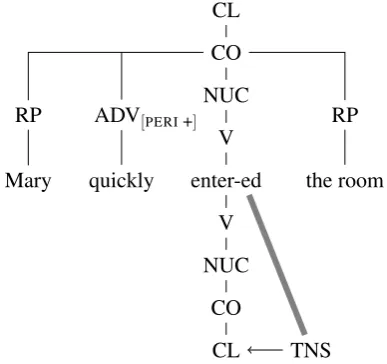
Figure 1: Simplified example of a syntactic repre-sentation in RRG with operator projection
grammatical categories such as aspect, modality, and tense. Each type of operator is assumed to at-tach to a specific layer: tense operators atat-tach to the clause, modality to the core, aspect to the nu-cleus. Moreover, the surface order of the operators reflects their attachment site in that the higher the layer an operator is attached to, the farther away from the nucleus the operator occurs on the sur-face.
While the ordering among the operators is thus systematically correlated with the scope given by their attachment site at the clausal skeleton, the surface order of the operators relative to argu-ments and adjuncts is much less transparent and often requires crossing branches. For this reason, RRG represents the constituent structure and the operator structure as different projections of the clause. The syntactic representation in Fig.1 illus-trates this idea: The tense (TNS) operator, which is a clause-level operator, attaches morphosyntacti-cally to the verb. The example also shows that the peripheral pace adverbquicklymodifies the core.
(‘RP’ stands for ‘referential phrase’.)
Johnson (1987) once proposed a formalization of the projection approach which uses two differ-ent context free grammars, one for analyzing the sequence consisting of the verb plus arguments and adjuncts, and one for the sequence consist-ing of the verb plus operators. The two grammars taken together then constitute a “projection gram-mar”. However, Johnson’s proposal is purely sur-face oriented and does not capture the fact that the two projections share basically the same clausal skeleton.
In the present paper, we propose a new approach that conflates the operator projection with the con-stituent structure, preserves the scope-related or-dering constraints of the operators and avoids crossing branches with other constituents. The ba-sic idea is that operators can attach to the clausal skeleton “in situ” and then project their content upwards (or downwards) to their respective scope layer. For instance, a tense operator, whose scope level is the clause, can be attached by sister ad-junction to a nuclear node and thereby avoids crossing branches with argument constituents.
The adjunction of the operators needs to be con-trolled in the following two respects: (i) The ad-junction of an operator is obligatoryif the infor-mation conveyed by the operator is required for a sentence to be complete. (ii) The scope-related or-deringof the operators must be respected. In our approach, these constraints are implemented with the help of feature structures attached to the edges of the trees.
The rest of the paper is organized as follows: Section 2briefly introduces a proposal for defin-ing tree composition in a way that leads to the kind of flat syntactic representations postulated by RRG. The two operations, (wrapping) substitu-tion and sister adjuncsubstitu-tion are intended to capture argument structure constructions, including long distance dependencies, and the flat adjunction of modifier expressions. Section3 presents the core idea of this paper which is to add feature struc-tures to edges (as well as to nodes) for bookkeep-ing purposes. The approach is then applied in Section 4 for the seamless alignment of the op-erator projection of RRG with the constituent pro-jection. Section5shows how the proposed repre-sentation of the operator projection behaves in the case of complex sentences, in which the structure of the clausal skeleton interacts with the
scope-taking behavior of the operators in intricate ways.
2 Tree composition in Role and Reference Grammar
RRG shares some fundamental properties with Tree Adjoining Grammar (TAG, Joshi and Sch-abes,1997;Abeillé and Rambow, 2000), notably its extended domain of locality and certain under-lying assumptions about the structure of elemen-tary syntactic building blocks. In particular, RRG assumes that a predicate and its arguments are re-alized within the same elementary tree (cf.Frank,
2002, for similar assumptions in TAG). Therefore RRG can be formalized as a tree-rewriting gram-mar in the spirit of TAG, albeit with slightly dif-ferent operations for combining elementary trees.
Previous work on formalizing tree composition in RRG (Kallmeyer et al., 2013; Osswald and Kallmeyer,in press) has identified two operations that are needed in order to cope with the flat struc-ture of RRG trees: An operation called(wrapping) substitutionthat serves to fill argument slots, i.e., to fill substitution nodes, and an operation called
sister adjunction used to add so-called periphery elements, i.e., modifiers.
2.1 (Wrapping) substitution for argument composition
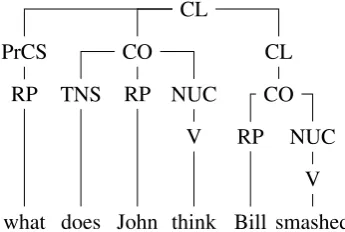
Simple substitution, as in TAG, consists of replac-ing a non-terminal leaf with a new tree of the same category. The idea behind wrapping substitution is that a substitution node (i.e., a non-terminal leaf) in the target tree gets filled by adding a subtree from a new tree. More concretely, this new tree gets split at a point where the lower part has the category of the substitution slot and can be in-serted there. The higher part is identified with the root of the target tree. It can add material above that root but also new material to the right or left of all the daughters of that root. Potential sites for splitting a tree are indicated by dominance links. In other words, wrapping such a tree around an-other one means stretching the dominance link in such a way that its upper node merges with the root while the lower node merges with a substi-tution node in the target tree. Such a wrapping substitution occurs for instance in the derivation of the long-distance dependency(1), given in Fig.2
(1) What does John think Bill smashed?
CL
CO CL
TNS RP NUC V John does think CL
PrCS RP
what
CL CO RP NUC
[image:3.595.87.278.101.258.2]V Bill smashed
Figure 2: Derivation for(1): wrapping substitution
CL
CO CL
TNS RP NUC V
John does think PrCS
RP
what
CO RP NUC
V
[image:3.595.93.266.312.428.2]Bill smashed
Figure 3: Derived tree for(1)
Note that in a first proposal of how to ap-ply wrapping substitution to tree composition in RRG,Kallmeyer et al.(2013) assumed a more bi-nary structure. The version sketched above goes back to Osswald and Kallmeyer (in press) and is more in line with the flat structures used in RRG. The idea of using wrapping substitution is partly inspired by the operationssubsertionin D-Tree Grammar (Rambow et al.,1995) and gener-alized substitution in D-Tree Substitution Gram-mar (Rambow et al., 2001), which, however, are more general. Wrapping substitution shares with subsertion the non-locality: the two nodes targeted by the wrapping substitution (i.e., the substitution node and the root node of the target tree) need not come from the same elementary tree and can be far apart from each other. If the number of wrapping substitutions that stretch across a node in the de-rived tree is limited by some constantk, it can be shown that an equivalentsimple Context-Free Tree Grammar (CFTG) (Kanazawa, 2016) of rank k
can be constructed, which is in turn equivalent to a
well-nestedLinear Context-Free Rewriting System
(LCFRS) (Vijay-Shanker et al.,1987;Seki et al.,
1991;Kanazawa,2009;Gómez-Rodríguez et al.,
2010) of fan-outk+1 (see Kallmeyer,2016, for more details on this equivalence).
2.2 Sister adjunction for modification
So-called peripheral elements in RRG are added via sister adjunction. An example is the modifier
quicklyin the example in(2). The corresponding derivation is given in Fig.4. The root of the mod-ifier tree merges with the target nodenof the ad-junction and the (necessarily unique) daughter is inserted as a new daughter ofn. The categories of the root andnhave to be the same.
(2) Mary quickly entered the room
CL CO
RP NUC
V
RP
Mary entered the room CO
ADV quickly
;
CL CO
RP NUC
V
RP
Mary entered the room ADV
quickly
Figure 4: Derivation for(2): modification via sis-ter adjunction
3 Adding feature structures to the syntactic trees
[image:3.595.324.494.320.558.2]not unify) express an obligatory adjunction con-straint.
In RRG, we want to pursue a similar strategy, namely modeling obligatory adjunction via feature mismatches. However, these mismatches cannot be on top and bottom features of the nodes as in TAG. But we can retain the idea that in places where adjunction occurs, two feature structures that are not unifiable get separated. In the case of sister adjunction, we add a new sister between two nodes or, to put it differently, between two edges. Therefore we propose the following for feature-based sister adjunction:
Nodes have just a single feature structure. In contrast, edges have two feature structures, a left one and a right one. In a sister adjunction, the feature structure of the root of the adjoined tree unifies with the feature structure of the node tar-geted by the adjunction. In the final derived tree, the two feature structures between two neighbour-ing edges have to unify. (Consequently, if they are not unifiable, this acts as an obligatory adjunction constraint.) Furthermore, features on the leftmost (resp. rightmost) edge percolate upwards, except if there is a substitution node, which blocks feature percolation. More precisely, the following unifica-tions occur in the final derived tree:
1. Whenever there are nodesv,v1,v2with edges
hv,v1i and hv,v2i such that v1 immediately precedesv2, the right feature structure fr1 of
hv,v1i unifies with the left feature structure
fl2 ofhv,v2i.
fr1 fl2
v
v1 v2
⇒ fr1 and fl2
are replaced with fr1tfl2
2. Whenever there are nodes v1,v2,v3 with edges hv1,v2i,hv2,v3i such that v3 does not have a sister to the left (to the right) andv2 was not a substitution node, the left (right) feature structure of hv2,v3i unifies with the left (right) feature structure ofhv1,v2i.
fl1
fl2
v1
v2
v3 . . .
⇒ fl1 and fl2
are both replaced with fl1tfl2 ifv2was not filled by substitution
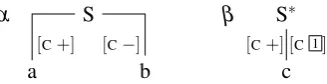
For illustration consider the simple example in Fig.5. The initial treeα carries an obligatory ad-junction constraint since the feature structures be-tween the two edges do not unifiy. β can adjoin repeatedly in between and, as a result, we obtain derived trees where the feature structures between neighbouring edges are unifiable.
[C+] [C−]
α S
a b
[C+] [C 1]
β S∗
[image:4.595.334.498.192.234.2]c Figure 5: Obligatory sister adjunction
In a substitution, the feature structure at the root of the tree that gets added and the one at the substi-tution site unify as well. In the more general case of a wrapping substitution with a dominance link from noden1ton2that gets stretched and a target tree with rootnrand substitution nodens, the fea-ture strucfea-tures ofn1 andnrunify and the ones of
n2andnsunify.
The constraint in 2. thatv2 was not a substitu-tion site is motivated by the hypothesis that substi-tution nodes act as islands concerning operators. An example is(1) where the complement clause is added by wrapping substitution and each of the two clauses requires its own tense operator. This restriction for the feature percolation is a working hypothesis; further examples of (wrapping) substi-tution need to be examined in order to determine whether this assumption makes the right general-ization or whether it is too restrictive.
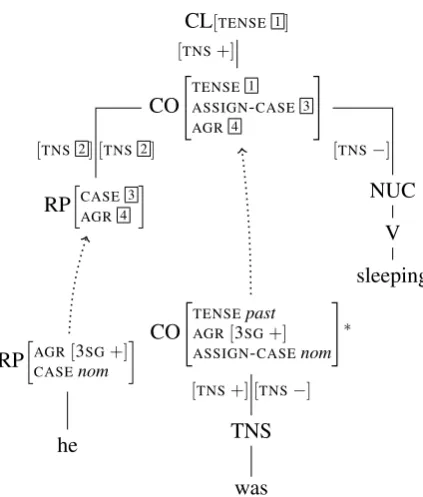
With the above definition of feature structure unification for edge features, the requirement for a non-finite verbal nucleus to obtain tense from a finite verb can for instance be modeled in a way similar to Fig. 5 via a TNS feature with values +/−, as illustrated in Fig. 6. The sleeping tree
[TNS−] CL[TENSE 1]
[TNS+]
CO
TENSE 1ASSIGN-CASE 3 AGR 4
[TNS 2] [TNS 2]
RPCASE 3AGR 4 NUC V sleeping
[TNS+] [TNS−] CO
TENSEAGR[3SGpast+]
ASSIGN-CASEnom
∗
TNS
was RPAGRCASE[3nomSG+]
[image:5.595.77.289.60.309.2]he
Figure 6: Obligatory adjunction of a tense marker.
4 Modeling the operator projection with features
We have seen that, in line withVan Valin(2005), we treat operators as modifiers that are added by sister adjunction. Moreover, we have illustrated in Fig.6how features can be used to enforce the adjunction of certain operators.
What is missing is a modeling of the operator projection of RRG. Each operator belongs to a cer-tain level of the layered structure (see Fig.7). The mapping from operators to levels of the layered structure explains (i) the scope behavior of opera-tors, since structurally higher operators take scope
Layer operators Nucleus Aspect
Negation Directionals Core Directionals
Event quantification Modality
Negation Clause Status
Tense Evidentials
Illocutionary Force
Figure 7: Operators in the layered structure of the clause (cf.Van Valin,2005, p. 9)
over lower ones, and (ii) surface order constraints for operators; higher operators are further away from the nucleus of the structure.
The problem is that the constituent and the oper-ator structure are not completely parallel, i.e., one can have structures where an operator belonging to a specific layer is, on the surface structure, sur-rounded by elements belonging to a lower layer in the constituent structure. Examples are(3)and the Turkish example in(4)(taken fromVan Valin,
2005, p.10), where a clause-level tense operator is embedded in the core. In (3), we have the RPJohnand the NUCsleepingthat form the CO constituent. In between, two operators are added, namely the nucleus-level aspectual operatorbeen
and the clause-level tense operatorhas. The for-mer can attach at the NUC node, consistent with its operator level. The latter, however, cannot ad-join to the clause node, except if crossing branches are allowed. Within the constituent structure, it is part of the CO constituent while its operator level is higher.
(3) John hasTNSbeenASPsleeping. (4) Gel-emi-yebil-ir-im.
come-ABLE.NEGMOD-PSBLSTA-AORTNS-1SG ‘I may be unable to come’
Similarly, in the Turkish example in (4), the clause-level status and tense operators occur be-tween the verb and the pronominal affix, which is part of the core.
Even though the constituent structure and the operator structure are not fully aligned, they de-pend on each other. Their hierarchical order is the same and the existence of a layer in the op-erator projection requires that this layer also exists in the constituent structure. For instance, one can only have clause-level operators if a clause node exists in the constituent structure. In the follow-ing we will show that the feature structure-based definition of tree rewriting with sister adjunction proposed above allows us to model the operator projection within the features while attaching the operators at their surface position. In other words, operators sometimes attach lower than their posi-tion in the operator structure. The features capture the constraints mentioned above.
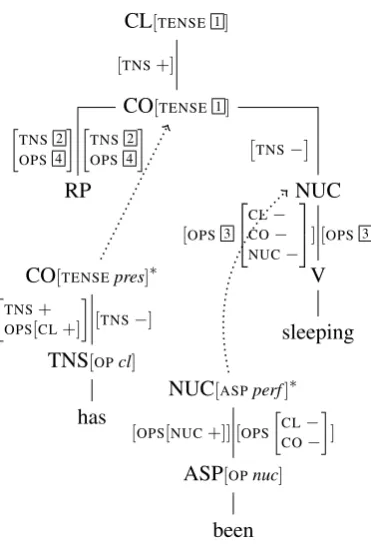
Let us illustrate the feature architecture for op-erators by the analysis of(3)shown in Fig.8.1 We
[image:5.595.106.255.561.729.2]
TNS 2 OPS 4
TNS 2 OPS 4
TNS−
CL[TENSE 1]
[TNS+] CO[TENSE 1]
RP NUC
[OPS 3
CLCO−−
NUC−
] [OPS 3]
V
sleeping
TNS+
OPS[CL+]
[TNS−] CO[TENSEpres]∗
TNS[OPcl]
has
[OPS[NUC+]] [OPS
CL− CO−
] NUC[ASPperf]∗
ASP[OPnuc]
[image:6.595.88.274.60.334.2]been
Figure 8: Trees for(3)
assume a featureOPS(for operator structure) used
on the edges that specifies which operator projec-tion layer(s) have been reached so far. Its value is a feature structure with featuresCL, CO andNUC
for the three layers, each with possible values+or
−. This feature is used in such a way as to guar-antee that nuclear, core and clausal operators have to appear in this order when moving outwards in the sentence, starting from the nuclear predicate. For instance, a nuclear operator such asbeenthat adjoins to the left of the predicate has a require-ment to the right that the levels CLand CO have
values −, i.e., are not reached yet. To the left, it just gives the information NUC +. On the other hand, a clausal operator such as the tense operator
has, when adjoining to the left of the nucleus, does not have any requirement for the operator level that has already been reached (hence there is no
OPSfeature specified on the right of the top-most
edge) but it states to the left of the edge that now
CLhas value+. In addition to theOPSfeature, the
preterminal nodes of the operator trees have a fea-ture OP indicating the operator level that the tree
targets, which can be different from the root node
count the progressive aspect of the present perfect progressive construction in(3). A more thorough analysis would derive perfectfrom the auxiliary choice ‘have’ and the past partici-ple morphology of ‘be’, whileprogressivederives from ‘be’ and the ‘-ing’ form of the main verb.
category of the tree that specifies the constituency level, i.e., the surface position. For example, has
is a clause-level operator that adjoins at the core node.
The OPSfeature can also be used to make sure
that operator levels are licensed by corresponding nodes in the constituent structure of the targeted elementary tree. If, for instance, the core layer is the highest layer of the predicative elementary tree, then theOPS features on the left of the
left-most edge and on the right of the rightleft-most edge immediately below the core node will have fea-turesCL−, which means that clausal operators are
not allowed within this core.
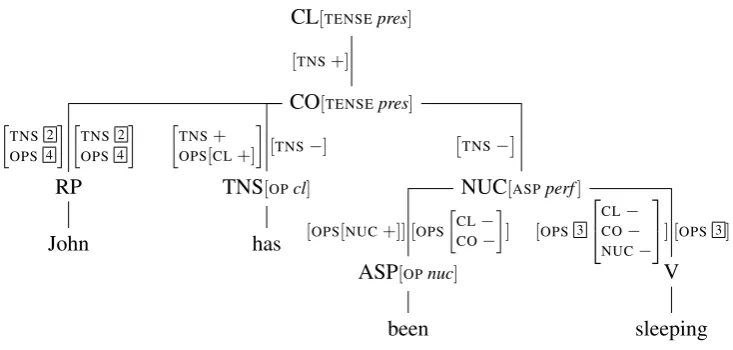
Fig. 9 shows the derived tree for sentence(3). The final feature unifications between neighbour-ing edges and between leftmost/rightmost edges below a node and the left feature structure/right feature structure of the edge to the mother lead to the following: The NUC +information is passed from the NUC–ASP edge to the left of the CO– NUC edge and it gets unified with the feature structure on the right of the CO–TNS edge. Fur-thermore, the feature structures between CO–RP and CO–TNS unify and the resulting values of
TNS andOPSare passed to the left of the CO–RP
edge and from there to the left of the CL–CO edge. Note that the root category of the operator tree (in our example CO in the case of hasand NUC in the case ofbeen) determines the attachment site of the operator in the constituent structure. A pos-sible constraint on these elementary trees, which remains to be verified empirically, is that with re-spect to RRG’s layered structure, the root node la-bel of an operator tree has to be lower or equal to the OP value at the operator node (i.e., at the
daughter of that root). This means for instance that there cannot be an operator with[OPnuc]and root category CO or CL.2
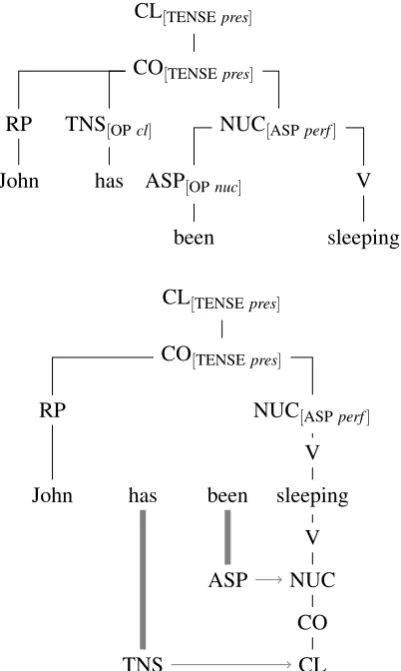
Since the preterminal nodes of the operators specify which operator projection layer the oper-ator belongs to, we can deterministically map a derived tree to the standard RRG structure where the constituent structure and the operator projec-tion are separated. The two structures for our ex-ample are given in Fig.10.
Note that a single lexical item can also con-tribute more than one operator. The operatorhad
in (5), for instance, contributes aspect (nuclear
2Such constraints can be implemented in a principled way
TNS 2 OPS 4
TNS 2 OPS 4
TNS−
CL[TENSEpres]
[TNS+] CO[TENSEpres]
RP
John
NUC[ASPperf] [OPS 3
CLCO−−
NUC−
] [OPS 3]
V
sleeping
TNS+
OPS[CL+]
[TNS−]
TNS[OPcl]
has [OPS[NUC+]] [OPS
CL− CO−
]
[image:7.595.116.483.62.237.2]ASP[OPnuc] been
Figure 9: Derived tree for(3)(before final edge feature unification)
level) and tense (clause level).
(5) John had slept.
We therefore modify the representation slightly in that we replace non-terminal operator categories such as TNS, ASP, etc. by a more general category OP, and the single feature OP by a complex
fea-ture strucfea-ture that lists all the feafea-tures contributed on the different operator layers. In the case of the operator in (5), this would yield the feature structure [NUC[ASP perf],CLAUSE[TENSE past]]. Likewise, the node label ASP[OPnuc] in the
up-per tree of Fig. 10 is to be replaced by the label OP[NUC[ASPperf]]under the new convention.
5 Operators in complex sentences
A crucial assumption of RRG concerning the structure of complex sentences is the distinction between embedded and non-embedded dependent structures. Embedded dependent structures cor-repsond to subordinations. By contrast, non-embedded dependent structures, which are re-ferred to as cosubordination structures, have ba-sically the form [[ ]X [ ]X]X. It is characteris-tic of this type of construction that operators that apply to category X are realized only once but have scope over both constituents. Cosubordina-tion differs from thecoordinationof two indepen-dent structures in that the latter type of construc-tion has the form[[ ]X[ ]X]Y, where Y is a higher-level category than X.
The Turkish sentence in (6) (taken from Van Valin,2005, p. 201) is an example of a core co-subordination construction (see alsoBohnemeyer and Van Valin, 2017, p. 155f). On the surface,
the deontic modal operator-meli(‘should, ought to’) is embedded in the second core, but it takes scope over the entire complex core. (‘LM’ stands for ‘linkage marker’.)
(6) [[Gid-ip]CO
go-LM
[gör-meli-yiz]CO]CO.
see-MOD-1PL ‘We ought to go and see.’
In the following, we leave aside the question of how to derive cosubordination structures. As a tentative working hypothesis, we may assume that the second embedded core in(6)is not added by substitution but, rather, that the first core is added to the second core by sister adjunction, due to the possible iteration of the construction. The focus of the present paper is on the adjunction of the opera-tor and the construction of the operaopera-tor projection from the constituent structure. The modal oper-ator in (6) adjoins to the second embedded core node and it carries a feature indicating that it is a core operator. The result is the derived structure in Fig.11(cf. Van Valin,2005, p. 204). In the case of a cosubordination as in Fig.11, an operator em-bedded in one part of the complex structure gener-ally takes scope over the larger category. Accord-ingly, in all elementary trees for cosubordination configurations, the relevant features (here MOD)
CL[TENSEpres]
CO[TENSEpres]
RP
John
NUC[ASPperf]
V
sleeping TNS[OPcl]
has ASP[OPnuc]
been
CL[TENSEpres]
CO[TENSEpres]
RP
John
NUC[ASPperf]
V
V NUC
CO CL sleeping
TNS has
[image:8.595.80.281.65.401.2]ASP been
Figure 10: Derived tree for(3)(without edge fea-tures) and corresponding RRG structure
between. In the case of Fig.11, this is the core of the entire sentence.
A similar example from English is given in
(7a) (cf. Van Valin, 2005, p.203) where we have a core consisting of three embedded core con-stituents where the first contains the modal opera-tormust. This operator takes scope over the entire large core. By contrast, in(7b) we have a struc-ture consisting of several cores which constitute a clause. I.e., we have a core coordination and not a core cosubordination. In this case, as correctly predicted by our analysis, the modal embedded in the first core scopes only over this one and not over both cores.
(7) a. [[Kim mustMODgo]CO[to try]CO[to wash the car]CO]CO
b. [[Kim mustMOD ask Pat]CO [to wash the car]CO]CL
The shared operator scope in(7a)is a standard cri-terion for distinguishing cosubordinate from
co-CL CO[MODdeont]
CO CO[MODdeont]
NUC LM NUC OP
[CO[MODdeont]] PRO
V V
gid ip gör meli yiz
Figure 11: Derived tree for(6)
ordinate constructions. Another diagnostic is the independent accessibility of the embedded cores by time-positional adverbials, which are analyzed as core-level modifiers (cf.Bohnemeyer and Van Valin, 2017). While(7b)does allow independent time-positional modification, as in Kim must ask Pat now to wash the car tomorrow, this is not an option for(7a): Both, #Kim must go now to try to wash the car tomorrow and #Kim must go to try now to wash the car tomorroware excluded.
Finally, let us consider a case of subordination in which the same layer category occurs twice on a path in the tree but an embedded operator targets only the lower of the two.
(8) Kim told Pat that she will arrive late.
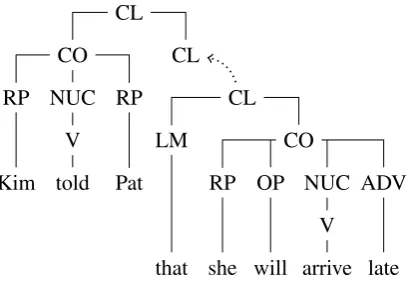
The example in(8)(adapted fromVan Valin,2005, p. 200) involves substituting a clausal argument into the tree anchored by told. This substitution step is shown in Fig.12.3 The operatorwillin the
embedded clause is a clausal operator that con-tributes tense. In the resulting tree, it will be dominated by the CL node of the embedded com-plement clause and, dominating this one, the CL node of the entire sentence. The latter, however, is not available as possible scope of this operator because there is a substitution node between this node and the operator. Consequently, we correctly predict that the tense operator only scopes over the embedded clause. Concering features, this would be reflected in the elementary tree fortold by the fact that the two CL nodes would not share the
TENSEfeature.
3Note that even in a long-distance dependency such as
[image:8.595.310.526.66.194.2]CL
CO CL
RP NUC V
RP
told
Kim Pat
CL
LM CO
RP OP NUC V
ADV
[image:9.595.80.284.64.206.2]that she will arrive late
Figure 12: Derivation for(8)
6 Conclusion
The work presented in this paper is part of a larger project of formalizing the theory of Role and Reference Grammar (Foley and Van Valin,
1984;Van Valin,2005). Based on extensive typo-logical research, RRG assumes a rather flat con-stituent structure that is interleaved with an opera-tor projection which reflects the scopal properties of functional elements. We offered a formaliza-tion of this approach that is inspired from Tree Ad-joining Grammars (TAG) and that integrates both structures in one tree, modeling the operator struc-ture within appropriate feastruc-ture strucstruc-tures. Further-more, due to the flat constituency structure, mod-ifiers are added via sister adjunction and adjunc-tion constraints are modeled via features attached to edges. The resulting architecture shares cen-tral assumptions about elementary trees with TAG but adopts a flat structure. Therefore, instead of using the standard TAG top and bottom feature structure of syntactic nodes, we proposed to use left and right features of edges in order to express adjunction constraints. Due to the features, addi-tional projections such as the operator projection, that are not completely parallel to the constituency structure, can be captured as well.
We assume that the scopal structure of periph-ery modifiers can be modeled in a similar way as the one of the operators. Their scope order also depends on their order with respect to the nuclear predicate: modifiers that are more outwards scope over modifiers that are closer to the nucleus. At the same time, the surface position of a modifier does not always correspond to its scope. For in-stance, a modifier scoping only over the nucleus of a clause can be separated from the verb by a core constituent. An example is the aspectual
ad-verbcompletelyin(9)(Van Valin,2005, pp. 19f).
(9) Leslie immersed herself completely in the new language.
This leads to a periphery projection that can be modeled via features in a way similar to the treat-ment of operators proposed in this paper.
One of the next steps towards a complete for-malization of RRG will be a detailed analysis of the different types of complex sentences (subor-dination, cosubordination and coordination at the levels of the different layers) with respect to the composition operations and the elementary trees involved. At that point, our hypothesis that substi-tution nodes block the feature passing on the edges and act as islands for the operator projection will be tested again.
Another topic to be investigated concerns a bi-narization of RRG’s flat structures. We have ar-gued in the beginning of this paper that the left and right feature structures between edges, which are used in the flat RRG structures to constrain sis-ter adjunction, correspond to the top and bottom feature structures on the nodes in the more binary standard TAG trees. A question is then whether we can actually define a binarization transforma-tion for RRG that turns the features into top and bottom on the nodes and that can be used for in-stance for feature-based RRG parsing.
Acknowledgments
We thank the anonymous reviewers for their valu-able comments. The work presented in this paper has been supported by the Collaborative Research Centre 991 “The Structure of Representations in Language, Cognition, and Science” funded by the German Research Foundation (DFG).
References
Anne Abeillé and Owen Rambow. 2000. Tree Ad-joining Grammar: An Overview. In Anne Abeillé and Owen Rambow, editors,Tree Adjoining Gram-mars: Formalisms, Linguistic Analysis and Process-ing, CSLI, pages 1–68.
Jürgen Bohnemeyer and Robert D. Van Valin, Jr. 2017. The macro-event property and the layered structure of the clause. Studies in Language41(1):142–197.
Benoit Crabbé, Denys Duchier, Claire Gardent, Joseph Le Roux, and Yannick Parmentier. 2013. XMG: eX-tensible MetaGrammar. Computational Linguistics
William A. Foley and Robert D. Van Valin, Jr. 1984.
Functional syntax and universal grammar. Cam-bridge University Press, CamCam-bridge.
Robert Frank. 2002. Phrase Structure Composition and Syntactic Dependencies. MIT Press, Cam-bridge, Mass.
Carlos Gómez-Rodríguez, Marco Kuhlmann, and Giorgio Satta. 2010. Efficient parsing of well-nested linear context-free rewriting systems. In
Human Language Technologies: The 2010 An-nual Conference of the North American Chap-ter of the Association for Computational Lin-guistics. Association for Computational Linguis-tics, Los Angeles, California, pages 276–284. http://www.aclweb.org/anthology/N10-1035.
Mark Johnson. 1987. A new approach to clause struc-ture in Role and Reference Grammar. In Davis Working Papers in Linguistics 2, University of Cali-fornia, Davis, CA, pages 55–59.
Aravind K. Joshi and Yves Schabes. 1997. Tree-Adjoning Grammars. In G. Rozenberg and A. Sa-lomaa, editors, Handbook of Formal Languages, Springer, Berlin, pages 69–123.
Laura Kallmeyer. 2016. On the mild context-sensitivity of k-tree wrapping grammar. In An-nie Foret, Glyn Morrill, Reinhard Muskens, Rainer Osswald, and Sylvain Pogodalla, editors, Formal Grammar. 20th and 21st International Conferences, FG 2015, Barcelona, Spain, August 2015, Revised Selected Papers. FG 2016, Bozen, Italy, August 2016, Proceedings. Springer, volume 9804 of Lec-ture Notes in Computer Science, pages 77–93.
Laura Kallmeyer, Rainer Osswald, and Robert D. Van Valin, Jr. 2013. Tree wrapping for Role and Ref-erence Grammar. In Glyn Morrill and Mark-Jan Nederhof, editors, Formal Grammar 2012/2013. Springer, volume 8036 ofLNCS, pages 175–190.
Makoto Kanazawa. 2009. The pumping lemma for well-nested Multiple Context-Free Languages. In V. Diekert and D. Nowotka, editors, DLT 2009. Springer, Berlin Heidelberg, volume 5583 ofLNCS, pages 312–325.
Makoto Kanazawa. 2016. Multidimensional trees and a Chomsky-Schützenberger-Weir representa-tion theorem for simple context-free tree grammars.
Journal of Logic and Computation 26(5):1469– 1516.
Rainer Osswald and Laura Kallmeyer. in press. To-wards a formalization of Role and Reference Gram-mar. In R. Kailuweit, E. Staudinger, and L. Künkel, editors, Applying and Expanding Role and Refer-ence Grammar.
Owen Rambow, K. Vijay-Shanker, and David Weir. 1995. D-Tree Grammars. InProceedings of ACL.
Owen Rambow, K. Vijay-Shanker, and David Weir. 2001. D-Tree Substitution Grammars. Computa-tional Linguistics.
Hiroyuki Seki, Takahashi Matsumura, Mamoru Fujii, and Tadao Kasami. 1991. On multiple context-free grammars. Theoretical Computer Science
88(2):191–229.
Robert D. Van Valin, Jr. 2005. Exploring the Syntax-Semantics Interface. Cambridge University Press.
Robert D. Van Valin, Jr. and Randy LaPolla. 1997. Syn-tax: Structure, meaning and function. Cambridge University Press.
K. Vijay-Shanker, David J. Weir, and Aravind K. Joshi. 1987. Characterizing structural descriptions pro-duced by various grammatical formalisms. In Pro-ceedings of ACL. Stanford.