Distributed Representation, LDA Topic Modelling and Deep Learning
for Emerging Named Entity Recognition from Social Media
Patrick Jansson
and
Shuhua Liu
Arcada University of Applied Sciences
Jan-Magnus Janssonin aukio 1, 00560 Helsinki, Finland {patrick.jansson, shuhua.liu}@arcada.fi
Abstract
This paper reports our participation in the W-NUT 2017 shared task on emerging and rare entity recognition from user generated noisy text such as tweets, online reviews and forum dis-cussions. To accomplish this challeng-ing task, we explore an approach that combines LDA topic modelling with deep learning on word level and char-acter level embeddings. The LDA top-ic modelling generates toptop-ic represen-tation for each tweet which is used as a feature for each word in the tweet. The deep learning components consist of two-layer bidirectional LSTM and a CRF output layer. Our submitted result performed at 39.98 (F1) on entity and 37.77 on surface forms. Our new ex-periments after submission reached a best performance of 41.81 on entity and 40.57 on surface forms.
1
Introduction
The shared task Emerging and Rare Entity Recognition at the 3rd Workshop on Noisy User-generated Text (W-NUT 2017) takes on the chal-lenge of identifying unusual, previously-unseen entities in noisy texts such as tweets, online re-views and other social discussions ( http://noisy-text.github.io/2017/emerging-rare-entities.html). The emergent nature of novel named entities in user generated content and the often very creative natural of their surface forms make the task of au-tomatic detection of such entities particularly dif-ficult. To address such challenges, the shared task
organizer prepared training, development and test datasets and provided to the participants. The da-tasets try to “resemble turbulent data containing few repeated entities, drawn from rapidly-changing text types or sources of non-mainstream entities”. Results from the shared task are evaluat-ed using F1 measures on the entities and surface forms found in the test data. It rewards systems at correctly detecting a diverse range of entities ra-ther than only the frequent ones.
Inspired by the work of Limsopatham and Col-lier (2016, winner of w-nut 2016 shared task on Named Entity Recognition in Twitter), Chiu and Nichols (2016), and Huang et al (2015), we ap-proached this shared task with bidirectional LSTM models (Long Short Term Memory recur-rent neural network model) enhanced by CRF output layer, using both character-level and word-level embeddings as inputs. In addition, different from the study of Limsopatham and Collier (2016), we didn’t make use of orthographic fea-tures of characters but tried to incorporate POS tags as well as document topics extracted from LDA topic modelling as optional inputs to the modelling process. The LDA topic modelling generates topic representation for each tweet which is used as a feature for each word in the tweet.
2
Data and Preprocessing
The shared task datasets consist of a training set, a development set and a test set. Basic statistics of each data set in shown in Table 1. The shared task focuses on discovering 6 types of target entities and surface forms of: Corporation, Creative-Work, Group, Location, Person and Product (Derczynski et al, 2017).
In counting surface forms, every "word-label" combination has to be unique and letter case sen-sitive. When the same word appears twice but as different entities both are counted.
For the stop words removing, we utilized the Stopwords ISO ( https://github.com/stopwords-iso/stopwords-en) list. The cutoff value for infre-quent terms is set as one when applying LDA modelling.
3
Emerging and Rare Entity Detection
from Social Media: Framework and
Methods
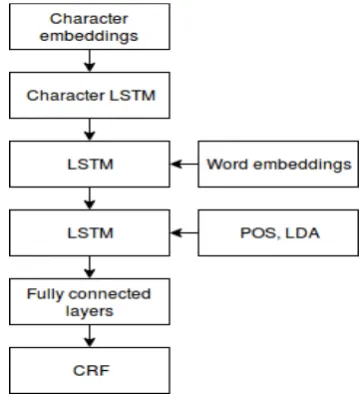
Our approach to emerging and rare entity detec-tion from social media is illustrated in Figure 1. Our methodology framework consists of the fol-lowing components: (1) character-level embed-dings and bidirectional LSTM modeling; (2)
word level embeddings and bidirectional LSTM modelling; (3) LDA topic modelling, POS tags enhanced bidirectional LSTM; (4) fully connect-ed layers, and (5) a CRF (Conditional Random Fields) output layer.
3.1
Character-level RepresentationCharacter-level information was found to be valuable input for named entity recognition from social media (Limsopatham and Collier, 2016; Vosoughi et al, 2016). Chiu and Nichols (2015) found that modelling both the character-level and word-level embeddings within a neural network for named entity recognition helps improve the performance.
In our system, each character is represented as an N dimensional embedding which is learned and adjusted during the training process. The character level representations will then be merged into one M dimensional (50d-200d seems to work well) representation for each word. Character capitalization is kept.
[image:2.595.80.269.220.490.2]We used 20-dimensional embeddings to rep-resent each character. To learn character-level representations for each word we use a bidirec-tional LSTM to create a 200-dimensional repre-sentation for each word.
Figure 1: Methodology Framework
3.2
Word EmbeddingsWord embeddings are distributed tion of words that offers continuous representa-tions of words and text features such as the lin-guistic context of words (Mikolv et al, 2013a,
Entities all
Training Dev Test
# tweets/posts 3394 1009 1287
Tokens total 62730 15733 23394
Entities total 3160 1250 1740
Corporation 267 46 88
Creative-work 346 238 360
Group 414 64 235
Location 793 107 244
Person 995 587 560
Product 345 208 253
Surface
Training Dev Test
Corporation 180 44 79
Creative-work 259 203 292
Group 343 60 188
Location 589 99 174
Person 742 484 476
Product 284 184 200
[image:2.595.323.504.442.641.2]2397 1074 1409
2013b). Word embeddings are the current norm for many text applications as they are found to be able to accurately capture not only syntactic reg-ularities but also (local) semantic regreg-ularities of words and phrases (Mikolv et al, 2013a, Hasen et al, 2015; Limsopatham and Collier, 2016; Vosoughi et al, 2016).
Estimation of the word vectors is done using various types of model architectures trained on large corpora. Word2vec (Mikolv et al, 2013a, 2013b) and GloVe (Pennington et al, 2014) are two widely used efficient model architectures and algorithms for learning high quality continu-ous vector representations of words from huge data sets with billions of words. They have been used to train and create word embeddings that can be applied directly by other applications.
Considering our target source and based on some primitive test, we choose to use 200-dimensional GloVe pre-trained embeddings (Pennington et al, 2014), which was trained on a Twitter corpus with 27 billion tokens and a vo-cabulary size of 1.2 million.
3.3
POS Tagging
Part of Speech is also an important indicator of named entities, which we would like to include in our model (Huang et al, 2015). GATE Twitter POS tagger (https://gate.ac.uk/wiki/twitter-postagger.html) is used to assign POS tags for each word. POS tags is represented as 50-dimensional trainable embedding.
3.4
LDA Topic Modelling
Topic modeling offers a powerful means for finding hidden thematic structure in large text collections. In topic models, topics are defined as a distribution over a fixed vocabulary of terms and documents are defined as a distribution over topics. LDA topic modeling and its variations represent the most popular methods (Blei et al, 2003; Blei, 2012).
We consider the topic composition of each Tweet or social media post an important indica-tor of subject domain context, which can be used to complement the local linguistic context of word vector. We make use of topic representa-tion for each tweet derived from LDA modelling as a feature for each word in the Tweet.
We applied the online LDA method by Hoff-man et al (2010), implemented in Genism (https://radimrehurek.com/gensim/models/ldamo del.html). It can handily analyze massive docu-ment collections or docudocu-ment streams.
When generate topic models, all the three da-tasets are combined into one corpus, and each entry is treated as a separate document. Each document is cleaned and preprocessed, which cludes removing stop-words, punctuation and in-frequent terms. An LDA model of 250 topics was trained and used for our system that generat-ed submittgenerat-ed results. Using the model, we get a document level topic for each document, the top-ic value is then assigned to each word in the doc-ument. We also use the model to get a topic for each word in the documents. If the probability that a document or a word belongs to a topic is, the same for each topic, a special token is as-signed to it instead of a topic. Each topic token is then assigned to a 250-dimensional embedding, embeddings for document and word-level topics are initialized separately.
3.5
Two-Layer Bidirectional LSTM
Bidirectional LSTM has been shown effective for modelling social media sentences (Huang et al., 2015; Dyer et al., 2015; Limsopatham and Collier, 2016). To learn deep neural models for named entity recognition we adopted a two-layer bidirectional LSTM, followed by two fully con-nected layers, and a Conditional Random Field (CRF) as an output layer where we maximize the joint likelihood.
For the first LSTM layer, we concatenate the 200-dimensional GloVe word embeddings and the 200-dimensional embeddings for character level representation. For the second layer, we concate-nate the output of the first layer with the POS-feature embeddings and LDA-POS-feature embed-dings. The LSTM output dimensions are 256 for the first layer and 512 for the second layer.
After the second LSTM layer, we use two fully connected layers at each time step, and feed this representation into the CRF output-layer. The di-mensions of the fully connected layers are 128 and 64 for the first and second layer respectively.
Between each layer in the network we applied dropout and batch normalization (Ioffe and Szre-gedy, 2015). A dropout rate of 0.25 is used for the first two layers of the network (the Character LSTM and the character + word LSTM). For all the other layers of the network, a dropout rate of 0.5 is used.
without adding complexity through an extra com-positional layer (Rei and Yannakoudakis, 2016).
Conditional random field (CRF) has shown to be one of the most effective methods for named entity recognition in general and in social media (Lafferty et al., 2001; McCallum and Li, 2003; Baldwin et al., 2015; Limsopatham and Collier, 2016). It also helped our system to gain perfor-mance in recognizing emerging entities and sur-face forms.
The deep neural model was implemented using Keras with a TensorFlow backend and Keras community contributions for the CRF implemen-tation. One model is trained for both entity and surface form recognition. Any feature can be in-cluded or exin-cluded as needed when running the model.
4
Experiments and Results
In this section, we report two sets of experiments and results. Results from the 1st set of experiments were submitted to the shared task organizer for evaluation. The 2nd set of experiments are done af-ter the submission. Using the ground truth re-leased by the organizer we evaluated the results directly by ourselves. The ground truth being available also helps us in identifying the best model.
4.1
1
stSet of Experiments and
Submit-ted Results
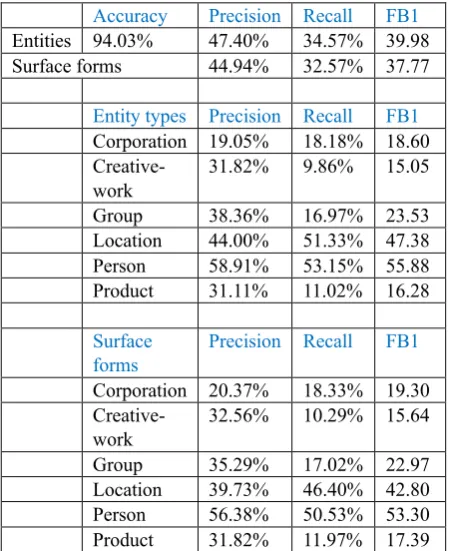
To train the model, the training set and the dev sets are merged, of which 10% (in terms of size, about half of the original dev set) are used for val-idation. We used a batch size of 32 for training, and the RMSprop optimizer with an initial leaning rate of 0.001. The results are shown in Table 2. The results from all participating systems are pre-sented in Table 3 (Derczynski, et al, 2017).
The overall performance of our system reached 39.98 on entities and 37.77 on surface forms. The performance on Person and Location types of en-tities and surface forms are comparatively better, with F1 score at 55,88 and 47,38 respectively for entities, and F1 score at 53.30 and 42.80 for their surface forms. The system is less effective on identifying Corporation, Product, Creative-work and Group types of entities and surface forms, es-pecially disappointing in terms of recall. For Crea-tive-work and Product type entities, recall only reached 9.86% and 11.02% respectively.
Accuracy Precision Recall FB1
Entities 94.03% 47.40% 34.57% 39.98
Surface forms 44.94% 32.57% 37.77
Entity types Precision Recall FB1
Corporation 19.05% 18.18% 18.60
Creative-work
31.82% 9.86% 15.05
Group 38.36% 16.97% 23.53
Location 44.00% 51.33% 47.38
Person 58.91% 53.15% 55.88
Product 31.11% 11.02% 16.28
Surface forms
Precision Recall FB1
Corporation 20.37% 18.33% 19.30
Creative-work
32.56% 10.29% 15.64
Group 35.29% 17.02% 22.97
Location 39.73% 46.40% 42.80
Person 56.38% 50.53% 53.30
[image:4.595.306.531.89.365.2]Product 31.82% 11.97% 17.39
Table 2: Our submitted results
Team F (entity) F (surface)
MIC-CIS 37.06 34.25
Arcada 39.98 37.77
Drexel-CCI 26.30 25.26
SJTU-Adapt 40.42 37.62
FLYTXT 38.35 36.31
SpinningBytes 40.78 39.33
UH Ritual 41.86 40.24
Table 3: Submitted results, all participants
4.2
2
ndSet of Experiments and Updated
Results
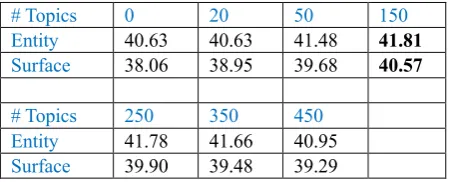
two runs of experiments, where each run goes through all the topic counts.
# Topics 0 20 50 150
Entity 40.63 40.63 41.48 41.81
Surface 38.06 38.95 39.68 40.57
# Topics 250 350 450
Entity 41.78 41.66 40.95
[image:5.595.71.296.112.203.2]Surface 39.90 39.48 39.29
Table 4: Performance variation related with number of topics for LDA modelling
When topic number set as 150, breakdown of the performance shows that the system performed best for the more difficult entity types and surface forms, as is shown in Table 5. For Creative-work and Product type entities, recall reached 15.49% and 14.96% respectively. For their surface forms, recall reached 16.18% and 16.24% respectively.
Accuracy Precision Recall FB1
Entities 94.10% 50.86% 35.50% 41.81
Surface forms 49.55% 34.35% 40.57
Entity types Precision Recall FB1
Corporation 31.71% 19.70% 24.30
Creative-work
37.29% 15.49% 21.89
Group 40.62% 15.76% 22.71
Location 49.09% 54.00% 51.43
Person 61.16% 51.75% 56.06
Product 31.15% 14.96% 20.21
Surface forms
Precision Recall FB1
Corporation 31.43% 18.33% 23.16
Creative-work
37.93% 16.18% 22.68
Group 40.32% 17.73% 24.63
Location 47.14% 52.80% 49.81
Person 60.06% 49.20% 54.09
Product 32.20% 16.24% 21.59
Table 5: Performance on different types of entities, number of topics for LDA modelling = 150
5
Discussion and Conclusion
In this paper, we reported our participation in the W-NUT 2017 shared task on emerging and rare entity recognition from user generated noisy text. We described our system that leverages the power of LDA topic modelling, POS tags, character-level
and word-level embeddings, bidirectional LTSM and CRF. The LDA topic modelling generates top-ic representation for each tweet or social media post. The deep learning model consists of two-layer bidirectional LSTM, two fully connected layers and a CRF output layer. We make use of topic representation for each tweet derived from LDA modelling as a feature for each word in a tweet or post. The topic composition of each post offers a certain subject domain context that could complement the local linguistic context of word embeddings.
We reported two sets of experiments and re-sults. Results from the 1st set of experiments were submitted to the shared task organizer for evalua-tion. Our submitted results performed at 39.98 (F1) on entities and 37.77 (F1) on surface forms.
The 2nd set of experiments are done as follow up study after the submission, adopting a different training strategy. Using the ground truth released by the organizer we evaluated the results directly by ourselves. The ground truth being available helped us to identify the best model.
We experimented more with different options of the number of topics in LDA topic modelling. We found that incorporating LDA features does have a positive effect on the performance. The new results reached a best performance of 41.81 on entities and 40.57 on surface forms, with the number of topics set as 150. When the number of topics is set the same as for our submitted results (i.e. 250), the new results showed performance gain as well, reached 41.78 on entities and 39.90 on surface forms.
For future work, it would be interesting to train the LDA model on a larger corpus, to hopefully find a more accurate subject domain context for each tweet or post. It would be useful as well to explore the effects of alternative word embed-dings such as fasttext. It would also be interesting to apply our system in identifying city event relat-ed entities and surface forms from other social media data.
Acknowledgements
References
Blei D, A. Ng and M. I. Jordan. 2003. Latent Dirichlet Allocation. Advances in Neural Information Pro-cessing Systems. Pages 601-608.
Blei D. 2012. Probabilistic Topic Models. Communi-cations of the ACM, 55(4):77-84.
Benjamin Strauss, Bethany E. Toma, Alan Ritter, Ma-rie Catherine de Marneffe, and Wei Xu. 2016. Re-sults of the wnut16 named entity recognition shared task. In Proceedings of the Workshop on Noisy User-generated Text (WNUT 2016), Osaka, Japan.
Baldwin Timothy, Young-Bum Kim, Marie Catherine de Marneffe, Alan Ritter, Bo Han, and Wei Xu. 2015. Shared tasks of the 2015 workshop on noisy user-generated text: Twitter lexical normalization and named entity recognition. ACL-IJCNLP, 126:2015.
Chiu Jason P. C., Eric Nichols, Named Entity Recog-nition with Bidirectional LSTM-CNNs, TACL2016 Derczynski Leon, Diana Maynard, Giuseppe Rizzo, Marieke van Erp, Genevieve Gorrell, Raphae ̈l Troncy, Johann Petrak, and Kalina Bontcheva. 2015. Analysis of named entity recognition and linking for tweets. Information Processing & Man-agement, 51(2):32–49.
Derczynski Leon, Eric Nichols, Marieke van Erp, Nut Limsopatham, Results of the WNUT2017 Shared Task on Novel and Emerging Entity Recognition, in Proceedings of the 3rd Workshop on Noisy, Us-er-generated Text, 2017
Dyer Chris, Miguel Ballesteros, Wang Ling, Austin Matthews, and Noah A Smith. 2015. Transition-based dependency parsing with stack long short-term memory. arXiv preprint arXiv:1505.08075.
Godin Frederic, Baptist Vandersmissen, Wesley De Neve and Rik Vande Walle. 2015. Multime-dialab@acl w-nut shared task: Named entity recognition for twitter micro posts using distributed word representations. ACL-IJCNLP 2015, page 146.
Hasan Sadid A., Yuan Ling, Joey Liu, Oladimeji Farri, Exploiting Neural Embeddings for Social Media Data Analysis. TREC 2015
Hoffman M, D. Blei and F. Bach. 2010. Online learn-ing for Latent Dirichlet Allocation. Advances in Neural Information Processing Systems 23, 856-864.
Huang Zhiheng, Wei Xu, Kai Yu, Bidirectional LSTM-CRF Models for Sequence Tagging, ArXiv2015
Lafferty John, Andrew McCallum, and Fernando Pe-reira. 2001. Conditional random fields: Probabilis-tic models for segmenting and labeling sequence data. In Proceedings of the eighteenth international conference on machine learning, ICML, volume 1, pages 282–289.
Ioffe Sergey, Szregedy Christian, Batch Normaliza-tion: Accelerating Deep Network Training by Re-ducing Internal Covariate Shift, ArXiv2015
Limsopatham Nut, Nigel Collier, Bidirectional LSTM for Named Entity Recognition in Twitter Messages, 2016
McCallum Andrew and Wei Li. 2003. Early results for named entity recognition with conditional random fields, feature induction and web-enhanced lexi-cons. In Proceedings of the seventh conference on Natural language learning at HLT-NAACL 2003-Volume 4, pages 188–191. Association for Compu-tational Linguistics.
Mikolov Tomas, Kai Chen, Greg Corrado, and Jeffrey Dean. 2013. Efficient Estimation of Word Repre-sentations in Vector Space. In Proceedings of Workshop at ICLR, 2013.
Mikolov Tomas, Ilya Sutskever, Kai Chen, Greg Cor-rado, and Jeffrey Dean. 2013. Distributed Repre-sentations of Words and Phrases and their Compo-sitionality. In Proceedings of NIPS, 2013
Pennington Jeffrey, Richard Socher, and Christopher D Manning. 2014. GloVe: Global vectors for word representation. In EMNLP, pages 1532–1543.
Vosoughi Soroush, Prashanth Vijayaraghavan, Deb Roy, Tweet2Vec: Learning Tweet Embeddings Us-ing Character-level CNN-LSTM Encoder-Decoder, Proceedings of SIGIR 2016, July 17-21, 2016, Pi-sa, Italy
Zhang Xiang, Junbo Zhao, Yann LeCun. Character-level Convolutional Networks for Text Classifica-tion. Advances in Neural Information Processing Systems 28 (NIPS 2015). Poster. Datasets. Code. Errata.