Shakespearizing Modern Language Using Copy-Enriched
Sequence-to-Sequence Models
Harsh Jhamtani∗, Varun Gangal∗, Eduard Hovy, Eric Nyberg
Language Technologies Institute Carnegie Mellon University
{jharsh,vgangal,hovy,ehn}@cs.cmu.edu
Abstract
Variations in writing styles are commonly used to adapt the content to a specific con-text, audience, or purpose. However, ap-plying stylistic variations is still largely a manual process, and there have been little efforts towards automating it. In this paper we explore automated methods to trans-form text from modern English to Shake-spearean English using an end to end train-able neural model with pointers to entrain-able copy action. To tackle limited amount of parallel data, we pre-train embeddings of words by leveraging external dictionaries mapping Shakespearean words to modern English words as well as additional text. Our methods are able to get a BLEU score of 31+, an improvement of ≈ 6 points over the strongest baseline. We publicly release our code to foster further research in this area.1
1 Introduction
Text is often morphed using a variety of lexi-cal and grammatilexi-cal transformations, adjusting the degree of formality, usage of catchy phrases, and other such stylistic changes to make it more ap-pealing. Moreover, different text styles appeal to different user segments (Saha Roy et al., 2015) (Kitis,1997) (Schwartz et al.,2013). Thus there is a need to effectively adapt text to different styles. However, manually transforming text to a desired style can be a tedious process.
There have been increased efforts towards ma-chine assisted text content creation and editing through automated methods for summarization
∗
* denotes equal contribution
1 https://github.com/harsh19/Shakespearizing-Modern-English
No Type Text
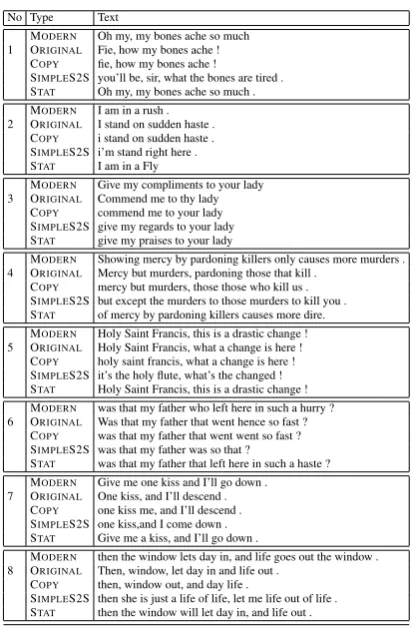
1 MORIGINALODERN Oh my, my bones ache so muchFie, how my bones ache ! COPY fie, how my bones ache ! SIMPLES2S you’ll be, sir, what the bones are tired . STAT Oh my, my bones ache so much . 2 MORIGINALODERN I am in a rush .I stand on sudden haste .
COPY i stand on sudden haste . SIMPLES2S i’m stand right here . STAT I am in a Fly
3 MORIGINALODERN Give my compliments to your ladyCommend me to thy lady COPY commend me to your lady SIMPLES2S give my regards to your lady STAT give my praises to your lady
4 MORIGINALODERN Showing mercy by pardoning killers only causes more murders .Mercy but murders, pardoning those that kill . COPY mercy but murders, those those who kill us .
SIMPLES2S but except the murders to those murders to kill you . STAT of mercy by pardoning killers causes more dire. 5 MORIGINALODERN Holy Saint Francis, this is a drastic change !Holy Saint Francis, what a change is here !
COPY holy saint francis, what a change is here ! SIMPLES2S it’s the holy flute, what’s the changed ! STAT Holy Saint Francis, this is a drastic change ! 6 MORIGINALODERN was that my father who left here in such a hurry ?Was that my father that went hence so fast ?
COPY was that my father that went went so fast ? SIMPLES2S was that my father was so that ?
STAT was that my father that left here in such a haste ? 7 MORIGINALODERN Give me one kiss and I’ll go down .One kiss, and I’ll descend .
COPY one kiss me, and I’ll descend . SIMPLES2S one kiss,and I come down . STAT Give me a kiss, and I’ll go down .
8 MORIGINALODERN then the window lets day in, and life goes out the window .Then, window, let day in and life out . COPY then, window out, and day life .
[image:1.595.313.521.288.603.2]SIMPLES2S then she is just a life of life, let me life out of life . STAT then the window will let day in, and life out .
Table 1: Examples from dataset showing mod-ern paraphrases (MODERN) of few sentences from
Shakespeare’s plays (ORIGINAL). We also show
transformation of modern text to Shakespearean text from our models (COPY, SIMPLES2S and
STAT).
(Rush et al., 2015) , brand naming (Hiranandani et al., 2017), text expansion (Srinivasan et al., 2017), etc. However, there is a dearth of auto-mated solutions for adapting text quickly to differ-ent styles. We consider the problem of transform-ing text written in modern English text to Shake-pearean style English. For the sake of brevity and clarity of exposition, we henceforth refer to the
Shakespeareansentences/side asOriginaland the modern English paraphrases asModern.
Unlike traditional domain or style transfer, our task is made more challenging by the fact that the two styles employ diachronically disparate regis-ters of English - one style uses the contemporary language while the other uses Early Modern En-glish2from theElizabethan Era(1558-1603).
Al-thoughEarly Modern Englishis not classified as a different language (unlikeOld EnglishandMiddle English), it does have novel words (acknownand
belike), novel grammatical constructions (two sec-ond personforms -thou (informal) andyou (for-mal) (Brown et al., 1960)), semantically drifted senses (e.g fetches is a synonym of excuses) and non-standard orthography (Rayson et al., 2007). Additionally, there is a domain difference since the Shakespearean play sentences are from a dramatic screenplay whereas the parallel modern English sentences are meant to be simplified explanation for high-school students.
Prior works in this field leverage a language model for the target style, achieving transforma-tion either using phrase tables (Xu et al., 2012), or by inserting relevant adjectives and adverbs (Saha Roy et al., 2015). Such works have lim-ited scope in the type of transformations that can be achieved. Moreover, statistical and rule MT based systems do not provide a direct mecha-nism to a) share word representation information between source and target sides b) incorporating constraints between words into word representa-tions in end-to-end fashion. Neural sequence-to-sequence models, on the other hand, provide such flexibility.
Our main contributions are as follows:
• We use a sentence level sequence to sequence neural model with a pointer network compo-nent to enable direct copying of words from input. We demonstrate that this method per-forms much better than prior phrase
transla-2https://en.wikipedia.org/wiki/Early_
Modern_English
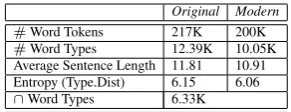
Original Modern #Word Tokens 217K 200K
#Word Types 12.39K 10.05K Average Sentence Length 11.81 10.91 Entropy (Type.Dist) 6.15 6.06
[image:2.595.343.489.61.117.2]∩Word Types 6.33K
Table 2: Dataset Statistics
tion based approaches for transforming Mod-ernEnglish text toShakespeareanEnglish.
• We leverage a dictionary providing mapping between Shakespearean words and modern English words to retrofit pre-trained word embeddings. Incorporating this extra infor-mation enables our model to perform well in spite of small size of parallel data.
Rest of the paper is organized as follows. We first provide a brief analysis of our dataset in (§2). We then elaborate on details of our methods in (§3,
§4, §5, §6). We then discuss experimental setup and baselines in (§7). Thereafter, we discuss the results and observations in (§8). We conclude with discussions on related work (§9) and future direc-tions (§10).
2 Dataset
Our dataset is a collection of line-by-line mod-ern paraphrases for 16 of Shakespeare’s 36 plays (Antony & Cleopatra, As You Like It, Comedy of Errors,Hamlet,Henry Vetc) from the educational site Sparknotes3. This dataset was compiled by
Xu et al. (2014;2012) and is freely available on github.4 14 plays covering 18,395 sentences form
the training data split. We kept 1218 sentences from the playTwelfth Nightas validation data set. The last play, Romeo and Juliet, comprising of 1462 sentences, forms the test set.
2.1 Examples
Table 1 shows some parallel pairs from the test split of our data, along with the corresponding target outputs from some of our models. Copy
andSimpleS2Srefer to our best performing atten-tional S2S models with and without aCopy com-ponent respectively. Stat refers to the best sta-tistical machine translation baseline using off-the-shelf GIZA++ aligner and MOSES. We can see through many of the examples how direct copy-ing from the source side helps theCopygenerates
3www.sparknotes.com
better outputs than theSimpleS2S. The approaches are described in greater detail in (§3) and (§7).
2.2 Analysis
Table 2 shows some statistics from the training split of the dataset. In general, theOriginal side has longer sentences and a larger vocabulary. The slightly higher entropy of theOriginalside’s fre-quency distribution indicates that the frequencies are more spread out over words. Intuitively, the large number of shared word types indicates that sharing the representation between Original and
Modernsides could provide some benefit.
3 Method Overview
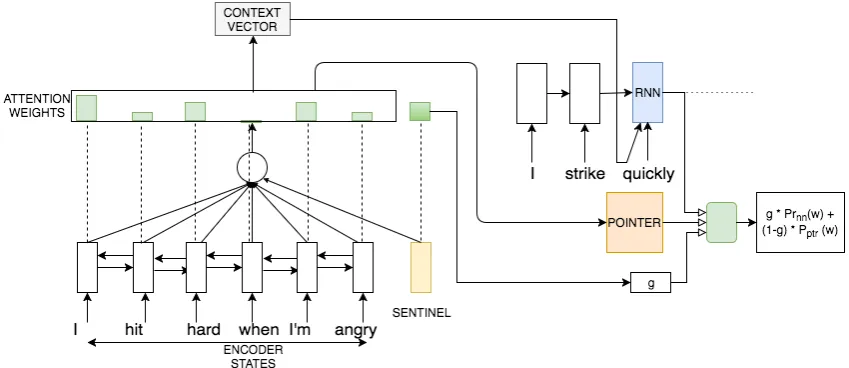
Overall architecture of the system is shown in Fig-ure 1. We use a bidirectional LSTM to encode the input modern English sentence. Our decoder side model is a mixture model of RNN module amd pointer network module. The two individ-ual modules share the attentions weights over en-coder states, although it is not necessary to do so. The decoder RNN predicts probability distribution of next word over the vocabulary, while pointer model predicts probability distribution over words in input. The two probabilities undergo a weighted addition, the weights themselves computed based on previous decoder hidden state and the encoder outputs.
Letx,ybe the some input - output sentence pair in the dataset. Both input x as well as outputy
are sequence of tokens. x =x1x2...xTenc, where
Tencrepresents the length of the input sequencex. Similarly,y = y1y2...yTdec. Each of xi,yj is a
token from the vocabulary.
4 Token embeddings
Each token in vocabulary is represented by a M
dimensional embedding vector. Let vocabularyV
be the union of modern English and Shakepearean vocabularies i.e. V = Vshakespeare ∪Vmodern.
Eenc and Edec represent the embedding matri-ces used by encoder and decoder respectively (
Eenc, Edec ∈ R|V|×M ). We consider union of the vocabularies for both input and output em-beddings because many of the tokens are com-mon in two vocabularies, and in the best per-forming setting we share embeddings between en-coder and deen-coder models. Let Eenc(t), repre-sent encoder side embeddings of some token t.
For some input sequence x, Eenc(x) is given as
(Eenc(x1), Eenc(x2), ...).
4.1 Pretraining of embeddings
Learning token embeddings from scratch in an end-to-end fashion along with the model greatly increases the number of parameters. To mitigate this, we consider pretraining of the token embed-dings. We pretrain our embeddings on all training sentences. We also experiment with adding ad-ditional data from PTB (Marcus et al.,1993) for better learning of embeddings. Additionally we leverage a dictionary mapping tokens from Shake-spearean English to modern English.
We consider four distinct strategies to train the embeddings. In the cases where we use exter-nal text data, we first train the embeddings us-ing both the external data and trainus-ing data, and then for the same number of iterations on train-ing data alone, to ensure adaptation. Note that we do not directly use off-the-shelf pretrained embed-dings such asGlove(Pennington et al.,2014) and
Word2Vec(Mikolov et al.,2013) since we need to learn embeddings for novel word forms (and also different word senses for extant word forms) on theOriginalside.
4.1.1 Plain
This method is the simplest pre-training method. Here, we do not use any additional data, and train word embeddings are trained on the union of Mod-ernandOriginalsentences.
4.1.2 PlainExt
In this method, we add all the sentences from the external text source (PTB) in addition to sentences in training split of our data.
4.1.3 Retro
We leverage a dictionaryLof approximate Orig-inal → Modernword pairs (Xu et al.,2012;Xu, 2014), crawled from shakespeare-words. com, a source distinct from Sparknotes. We ex-plicitly add the two 2nd personsand their corre-sponding forms (thy, thou, thyself etc) which are very frequent but not present inL. The final dictio-nary we use has 1524 pairs. Faruqui et al (2014) proposed a retrofittingmethod to update a set of word embeddings to incorporate pairwise similar-ity constraints. Given a set of embeddingspi ∈P, a vocabularyV, and a setCof pairwise constraints
Figure 1: Depiction of our overall architecture (showing decoder step 3). Attention weights are computed using previous decoder hidden stateh2, encoder representations, and sentinel vector. Attention weights
are shared by decoder RNN and pointer models. The final probability distribution over vocabulary comes from both the decoder RNN and the pointer network. Similar formulation is used over all decoder steps
new set of embeddings qi ∈ Q to minimize the following objective:
f(Q) =δ
i=|V| X
i=1
(pi−qi)2+ω X (i,j)∈C
(qi−qj)2 (1)
We use their off-the-shelf implementation5to
en-code the dictionary constraints into our pretrained embeddings, setting C = Land using suggested default hyperparameters for δ, ω and number of iterations.
4.1.4 RetroExt
This method is similar toRetro, except that we use sentences from the external data (PTB) in addition to training sentences.
We useNoneto represent the settings where we do not pretrain the embeddings.
4.2 Fixed embeddings
Fine-tuning pre-trained embeddings for a given task may lead tooverfitting, especially in scenarios with small amount of supervised data for the task (Madhyastha et al.,2015). This is because embed-dings for only a fraction of vocabulary items get updated, leaving the embeddings unchanged for many vocabulary items. To avoid this, we con-sider fixed embeddings pretrained as per proce-dures described earlier. While reporting results in Section (§8), we separately report results for fixed
5github.com/mfaruqui/retrofitting
(FIXED) and trainable (VAR) embeddings, and ob-serve that keeping embeddings fixed leads to bet-ter performance.
5 Method Description
In this section we give details of the various mod-ules in the proposed neural model.
5.1 Encoder model
Let −−−−−−→LST Menc and ←−−−−−−LST Menc represent the for-ward and reverse encoder. h−→enc
t represent hidden state of encoder model at stept(h−→enc
t ∈RH). The following equations describe the model:
henc0−−→=−→0,h|←−−encx| =−→0 (2) h−−→enct =−−−−−−→LST Menc(henct−1, Eenc(xt)) (3) h←−−enc
t =←−−−−−−LST Menc(henct+1, Eenc(xt)) (4) henct =h
−−→ enc t +h
←−− enc
t (5)
We use addition to combine the forward and back-ward encoder states, rather than concatenation which is standardly used, since it doesn’t add ex-tra parameters, which is important in a low-data scenario such as ours.
5.2 Attention Lethdec
t represent the hidden state of the decoder LSTM at stept. LetEdec(yt−1)represent the
We first compute a query vector, which is a linear transformation of hdec
t−1. A sentinel vector s∈RH is concatenated with the encoder states to createFatt∈R(Tenc+1)×H, whereTencrepresents the number of tokens in encoder input sequence
x. A normalized attention weight vectorαnormis computed. The valueg, which corresponds to at-tention weight over sentinel vector, represents the weight given to the decoder RNN module while computing output probabilties.
q=hdec
t−1Wq Wq∈RH×H (6)
Fatt=concat(henc1..Tenc,s) Fatt∈R(Tenc+1)×H (7)
αi=
H X
j=1
(tanh(Fatt(ij)qj)) +bi αi,bi∈R (8)
αnorm=softmax(α) αnorm∈RTenc+1 (9) β=αnorm1,2,...,Tenc β∈RTenc (10)
g=αnormTenc+1 g∈R (11)
5.3 Pointer model
As pointed out earlier, a pair of corresponding
Original and Modern sentences have significant vocabulary overlap. Moreover, there are lot of proper nouns and rare words which might not be predicted by a sequence to sequence model. To rectify this, pointer networks have been used to en-able copying of tokens from input directly (Merity et al.,2016). The pointer module provides location based attention, and output probability distribution due to pointer network module can be expressed as follows:
PP T R t (w) =
X
xj=w
(βj) (12)
5.4 Decoder RNN
Summation of encoder states weighed by corre-sponding attention weights yields context vector. Output probabilities over vocabulary as per the de-coder LSTM module are computed as follows:
ct= Tenc
X
i=1
βihenci (13) hdec
t =LST M(hdect−1,[concat(Edec(yt−1),ct)]) (14)
PtLST M=softmax(Wout[concat(hdect ,ct)] +bout) (15)
During training, we feed the ground truth foryt−1,
whereas while making predictions on test data, predicted output from previous step is used in-stead.
5.5 Output prediction
Output probability of a token w at step t is a weighted sum of probabilities from decoder LSTM model and pointer model given as follows:
Pt(w) =g×PtLST M(w) + (1−g)×PtP T R(w) (16)
PP T R
t (w)takes a non-zero value only ifw oc-curs in input sequence, otherwise it is 0. Forc-ingg= 0would correspond to not having aCopy
component, reducing the model to a plain atten-tional S2S model, which we refer to as a Sim-pleS2Smodel.
6 Loss functions
Cross entropy loss is used to train the model. For a data point(x,y) ∈ Dand predicted probability distributionsPt(w) over the different wordsw ∈
Vfor each time stept∈ {1, . . . , Tdec}, the loss is given by
− Tdec
X
t=1
logp Pt(yt) (17)
Sentinel Loss (SL): Following from work by (Merity et al.,2016), we consider additional sen-tinel loss. This loss function can be considered as a form ofsupervised attention. Sentinel loss is given as follows:
− Tdec
X
t=1
log(g(t)+ X xj=yt
(β(t)
j )) (18)
We report the results demonstrating the impact of including the sentinel loss function (+SL).
7 Experiments
In this section we describe the experimental setup and evaluation criteria used.
7.1 Preprocessing
We lowercase sentences and then use NLTK’s PUNKT tokenizer to tokenize all sentences. The
7.2 Baseline Methods 7.2.1 As-it-is
Since both source and target side are English, just replicating the input on the target side is a valid and competitive baseline, with a BLEU of21+. 7.2.2 Dictionary
Xu et al. (2012) provide a dictionary mapping be-tween large number of Shakespearean and modern English words. We augment this dictionary with pairs corresponding to the2nd person thou (thou,
thy,thyself) since these common tokens were not present.
Directly using this dictionary to perform word-by-word replacement is another admittable base-line. As was noted by Xu et al. (2012), this base-line actually performs worse than As-it-is. This could be due to its performing aggressive replace-ment without regard for word context. Moreover, a dictionary cannot easily capture one-to-many mappings as well as long-range dependencies6.
7.2.3 Off-the-shelf SMT
To train statistical machine translation (SMT) baselines, we use publicly available open-source toolkit MOSES (Koehn et al., 2007), along with the GIZA++ word aligner (Och, 2003), as was done in (Xu et al.,2012). For training the target-side LM component, we use the lmplz toolkit within MOSES to train a 4-gram LM. We also use
MERT (Och,2003), available as part of MOSES, to tune on the validation set.
For fairness of comparison, it is necessary to use the pairwise dictionary andPTBwhile training the SMT models as well - the most obvious way for this is to use the dictionary andPTBas additional training data for the alignment component and the target-side LM respectively. We experiment with several SMT models, ablating for the use of both
PTBand dictionary. In8, we only report the per-formance of the best of these approaches.
7.3 Evaluation
Our primary evaluation metric isBLEU(Papineni et al.,2002) . We computeBLEUusing the freely available and very widely used perl script7 from
the MOSES decoder.
We also report PINC (Chen and Dolan,2011), which originates from paraphrase evaluation
liter-6thou-thyself and you-yourself
7http://tinyurl.com/yben45gm
ature and evaluates how much the target side para-phrases resemble the source side. Given a source sentencesand a target side paraphrasecgenerated by the system,PINC(s,c)is defined as
P INC(s, c) = 1− 1
N
n=N
X
n=1
|Ngram(c, n)∩Ngram(s, n)| |Ngram(c, n)|
where Ngram(x, n) denotes the set of n-grams of length n in sentence x, and N is the maxi-mum length of ngram considered. We set N = 4. Higher the PINC, greater the novelty of para-phrases generated by the system. Note, however, that PINC does not measure fluency of generated paraphrases.
7.4 Training and Parameters
We use a minibatch-size of32and theADAM op-timizer (Kingma and Ba,2014) with learning rate
0.001, momentum parameters0.9 and0.999, and
= 10−8. All our implementations are written in
Python using Tensorflow 1.1.0 framework. For every model, we experimented with two configurations of embedding and LSTM size
-S (128-128), ME (192-192) and L (256-256). Across models, we find that the ME configura-tion performs better in terms of highest valida-tion BLEU. We also find that larger configuravalida-tions (384-384 & 512-512) fail to converge or perform very poorly8. Here, we report results only for the ME configuration for all the models. For all our models, we picked the best saved model over 15 epochs which has the highest validation BLEU. 7.5 Decoding
At test-time we use greedy decoding to find the most likely target sentence9. We also experiment
with a post-processing strategy which replaces
UNKsin the target output with the highest aligned (maximum attention) source word. We find that this gives a small jump inBLEUof about 0.1-0.2 for all neural models10. Our best model, for
in-stance, gets a jump of 0.14 to reach a BLEU of 31.26from 31.12.
8 Results
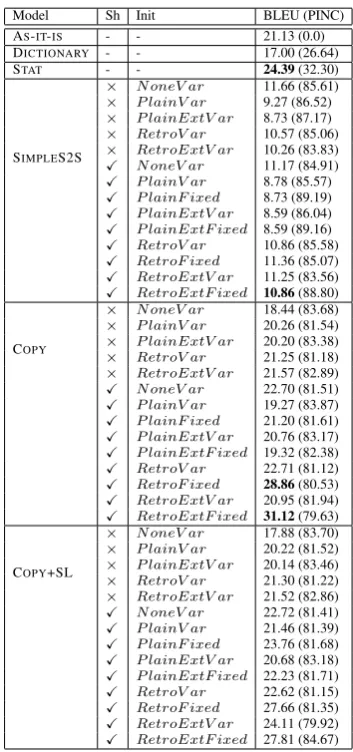
The results in Table 3 confirm most of our hy-potheses about the right architecture for this task.
8This is expected given the small parallel data
9Empirically, we observed that beam search does not give improvements for our task
• Copy component: We can observe from Table 3 that the various Copy models each outperform their SimpleS2S counterparts by atleast 7-8 BLEU points.
• Retrofitting dictionary constraints: The
Retro configurations generally outperform their corresponding Plain configura-tions. For instance, our best configuration
Copy.Yes.RetroExtFixed gets a better BLEU thanCopy.Yes.PlainExtFixed by a margin of atleast 11.
• Sharing Embeddings: Sharing source and target side embeddings benefits all theRetro
configurations, although it slightly deterio-rates performance (about 1 BLEU point) for some of thePlainconfigurations.
• Fixing Embeddings: Fixed configura-tions always perform better than corre-sponding Var ones (save some exceptions). For instance, Copy.Yes.RetroExtFixed get a BLEU of 31.12 compared to 20.95 for
Copy.Yes.RetroExtVar. Due to fixing embed-dings, the former has just half as many pa-rameters as the latter (5.25M vs 9.40M)
• Effect of External Data: Pretrain-ing with external data Ext works well along with retrofitting Retro. For in-stance, Copy.Yes.RetroExtFixed gets a BLEU improvement of 2+ points over
Copy.Yes.RetroFixed
• Effect of Pretraining: For the Sim-pleS2S models, pre-training adversely af-fects BLEU. However, for the Copy mod-els, pre-training leads to improvement in BLEU. The simplest pretrainedCopymodel,
Copy.No.PlainVar has a BLEU score 1.8 higher thanCopy.No.NoneVar.
• PINC scores: All the neural models have higher PINC scores than the statistical and dictionary approaches, which indicate that the target sentences produced differ more from the source sentences than those pro-duced by these approaches.
• Sentinel Loss:Adding the sentinel loss does not have any significant effect, and ends up reducing BLEU by a point or two, as seen with theCopy+SLconfigurations.
8.1 Qualitative Analysis
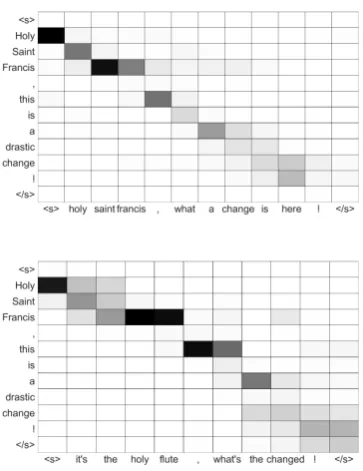
Figure 2 shows the attention matrices from our best Copy model (Copy.Yes.RetroExtFixed) and our best SimpleS2S model ( Sim-pleS2S.Yes.Retrofixed) respectively for the same input test sentence. Without an explicit
Copy component, the SimpleS2S model cannot predict the wordssaintandfrancis, and drifts off after predicting incorrect wordflute.
Model Sh Init BLEU (PINC)
AS-IT-IS - - 21.13 (0.0)
DICTIONARY - - 17.00 (26.64)
STAT - - 24.39(32.30)
SIMPLES2S
× NoneV ar 11.66 (85.61)
× P lainV ar 9.27 (86.52)
× P lainExtV ar 8.73 (87.17)
× RetroV ar 10.57 (85.06)
× RetroExtV ar 10.26 (83.83)
X NoneV ar 11.17 (84.91)
X P lainV ar 8.78 (85.57)
X P lainF ixed 8.73 (89.19)
X P lainExtV ar 8.59 (86.04)
X P lainExtF ixed 8.59 (89.16)
X RetroV ar 10.86 (85.58)
X RetroF ixed 11.36 (85.07)
X RetroExtV ar 11.25 (83.56)
X RetroExtF ixed 10.86(88.80)
COPY
× NoneV ar 18.44 (83.68)
× P lainV ar 20.26 (81.54)
× P lainExtV ar 20.20 (83.38)
× RetroV ar 21.25 (81.18)
× RetroExtV ar 21.57 (82.89)
X NoneV ar 22.70 (81.51)
X P lainV ar 19.27 (83.87)
X P lainF ixed 21.20 (81.61)
X P lainExtV ar 20.76 (83.17)
X P lainExtF ixed 19.32 (82.38)
X RetroV ar 22.71 (81.12)
X RetroF ixed 28.86(80.53)
X RetroExtV ar 20.95 (81.94)
X RetroExtF ixed 31.12(79.63)
COPY+SL
× NoneV ar 17.88 (83.70)
× P lainV ar 20.22 (81.52)
× P lainExtV ar 20.14 (83.46)
× RetroV ar 21.30 (81.22)
× RetroExtV ar 21.52 (82.86)
X NoneV ar 22.72 (81.41)
X P lainV ar 21.46 (81.39)
X P lainF ixed 23.76 (81.68)
X P lainExtV ar 20.68 (83.18)
X P lainExtF ixed 22.23 (81.71)
X RetroV ar 22.62 (81.15)
X RetroF ixed 27.66 (81.35)
X RetroExtV ar 24.11 (79.92)
X RetroExtF ixed 27.81 (84.67)
Table 3: Test BLEU results. Shdenotes encoder-decoder embedding sharing (No=×,Yes=X) . Init
denotes the manner of initializing embedding vec-tors. The-Fixed or-Var suffix indicates whether embeddings are fixed or trainable. COPY and SIMPLES2S denote presence/absence of Copy
component. +SL denotes sentinel loss.
Table1presents model outputs11 for some test
examples. In general, theCopymodel outputs
[image:7.595.327.504.199.576.2]Figure 2: Attention matrices from a Copy (top) and asimple S2S (bottom) model respectively on the input sentence “Holy Saint Francis, this is a drastic change!”.< s >and< /s >are start and stop characters. Darker cells are higher-valued.
semble the ground truth more closely compared to
SimpleS2S and Stat . In some cases, it faces is-sues with repetition (Examples 5 and 7) and flu-ency (Example 9).
9 Related Work
There have been some prior work on style adapta-tion. Xu et al. (2012) use phrase table based statis-tical machine translation to transform text to target style. On the other hand our method is an end-to-end trainable neural network. Saha Roy et al (2015) leverage different language models based on geolocation and occupation to align a text to specific style. However, their work is limited to addition of adjectives and adverbs. Our method can handle more generic transformations includ-ing addition and deletion of words.
Pointer networks (Vinyals et al.,2015) allow the use of input-side words directly as output in a neu-ral S2S model, and have been used for tasks like extractive summarization (See et al.,2017) (Zeng et al., 2016) and question answering (Wang and Jiang, 2016). However, pointer networks cannot generate words not present in the input. A mix-ture model of recurrent neural network and pointer
network has been shown to achieve good perfor-mance on language modeling task (Merity et al., 2016).
S2S neural models, first proposed bySutskever et al.(2014), and enhanced with a attention mech-anism by Bahdanau et al. (2014), have yielded state-of-the-art results for machine translation (MT), , summarization (Rush et al.,2015), etc. In the context of MT, various settings such as multi-source MT (Zoph and Knight,2016) and MT with external information (Sennrich et al., 2016) have been explored. Distinct from all of these, our work attempts to solve a Modern English → Shake-spearean English style transformation task. Al-though closely related to both paraphrasing and MT, our task has some differentiating character-istics such as considerable source-target overlap in vocabulary and grammar (unlike MT), and dif-ferent source and target language (unlike para-phrasing). Gangal et al. (2017) have proposed a neural sequence-to-sequence solution for generat-ing a portmanteau given two English root-words. Though their task also involves large overlap in target and input, they do not employ any spe-cial copying mechanism. Unlike text simplifica-tion and summarizasimplifica-tion, our task does not involve shortening content length.
10 Conclusion
In this paper we have proposed to use a mix-ture model of pointer network and LSTM to transform Modern English text to Shakespearean style English. We demonstrate the effectiveness of our proposed approaches over the baselines. Our experiments reveal the utility of incorporat-ing input-copyincorporat-ing mechanism, and usincorporat-ing dictio-nary constraints for problems with shared (but non-identical) source-target sides and sparse par-allel data.
We have demonstrated the transformation to Shakespearean style English only. Methods have to be explored to achieve other stylistic variations corresponding to formality and politeness of text, usage of fancier words and expressions, etc. We release our code publicly to foster further research on stylistic transformations on text.12.
Acknowledgements
We thank Taylor Berg-Kirkpatrick and anonymous reviewers for their comments. This research was supported in part by DARPA grant FA8750-12-2-0342 funded under the DEFT program.
References
Dzmitry Bahdanau, Kyunghyun Cho, and Yoshua Ben-gio. 2014. Neural machine translation by jointly learning to align and translate. arXiv:1409.0473.
Roger Brown, Albert Gilman, et al. 1960. The pro-nouns of power and solidarity. Article.
David L Chen and William B Dolan. 2011. Collect-ing highly parallel data for paraphrase evaluation. In Proceedings of the 49th Annual Meeting of the Association for Computational Linguistics: Human Language Technologies-Volume 1, pages 190–200. Association for Computational Linguistics.
Manaal Faruqui, Jesse Dodge, Sujay K Jauhar, Chris Dyer, Eduard Hovy, and Noah A Smith. 2014. Retrofitting word vectors to semantic lexicons. arXiv preprint arXiv:1411.4166.
Varun Gangal, Harsh Jhamtani, Graham Neubig, Ed-uard Hovy, and Eric Nyberg. 2017. Charmanteau: Character embedding models for portmanteau cre-ation. InConference on Empirical Methods in Nat-ural Language Processing (EMNLP), Copenhagen, Denmark.
Gaurush Hiranandani, Pranav Maneriker, and Harsh Jhamtani. 2017. Generating appealing brand names. arXiv preprint arXiv:1706.09335.
Diederik Kingma and Jimmy Ba. 2014. Adam: A method for stochastic optimization. arXiv preprint arXiv:1412.6980.
Eliza Kitis. 1997. Adspart of our lives: linguistic awareness of powerful advertising. Word & Image, 13(3):304–313.
Philipp Koehn, Hieu Hoang, Alexandra Birch, Chris Callison-Burch, Marcello Federico, Nicola Bertoldi, Brooke Cowan, Wade Shen, Christine Moran, Richard Zens, et al. 2007. Moses: Open source toolkit for statistical machine translation. In Pro-ceedings of the 45th annual meeting of the ACL on interactive poster and demonstration sessions, pages 177–180. Association for Computational Linguis-tics.
Pranava Swaroop Madhyastha, Mohit Bansal, Kevin Gimpel, and Karen Livescu. 2015. Mapping un-seen words to task-trained embedding spaces. arXiv preprint arXiv:1510.02387.
Mitchell P Marcus, Mary Ann Marcinkiewicz, and Beatrice Santorini. 1993. Building a large annotated corpus of english: The penn treebank. Computa-tional linguistics, 19(2):313–330.
Stephen Merity, Caiming Xiong, James Bradbury, and Richard Socher. 2016. Pointer Sentinel Mixture Models.arXiv preprint arXiv:1609.07843.
Tomas Mikolov, Kai Chen, Greg Corrado, and Jef-frey Dean. 2013. Efficient estimation of word representations in vector space. arXiv preprint arXiv:1301.3781.
Franz Josef Och. 2003. Minimum error rate training in statistical machine translation. InProceedings of the 41st Annual Meeting on Association for Compu-tational Linguistics-Volume 1, pages 160–167. As-sociation for Computational Linguistics.
Kishore Papineni, Salim Roukos, Todd Ward, and Wei-Jing Zhu. 2002. Bleu: a method for automatic eval-uation of machine translation. In Proceedings of the 40th annual meeting on association for compu-tational linguistics, pages 311–318. Association for Computational Linguistics.
Jeffrey Pennington, Richard Socher, and Christopher D Manning. 2014. Glove: Global Vectors for Word Representation. In EMNLP, volume 14, pages 1532–1543.
Paul Rayson, Dawn Archer, Alistair Baron, Jonathan Culpeper, and Nicholas Smith. 2007. Tagging the Bard: Evaluating the accuracy of a modern POS tag-ger on Early Modern English corpora. Article.
Alexander M Rush, Sumit Chopra, and Jason We-ston. 2015. A neural attention model for ab-stractive sentence summarization. arXiv preprint arXiv:1509.00685.
Rishiraj Saha Roy, Aishwarya Padmakumar, Guna Prasaad Jeganathan, and Ponnurangam Kumaraguru. 2015. Automated Linguistic Per-sonalization of Targeted Marketing Messages Mining User-Generated Text on Social Media. In 16th International Conference on Intelligent Text Processing and Computational Linguistics 2015 (CICLing ’15), pages 203–224. Springer International Publishing.
H Andrew Schwartz, Johannes C Eichstaedt, Mar-garet L Kern, Lukasz Dziurzynski, Stephanie M Ra-mones, Megha Agrawal, Achal Shah, Michal Kosin-ski, David Stillwell, Martin EP Seligman, et al. 2013. Personality, gender, and age in the language of social media: The open-vocabulary approach. PloS one, 8(9):e73791.
Rico Sennrich, Barry Haddow, and Alexandra Birch. 2016. Controlling politeness in neural machine translation via side constraints. In Proceedings of NAACL-HLT, pages 35–40.
Balaji Vasan Srinivasan, Rishiraj Saha Roy, Harsh Jhamtani, Natwar Modani, and Niyati Chhaya. 2017. Corpus-based automatic text expansion. In CICLING.
Ilya Sutskever, Oriol Vinyals, and Quoc V Le. 2014. Sequence to sequence learning with neural net-works. In Neural information processing systems, pages 3104–3112.
Oriol Vinyals, Meire Fortunato, and Navdeep Jaitly. 2015. Pointer networks. InAdvances in Neural In-formation Processing Systems, pages 2692–2700. Shuohang Wang and Jing Jiang. 2016. Machine
com-prehension using match-lstm and answer pointer. arXiv preprint arXiv:1608.07905.
Wei Xu. 2014.Data-driven approaches for paraphras-ing across language variations. Ph.D. thesis, New York University.
Wei Xu, Alan Ritter, William B Dolan, Ralph Grish-man, and Colin Cherry. 2012. Paraphrasing for style. In24th International Conference on Compu-tational Linguistics, COLING 2012.
Wenyuan Zeng, Wenjie Luo, Sanja Fidler, and Raquel Urtasun. 2016. Efficient Summarization with Read-Again and Copy Mechanism. arXiv preprint arXiv:1611.03382.