Example Selection for Bootstrapping Statistical Parsers
Mark Steedman
∗, Rebecca Hwa
§, Stephen Clark
∗, Miles Osborne
∗, Anoop Sarkar
¶Julia Hockenmaier
∗, Paul Ruhlen
†Steven Baker
‡, Jeremiah Crim
†∗
School of Informatics, University of Edinburgh
{
steedman,stephenc,julia,osborne
}
@cogsci.ed.ac.uk
§
Institute for Advanced Computer Studies, University of Maryland
[email protected]
¶
School of Computing Science, Simon Fraser University
[email protected]
†
Center for Language and Speech Processing, Johns Hopkins University
[email protected],[email protected]
‡
Department of Computer Science, Cornell University
[email protected]
Abstract
This paper investigates bootstrapping for statis-tical parsers to reduce their reliance on manu-ally annotated training data. We consider both a mostly-unsupervised approach, co-training, in which two parsers are iteratively re-trained on each other’s output; and a semi-supervised approach, corrected co-training, in which a human corrects each parser’s output before adding it to the training data. The selection of labeled training examples is an integral part of both frameworks. We propose several selection methods based on the criteria of minimizing er-rors in the data and maximizing training util-ity. We show that incorporating the utility cri-terion into the selection method results in better parsers for both frameworks.
1
Introduction
Current state-of-the-art statistical parsers (Collins, 1999; Charniak, 2000) are trained on large annotated corpora such as the Penn Treebank (Marcus et al., 1993). How-ever, the production of such corpora is expensive and labor-intensive. Given this bottleneck, there is consider-able interest in (partially) automating the annotation pro-cess.
To overcome this bottleneck, two approaches from ma-chine learning have been applied to training parsers. One is sample selection (Thompson et al., 1999; Hwa, 2000; Tang et al., 2002), a variant of active learning (Cohn et al., 1994), which tries to identify a small set of unlabeled
sen-tences with high training utility for the human to label1.
Sentences with high training utility are those most likely to improve the parser. The other approach, and the fo-cus of this paper, is co-training (Sarkar, 2001), a mostly-unsupervised algorithm that replaces the human by hav-ing two (or more) parsers label trainhav-ing examples for each other. The goal is for both parsers to improve by boot-strapping off each other’s strengths. Because the parsers may label examples incorrectly, only a subset of their out-put, chosen by some selection mechanism, is used in or-der to minimize errors. The choice of selection method significantly affects the quality of the resulting parsers.
We investigate a novel approach of selecting training examples for co-training parsers by incorporating the idea of maximizing training utility from sample selection. The selection mechanism is integral to both sample selection and co-training; however, because co-training and sam-ple selection have different goals, their selection methods focus on different criteria: co-training typically favors se-lecting accurately labeled examples, while sample selec-tion typically favors selecting examples with high train-ing utility, which often are not sentences that the parsers already label accurately. In this work, we investigate se-lection methods for co-training that explore the trade-off between maximizing training utility and minimizing er-rors.
Empirical studies were conducted to compare selection methods under both co-training and a semi-supervised framework called corrected co-training (Pierce and Cardie, 2001), in which the selected examples are man-ually checked and corrected before being added to the
1
In the context of training parsers, a labeled example is a sentence with its parse tree. Throughout this paper, we use the term “label” and “parse” interchangeably.
training data. For co-training, we show that the benefit of selecting examples with high training utility can offset the additional errors they contain. For corrected co-training, we show that selecting examples with high training util-ity reduces the number of sentences the human annotator has to check. For both frameworks, we show that selec-tion methods that maximize training utility find labeled examples that result in better trained parsers than those that only minimize error.
2
Co-training
Blum and Mitchell (1998) introduced co-training to
bootstrap two classifiers with different views of the data. The two classifiers are initially trained on a small amount of annotated seed data; then they label unannotated data for each other in an iterative training process. Blum and Mitchell prove that, when the two views are conditionally
independent given the label, and each view is sufficient
for learning the task, co-training can boost an initial weak learner using unlabeled data.
The theory underlying co-training has been extended by Dasgupta et al. (2002) to prove that, by maximizing their agreement over the unlabeled data, the two learn-ers make few generalization errors (under the same in-dependence assumption adopted by Blum and Mitchell). Abney (2002) argues that this assumption is extremely strong and typically violated in the data, and he proposes a weaker independence assumption.
Goldman and Zhou (2000) show that, through care-ful selection of newly labeled examples, co-training can work even when the classifiers’ views do not satisfy the independence assumption. In this paper we investi-gate methods for selecting labeled examples produced by two statistical parsers. We do not explicitly maximize agreement (along the lines of Abney’s algorithm (2002)) because it is too computationally intensive for training parsers.
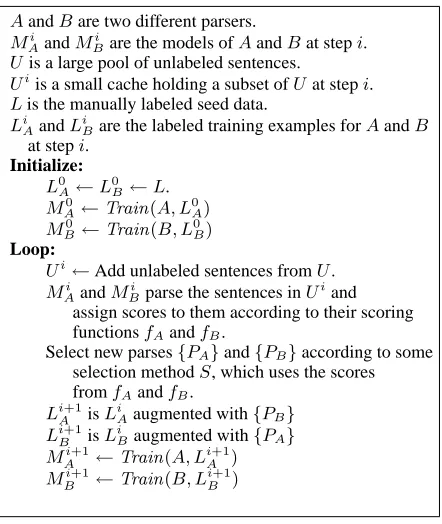
The pseudocode for our co-training framework is given in Figure 1. It consists of two different parsers and a cen-tral control that interfaces between the two parsers and the data. At each co-training iteration, a small set of sen-tences is drawn from a large pool of unlabeled sensen-tences and stored in a cache. Both parsers then attempt to label every sentence in the cache. Next, a subset of the newly labeled sentences is selected to be added to the train-ing data. The examples added to the traintrain-ing set of one parser (referred to as the student) are only those produced by the other parser (referred to as the teacher), although the methods we use generalize to the case in which the parsers share a single training set. During selection, one parser first acts as the teacher and the other as the student, and then the roles are reversed.
AandBare two different parsers.
Mi
AandMBi are the models ofAandBat stepi.
Uis a large pool of unlabeled sentences.
Ui
is a small cache holding a subset ofU at stepi.
Lis the manually labeled seed data.
LiAandLiBare the labeled training examples forAandB
at stepi.
Initialize:
L0
A←L0B←L.
M0
A←Train(A, L0A)
M0
B←Train(B, L0B)
Loop:
Ui←
Add unlabeled sentences fromU.
MAi andMBi parse the sentences inUiand
assign scores to them according to their scoring functionsfAandfB.
Select new parses{PA}and{PB}according to some
selection methodS, which uses the scores fromfAandfB.
LiA+1isLiAaugmented with{PB}
LiB+1isLiBaugmented with{PA}
MAi+1←Train(A, LiA+1)
Mi+1
B ←Train(B, L i+1
[image:2.612.317.538.69.331.2]B )
Figure 1: The pseudo-code for the co-training algorithm
3
Selecting Training Examples
In each iteration, selection is performed in two steps.
First, each parser uses some scoring function,f, to assess
the parses it generated for the sentences in the cache.2
Second, the central control uses some selection method,
S, to choose a subset of these labeled sentences (based on
the scores assigned byf) to add to the parsers’ training
data. The focus of this paper is on the selection phase, but to more fully investigate the effect of different selection methods we also consider two possible scoring functions.
3.1 Scoring functions
The scoring function attempts to quantify the correctness of the parses produced by each parser. An ideal scor-ing function would give the true accuracy rates (e.g., F-score, the combined labeled precision and recall rates). In practice, accuracy is approximated by some notion of confidence. For example, one easy-to-compute scor-ing function measures the conditional probability of the (most likely) parse. If a high probability is assigned, the parser is said to be confident in the label it produced.
In our experimental studies, we considered the selec-tion methods’ interacselec-tion with two scoring funcselec-tions: an
oracle scoring functionfF-score that returns the F-score
of the parse as measured against a gold standard, and a
2
practical scoring function fprob that returns the
condi-tional probability of the parse.3
3.2 Selection methods
Based on the scores assigned by the scoring function, the selection method chooses a subset of the parser la-beled sentences that best satisfy some selection criteria. One such criterion is the accuracy of the labeled exam-ples, which may be estimated by the teacher parser’s con-fidence in its labels. However, the examples that the teacher correctly labeled may not be those that the stu-dent needs. We hypothesize that the training utility of the examples for the student parser is another important criterion.
Training utility measures the improvement a parser would make if that sentence were correctly labeled and added to the training set. Like accuracy, the utility of an unlabeled sentence is difficult to quantify; therefore, we approximate it with values that can be computed from features of the sentence. For example, sentences contain-ing many unknown words may have high traincontain-ing util-ity; so might sentences that a parser has trouble parsing. Under the co-training framework, we estimate the train-ing utility of a sentence for the student by compartrain-ing the score the student assigned to its parse (according to its scoring function) against the score the teacher assigned to its own parse.
To investigate how the selection criteria of utility and accuracy affect the co-training process, we considered a number of selection methods that satisfy the requirements of accuracy and training utility to varying degrees. The different selection methods are shown below. For each method, a sentence (as labeled by the teacher parser) is selected if:
• above-n (Sabove-n): the score of the teacher’s parse
(using its scoring function)≥n.
• difference (Sdiff-n): the score of the teacher’s parse is greater than the score of the student’s parse by
some thresholdn.
• intersection (Sint-n): the score of the teacher’s parse
is in the set of the teacher’s n percent
highest-scoring labeled sentences, and the score of the stu-dent’s parse for the same sentence is in the set of
the student’snpercent lowest-scoring labeled
sen-tences.
Each selection method has a control parameter,n, that
determines the number of labeled sentences to add at each co-training iteration. It also serves as an indirect control
3
A nice property of using conditional probability,
P r(parse|sentence), as the scoring function is that it normalizes for sentence length.
of the number of errors added to the training set. For
ex-ample, theSabove-nmethod would allow more sentences
to be selected ifnwas set to a low value (with respect to
the scoring function); however, this is likely to reduce the accuracy rate of the training set.
The above-n method attempts to maximize the accu-racy of the data (assuming that parses with higher scores are more accurate). The difference method attempts to maximize training utility: as long as the teacher’s label-ing is more accurate than that of the student, it is cho-sen, even if its absolute accuracy rate is low. The
inter-section method attempts to maximize both: the selected
sentences are accurately labeled by the teacher and incor-rectly labeled by the student.
4
Experiments
Experiments were performed to compare the effect of the selection methods on training and corrected
co-training. We consider a selection method, S1, superior
to another, S2, if, when a large unlabeled pool of
sen-tences has been exhausted, the examples selected byS1
(as labeled by the machine, and possibly corrected by the human) improve the parser more than those selected by
S2. All experiments shared the same general setup, as
described below.
4.1 Experimental Setup
For two parsers to co-train, they should generate com-parable output but use independent statistical models. In our experiments, we used a lexicalized context free grammar parser developed by Collins (1999), and a lex-icalized Tree Adjoining Grammar parser developed by Sarkar (2002). Both parsers were initialized with some seed data. Since the goal is to minimize human annotated data, the size of the seed data should be small. In this
pa-per we used a seed set size of1,000sentences, taken from
section 2 of the Wall Street Journal (WSJ) Penn Tree-bank. The total pool of unlabeled sentences was the re-mainder of sections 2-21 (stripped of their annotations), consisting of about 38,000 sentences. The cache size is set at 500 sentences. We have explored using different settings for the seed set size (Steedman et al., 2003).
The parsers were evaluated on unseen test sentences (section 23 of the WSJ corpus). Section 0 was used as a development set for determining parameters. The eval-uation metric is the Parseval F-score over labeled
con-stituents: F-score = 2×LR×LPLR+LP , where LP and LR
80 80.5 81 81.5 82 82.5 83 83.5 84
0 2000 4000 6000 8000 10000 12000
Parsing Accuracy on Test Data (Fscore)
Number of Training Sentences
above-70% diff-10% int-60% No selection(Human annotated)
80 80.5 81 81.5 82 82.5 83 83.5 84
0 2000 4000 6000 8000 10000 12000
Parsing Accuracy on Test Data (Fscore)
Number of Training Sentences
above-90% diff-10% int-30% No selection(Human annotated)
[image:4.612.81.538.75.246.2](a) (b)
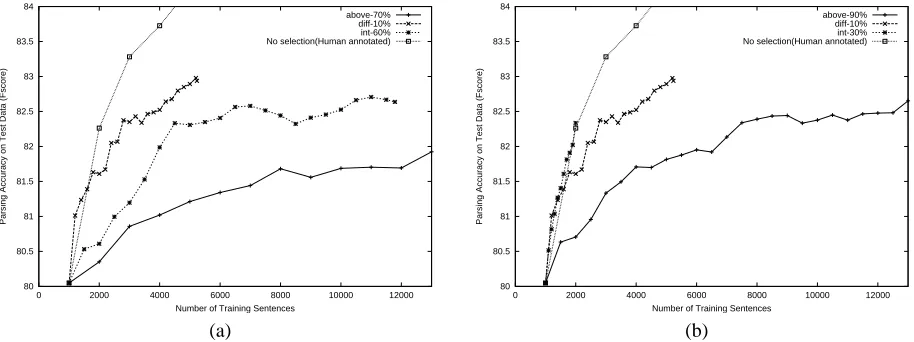
Figure 2: A comparison of selection methods using the oracle scoring function,fF-score, controlling for the label
quality of the training data. (a) The average accuracy rates are about 85%. (b) The average accuracy rates (except for
those selected bySdiff-10%) are about 95%.
4.2 Experiment 1: Selection Methods and Co-Training
We first examine the effect of the three selection meth-ods on co-training without correction (i.e., the chosen machine-labeled training examples may contain errors). Because the selection decisions are based on the scores that the parsers assign to their outputs, the reliability of the scoring function has a significant impact on the per-formance of the selection methods. We evaluate the ef-fectiveness of the selection methods using two scoring functions. In Section 4.2.1, each parser assesses its out-put with an oracle scoring function that returns the Par-seval F-score of the output (as compared to the human annotated gold-standard). This is an idealized condition that gives us direct control over the error rate of the la-beled training data. By keeping the error rates constant, our goal is to determine which selection method is more successful in finding sentences with high training utility.
In Section 4.2.2 we replace the oracle scoring function
withfprob, which returns the conditional probability of
the best parse as the score. We compare how the selection methods’ performances degrade under the realistic con-dition of basing selection decisions on unreliable parser output assessment scores.
4.2.1 Using the oracle scoring function,fF-score
The goal of this experiment is to evaluate the selection methods using a reliable scoring function. We therefore
use an oracle scoring function,fF-score, which
guaran-tees a perfect assessment of the parser’s output. This, however, may be too powerful. In practice, we expect even a reliable scoring function to sometimes assign high scores to inaccurate parses. We account for this effect by
adjusting the selection method’s control parameter to af-fect two factors: the accuracy rate of the newly labeled training data, and the number of labeled sentences added at each training iteration. A relaxed parameter setting adds more parses to the training data, but also reduces the accuracy of the training data.
Figure 2 compares the effect of the three selection methods on co-training for the relaxed (left graph) and the strict (right graph) parameter settings. Each curve in the two graphs charts the improvement in the parser’s ac-curacy in parsing the test sentences (y-axis) as it is trained on more data chosen by its selection method (x-axis). The curves have different endpoints because the selection methods chose a different number of sentences from the same 38K unlabeled pool. For reference, we also plotted the improvement of a fully-supervised parser (i.e., trained on human-annotated data, with no selection).
For the more relaxed setting, the parameters are chosen so that the newly labeled training data have an average accuracy rate of about 85%:
• Sabove-70%requires the labels to have an F-score≥
70%. It adds about 330 labeled sentences (out of the 500 sentence cache) with an average accuracy rate of 85% to the training data per iteration.
• Sdiff-10%requires the score difference between the teacher’s labeling and the student’s labeling to be at least 10%. It adds about 50 labeled sentences with an average accuracy rate of 80%.
150 labeled sentences with an average accuracy rate of 85%.
Although none rivals the parser trained on human an-notated data, the selection method that improves the
parser the most is Sdiff-10%. One interpretation is that
the training utility of the examples chosen bySdiff-10%
outweighs the cost of errors introduced into the training data. Another interpretation is that the other two selection methods let in too many sentences containing errors. In
the right graph, we compare the sameSdiff-10%with the
other two selection methods using stricter control, such that the average accuracy rate for these methods is now about 95%:
• Sabove-90% now requires the parses to be at least 90% correct. It adds about 150 labeled sentences per iteration.
• Sint-30% now requires the teacher’s parse to be in the top 30% of its output and the student’s parse for the same sentence in its bottom 30%. It adds about 15 labeled sentences.
The stricter control on Sabove-90% improved the
parser’s performance, but not enough to overtake
Sdiff-10% after all the sentences in the unlabeled pool had been considered, even though the training data of
Sdiff-10% contained many more errors. Sint-30% has a
faster initial improvement4, closely tracking the progress
of the fully-supervised parser. However, the stringent re-quirement exhausted the unlabeled data pool before
train-ing the parser to convergence. Sint-30% might continue
to help the parser to improve if it had access to more un-labeled data, which is easier to acquire than annotated
data5.
Comparing the three selection methods under both strict and relaxed control settings, the results suggest that training utility is an important criterion in selecting train-ing examples, even at the cost of reduced accuracy.
4.2.2 Using thefprobscoring function
To determine the effect of unreliable scores on the se-lection methods, we replace the oracle scoring function,
fF-score, with fprob, which approximates the accuracy of a parse with its conditional probability. Although this is a poor estimate of accuracy (especially when computed from a partially trained parser), it is very easy to compute. The unreliable scores also reduce the correlation between the selection control parameters and the level of errors in the training data. In this experiment, we set the parame-ters for all three selection methods so that approximately
4
A fast improvement rate is not a central concern here, but it will be more relevant for corrected co-training.
5
This oracle experiment is bounded by the size of the anno-tated portion of the WSJ corpus.
79.8 80 80.2 80.4 80.6 80.8 81 81.2
1000 1500 2000 2500 3000 3500 4000 4500 5000
Parsing Accuracy on Test Data (Fscore)
Number of Training Sentences
[image:5.612.324.528.73.216.2]above-70% diff-30% int-30%
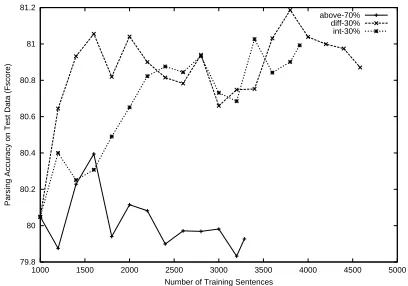
Figure 3: A comparison of selection methods using the
conditional probability scoring function,fprob.
30-50 sentences were added to the training data per iter-ation. The average accuracy rate of the training data for
Sabove-70% was about 85%, and the rate for Sdiff-30%
andSint-30%was about 75%.
As expected, the parser performances of all three
selec-tion methods usingfprob(shown in Figure 3) are lower
than usingfF-score (see Figure 2). However,Sdiff-30%
andSint-30% helped the co-training parsers to improve with a 5% error reduction (1% absolute difference) over the parser trained only on the initial seed data. In
con-trast, despite an initial improvement, usingSabove-70%
did not help to improve the parser. In their experiments on NP identifiers, Pierce and Cardie (2001) observed a sim-ilar effect. They hypothesize that co-training does not scale well for natural language learning tasks that require a huge amount of training data because too many errors are accrued over time. Our experimental results suggest that the use of training utility in the selection process can make co-training parsers more tolerant to these accumu-lated errors.
4.3 Experiment 2: Selection Methods and Corrected Co-training
To address the problem of the training data accumulating too many errors over time, Pierce and Cardie proposed a semi-supervised variant of co-training called corrected co-training, which allows a human annotator to review and correct the output of the parsers before adding it to the training data. The main selection criterion in their co-training system is accuracy (approximated by confi-dence). They argue that selecting examples with nearly correct labels would require few manual interventions from the annotator.
exam-80 81 82 83 84 85 86 87
2000 4000 6000 8000 10000 12000
Parsing Accuracy on Test Data (Fscore)
Number of Training Sentences
above-90% diff-10% int-30% No selection
80 81 82 83 84 85 86 87
0 5000 10000 15000 20000 25000 30000 35000 40000 45000
Parsing Accuracy on Test Data (Fscore)
Number of Constituents to Correct in the Training Data above-90%
diff-10% int-30% No selection
[image:6.612.80.541.73.248.2](a) (b)
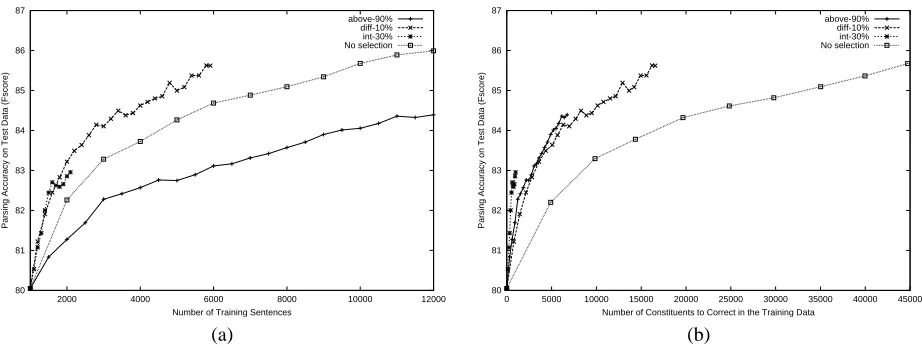
Figure 4: A comparison of selection methods for corrected co-training usingfF-score(a) in terms of the number of
sentences added to the training data; (b) in terms of the number of manually corrected constituents.
ples with higher training utility would require less effort from the annotator. In our experiments, we simulated the interactive sample selection process by revealing the gold standard. As before, we compare the three selection
methods using bothfF-score andfprob as scoring
func-tions.6
4.3.1 Using the oracle scoring function,fF-score
Figure 4 shows the effect of the three selection meth-ods (using the strict parameter setting) on corrected co-training. As a point of reference, we plot the improve-ment rate for a fully supervised parser (same as the one in Figure 2). In addition to charting the parser’s perfor-mance in terms of the number of labeled training sen-tences (left graph), we also chart the parser’s performance in terms of the the number of constituents the machine mislabeled (right graph). The pair of graphs indicates the amount of human effort required: the left graph shows the number of sentences the human has to check, and the right graph shows the number of constituents the human has to correct.
Comparing Sabove-90% and Sdiff-10%, we see that
Sdiff-10%trains a better parser thanSabove-90%when all the unlabeled sentences have been considered. It also im-proves the parser using a smaller set of training exam-ples. Thus, for the same parsing performance, it requires
the human to check fewer sentences thanSabove-90%and
the reference case of no selection (Figure 4(a)). On the other hand, because the labeled sentences selected by
Sdiff-10% contain more mistakes than those selected by
Sabove-90%,Sdiff-10%requires slightly more corrections
6
The selection control parameters are the same as the previ-ous set of experiments, using the strict setting (i.e., Figure 2(b)) forfF-score.
than Sabove-90% for the same level of parsing perfor-mance; though both require fewer corrections than the reference case of no selection (Figure 4(b)). Because the amount of effort spent by the annotator depends on the number of sentences checked as well as the amount
of corrections made, whetherSdiff-10%orSabove-90%is
more effort reducing may be a matter of the annotator’s preference.
The selection method that improves the parser at the
fastest rate isSint-30%. For the same parser performance
level, it selects the fewest number of sentences for a hu-man to check and requires the huhu-man to make the least number of corrections. However, as we have seen in the earlier experiment, very few sentences in the unlabeled pool satisfy its stringent criteria, so it ran out of data be-fore the parser was trained to convergence. At this point
we cannot determine whetherSint-30%might continue to
improve the parser if we used a larger set of unlabeled data.
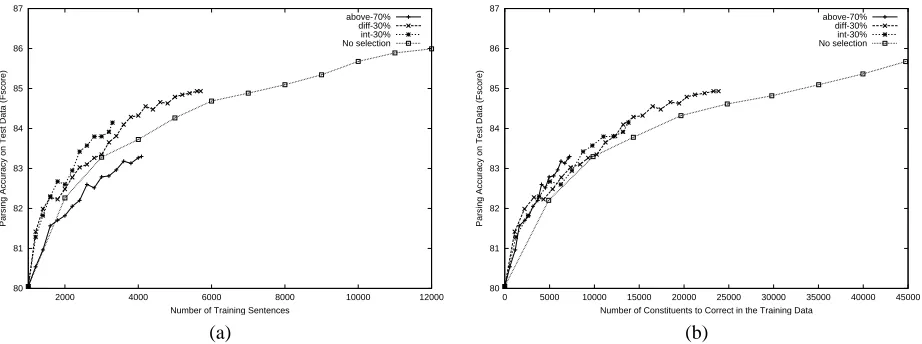
4.3.2 Using thefprobscoring function
We also consider the effect of unreliable scores in the corrected co-training framework. A comparison between
the selection methods usingfprob is reported in Figure
5. The left graph charts parser performance in terms of the number of sentences the human must check; the right charts parser performance in terms of the number of con-stituents the human must correct. As expected, the unreli-able scoring function degrades the effectiveness of the se-lection methods; however, compared to its unsupervised counterpart (Figure 3), the degradation is not as severe.
In fact,Sdiff-30% andSint-30% still require fewer
performance thanSabove-70%. Finally, in terms of reduc-ing human effort, the three selection methods require the human to correct comparable amount of parser errors for
the same level of parsing performance, but forSdiff-30%
andSint-30%, fewer sentences need to be checked.
4.3.3 Discussion
Corrected co-training can be seen as a form of active learning, whose goal is to identify the smallest set of un-labeled data with high training utility for the human to label. Active learning can be applied to a single learner (Lewis and Catlett, 1994) and to multiple learners (Fre-und et al., 1997; Engelson and Dagan, 1996; Ngai and Yarowsky, 2000). In the context of parsing, all previ-ous work (Thompson et al., 1999; Hwa, 2000; Tang et al., 2002) has focussed on single learners. Corrected co-training is the first application of active learning for mul-tiple parsers. We are currently investigating comparisons to the single learner approaches.
Our approach is similar to co-testing (Muslea et al., 2002), an active learning technique that uses two classi-fiers to find contentious examples (i.e., data for which the classifiers’ labels disagree) for a human to label. There is a subtle but significant difference, however, in that their goal is to reduce the total number of labeled training ex-amples whereas we also wish to reduce the number of
corrections made by the human. Therefore, our selection
methods must take into account the quality of the parse produced by the teacher in addition to how different its parse is from the one produced by the student. The
inter-section method precisely aims at selecting sentences that
satisfy both requirements. Exploring different selection methods is part of our on-going research effort.
5
Conclusion
We have considered three selection methods that have dif-ferent priorities in balancing the two (often competing) criteria of accuracy and training utility. We have em-pirically compared their effect on co-training, in which two parsers label data for each other, as well as corrected co-training, in which a human corrects the parser labeled data before adding it to the training set. Our results sug-gest that training utility is an important selection criterion to consider, even at the cost of potentially reducing the ac-curacy of the training data. In our empirical studies, the selection method that aims to maximize training utility,
Sdiff-n, consistently finds better examples than the one
that aims to maximize accuracy, Sabove-n. Our results
also suggest that the selection method that aims to
maxi-mize both accuracy and utility,Sint-n, shows promise in
improving co-training parsers and in reducing human ef-fort for corrected co-training; however, a much larger
un-labeled data set is needed to verify the benefit ofSint-n.
The results of this study indicate the need for scor-ing functions that are better estimates of the accuracy of the parser’s output than conditional probabilities. Our oracle experiments show that, by using effective selec-tion methods, the co-training process can improve parser peformance even when the newly labeled parses are not completely accurate. This suggests that co-training may still be beneficial when using a practical scoring function that might only coarsely distinguish accurate parses from inaccurate parses. Further avenues to ex-plore include the development of selection methods to efficiently approximate maximizing the objective func-tion of parser agreement on unlabeled data, following the work of Dasgupta et al. (2002) and Abney (2002). Also, co-training might be made more effective if partial parses were used as training data. Finally, we are conducting ex-periments to compare corrected co-training with other ac-tive learning methods. We hope these studies will reveal ways to combine the strengths of co-training and active learning to make better use of unlabeled data.
Acknowledgments
This work has been supported, in part, by NSF/DARPA funded 2002 Human Language Engineering Workshop at JHU, EPSRC grant GR/M96889, the Department of Defense contract RD-02-5700, and ONR MURI Con-tract FCPO.810548265. We would like to thank Chris Callison-Burch, Michael Collins, John Henderson, Lil-lian Lee, Andrew McCallum, and Fernando Pereira for helpful discussions; to Ric Crabbe, Adam Lopez, the par-ticipants of CS775 at Cornell University, and the review-ers for their comments on this paper.
References
Steven Abney. 2002. Bootstrapping. In Proceedings of the
40th Annual Meeting of the Association for Computational Linguistics, pages 360–367, Philadelphia, PA.
Avrim Blum and Tom Mitchell. 1998. Combining labeled and unlabeled data with co-training. In Proceedings of the
11th Annual Conference on Computational Learning Theory,
pages 92–100, Madison, WI.
Eugene Charniak. 2000. A maximum-entropy-inspired parser. In Proceedings of the 1st Annual Meeting of the NAACL.
David Cohn, Les Atlas, and Richard Ladner. 1994. Improv-ing generalization with active learnImprov-ing. Machine LearnImprov-ing, 15(2):201–221.
Michael Collins. 1999. Head-Driven Statistical Models for
Natural Language Parsing. Ph.D. thesis, University of
Penn-sylvania.
80 81 82 83 84 85 86 87
2000 4000 6000 8000 10000 12000
Parsing Accuracy on Test Data (Fscore)
Number of Training Sentences
above-70% diff-30% int-30% No selection
80 81 82 83 84 85 86 87
0 5000 10000 15000 20000 25000 30000 35000 40000 45000
Parsing Accuracy on Test Data (Fscore)
Number of Constituents to Correct in the Training Data above-70%
diff-30% int-30% No selection
[image:8.612.81.542.74.246.2](a) (b)
Figure 5: A comparison of selection methods for corrected co-training using fprob (a) in terms of the number of
sentences added to the training data; (b) in terms of the number of manually corrected constituents.
in Neural Information Processing Systems 14, Cambridge,
MA. MIT Press.
Sean P. Engelson and Ido Dagan. 1996. Minimizing manual annotation cost in supervised training from copora. In
Pro-ceedings of the 34th Annual Meeting of the ACL, pages 319–
326.
Yoav Freund, H. Sebastian Seung, Eli Shamir, and Naftali Tishby. 1997. Selective sampling using the query by com-mittee algorithm. Machine Learning, 28(2-3):133–168.
Sally Goldman and Yan Zhou. 2000. Enhancing supervised learning with unlabeled data. In Proceedings of the 17th
In-ternational Conference on Machine Learning, Stanford, CA.
Rebecca Hwa. 2000. Sample selection for statistical grammar induction. In Proceedings of the 2000 Joint SIGDAT
Confer-ence on EMNLP and VLC, pages 45–52, Hong Kong, China,
October.
David D. Lewis and Jason Catlett. 1994. Heterogeneous un-certainty sampling for supervised learning. In Proceedings
of the Eleventh International Conference on Machine Learn-ing, pages 148–156.
Mitchell Marcus, Beatrice Santorini, and Mary Ann Marcinkiewicz. 1993. Building a large annotated cor-pus of English: the Penn Treebank. Computational Linguistics, 19(2):313–330.
Ion Muslea, Steve Minton, and Craig Knoblock. 2002. Selec-tive sampling with redundant views. In Proceedings of the
Seventeenth National Conference on Artificial Intelligence,
pages 621–626.
Grace Ngai and David Yarowsky. 2000. Rule writing or an-notation: Cost-efficient resource usage for base noun phrase chunking. In Proceedings of the 38th Annual Meeting of the
ACL, pages 117–125, Hong Kong, China, October.
David Pierce and Claire Cardie. 2001. Limitations of co-training for natural language learning from large datasets. In
Proceedings of the Empirical Methods in NLP Conference,
Pittsburgh, PA.
Anoop Sarkar. 2001. Applying co-training methods to statisti-cal parsing. In Proceedings of the 2nd Annual Meeting of the
NAACL, pages 95–102, Pittsburgh, PA.
Anoop Sarkar. 2002. Statistical Parsing Algorithms for
Lexi-calized Tree Adjoining Grammars. Ph.D. thesis, University
of Pennsylvania.
Mark Steedman, Miles Osborne, Anoop Sarkar, Stephen Clark, Rebecca Hwa, Julia Hockenmaier, Paul Ruhlen, Steven Baker, and Jeremiah Crim. 2003. Bootstrapping statistical parsers from small datasets. In The Proceedings of the
An-nual Meeting of the European Chapter of the ACL. To
ap-pear.
Min Tang, Xiaoqiang Luo, and Salim Roukos. 2002. Active learning for statistical natural language parsing. In
Proceed-ings of the 40th Annual Meeting of the ACL, pages 120–127,
July.