The Automatic Characterization of Grammars from Small Wordlists
Jordan Kodner1, Spencer Caplan1, Hongzhi Xu2, Mitchell P. Marcus2, Charles Yang1University of Pennsylvania
1 Department of Linguistics
2Department of Computer and Information Science {jkodner, spcaplan}@sas.upenn.edu
{xh, mitch}@cis.upenn.edu [email protected]
Abstract
We present two novel examples of simple algorithms which characterize the gram-mars of low-resource languages: a tool for the characterization of vowel harmony, and a framework for unsupervised mor-phological segmentation which achieves state-of-the-art performance. Accurate characterization of grammars jump starts the process of description by a trained linguist. Furthermore, morphological segmentation provides gains in machine translation as well, a perennial challenge for low-resource undocumented and en-dangered languages.
1 Introduction
A persistent difficulty in describing a language’s grammar is the time consuming and error prone task of pouring over collected data searching for patterns. While the idea of automation is appeal-ing, existing natural language processing applica-tions are often non-functional on the kind of data which may be collected in the field. They may rely on supervised algorithms which require labeled or annotated data, but that defeats the purpose here. A successful tool for characterizing an unknown grammar should not require the user to have de-scribed the grammar beforehand. So called unsu-pervised algorithms, which are are trained on unla-beled data, exist, but they tend to require very large digital corpora to perform well. This is not a prob-lem for tools meant to run on English or French, but collecting enough material on an endangered or undocumented language is often extremely dif-ficult or impossible.
Standard NLP applications are not up to the task. Useful tools in this field must run on un-usually small corpora with high enough accuracy if they are to be a help rather than a hindrance to
a trained linguist. So, what is needed is a class of tools designed specifically with small data in mind and which will work for a diverse variety of languages. We present two such tools that oper-ate on different grammatical domains. The first is a method for automatically searching for, iden-tifying, and characterizing vowel harmony. De-signed with small raw wordlists in mind, it lever-ages basic typological and theoretical principles. Tested on families ranging from Turkic (Turk-ish, Uyghur) to Pama-Nyungan (Warlpiri), it ac-curately describes diverse harmony systems. Our approach is novel in that it does not require the re-searcher to specify what kind of harmony system, if any, to expect. The algorithm discovers the pat-terns on its own.
Additionally, we present an algorithm which achieves state-of-the-art results in unsupervised morphological segmentation. Prior work in unsu-pervised segmentation has taken advantage of very large corpora, on the order of billions of words (Goldwater et al., 2006; Narasimhan et al., 2015). Tested on English and Turkish, our algorithm pro-duces superior results not on billions, but on only hundreds of thousands of words. An obvious issue here is the lack of languages to test on. While any-one can run the algorithm on any language, we can only test the quality of the segmentation on lan-guages for which a gold-standard segmentation al-ready exists. To remedy this, we are currently de-veloping annotation standards for automatic mor-phological segmentation, with Korean and Faroese as test languages. We hope this will prove use-ful for other researchers working on their own lan-guages of interest.
2 Discovering and Describing Vowel Harmony
We begin with an algorithm for discovering vowel harmony in unannotated wordlists. It is designed to produce some kind of useful output no matter
how small its input data, but the more that is pro-vided to it, the more information it will extract. In all, it answers a number of important questions about a language’s vowel harmony system begin-ning with the obvious: does this language have vowel harmony?. If so, then what are the har-monizing sets, and how do vowels map between them? Which vowels, if any, are neutral? Are neu-tral vowels transparent or opaque? Is secondary harmony present? And so on. These questions constitute the major part of what defines a har-mony system. Answering them gives a trained lin-guist a leg up before working out the finer details, or serves to inform other NLP tools in a pipeline.
While prior work exists on the automatic dis-covery or analysis of vowel harmony systems, our method is, to our knowledge, the first end-to-end pipeline for describing both primary and secondary vowel harmony on arbitrary languages. The Vowel Harmony Calculator (Harrison et al., 2004) calculates metrics over a language given a specification of its harmony system. This is not useful for the present purpose because it re-quires a description of the system beforehand. Sanders and Harrison (2012) improves on this by not requiring a full description as input. Never-theless, it only provides a metric for how “har-monic” languages are and not a description of the vowel harmony system (Sanders and Harrison, 2012). Baker (2009) describes a two-state Hid-den Markov Model (HMM) which characterizes English and Italian, and may describe Turkish and Finnish correctly depending on random initial pa-rameter settings (Baker, 2009). The model is re-stricting in that it requires the user to decide up-front how many levels of harmony to find. It only accounts for secondary harmony by setting up the HMM with four initial states at the outset. The pa-per also shows that a models using mutual infor-mation (MI) and Boltzmann fields can accurately identify vowel-to-vowel interactions but does not provide a means for describing vowel harmony given the results.
2.1 Algorithm Overview
In an approach broadly similar to (Baker, 2009)’s MI model, our algorithm leverages distributional patterns within the vowel system to extract infor-mation about vowel harmony. But due to clever transformations of the data and typologically mo-tivated assumptions, it neatly extracts the detailed
information about the system to produce a descrip-tion.
The algorithm is flexible in its input. At a min-imum, all it requires is a wordlist a few hundred words long. If the orthography corresponds more-or-less to a phonemic representation (like with Finnish, for example), no transcription is needed. This alone provides enough information for a ba-sic rough analysis. A wordlist thousands long, with frequencies if possible, is better. For a com-plete analysis, the current version of the algorithm requires a short list of potentially relevant vowel features for each vowel. These basic features (e.g.,
±rnd,±hi, etc.) are not strongly tied to any
par-ticular phonological theory, and are customizable by the researcher.
The algorithm takes a wordlist (with frequen-cies if available) as input, a list of vowels in the same orthography as the input, and an optional ta-ble of proposed vowel features for each vowel. It outputs a partition of the vowel space into two pri-mary harmonizing sets if present, and/or a neutral set. If provided with features, it outputs mappings between the two sets and a partition for secondary harmony if present.
Algorithm 1 describes the detection process. At a high level, it proceeds as follows. First, if fre-quencies are provided, the lowest frequency items are removed. These are more likely than high fre-quency items to contain names and loan words which fail to adhere to the harmony pattern. Then tier-adjacent vowel pairs are tabulated. For exam-ple, in the FinnishKalevala, the tier-adjacent pairs area-e,e-a, anda-a. These counts are converted to mutual information. The MI step is necessary to account for the uneven frequencies of individ-ual vowels. For example, ifa is very common in a language while y is rare, the counts for every vowel withamight be higher than withyin spite of harmony constraints. MI controls for these un-conditioned frequency effects.
har-mony set. Any vowel with a sufficiently level distribution is probably neutral. If all or all but one of the language’s vowels appears neutral, then the language does not have vowel harmony1.
K-means clustering, a standard and simple unsuper-vised clustering algorithm, is used to find the op-timal division of the non-neutral vowels into two harmonizing sets. If features are provided, they are used to match up which vowel maps to which between sets. Then the process is rerun with the harmonizing feature removed to find additional harmony patterns.
Algorithm 1VH Characterization Algorithm
iffrequencies providedthen Trim tail offwordlist whileT ruedo
Calculate tier-adjacent vowel-vowel co-occurrence matrix
Calculate MI between each vowel pair
Identify vowels whose MI distributions uniform within threshold.
Assign these to the neutral vowel set and remove from consideration
ifnumber of non-neutral vowels≤1then return
Run k-means (k= 2) clustering on the remaining vow-els’ MI vectors
ifnofeaturesprovidedthen return
else
Map vowels between harmonizing sets by finding pairs that share the most features in common.
vowel list←Collapse vowels along the harmoniz-ing feature
rerun for secondary harmony return
The algorithm requires that a list of vowels be provided as input. This might be a problem if the user chooses to include marginal vowels from loanwords as input, for examplehyiin German or
h˚aiin Finnish. So as a fail-safe, the algorithm has
facilities for automatically detecting and removing such vowels from the analysis. Marginal vowels tend to have much higher self-MI than MI with any other vowel, allowing them to be identified. This follows intuitively from the assumption that marginal vowels tend to appear only in loanwords.
1Vowel harmony requires a partitioning of the vowel sys-tem into at least two sets. Therefore, there need to be at least two vowels with skewed distributions to propose harmony
2.2 Results
This simple algorithm performs very well on the languages tested. We choose languages with eas-ily accessible corpora from Indo-European, Tur-kic, Uralic, and Pama-Nyungan, but we have good reason to believe that the results port to other fam-ilies as well. We begin by testing Turkish, Finnish, Hungarian, Uyghur, and Warlpiri with corpora ranging in size from roughly 28,000 to 400,000. The model achieves perfect results out-of-the-box on three of five languages tested. This in-cludes successfully capturing secondary harmony in Turkish.
The Warlpiri result is encouraging because it demonstrates that the algorithm may be expected to perform on wordlists in only the tens of thou-sands. It is worth noting that the Turkish results are despite upwards of 30% of lexical items con-taining at least one harmony violation (due mostly to a set of bound morphemes with refuse to par-ticipate in harmony). This underlines the algo-rithm’s robustness. The algorithm also appropri-ately maps vowels between harmonizing sets in all cases when features are provided as input.
In both Hungarian and Uyghur, all errors were of the same type: they misclassified harmonizing vowels as neutral. It is encouraging that the algo-rithm never places a vowel in the wrong harmoniz-ing set. In that way, it does not lead the researcher astray as to the nature of the specific language’s harmony system. A second test was performed on Hungarian in which vowel length (as acute ac-cents) was removed from the orthography. After this change, Hungarian achieved a perfect score as well.
English and German were chosen as control cases. Neither language exhibits vowel harmony, and vowel harmony was discovered in neither lan-guage.
Finally, two experiments were conducted to test the limits of the algorithm’s power. First, the algorithm was run on Estonian (Finnic), which crucially once had, but has since lost produc-tive harmony (Harms, 1962). We predicted that such a language would still show remnants of har-mony’s distributional fingerprint. This turns out to be the case. Run on 87,586 types with no frequency information (Eesti Kirjandusmuuseumi Folkloristika Osakond, 2005), we discover rem-nant front-back harmony. hai, hei, hii, and hui
Language # Types Primary H? V correct Secondary H? V correct
Turkish 303,013 X 8/8 X 4/4
Finnish 396,770 X 8/8 – –
Hungarian 53,839 X 11/15 – –
Uyghur 392,403 X 7/8 – –
Warlpiri 28,885 X 3/3 – –
German 225,327 – 5/5 – –
[image:4.595.139.461.61.146.2]English 101,438 – 6/6 – –
Table 1: Vowel co-occurrences are taken from corpus orthographies. Marginal vowels (e.g. Finnish ˚a
and Germany) are automatically detected and removed. Corpora are from MorphoChallenge (Kurimo et al., 2010) when available. Uyghur and Hungarian were provided for the DARPA LORELEI project. Warlpiri is from (Swartz, 1997).
we expect some erosion in the distributional asym-metries. The remaining vowels divide into two classes along frontness: h¨ai,h¨oi,h¨uivs. hoi,h˜oi
(/7/). This is system is reminiscent of productive harmony in Finnish today and provides interesting insight into diachronic study of the language.
Second, we test the limits of the input data. A run on the most frequent 500 types for Turkish successfully discovers primary but not secondary harmony. This seems to represent the lower bound on the algorithm’s performance window. A second test on Buryat (Mongolic) confirmed this lower bound. Only spurious harmony was detected on a wordlist of 235 stems without frequencies (Lade-foged and Blankenship, 2007). We expect that wordlists containing inflected forms to perform better than lists of stems because harmony alter-nations are frequently observed as allomorphy.
Overall, these results are highly encouraging. On all but the smallest of wordlists, the algorithm produces sufficiently accurate results to be of use to linguists. It is even useful for diachronic study, uncovering lost harmony in Estonian. Future work will leverage morphological segmentation to achieve mapping without the linguist having to provide vowel features to the algorithm. We also expect to test on a variety of poorly documented languages once we acquire more wordlists.
3 Morphological Segmentation for Small Data
We now turn to our algorithm for unsupervised morphological segmentation. As with the vowel harmony algorithm, this is designed specifically with small corpora in mind. Nevertheless, it has achieved state-of-the-art performance on standard test languages. This algorithm is unique in lever-aging the concept of paradigms in discovering seg-mentation. While the notion of paradigms is
com-mon in traditional morphology literature (Stump, 2001), it has not often been used in automatic seg-mentation tasks.
Automatic segmentation should be contrasted with automatic feature analysis. Segmentation is the division of whole word strings into morpheme subunits. It is a function only of form. Well-equipped segmentation processes such as the one presented here, permit transformations as well. These account for orthographic rules (e.g., the doubling on <n> in running → run +n ing) or theoretical concerns, such as allomorphy or stem alternations (e.g., Latin paludis from palus as
palus +d-s is). Feature analysis, on the other hand, is a function of meaning. Words are annotated by the semantic contribution of each of their compo-nent morphemes rather than split into substrings. Feature analysis is not well suited for unsuper-vised tasks because it requires that the meaning of each morpheme be provided beforehand. It is not possible, from a wordlist alone at least, to deduce them. The combination of segmental and featural analysis yields enough information for a standard Leipzig gloss.
Segmentation
nd aka chi teng es a
Features
buy C A U S F V 1S M C L7O M P A S T
Gloss
nd
1S M
-aka -P A S T
-chi
-C L7O M
-teng -buy -es-C A U S
-a
-F V
Figure 1: Gloss for the Shona (S-Bantu) verb
While the paradigm approach is novel, other al-gorithms for morphological segmentation already exist. Probably the most famous is the Morfes-sor family of algorithms (Creutz and Lagus, 2005), which have come to be treated as a standard base-line. Also of note is the Morsel algorithm which achieved the best performance for English and Finnish at the most recent MorphoChallenge (Lig-nos, 2010).
The current published state-of-the-art, Mor-phoChain (Narasimhan et al., 2015) achieves top performance for English, Turkish, and Arabic. The algorithm gets its name from the way in which it conceives as words as derivational chains. Any word is composed of a stem plus some series of affixations and transformations. Then the prob-ability of each step in a derivation is computed considering a number of features (in the machine learning sense, i.e., predictors). Most of these fea-tures are word-internal and can be computed di-rectly from a wordlist. The would-be frequency of the proposed affix, whether or not the stem ap-pears independently, correlations between affixes, and the scope of the required transformations are taken into account among other things.
Word-internal features alone push Mor-phoChain’s performance above the competition. But to achieve its most impressive result, it falls back on word-external features as well. Cosine similarity between derivations in the chain is calculated via Word2Vec (Mikolov et al., 2013) feature vectors. The distributional similarities captures by Word2Vec approximate semantic and syntactic similarity. For example, teach and
teach-er show high distributional similarity and are semantically related, while corn andcorn-er
are not distributionally similar and are not related. This information is useful for detecting spurious segmentations such ascorn-erwhich would seem very plausible based on word-internal information alone. Word2Vec does not require labels and is thus unsupervised. However, corpora of at least
hundreds of millions of words of running text are needed to calculate reliable vectors. Since these are on the order of a million times larger than the wordlists that we target, this subverts our goal.
The practical benefits of word segmentation models are more than simply theoretical. Our framework has been leveraged to improve the per-formance of the best systems for low-resource Uyghur machine translation as well as the
auto-matic detection of named entities for the DARPA LORELEI project. Bridging the performance gap of NLP applications on languages without large annotated corpora, which is the vast majority, ben-efits the communities that speak them through greater accessibility of information.
3.1 Algorithm Overview
The morphological segmentation algorithm com-bines three processes: segmentation, paradigm construction, and pruning. An overview of each is provided. Iterative application of these three func-tions on an unannotated wordlist with frequencies yields segmentations as described in the introduc-tion to this project.
Algorithm 2Morphological Segmentation Algo-rithm Overview
ifpre-segmentationthen Split compounds
Calculate initialP(r)on attested frequencies Perform initial segmentations
whileiterationdo Create paradigms Prune paradigms return
3.1.1 Segmentation
Initial segmentation is achieved through a Bayesian model which estimates a probability P(r, s, t) over candidate roots r, affixes s, and transformations t for each word. This process is itself iterative. ‘Root’ here refers to what remains after a single affix is removed from the word rather than its theoretically defined
√
ROOT. So after a single iteration, the Shona wordndakachitengesawith formal root√T EN G is segmented into root ndakachitenges and affix a. The algorithm acknowledges that af-fixation often triggers additional phonological (or at least orthographical) processes. These are captured through the transformations deletion,
substitution, and duplication at segmentation boundaries. Only considering transformations at segmentation boundaries drastically reduces the search space but prevents us from considering Semitic templatic morphology, for example. We are working to incorporate this functionality into future versions of the algorithm.
• Deletion (DEL) of the end letter x of root
r. E.g., the word ‘using’ as (use, ing,
DEL-e).
• Substitution(SUB) of the end letter x of root r with z. E.g., the word ‘carries’ as(carry,
es, SUB-y+i).
• Duplication(DUP) of the end letter x of root
r. E.g., the word ‘stopped’ as(stop, ed,
[image:6.595.345.489.223.321.2]DUP+p).
Figure 2: Description of transformations
cannot describe the word. Otherwise, it is defined as follows:
P(r, s, t|w) = P(Pr)×P(s)×P(t|f(r, s)) (r0,s0,t0)∈wP(r0, s0, t0)
This formula is based on the assumption that rootsr and suffixes sare independent. Transfor-mations, however, are conditioned on a function f(r, s)defined over the entire corpus. For exam-ple, the -edsuffix in English deletes any immedi-ately precedingein the root. The f function al-lows these generalizations to be captured as mor-phological rules rather than individual cases.
Initially, each possible candidate segmentation is assumed to have equal probability1/|(r, s, t)∈ w|. This generates spurious segmentations of atomic roots with high probability. Subsequent pa-rameter estimation through paradigms and pruning removes spurious segmentations to yield a maxi-mum likelihood segmentation.
(r, s, t|w) = argmax
(r0,s0,t0) P(r
0, s0, t0)
As an additional step, the algorithm has the option of pre-segmenting compound words. If a wordw contains two individually attested words w1 and
w2, the word is split and both of its components
are evaluated separately. This process is found to improve overall recall. As a final optional step, initial P(r) can be weighted by frequency. In languages which attest bare roots, more frequent roots are more likely to be valid.
3.1.2 Paradigm Construction
The segmentation step yields a triple (r, s, t) for each word. Grouping triples by their root yields a set of suffixes, aparadigmenumerating attested affixes on the root. For example, the root walk
surfaces with suffixes{-s,-ing,-ed,-er}. Note that many roots may share the same paradigm. For ex-ample, stop, and bakeshare a paradigm set with
walk.
Paradigms are tabulated by the number of times each occurs in the proposed segmentations. We define a paradigm’ssupportas its frequency in this calculation. We assume that more robustly sup-ported paradigms are more likely to contain only valid affixes. Table 2 shows the most common paradigms discovered for English.
Paradigm Support
(-ed, -ing, -s) 772
(-ed, -ing) 331
(-ed, -er, -ing, -s) 219
(-ly, -ness) 208
(-ed, -ing, -ion, -s) 154
[image:6.595.327.505.377.584.2](-ic, -s) 125
Table 2: Frequent English suffix paradigms con-tain valid affixes
Root Paradigm
ticker (-s, -tape)
piney (-al, -apple, -a, -hill, -hurst, -ido, -iro, -wood)
corks (-an, -screw, -well) sidle (-aw, -ed, -ee, -er, -ey, -in,
-ine, -ing, -s)
lantz (-anum, -ra, -ronix, -ry) nadir (-adze, -la, -ne, -s) reith (-a, -er, -ian)
bodin (-ce, -es, -etz, -ford, -ly, -ne, -ng, -ngton)
musee (-euw, -s, -um) taiyo (-iba, -uan) bilge (-er, -rami, -s)
Table 3: Ten suffix paradigms only supported by a single root. These contain many spurious affixes.
3.1.3 Paradigm Pruning
Not all proposed paradigms are real. Some are the result of segmentation errors. For example, if
closetis segmented as (close, t, NULL), then it will yield a paradigm{-er,-est,-ed,-ing,-s,-t}. Iden-tifying such spurious paradigms directs the algo-rithm towards potentially spurious affixes.
and at least two members are retained as well-supported. All other paradigms are considered suspect. We identify which component affixes of these paradigms receive the most support from other paradigms. The score of a set of affixesSis described as follows. It is the combined frequency of each member affix across all paradigms.
score(S) =X
s∈S
f req(s)
For example, the {-er, -est, -ed, -ing, -s} sub-set of the spuriouscloset paradigm has the high-est possible score of all subsets, and is a well-supported paradigm in and of itself. Therefore we can discard-twith reasonable confidence.
The probability P(s) of each suffix is re-estimated over its attestation all the remaining paradigms. We then rerun the initial segmentation step. This time, spurious affixes probabilities have been penalized, so errors along the lines of (close, t, NULL) are less likely to reoccur. This improves algorithm precision by eliminating spurious affix-ation.
3.2 Experiments and Results 3.2.1 Data and Evaluation
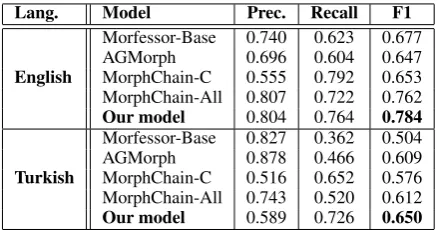
To facilitate comparison between our algorithm and currently used competitors, we adopt the same data set used by (Narasimhan et al., 2015) and (Kurimo et al., 2010), the MorphoChallenge 2010 set for training and the combined MorphoChal-lenge 2005-2010 for testing. We test against Mor-fessor, as well as AGMorph (Sirts and Goldwater, 2013), MorphoChain-C (with only word-internal information), and the full MorphoChain model which is trained on (word-external) word embed-dings from English Wikipedia and the BOUN cor-pus (Sak et al., 2008). MorphoChain-C presents the best direct comparison to our model since we do not consider word-external data. Nevertheless, our model outperforms both implementations.
The output of each algorithm is scored accord-ing to the MorphoChain metric. Precision, re-call, and F1 are calculated across segmentation points. For example, walking segmented as wal kingcontains one incorrect segmentation point af-terwaland is missing a correct segmentation point inking. However,walk ingcontains a correct seg-mentation point and no incorrect ones.
First, we report the contribution from each of our algorithm’s component processes. Table 4
shows the results.Baseis only the initial Bayesian segmentation step. Suff extends the Bayesian model with a final re-estimation based on suffix frequencies.Transimplements the above plus seg-mentation. Comp extendsTrans with compound splitting. Pruneimplements paradigm pruning as well, andFreqconsiders root frequencies in initial segmentation.
English Turkish
Prec Rec F1 Prec Rec F1
[image:7.595.306.537.181.268.2]Base 0.414 0.725 0.527 0.525 0.666 0.587 Suff 0.490 0.648 0.558 0.617 0.621 0.619 Tran 0.524 0.757 0.619 0.589 0.726 0.650 Comp 0.504 0.843 0.631 0.581 0.727 0.646 Prun 0.709 0.784 0.744 0.652 0.518 0.577 Freq 0.804 0.764 0.784 0.715 0.467 0.565
Table 4: Contribution of each algorithm compo-nent
Segmentation on English performs the best when all optional processes are enforced in the model. This is not the case for Turkish however, which achieves its peak performance at Trans. This discrepancy has to do with the relative avail-ability of bare roots in the languages. English has limited affixation, and it can be assumed that many bare roots will appear in any reasonable English dataset. This is not the case for Turkish, however, in which nearly all noun and verb tokens have at least one affix. Therefore, processes which rely on the presence of unaffixed bare roots in the corpus cannot function.
Lang. Model Prec. Recall F1
[image:7.595.307.526.501.616.2]Morfessor-Base 0.740 0.623 0.677 AGMorph 0.696 0.604 0.647 English MorphChain-C 0.555 0.792 0.653 MorphChain-All 0.807 0.722 0.762 Our model 0.804 0.764 0.784 Morfessor-Base 0.827 0.362 0.504 AGMorph 0.878 0.466 0.609 Turkish MorphChain-C 0.516 0.652 0.576 MorphChain-All 0.743 0.520 0.612 Our model 0.589 0.726 0.650
Table 5: All numbers except for ours are reported in (Narasimhan et al., 2015). All scoring was per-formed using the MorphoChain metric. Best re-sults are reported for English and Turkish.
3.3 Testing on Other Languages
Paradigm Support
(-al) 54
(-ly) 43
(-idad) 32
(-ismo) 29
(-ing, -s) 25
(-er) 23
(-ed) 21
(-ista) 19
(-ly, -s) 15
(-ed, -s) 13
(-er, -ing, -s) 11
(-er, -s) 11
[image:8.595.123.240.61.255.2](-ed, -ing) 11
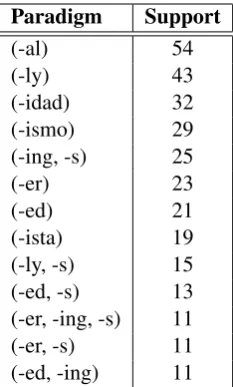
Table 6: Foreign influence among the top 30 most frequent Tagalog suffix paradigms
on under-documented languages for which seg-mented wordlists are hard to come by. The DARPA LORELEI project had originally planned to produce human-annotated segmentations for a wide range of languages, but this has not yet come to fruition. In response, we are developing simple annotation standards which linguists and knowl-edgeable native speakers may use to produce seg-mented wordlists of their own.
We have run segmentation on Navajo, Tagalog, and Yoruba in additional to the languages reported above. Unfortunately, because no gold standards are available, the algorithm’s performance can-not be assessed quantitatively. Additionally, the DARPA LORELEI and Wikipedia data which we tested on contain substantial English (and Spanish for Tagalog) vocabulary. Table 6 shows the effect this has on paradigms.
4 Discussion and Conclusion
The success of these unsupervised algorithms at-tests to what can be accomplished by gleaning in-formation from small corpora. The vowel har-mony detector describes harhar-mony systems with high accuracy at as few as 500 types. The segmen-tation performs very well, on languages for which its accuracy could be assessed quantitatively, with corpora orders of magnitude smaller than what can be successfully processed by the next best method. Nevertheless, both algorithms are incomplete.
An obvious next step is to combine the two into a single pipeline. This is projected to have bene-fits for both. One inconvenience with the current
iteration of the harmony detector is that it requires a linguist to provide features for each of the lan-guage’s vowels if a harmony mapping is desired. It would be nice for this process to happen auto-matically instead. And here it is useful to lever-age morphology. A langulever-age with affixal mor-phology and harmony should present two or more sets of paradigms which differ according to har-mony. For example, in Turkish, the plural -lar
occurs in paradigms with other back vowel allo-morphs while -ler occurs with other front vowel allomorphs. There should exist a mapping be-tween morphemes like -lar and -ler which dif-fer only in their vowels. Combining the evidence across all of the morphemes will allow us to cre-ate harmony mappings without explicit reference to features.
There are improvements to be made in the other direction as well. Vowel harmony information will improve segmentation accuracy. As it is, the seg-mentation algorithm has no way of knowing that two paradigms which differ only due to harmony constraints are in fact two sets of phonologically determined allomorphs. This forces it to spread sparse evidence over an unnecessarily large num-ber of paradigms. Understanding harmony will allow the algorithm to collapse these sets, calcu-late more accurate support, and therefore improve overall performance.
Harmony aside, a vital resource for estimating and improving the performance of the segmen-tation algorithm is the presence of morphologi-cally segmented gold standards in a variety of lan-guages. We have taken up this task and are work-ing towards annotation conventions for this kind of work. So far, we are still in the early phases of the process but have already begun annotation on Faroese and Korean as test languages. These are useful languages for testing because they ex-hibit a variety of affixes and alternations that need to be accounted for. With an effective annotation standard, we can also proceed to develop a new scoring metric for segmentation. It will address concerns raised by the existing MorphoChallenge metric (Kurimo et al., 2007) due to the lack of a unified annotation standard.
and/or suffixes, shows reduplication, etc. As with vowel harmony, these will aid linguists seeking to describe the grammars of undocumented lan-guages. Additionally, they will prove useful as in-puts to the segmentation algorithm.
Acknowledgments
We thank the rest of the University of Pennsylva-nia’s LORELEI summer research team for their helpful insights. We also thank audiences at the 10th Northeast Computational Phonology Circle (NECPhon) and Penn’s Computational Linguis-tics and Lunch series for their suggestions, as well as the anonymous reviewers for ComputEL-2 who gave us useful comments. This research was funded by the DARPA LORELEI program under Agreement No. HR0011-15-2-0023.
References
Adam C Baker. 2009. Two statistical approaches to finding vowel harmony. Technical report, Citeseer.
Mathias Creutz and Krista Lagus. 2005.Unsupervised
morpheme segmentation and morphology induction from text corpora using Morfessor 1.0. Helsinki University of Technology.
Eesti Kirjandusmuuseumi Folkloristika Osakond. 2005. Estnische sprichw¨orter.
Sharon Goldwater, Thomas L Griffiths, and Mark
John-son. 2006. Contextual dependencies in
unsu-pervised word segmentation. In Proceedings of
the 21st International Conference on Computational Linguistics and the 44th annual meeting of the Asso-ciation for Computational Linguistics, pages 673– 680. Association for Computational Linguistics.
Robert Thomas Harms. 1962.Estonian grammar,
vol-ume 28. Indiana University.
David Harrison, Emily Thomforde, and Michael OKeefe. 2004. The vowel harmony calculator. Mikko Kurimo, Mathias Creutz, and Matti Varjokallio.
2007. Morpho challenge evaluation using a
lin-guistic gold standard. In Workshop of the
Cross-Language Evaluation Forum for European Lan-guages, pages 864–872. Springer.
Mikko Kurimo, Sami Virpioja, Ville Turunen, and Krista Lagus. 2010. Morpho challenge
competi-tion 2005–2010: evaluacompeti-tions and results. In
Pro-ceedings of the 11th Meeting of the ACL Special Interest Group on Computational Morphology and Phonology, pages 87–95. Association for Computa-tional Linguistics.
Peter Ladefoged and B Blankenship. 2007. The ucla phonetics lab archive - buryat.
Constantine Lignos. 2010. Learning from unseen
data. InProceedings of the Morpho Challenge 2010
Workshop, pages 35–38.
Tomas Mikolov, Ilya Sutskever, Kai Chen, Greg S Cor-rado, and Jeff Dean. 2013. Distributed representa-tions of words and phrases and their
compositional-ity. InAdvances in neural information processing
systems, pages 3111–3119.
Karthik Narasimhan, Regina Barzilay, and Tommi
Jaakkola. 2015. An unsupervised method for
uncovering morphological chains. arXiv preprint
arXiv:1503.02335.
Has¸im Sak, Tunga G¨ung¨or, and Murat Sarac¸lar. 2008. Turkish language resources: Morphological parser, morphological disambiguator and web corpus. In
Advances in natural language processing, pages 417–427. Springer.
Nathan Sanders and K David Harrison. 2012. Dis-covering new vowel harmony patterns using a
pair-wise statistical model. In Poster presented at the
20th Manchester Phonology Meeting, University of Manchester.
Kairit Sirts and Sharon Goldwater. 2013. Minimally-supervised morphological segmentation using
adap-tor grammars. Transactions of the Association for
Computational Linguistics, 1:255–266.
Gregory T Stump. 2001. Inflectional morphology:
A theory of paradigm structure, volume 93. Cam-bridge University Press.
Stephen Swartz. 1997. Warlpiri yimi kuja karlipa