Unsupervised POS Induction with Word Embeddings
Chu-Cheng Lin Waleed Ammar Chris Dyer Lori Levin
School of Computer Science Carnegie Mellon University
{chuchenl,wammar,cdyer,lsl}@cs.cmu.edu
Abstract
Unsupervised word embeddings have been shown to be valuable as features in supervised learning problems; however, their role in unsu-pervised problems has been less thoroughly ex-plored. In this paper, we show that embeddings can likewise add value to the problem of unsu-pervised POS induction. In two representative models of POS induction, we replace multi-nomial distributions over the vocabulary with multivariate Gaussian distributions over word embeddings and observe consistent improve-ments in eight languages. We also analyze the effect of various choices while inducing word embeddings on “downstream” POS induction results.
1 Introduction
Unsupervised POS induction is the problem of as-signing word tokens to syntactic categories given only a corpus of untagged text. In this paper we
ex-plore the effect of replacing words with their vector
space embeddings1 in two POS induction models:
the classic first-order HMM (Kupiec, 1992) and the newly introduced conditional random field autoen-coder (Ammar et al., 2014). In each model, instead
of using a conditional multinomial distribution2 to
generate a word tokenwi ∈Vgiven a POS tagti ∈T,
we use a conditional Gaussian distribution and
gen-erate a d-dimensional word embedding vwi ∈ R
d
giventi.
1Unlike Yatbaz et al. (2014), we leverage easily obtainable and widely used embeddings of word types.
2Also known as a categorical distribution.
Our findings suggest that, in both models, sub-stantial improvements are possible when word em-beddings are used rather than opaque word types. However, the independence assumptions made by the model used to induce embeddings strongly
deter-mines its effectiveness for POS induction: embedding
models that model short-range context are more ef-fective than those that model longer-range contexts. This result is unsurprising, but it illustrates the lack of an evaluation metric that measures the syntactic (rather than semantic) information in word embed-dings. Our results also confirm the conclusions of Sirts et al. (2014) who were likewise able to improve POS induction results, albeit using a custom clus-tering model based on the the distance-dependent Chinese restaurant process (Blei and Frazier, 2011). Our contributions are as follows: (i) reparameter-ization of token-level POS induction models to use word embeddings; and (ii) a systematic evaluation of word embeddings with respect to the syntactic information they contain.
2 Vector Space Word Embeddings
Word embeddings represent words in a language’s
vocabulary as points in ad-dimensional space such
that nearby words (points) are similar in terms of their distributional properties. A variety of techniques for learning embeddings have been proposed, e.g., matrix factorization (Deerwester et al., 1990; Dhillon et al., 2011) and neural language modeling (Mikolov et al., 2011; Collobert and Weston, 2008).
For the POS induction task, we specifically need embeddings that capture syntactic similarities. There-fore we experiment with two types of embeddings
that are known for such properties:
• Skip-gram embeddings(Mikolov et al., 2013) are based on a log bilinear model that predicts an un-ordered set of context words given a target word. Bansal et al. (2014) found that smaller context win-dow sizes tend to result in embeddings with more syntactic information. We confirm this finding in our experiments.
• Structured skip-gram embeddings(Ling et al.,
2015) extend thestandardskip-gram embeddings
(Mikolov et al., 2013) by taking into account the relative positions of words in a given context.
We use the toolword2vec3and Ling et al. (2015)’s
modified version4to generate both plain and
struc-tured skip-gram embeddings in nine languages.
3 Models for POS Induction
In this section, we briefly review two classes of mod-els used for POS induction (HMMs and CRF autoen-coders), and explain how to generate word embed-ding observations in each class. We will represent a sentence of length`as w = hw1,w2,. . . ,w`i ∈ V`
and a sequence of tags as t = ht1,t2,. . . ,t`i ∈ T`.
The embeddings of word typew ∈V will be written
asvw ∈Rd.
3.1 Hidden Markov Models
The hidden Markov model with multinomial emis-sions is a classic model for POS induction. This model makes the assumption that a latent Markov pro-cess with discrete states representing POS categories emits individual words in the vocabulary according to state (i.e., tag) specific emission distributions. An HMM thus defines the following joint distribution over sequences of observations and tags:
p(w,t) = ` Y
i=1
p(ti |ti−1)×p(wi | ti) (1)
where distributionsp(ti |ti−1) represents the
transi-tion probability andp(wi | ti) is the emission
prob-ability, the probability of a particular tag generating the word at positioni.5
We consider two variants of the HMM as baselines:
3https://code.google.com/p/word2vec/
4https://github.com/wlin12/wang2vec/
5Terms for the starting and stopping transition probabilities are omitted for brevity.
• p(wi | ti) is parameterized as a “naïve
multino-mial” distribution with one distinct parameter for each word type.
• p(wi |ti) is parameterized as a multinomial
logis-tic regression model with hand-engineered features as detailed in (Berg-Kirkpatrick et al., 2010).
Gaussian Emissions. We now consider
incorporat-ing word embeddincorporat-ings in the HMM. Given a tagt ∈T,
instead of generating the observed wordw∈V, we
generate the (pre-trained) embeddingvw ∈Rdof that
word. The conditional probability density assigned
tovw |tfollows a multivariate Gaussian distribution
with meanµt and covariance matrixΣt:
p(vw;µt,Σt) =
exp−12(vw−µt)>Σ−t1(vw−µt)
p
(2π)d|Σt|
(2) This parameterization makes the assumption that
em-beddings of words which are often tagged ast are
concentrated around some point µt ∈ Rd, and the
concentration decays according to the covariance ma-trixΣt.6
Now, the joint distribution over a sequence of observations v = hvw1,vw2. . . ,vw`i (which
corre-sponds to word sequencew=hw1,w2,. . . ,w`,i) and
a tag sequencet=ht1,t2. . . ,t`ibecomes:
p(v,t) = ` Y
i=1
p(ti |ti−1)×p(vwi;µti,Σti)
We use the Baum–Welch algorithm to fit the µt
andΣti parameters. In every iteration, we updateµt∗
as follows:
µnew t∗ =
P
v∈TP Pi=1...`p(ti =t∗| v)×vwi
v∈TPi=1...`p(ti =t∗| v)
(3)
whereT is a data set of word embedding sequences
v each of length|v| = `, and p(ti = t∗ | v) is the
posterior probability of labelt∗at positioniin the
sequencev. Likewise the update toΣt∗ is:
Σnew t∗ =
P
v∈TP Pi=1...`p(ti =t∗ |v)×δδ> v∈T Pi=1...`p(ti =t∗| v)
(4)
whereδ =vwi −µnewt∗ .
3.2 Conditional Random Field Autoencoders
The second class of models this work extends is called CRF autoencoders, which we recently pro-posed in (Ammar et al., 2014). It is a scalable family of models for feature-rich learning from unlabeled examples. The model conditions on one copy of the structured input, and generates a reconstruction of the input via a set of interdependent latent variables which represent the linguistic structure of interest. As shown in Eq. 5, the model factorizes into two distinct
parts: the encoding modelp(t | w) and the
recon-struction modelp(wˆ | t); wherewis the structured
input (e.g., a token sequence),tis the linguistic
struc-ture of interest (e.g., a sequence of POS tags), and
ˆ
wis a generic reconstruction of the input. For POS
induction, the encoding model is a linear-chain CRF
with feature vectorλand local feature functionsf.
p(wˆ,t | w) =p(t | w)×p(wˆ | t)
∝p(wˆ | t)×expλ·
|w|
X
i=1
f(ti,ti−1,w) (5)
In (Ammar et al., 2014), we explored two kinds of
reconstructionswˆ: surface forms and Brown clusters
(Brown et al., 1992), and used “stupid multinomials”
as the underlying distributions for re-generatingwˆ.
Gaussian Reconstruction. In this paper, we used
-dimensional word embedding reconstructions ˆwi =
vwi ∈R
d, and replace the multinomial distribution of
the reconstruction model with the multivariate Gaus-sian distribution in Eq. 2. We again use the Baum–
Welch algorithm to estimate µt∗ andΣt∗ similar to
Eq. 3. The only difference is that posterior label
prob-abilities are now conditional on both the input
se-quence w and the embeddings sequence v, i.e.,
re-placep(ti =t∗ | v) in Eq. 2 withp(ti=t∗| w,v).
4 Experiments
In this section, we attempt to answer the following questions:
• §4.1: Do syntactically-informed word embeddings
improve POS induction? Which model performs best?
• §4.2: What kind of word embeddings are suitable
for POS induction?
4.1 Choice of POS Induction Models
Here, we compare the following models for POS induction:
• Baseline: HMM with multinomial emissions
(Ku-piec, 1992),
• Baseline: HMM with log-linear emissions
(Berg-Kirkpatrick et al., 2010),
• Baseline: CRF autoencoder with multinomial
re-constructions (Ammar et al., 2014),7
• Proposed: HMM with Gaussian emissions, and
• Proposed: CRF autoencoder with Gaussian
recon-structions.
Data. To train the POS induction models, we used the plain text from the training sections of the CoNLL-X shared task (Buchholz and Marsi, 2006) (for Danish and Turkish), the CoNLL 2007 shared task (Nivre et al., 2007) (for Arabic, Basque, Greek, Hungarian and Italian), and the Ukwabelana corpus (Spiegler et al., 2010) (for Zulu). For evaluation, we obtain the corresponding gold-standard POS tags by deterministically mapping the language-specific POS tags in the aforementioned corpora to the correspond-ing universal POS tag set (Petrov et al., 2012). This is the same set up we used in (Ammar et al., 2014).
Setup. In this section, we used skip-gram (i.e.,
word2vec) embeddings with a context window size
= 1 and with dimensionalityd = 100, trained with
the largest corpora for each language in (Quasthoff
et al., 2006), in addition to the plain text used to train
the POS induction models.8In the proposed models,
we only show results for estimating µt, assuming
a diagonal covariance matrixΣt(k,k) = 0.45∀k ∈
{1,. . . ,d}.9While the CRF autoencoder with multi-nomial reconstructions were carefully initialized as
7We use the configuration with best performance which re-constructs Brown clusters.
8We used thecorpus/tokenize-anything.shscript in the cdec decoder (Dyer et al., 2010) to tokenize the corpora from (Quasthoffet al., 2006). The other corpora were already tokenized. In Arabic and Italian, we found a lot of discrepancies between the tokenization used for inducing word embeddings and the tokenization used for evaluation. We expect our results to improve with consistent tokenization.
9Surprisingly, we found that estimatingΣtsignificantly
Arabic Basque Danish Greek Hungarian Italian Turkish Zulu Average
V−measure
0.0
0.2
0.4
0.6
0.8 Multinomial HMM
Multinomial Featurized HMM
Multinomial CRF Autoencoder Gaussian HMM
Gaussian CRF Autoencoder
Arabic Basque Danish Greek Hungarian Italian Turkish Zulu Average
V−measure
0.0
0.2
0.4
0.6
0.8 HMM (standard skip−gram)
CRF Autoencoder (standard skip−gram)
[image:4.612.75.557.80.169.2]HMM (structured skip−gram) CRF Autoencoder (structured skip−gram)
Figure 1: POS induction results. (V-measure, higher is better.) Window size is 1 for all word embeddings.
Left: Models which use standard skip-gram word embeddings (i.e., Gaussian HMM and Gaussian CRF
Autoencoder) outperform all baselines on average across languages.Right: comparison between standard
and structured skip-grams on Gaussian HMM and CRF Autoencoder.
discussed in (Ammar et al., 2014), CRF autoencoder with Gaussian reconstructions were initialized
uni-formly at random in [−1,1]. All HMM models were
also randomly initialized. We tuned all hyperparame-ters on the English PTB corpus, then fixed them for all languages.
Evaluation. We use the V-measure evaluation met-ric (Rosenberg and Hirschberg, 2007) to evaluate the
predicted syntactic classes at the token level.10
Results. The results in Fig. 1 clearly suggest that we can use word embeddings to improve POS induc-tion. Surprisingly, the feature-less Gaussian HMM model outperforms the strong feature-rich baselines: Multinomial Featurized HMM and Multinomial CRF Autoencoder. One explanation is that our word em-beddings were induced using larger unlabeled cor-pora than those used to train the POS induction mod-els. The best results are obtained using both word em-beddings and feature-rich models using the Gaussian CRF autoencoder model. This set of results suggest that word embeddings and hand-engineered features play complementary roles in POS induction. It is worth noting that the CRF autoencoder model with Gaussian reconstructions did not require careful ini-tialization.11
10We found the V-measure results to be consistent with the many-to-one evaluation metric (Johnson, 2007). We only show one set of results for brevity.
11In (Ammar et al., 2014), we found that careful initialization for the CRF autoencoder model with multinomial reconstructions is necessary.
4.2 Choice of Embeddings
Standard skip-gram vs. structured skip-gram.
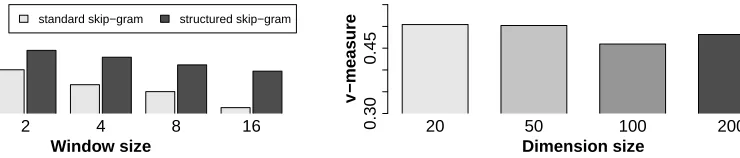
On Gaussian HMMs, structured skip-gram embed-dings score moderately higher than standard skip-grams. And as context window size gets larger, the gap widens (as shown in Fig. 2.) The reason may be that structured skip-gram embeddings give each position within the context window its own project
matrix, so the smearing effect is not as pronounced
as the window grows when compared to the standard embeddings. However the best performance is still
obtained when window size is small.12
Dimensions =20 vs. 200. We also varied the
number of dimensions in the word vectors (d ∈
{20,50,100,200}). The best V-measure we obtain
is 0.504 (d =20) and the worst is 0.460 (d =100).
However, we did not observe a consistent pattern as shown in Fig. 3.
Window size=1 vs. 16. Finally, we varied the win-dow size for the context surrounding target words (w ∈ {1,2,4,8,16}). w = 1 yields the best average
V-measure across the eight languages as shown in Fig. 2. This is true for both standard and structured
1 2 4 8 16
Window size
a
vg. V−measure
0.30
0.45
[image:5.612.71.298.76.156.2]standard skip−gram structured skip−gram
Figure 2: Effect of window size and embeddings type
on POS induction over the languages in Fig. 1.d =
100. The model is HMM with Gaussian emissions.
skip-gram models. Notably, larger window sizes ap-pear to produce word embeddings with less syntactic information. This result confirms the observations of Bansal et al. (2014).
4.3 Discussion
We have shown that (re)generating word embeddings does much better than generating opaque word types in unsupervised POS induction. At a high level, this confirms prior findings that unsupervised word em-beddings capture syntactic properties of words, and
shows that different embeddings capture more
syn-tactically salient information than others. As such, we contend that unsupervised POS induction can be seen as a diagnostic metric for assessing the syntactic quality of embeddings.
To get a better understanding of what the multi-variate Gaussian models have learned, we conduct a hill-climbing experiment on our English dataset. We seed each POS category with the average vector of 10 randomly sampled words from that category and train the model. Seeding unsurprisingly improves tag-ging performance. We also find words that are the nearest to the centroids generally agree with the cor-rect category label, which validate our assumption that syntactically similar words tend to cluster in the high-dimensional embedding space. It also shows that careful initialization of model parameters can bring further improvements.
However we also find that words that are close to the centroid are not necessarily representative of what linguists consider to be prototypical. For exam-ple, Hopper and Thompson (1983) show that physical, telic, past tense verbs are more prototypical with re-spect to case marking, agreement, and other syntactic
20 50 100 200
Dimension size
V−measure
0.30
[image:5.612.140.510.79.158.2]0.45
Figure 3: Effect of dimension size on POS induction
on a subset of the English PTB corpus.w =1. The
model is HMM with Gaussian emissions.
behavior. However, the verbs nearest our centroid all seem rather abstract. In English, the nearest 5 words
in the verb category are entails, aspires, attaches,
foresees, deems. This may be because these words seldom serve functions other than verbs; and plac-ing the centroid around them incurs less penalty (in
contrast to physical verbs, e.g.bite, which often also
act as nouns). Therefore one should be cautious in interpreting what is prototypical about them.
5 Conclusion
We propose using a multivariate Gaussian model to generate vector space representations of observed words in generative or hybrid models for POS induc-tion, as a superior alternative to using multinomial distributions to generate categorical word types. We find the performance from a simple Gaussian HMM competitive with strong feature-rich baselines. We further show that substituting the emission part of the CRF autoencoder can bring further improvements. We also confirm previous findings which suggest that smaller context windows in skip-gram models result in word embeddings which encode more syn-tactic information. It would be interesting to see if we can apply this approach to other tasks which require generative modeling of textual observations such as language modeling and grammar induction.
Acknowledgements
This work was sponsored by the U.S. Army Research
Laboratory and the U.S. Army Research Office
un-der contract/grant numbers W911NF-11-2-0042 and
References
Waleed Ammar, Chris Dyer, and Noah A. Smith. 2014. Conditional random field autoencoders for unsuper-vised structured prediction. InNIPS.
Mohit Bansal, Kevin Gimpel, and Karen Livescu. 2014. Tailoring continuous word representations for depen-dency parsing. InProc. of ACL.
Taylor Berg-Kirkpatrick, Alexandre Bouchard-Côté, John DeNero, and Dan Klein. 2010. Painless unsupervised learning with features. InProc. of NAACL.
David M. Blei and Peter I. Frazier. 2011. Distance depen-dent Chinese restaurant processes. JMLR.
Peter F. Brown, Peter V. deSouza, Robert L. Mercer, Vin-cent J. Della Pietra, and Jenifer C. Lai. 1992. Class-based n-gram models of natural language. Computa-tional Linguistics.
Sabine Buchholz and Erwin Marsi. 2006. CoNLL-X shared task on multilingual dependency parsing. In CoNLL-X.
Ronan Collobert and Jason Weston. 2008. A unified ar-chitecture for natural language processing: Deep neural networks with multitask learning. InProc. of ICML. Ronan Collobert, Jason Weston, Léon Bottou, Michael
Karlen, Koray Kavukcuoglu, and Pavel Kuksa. 2011. Natural language processing (almost) from scratch. JMLR, 12:2493–2537, November.
Scott Deerwester, Susan T. Dumais, George W. Furnas, Thomas K. Landauer, and Richard Harshman. 1990. Indexing by latent semantic analysis. Journal of the American society for information science, 41(6):391– 407.
Paramveer S. Dhillon, Dean Foster, and Lyle Ungar. 2011. Multi-view learning of word embeddings via CCA. In NIPS, volume 24.
Chris Dyer, Adam Lopez, Juri Ganitkevitch, Johnathan Weese, Ferhan Ture, Phil Blunsom, Hendra Setiawan, Vladimir Eidelman, and Philip Resnik. 2010. cdec: A decoder, alignment, and learning framework for finite-state and context-free translation models. InProc. of ACL.
J. Gauvain and Chin-Hui Lee. 1994. Maximum a pos-teriori estimation for multivariate Gaussian mixture observations of Markov chains.Speech and Audio Pro-cessing, IEEE Transactions on, 2(2):291–298, Apr. Paul Hopper and Sandra Thompson. 1983. The iconicity
of the universal categories “noun” and “verb”. In John Haiman, editor,Iconicity in Syntax: Proceedings of a symposium on iconicity in syntax.
Mark Johnson. 2007. Why doesn’t EM find good HMM POS-taggers? InProc. of EMNLP.
Julian Kupiec. 1992. Robust part-of-speech tagging us-ing a hidden Markov model. Computer Speech and Language, 6:225–242.
Wang Ling, Chris Dyer, Alan Black, and Isabel Trancoso. 2015. Two/too simple adaptations of word2vec for syntax problems. InProc. of NAACL.
Tomas Mikolov, Stefan Kombrink, Anoop Deoras, Lukar Burget, and J Cernocky. 2011. RNNLM — recurrent neural network language modeling toolkit. InProc. of the 2011 ASRU Workshop, pages 196–201.
Tomas Mikolov, Kai Chen, Greg Corrado, and Jeffrey Dean. 2013. Efficient estimation of word represen-tations in vector space.ArXiv e-prints, January. Joakim Nivre, Johan Hall, Sandra Kubler, Ryan McDonald,
Jens Nilsson, Sebastian Riedel, and Deniz Yuret. 2007. The CoNLL 2007 shared task on dependency parsing. InProc. of CoNLL.
Slav Petrov, Dipanjan Das, and Ryan McDonald. 2012. A universal part-of-speech tagset. InProc. of LREC, May.
Uwe Quasthoff, Matthias Richter, and Christian Biemann. 2006. Corpus portal for search in monolingual corpora. InProc. of LREC, pages 1799–1802.
Andrew Rosenberg and Julia Hirschberg. 2007. V-measure: A conditional entropy-based external cluster evaluation measure. InEMNLP-CoNLL.
T. Shinozaki and T. Kawahara. 2007. HMM training based on CV-EM and CV gaussian mixture optimiza-tion. InProc. of the 2007 ASRU Workshop, pages 318– 322, Dec.
Kairit Sirts, Jacob Eisenstein, Micha Elsner, and Sharon Goldwater. 2014. POS induction with distribu-tional and morphological information using a distance-dependent Chinese restaurant process. InProc. of ACL. Sebastian Spiegler, Andrew van der Spuy, and Peter A. Flach. 2010. Ukwabelana: An open-source morpho-logical Zulu corpus. InProc. of COLING, pages 1020– 1028.