CASSA: A Context-Aware Synonym Simplification Algorithm
Ricardo Baeza-Yates Yahoo Labs & Web Research Group Universitat Pompeu Fabra,
Barcelona, Spain [email protected]
Luz Rello
Human-Computer Interaction Institute Carnegie Mellon University
Pittsburgh, PA, USA [email protected]
Julia Dembowski Department of Computational Linguistics Saarland University, Germany [email protected]
Abstract
We present a new context-aware method for lexical simplification that uses two free lan-guage resources and real web frequencies. We compare it with the state-of-the-art method for lexical simplification in Spanish and the es-tablished simplification baseline, that is, the most frequent synonym. Our method im-proves upon the other methods in the detection of complex words, in meaning preservation, and in simplicity. Although we use Spanish, the method can be extended to other languages since it does not require alignment of parallel corpora.
1 Introduction
Simplified text is crucial for some populations to read effectively, especially for cognitively impaired people such as people with autism spectrum disor-der (Evans et al., 2014; Orasan et al., 2013), aphasia (Carroll et al., 1999), dyslexia (Rello et al., 2013a), Down syndrome (Saggion et al., 2015; Saggion et al., 2011), or other intellectual disabilities (Huener-fauth et al., 2009).
In fact, the United Nations (1994) proposed a set of standard rules to leverage document accessibility for persons with disabilities. Text simplification at-tempts to solve this problem automatically by reduc-ing the complexity of the lexicon, syntax, or seman-tics while attempting to preserve its meaning and in-formation content (Siddharthan, 2006). Among all the types of text simplification this paper focuses on lexical simplification.
Lexical simplification methods require language resources, such as simplified corpora or synonyms dictionaries. For languages with less resources than English, e.g. no Simple Wikipedia (Biran et al., 2011; Yatskar et al., 2010) or less representation in WordNet, such as Spanish,1 the creation of lexical simplification methods is more challenging.
Our approach makes use of two free resources, Google Books Ngram Corpus and the Spanish OpenThesaurus, as well as real web frequencies to create a lexical simplification system. Our system improves upon the state of the art for lexical simpli-fication in Spanish and the established simplisimpli-fication baseline,i.e., the most frequent synonym, in several aspects: complex word detection, meaning preser-vation, and simplicity. We also show the coverage of our technique in a collection of books in Spanish, as this is another relevant measure of a simplifica-tion algorithm. The method is language independent and given that these resources are available in other languages, it could be easily extended to other lan-guages with similar language resources.
The rest of the paper is organized as follows. The next section presents related work. Then in Section 3 we present the simplification algorithm while in Sec-tions 4 and 5 we present our experimental evalua-tion. Finally, in Section 6 we discuss our results, ex-tensions to other languages, and outline future work.
1The Spanish part of EuroWordNet contains only 50,526
word meanings and 23,370 synsets, in comparison to 187,602 meanings and 94,515 synsets in the English WordNet 1.5. (Vossen, 2004).
2 Related Work
Lexical simplificationis a kind of text simplification that aims at the word level. It can be performed through the substitution of words by simpler syn-onyms, by adding a definition, or by showing sim-pler synonyms. Most of the approaches aim at the substitution of complex words.
To find appropriate synonyms, many approaches use WordNet (Burstein et al., 2007; Carroll et al., 1999; Lal and Ruger, 2002). De Belder et al. (2010) apply explicit word sense disambiguation with a latent words language model. Devlin and Un-thank (2006) use dictionaries. Aluisio and Gasperin (2010) use a thesaurus and lexical ontologies.
More recently, Biran et al. (2011) and Yatskar et al. (2010) used Simple English Wikipedia, in combination with the standard English Wikipedia for their lexical simplification algorithms using ma-chine learning.
There are also machine translation based ap-proaches (Coster and Kauchak, 2011; Specia, 2010) as well as hybrid approaches (Narayan and Gardent, 2014; Siddharthan and Angrosh, 2014) that are also able to handle lexical simplification, since the trans-lation model maps words from the non-simplified language to words of the simplified language.
The closest algorithm to ours is LexSiS (Bott et al., 2012; Saggion et al., 2013), that uses the Span-ish OpenThesaurus and a corpus that contains 6,595 words of original and 3,912 words of manually sim-plified news articles. To the best of our knowledge this is the first and only lexical simplification algo-rithm for Spanish. Hence, we use it here as the state-of-the-art in our evaluation.
To the best of our knowledge, our approach is novel in using the Google Books Ngram corpus for the word context, Open Thesaurus for the syn-onyms, and real web frequencies for disambiguat-ing synonym candidates. However, Google Ngram have been previously used to find synonyms, for instance to expand user queries by including syn-onyms (Baker and Lamping, 2011).
3 Method
CASSA (Context-Aware Synonym Simplification Algorithm) is a method that generates simpler syn-onyms of a word. It takes into consideration the
con-text and the web frequency of the complex word for disambiguation.
3.1 Resources
Our method uses the following two resources:
– Spanish OpenThesaurus (version 2): The thesaurus is freely available2 to be used with OpenOffice.org. This thesaurus provides 21,378 target words (lemmas) with a total of 44,348 different word senses for them. The following is a part of the thesaurus entry for farol, which is ambiguous, as it could mean ‘lie’, ‘lamp’, or the adjective ‘flashy’, among others.
farol
- embuste|mentira (‘lie’)
- luz|l´ampara|fuego|bombilla
(‘lamp’)
- ostentoso|jactancioso|farolero
(‘flashy’)
– Google Books Ngram Corpus for Spanish (2012 edition): The corpus consists of n-grams and their usage frequency over time,3 and is derived from 8,116,746 books, over 6% of all books ever published. The corpus has 854,649 volumes and 83,967,471,303 tokens (Lin et al., 2012).
3.2 Algorithm Description
First, we modified and enriched the Spanish OpenThesaurus and created our List of Senses. In-stead of having a target word with different senses, we included the target word in each sense, and we kept a list of unique senses, including for each word its frequency in the Web using a large search engine index. The Spanish OpenThesaurus contains single-word and multi-single-word expressions. We only treated single-word units, which represent 98% of the cases, leaving out only 399 multi-word expressions, such asde esta forma (‘in this manner’).
We lemmatized the words because the frequen-cies were all for inflected word forms as they ap-pear in the Web while we were interested in the lemma frequencies for the synonyms, adding all the
frequencies for each lemma. We take into account the frequency of the words, because previous stud-ies have shown that less frequent words were found to be more challenging for people with and without the most frequent reading disorder, that is, dyslexia (Rello et al., 2013b).
Second, we use the 5-grams in the Google Books Ngram Corpus, where we use the third token of each 5-gram as our target words. The other tokens are the context of the target word. A context is considered valid if all words, including the target word, consist only of lowercase alphabetic characters, to filter for proper names, and is not a stop word, using a stan-dard list of stop words in Spanish.
The lemmatized token is included in the list of target words only if it appears in our List of Senses. The remaining four tokens are the context, kept in a context list. We count the frequency of the target word appearing with that context in the corpus, as well as the frequency of the same context appearing with different target words. See two possible con-texts fornocheandfortunain the examples below:
era una noche oscura de(‘it was a dark night of’) de probar fortuna en el(‘to try fortune in the’) Third, we define the complexity of a word using the relative frequency of the synonyms within the same sense in the List of Senses.
That is, our definition is tailored to web text. For this we use a parameter k such that if a word isk or more times less frequent than one or more of its synonyms, is considered a complex word. We used k = 10as the default threshold to get that 27% of the words have simpler synonyms. We later show how this percentage changes with smallerk.
Finally, for each complex word and the contexts it appears in, we select as simpler synonym the most frequent synonym of the sense that appears most frequently for the n-gram corresponding to that
(word, context)pair. That is, to disambiguate the
sense, our method uses the context where the target word appears. If the context is not found, we use the most frequent sense (baseline below).
4 Quality Evaluation
4.1 Comparison Points
Baseline: replaces a word with its most frequent synonym (presumed to be the simplest). This
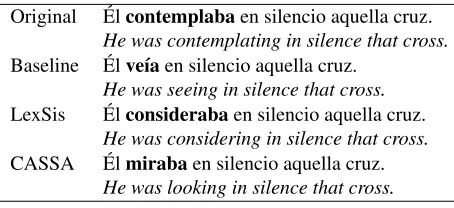
base-Original ´Elcontemplabaen silencio aquella cruz.
He was contemplating in silence that cross.
Baseline ´Elve´ıaen silencio aquella cruz.
He was seeing in silence that cross.
LexSis ´Elconsiderabaen silencio aquella cruz.
He was considering in silence that cross.
CASSA ´Elmirabaen silencio aquella cruz.
[image:3.612.314.541.54.158.2]He was looking in silence that cross.
Figure 1: Example of substitutions performed by the three algorithms.
line has been broadly used in previous lexical sim-plification studies (Burstein et al., 2007; Carroll et al., 1999; Devlin and Unthank, 2006; Lal and Ruger, 2002), with the exception of (Bott et al., 2012) that used word frequency and length. It is very hard to beat this baseline for simpler synonyms generation. For instance, in SemEval task for English lexical simplification (Specia et al., 2012), only one sys-tem out of nine outperformed the frequency base-line. For the complexity part we use the same as our new method. That is, both algorithms consider the same words as complex.
LexSiS: replaces a word with the output of the state-of-the-art method for Spanish lexical simplifi-cation (Bott et al., 2012).
4.2 Frequency Bands
We divided the selected complex words methods into two groups: [LOW], that includes very low frequency complex words, and [HIGH], that con-tains high frequency complex words. The word frequency ranges from 40 to 2,000 occurrences in Google Books Ngram Corpus for the [LOW] group, and from 2,001 to 1,300,000 for the [HIGH] group.
4.3 Evaluation Datasets
shows a set of substitutions along with the original sentence.
Similar studies had smaller or slightly larger eval-uation data sets. In Yatskar et al. (2010), 200 simplification examples were rated by six annota-tors (three native, three non-native speakers of En-glish), although only the native speakers annotations were used for the results because they yielded higher inter-annotator agreement. Biranet al. (2011) used 130 examples that were judged by three annotators (native English speakers). In Bottet al.(2012), three annotators (native speakers of Spanish) rated 69 sen-tences each of the Spanish lexical simplification per-formed by LexSiS.
Complexity dataset: This dataset was created to evaluate the degree of complexity of the words se-lected by the algorithms. Using the same texts as before we extracted 40 random complex words ac-cording to LexSiS and 40 acac-cording to our method (recall that those also are complex for the baseline).
4.4 Judgment Guidelines
We presented the 200 examples in two different on-line tests, one for each evaluation dataset. The exam-ples were presented in random order to three native Spanish speakers, frequent readers and non-authors of this paper. For the Main Dataset each annota-tor rated the simplification examples on two scales: Meaning Preservation –does the transformation pre-serve the original meaning of the sentence (yes/no); and Simplification –does the transformation result in a simpler sentence (more complex, same complexity or simpler). For the Complexity Dataset the annota-tors rated the examples on a three point scale (com-plex, neither complex or simple and simple).
We used Fleiss Kappa (Fleiss, 1971) to measure the inter-annotator agreement for multiple raters. We obtained a reasonable agreement: 0.46 for mean-ing preservation, 0.54 for simplicity ratmean-ings, and 0.41 for complexity. Hence, we have a moderate agreement (Landis and Koch, 1977), comparable with agreements in related literature (Biran et al., 2011; Bott et al., 2012; Yatskar et al., 2010).
4.5 Results
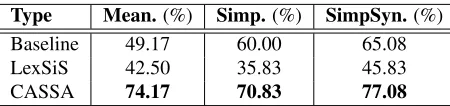
In Table 1 we show the results for the Main Dataset, where in the last column we consider only the
sim-Type Mean.(%) Simp.(%) SimpSyn.(%)
Baseline 49.17 60.00 65.08
LexSiS 42.50 35.83 45.83
[image:4.612.314.539.54.107.2]CASSA 74.17 70.83 77.08
Table 1: Average percentage scores in meaning preser-vation (Mean.), simplification (Simp.), and simplification among the synonyms (SimpSyn.).
pler synonym substitutions (21 for Baseline, 16 for LexSiS, and 32 for ours) that preserved their mean-ing (agreement of 2 annotators). In this case, the simplicity performance improves for all the meth-ods. In Table 2 we give the results for the two band frequencies for meaning preservation and simplicity. In the dataset our method overlaps in 15.79% with LexSiS candidates and in 65.79% with the baseline. The results of LexSiS are consistent with the ones presented in Bottet al. (2012) for the news genre. In that study only for one dataset among three im-proved upon the frequency baseline in some mea-sures (meaning preservation and global simplicity). As it can be observed from the frequency band re-sults and the complexity measure, LexSiS offers bet-ter synonyms for high frequency and not for low fre-quency words. On the other hand, our method im-proves with low frequency complex words.
In the complexity evaluation, the prediction accu-racy for complex words was only 13.33% for Lex-Sis while was more than double, 34.17%, for ours (idem for the baseline as it used the same complex-ity criteria). The percentages for the complexcomplex-ity are low as the annotators were regular readers and non-impaired native speakers. For people with lan-guage difficulties or cognitive disabilities the accu-racy should be higher because people which cogni-tive disabilities are more sensicogni-tive to text simplifi-cations, such as people with Down Syndrome (Sag-gion et al., 2015), dyslexia (Rello and Baeza-Yates, 2014), or mild intellectual disabilities (Huenerfauth et al., 2009).
5 Coverage Evaluation
Type Freq. Meaning(%) Simp.(%)
Baseline [HIGH] 40.00 58.33
LexSiS [HIGH] 41.67 36.67
CASSA [HIGH] 73.33 70.00
Baseline [LOW] 58.33 61.67
LexSiS [LOW] 43.33 35.00
[image:5.612.79.292.54.144.2]CASSA [LOW] 75.00 71.67
Table 2: Average percentage scores by frequency band.
Case k= 10 k= 5 k= 2 Nok
Comp. words 27.16 38.80 54.24 100.00 Baseline (abs.) 24.07 35.32 50.14 84.43 Baseline (rel.) 88.62 91.03 92.04 84.43 Comp. contexts 27.95 40.03 55.84 100.00
CASSA (abs.) 2.67 4.14 6.44 12.14
CASSA (rel.) 9.55 10.34 11.53 12.14
Table 3: Coverage of the baseline and our method.
method. We included the books that are compulsory readings for secondary and high school in Spain. This corpus is composed by 16,495,885 tokens and 5,886,366 lexical words (without stop words, proper names and punctuation marks).4
The coverage of the Spanish Open Thesaurus in our corpus is 88.34%.5 This is the maximum that any simplification algorithm that uses this resource can obtain. In Table 3 we present the coverage of the baseline and our method depending on the threshold kused to decide what a complex word is and hence a complex content, including the absolute percentages as well as the relative percentages with respect to the complex words or contexts.
For smaller k, the coverage of the baseline in-creases significantly being the maximum possible 84.43% when all words are considered complex (more than three times the default coverage). On the other hand, our method does not increase much the coverage as that is limited by the context cov-erage reaching a maximum of 12.14%, only 27% more than the default case (k = 10). This maxi-mum, compared with the baseline is a bit more than 14% of the cases, implying that our method is equal to the baseline around 85% of the time.
4All the book titles used for this corpus are given in the
Ap-pendix of Rello (2014).
5Note that this only applies to the corpus used in the
cover-age, not for the evaluation dataset.
Considering the maximum possible coverage of the baseline and assuming that all non covered sen-tences contain complex words (most probable case), the simplicity performance of the baseline drops to 53.1% while for ours would be 54.2% (that is, a 2.1% improvement). This should improve if any of the resources used grow.
6 Conclusions and Future Work
Our method improves upon LexSiS and the base-line for all the measures. As we mentioned earlier, even beating the baseline is very hard and we im-prove upon both other methods by more than 50% in meaning preservation and is 11.8% better than the baseline, the second best, for simplicity. Compared to the results for English of Biranet al.(2011) using WordNet, our method has better simplicity scores for low frequency words as well as is in meaning preservation, although they are not directly compa-rable as different resources are used.
Although Open Thesaurus is available in nine lan-guages and Google Books Ngrams in seven, there are only two languages in both sets: Spanish and German. Hence our method should be easily ex-tended to German. Other languages are also possible with language resources, in particular English. Acknowledgments
We thank Diego Saez-Trumper, Eduardo Graells and Miguel Ballesteros for their suggestions in the im-plementation of CASSA.
References
S. M. Alu´ısio and C. Gasperin. 2010. Fostering digital inclusion and accessibility: the PorSimples project for simplification of Portuguese texts. InProc. NAACL HLT ’10 Workshop YIWCALA ’10, pages 46– 53, Stroudsburg, PA, USA.
S. D. Baker and J. O. Lamping. 2011. Identifying a syn-onym with n-gram agreement for a query phrase. US Patent 7,925,498.
O. Biran, S. Brody, and N. Elhadad. 2011. Putting it simply: a context-aware approach to lexical simpli-fication. InProc. ACL’11, pages 496–501, Portland, Oregon, USA.
J. Burstein, J. Shore, J. Sabatini, Yong-Won Lee, and M. Ventura. 2007. The automated text adaptation tool. (demo). InProc. NAACL’07, pages 3–4.
J. Carroll, G. Minnen, D. Pearce, Y. Canning, S. De-vlin, and J. Tait. 1999. Simplifying text for language-impaired readers. InProc. EACL ’09, pages 269–270. W. Coster and D. Kauchak. 2011. Learning to sim-plify sentences using wikipedia. In Proceedings of the Workshop on Monolingual Text-To-Text Genera-tion, pages 1–9. Association for Computational Lin-guistics.
J. De Belder, K. Deschacht, and Marie-Francine Moens. 2010. Lexical simplification. In Proceedings of LTEC 2010: 1st International Conference on Inter-disciplinary Research on Technology, Education and Communication.
S. Devlin and G. Unthank. 2006. Helping aphasic peo-ple process online information. InProc. ASSETS ’06, pages 225–226. ACM.
R. Evans, C. Orasan, and I. Dornescu. 2014. An evaluation of syntactic simplification rules for people with autism. In Proceedings of the 3rd Workshop on Predicting and Improving Text Readability for Target Reader Populations (PITR) at EACL, pages 131–140. J. L. Fleiss. 1971. Measuring nominal scale
agree-ment among many raters. Psychological Bulletin, 76(5):378–382.
M. Huenerfauth, L. Feng, and N. Elhadad. 2009. Com-paring evaluation techniques for text readability soft-ware for adults with intellectual disabilities. InProc. ASSETS ’09, pages 3–10. ACM.
P. Lal and S. Ruger. 2002. Extract-based summarization with simplification. InProceedings of the ACL 2002 Automatic Summarization / DUC 2002 Workshop. J.R. Landis and G.G. Koch. 1977. The measurement of
observer agreement for categorical data. Biometrics, pages 159–174.
Y. Lin, J-B. Michel, A. E. Lieberman, J. Orwant, W. Brockman, and S. Petrov. 2012. Syntactic anno-tations for the Google books ngram corpus. (demo). InProc. ACL’12, pages 169–174.
S. Narayan and C. Gardent. 2014. Hybrid simplifica-tion using deep semantics and machine translasimplifica-tion. In
ACL’14, pages 435–445.
United Nations. 1994. Standard Rules on the Equaliza-tion of Opportunities for Persons with Disabilities. C. Orasan, R. Evans, and I. Dornescu, 2013. Towards
Multilingual Europe 2020: A Romanian Perspective, chapter Text Simplification for People with Autis-tic Spectrum Disorders, pages 287–312. Romanian Academy Publishing House, Bucharest.
L. Rello and R. Baeza-Yates. 2014. Evaluation of Dyswebxia: A reading app designed for people with dyslexia. InProc. W4A ’14, Seoul, Korea.
L. Rello, R. Baeza-Yates, S. Bott, and H. Saggion. 2013a. Simplify or help? Text simplification strategies for people with dyslexia. In Proc. W4A ’13, Rio de Janeiro, Brazil.
L. Rello, R. Baeza-Yates, L. Dempere, and H. Sag-gion. 2013b. Frequent words improve readability and short words improve understandability for people with dyslexia. InProc. INTERACT ’13, Cape Town, South Africa.
L. Rello. 2014. DysWebxia. A Text Accessibility Model for People with Dyslexia. Ph.D. thesis, Universitat Pompeu Fabra.
H. Saggion, E. G´omez-Mart´ınez, E. Etayo, A. Anula, and L. Bourg. 2011. Text Simplification in Simplext: Making Text More Accessible.Revista de la Sociedad Espa˜nola para el Procesamiento del Lenguaje Natural (Journal of the Spanish Society for Natural Language Processing), 47.
H. Saggion, S. Bott, and L. Rello. 2013. Comparing resources for Spanish lexical simplification. InSLSP 2013: Statistical Language and Speech Processing, volume 7978 of Lecture Notes in Computer Science, pages 236–247.
H. Saggion, S. ˇStajner, S. Bott, S. Mille, L. Rello, and B. Drndarevic. 2015. Making it simplext: Implemen-tation and evaluation of a text simplification system for spanish. ACM Transactions on Accessible Computing (TACCESS), In Press.
A. Siddharthan and M.A. Angrosh. 2014. Hybrid text simplification using synchronous dependency gram-mars with hand-written and automatically harvested rules. InProceedings of the 14th Conference of the Eu-ropean Chapter of the Association for Computational Linguistics (EACL), Gothenburg, Sweden,, pages 722– 731.
A. Siddharthan. 2006. Syntactic simplification and text cohesion. Research on Language and Computation, 4(1):77–109.
L. Specia, S. K. Jauhar, and R. Mihalcea. 2012. Semeval-2012 task 1: English lexical simplification. InProceedings of the First Joint Conference on Lexi-cal and Computational Semantics, pages 347–355. L. Specia. 2010. Translating from Complex to
Simpli-fied Sentences. InPROPOR, pages 30–39.
P. Vossen. 2004. EuroWordNet: A multilingual database with lexical semantic networks. International Journal of Lexicography, 17(2):161–173.