A Multi-Dimensional Bayesian Approach to Lexical Style
Julian Brooke
Department of Computer Science University of Toronto [email protected]
Graeme Hirst
Department of Computer Science University of Toronto
Abstract
We adapt the popular LDA topic model (Blei et al., 2003) to the representation of stylistic lexical information, evaluating our model on the basis of human-interpretability at the word and text level. We show, in particular, that this model can be applied to the task of inducing stylistic lexicons, and that a multi-dimensional approach is warranted given the correlations among stylistic dimensions.
1 Introduction
In language, stylistic variation is a reflection of var-ious contextual factors, including the backgrounds of and relationship between the parties involved. Although in the context of prescriptive linguistics (Strunk and White, 1979), style is often assumed to be a matter of aesthetics, the stylistic intuitions of language users are inextricably linked to the conven-tions of register and genre (Biber and Conrad, 2009). Intentional or not, stylistic differences play a role in numerous NLP tasks. Examples include genre classification (Kessler et al., 1997), author profil-ing (Garera and Yarowsky, 2009; Rosenthal and Mc-Keown, 2011), social relationship classification (Pe-terson et al., 2011), sentiment analysis (Wilson et al., 2005), readability classification (Collins-Thompson and Callan, 2005), and text generation (Hovy, 1990; Inkpen and Hirst, 2006). Following the classic work of Biber (1988), computational modeling of style has often focused on textual statistics and the fre-quency of function words and syntactic categories. When content words are considered, they are of-ten limited to manually-constructed lists (Argamon
et al., 2007), or used as individual features for su-pervised classification, which can be confounded by topic (Petrenz and Webber, 2011) or fail in the face of lexical variety. Our interest is models that offer broad lexical coverage of human-identifiable stylis-tic variation.
Research most similar to ours has focused on clas-sifying the lexicon in terms of individual aspects rel-evant to style (e.g. formality, specificity, readability) (Brooke et al., 2010; Pan and Yang, 2010; Kidwell et al., 2009) and a large body of research on the in-duction of polarity lexicons, in particular from large corpora (Turney, 2002; Kaji and Kitsuregawa, 2007; Velikovich et al., 2010). Our work is the first to rep-resent multiple dimensions of style in a single statis-tical model, adapting latent Dirichlet allocation (Blei et al., 2003), a Bayesian ‘topic’ model, to our stylis-tic purposes; as such, our approach also follows on recent interest in the interpretability of topic-model topics (Chang et al., 2009; Newman et al., 2011). We show that our model can be used for acquisition of stylistic lexicons, and we also evaluate the model relative to theories of register variation and the ex-pected stylistic character of particular genres.
2 Model
2.1 Linguistic foundations
In English manuals of style and other prescriptivist texts (Fowler and Fowler, 1906; Gunning, 1952; Follett, 1966; Strunk and White, 1979; Kane, 1983; Hayakawa, 1994), writers are urged to pay atten-tion to various aspects of lexical style, including el-ements such as clarity, familiarity, readability,
mality, fanciness, colloquialness, specificity, con-creteness, objectivity, and naturalness; these stylis-tic categories reflect common aesthestylis-tic judgments about language. In descriptive studies of register, some researchers have posited a few fixed styles (Joos, 1961) or a small, discrete set of situational constraints which determine style and register (Crys-tal and Davy, 1969; Halliday and Hasan, 1976); by contrast, the applied approach of Biber (1988) and theoretical framework of Leckie-Tarry (1995) offer a more continuous interpretation of register variation. In Biber’s approach, functional dimensions such as Involved vs. Informational, Argumentative vs. Non-argumentative, and Abstract vs. non-Abstract
are derived in an unsupervised manner from a mixed-genre corpus, with the labels assigned de-pending on where features (a small set of known in-dicators of register) and genres fall on each spec-trum. The theory of Leckie-Tarry posits a single main cline of register with one pole (the oral pole) reflecting a full reliance on the context of the lin-guistic situation, and the other (the literate pole) re-flecting a reliance on cultural knowledge. The more specific elements of register are represented as sub-clines which are strongly influenced by this main cline, creating probabilistic relationships between related dimensions (Birch, 1995).
For the present study, we have chosen 3 dimen-sions (6 styles) which are clearly represented in the lexicon, which are discussed often in the relevant lit-erature, and which fit well into the Leckie-Tarry con-ception of related subclines: colloquial vs. literary, concrete vs. abstract, and subjective vs. objective. In addition to a negative correlation between opposing styles, we also expect a positive correlation between stylistic aspects that tend toward the same main pole, situational (i.e. colloquial, concrete, subjective) or cultural (i.e. literary, abstract, objective). These cor-relations can potentially interfere with accurate lex-ical acquisition.
2.2 Implementation
Our main model is an adaption of the popular latent Dirichlet allocation topic model (Blei et al., 2003), with each of the 6 styles corresponding to a topic. Briefly, latent Dirichlet allocation (LDA) is a gener-ative Bayesian model: for each documentd, a dis-tribution of topicsθdis drawn from a Dirichlet prior
(with parameterα). For each topicz, there is a
prob-ability distribution βz1 corresponding to the proba-bility of that topic generating any given word in the vocabulary. Words in documentd are generated by first selecting a topic z randomly according to θd, and then randomly selecting a wordwaccording to
βz. An extension of LDA, the correlated topic model (CTM) (Blei and Lafferty, 2007), supposes a more complex representation of topics: given a matrixΣ representing the covariance between topics and µ
representing the means, for each document a topic distribution η (analogous to θ) is drawn from the logistic normal distribution. Given a corpus, good estimates for the relevant parameters can be derived using Bayesian inference.
For both LDA and CTM we use the original variational Bayes implementation of Blei. Varia-tional Bayes (VB) works by approximating the true posterior with a simpler distribution, minimizing the Kullback-Leibler divergence between the two through iterative updates of specially-introduced free variables. The mathematical and algorithmic details are omitted here; see Blei et al. (2003; 2007). Our early investigations used an online, batch ver-sion of LDA (Hoffman et al., 2010), which is more appropriate for large corpora because it requires only a single iteration over the dataset. We discov-ered, however, that batch models were markedly in-ferior to more traditional models for our purposes because the influence of the initial model diminishes too quickly; here, we need particular topics in the model to correspond to particular styles, and we ac-complish this by seeding the model with known in-stances of each style (see Section 3). Specifically, our initialβconsists of distributions where the entire
probability mass is divided amongst the seeds for each corresponding topic, and a full iteration over the corpus occurs before β is updated. Typically,
LDA iterates over the corpus until a convergence re-quirement is met, but in this case this is neither prac-tical (due to the size of our corpus) nor necessarily desirable; the diminishing effects of the initial seed-ing means that the model may not stabilize, in terms of its likelihood, until after it has shifted away from our desired stylistic dimensions towards some other
1Some versions of LDA smooth this distribution using a
variation in the data. Therefore, we treat the optimal number of iterations as a variable to investigate.
The model is trained on a 1 million text por-tion of the 2009 version of the ICWSM Spinn3r dataset (Burton et al., 2009), a corpus of blogs we have previously used for formality lexicon induction (Brooke et al., 2010). Since our method relies on co-occurrence, we followed our earlier work in using only texts with at least 100 different word types. All words were tokenized and converted to lower-case, with no further lemmatization. Following Hoffman et al. (2010), we initialized theα of our models to
1/k wherek is the number of topics. Otherwise we used the default settings; when they overlap they were identical for the LDA and CTM models.
3 Lexicon Induction
Our primary evaluation is based on the stylistic in-duction of held-out seed words. The words were collected from various sources by the first author and further reviewed by the second; we are both native speakers of English with significant experi-ence in English linguistics. Included words had to be clear, extreme members of their stylistic cate-gory, with little or no ambiguity with respect to their style. The colloquial seeds consist of English slang terms and acronyms, e.g.cuz,gig,asshole,lol. The literary seeds were primarily drawn from web sites which explain difficult language in texts such as the Bible andLord of the Rings; examples include be-hold, resplendent, amiss, and thine. The concrete seeds all denote objects and actions strongly rooted in the physical world, e.g.shoveandlamppost, while the abstract seeds all involve concepts which require significant human psychological or cultural knowl-edge to grasp, for instance patriotism and noncha-lant. For our subjective seeds, we used an edited list of strongly positive and negative terms from a manually-constructed sentiment lexicon (Taboada et al., 2011), e.g.gorgeousanddepraved, and for our objective set we selected words from sets of near-synonyms where one was clearly an emotionally-distant alternative, e.g.residence (forhome), jocu-lar(forfunny) andcommunicable (forcontagious). We filtered initial lists to 150 of each type, remov-ing words which did not appear in the corpus or which occurred in multiple lists. For evaluation we
used stratified 3-fold crossvalidation, averaged over 5 different (3-way) splits of the seeds, with the same splits used for all evaluated conditions.
Given two sets of opposing seeds, we follow our earlier work in evaluating our performance in terms of the number of pairings of seeds from each set which have the expected stylistic relationship rel-ative to each other (the guessing baseline is 0.5). Given a wordwand two opposing styles (topics) p
andn, we placewon thePNdimension according to theβ of our trained model as follows:
PNw=
βpw−βnw
βpw+βnw
The normalization is important because otherwise more-common words would tend to have higher
PN’s, when in fact the opposite is true (rare words tend to be more stylistically prominent). We then calculate pairwise accuracy as the percentage of pairshwp,wni (wp∈Pseeds andwn∈Nseeds) where
PNwp>PNwn. However, this metric does not address the case where the degree of a word in one stylistic dimension is overestimated because of its status on a parallel dimension. Two more-holistic alternatives are total accuracy, the percentage of seeds for which the highestβtw is the topict for whichwis a seed (guessing baseline is 0.17), and the average rank of the correct t as ordered by βtw (in the range 1–6, guessing baseline is 3.5); the latter is more forgiving of near misses.
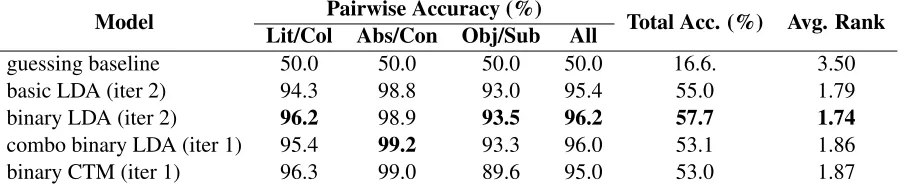
We tested a few options which involved straight-forward modifications to model training. Standard LDA produces all tokens in the document, but when dealing with style rather than topic, the number of times a word appears is much less relevant (Brooke et al., 2010). Our binary model assumes an LDA that generates types, not tokens.2A key comparison
2At the theoretical level, this move is admittedly
Model Pairwise Accuracy (%) Total Acc. (%) Avg. Rank Lit/Col Abs/Con Obj/Sub All
guessing baseline 50.0 50.0 50.0 50.0 16.6. 3.50
basic LDA (iter 2) 94.3 98.8 93.0 95.4 55.0 1.79
binary LDA (iter 2) 96.2 98.9 93.5 96.2 57.7 1.74
[image:4.612.83.533.60.153.2]combo binary LDA (iter 1) 95.4 99.2 93.3 96.0 53.1 1.86 binary CTM (iter 1) 96.3 99.0 89.6 95.0 53.0 1.87
Table 1: Model performance in lexical induction of seeds. Bold indicates best in column.
here is with a combined LDA model (combo), an amalgamation of three independently trained 2-topic models, one for each dimension; this tests our key hypothesis that training dimensions of style together is beneficial. Finally, we test against the correlated topic model (CTM), which offers an explicit repre-sentation of style correlation, but which has done poorly with respect to interpretability, despite offer-ing better perplexity (Chang et al., 2009).
The results of the lexicon induction evaluation are in Table 1. Since the number of optimal iter-ations varies, we report the result from the best of the first five iterations, as measured by total accu-racy; the best iteration is shown in parenthesis. In general, all the results are high enough—we are re-liably above 90% for the pairwise task, and above 50% for the 6-way task—for us to conclude with some confidence that our model is capturing a sig-nificant amount of stylistic variation. As predicted, using words as boolean features had a net positive gain, consistent across all of our metrics, though this effect was not as marked as we have seen previously. The model with independent training of each dimen-sion (combo) did noticeably worse, supporting our conclusion that a multidimensional approach is war-ranted here. Particularly striking is the much larger drop in overall accuracy as compared to pairwise ac-curacy, which suggests that the combo model is cap-turing the general trends but not distinguishing cor-related styles as well. However, the most complex model, the CTM, actually does slightly worse than the combo, which was contrary to our expectations but nonetheless consistent with previous work on the interpretability of topic models. The performance of the full LDA models benefited from a second
itera-traditional LDA is influenced too much by multiple instances of the same word.
tion, but this was not true of combo LDA or CTM, and the performance of all models dropped after the second iteration.
An analysis of individual errors reveals, unsur-prisingly, that most of the errors occur across styles on the same pole; by far the largest single com-mon misclassification is objective words to abstract. Of the words that consistently show this misclas-sification across the runs, many of them, e.g. ani-mate, aperture, encircle, and constrainare clearly errors (if anything, these words tend towards con-creteness), but in other cases the word in question is arguably also fairly abstract, e.g. categorizeand
predominant, and might not be labeled an error at all. Other signs that our model might be doing bet-ter than our total accuracy metric gives it credit for: many of the subjective words that are consistently mislabeled as literary have an exaggerated, literary feel, e.g.jubilant,grievous, andmalevolent.
4 Text-level Analysis
Our secondary analysis involved evaluating theθ’s
of our best configuration (based on average pairwise and total accuracy) on other texts. After training, we carried out inference on the BNC corpus, aver-aging the resultingθ’s to see which styles are
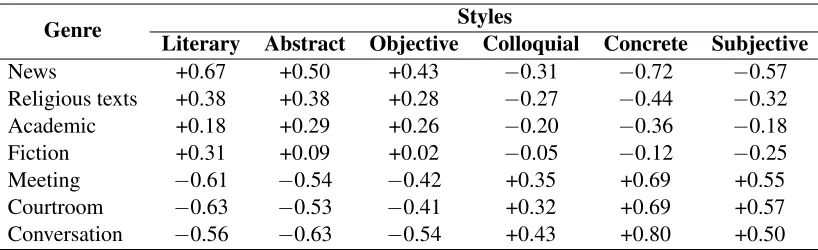
asso-ciated with which genres. Appearances of the seed terms for each model were disregarded during this process; only the induced part of the lexicon was used. The average differences relative to the mean across the various stylistic dimensions (as measured by the probabilities inθ) are given for a selection of
genres in Table 2.
Genre Styles
Literary Abstract Objective Colloquial Concrete Subjective
News +0.67 +0.50 +0.43 −0.31 −0.72 −0.57
[image:5.612.102.511.56.181.2]Religious texts +0.38 +0.38 +0.28 −0.27 −0.44 −0.32 Academic +0.18 +0.29 +0.26 −0.20 −0.36 −0.18 Fiction +0.31 +0.09 +0.02 −0.05 −0.12 −0.25 Meeting −0.61 −0.54 −0.42 +0.35 +0.69 +0.55 Courtroom −0.63 −0.53 −0.41 +0.32 +0.69 +0.57 Conversation −0.56 −0.63 −0.54 +0.43 +0.80 +0.50
Table 2: Average differences from corpus mean of LDA-derived stylistic dimension probabilities for various genres in the BNC, in hundredths.
true for spoken genres. The magnitude of this ef-fect is more difficult to interpret: though it is clear why fiction should sit on the boundary (since it con-tains spoken dialogue), the appearance of news at the written extreme is odd, though it might be due to the fact that news blogs are the most prevalent for-mal genre in the training corpus.
However, if we ignore magnitude and focus on the relative ratios of the stylistic differences for styles on the same pole, we can identify some individ-ual stylistic effects among genres within the same medium. Relative to the other written genres, for in-stance, fiction is, sensibly, more literary and much less objective, while academic texts are much more abstract and objective; for the other two written gen-res, the spread is more even, though relative to re-ligious texts, news is more objective. At the sit-uational pole, fiction also stands out, being much more colloquial and concrete than other written gen-res. Predictably, if we consider again the ratios across styles, conversation is the most colloquial genre here, though the difference is subtle.
We carried out a correlation analysis of the LDA-reduced styles of all texts in the BNC and, con-sistent with the genre results in Table 2, found a strong positive correlation for all styles on the same main pole, averaging 0.83. The average negative correlation between opposing poles is even higher,
−0.88. This supports the Leckie-Tarry formulation. The independence assumptions of the LDA model did not prevent strong correlations from forming be-tween these distinct yet clearly interrelated dimen-sions; if anything, the correlations are stronger than we would have predicted.
5 Conclusion
We have introduced a Bayesian model of stylistic variation. Topic models like LDA are often evalu-ated using information-theoretic measures, but our emphasis has been on interpretibility: at the word level we can use the model to induce stylistic lex-icons which correspond to human judgement, and at the text level we can use it distinguish genres in expected ways. Another theme has been to offer ev-idence that indeed a multi-dimensional approach is strongly warranted: importantly, our results indicate that separate unidimensional models of style are in-ferior for identifying the core stylistic character of each word, and in our secondary analysis we found strong correlations among styles attributable to the situational/cultural dichotomy. However, an off-the-shelf model that integrates correlation among topics did not outperform basic LDA.
One advantage of a Bayesian approach is in the flexibility of the model: there are any number of other interesting possible extensions at both the θ
andβ levels of the model, including alternative
ap-proaches to correlation (Li and McCallum, 2006). Beyond Bayesian models, vector space and graphi-cal approaches should be compared. More work is clearly needed to improve evaluation: some of our seeds could fall into multiple stylistic categories, so a more detailed annotation would be useful.
Acknowledgements
References
Shlomo Argamon, Casey Whitelaw, Paul Chase, Sob-han Raj Hota, Navendu Garg, and Shlomo Levitan. 2007. Stylistic text classification using functional lex-ical features. Journal of the American Society for In-formation Science and Technology, 7:91–109. Douglas Biber and Susan Conrad. 2009.Register, Genre,
and Style. Cambridge University Press.
Douglas Biber. 1988.Variation Across Speech and Writ-ing. Cambridge University Press.
David Birch. 1995. Introduction. In Helen Leckie-Tarry, editor,Language and Context: A Functional Linguis-tic Theory of Register. Pinter.
David M. Blei and John D. Lafferty. 2007. Correlated topic models. Annals of Applied Statistics, 1(1):17– 35.
David M. Blei, Andrew Y. Ng, Michael I. Jordan, and John Lafferty. 2003. Latent Dirichlet allocation.
Journal of Machine Learning Research, 3:993–1022. Julian Brooke, Tong Wang, and Graeme Hirst. 2010.
Au-tomatic acquisition of lexical formality. In Proceed-ings of the 23rd International Conference on Compu-tational Linguistics (COLING ’10), Beijing.
Kevin Burton, Akshay Java, and Ian Soboroff. 2009. The ICWSM 2009 Spinn3r Dataset. InProceedings of the Third Annual Conference on Weblogs and Social Me-dia (ICWSM 2009), San Jose, CA.
Jonathan Chang, Jordan Boyd-Graber, Sean Gerrish, Chong Wang, and David Blei. 2009. Reading tea leaves: How humans interpret topic models. In Pro-ceedings of Neural Information Processing Systems (NIPS ’09).
Kevyn Collins-Thompson and Jamie Callan. 2005. Predicting reading difficulty with statistical language models. Journal of the American Society for Informa-tion Science Technology, 56(13):1448–1462.
David Crystal and Derek Davy. 1969. Investigating En-glish Style. Indiana University Press.
Gabriel Doyle and Charles Elkan. 2009. Accounting for burstiness in topic models. In International Confer-ence on Machine Learning (ICML ’09).
Wilson Follett. 1966. Modern American Usage. Hill & Wang, New York.
H. W. Fowler and F. G. Fowler. 1906. The King’s En-glish. Clarendon Press, Oxford, 2nd edition.
Nikesh Garera and David Yarowsky. 2009. Modeling la-tent biographic attributes in conversational genres. In
Proceedings of the Joint Conference of the 47th An-nual Meeting of the ACL and the 4th International Joint Conference on Natural Language Processing of the AFNLP (ACL-IJCNLP ’09), pages 710–718, Sin-gapore.
Robert Gunning. 1952. The Technique of Clear Writing. McGraw-Hill, New York.
M.A.K. Halliday and Ruqaiya Hasan. 1976.Cohesion in English. Longman, London.
S.I. Hayakawa, editor. 1994. Choose the Right Word. HarperCollins Publishers, second edition. Revised by Eugene Ehrlich.
Matthew D. Hoffman, David M. Blei, and Francis R. Bach. 2010. Online learning for latent Dirichlet al-location. InNeural Information Processing Systems (NIPS ’10), pages 856–864.
Eduard H. Hovy. 1990. Pragmatics and natural language generation.Artificial Intelligence, 43:153–197. Diana Inkpen and Graeme Hirst. 2006. Building and
using a lexical knowledge base of near-synonym dif-ferences.Computational Linguistics, 32(2):223–262. Martin Joos. 1961. The Five Clocks. Harcourt, Brace
and World, New York.
Nobuhiro Kaji and Masaru Kitsuregawa. 2007. Build-ing lexicon for sentiment analysis from massive col-lection of HTML documents. InProceedings of the 2007 Joint Conference on Empirical Methods in Natu-ral Language Processing and Computational NatuNatu-ral Language Learning (EMNLP-CoNLL ’07).
Thomas S. Kane. 1983. The Oxford Guide to Writing. Oxford Univeristy Press.
Brett Kessler, Geoffrey Nunberg, and Hinrich Sch¨utze. 1997. Automatic detection of text genre. In Proceed-ings of the 35th Annual Meeting of the Association for Computational Linguistics (ACL ’97), pages 32– 38, Madrid, Spain.
Paul Kidwell, Guy Lebanon, and Kevyn Collins-Thompson. 2009. Statistical estimation of word acquisition with application to readability predic-tion. In Proceedings of the 2009 Conference on Empirical Methods in Natural Language Processing (EMNLP’09), pages 900–909, Singapore.
Helen Leckie-Tarry. 1995. Language and Context: A Functional Linguistic Theory of Register. Pinter. Wei Li and Andrew McCallum. 2006. Pachinko
alloca-tion: DAG-structured mixture models of topic correla-tions. InProceedings of the 23rd International Con-ference on Machine Learning, ICML ’06, pages 577– 584.
David Newman, Edwin V. Bonilla, and Wray Buntine. 2011. Improving topic coherence with regularized topic models. InProceedings of Advances in Neural Information Processing Systems (NIPS ’11).
Sinno Jialin Pan and Qiang Yang. 2010. A survey on transfer learning. IEEE Transactions on Knowledge and Data Engineering, 22(10).
the Enron corpus. InProceedings of the 49th Annual Meeting of the Association for Computational Linguis-tics (ACL ’11), Portland, Oregon.
Philipp Petrenz and Bonnie Webber. 2011. Stable clas-sification of text genres. Computational Linguistics, 37(2):385–393, June.
J. Reisinger, A. Waters, B. Silverthorn, and R. Mooney. 2010. Spherical topic models. InInternational Con-ference on Machine Learning (ICML ’10).
Sara Rosenthal and Kathleen McKeown. 2011. Age pre-diction in blogs: A study of style, content, and online behavior in pre- and post-social media generations. In
Proceedings of the 49th Annual Meeting of the Associ-ation for ComputAssoci-ational Linguistics (ACL ’11), Port-land, Oregon.
William Strunk and E.B. White. 1979. The Elements of Style. Macmillan, 3rd edition.
Maite Taboada, Julian Brooke, Milan Tofiloski, Kimberly Voll, and Manfred Stede. 2011. Lexicon-based meth-ods for sentiment analysis. Computational Linguis-tics, 37(2):267–307.
Peter D. Turney. 2002. Thumbs up or thumbs down?: semantic orientation applied to unsupervised classifi-cation of reviews. InProceedings of the 40th Annual Meeting on Association for Computational Linguis-tics, ACL ’02, pages 417–424, Philadelphia, Pennsyl-vania.
Leonid Velikovich, Sasha Blair-Goldensohn, Kerry Han-nan, and Ryan McDonald. 2010. The viability of web-derived polarity lexicons. InHuman Language Tech-nologies: The 2010 Annual Conference of the North American Chapter of the Association for Computa-tional Linguistics, HLT ’10, pages 777–785, Los An-geles, California.