Longitudinal Studies of Variation Sets in Child-directed Speech
Mats Wir´en, Kristina Nilsson Bj¨orkenstam, Gintar˙e Grigonyt˙e and Elisabet Eir Cortes Department of Linguistics
Stockholm University SE-106 91 Stockholm, Sweden
{mats.wiren, kristina.nilsson, gintare, elisabet.cortes}@ling.su.se
Abstract
One of the characteristics of child-directed speech is its high degree of repetitious-ness. Sequences of repetitious utterances with a constant intention, variation sets, have been shown to be correlated with children’s language acquisition. To obtain a baseline for the occurrences of variation sets in Swedish, we annotate 18 parent– child dyads using a generalised definition according to which the varying form may pertain not just to the wording but also to prosody and/or non-verbal cues. To facili-tate further empirical investigation, we in-troduce a surface algorithm for automatic extraction of variation sets which is eas-ily replicable and language-independent. We evaluate the algorithm on the Swedish gold standard, and use it for extracting variation sets in Croatian, English and Russian. We show that the proportion of variation sets in child-directed speech de-creases consistently as a function of chil-dren’s age across Swedish, Croatian, En-glish and Russian.
1 Introduction
1.1 Background and motivation
Child-directed speech has many characteristics that set it apart from adult-directed language, such as shorter utterances, lower speech rate, fewer disfluencies, lower syntactic complexity, greater modulation ofF0and high repetitiousness (Broen,
1972). Here is an example of the latter property from our data:1
1Translation of utterances from the MINGLE-3 corpus (Bj¨orkenstam and Wir´en, 2014) with parental speech to a child aged 1;3 (compare Section 3).
You can put the animals there.
You can take the pig and the cat and put them there.
Can you put them there? Good.
Can you put the pig there too?
Sequences of such (partial) self-repetitions with a constant intention have been calledvariation sets, and have been shown to account for a large pro-portion of the language that children hear (K¨untay and Slobin, 1996; Clark., 2009, p. 37).2
Why does this phenomenon occur? To some extent, repetitiousness may serve simply to cap-ture and maintain the child’s attention, but our intuitions tell us that it is likely to also facili-tate language learning for infants. For example, it may allow for effective segmentation of pho-netic material (Bard and Anderson, 1983), and it has been shown to be a predictor of syntax growth (Hoff-Ginsberg, 1986; Hoff-Ginsberg, 1990; Wa-terfall, 2006). In a similar vein, investigating so-cial and attentional cues in word learning, Frank et al. (2012), point out that the temporal proximity and continuity of repetitious language create sup-portive contexts where partial understanding of in-dividual utterances can lead to fuller understand-ing.3
But variation sets have also been shown to ben-efit artificial language learning. In an experiment on this, Onnis et al. (2008) showed that adults ex-posed to input with varation sets performed bet-ter in phrase segmentation and phrase-boundary judgement tasks than a control group who heard
2”Variation set” is actually a misnomer, since the idea is that the order of individual utterances is important.
3It is also interesting to note that child-directed signing shares many characteristics of child-directed speech, such as prosodic exaggeration, lexical and syntactic simplification, and repetition (Masataka, 2000), and these shared character-istics include variation sets (Hoiting and Slobin, 2002).
the same input in scrambled order without varia-tion sets. They note that “[f]rom a computavaria-tional standpoint, the key characteristic of variation sets is that local mechanisms of alignment and compar-ison allow even memory-limited learners to dis-cover structure that they would otherwise miss” (Onnis et al., 2008, p. 424).
1.2 Related work
Early studies of child-directed language dealing with partial and exact repetition include Broen (1972), Snow (1972), Kaye (1980) and Hoff-Ginsberg (1986; 1990). For example, Broen (ibid., p. 29, 43) tracked “clusters of sequential sen-tences” where “the meaning remains constant”. Snow (ibid.) found more partial and exact repe-titions to 2-year olds than to 10-year olds.
K¨untay and Slobin (1996) introduced the term ”variation set”, by which they meant a contiguous sequence of repetitions with varying form but con-stant intention. They pointed out that the core of a variation set (and the main vehicle for express-ing the intention) is almost always a verb, with op-tionally expressed arguments. (In the above exam-ple from the MINGLE-3 corpus, this verb would be ”put”.) The possible variations were taken to be ”(1) lexical substitution and rephrasing, (2) ad-dition and deletion of specific referential terms, and (3) reordering of constituents” (K¨untay and Slobin, 2002, p. 6). Their definition did not in-clude exact repetitions, however. Furthermore, it appears that in order for a new utterance to be con-sidered a member of a existing variation set, the new utterance has to satisfy the above conditions forallof the previous utterances taken to be in the set.
K¨untay and Slobin’s study was based on tran-scripts of everyday interaction between a Turkish-speaking mother and her child over a seven-month period, during which the child was between 1;8 and 2;3 years. The finding was that 21% of the utterances occurred within variation sets, and that these sets were positively associated with chil-dren’s acquisition of specific verbs. A follow-up study of transcripts of another Turkish-speaking mother and a child (at age 1;3 and 2;0 years) showed how the communicative functions of the variation sets changed as a function of age (K¨untay and Slobin, 2002).
Waterfall (2006) provided the first longitudi-nal study of variation sets in English, based on
12 mother–child dyads with children between 1;2 and 2;6 years. Waterfall’s (2006, p. 21) defini-tion of variadefini-tion set is somewhat different from K¨untay and Slobin’s, though it is not clear what effect that has in practice. Basically, she defines a variation set as a sequence of utterances that be-longs to the same conversational turn, that relates to the same event or situation, that ”have similar or related meanings”, and shares at least one noun or verb. Again, it appears that these conditions should hold between all utterances within the set, and like K¨untay and Slobin, she did not include exact repetitions. Also, she allowed up to four non-related intervening utterances in a variation set. Waterfall found that children’s production of nominal and verbal structures was correlated with peaks in the parents’ use of that structure in vari-ation sets. She also found a moderate decrease in the proportion of utterances that are part of vari-ation sets as a function of age, from 17% at 1;2 years to 12% at 2;6 years.
Attempts at automatic extraction of variation sets naturally focus on form rather than func-tion. Brodsky et al. (2007) suggest a simple def-inition of a variation set as a sequence of utter-ances where each successive pair of utterutter-ances has a lexical overlap of at least one element, ex-cluding words on a stoplist (which includes high-frequency words). Variation sets are thus extracted by comparing pairs of successive utterances for re-peated words, resulting in sets with at least one non-stoplisted word in common. Using an auto-mated procedure of this kind, Brodsky et al. ob-tain a proportion of 21.5% of thewordsin Water-fall’s (2006) corpus occurring in variation sets, and 18.3% of the words in the English CHILDES col-lection (MacWhinney, 2000). Similar studies have been performed by Onnis et al. (2008) and Water-fall et al. (2010). For example, when Onnis et al. used an automated procedure based on Waterfall’s (2006) criteria on the Lara corpus from CHILDES (involving one child between 1;9 and 3;3 years), they obtained a proportion of 27,9% of the utter-ances being inside variation sets.
1.3 The problem
definition which subsumes earlier work but where the repetitiousness may also be, on the one hand, semantic (with no or very little surface repetition) and, on the other hand, prosodic or non-verbal (while displaying exact repetition). To obtain a baseline for the behaviour of this phenomenon in Swedish, we develop a gold standard for variation sets. To facilitate further empirical investigation, we introduce a surface algorithm which we eval-uate on the gold standard and apply to Croatian, English and Russian.
2 Criteria for variation sets 2.1 Basic criteria
A starting-point for our work is K¨untay and Slobin’s (1996; 2002) definition, which takes vari-ation sets to be sequences of utterances with the same communicative intention but with small dif-ferences in form. Basically, our definition sub-sumes K¨untay and Slobin’s, but we extend it in certain ways. First, along with Brodsky et al. (2007), we extract variation sets (whether manu-ally in the gold standard or automaticmanu-ally using the algorithm) by comparing successive pairs of utter-ances: first–second, second–third, etc. Also, up to two intervening utterances (such as interjections) by the parent are allowed any time in a sequence (similarly to Snow (1972, p. 251) and Brodsky et al. (2007)). Furthermore, we allow for verbal input from the child within variation sets. The rationale for this is that our data covers the ages 0;7–2;9 years (see Section 3), and especially in the early dyads the children are still learning to take turns. As for constant intention, we make one exception from this, following K¨untay and Slobin (2002): we include question–answer sequences where the parent provides both the question and the answer in variation sets.
2.2 Surface and semantic repetitiousness
A difference compared to previous work that we are aware of is that we aim at capturing a continu-ous scale of surface and semantic repetiticontinu-ousness, where, at one extreme, the repetitiousness may be purely semantic without any surface similarity at all. Here is an example of this from our data, with approximate translations:
Titta h¨ar d˚a! (But look here!)
Har du sett vilka tjusiga byxor?
(Have you seen the fancy pants?) Kolla!
(Look!)
[image:3.595.310.508.162.508.2]The intention in each of these utterances is to make the child look at the pants, but there is no overlap whatsoever in form between the utterances.
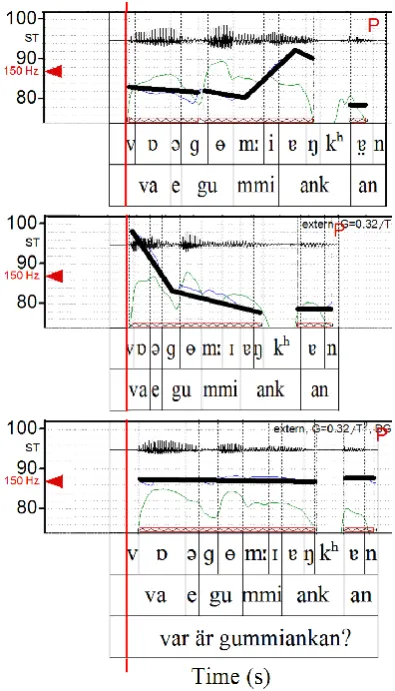
Figure 1: Phonetic and prosodic analysis of a repetition of the Swedish phrase ”Var ¨ar gummi-ankan?” (”Where is the rubber duck?”), uttered by a male speaker. The utterances are ordered with the first utterance on top. The y-axis represents frequency (semitones) and the x-axis represents time (seconds). Black thick horizontal lines show stylised intonation based on tonal perception.
2.3 Multimodal variation
When-ever word-for-word repetition occurred in the writ-ten transcript of the three dyads, we found consis-tent patterns of prosodic variation in the parents’ speech, involving pitch, timing and/or stress, and typically also variation of their non-verbal cues, involving eye gaze direction, deictic gestures or object manipulation.
Figure 1 shows a phonetic and prosodic analy-sis of a variation set from our data with three exact repetitions of the Swedish utterance ”Var ¨ar gum-miankan?” (”Where is the rubber duck?”).4 The vertical line indicates time-synchronized starts of the repetitions. In the analysis window for each repetition, a black thick horizontal line shows styl-ized intonation based on tonal perception (per-ceived pitch). A downwards tilted line means falling intonation (from brighter to deeper voice), upwards tilted means rising intonation. In the background, the waveform and intensity (thin line) can be seen. The annotation rows beneath each repetition contains phonetic transcription in IPA (top row) and syllable segmentation (second row). The third row at the bottom contains an ortho-graphic annotation.5
Here, the first utterance (shown at the top of the figure) initially displays relatively flat intona-tion, and then rising intonation with a peak on the first syllable in the noun ”ankan” (”duck”), with a fall on the last syllable. In contrast, the sec-ond utterance has shorter duration and falling in-tonation throughout. Finally, the third utterance has completely flat intonation, with duration sim-ilar to the first utterance but with a prolongation of the first syllable, corresponding to the adverb ”var” (”where”).
Although this is just a small study, the fact that variation is here being systematically manifested through prosody and/or non-verbal cues when the wording is constant fits well with our general im-pression of exact repetitions. It is because of this multimodal variation that we include verbatim repetitions in variation sets.
3 Data
Our data consists of transcripts of Swedish child-directed speech from the MINGLE-3 corpus
4The examples in this section are from the MINGLE-3 corpus (Bj¨orkenstam and Wir´en, 2014), with approximate English translations.
5The intonation analyses were done in Prosogram (Mertens, 2004), and the figures were compiled from Proso-gram and Praat (Boersma, 2001).
(Bj¨orkenstam and Wir´en, 2014), consisting of 18 longitudinal dyads with three children (two girls, one boy) recorded between the ages of 7 and 33 months with six dyads per child, all of which is multimodally annotated. The complete duration of the 18 dyads is 7:29 hours (mean duration 24:58 minutes). The video and audio recordings were made from naturalistic parent–child interaction in a recording studio at the Phonetics Laboratory at Stockholm University (Lacerda, 2009). The chil-dren were interacting alternately with their moth-ers (10 dyads) and fathmoth-ers (8 dyads). The sce-nario was free play.6 The ELAN annotation tool (Wittenburg et al., 2006) was used for transcrip-tion of parent and child utterances, as well as annotation of eye gaze, deictic gestures and ob-ject manipulation (Bj¨orkenstam and Wir´en, 2014). The transcripts have been automatically annotated with part-of-speech and morphosyntactic tags us-ing Stagger ( ¨Ostlus-ing, 2013), followed by manual correction.
4 Creating a gold standard
The manual annotation of variation sets started with analysis of four dyads, based on a guideline according to the criteria in Section 2. The same criteria were applied throughout all age groups. The annotations were made in ELAN, using time-lines to code the extensions of variations sets across utterances, and taking into account both verbal and non-verbal input from parent and child from transcriptions, audio and video.
Each of the four dyads was annotated by two coders independently. The resulting annotations were merged, and a third annotator marked cases of disagreement. This resulted in an interannota-tor agreement (measured as set overlap between annotators) of 78%. The remaining 14 dyads were annotated by one annotator. During this phase, a classification of communicative intention based on the Inventory of Communicative Acts-Abridged (Ninio et al., 1994) was added. This classifica-tion was evaluated by comparing four representa-tive dyads annotated by three independent annota-tors, resulting in a Fleiss’s kappa of 0.63.
Table 1: Results of the longitudinal study of Swedish variation sets (also used as gold standard in Table 3). The third row shows the proportions of child-directed utterances that are in variation sets. Each figure is obtained by first calculating the proportion per dyad and then averaging the proportions over all dyads in the respective age group. Boldface indicates statistically significant difference to boldfaced neighbour (z-test of sample proportions; respectively,z = 8,p < 0.0001,z = 2.3,p < 0.02,z = 8.2,
p <0.0001, two-tailed). The fourth row shows the proportions of exact repetitions within variation sets. Each figure is obtained by first calculating the proportion per variation set and averaging over the dyad, then averaging over all dyads in the respective age group.
Longitudinal study of Swedish variation sets Group 10;7–0;9 Group 21;0–1;2 Group 31;4–1;7 Group 42;3–2;9
Number of dyads 5 5 5 3
Number of child-directed utterances 1032 1421 1492 724
Proportion of utterances that are in variation sets 50% 34% 30% 14%
Proportion of exact repetitions in variation sets 24% 16% 13% 10%
5 Results: Gold standard variation sets
In order to obtain a baseline for how the proportion of utterances that are in variation sets varied as a function of age of the children, we grouped the dyads according to child age in the following four data sets:
Age group 1: 0;7–0;9 (7–9 months) Age group 2: 1;0–1;2 (12–14 months) Age group 3: 1;4–1;7 (16–19 months) Age group 4: 2;3–2;9 (27–33 months)
As shown in Table 1, our gold standard displayed a consistent decrease in the proportion of utterances in variation sets over time, from 50% for age group 1 to 14% for group 4. The proportion of verbatim repetitions in variation sets also decreased, from 24% for age group 1 to 10% for group 4.
6 Automatic extraction of variation sets
The method that we use for extracting variation sets is deliberately surface-based to allow us to de-termine how far this can bring us relative to our gold standard, which is based on both surface and semantic criteria. As mentioned above, the algo-rithm performs a stepwise comparison of pairs of successive utterances. The criterion for including two successive utterances in a variation set is that the difference between them (regarded as strings) does not fall below a certain similarity threshold. Additionally, following Brodsky et al. (2007) and others, we allow for sequences of maximally two intervening dissimilar utterances that do not obey this condition.
For string comparison, we used Ratcliff– Obershelp pattern recognition (Black, 2004) as implemented in the Python module difflib.7 We refer to the variation-set extraction algorithm using this as ”difflib ratio”, DLR.8 When com-paring two strings, the matcher returns a value be-tween 0 and 1. A value of 1 corresponds to an exact repetition, and 0 corresponds to two utter-ances without any overlap of words. By using this value as a parameter, we can obtain a threshold for the desired degree of similarity. The threshold can either be selected arbitrarily, or learned from evaluation against the gold standard variation sets. When evaluated against the gold standard, the op-timal similarity threshold was 0.55 (see Figure 2).
We experimented with including information from the part-of-speech tagging of the transcripts (see Section 3) in such a way that the pair of strings compared consisted of both the words and their part-of-speech tags. Our intuition was that this might give us a more refined analysis, for example, by distinguishing cases of homonymy. This version of the algorithm turned out not to im-prove performance, however (see Figure 2), and was therefore dropped.
7https://docs.python.org/2/library/
difflib.html#module-difflib.
0 0.1 0.2 0.3 0.4 0.5 0.6
0.1 0.2 0.3 0.4 0.5 0.6 0.7 0.8 0.9 1
[image:6.595.82.515.62.200.2]Precision Recall F-‐score Precision_POS Recall_POS F-‐score_POS
Figure 2: Results of strict matching with the DLR similarity measure on raw (solid lines) and part-of-speech tagged data (dotted lines). Similarity level thresholds onx-axis; precision, recall andF-score on
[image:6.595.96.501.315.455.2]y-axis.
Table 2: Example variation set from the gold standard (utterance 3–4) and utterances exrqcted by the algorithm (utterance 1–4).
Example utterances Member of Extracted by gold set algorithm
1. Ska vi l¨agga ner n˚anting i i v¨askan d˚a?
(Are we going to put something in in the bag then?) – Yes 2. Va?
(Huh?) – Yes
3. Ska du l¨agga ner kossan i v¨askan kanske?
(Are you going to put down the cow in the bag maybe?) Yes Yes 4. Ska vi l¨agga ner kossan?
(Are we going to put down the cow?) Yes Yes
7 Results: Automated extraction
7.1 Evaluation on Swedish gold standard
We evaluated the algorithm against the gold stan-dard variation sets using two kinds of metrics, which we refer to as strict and fuzzy matching. Strict matching requires exact matching on the ut-terance level of the extracted variation set and the corresponding gold standard set, whereas fuzzy matching allows for partial overlaps of the ex-tracted variation set and the gold standard set. In the example in Table 2, only utterance 3 and 4 are members of the gold standard variation set, whereas the algorithm extracts utterances 1–4. Hence, the strict matching metric treats this ex-tracted set as a false positive, whereas the fuzzy matching metric treats it as a true positive. As for fuzzy matching, we need a way of calculat-ing precision for different degrees of overlaps with the gold set. The measure we have adopted for this purpose ismean average precision(MAP), see
Croft et al. (2009, p. 313).
Table 3 summarizes the results of extraction of variation sets relative to the gold standard ac-cording to the strict and fuzzy metric. Strict
F-score reaches 0.56 and fuzzy F-score reaches 0.82 for age group 1, but F-scores gradually de-crease with increasing age. Apparently, the varia-tion displayed in the parents’ speech becomes less amenable to surface methods as the children grow older. An indirect sign of this increased complex-ity in variation sets is that the proportion of exact repetitions decreases as the children grow older, as shown in Table 1.
7.2 Extraction of variation sets in Croatian, English and Russian
lon-Table 3: Evaluation of the algorithm for automatic variation-set extraction against the Swedish gold standard per age group.
String matching relative to gold standard Group 10;7–0;9 Group 21;0–1;2 Group 31;4–1;7 Group 42;3–2;9
Strict precision Strict recall
StrictF-score
0.539 0.581
0.559
0.406 0.406
0.406
0.351 0.446
0.392
0.217 0.333
0.262
Fuzzy precision Fuzzy recall
FuzzyF-score
0.774 0.877
0.822
0.627 0.763
0.689
0.505 0.743
0.601
0.324 0.615
[image:7.595.80.520.303.455.2]0.425
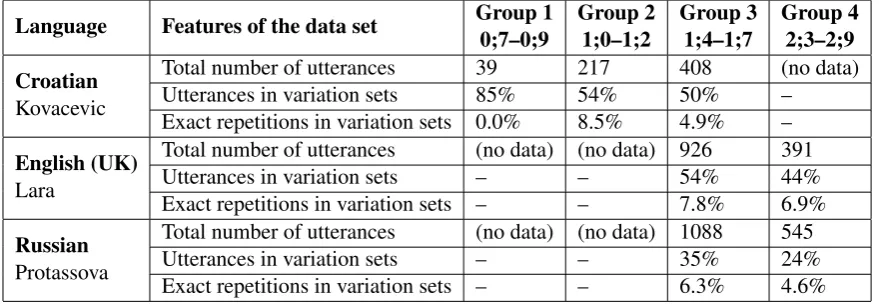
Table 4: Results of the algorithm for automatic variation-set extraction applied to Croatian, English and Russian child-directed utterances from CHILDES. The rows show the number of utterances in each age group, the average proportion of utterances that are in variation sets, and the average proportion of exact repetitions in the variation sets, with figures having being calculated in the same way as in Table 1.
Language Features of the data set Group 10;7–0;9 Group 21;0–1;2 Group 31;4–1;7 Group 42;3–2;9
Croatian
Kovacevic
Total number of utterances 39 217 408 (no data)
Utterances in variation sets 85% 54% 50% –
Exact repetitions in variation sets 0.0% 8.5% 4.9% –
English (UK)
Lara
Total number of utterances (no data) (no data) 926 391
Utterances in variation sets – – 54% 44%
Exact repetitions in variation sets – – 7.8% 6.9%
Russian
Protassova
Total number of utterances (no data) (no data) 1088 545
Utterances in variation sets – – 35% 24%
Exact repetitions in variation sets – – 6.3% 4.6%
gitudinal corpora in Croatian,9English10and Rus-sian from CHILDES (MacWhinney, 2000).11 Al-though it was not possible to find a perfect cor-respondance with the age groups for Swedish, Table 4 shows how the selection of languages and transcripts from CHILDES partly matches the Swedish data. As shown in Table 4, both the pro-portion of variation sets and the propro-portion of ex-act repetitions as far, as can be seen, decrease con-sistently for Croatian, English and Russian.
8 Discussion
In our study of the Swedish gold standard, we obtained statistically significant decreases in the proportion of utterances within variation sets as a function of age between all age groups, from
9Kovacevic: Vjeran, files 20 (0;10 years) 23 (1;2 years), 33 (1;7 years).
10Lara, files 1-09-13 (1;9 years), 2-06-00 (2;6 years). 11Protassova: Varv, files 01 (1;6 years), 04 (1;10 years), 06 (2;4 years).
50% for age group 1 to 14% for age group 4 (see Table 1). These differences were also more con-sistent than in Waterfall (2006), who obtained an overall decrease from 17% for 1;2 years to 12% for 2;6 years (ibid., p. 125). Waterfall’s age span was shorter than ours,12 but its decrease was still less pronounced within the comparable age in-terval. It is also interesting to see that we ob-tained the largest proportion of variation sets for the youngest age group (0;7–0;9 years), which was not covered by Waterfall.
The fact that we see larger age-related differ-ences in our data does not seem to be attributable to the inclusion of exact repetitions in our varia-tion sets, judging from the proporvaria-tiones of these in Table 1. In any case, and as argued in Sec-tion 2, the reason for extending the definiSec-tion of variation sets in this way is motivated by an
depth analysis of a subset of these utterances in our multimodally annotated corpus. We conjec-ture that when an utterance is repeated verbatim, there is instead multimodal variation that increases the information and helps the child learn from the utterance. As far as we know, our longitudinal fig-ures on proportions of exact repetitions are also the first that have been reported.
Our automatic algorithm for variation set ex-traction is deliberately surface-based in order to test how far this kind of method can bring us. An independent advantage is that it is easily replica-ble since it is based on a standard library for string comparison. The algorithm reaches a fuzzy F -score of up to 0.82 (strict: up to 0.56) relative to the Swedish gold standard in spite of only using crite-ria related to form. TheF-score drops as a function of age, however (see Table 3); we conjecture that this is due to the relation between form and inten-tion becoming less transparent with increased age. That is, as the child develops and learns more lan-guage, the parents’ variation gets more complex. One way of handling this complexity would be by generalizing the algorithm to recognize intention.
Since the algorithm only uses form-based cri-teria, it is in principle also language-independent. We obtain consistent decreases of the proportions of utterances in variation sets also when we ap-ply the algorithm to Croatian, English and Russian corpora of child-directed language (see Table 4). Although in this case we have no evaluations, it is interesting to see that the behaviour corresponds to what we expected.
9 Conclusion
We have investigated the longitudinal behaviour of variation sets in child-directed speech according to a generalised definition. Variation sets appear to function as a device for effective communication and learning with young children: the speaker re-peats the same content while varying the wording, prosody and/or non-verbal cues in order to max-imise the chance of comprehension. With increas-ing age and language comprehension, there is less need for such repetitiousness.
Our study of Swedish covered a larger age span and displayed a more consistent decrease than Wa-terfall’s (2006) study of American English. Our automatic algorithm seems to usefully approxi-mate manual extraction of variation sets at least for lower age groups, and an advantage is that the
algorithm is easily replicable. Applications of the algorithm to Croatian, English and Russian dis-played similar decreases in the proportions of ut-terances in variation sets as a function of ages. We also found that the proportions of exact repetitions are similarly decreasing as a function of age for all languages, and we have demonstrated how multi-modal cues seem to provide other dimensions of variation in these utterances.
Acknowledgements
This research is part of the project “Modelling the emergence of linguistic structures in early child-hood”, funded by the Swedish Research Council as 2011-675-86010-31. We would like to thank Lisa Tengstrand and Claudia Ekl˚as Tejman for an-notation work, and Annika Otsa for extracting and preparing the CHILDES data. Finally, we would like to thank the three anonymous reviewers for valuable comments.
References
Ellen Gurman Bard and Anne H. Anderson. 1983. The
unintelligibility of speech to children. Journal of
Child Language, 10(2):265–292.
Kristina Nilsson Bj¨orkenstam and Mats Wir´en. 2014. Multimodal annotation of synchrony in parent-child
interaction. InProceedings of The 10th Workshop
on Multimodal Corpora: Combining applied and basic research targets, 2014, Reykjavik, Iceland, May. ELRA.
Paul E Black. 2004. Ratcliff/obershelp pattern
recog-nition. Dictionary of Algorithms and Data
Struc-tures, 17.
Paul Boersma. 2001. Praat, a system for doing
phonet-ics by computer. Glot International, 5(9/10):341–
345.
Peter Brodsky, Heidi R. Waterfall, and Shimon Edel-man. 2007. Characterizing motherese: On the com-putational structure of child-directed language. In
Proc. 29th Cognitive Science Society Conference, Nashville, TN.
Patricia A. Broen. 1972.The verbal environment of the
language-learning child. ASHA Monographs Num-ber 17, American Speech and Hearing Association. Washington D.C.
Eve V. Clark. 2009.First Language Acquisition.
Cam-bridge University Press, CamCam-bridge, UK.
W. Bruce Croft, Donald Metzler, and Trevor Strohman.
2009. Search Engines: Information Retrieval in
Michael C. Frank, Joshua B. Tenenbaum, and Anne Fernald. 2012. Social and discourse contributions to the determination of reference in cross-situational
learning. Language Learning and Development,
00:1–24.
Erika Hoff-Ginsberg. 1986. Function and structure in maternal speech: Their relation to the child’s
de-velopment of syntax. Developmental Psychology,
22(3):155–163.
Erika Hoff-Ginsberg. 1990. Maternal speech and the
child’s development of syntax: a further look.
Jour-nal of Child Language, 17:85–99.
Nini Hoiting and Dan I. Slobin. 2002. What a deaf child needs to see: Advantages of a natural sign language over a sign system. In R.
Schul-meister and H. Reinitzer, editors, Progress in sign
language research. In honor of Siegmund Prill-witz/Fortschritte in der Geb¨ardensprachforschung. Festschrift f¨ur Siegmund Prillwitz, pages 268–277. Signum, Hamburg.
Kenneth Kaye. 1980. Why we don’t talk ‘baby talk’ to
babies. Journal of Child Language, 7:489–507.
Aylin C. K¨untay and Dan I. Slobin. 1996. Listen-ing to a turkish mother: Some puzzles for
acquisi-tion. InSocial Interaction, Social Context, and
Lan-guage. Essays in the Honor of Susan Ervin-Tripp, pages 265–286. Lawrence Erlbaum, Mahwah, NJ.
Aylin C. K¨untay and Dan I. Slobin. 2002. Putting in-teraction back into child language: Examples from
Turkish. Psychology of Language and
Communica-tion, 6:5–14.
Francisco Lacerda. 2009. On the emergence of early linguistic functions: A biological and interactional perspective. In K. Alter, M. Horne, M. Lindgren,
M. Roll, and J. von Koss Torkildsen, editors,Brain
Talk: Discourse with and in the brain, pages 207– 230. Media-Tryck, Lund, Sweden.
Vladimir I. Levenshtein. 1966. Binary codes capable of correcting deletions, insertions, and reversals. In
Soviet physics doklady, volume 10, pages 707–710.
Brian MacWhinney. 2000. The CHILDES Project:
Tools for analyzing talk. Lawrence Erlbaum Asso-ciates, Mahwah, NJ, 3 edition.
Nobuo Masataka. 2000. The role of modality and input in the earliest stages of language acquisition: Studies of japanese sign language. In C. Cham-berlain, J. P. Morford, and R. I. Mayberry, editors,
Language acquisition by eye, pages 3–24. Erlbaum, Hillsdale, NJ.
Piet Mertens. 2004. The prosogram: Semi-automatic transcription of prosody based on a tonal
percep-tion model. InProceedings of Speech Prosody 2004,
pages 549–552, Nara, Japan.
Anat Ninio, Catherine E. Snow, Barbara A. Pan, and Pamela R. Rollins. 1994. Classifying
communica-tive acts in children’s interactions. Journal of
Com-municative Disorders, 27:157–187.
Luca Onnis, Heidi R. Waterfall, and Shimon Edel-man. 2008. Learn locally, act globally:
Learn-ing language from variation set cues. Cognition,
109(3):423–430.
Robert ¨Ostling. 2013. Stagger: an open-source part
of speech tagger for swedish. Northern European
Journal of Language Technology, 3:1–18.
Catherine E. Snow. 1972. Mothers’ speech to children
learning language. Child Development, 43(2):549–
565.
Heidi R. Waterfall, Ben Sandbank, Luca Onnis, and Shimon Edelman. 2010. An empirical generative framework for computational modeling of language
acquisition. Journal of Child Language, 37:671–
703.
Heidi R. Waterfall. 2006. A Little Change is a Good
Thing: Feature Theory, Language Acquisition and Variation Sets. Ph.D. thesis, Department of Linguis-tics, University of Chicago.
P. Wittenburg, H. Brugman, A. Russel, A. Klassmann, and H. Sloetjes. 2006. Elan: a professional
frame-work for multimodality research. InProceedings of