SMT and Hybrid systems of the QTLeap project in the WMT16 IT-task
Rosa Del GaudioHigher Functions Sistemas Inteligentes, Lisbon, Portugal
Gorka Labaka, Eneko Agirre
University of the Basque Country, UPV/EHU, San Sebastian, Spain
{gorka.labaka,e.agirre}@ehu.eus Petya Osenova, Kiril Simov
Linguistic Modelling Department, IICT-BAS, Sofia, Bulgaria
{petya,kivs}@bultreebank.org Martin Popel
Charles University in Prague, Faculty of Mathematics and Physics, ´UFAL, Czechia
Dieke Oele, Gertjan van Noord
Rijksuniversiteit Groningen, Groningen, The Netherlands
{d.oele,g.j.van.noord}@rug.nl
Lu´ıs Gomes, Jo˜ao Rodrigues, Steven Neale, Jo˜ao Silva, Andreia Querido, Nuno Rendeiro, Ant´onio Branco
Universidade de Lisboa, Departamento de Inform´atica, Faculdade de Ciˆencias
[email protected],{joao.rodrigues,steven.neale,jsilva, andreia.querido,nuno.rendeiro,antonio.branco}@di.fc.ul.pt
Abstract
This paper presents the description of 12 systems submitted to the WMT16 IT-task, covering six different languages, namely Basque, Bulgarian, Dutch, Czech, Por-tuguese and Spanish. All these systems were developed under the scope of the QTLeap project, presenting a common strategy. For each language two different systems were submitted, namely a phrase-based MT system built using Moses, and a system exploiting deep language engi-neering approaches, that in all the lan-guages but Bulgarian was implemented using TectoMT. For 4 of the 6 languages, the TectoMT-based system performs better than the Moses-based one.
1 Introduction
The QTLeap1project focuses on the development
of an articulated methodology for machine trans-lation that explores deep language engineering ap-proaches and sophisticated semantic datasets. The
1http://www.qtleap.eu
underling hypothesis is that the deeper the level of representation, the better the translation be-comes since deeper representations abstract away from surface aspects that are specific to a given language. At the limit, the representation of the meaning of a sentence, and of all its paraphrases, would be shared among all languages.
This purpose is supported by recent advances in terms of lexical processing. These advances have been made possible by enhanced techniques for referential and conceptual ambiguity resolu-tion, and supported also by new types of datasets recently developed as linked open data.
The overall goal of the project is to produce quality translation between English (EN) and an-other language X by using deep linguistic infor-mation. All language pairs follow the same pro-cessing pipeline of analysis, transfer and synthe-sis (generation) and adopt the same hybrid MT approach of using both statistical as well as rule-based components in a tightly integrated way for the best possible results.
In this paper, we present the systems developed by the University of Basque Country for Basque
and Spanish, Charles University in Prague for Czech, by University of Groningen for Dutch, by University of Lisbon for Portuguese and by IICT-BAS of the Bulgarian Academy of Sciences for Bulgarian.
For each language two different systems were submitted, corresponding to different phases of the project, namely a phrase-based MT system built using Moses (Koehn et al., 2007), and a system exploiting deep language engineering approaches, that in all the languages but Bulgarian was im-plemented using TectoMT ( ˇZabokrtsk´y and Popel, 2009). For Bulgarian, its second MT system is not based on TectoMT, but on exploiting deep factors in Moses. All 12 systems are constrained, that is trained only on the data provided by the WMT16 IT-task organizers.
We present briefly the Moses common setting and the TectoMT structure and then more detailed information for each language system are pro-vided. In the last Section, results based on BLEU and TrueSkill are given and discussed.
2 Moses
All the systems submitted that were based on Moses have been trained on a phrase-based model by Giza++ or mGiza with “grow-diag-final-and” symmetrization and “msd-bidirectional-fe” reordering (Koehn et al., 2003). For the language pairs where big quantities of domain-specific monolingual data were available along with the generic domain data, separate language models (domain-specific and generic) were interpolated against our ICT domain-specific development set. For LM training and interpolation, the SRILM toolkit (Stolcke, 2002) was used. The method of truecasing has been adopted for several language pairs where it proved useful.
3 TectoMT
The deep translation is based on the TectoMT system, an open-source MT system based on the Treex platform for general natural-language pro-cessing. TectoMT uses a combination of rule-based and statistical (trained) modules (blocks in Treex terminology), with a statistical transfer based on HMTM (Hidden Markov Tree Model) at the level of a deep, so-called tectogrammatical, representation of sentence structure. The general TectoMT pipeline is language independent, and consists of analysis, deep transfer, and synthesis
steps.
The design of TectoMT is highly modular and consists of a language-universal core and language-specific additions and distinguishes two levels of syntactic description:
• Surface dependency syntax (a-layer) –
sur-face dependency trees containing all the to-kens in the sentence.
• Deep syntax (t-layer) – dependency trees that
contain only content words (nouns, main verbs, adjectives, adverbs) as nodes. Each node has a deep lemma (t-lemma), a semantic function label (functor), a morpho-syntactic form label (formeme), and various grammat-ical attributes (grammatemes), such as num-ber, gender, tense, or modality.
T-layer representations of the same sentence in different languages are closer to each other than the surface texts; in many cases, there is a 1:1 node correspondence among the t-layer trees. Tec-toMTs transfer exploits this by translating the tree isomorphically, i.e., node-by-node and assuming that the shape will not change in most cases (apart from a few exceptions handled by specific rules).
The translation is further factorized: t-lemmas, formemes, and grammatemes are translated us-ing separate Translation Models (TM). The t-lemma and formeme TMs are an interpolation of maximum entropy discriminative models (Max-Ent) (Mareˇcek et al., 2010) and simple conditional probability models. The MaxEnt models are in fact an ensemble of models, one for each indi-vidual source t-lemma/formeme. The combined translation models provide several translation op-tions for each node along with their estimated probability. The best options are then selected using a Hidden Markov Tree Model (HMTM) with a target-language tree model ( ˇZabokrtsk´y and Popel, 2009).
For this specific task, where we need to work on a specific domain, an extended version of Tec-toMT was used allowing interpolation of multiple TMs (Rosa et al., 2015).
4 Basque
adaptation and MERT training. Batch2 domain corpus was used for testing during development.
The Moses system, EU-Moses, uses factored models to allow lemma-based word-alignment. After word alignment, the rest of the training pro-cess is based on lowercased word-forms and stan-dard parameters: Stanford CoreNLP (Manning et al., 2014) and Eustagger (Alegria et al., 2002) tools are used for tokenization and lemmatiza-tion, MGIZA for word alignment with the ”grow-diag-final-and” symmetrization heuristic, a maxi-mum length of 75 tokens per sentence and 5 to-kens per phrase, translation probabilities in both directions, lexical weightings in both directions, a phrase length penalty, a ”phrase-mslr-fe” lex-icalized reordering model and a target language model. As for the language model, a 5-gram model was trained. The weights for the differ-ent compondiffer-ents were adjusted to optimize BLEU using MERT tuning over the Batch1 development set, with an n-best list of size 100.
For the TectoMT system, EU-Treexexisting tools were used in order to get the a-layer. Eu-stagger is a robust and wide coverage morpholog-ical analyzer and POS tagger. The dependency parser is based on the MATE-tools (Bjrkelund et al., 2010). Basque models have been trained us-ing the Basque Dependency Treebank (BDT) cor-pus (Aduriz et al., 2003). Transformation from the a-level analysis into t-level is partially performed with language-independent blocks thanks to the support of Interset (Zeman, 2008).
The English-to-Basque TectoMT system uses the PaCo2 and the Batch1 corpora to train two sep-arate translation models, and they are used to cre-ate an interpolcre-ated list of translation candidcre-ates. In addition to that, the terminological equivalences extracted from the localization PO files (VLC, LO and KDE) as well as the domain terms extracted from Wikipedia are used to identify domain terms before syntactical analysis and to ensure domain translation on transfer. Finally, an extra module to treat non linguistic elements (URLs, shell com-mands, ...) has been used, to identify the elements that should be maintained untranslated on the out-put.
5 Bulgarian
Bulgarian team participated with two systems im-plemented using Moses: BG-Moses— a system that is based on standard factored Moses with
fac-tors retrieved from POS tagged, lemmatized par-allel corpora; and BG-DeepMoses— a system that also is based on standard factored Moses but the translation is done in two steps: (1) semantics-based translation of the source language text to a mixed source-target language text which is then (2) translated to the target language via Moses. The latter system builds on Simov et al. (2015).
As training data for both systems the following corpora were used: the Setimes parallel corpus, the Europarl parallel corpus and a corpus created on the basis of the documentation of LibreOffice. The corpora are linguistically processed with the IXA2 pipeline for the English part and the BTB
pipeline for the Bulgarian. The analyses include POS tagging, lemmatization and WSD, using the UKB system,3 which provides graph-based
meth-ods for Word Sense Disambiguation and lexical similarity measurements.
For the BG-Moses system, the fol-lowing factors have been constructed: WordForm|Lemma|POStag.
For theBG-DeepMosessystem, we exploited also the information from word sense annota-tion in order to predict some translaannota-tions from English to Bulgarian based on the WordNet synsets and their mappings to the Bulgarian WordNet. Thus, we replaced the English word form with a representative lemma in Bulgarian. The motivation for using representative lemmas in Bulgarian is as follows: we aim at unifying the various synsets with similar translations in the Bulgarian language. After the creation of this intermediate English/Bulgarian text, we trained Moses with the following factors: ENWordForm-BGLemma|Lemma|BGPOStag,
where ENWordForm-BGLemma is an English word form when there is no appropriate Bulgarian one, or the Bulgarian lemma; BGPOStag is the ap-propriate Bulgarian tag representing grammatical features like number, tense, etc.
6 Czech
The Czech Moses system follows the CU-Bojar system (Bojar et al., 2013). A factored phrase-based model was trained phrase-based on truecased forms translated directly to the pair <truecased form, morphological tag>. There were three LMs for
Czech:
• 8grams of morphological tags from the monolingual part of news and political cor-pora,
• 6grams of forms from the monolingual part
of news and political corpora and
• 6grams from the Czech side of a bilingual Czech-English corpus CzEng.
The pre-processing of this SMT system has been harmonized with the pre-existing version of Tecto-MT: Tokenization and lemmatization is handled by Treex followed by further tokeniza-tion at any letter-digit-punctuatokeniza-tion boundary. Ad-ditionally, casing is handled by a Czech-specific supervised truecasing method. The output of the lemmatizer is used, as names have lemmas capi-talized, the casing of the lemma is cast to the token (lowercasing non-names at sentence beginnings, lowercasing also ALL CAPS if correctly lemma-tized). Finally, the translation is done using case-sensitive tokens and finally the first letter in every sentence is only capitalized.
The TectoMT analysis pipeline is based on the annotation pipeline of the CzEng 1.0 corpus (Bo-jar et al., 2012) starting with a rule-based tokenizer and a statistical part-of-speech tagger (Strakov´a et al., 2014) and dependency parser (McDonald et al., 2005; Nov´ak and ˇZabokrtsk´y, 2007). These steps result in a-layer trees, which are then con-verted to t-layer using a rule-based process.
The English-to-Czech transfer uses a combi-nation of translation models and tree model ranking. The Czech synthesis pipeline has re-mained basically unchanged since the original TectoMT system ( ˇZabokrtsk´y et al., 2008).
7 Dutch
The Moses system for Dutch was trained on the third version of the Europarl corpus (Koehn, 2005) and the in-domain KDE4 Localization data (Tiedemann, 2012). Words are aligned with GIZA++ and tuning was done with MERT. The applied heuristics for the Dutch baselines were set to “grow-diag-final-and” alignment and “msd-bidirectional-fe” reordering. For the creation of the language models, IRSTLM was used to train a 5-gram language model with Kneser-Ney smooth-ing on the monolsmooth-ingual part of the trainsmooth-ing cor-pora.
For the TectoMT system, the analysis of Dutch input uses the Alpino system (Noord, 2006), a
stochastic attribute value grammar. The transfer uses discriminative (context-sensitive) and dictio-nary translation models. In addition, a few rule-based modules are employed that handle changes in t-tree topology and Dutch grammatical gender.
The Dutch synthesis pipeline includes mor-phology initialization and agreements (subject-predicate and attribute-noun), insertion of prepo-sitions and conjunctions based on formemes, and insertion of punctuation, possessive pronouns and Dutch pronominal adverbs. The t-tree result-ing from the transfer phase is first converted into an Abstract Dependency Tree (ADT) using rule-based modules implemented in Treex. The ADT is then passed to the Alpino generator (de Kok and Noord, 2010), which handles the creation of the actual sentence including inflected word forms.
8 Spanish
The Moses system developed for the translation from English to Spanish, ES-Moses, uses stan-dard parameters: tokenization and truecasing us-ing tools available in Moses toolkit, MGIZA for word alignment with the “grow-diag-final-and” symmetrization heuristic, a maximum length of 80 tokens per sentence and 5 tokens per phrase, translation probabilities in both directions with Good–Turing discounting, lexical weightings in both directions, a phrase length penalty, an “msd-bidirectional-fe” lexicalized reordering model and a 5-gram target language model. The weights for the different components were adjusted to opti-mize BLEU using MERT tuning over the Batch1 development set, with an n-best list of size 100.
The English-to-Spanish TectoMT,ES-Treex, system uses the Europarl and the Batch1 corpora to train two separate translation models, and these were used to create an interpolated list of transla-tion candidates. In additransla-tion to that, the termino-logical equivalences extracted from the localiza-tion PO files (VLC, LO and KDE) as well as the domain terms extracted from Wikipedia are used to identify domain terms before syntactic analysis and to ensure domain translation on transfer. Fi-nally, an extra module to treat non linguistic ele-ments (URLs, shell commands, ...) has been used to identify the elements that should be maintained untranslated on the output.
mod-eling, and the in-domain batch1 corpus was used for domain adaptation and MERT training. The Batch2 domain-specific corpus was used for test-ing durtest-ing development. We have not used all the available parallel corpora, because of the compu-tational restrictions in analyzing all those corpora at the tectogrammatical level of the TectoMT sys-tem.
9 Portuguese
The Moses system for the translation from En-glish to Portuguese, PT-Moses, was obtained by using the default parameters and tools regard-ing the trainregard-ing of a phrase-based model. For the pre-processing, a sentence length of 80 words was used and the tokenization was performed by the Moses tokenizer. No lemmatization or com-pound splitting was used and the casing was ob-tained with the Moses truecaser. For the train-ing, a phrase-based model was used with a lan-guage model order of 5, with Kneser-Ney smooth-ing, which was interpolated using the SRILM tool. The word alignment was done with Giza++ on full forms and the final tuning was done using MERT. The Europarl corpus was used for the training data, both as monolingual data for training lan-guage models and as parallel data for training the phrase-table.
Regarding the English-to-Portuguese TectoMT system (Silva et al., 2015)(Rodrigues et al., 2016a),PT-Treex, in order to get the a-layer the Portuguese system resorted to LX-Suite (Branco and Silva, 2006), a set of pre-existing shallow pro-cessing tools for Portuguese that include a sen-tence segmenter, a tokenizer, a POS tagger, a mor-phological analyser and a dependency parser, all with state-of-the-art performance. Treex blocks were created to be called and interfaced with these tools.
After running the shallow processing tools, the dependency output of the parser is converted into Universal Dependencies (UD) (de Marneffe et al., 2014). These dependencies are then converted into the a-layer tree (a-tree) in a second step. Both steps are implemented as rule-based Treex blocks. Converting the a-tree into a t-layer tree (t-tree) is done through rule-based Treex blocks that manip-ulate the tree structure.
The transfer phase is handled by a tree-to-tree maximum entropy translation model (Mareˇcek et al., 2010) working at the deep syntactic level
of tectogrammatical trees. Two separate models were trained and interpolated, the first model with over 1.9 million sentences from Europarl (Koehn, 2005) and the second model composed of the Batch1, the Microsoft Terminology Collection and the LibreOffice localization data (ˇStajner et al., 2016). Each pair of parallel sentences, one in En-glish and one in Portuguese, are analyzed by Treex up to the t-layer level, where each pair of trees are fed into the model.
The TectoMT synthesis (Rodrigues et al., 2016b) included other two lexical-semantics-related modules, the HideIT and gazetteers. The HideIT module handles entities that do not require translation such as URLs and shell commands. The gazetteers are specialized lexicons that han-dle the translation of named entities from the IT-domain such as menu items and button names.
Finally, synset IDs were used as additional con-textual features in the lemma-to-lemma Discrimi-native Translation Models (Neale et al., 2016).
10 Results
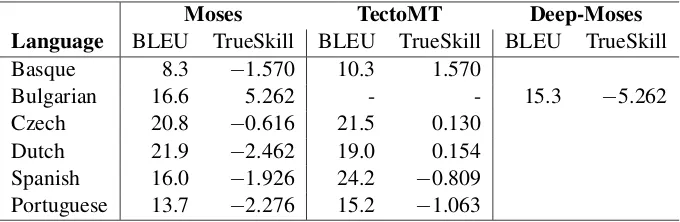
Table 1 presents the results of automatic and man-ual evaluation, based on BLEU and TrueSkill4
scores respectively. For 4 of the 6 languages, the TectoMT-based system performs better than the Moses-based one when considering both BLEU and TrueSkill scores. For Bulgarian, the BG-DeepFMoses performs worse than the
BG-FMoses on both scores. For Dutch, the Moses system outperforms the TectoMT only when considering the BLUE score, but not the TrueSkill score.
Regarding Bulgarian, although BG-Deep-FMoses system performed worse than
BG-Moses, the automatic conversion of the source text into near-target language text represents a promising direction for further improvement of the English-to-Bulgarian MT system. We assume that the current drop might be overcome by improving the WordNet information for Bulgarian, its mapping to the English WordNet as well as the processing pipelines. Also, we plan to train this system on more data and to exploit other bilingual dictionaries.
For the English→Dutch translation direction, the Moses system outperforms TectoMT in terms of BLEU score. The results of the manual evalu-ation, however, are in favor of the TectoMT
Moses TectoMT Deep-Moses
Language BLEU TrueSkill BLEU TrueSkill BLEU TrueSkill
Basque 8.3 −1.570 10.3 1.570
Bulgarian 16.6 5.262 - - 15.3 −5.262
Czech 20.8 −0.616 21.5 0.130 Dutch 21.9 −2.462 19.0 0.154
Spanish 16.0 −1.926 24.2 −0.809
[image:6.595.129.469.62.173.2]Portuguese 13.7 −2.276 15.2 −1.063
Table 1: Automatic and manual evaluation results.
tem. This difference may in part be caused by the fact that BLEU only scores exact word or phrase matches and the TectoMT output shows more lex-ical flexibility as compared to Moses. We get bet-ter results, in bet-terms of BLEU-score, in the oppo-site translation direction which indicates that more effort should be put into this translation direction. Our focus here lies on the Dutch synthesis pipeline where we still need to fix some basic errors. Also we intend to implement more modules that are based on lexical semantics.
We also presented at the IT-task a third sys-tem for Czech, Dutch, Spanish and Portuguese, called Chimera that combines Moses and Tec-toMT (Rosa et al., 2016).
Acknowledgments
This work has been supported by the 7th Frame-work Programme of the EU grant QTLeap (No. 610516).
References
Itzair Aduriz, Mara Jess Aranzabe, Jose Mari Arriola, Aitziber Atutxa, Arantza Daz de Ilarraza, Aitzpea Garmendia, and Maite Oronoz. 2003. Construction of a Basque dependency treebank. InProceedings of the 2nd Workshop on Treebanks and Linguistic Theories, pages 201–204.
I˜naki Alegria, Maria Jesus Aranzabe, Aitzol Ezeiza, Nerea Ezeiza, and Ruben Urizar. 2002. Robust-ness and customisation in an analyser/lemmatiser for basque. InProceedings of the 3rd International Conference on Language Resources and Evaluation (LREC). Customizing knowledge in NLP applica-tions Workshop.
Anders Bjrkelund, Bernd Bohnet, Love Hafdell, and Pierre Nugues. 2010. A high-performance syntactic and semantic dependency parser. InColing 2010: Demonstrations, pages 33–36, Beijing, China, Au-gust. Coling 2010 Organizing Committee.
Ondˇrej Bojar, Zdenˇek ˇZabokrtskˇy, Ondˇrej Duˇsek, Pe-tra Galuˇsˇc´akov´a, Martin Majliˇs, David Mareˇcek, Jiˇr´ı Marˇs´ık, Michal Nov´ak, Martin Popel, and Aleˇs Tamchyna. 2012. The joy of parallelism with czeng 1.0. In Nicoletta Calzolari, editor, Proceed-ings of the Eight International Conference on Lan-guage Resources and Evaluation (LREC’12), Istan-bul, Turkey, May. European Language Resources Association (ELRA).
Ondˇrej Bojar, Rudolf Rosa, and Aleˇs Tamchyna. 2013. Chimera – three heads for English-to-Czech trans-lation. In Proceedings of the Eighth Workshop on Statistical Machine Translation, pages 92–98, Sofia, Bulgaria, August. Association for Computational Linguistics.
Ant´onio Branco and Jo˜ao Silva. 2006. A Suite of Shal-low Processing Tools for Portuguese: LX-Suite. In Proceedings of the 11th Conference of the European Chapter of the Association for Computational Lin-guistics (EACL).
Daniel de Kok and Gertjan Van Noord. 2010. A sen-tence generator for dutch. In LOT Occasional Se-ries, pages 75–90.
Marie-Catherine de Marneffe, Natalia Silveira, Tim-othy Dozat, Katri Haverinen, Filip Ginter, Joakim Nivre, and Christopher Manning. 2014. Universal Stanford dependencies: A cross-linguistic typology. InProceedings of the 9th Language Resources and Evaluation Conference.
Philipp Koehn, Franz Josef Och, and Daniel Marcu. 2003. Statistical phrase-based translation. In Pro-ceedings of the Conference of the North American Chapter of the Association for Computational Lin-guistics on Human Language Technology - Volume 1, pages 48–54. Association for Computational Lin-guistics.
Philipp Koehn. 2005. Europarl: A parallel corpus for statistical machine translation. InProceedings of the Tenth Machine Translation Summit, pages 79–86. Christopher D. Manning, Mihai Surdeanu, John Bauer,
Jenny Finkel, Steven J. Bethard, and David Mc-Closky. 2014. The Stanford CoreNLP natural lan-guage processing toolkit. InAssociation for Compu-tational Linguistics (ACL) System Demonstrations, pages 55–60.
David Mareˇcek, Martin Popel, and Zdenˇek ˇZabokrtsk´y. 2010. Maximum entropy translation model in dependency-based MT framework. InProceedings of the Joint 5th Workshop on Statistical Machine Translation and MetricsMATR, pages 201–206. Ryan McDonald, Fernando Pereira, Kiril Ribarov, and
Jan Haji. 2005. Non-projective dependency parsing using spanning tree algorithms. InIn Proceedings of Human Language Technology Conference and Con-ference on Empirical Methods in Natural Language Processing, pages 523–530.
Steven Neale, Luis Gomes, Eneko Agirre, Oier Lopez de Lacalle, and Ant´onio Branco. 2016. Word sense-aware machine translation: Including senses as contextual features for improved translation mod-els. InProceedings of the 10th Language Resources and Evaluation Conference (LREC), European Lan-guage Resources Association, Portoroˇz, Slovenia. To appear.
Gertjan Van Noord. 2006. At last parsing is now op-erational. In In TALN 2006, Verbum Ex Machina, Actes De La 13e Conference sur Le Traitement Au-tomatique des Langues naturelles, pages 20–42.
V´aclav Nov´ak and Zdenˇek ˇZabokrtsk´y. 2007. Feature engineering in maximum spanning tree dependency parser. In V´aclav Matouˇsek and Pavel Mautner, editors, Text, Speech and Dialogue: 10th Interna-tional Conference, TSD 2007, Pilsen, Czech Repub-lic, September 3-7, 2007. Proceedings, pages 92–98, Berlin, Heidelberg. Springer Berlin Heidelberg. Jo˜ao Rodrigues, Luıs Gomes, Steve Neale, Andreia
Querido, Nuno Rendeiro, Sanja ˇStajner, Jo˜ao Silva, and Ant´onio Branco. 2016a. Domain-specific hy-brid machine translation from english to portuguese. InLecture Notes in Artificial Intelligence. Springer. To appear.
Jo˜ao Rodrigues, Nuno Rendeiro, Andreia Querido, Sanja ˇStajner, and Ant´onio Branco. 2016b. Boot-strapping a hybrid mt system to a new language pair. In Proceedings of the 10th Language Re-sources and Evaluation Conference (LREC), Eu-ropean Language Resources Association, Portoroˇz, Slovenia. To appear.
Rudolf Rosa, Ondˇrej Duˇsek, Michal Nov´ak, and Martin Popel. 2015. Translation model interpolation for domain adaptation in tectomt. InProceedings of the 1st Deep Machine Translation Workshop, pages 89– 96, Praha, Czechia. ´UFAL MFF UK.
Rudolf Rosa, Roman Sudarikov, Michal Nov´4k, Martin Popel, and Ondˇrej Bojar. 2016. Dictionary-based domain adaptation of mt systems without retraining. In Proceedings of the 1sh Conference of Machine Translation, WMT2016, Berlin, Germany. To ap-pear.
Jo˜ao Silva, Jo˜ao Rodrigues, Luıs Gomes, and Ant´onio Branco. 2015. Bootstrapping a hybrid deep mt sys-tem. InProceedings of the ACL2015 Fourth Work-shop on Hybrid Approaches to Translation, pages 1– 5.
Kiril Simov, Iliana Simova, Velislava Todorova, and Petya Osenova. 2015. Factored models for deep machine translation. In Proceedings of the 1st Deep Machine Translation Workshop (DMTW 2015), pages 97–105.
Andreas Stolcke. 2002. SRILM - an Extensible Lan-guage Modeling Toolkit. InProceedings of the In-ternational Conference on Spoken Language Pro-cessing (ICSLP), pages 901–904.
Jana Strakov´a, Milan Straka, and Jan Hajiˇc. 2014. Open-source tools for morphology, lemmatization, pos tagging and named entity recognition. InIn Pro-ceedings of 52nd Annual Meeting of the Association for Computational Linguistics: System Demonstra-tions, page 1318, Baltimore, Maryland. Association for Computational Linguistics.
Jrg Tiedemann. 2012. Parallel Data, Tools and Inter-faces in OPUS. InProceedings of the Eight Interna-tional Conference on Language Resources and Eval-uation (LREC’12). European Language Resources Association.
Sanja ˇStajner, Andreia Querido, Nuno Rendeiro, Jo˜ao Rodrigues, and Ant´onio Branco. 2016. Use of domain-specific language resources in machine translation. In Proceedings of the 10th Language Resources and Evaluation Conference (LREC), Eu-ropean Language Resources Association, Portoroˇz, Slovenia. To appear.
Zdenˇek ˇZabokrtsk´y and Martin Popel. 2009. Hidden Markov Tree Model in Dependency-based Machine Translation. In Proceedings of the ACL-IJCNLP 2009 Conference Short Papers, pages 145–148. Zdenˇek ˇZabokrtsk´y, Jan Pt´aˇcek, and Petr Pajas. 2008.
Tectomt: Highly modular mt system with tec-togrammatics used as transfer layer. In Proceed-ings of the Third Workshop on Statistical Machine Translation, StatMT ’08, pages 167–170, Strouds-burg, PA, USA. Association for Computational Lin-guistics.