Correction Detection and Error Type Selection as an ESL Educational Aid
Ben Swanson Brown University [email protected]
Elif Yamangil Harvard University [email protected]
Abstract
We present a classifier that discriminates be-tween types of corrections made by teachers of English in student essays. We define a set of linguistically motivated feature templates for a log-linear classification model, train this classifier on sentence pairs extracted from the Cambridge Learner Corpus, and achieve 89% accuracy improving upon a 33% base-line. Furthermore, we incorporate our classi-fier into a novel application that takes as input a set of corrected essays that have been sen-tence aligned with their originals and outputs the individual corrections classified by error type. We report the F-Score of our implemen-tation on this task.
1 Introduction
In a typical foreign language education classroom setting, teachers are presented with student essays that are often fraught with errors. These errors can be grammatical, semantic, stylistic, simple spelling errors, etc. One task of the teacher is to isolate these errors and provide feedback to the student with cor-rections. In this body of work, we address the pos-sibility of augmenting this process with NLP tools and techniques, in the spirit of Computer Assisted Language Learning (CALL).
We propose a step-wise approach in which a teacher first corrects an essay and then a computer program aligns their output with the original text and separates and classifies independent edits. With the program’s analysis the teacher would be provided accurate information that could be used in effective
lesson planning tailored to the students’ strengths and weaknesses.
This suggests a novel NLP task with two compo-nents: The first isolates individual corrections made by the teacher, and the second classifies these cor-rections into error types that the teacher would find useful. A suitable corpus for developing this pro-gram is the Cambridge Learner Corpus (CLC) (Yan-nakoudakis et al., 2011). The CLC contains approxi-mately 1200 essays with error corrections annotated in XML within sentences. Furthermore, these cor-rections are tagged with linguistically motivated er-ror type codes.
To the best of our knowledge our proposed task is unexplored in previous work. However, there is a significant amount of related work in automated grammatical error correction (Fitzgerald et al., 2009; Gamon, 2011; West et al., 2011). The Helping Our Own (HOO) shared task (Dale and Kilgarriff, 2010) also explores this issue, with Rozovskaya et al. (2011) as the best performing system to date. While often addressing the problem of error type selection directly, previous work has dealt with the more obviously useful task of end to end error detec-tion and correcdetec-tion. As such, their classificadetec-tion sys-tems are crippled by poor recall of errors as well as the lack of information from the corrected sentence and yield very low accuracies for error detection and type selection, e.g. Gamon (2011).
Our task is fundamentally different as we assume the presence of both the original and corrected text. While the utility of such a system is not as obvi-ous as full error correction, we note two possible applications of our technique. The first, mentioned
above, is as an analytical tool for language teach-ers. The second is as a complementary tool for au-tomated error correction systems themselves. Just as tools such as BLAST (Stymne, 2011) are useful in the development of machine translation systems, our system can produce accurate summaries of the corrections made by automated systems even if the systems themselves do not involve such fine grained error type analysis.
In the following, we describe our experimental methodology (Section 2) and then discuss the fea-ture set we employ for classification (Section 3) and its performance. Next, we outline our application (Section 4), its heuristic correction detection strat-egy and empirical evaluation. We finish by dis-cussing the implications for real world systems (Sec-tion 5) and avenues for improvement.
2 Methodology
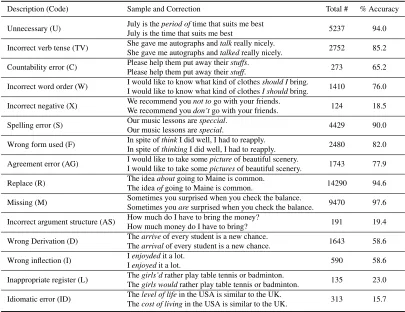
Sentences in the CLC contain one or more error cor-rections, each of which is labeled with one of 75 error types (Nicholls, 2003). Error types include countability errors, verb tense errors, word order er-rors, etc. and are often predicated on the part of speech involved. For example, the category AG (agreement) is augmented to form AGN (agreement of a noun) to tag an error such as “here are some of my opinion”. For ease of analysis and due to the high accuracy of state-of-the-art POS tagging, in addition to the full 75 class problem we also perform experiments using a compressed set of 15 classes. This compressed set removes the part of speech components of the error types as shown in Figure 1.
We create a dataset of corrections from the CLC by extracting sentence pairs (x, y) where x is the original (student’s) sentence and y is its corrected form by the teacher. We create multiple instances out of sentence pairs that contain multiple correc-tions. For example, consider the sentence “With this letter I would ask you if you wuld change it”. This consists of two errors: “ask” should be replaced with “like to ask” and “wuld” is misspelled. These are marked separately in the CLC, and imply the cor-rected sentence “With this letter I wouldlike to ask
you if you would change it”. Here we extract two instances consisting of “With this letter I wouldask
you if youwouldchange it” and “With this letter I wouldlike to askif youwuldchange it”, each paired with the fully corrected sentence. As each correc-tion in the CLC is tagged with an error typet, we then form a dataset of triples(x, y, t). This yields 45080 such instances. We use these data in cross-validation experiments with the feature based Max-Ent classifier in the Mallet (McCallum, 2002) soft-ware package.
3 Feature Set
We use the minimum unweighted edit distance path betweenxandyas a source of features. The edit dis-tance operations that compose the path are Delete, Insert, Substitute, and Equal. To illustrate, the op-erations we would get from the sentences above would be (Insert, “like”), (Insert, “to”), (Substitute, “wuld”, “would”), and (Equal, w, w) for all other wordsw.
Our feature set consists of three main categories and a global category (See Figure 2). For each edit distance operation other than Equal we use an indi-cator feature, as well as word+operation indiindi-cators, for example “the wordwwas inserted” or “the word w1was substituted withw2”. ThePOS Context fea-tures encode the part of speech context of the edit, recording the parts of speech immediately preced-ing and followpreced-ing the edit in the corrected sentence. For all POS based features we use only tags from the corrected sentencey, as our tags are obtained auto-matically.
Description (Code) Sample and Correction Total # % Accuracy
Unnecessary (U) July is theperiod oftime that suits me best 5237 94.0 July is the time that suits me best
Incorrect verb tense (TV) She gave me autographs andtalkreally nicely. 2752 85.2 She gave me autographs andtalkedreally nicely.
Countability error (C) Please help them put away theirstuffs. 273 65.2 Please help them put away theirstuff.
Incorrect word order (W) I would like to know what kind of clothesshould Ibring. 1410 76.0 I would like to know what kind of clothesI shouldbring.
Incorrect negative (X) We recommend younot togo with your friends. 124 18.5 We recommend youdon’tgo with your friends.
Spelling error (S) Our music lessons arespeccial. 4429 90.0 Our music lessons arespecial.
Wrong form used (F) In spite ofthinkI did well, I had to reapply. 2480 82.0 In spite ofthinkingI did well, I had to reapply.
Agreement error (AG) I would like to take somepictureof beautiful scenery. 1743 77.9 I would like to take somepicturesof beautiful scenery.
Replace (R) The ideaaboutgoing to Maine is common. 14290 94.6 The ideaofgoing to Maine is common.
Missing (M) Sometimes you surprised when you check the balance. 9470 97.6 Sometimes youaresurprised when you check the balance.
Incorrect argument structure (AS) How much do I have to bring the money? 191 19.4 How much money do I have to bring?
Wrong Derivation (D) Thearriveof every student is a new chance. 1643 58.6 Thearrivalof every student is a new chance.
Wrong inflection (I) Ienjoydedit a lot. 590 58.6 Ienjoyedit a lot.
Inappropriate register (L) Thegirls’drather play table tennis or badminton. 135 23.0 Thegirls wouldrather play table tennis or badminton.
[image:3.612.103.508.57.369.2]Idiomatic error (ID) Thelevel of lifein the USA is similar to the UK. 313 15.7 Thecost of livingin the USA is similar to the UK.
Figure 1: Error types in the collapsed 15 class set.
3.1 Evaluation
We perform five-fold cross-validation and achieve a classification accuracy of 88.9% for the 15 class problem and 83.8% for the full 75 class problem. The accuracies of the most common class base-lines are 33.3% and 7.8% respectively. The most common confusion in the 15 class case is between D (Derivation), R (Replacement) and S (Spelling). These are mainly due to context-sensitive spelling corrections falling into the Replace category or noise in the mark-up of derivation errors. For the 75 class case the most common confusion is between agree-ment of noun (AGN) and form of noun (FN). This is unsurprising as we do not incorporate long distance features which would encode agreement.
To check against over-fitting we performed an ex-periment where we take away the strongly lexical-ized features (such as “word w is inserted”) and observed a reduction from 88.9% to82.4% for 15 class classification accuracy. The lack of a dramatic reduction demonstrates the generalization power of
our feature templates.
4 An Educational Application
As mentioned earlier, we incorporate our classifier in an educational software tool. The input to this tool is a group of aligned sentence pairs from orig-inal and teacher edited versions of a set of essays. This tool has two components devoted to (1) isola-tion of individual correcisola-tions in a sentence pair, and (2) classification of these corrections. This software could be easily integrated in real world curriculum as it is natural for the teacher to produce corrected versions of student essays without stopping to label and analyze distribution of correction types.
We devise a family of heuristic strategies to separate independent corrections from one another. Heuristichiallows at mosticonsecutive Equal edit
• Insert – Insert – Insert(w) – POS Context
• Delete – Delete – Delete(w) – POS Context
• Substitution – Substitution – Substitution(w1,w2) – Character Edit Distance – Common Prefix Length – In Dictionary? – Previous Word – POS of Substitution – Same Stem? – Suffixes
• Global
– Same Words? – Number Of Edits
Figure 2: List of features used in our classifier.
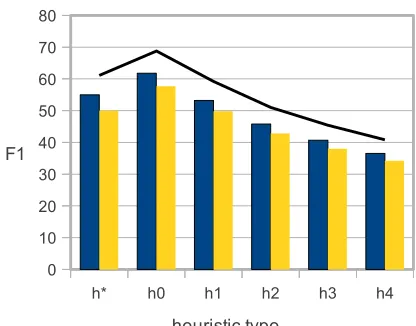
a heuristic h∗ that treats every non-Equal edit as an individual correction. This is different than h0, which would merge edits that do not have an in-tervening Equal operation. F-scores (using 5 fold cross-validation) obtained by different heuristics are reported in Figure 3 for the 15 and 75 class prob-lems. For these F-scores we attempt to predict both the boundaries and the labels of the corrections. The unlabeled F-score (shown as a line) evaluates the heuristic itself and provides an upper bound for the labeled F-score of the overall application. We see that the best upper bound and F-scores are achieved with heuristic h0 which merges consecutive non-Equal edits.
5 Future Work
There are several directions in which this work could be extended. The most obvious is to replace the correction detection heuristic with a more robust al-gorithm. Our log-linear classifier is perhaps better suited for this task than other discriminative clas-sifiers as it can be extended in a larger framework which maximizes the joint probability of all correc-tions. Our work shows thath0 will provide a strong baseline for such experiments.
[image:4.612.320.528.66.229.2]
Figure 3: Application F-score against different correction detection strategies. The left and right bars show the 15 and 75 class cases respectively. The line shows the unla-beled F-score upper bound.
While our classification accuracies are quite good, error analysis reveals that we lack the ability to capture long range lexical dependencies necessary to recognize many agreement errors. Incorporating such syntactic information through the use of syn-chronous grammars such as those used by Yamangil and Shieber (2010) would likely lead to improved performance. Furthermore, while in this work we focus on the ESL motivation, our system could also be used to aid development of automated correc-tion systems, as was suggested by BLAST (Stymne, 2011) for machine translation.
Finally, there would be much to be gained by test-ing our application in real classroom setttest-ings. Ev-ery day, teachers of English correct essays and could possibly provide us with feedback. Our main con-cern from such testing would be the determination of a label set which is appropriate for the teachers’ concerns. We expect that the 15 class case is too coarse and the 75 class case too fine grained to pro-vide an effective analysis.
References
INLG ’10, pages 263–267, Stroudsburg, PA, USA. As-sociation for Computational Linguistics.
Erin Fitzgerald, Frederick Jelinek, and Keith Hall. 2009. Integrating sentence- and word-level error identifica-tion for disfluency correcidentifica-tion. In Proceedings of the 2009 Conference on Empirical Methods in Natural Language Processing: Volume 2 - Volume 2, EMNLP ’09, pages 765–774, Stroudsburg, PA, USA. Associa-tion for ComputaAssocia-tional Linguistics.
Michael Gamon. 2011. High-order sequence modeling for language learner error detection. In Proceedings of the 6th Workshop on Innovative Use of NLP for Building Educational Applications, IUNLPBEA ’11, pages 180–189, Stroudsburg, PA, USA. Association for Computational Linguistics.
Andrew Kachites McCallum. 2002. Mal-let: A machine learning for language toolkit. http://www.cs.umass.edu/ mccallum/mallet.
D. Nicholls. 2003. The cambridge learner corpus: Error coding and analysis for lexicography and elt. In Pro-ceedings of the Corpus Linguistics 2003 conference, pages 572–581.
A. Rozovskaya, M. Sammons, J. Gioja, and D. Roth. 2011. University of illinois system in hoo text cor-rection shared task.
Sara Stymne. 2011. Blast: A tool for error analysis of machine translation output. In ACL (System Demon-strations), pages 56–61.
Randy West, Y. Albert Park, and Roger Levy. 2011. Bilingual random walk models for automated gram-mar correction of esl author-produced text. In Pro-ceedings of the 6th Workshop on Innovative Use of NLP for Building Educational Applications, IUNLP-BEA ’11, pages 170–179, Stroudsburg, PA, USA. As-sociation for Computational Linguistics.
Elif Yamangil and Stuart M. Shieber. 2010. Bayesian synchronous tree-substitution grammar induction and its application to sentence compression. InACL, pages 937–947.