Automatic Generation of Context-Based Fill-in-the-Blank Exercises Using
Co-occurrence Likelihoods and Google
n-grams
Jennifer Hill and Rahul Simha The George Washington University
800 22nd Street NW Washington, DC 20052, USA
[email protected] [email protected]
Abstract
In this paper, we propose a method of au-tomatically generating multiple-choice fill-in-the-blank exercises from existing text pas-sages that challenge a reader’s comprehen-sion skills and contextual awareness. We use a unique application of word co-occurrence likelihoods and the Googlen-grams corpus to select words with strong contextual links to their surrounding text, and to generate distrac-tors that make sense only in an isolated nar-row context and not in the full context of the passage. Results show that our method is suc-cessful at generating questions with distrac-tors that are semantically consistent in a nar-row context but inconsistent given the full text, with largern-grams yielding significantly bet-ter results.
1 Introduction
According to the American Library Association, ap-proximately 43% of Americans have reading skills at or below the most basic level of prose literacy, defined as the ability to “search, comprehend, and use information from continuous texts” (Baer et al., 2009). These underdeveloped literacy skills are in many cases the result of poor reading comprehen-sion. Results from a large-scale national survey indi-cate that most adult learners with low literacy skills have “difficulty integrating and synthesizing infor-mation from any but the simplest texts,” likely due to a number of factors including poor phonemic aware-ness, vocabulary understanding, and reading fluency (Krudenier, 2002). It also suggests that adults in ba-sic education programs are more likely to view
read-ing as simply a decodread-ing task rather than a multi-faceted skill involving semantic processing, active memory, and inference.
One method of addressing weak reading skills is the cloze, or fill-in-the-blank (FITB), exercise. These exercises involve strategically removing tar-get words from a text and requiring the reader to identify the missing word among a list of distrac-tors. However, while FITB exercises can be valu-able resources for practicing and improving reading skills, they are time consuming to create by hand. The goal of this paper is to suggest a method for automatically creating such exercises from existing text passages. Such a method would allow for sig-nificantly faster and less costly exercise creation on a larger scale, and would allow for nearly any desired reading materials to serve as a learning resource.
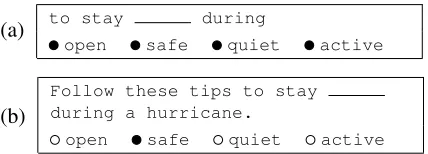
We propose that, for native English speakers, a good reading comprehension question challenges the reader not with syntactic errors or unusual word senses, but rather with contextual inconsistencies. Figure 1 gives an example of the type of question we wish to generate: when looking at a narrow con-text, all four of the word choices are logical selec-tions for the blank, but when the meaning implied by the surrounding text is taken into account, only one choice is sensible. This type of exercise encour-ages engagement and focus while reading: as a well-formed question should not have obvious inconsis-tencies within a narrow reference frame, a reader must actively construct meaning as they read in or-der to identify the correct answer.
In this paper, we propose a method of automati-cally generating FITB questions from existing text
(a) to stayopen safe duringquiet active
(b) Follow these tips to stayduring a hurricane.
[image:2.612.79.293.63.140.2]open safe quiet active
Figure 1:An example illustrating the premise behind our exer-cises: (a) In a narrow context, all four word choices are equally fitting; (b) In the full context, only the target word logically fits
passages that follow this context-specific pattern, using a unique application of word co-occurrence likelihoods and the Google Books n-gram corpus (Michel et al., 2010).
2 Previous Work
Ours is not the first paper to address the task of generating fill-in-the-blank questions. Many pre-vious studies focus on automatically creating exer-cises specifically for language learning and vocab-ulary assessment. Sakaguchi et al. (2013) describe a method of generating distractors for assessing an ESL reader’s ability to distinguish semantic nuances between vocabulary words. Brown et al. (2005) uti-lize WordNet word relations and frequencies to gen-erate distractors for vocabulary words from equally-challenging terms. Pino and Eskenazi (2009) and Goto et al. (2010) both explore different meth-ods of generating distractors of different classes de-signed to indicate particular deficiencies in phonetic or morphological vocabulary mastery.
Others focus on generating exercises for quizzing or knowledge testing purposes. Agarwal and Man-nem (2011) explore generating gap-fill exercises from informative sentences in textbooks, while Karamanis and Mitkov (2006) locate suitable dis-tractors for medical texts from domain-specific doc-uments. Both of these methods choose distractors from other sentences in a constrained set of source texts rather than relying on external corpora.
A few studies have focused on more comprehension-specific exercises, generating distractors that are semantically similar to the target word. Zesch and Melamud (2014) propose a method of generating semantically similar distractors to the target word using context-sensitive lexical inference rules. The distractors generated using this method
are contextually and semantically similar to the target word, but not in the context being used in the sentence. Kumar et al.’s RevUP system (2015) utilizes a word vector model trained on the desired text domain to find semantically-similar words and verifies their similarity using WordNet synsets. Aldabe et al. (2009) generate semantically-similar distractors using distributional data obtained from the British National Corpus, and also, like our study, utilize the Google n-grams corpus to determine each generated distractor’s probability of occurring with its surrounding terms. However, their study differs from ours in that they utilize the Google n-grams solely for validating that their chosen distractors make sense, whereas we use the corpus for the actual generation of the distractors.
Perhaps the closest cousin to our proposed method can be found in the DQGen system (Mostow and Jang, 2012). DQGen generates cloze questions designed to test different types of comprehension failure in children, one of which involves creating “plausible” distractors that create contextually sen-sible sentences in isolation but do not fit in the con-text of the rest of the con-text. Their system also utilizes the Googlen-grams corpus for finding semantically consistent distractors for these sentences. However, they do not address the challenge of choosing strate-gic target words, and their attempt to generate dis-tractors at the sentence level that are contextually in-consistent at the passage level returned underwhelm-ing results, as most target words were found to be easily distinguishable without needing previous sen-tences for context. While our paper addresses a similar task of finding distractors that are plausible when external context is excluded, we generate dis-tractors at the narrower phrase level that rely on the surrounding text for context.
3 Exercise Creation
3.1 Choosing Target Words
The first step to creating a FITB question from a text passage is to choose which words to replace with blanks. We consider a “good” blanked question to be one in which there are enough context clues in the surrounding text for the reader to understand the text’s intended meaning even when the chosen word is removed. If the reader is able to understand the sentence’s intended meaning with the target word re-moved, then the task of replacing the word should be trivial.
We begin by considering every word in the sen-tence as a potential word to be blanked. However, many words would not make good target words in practice. We discard function words (articles, pro-nouns, conjunctions, etc.) from the pool due to their closed nature and frequent appearance across documents. However, unlike some other stud-ies (Coniam, 1997) (Shei, 2001), we do not use global word frequencies to find uncommon words from which to create blanks. We propose that even easily-understood target words that success-fully challenge comprehension of the surrounding context will implicitly test mastery of the more chal-lenging words in the passage. However, we do consider local word frequencies, eliminating words whose stemmed form appears in the document mul-tiple times, so that readers cannot identify target words simply by recognition due to previous en-counters.
Because our exercises are designed to test under-standing rather than knowledge, we also do not wish to “quiz” readers on facts, as is the case in several other studies (Karamanis et al., 2006). Therefore we also disregard classes of words that typically present factual information and could be easily exchanged for any other word of the same class (see Figure 2). These include:
• Named entitiesSpecific entities, such as peo-ple, locations, and organizations
• NumbersDigits and their written forms After this filtering step, the remaining set of words serves as our pool ofpotential blanks.
From this pool, we must then locate the words which relate most closely to their surrounding text. We explore several different “scopes” of context sur-rounding the potential blanks, and utilize word
co-× In fall of 2012, the New York City government began receiving unusual complaints.
[image:3.612.313.538.66.147.2]× By the time California became a state, it was already an important place for farming.
Figure 2:Examples of poor target words
occurrence likelihoods to find the potential blanks that have the strongest contextual links to informa-tion within that scope. By removing words that have a meaningful contextual relationship to one or more other words in the scope, we aim to ensure that there are enough hints left remaining to enable the reader to make a reasonable inference about the blanked word.
3.1.1 Contextual Scope
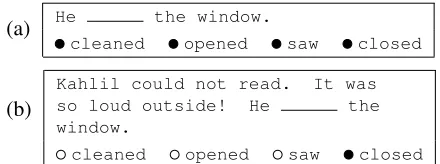
Though our goal is to generate blanks at the sen-tence level, individual sensen-tences in a passage are rarely conceptually independent from one another. True understanding of a sentence’s meaning often relies on information that has been gathered from previous sentences in the passage. Figure 3 gives an example of a question that relies on previous infor-mation to answer correctly.
(a) Hecleaned the window.opened saw closed
(b)
Kahlil could not read. It was
so loud outside! He the
window.
cleaned opened saw closed
Figure 3:An example of contextual scope influencing answer selection. When the wordclosedis removed (a), the reader must rely on the previous sentences to provide the context clues nec-essary to fill this blank (b).
[image:3.612.316.536.429.511.2]inter-nalized from the sentences they have already read in order to test their intersentential comprehension.
Three scopes were tested in this paper:
s1: Context words are chosen only from the target sentence{st}
s2: Context words are chosen from the target sen-tence and the preceding sensen-tence{st−1, st}
s3: Context words are chosen from the tar-get sentence and the two preceding sentences
{st−2, st−1, st}
The pool of scope words for each sentence is filtered less rigorously than the pool of potential blanks, as many of the word classes that make poor blanks are poor choices specifically because they provide important factual information that we wish to leverage for context. We therefore choose only to remove function words from the pool, leaving named entities, numbers, and frequently-occurring words.
3.1.2 Word Co-occurrences
We assume that words that co-occur together reg-ularly are likely to have a contextual and/or seman-tic relationship to one another. We therefore utilize word co-occurrence likelihoods to select the poten-tial blanks with the strongest relationship to their scope-specific context words.
To represent word co-occurrence likelihoods, we use the word vector space model GloVe (Penning-ton et al., 2014), trained on 42-billion tokens. The GloVe model formulates word vectors such that the dot product of any two word vectorswˆ1·wˆ2 repre-sents the logarithm of the words’ probability of co-occurring together in a document.
Our goal is to find the scope word for each poten-tial blank with the highest likelihood of co-occurring with that blanked word. Using the GloVe model, for each potential blankb∈B, we find the closest scope wordcin the set of all scope wordsSfor that blank such that(b, c) = arg min(ˆb·ˆs) (∀s∈S such that s.stem6= b.stem). Each of these pairs is added to the pool of blanks to carry to the task of choosing distractors.
3.2 Choosing Distractors
To turn a blanked passage into an exercise, each blank is presented as a multiple choice question. The reader is given four words to choose from that
could potentially fit the given blank: the target word and three distractors. For our exercises that specif-ically target contextual understanding, we specify that a good distractor should make sense both gram-matically and logically within a narrow context, but should not make sense within the broader context of the surrounding words.
To accomplish this, we explore a unique applica-tion of the Google Booksn-grams Corpus for gen-erating reasonable distractors for a blanked word. Googlen-grams is a massive corpus containing fre-quency counts for all unigrams through 5-grams that occur across all texts in the Google Books corpus.
When you step on the pedals of a bicycle, it causes the wheels to spin.
[image:4.612.316.535.251.329.2]it [causes] the [causes] the wheels × bicycle it [causes]
Figure 4:An example of the sentence-level trigrams extracted from a sentence. Note that ann-gram cannot occur between two clauses.
We begin by gathering every 2- through 5-gram in the original sentence that contains the target word. If the sentence contains multiple clauses, we con-sider only the clause which contains the target word. This allows us to avoid selecting n-grams of un-usual or unintended structure (see Figure 4). We then use a sliding window to gather all n-grams (2 ≤ n ≤ 5) within the clause of the form
{w1...wt−1,[wt], wt+1...wn}, where the target word
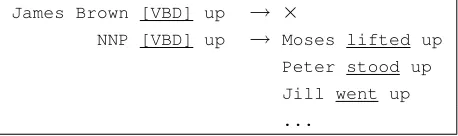
[wt] occupies each position 1 ≤ t ≤ n. We then search the Google corpus forn-grams matching each pattern{w1...wt−1,[wt.pos], wt+1...wn}(1 ≤ t ≤n), wherewt.pos represents the part of speech of the target wordwt (obtained using the Stanford Part-Of-Speech Tagger (Toutanova et al., 2003)). If the query returns no results, we attempt to general-ize the pattern further by replacing proper names and pronouns with their part of speech (see Figure 5).
We utilize a back-off model when querying for distractors, usingn-grams of sizen= {5...2}. For eachn-sized pattern searched, we find the intersec-tionDof all words at indext(limiting our results to the top 100 for the sake of performance).
James Brown [VBD] up → ×
[image:5.612.74.303.66.134.2]NNP [VBD] up → Moses lifted up Peter stood up Jill went up ...
Figure 5:Whenn-gram queries return no results, we generalize specific terms to increase the likelihood of finding a match
need to remove all words in D that are likely to make too much sense in context. Because synonyms can often be used interchangeably in the same sen-tence, we discard all words that are direct synonyms ofwt(using synsets gathered from WordNet1). We also remove all wordsd ∈ D such that( ˆwt·dˆ) <
( ˆwt·ˆc)(wherecis the closest scope word in the pair
(wt, c)), because these words have a higher likeli-hood than the target word does of co-occurring with their context words.
If the resulting filtered setD contains fewer than three words (the minimum required to create a mul-tiple choice question), we back off to the next largest value of n, continuing this pattern until we have found three or more distractors for the blank. If fewer than three distractors are found aftern = 2, the word is discarded from the pool of potential blanks. From the final set D, we select the three least-frequently occurring distractors in the Google corpus.
3.3 Exercise Generation
Once we have found all remaining potential blanks that have three or more distractors, we must pare down the list to create the final passage-level exer-cise. If any one sentence has more than one poten-tial blank, we choose the blank that has the high-est co-occurrence likelihood with its paired scope word and discard the other(s). We also discard any blanks whose paired scope word was itself made into a blank (because the context has been removed).
The resulting set of blanks constitutes the set of “best” questions for the passage. We then can present the passage-level exercise in its entirety, re-placing each blanked word with a multiple choice question consisting of the target word and its three chosen distractors. Though we choose not to do so,
1Princeton University “About WordNet.” WordNet.
Prince-ton University. 2010.<http://wordnet.princeton.edu>
the number of blanked sentences can also be man-ually limited by selecting the topxblanks from the set of all word pairs sorted by descending likelihood.
4 Evaluation
Our corpus of documents was composed of approx-imately 1000 reading comprehension text passages obtained from ReadWorks.org2, ranging in reading
level from 100L to 1000L using the Lexile scale. We randomly selected 120 non-unique passages (i.e. one passage could be selected more than once) from which to create questions. For each instance of a se-lected passage, we generated a single blanked sen-tence and its top three distractors, to be presented as a multiple choice question.
The questionnaire was separated into two sec-tions, both of which asked participants to answer a set of generated FITB questions. The first section presented each question at the phrase level (i.e. the blanked surrounded by a small subset of the words in the full sentence). The words to include in these phrases were selected by hand to present the blank in a representational narrow context. The second sec-tion presented sentence-level FITB quessec-tions, sur-rounded by the context of the entire passage (or, in the case of particularly long passages, by relevant paragraphs from the full text). For both sections, participants were presented with four word choices for each blank, and were asked to selectall of the words they believed logically fit the blank.
67 native English-speaking volunteers were asked to provide their feedback on each generated blank through an anonymous online questionnaire. Each participant was given a random subset of questions from each section to answer: 20 phrase-level ques-tions, and 10 sentence-level questions. Participants were not aware that the questions were generated au-tomatically and were not informed of the research objectives or what we hoped to obtain from their an-swers in order to avoid potential feedback bias.
5 Results
Alderson et al. (1995) proposed that multiple choice questions be evaluated using two metrics: reliabil-ity and validity. However, because our questions
were not answered by the target audience (i.e. low-literacy readers), we cannot compute reliability us-ing traditional methods (such as Cronbach’s alpha). We focus instead on evaluating the validity of our exercises by determining how well they conform to our proposed method of targeting narrow vs. full context.
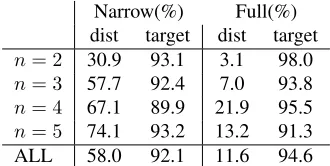
We assess the validity of our questions and the chosen distractors by examining the proportion of words that fit each blank in a narrow context to words that fit the same blank in the broader context of the surrounding text. In an ideal question, the tar-get word and all distractors should fit in the narrow context, and only the target word should fit given the full context. Thus, for target words, we aim for 100% fit in both contexts; for distractors, we aim for 100% fit in the narrow context and 0% in the full.
Narrow(%) Full(%) dist target dist target
n= 2 30.9 93.1 3.1 98.0
n= 3 57.7 92.4 7.0 93.8
n= 4 67.1 89.9 21.9 95.5
n= 5 74.1 93.2 13.2 91.3
[image:6.612.316.536.250.335.2]ALL 58.0 92.1 11.6 94.6
Table 1: The percentage of distractors and target words cho-sen to fit each blank given the narrow context (left) and the full passage (right)
As can be seen in Table 1, the proportion of dis-tractors deemed to fit the blanks in a narrow context increases substantially asnincreases, while the pro-portion of target words chosen to fit is relatively un-affected. This pattern also holds true given the full context, although to a lesser extent.
On average, 58% of all distractors generated were deemed to fit in their given blanks in a narrow con-text, although this number is skewed by the poor per-formance of the bigram model. The 5-gram model was the best-performing for finding distractors that fit in the narrow context, achieving an average fit of approximately 74%. As n increases, more of the syntactic and semantic features of the phrase are able to be incorporated into the distractor selection, increasing the chances of the selected word making both grammatical and contextual sense withall of the words in the phrase.
Less than 12% of all distractors on average were deemed to fit the same blanks when given the full
context, though the 4-gram model had the worst per-formance with nearly 22% fit. The bigram model performed best in the full context with approxi-mately 3% fit; however, its poor performance in the narrow context suggests that these words are obvi-ously incorrect and therefore not suitable distractors. Table 2 compares the proportions of distrac-tors fitting within each context across both n-gram model and scope (s1throughs3). The same pattern of increasing fit with higher values ofncan be ob-served within each scope. However, the scope does not appear to have a significant affect on the quality of the distractors generated.
Narrow(%) Full(%)
s1 s2 s3 s1 s2 s3
n= 2 29.5 31.9 27.9 3.2 3.0 3.4
n= 3 53.7 61.2 61.0 4.6 10.2 11.1
n= 4 64.8 66.7 66.1 25.3 18.9 21.5
n= 5 75.7 74.9 75.0 13.6 13.9 20.6 ALL 56.2 59.4 56.9 10.4 11.9 13.5
Table 2:The percentage of distractors fitting each blank given the narrow (left) and full context (right), for each scope.
6 Limitations and Future Work
The proportion of words deemed to fit in the nar-row contexts is lower than expected for both target words and distractors. We suspect that the concept of words “fitting” in a sentence fragment may not have been fully understood by some participants. For example, many respondents said that the word
wentwas not a suitable fit for the phraseHidalgo about this. In this case, some partic-ipants may have struggled to identify the phrasal verb “to go about” as being grammatically correct because it clashed with the other choices (heard,
agreed, said), where they might have chosen it to fit if it had been presented independently. A fu-ture study will explore a less subjective method of evaluating target words within a narrow context.
[image:6.612.103.268.304.387.2]tar-get word (for example, the words turned and
flushed, which are not obvious synonyms but are interchangeable given the context of the phrase
her face red.) While we are able to re-move direct synonyms using WordNet, we will work to incorporate a more robust synonym-filtering pro-cess in future work, taking advantage of the already-utilized corpora.
We also wish to further explore the relationship between scope and the target words chosen. While we have seen that adjusting the scope has little effect on the quality of the distractors generated, it remains to be seen if the target words themselves are of “bet-ter” quality for targeting comprehension as the scope of available context increases.
Alongside improvements to the question genera-tion algorithm’s performance, we also wish to prove the efficacy of these types of exercises in target-ing the readtarget-ing comprehension skills of low-literacy users. This process will involve further user evalua-tion, this time involving the target audience.
7 Conclusions
In this paper we have discussed a method of auto-matically generating fill-in-the-blank questions de-signed to target a reader’s comprehension skills and contextual awareness. We have explored the idea of using word co-occurrence likelihoods coupled with scopes of context to find words with strong links to their surrounding text from which to make blanks. We have also tested a novel approach to generating distractors for these words using the Google Books n-grams corpus to find words that are semantically and logically appropriate for the given blanks in a narrow context but which do not make sense given the intention of the passage.
Results suggest that larger n-grams are signifi-cantly more effective in creating sensible distrac-tors that make sense within a narrow context, and that a large portion of these distractors become no longer suitable once the full context of the passage has been introduced. This suggests that our method is a promising first step towards the generation of these types of comprehension-challenging exercises.
References
Manish Agarwal and Prashanth Mannem. 2011. Auto-matic gap-fill question generation from text books. In
Proceedings of the 6th Workshop on Innovative Use of NLP for Building Educational Applications, pages 56–64.
Itziar Aldabe, Montse Maritxalar, and Ruslan Mitkov. 2009. A study on the automatic selection of candi-date sentences distractors.Frontiers in Artificial Intel-ligence and Applications, 200(1):656–658.
J. Charles Alderson, Caroline Clapham, and Dianne Wall. 1995. Language Test Construction and Evaluation. Justin Baer, Mark Kutner, John Sabatini, and Sheida
White. 2009. Basic reading skills and the literacy of america’s least literate adults: Results from the 2003 national assessment of adult literacy (naal) supplemen-tal studies.National Center for Education Statistics. Jonathan C. Brown, Gwen A. Frishkoff, and Maxine
Es-kenazi. 2005. Automatic question generation for vo-cabulary assessment. InProceedings of Human Lan-guage Technology Conference and Conference on Em-pirical Methods in Natural Language Processing, page 826.
David Coniam. 1997. A preliminary inquiry into using corpus word frequency data in the automatic genera-tion of english language cloze tests.CALICO Journal, 14(2):15–33.
Takuya Goto, Tomoko Kojiri, Toyohide Watanabe, To-moharu Iwata, and Takeshi Yamada. 2010. Automatic generation system of multiple-choice cloze questions and its evaluation. Knowledge Management and E-Learning, 2(3):210–224.
Nikiforos Karamanis, Le An Ha, and Ruslan Mitkov. 2006. Generating multiple-choice test items from medical text: A pilot study. In Proceedings of the Fourth International Natural Language Generation Conference, number July, pages 111–113.
John Krudenier. 2002. Research Based Principles for Adult Basic Education Reading Instruction.
Girish Kumar, Rafael E. Banchs, and Luis F. D’Haro. 2015. Revup: Automatic gap-fill question generation from educational texts. In Proceedings of the 10th Workshop on Innovative Use of NLP for Building Ed-ucational Applications, pages 154–161.
Jean-Baptiste Michel, Yuan Kui Shen, Aviva Presser Aiden, Adrian Veres, Matthew K Gray, Joseph P Pickett, Dale Hoiberg, Dan Clancy, Peter Norvig, Jon Orwant, Steven Pinker, Martin A Nowak, and Erez Lieberman Aiden. 2010. Quantitative analysis of culture using millions of digitized books. Sciencex-press, 331(6014):176–182.
InProceedings of the 7th Workshop on Innovative Use of NLP for Building Educational Applications, pages 136–146.
Jeffrey Pennington, Richard Socher, and Christopher D Manning. 2014. Glove: Global vectors for word rep-resentation. Proceedings of the 2014 Conference on Empirical Methods in Natural Language Processing, pages 1532–1543.
Juan Pino and Maxine Eskenazi. 2009. Semi-automatic generation of cloze question distractors effect of stu-dents l1. Proceedings of the SLaTE Workshop on Speech and Language Technology in Education, pages 1–4.
Keisuke Sakaguchi, Yuki Arase, and Mamoru Komachi. 2013. Discriminative approach to fill-in-the-blank quiz generation for language learners. InProceedings of the 51st Annual Meeting of the Association for Com-putational Linguistics, pages 238–242.
Timothy Shanahan, Michael L. Kamil, and Aileen Webb Tobin. 1984. Cloze as a measure of intersenten-tial comprehension. Reading Research Quarterly, 14(2):229.
Chi-Chiang Shei. 2001. Followyou!: An automatic lan-guage lesson generation system. Computer Assisted Language Learning, 14(2):129–144.
Kristina Toutanova, Dan Klein, and Christopher D Man-ning. 2003. Feature-rich part-of-speech tagging with a cyclic dependency network. InProceedings of the 2003 Conference of the North American Chapter of the Association for Computational Linguistics on Human Language Technology, pages 252–259.